

Medical billing is not simply a function that involves back-office operations. Instead, it is one of the factors that will determine how fast the practice will receive payments from the patients or third-party payers. The cost incurred by billing mistakes or inefficiencies is likely to be huge, as shown by the American Medical Association’s data indicating that 32% of outpatient commercial claims and 11% of traditional Medicare claims still remain unpaid 90 days after submission. Other reasons for claim denials include coding, payer requirements, and medical necessity. However, the overall administrative cost is enormous as well. As seen from the findings presented in the 2024 CAQH index, the cost of healthcare administration in the United States amounts to about $440 billion each year, with around $20 billion of cost-saving potential through automation.
With the rising complexities of billing, most health care organizations are now looking at outsourcing the task of medical billing to relieve administrative burden and improve revenue cycle management. A competent medical billing company will help to handle tasks such as verifying patient eligibility, claim submission, denial tracking, accounts receivable and payments, among others, leaving more time for physicians and staff members to attend to patient care needs. It is also possible to save money through the use of technology since according to the 2024 CAQH Index, the cost of electronically submitting claims amounts to approximately $3.05 per transaction, which is lower than the cost of manual submission at $6.33. This translates into savings of up to $3.28 per transaction. However, not all billing partners are the same.
What Is a Medical Billing Company?
A medical billing company is a third party service company responsible for conducting certain, or even all, of the financial and administrative activities associated with collecting payments from insurance companies and patients in order to pay the health care providers. It covers a wide range of activities starting from patient registration, insurance eligibility checks, and coding, charge entry and claim creation, claim filing electronically, claim posting, collection of outstanding payments and denial management. Through its activities the medical billing company helps clinics conduct their work with fewer billing mistakes, timely submission of claims, tracking of the outstanding payments, and better cash flow.
Outsourcing can have a scope that can be limited to providing basic medical billing services or extend to providing medical billing RCM solutions. In the former case, outsourcing will include claim processing, payments posting, and follow up whereas the latter would involve a provider of full-service medical billing RCM solutions to take complete care of the financial process right from patient registration to final payment. Outsourcing helps both physician practices, specialty clinics, hospitals, ambulatory care centers, and also small practices who don’t have adequate billing resources or do not wish to burden themselves with extensive administrative work. For small practices especially, outsourcing their billing to a well-known billing firm helps them in leveraging billing resources and billing technology without investing in hiring a huge billing team in-house. Comparing different medical billing companies can help practices evaluate expertise, technology, pricing, compliance, and overall revenue-cycle performance before making a decision.
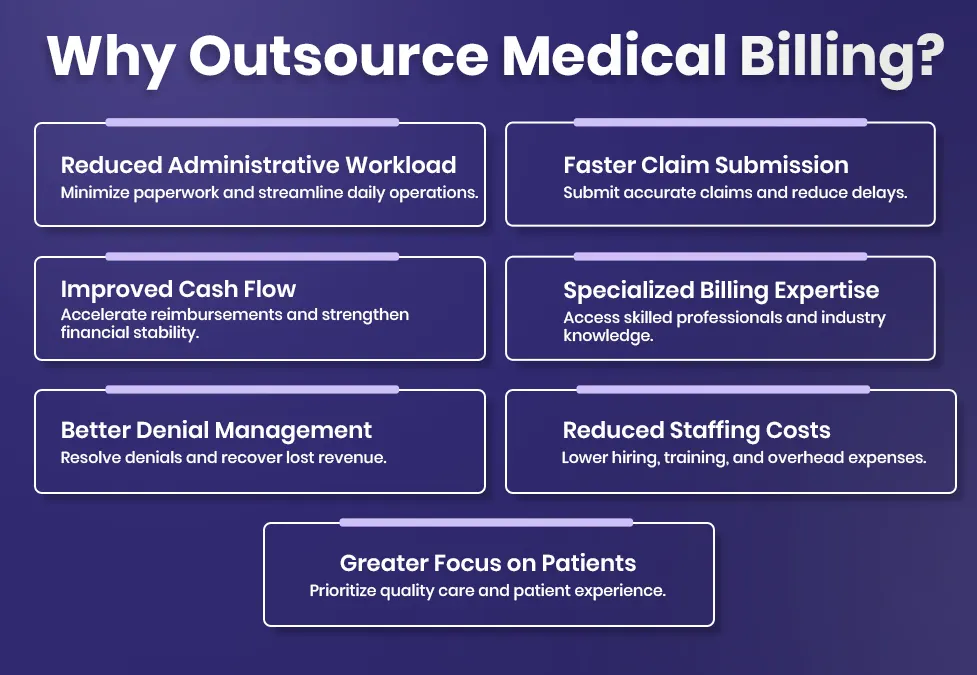
Why Outsource Medical Billing?
Medical billing outsourcing gives healthcare providers the chance to delegate complicated revenue cycle-related activities to experts in the field. Rather than handling all aspects of the billing process themselves, healthcare providers are able to focus on more important things such as providing quality care for their patients.
Reduced Administrative Workload
The process of medical billing consists of eligibility determination, coding, claims processing, posting of payments, follow-up, and documentation. By outsourcing all of the above processes, one can minimize the burden that falls on doctors and administrative workers in the office. Specialized personnel take care of routine financial issues and enable other workers to concentrate on other vital activities.
Faster and More Accurate Claim Submission
Professional billing groups are aware of the needs of payers and the procedures for coding and submitting claims. They can be helpful in detecting any problems that might be present in the process of bill submission and can save time by preventing delays.
Improved Collections and Cash Flow
Good outsourcing of billing services can help a practice have better cash flows as a result of prompt submission of their claims and regular monitoring of any outstanding claims. The billing professionals will monitor all the unpaid claims and resolve any problems with reimbursements.
Access to Specialized Billing Expertise
There may be frequent changes in medical billing laws, payer guidelines, medical codes, and reimbursement processes. Outsourcing allows access to experts whose area of specialization is these particular issues. Unlike general administrators, providers will get the benefit of having experts in their field who are knowledgeable and skilled in dealing with all these issues.
Better Medical Billing Denial Management
Claim denials may lead to delays in reimbursements, and they may take up precious time from your staff members. There are specialized billing service providers who may classify the reasons for the denial, resolve the problem, appeal in case needed, and keep track of the problems that are recurring.
Reduced Staffing and Training Costs
A practice that maintains its own billing department will have to pay salaries, provide fringe benefits, recruit staff members, train staff members, purchase software, and facilitate continuous professional development. Outsourcing helps cut costs associated with these activities since it allows the practice to utilize a pre-existing billing team without having to employ all specialists individually.
Improved Focus on Patient Care
The time of doctors and staff members will be saved since they will not have to devote any time to solving billing problems. Billing that is outsourced moves financial management from the hands of the doctors to those of the billing professionals and helps distinguish between the care of the patients and the financial process.
When Should a Practice Consider Outsourcing?
Outsourcing medical billing services can be advantageous for a practice that finds it difficult to perform well in terms of revenue cycle management. Some practices may not have sufficient personnel to create a billing department due to their small size or rapid growth, while those practices encountering denials of their claims can require specialized skills related to coding, payer regulations, and denials management. Moreover, outsourcing can help practices which have difficulty receiving payments promptly, suffer from mounting accounts receivable, or spend too much time chasing unpaid claims. Staffing issues, high turnover rate, and complexity of billing procedures are other situations where practices can take advantage of a billing partner.
Many practices choose to outsource medical billing services to reduce administrative workloads, improve billing efficiency, and access specialized revenue-cycle expertise without expanding their in-house team.
Services to Look for in a Medical Billing Company
As such, in the process of choosing a suitable company for medical billings, practices need to do more than looking at claim submissions alone. An effective service provider will be one that provides services related to revenue cycle processes, including verification, coding, claims submission, payments, denials, reporting, credentialing, and revenue cycle management.
Patient Eligibility and Insurance Verification
Patient eligibility and insurance verification help to determine the eligibility of patients for services and insurance coverage before the provision of services. The billing department is able to verify active insurance status, coverage, deductibles, copayments, coinsurance, and authorization requirements. Verification prevents surprises on the billings from the patient side and unnecessary claim denials.
Medical Coding and Charge Entry
Proper coding and billing of charges is important for correct reimbursement of health care organizations. Professional billing companies must have personnel who know coding and other billing regulations. They must be able to code correctly according to documentation and enter charges in time; otherwise, problems can arise and payments may not be received on time.
Medical Billing Company Claim Submission
Submission of claims in an efficient manner is one of the duties that a medical billing firm performs. It is important that the providers choose the firms which do the electronic submissions of claims, scrubbing, verification of information, and submission tracking. This will help in preventing denials and delays in payment.
Payment Posting
Payment posting refers to the accurate recording of insurance payments, adjustment payments, payments made by patients, and balances. The most reputable companies will reconcile payments with the remittance advice and any discrepancies that may arise. Proper payment posting gives an accurate financial perspective and enables proper balance tracking.
Accounts Receivable Management
Effective account receivable management ensures that payment is collected for the services provided in a timely fashion. It involves keeping track of aging receivables, prioritizing payments due, contacting the payers about unpaid receivables, and following up according to the procedure followed by the practice.
Medical Billing Denial Management Services
The denial management service provides assistance to a practice to analyze the reason for rejection or denial of a claim and take necessary corrective actions. It is essential that a good billing service classifies the reason for denial, takes appropriate corrective actions, appeals, where applicable, and tracks any trends.
Patient Billing and Collections
Patient billing is responsible for handling any outstanding finances owed once the insurance claims process has been completed. The billing company will be able to create bills, relay information regarding the outstanding bills, answer any billing-related queries, and set up the right collection process. Effective patient billing leads to fewer misunderstandings and improved collections.
Reporting and Analytics
The role of analytics and reporting is to make the practice aware of how well their billing operations are going. A good billing company should produce detailed reports that will help with tracking denial rates, AR aging, collections rate, reimbursement, and claims success.
Credentialing Support
The credentialing support enables the healthcare professionals to enroll themselves as providers in the insurance network. The billing company will assist the providers in the process as per the agreement between the parties involved. Credentialing will help to prevent any issues related to non-payment due to wrong provider details or expired credentials.
Complete Revenue Cycle Management Medical Billing
A full cycle of medical billing encompasses the financial processes starting from patient registration and eligibility to coding, claims submission, payments posting, denials follow-up, account receivable and collections. Medical practices that intend to have all processes done outsourced should opt for a partner who can coordinate all these processes. Consistent medical coding services can help certify that documented procedures and diagnoses are accurately coded, supporting cleaner claims and reducing avoidable billing errors.
Expert Insight: Before selecting a medical billing company, make sure the services they provide include all aspects of the revenue cycle of your practice. Make them show their reports, describe the level of their services, provide the cost details, and have experience in your field.
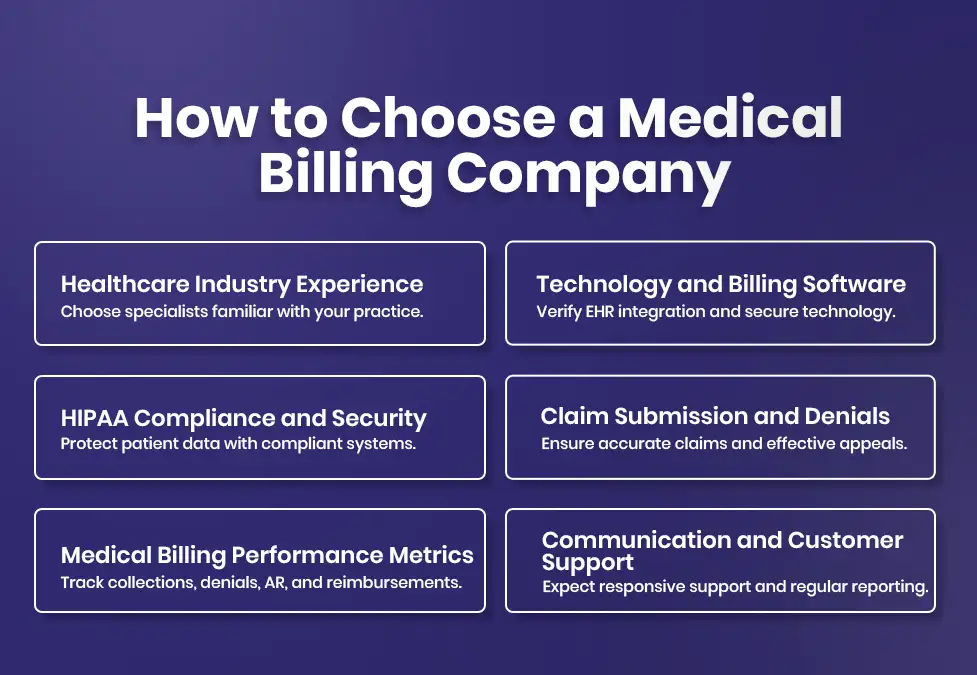
How to Choose a Medical Billing Company
Selecting an appropriate medical billing company involves much more than considering the costs. The practice needs to evaluate specialty expertise, technology, HIPAA compliance, claim handling, quantifiable billing results, communications, and support before it determines whether or not it is capable of improving efficiency and reimbursement performance.
1. Evaluate Healthcare Industry Experience
Experience in the industry is another crucial criterion to consider when choosing between medical billing companies. It is advisable to identify a service provider that has worked for similar specialties in order to get familiar with payer requirements, coding standards, and reimbursement challenges. Some of the questions that need to be answered include years in the business and the kind of providers served.
2. Check Technology and Billing Software
Technology plays a significant role when it comes to billing efficiency and effectiveness. Ask whether or not the company works together with your EHR/EMR and practice management software and enables automatic claim scrubbing. The real-time reporting must give you insights on how your billing is doing, and secure data transmission will help to protect your sensitive data.
3. Verify HIPAA Compliance and Data Security
Since the medical billing firm processes protected health information, security and confidentiality should be considered. Inquire about how the company protects patient information when storing it, transmitting it, accessing it, and protecting it from any unauthorized uses. Examine how the firm meets HIPAA requirements, trains its employees, provides for protection, and responds to security breaches.
4. Assess Claim Submission and Denial Management
Claim submission and denial management have a direct impact on the reimbursement process. Learn how the company prepares and cleans the claim before submission, how fast the complete claim is sent after its completion, and the electronic transmission rate of claims. Find out how claims are identified when they are rejected or denied, how they are corrected and appealed.
5. Review Medical Billing Performance Metrics
It is important for medical billing partners to deliver quantifiable performance results rather than make promises regarding improvement of collections. It is necessary to evaluate certain performance metrics such as clean claim percentage, first pass resolution rate, days in AR, denial percentage, collections percentage, net collection percentage, and average reimbursement time. This will allow practices to understand if the medical billing partner delivers any financial gains.
6. Compare Communication and Customer Support
Effective communication is very crucial to ensure that the outsourcing process succeeds. It is important to find out whether an account manager is assigned by the company and how often performance reports will be issued. Find out what their standard response time will be, their mode of communication and how critical billing issues will be escalated.
How to Evaluate a Medical Billing Company
Prior to choosing a medical billing service provider, ask for references and pertinent case studies to learn about its experience and performance working with firms like yours. Ask for sample reports reflecting various metrics, including collections, denial rates, accounts receivable aging, and performance of claims. Pay attention to the experience of the provider in handling cases of certain specialties. Evaluate its transparency concerning the way it works with claims, denials, payments, and compliance issues.
It would also be important to find out whether the firm could expand its services in case your practice is going to grow further. Can it handle more providers, locations, specialties, or a larger number of claims? In case you compare different providers, it will be wise not to pay your attention only to price. It is much more important to evaluate the full package of services offered by a company.
Understanding Medical Billing Company Pricing
Medical billing firms have numerous methods of pricing, which include percentage-of-collections, flat-fee, per-claim, and hybrid pricing. The percentage pricing is calculated using a set percentage of the revenue collected, flat-fee pricing is charged through a set periodic fee, while the per-claim pricing involves a set fee for each claim processed. Pricing may be affected by the size of the practice, specialty, number of claims, services offered, coding needs, and complexity of the revenue cycle process. Practices need to know what services are offered before signing any agreement.
A low price does not imply that the provider will provide you with quality services. Providers with high rates usually do offer more services, have better communication, effective denial management, and better reporting compared to those with low prices. The low-priced providers may also charge some extra charges, which make the total cost more expensive. Before selecting any firm, find out whether the firm offers additional charges for setup, monthly minimum, termination, statements, coding, credentialing, and others. You should seek a comprehensive pricing proposal from the firm.
Reviewing a Medical Billing Company Contract
It is essential for practices to scrutinize every detail in the medical billing company contract before they sign off on it. The contract should state all terms including pricing, services provided, duties, performance levels, access to information, HIPAA requirements, and consequences that may arise if the contract ends.
Contract Length and Renewal Terms
Look at the duration of the initial contract term and see if it will automatically renew. Find out how much notice you need to give so that you can stop it from renewing and if there is any difference in price or services once it is renewed.
Pricing and Payment Terms
The contract must define how the billing fees will be determined as well as the date they are to be paid. It is important to determine whether the charges will be based on collection fees, claims, a flat fee, or any other basis. Fees related to setup costs, minimum fees, added service fees, and payment due dates are discussed.
Included and Excluded Services
Make sure that the agreement includes a description of all the services included under the terms of the contract. Make sure that coding, eligibility verification, claims submission, payment posting, denial management, AR follow-up, patient billing, credentialing, and reporting are included. Identifying excluded services will avoid disputes in the future.
Performance Expectations
It should be noted that a good contract should outline some expectations in terms of the quality of services provided and communication. In case it is necessary, the process of reporting, timeframes for processing claims, actions to take in case of denials, and communication standards and reviews should be outlined.
Data Ownership and Access
This agreement should clearly specify that the practice owns the relevant information and controls the billing and patient information. Clarify access, export, and transfer issues, where applicable, regarding this information. Inquire as to data formats, retention periods, backup, and the practice’s timely access to its own data at the end of the relationship.
HIPAA Responsibilities
Since medical billing deals with protected health information, the agreement must have clear descriptions of HIPAA responsibilities on the part of both parties. Look at clauses regarding data protection, access permission, security, breach reporting, access to information by employees, and dealing with protected health information. Both parties should also clearly understand their obligations under HIPAA business associate requirements, including appropriate safeguards and permitted uses and disclosures of PHI.
Termination Clauses
Take a careful look at the conditions under which either of the parties may be able to terminate the agreement. Make sure to review any notice periods, termination fees, breach clauses, and continuing obligations following termination. It is essential that the contract include a practical method for terminating the relationship.
Transition Procedures if the Relationship Ends
The terms of the contract must cover the details of the transition process in the event that the partnership dissolves. The individuals responsible for transferring all claims, accounting records, payment information, documentation, and any other necessary information need to be clearly stated in the contract to ensure smooth claim management.
Reporting and Audit Rights
Determine what kinds of financial and operational reporting need to be provided by the billing service along with how often these reports need to be sent out. There must be adequate transparency in relation to collections, denials, accounts receivable aging, claims activity, and any other specified metrics. The agreement should also spell out acceptable audit rights.
Best Medical Billing Companies: What Sets Them Apart?
What differentiates the top-notch medical billing companies is their ability to combine experience in the field, transparency, reliability of technology, tangible results, and customer support. The decision should not be based on the cost factor only but rather on whether the company has the potential to consistently enhance the performance of the revenue cycle.
Specialty Expertise
A professional medical billing company will know that billing needs can differ quite considerably among specialties. Seek out a company that has dealt with billing in your specialty before and knows about your specialty’s coding, payer issues, documentation, and other specific difficulties associated with billing in your field.
Transparent Pricing
The best billing companies make the fee structure and services offered easy for you to understand. The practices need to be provided with clear details on what the pricing includes in terms of percentage fee, flat rate, per-claim charge, initial set up cost, minimum, and any other service.
Strong Denial Management
Good denial management is one of the hallmarks of an effective billing partner. Good billing companies not only take steps to fix the problem but they also analyze the trends that lead to denials and try to address those issues and file appeals for their clients accordingly. This could help practices earn their lost money. Professional denial management services help practices identify the causes of rejected and denied claims, manage appeals, recover eligible revenue, and minimize recurring denial patterns.
Proven Performance Metrics
The best companies back up their claims with performance metrics that can be measured. These metrics should include things like clean claims rate, denial rate, days in accounts receivable, and collection rate. This helps them to measure whether the company is performing well and providing any value in terms of money.
Modern Technology
Billing software solutions can help increase efficiency, billing accuracy, reporting, and communication. Identify software solutions which offer EHR integration, practice management integration, electronic claims filing, automatic claims scrubbing, data security, and real-time reporting. Technology should enhance the capabilities of knowledgeable billers and not take their place in dealing with difficult revenue cycle challenges.
Responsive Support
Effective communications are key when an external entity handles the revenues of the medical practice. An effective billing partner will ensure that there are designated individuals who have set response times and proper means of communication, as well as account reviews. This responsiveness will ensure that any issues regarding billing are sorted out quickly.
HIPAA-Compliant Processes
Since the information that the medical billing firms have to deal with is quite sensitive both in terms of patient information and financial transactions, therefore, privacy and security become crucial. Hence, it is imperative that practices select such providers who have proper policies and precautions under HIPAA, which ensure security of protected health information.
Scalable Services
It is important for a billing company to have the ability to scale to meet the changing needs of the practice. With the practice adding more physicians, increasing location, patient volume, or specialties, the billing company needs to have the capability to handle such situations without disrupting the billing process.
Positive Client References
The client references will give you good understanding about the billing company’s real performance level. You should ask for references from the practices having the same specialty, size or requirements in terms of billing. During discussion with the reference, you should inquire about the communication, collection, denial management, reporting and overall satisfaction level.
Professional Guidance: Do not pick a company to handle your medical billing solely based on price. There is much more to consider, including specialty expertise, denials management, technology, security, reporting, scalability, and references, to find one who can bring real results.
Choosing a Medical Billing Company for Small Practices
Small practices differ from large health organizations in billing terms in that they might have smaller staffs, less claims, more limited funds and less ability to handle complicated revenue cycle operations. Therefore, when selecting a medical billing service provider, small practices need to pay attention to the flexible pricing and scalability of the offered services, since changes in providers, number of patients, services etc. should be manageable. It is beneficial to have a personal account manager who will understand your process flow, answer questions on time and give you performance reports.
The issue of cost transparency cannot be neglected by small practices due to their limited budgets. One should be clear about the included services and any possible setup fee, minimum charge, coding fee etc. Outsourcing is going to help small practices to take advantage of experienced professionals, specialized knowledge, technology and denial management without the costly process of hiring, training and employing a huge team of billing experts.
Red Flags to Watch For
The selection of a medical billing company needs to be done with care, as an improper choice will delay billing, increase the administrative burden, and adversely impact income. While practices need to move beyond the sales pitch, they need to be wary of certain red flags regarding pricing, contracts, communication, and more.
Unclear Pricing
Billing firms must be clear about their rates and what services they offer. Watch out if a service provider is unclear about their rates or does not discuss extra charges at all. Inquire about the setup charges, minimum, percentage, claims, coding fees, etc., before entering into any contract with them.
Long-Term Contracts with Restrictive Exit Clauses
It is not necessarily an issue to have long-term contracts, although restrictive termination clauses pose some risks that may not be necessary. You must consider your contract’s duration, requirements for renewal, notice period, and termination cost. The practice must know what to do when the company does not meet expectations or billing changes occur.
Poor Communication
A lack of promptness in response, lack of clear points of contact, and irregular updates may make an outsourced billing process hard to manage. Inquire on the following: how soon are billing queries answered; what is the point of contact in case of emergency; and how regularly do account reviews take place?
Lack of Specialty Experience
The firm might not be familiar with the coding, documentation, payers, and reimbursement issues related to your specialty because they lack experience dealing with your specialty. It is advisable to find out how many similar clients they have and ask for references/case studies where possible. This is even more critical if billing involves complicated procedures.
Limited Reporting
The inability to provide reports can be an indication that the billing company is not working well. You should be careful if a service provider does not provide reports for things like collections, denied claims, accounts receivable, and more. The practices should get enough information to gauge the company’s performance.
High or Unexplained Denial Rates
High denial rates may be an indication of coding and documentation problems, eligibility and authorization errors, incorrect claim submissions, and other issues. The company should be able to provide information regarding their denial rates and their most common causes. It is expected that a good provider would have a system in place for handling denials.
Weak Data-Security Practices
Since medical billing firms deal with confidential patient information, poor security standards would be an important red flag. It is important to inquire about the security measures involved in storing, accessing, transmitting, backing up, and protecting the data. Take time to review the firm’s HIPAA policies, security controls, access policies, and breach response process.
No Clear Process for Handling Rejected Claims
Claims that are rejected must be identified and corrected as soon as possible to prevent any unnecessary delays in payment. It is important for a billing company to clearly outline the process used to identify, determine the cause of rejection, correct, resubmit and track the results of the process.
Promises of Unrealistic Collection Improvements
Exercise caution when dealing with vendors who promise significant improvements in collection but fail to evaluate the financial status of your company. This is because the success of the revenue cycle is determined by things like payer mix, specialty, coding, payment, volume of patients and processes already in place.
Medical Billing Company Comparison: Questions to Ask
It is important that practices develop a uniform checklist to use when comparing medical billing companies to ensure that all potential partners get judged by the same yardsticks. Some questions to ask include number of years of experience, the type of specialties that it serves, type of services provided, technology compatibility and integration capability, HIPPA compliance, denial management processes used, and the performance metrics. The answer to some of these questions can help determine whether the company has the necessary skills and processes to handle the practice’s revenue cycle.
In addition, it is important that the practices determine the financial and relationship terms of the partnership during the selection process. Practices can ask for an explanation on the billing pricing structure, which may include setup fees and any additional cost, and determine the duration of the contract. In addition, the account management process should be assessed and references as well as case studies of practices with similar needs can be requested. Comparison of the different providers on the basis of these factors will help in making an informed decision.
Final Decision: How to Select the Right Partner
Begin by compiling a list of qualified medical billing companies that fit the criteria of the specialty practice, number of patients, and process needs. Review the service capabilities, technical solutions, cost, data security policy, HIPAA compliance, denials management capability, and performance metrics for each of these firms. Obtain proposals and, if possible, technology demonstrations in order to evaluate the fit between the company and your business. References and case studies from similar practices could be another source of information about a prospective provider’s reputation and achievements.
Before you make a final choice, take a careful look at the contract with a medical billing company. Be sure to pay special attention to pricing, scope of services provided, performance requirements, terms and conditions of the contract, including termination options and the issues related to data security and transfer. The ideal partner would not only be cost-efficient, but also would possess relevant experience and capabilities in the area, communication, technology, and would show good results.
How iSolve RCM Is the Right Medical Billing Company for You
Selecting an appropriate medical billing firm requires finding a reliable partner that possesses industry experience, transparency, technology, customer support, and successful revenue cycle performance. iSolve RCM will assist practices with managing crucial billing tasks, such as claim submission, payment posting, accounts receivable collection, and claim denials management. With the assistance of iSolve RCM, practices will be able to handle billing issues effectively while minimizing administrative workloads of their internal staffs. The aim of iSolve RCM is to provide each practice with the required billing services that correspond to its specialization and requirements. If you want to find a reliable medical billing company in the USA, iSolve RCM can be considered as a good choice.
FAQs
What specialties do you support?
Ask which specialties the billing company currently offers services for, and what their experience level is with your particular specialty. This is important to consider, as each specialty has different coding rules, payer rules, documentation requirements, authorization needs, and billing issues that you will need help with.
What percentage of claims are submitted electronically?
Find out the percentage of claims that are filed electronically and whether there is an automated system of claim scrubbing before submitting them. A high percentage of filing claims electronically will increase efficiency, and claim validation will allow discovering the absence of important information that might cause the rejection of your claim.
How do you manage denied claims?
Ask for an explanation of the total denial management process of the company. Identify how the company recognizes, classifies, fixes, appeals, and tracks denied claims. Also, find out if the company analyzes denial patterns and recovers from such denials. This should be done in a proactive manner, dealing with specific claims and underlying causes.
Which medical billing performance metrics do you report?
Identify which metrics relating to performance have been incorporated in the routine reports. The performance metrics that can be significant in this regard would be the clean claim ratio, denial ratio, days on accounts receivable, collection ratio, net collection ratio, reimbursement ratio, and outstanding AR.
How frequently will we receive reports?
Inquire about the regularity of delivery of financial and operating reports, and if the frequency of such reports can be tailored to suit your needs. For example, monthly reports might be sufficient for regular performance monitoring, while for bigger or more complicated firms, the frequency of reports might need to be higher.
What software and EHR systems do you support?
Inquire into which EHR, EMR, practice management, clearinghouse, and billing systems the organization works with. Determine whether their systems would work seamlessly with your existing technology without generating additional paperwork. Other things you need to ask include data transfer, implementation needs, technical support, security, and adding systems.