
Most practices find out how compliant their billing is when a letter arrives: a Medicare contractor asking for 20 records, a payer requesting refunds or a patient complaint about a bill. By then the review is happening on someone else’s schedule. A medical billing compliance checklist lets a practice run that review first, on its own terms.
Medical billing compliance means billing only for services that were provided, documented and medically necessary, coding them correctly, protecting patient data and returning any money paid in error. This checklist covers the ten areas a practice should review, how to run a billing audit, the KPIs that show whether compliance is working and what tends to trigger a CMS audit.
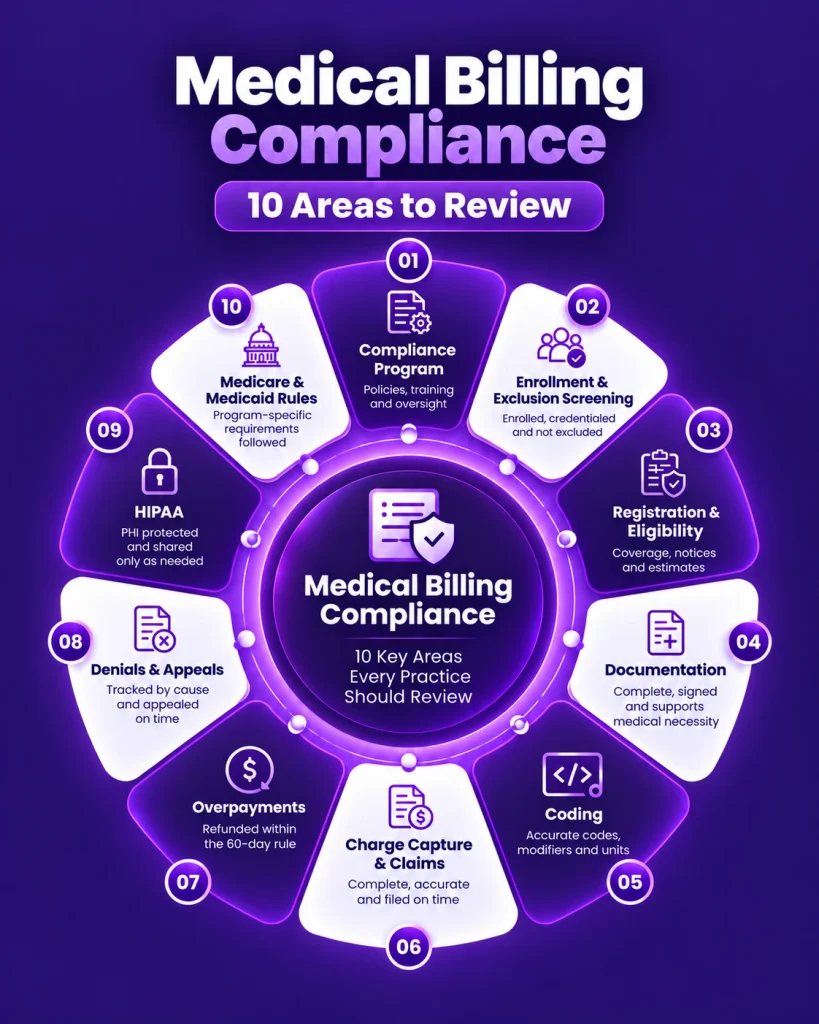
The Checklist at a Glance
| Area | Core Question |
|---|---|
| 1. Compliance program | Do we have the seven elements OIG expects, in a form that fits our size? |
| 2. Enrollment and exclusion screening | Is every provider enrolled, credentialed and clear of federal exclusion lists? |
| 3. Registration and eligibility | Are coverage, notices and patient estimates handled before the visit? |
| 4. Documentation | Does every billed service have a signed, complete record behind it? |
| 5. Coding | Do codes, modifiers and units match the documentation and current rules? |
| 6. Charge capture and claims | Are claims complete, accurate and filed on time? |
| 7. Overpayments | Are credit balances and errors refunded within the 60-day rule? |
| 8. Denials and appeals | Are denials tracked by cause and appealed before deadlines? |
| 9. HIPAA | Is billing PHI protected and shared only as needed? |
| 10. Medicare and Medicaid rules | Are program-specific requirements built into the workflow? |
What Is Medical Billing Compliance?
Medical billing compliance is the set of policies and checks that keep a practice’s claims consistent with federal and state law, payer rules and coding standards. In practice, it means a claim should go out only when the service was performed, documented, medically necessary and coded correctly, and that any payment the practice was not entitled to goes back.
The federal government’s main reference is the HHS Office of Inspector General’s General Compliance Program Guidance, released on November 6, 2023, which consolidates OIG’s earlier guidance into one document. As Morgan Lewis summarized, OIG had previously issued guidance for specific segments, including physician practices and third-party medical billing companies. The GCPG keeps the long-standing seven elements of a compliance program and explains how small practices can adapt them.
The Medical Billing Compliance Checklist
Work through each area once a year at minimum, and again whenever a payer rule, provider or billing system changes.
1. Compliance program foundation
OIG’s seven elements are voluntary for most practices, but they are what investigators look for. A small practice can meet them with a compliance officer who is also the practice manager, short written policies and a yearly review.
| Done | Review Item | Why It Matters |
|---|---|---|
| ☑️ | Written billing and coding policies, reviewed in the past year | Shows the practice knows its rules and follows them |
| ☑️ | A named compliance officer with authority to act | Someone owns the program |
| ☑️ | Annual compliance training for billing staff and providers | Staff cannot follow rules they were never taught |
| ☑️ | A way to report concerns without retaliation | Problems surface internally before they surface externally |
| ☑️ | Consistent consequences for violations | Rules that are not enforced are not rules |
| ☑️ | A yearly risk assessment and audit plan | Focuses reviews on the riskiest services |
| ☑️ | A documented process for fixing problems found | Turns findings into corrections |
2. Provider enrollment and exclusion screening
A claim is only valid if the rendering provider is enrolled with the payer and eligible to be paid. Keep credentialing and enrollment current and screen everyone who touches federal program business against exclusion lists.
| Done | Review Item | Why It Matters |
|---|---|---|
| ☑️ | Every provider enrolled and credentialed with each payer billed | Prevents enrollment denials and improper payments |
| ☑️ | Staff and providers checked against the OIG exclusion list and SAM.gov before hire and monthly | Federal programs do not pay for services involving excluded individuals |
| ☑️ | Medicare revalidation and CAQH attestation dates tracked | Lapsed enrollment stops payment |
| ☑️ | Practice locations and reassignments match enrollment records | Claims from unenrolled locations can be denied or recouped |
3. Patient registration, eligibility and notices
| Done | Review Item | Why It Matters |
|---|---|---|
| ☑️ | Insurance eligibility verified before each visit | Coverage errors are a top denial cause; see our eligibility verification guide |
| ☑️ | Medicare Secondary Payer information collected | Medicare should not pay first when another payer is primary |
| ☑️ | Advance Beneficiary Notice (ABN) used when Medicare may not cover a service | Without a valid ABN, the practice usually cannot bill the patient |
| ☑️ | Good Faith Estimates given to uninsured and self-pay patients | Required under the No Surprises Act since 2022 |
| ☑️ | Copays and deductibles collected consistently | Routine waivers can raise fraud and abuse concerns |
4. Medical record documentation requirements
The golden rule of billing compliance is simple: if it is not documented, it was not done. Documentation has to support every element of the code billed.
| Done | Review Item | Why It Matters |
|---|---|---|
| ☑️ | Every note signed and dated by the treating provider | Unsigned records do not support payment on review |
| ☑️ | E/M level supported by medical decision making or total time | Office E/M codes are selected by MDM or time, not history and exam |
| ☑️ | Medical necessity clear from diagnoses and findings | The record must show why the service was needed |
| ☑️ | Orders present for tests and services that require them | Missing orders are a common audit finding |
| ☑️ | Time documented for time-based codes | Therapy, psychotherapy and critical care depend on minutes |
| ☑️ | Cloned or copy-forward notes reviewed | Identical notes across visits undermine medical necessity |
5. Coding compliance
Coding is where most billing compliance risk sits, so a medical billing audit should always include a coding review.
| Done | Review Item | Why It Matters |
|---|---|---|
| ☑️ | Current-year CPT, HCPCS and ICD-10-CM code sets loaded | Deleted or invalid codes reject or deny |
| ☑️ | NCCI edits and medically unlikely edits (MUEs) applied | Prevents unbundling and impossible units |
| ☑️ | Modifiers 25, 59 and the X modifiers supported by documentation | These modifiers are frequent audit targets |
| ☑️ | Diagnoses coded to the highest specificity the record supports | Supports medical necessity and accurate payment |
| ☑️ | Coverage policies (LCDs, NCDs, payer policies) checked for high-risk services | A covered code can still deny without a covered diagnosis |
| ☑️ | E/M level distribution compared with peers | Unusual patterns attract payer attention |
6. Charge capture and claim submission
| Done | Review Item | Why It Matters |
|---|---|---|
| ☑️ | Every service documented is charged, and every charge is documented | Missed charges lose revenue; unsupported charges create overpayments |
| ☑️ | Charges entered within a set number of days of service | Long charge lag delays payment and risks timely filing |
| ☑️ | Claims filed within payer deadlines, including Medicare’s 12 months | Late claims cannot be paid |
| ☑️ | Correct place of service, rendering provider and NPI on every claim | Wrong POS or provider changes the payment or denies the claim |
| ☑️ | Claims scrubbed before submission | Raises the clean claim rate and catches errors early |
7. Overpayments and credit balances
Medicare and Medicaid require providers to report and return an identified overpayment within 60 days. Since January 1, 2025, that clock can be suspended for up to 180 days while the provider conducts a timely, good-faith investigation of related overpayments, as Bass Berry explained.
| Done | Review Item | Why It Matters |
|---|---|---|
| ☑️ | Credit balance report reviewed monthly | Unresolved credits are often unreturned overpayments |
| ☑️ | Refunds issued to payers and patients within required timeframes | Keeping overpayments can create False Claims Act liability |
| ☑️ | Date an overpayment was identified and the investigation start documented | Proves the 60-day and 180-day timelines were met |
| ☑️ | Audit findings with payment impact traced to refunds | An audit that finds errors but returns nothing increases risk |
8. Denials and appeals
| Done | Review Item | Why It Matters |
|---|---|---|
| ☑️ | Denials tracked by reason code, payer and provider | Shows root causes instead of one-off fixes |
| ☑️ | Appeals filed before each payer’s deadline | Missed deadlines turn recoverable revenue into write-offs |
| ☑️ | Corrected claims used only for real errors | Resubmitting unchanged claims can look like duplicate billing |
| ☑️ | Repeat denial causes fed back to front desk, providers and coders | Prevention is the goal of denial management |
9. HIPAA privacy and security in billing
Billing data is protected health information. Our guide to HIPAA compliance in medical billing covers the rules in detail; these are the checklist items.
| Done | Review Item | Why It Matters |
|---|---|---|
| ☑️ | Signed business associate agreements with the billing company, clearinghouse and other vendors | Required before any vendor handles PHI |
| ☑️ | Current security risk analysis covering billing systems and remote staff | The most common OCR finding |
| ☑️ | Role-based access, unique logins and multi-factor authentication | Limits who can see billing PHI |
| ☑️ | Minimum necessary applied to payer and collection disclosures | Payment disclosures must be limited to what is needed |
| ☑️ | Notice of Privacy Practices updated for the February 16, 2026 changes | The only new HIPAA requirement in force in 2026 |
10. Medicare and Medicaid billing requirements
| Done | Review Item | Why It Matters |
|---|---|---|
| ☑️ | Medicare signature, order and incident-to rules followed | Common reasons Medicare reviewers deny claims |
| ☑️ | ABNs used correctly, with the right modifiers on the claim | Determines whether the patient can be billed |
| ☑️ | Medicaid billed as payer of last resort | Other coverage must be billed first |
| ☑️ | State Medicaid rules, prior authorization and ordering-provider enrollment checked | Medicaid requirements vary by state |
| ☑️ | Medicare Advantage plan rules handled separately from Original Medicare | MA plans set their own authorization and billing policies |
Compliance tip: Do not treat the checklist as paperwork. Every unchecked box is either a denial waiting to happen or a payment you may have to give back.
What Are the Steps Involved in a Medical Billing Audit?
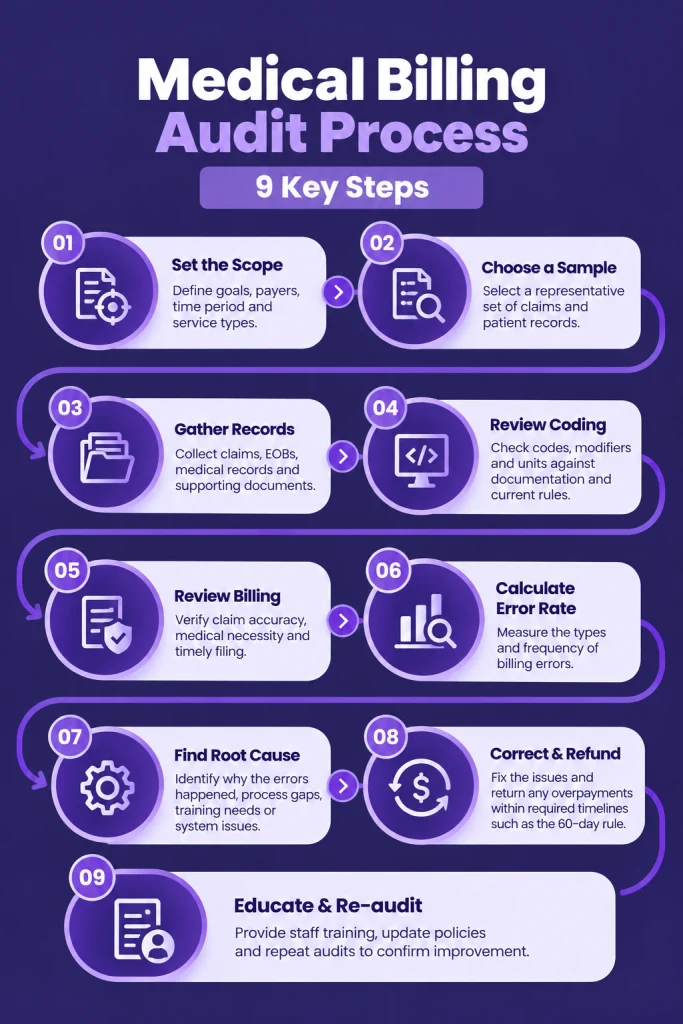
A medical billing audit compares claims with the medical record and the rules that apply to them. Most audits follow the same nine steps:
| Step | What Happens |
|---|---|
| 1. Set the scope | Choose the providers, services, payers and time period; decide between a prospective (before billing) or retrospective (after payment) review |
| 2. Choose the sample | Pull a random sample per provider, or a focused sample of high-risk codes |
| 3. Gather records | Collect notes, orders, signatures, claims and remittances for each encounter |
| 4. Review coding and documentation | Check codes, modifiers, units and diagnoses against the record and current guidelines |
| 5. Review billing | Check eligibility, place of service, provider, timely filing and payment |
| 6. Calculate the error rate | Measure errors by claim and by dollar, separating overpayments from underpayments |
| 7. Find root causes | Trace each error to its source, such as a template, a training gap or a system setting |
| 8. Correct and refund | Fix claims, return overpayments within the 60-day rule and document the action |
| 9. Educate and re-audit | Train the people involved and audit the same area again to confirm the fix |
An internal audit can be run by trained staff, while an external audit brings an independent reviewer. When a practice suspects a significant problem, many organizations involve legal counsel before starting so the findings can be handled appropriately.
What Are the 7 Most Important KPIs in Medical Billing?
Compliance and performance show up in the same numbers. These seven KPIs reveal whether a practice’s billing is accurate, timely and complete.
| KPI | How to Calculate | What It Tells You |
|---|---|---|
| Net collection rate | Payments ÷ (charges − contractual adjustments) x 100 | How much of the collectible amount is collected; 95% or higher is a common target |
| Days in accounts receivable | Total A/R ÷ average daily charges | How quickly claims are paid |
| A/R over 120 days | A/R older than 120 days ÷ total A/R | How much revenue is at risk of never being paid |
| Clean claim rate | Claims accepted on first submission ÷ claims submitted | Front-end and coding accuracy |
| Denial rate | Claims denied ÷ claims submitted | Where documentation, coding or eligibility breaks down |
| Charge lag | Average days from service to charge entry | Workflow speed and timely filing risk |
| Patient collection rate | Patient payments ÷ patient responsibility | How well patient balances are collected |
Benchmarks vary by specialty, but practice guidance based on MGMA data, such as this ACAAI practice guide, recommends a net collection rate of 95% or higher and says that in a better-performing practice no more than 10% of outstanding charges should be over 120 days old. For a deeper look at the first KPI, see our guide to average medical billing collection rates.
What Triggers a CMS Audit?
CMS uses several contractors to review claims, and most reviews start with data rather than a tip.
| Reviewer | What It Does |
|---|---|
| Medicare Administrative Contractor (MAC) | Runs Targeted Probe and Educate reviews of 20 to 40 claims per round, for up to three rounds, with education between rounds |
| Recovery Audit Contractor (RAC) | Reviews paid claims on CMS-approved topics and recovers improper payments |
| Unified Program Integrity Contractor (UPIC) | Investigates potential fraud, waste and abuse |
| Comprehensive Error Rate Testing (CERT) | Reviews a random sample of claims to measure the national error rate |
The most common triggers are billing patterns that stand out from peers, such as high E/M levels or heavy use of certain modifiers; services that CMS or OIG have flagged as high risk; high error rates in earlier reviews; and complaints from patients, employees or whistleblowers. Recovery auditors work from published topics, including one on facility versus non-facility reimbursement that targets place of service errors.
Medical Billing Fraud and Abuse: The Laws Behind the Checklist
Fraud means knowingly billing for something that was not provided or not allowed. Abuse means practices that lead to unnecessary costs or improper payment without the same intent. Five federal laws shape both.
| Law | What It Prohibits in Billing |
|---|---|
| False Claims Act | Knowingly submitting false claims or keeping overpayments; “knowingly” includes reckless disregard and deliberate ignorance; treble damages plus per-claim penalties |
| Anti-Kickback Statute | Paying or receiving anything of value to induce referrals of federal program business |
| Stark Law | Physician referrals for certain designated health services to entities they have a financial relationship with, unless an exception applies |
| Civil Monetary Penalties Law | Lets OIG impose penalties for false claims, kickbacks and other prohibited conduct |
| Exclusion authorities | Bar payment for items or services furnished, ordered or prescribed by excluded individuals or entities |
Upcoding, unbundling, billing for services not rendered and routinely waiving copays are the billing behaviors that most often move a case from an error to an allegation of fraud.
What Are the 10 Steps in the Medical Billing Process?
Each step of the billing process has its own compliance checkpoint, which is why a checklist works best when it follows the same order.

| Step | Compliance Checkpoint |
|---|---|
| 1. Patient registration | Accurate demographics and insurance details |
| 2. Eligibility and benefits verification | Coverage confirmed; ABN or Good Faith Estimate where required |
| 3. Documentation of the visit | Signed, complete record supporting medical necessity |
| 4. Medical coding | Codes, modifiers and units supported by the record |
| 5. Charge entry | Every documented service charged once |
| 6. Claim scrubbing and submission | Claim checked against payer edits and filed on time |
| 7. Payer adjudication | Remittance reviewed against expected payment |
| 8. Payment posting | Payments, adjustments and credits posted accurately |
| 9. Denial management and appeals | Denials worked to root cause before deadlines |
| 10. Patient billing and A/R follow-up | Clear statements, compliant collection and overpayment refunds |
How to Create a Compliance Checklist for Your Practice
A checklist works only if it fits the practice. Build it in six steps:
1. Start with your risks. Use last year’s denials, audit findings and payer letters to list the services and processes most likely to go wrong.
2. Map the rules. Match each risk to the rule behind it: CMS manuals, LCDs, payer policies, CPT guidelines or HIPAA.
3. Write checkable items. Each line should be a yes-or-no question, such as “Is every E/M note signed within the practice’s set timeframe?”
4. Assign owners and frequency. Name who checks each item and how often: daily, monthly, quarterly or yearly.
5. Keep evidence. Store the results, sample lists and corrective actions, since documentation is what proves the review happened.
6. Update it every year. Add new codes, payer rules and regulations, and retire items that no longer apply.
What Is the Golden Rule for Appropriate Medical Billing?
The golden rule is: if it is not documented, it was not done. Bill only for services that were provided, documented and medically necessary, at the level the record supports. Almost every compliance requirement in this checklist is a way of applying that rule consistently.
How iSolve RCM Supports Medical Billing Compliance
iSolve RCM is a medical billing company that builds compliance checks into the billing workflow, from eligibility and coding review to denial tracking and credit balance follow-up. Practices that want an independent review can start with an iSolve medical billing audit.

Frequently Asked Questions
How often should a practice audit its billing?
At least once a year for every provider, with more frequent reviews of high-risk services, new providers and any area where denials or payer letters point to a problem. OIG’s guidance expects auditing and monitoring to be ongoing.
What is the difference between a coding audit and a billing audit?
A coding audit checks whether codes, modifiers and units match the documentation. A billing audit also checks eligibility, claim data, timely filing, payment posting, refunds and follow-up. Most compliance reviews include both.
What is a billing compliance risk assessment?
A billing compliance risk assessment identifies which services, providers and processes are most likely to produce billing errors, using data such as denial rates, coding patterns and past audit findings. It decides where the audit plan should focus.
What happens if an audit finds an overpayment?
The practice must report and return Medicare and Medicaid overpayments within 60 days of identifying them. Since 2025, the deadline can be suspended for up to 180 days while the practice investigates related overpayments in good faith.
Do medical billing companies have to follow compliance rules?
Yes. Billing companies must follow payer rules and federal law when submitting claims, and they are business associates under HIPAA. OIG has long published compliance guidance specifically for third-party medical billing companies.
What records should a practice keep for billing compliance?
Keep medical records, claims, remittances, ABNs, audit results, policies and training records. HIPAA requires compliance documentation to be kept for six years, and many payers and states set their own record retention periods.


