

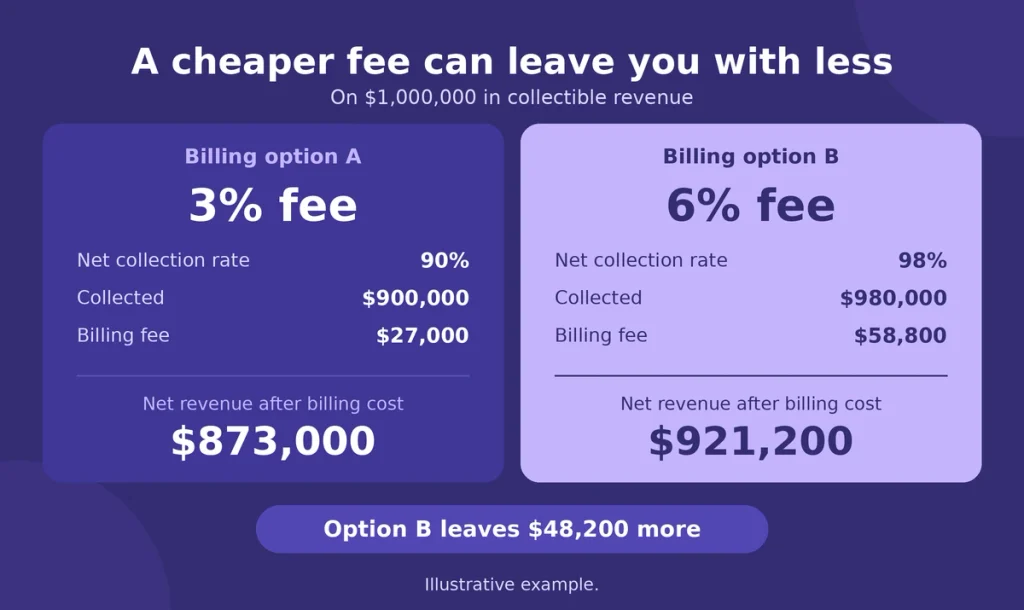
A billing company that charges 3% and collects 90% of what a practice is owed costs more than one that charges 6% and collects 98%. On $1 million in collectible revenue, the first leaves the practice $873,000 after fees; the second leaves $921,200. The cheaper rate costs $48,200.
That is the mistake practices make when they compare medical billing fees on their own. The fee is a cost. The collection rate is revenue. What matters is the money left after both, and measuring that takes a few specific numbers: cost to collect, net collection rate, days in A/R and the cost of denials and rework. This guide explains each one, how to calculate it and what good looks like.
Quick answer: To compare medical billing cost against revenue, measure net revenue after billing cost (collections minus all billing expenses), cost to collect (billing expenses ÷ collections), net collection rate (payments ÷ collectible charges) and denial and A/R trends. A higher fee that raises your net collection rate can leave more money in the practice than a lower fee that does not.
Cost vs. Revenue Metrics at a Glance
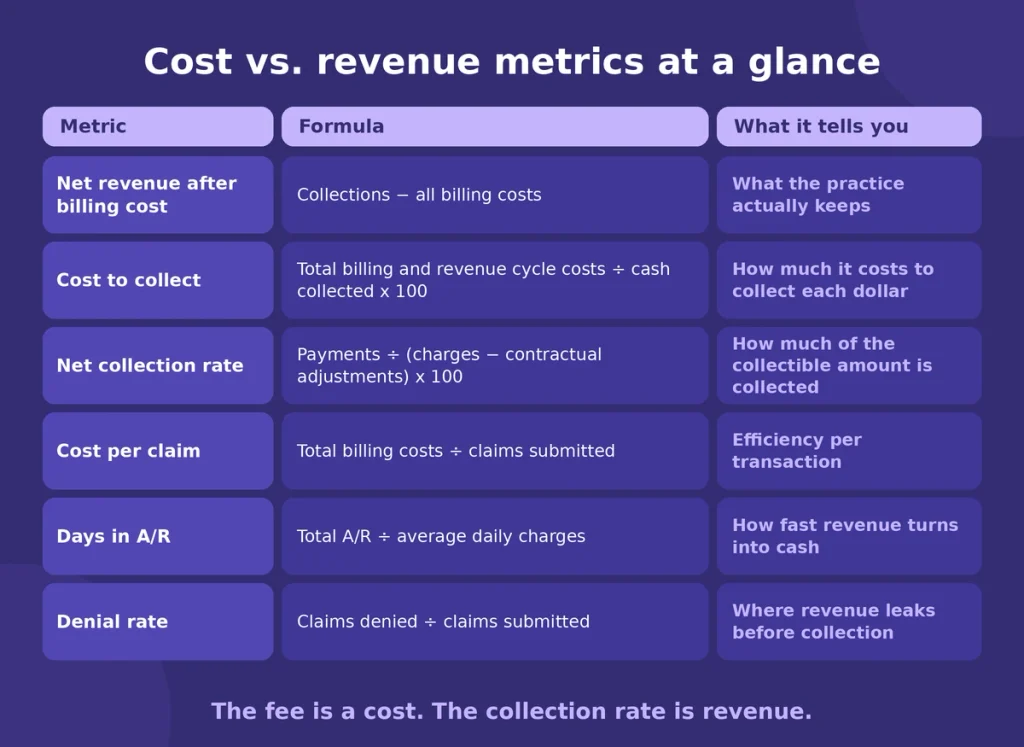
| Metric | Formula | What It Tells You |
|---|---|---|
| Net revenue after billing cost | Collections − all billing costs | What the practice actually keeps |
| Cost to collect | Total billing and revenue cycle costs ÷ cash collected x 100 | How much it costs to collect each dollar |
| Net collection rate | Payments ÷ (charges − contractual adjustments) x 100 | How much of the collectible amount is collected |
| Cost per claim | Total billing costs ÷ claims submitted | Efficiency per transaction |
| Days in A/R | Total A/R ÷ average daily charges | How fast revenue turns into cash |
| Denial rate | Claims denied ÷ claims submitted | Where revenue leaks before collection |

What Is the Difference Between Revenue and Billing?
Billing is the process of creating and submitting claims and statements for services. Revenue is the money the practice earns from those services. A practice can bill $1.5 million in charges and earn far less, because charges are reduced by contractual adjustments, denials, write-offs and unpaid patient balances. These terms describe each step:
| Term | Meaning |
|---|---|
| Gross charges | The practice’s full fee schedule amounts for services billed |
| Contractual adjustments | The difference between charges and the payer’s allowed amounts |
| Net patient revenue | Charges minus contractual adjustments and other deductions: what the practice expects to collect |
| Medical claims revenue | Payments received from insurance claims |
| Cash collections | Money actually received from payers and patients |
| Bad debt and write-offs | Balances the practice could not collect |
Revenue in healthcare, whether hospital revenue or physician practice revenue, is measured on net patient revenue and cash collections, not gross charges.
What Is the Difference Between Medical Billing and Revenue Cycle Management?
Medical billing covers claims, payments, denials and follow-up. Revenue cycle management covers the whole financial process, from scheduling and eligibility through coding, billing, payment posting, denials, patient collections and reporting. The billing and reimbursement cycle sits inside the larger revenue cycle. That difference matters for cost: an RCM partner may charge more than a billing-only service but prevents the front-end errors that cost billing teams the most. iSolve RCM’s revenue cycle management services cover the full cycle.
Which system is not part of the revenue cycle?
Systems that never touch patient financial data, such as human resources, payroll, supply inventory and accounts payable, are not part of the revenue cycle. Scheduling, registration, the EHR, coding tools, the practice management and billing system, the clearinghouse and payment posting are.
What Does Medical Billing Cost?
| Pricing Model | Typical Cost | Note |
|---|---|---|
| Percentage of collections | Headline rates commonly 4% to 7%, as Medical Economics reported | iSolve RCM starts at 2.99% |
| Flat fee | A set monthly fee | Predictable, but check volume limits |
| Per claim | A fixed fee per claim | Cost tracks volume, not collections |
| Hourly | Published rates as low as $7 per hour from offshore vendors such as Sunknowledge | The practice usually manages the work |
| In-house | Median wage of $50,250 a year, or $24.16 an hour, for medical records specialists, per BLS | Plus benefits, software and turnover |
Our guide to medical billing outsourcing cost covers pricing models and hidden charges in detail. The rest of this guide focuses on measuring what that cost returns.
How Do You Measure Cost to Collect?
Cost to collect is the cost of collecting each dollar of revenue. HFMA calculates it by adding the total expenses of patient access and patient financial services and dividing by cash collections, as its cost-to-collect guidance explains. For a practice, include billing staff, software, clearinghouse fees, outsourced billing fees and statement costs.
Cost to collect = total revenue cycle costs ÷ cash collected x 100
HFMA notes that the best-practice standard for cost to collect has dropped from 3% to 2% over recent years, according to its benchmark discussion, a figure set mainly by hospitals and health systems. Physician practices often run higher because they lack hospital scale, so compare your number with practices of similar size and specialty, and watch the trend.
Cost per claim
Divide total revenue cycle costs by the number of claims submitted in the same period. A rising cost per claim with flat volume usually means rework: denials, resubmissions and manual follow-up.
Why Does Net Collection Rate Matter More Than the Billing Fee?
Net collection rate shows how much of the money you are owed actually arrives. Practice guidance based on MGMA data recommends a net collection rate of 95% or higher, as the ACAAI practice guide notes, and our guide to average medical billing collection rates explains the benchmarks by specialty. Here is how the fee and the collection rate interact:
| Billing Option A | Billing Option B | |
|---|---|---|
| Collectible revenue | $1,000,000 | $1,000,000 |
| Net collection rate | 90% | 98% |
| Collected | $900,000 | $980,000 |
| Billing fee | 3% ($27,000) | 6% ($58,800) |
| Net revenue after billing cost | $873,000 | $921,200 |
Pro Tip: When you compare billing companies, ask each one to show the net collection rate it achieves for practices like yours, calculated with the same formula. A fee quote without a collection rate is half the comparison.
What Other Metrics Should Practices Track?
HFMA’s MAP Keys set standard definitions for 29 revenue cycle KPIs, including cost to collect, as its MAP Keys page describes. For physician practices, HFMA added practice-specific keys such as practice operating margin, practice net days in A/R, practice cash collection percentage and physician compensation as a percentage of net revenue, as Healthcare Finance News reported. Together with the metrics above, these show whether billing spending is producing revenue:
| Metric | Why It Matters for Cost vs. Revenue |
|---|---|
| Days in A/R and A/R over 120 days | Slow collection ties up cash; ACAAI guidance targets 10% or less over 120 days |
| Denial rate and overturn rate | Denials add rework cost and delay revenue |
| Clean claim rate | First-pass acceptance lowers cost per claim |
| Point-of-service collections | Collecting at the visit is the cheapest patient collection |
| Practice operating margin | Shows whether revenue covers all costs, including billing |
What Are the Operational Costs of Billing Confusion?
Billing confusion has costs that never appear on an invoice. Each denied claim costs about $57.23 to work, according to Premier. Unclear patient statements create phone calls, payment delays and bad debt. Multiple billing channels (paper statements, portals, text-to-pay) can raise collections when they are coordinated but add cost when each runs separately. Staff turnover resets training and leaves claims unworked.
These costs belong in your cost-to-collect calculation. Reducing them is usually cheaper than raising collections any other way, which is why denial management and clear patient billing have the highest return in most practices.
How Should You Price a Medical Billing Service?
If you run a billing company, price against the value you create, not just your costs. Most companies charge a percentage of collections, adjusted for specialty, claim volume, average claim value and the services included. Show clients the net revenue they keep after your fee, using their own data. A price that is explained in net revenue terms is easier to defend than the lowest rate.
How Can Practices Raise Revenue Without Raising Billing Cost?
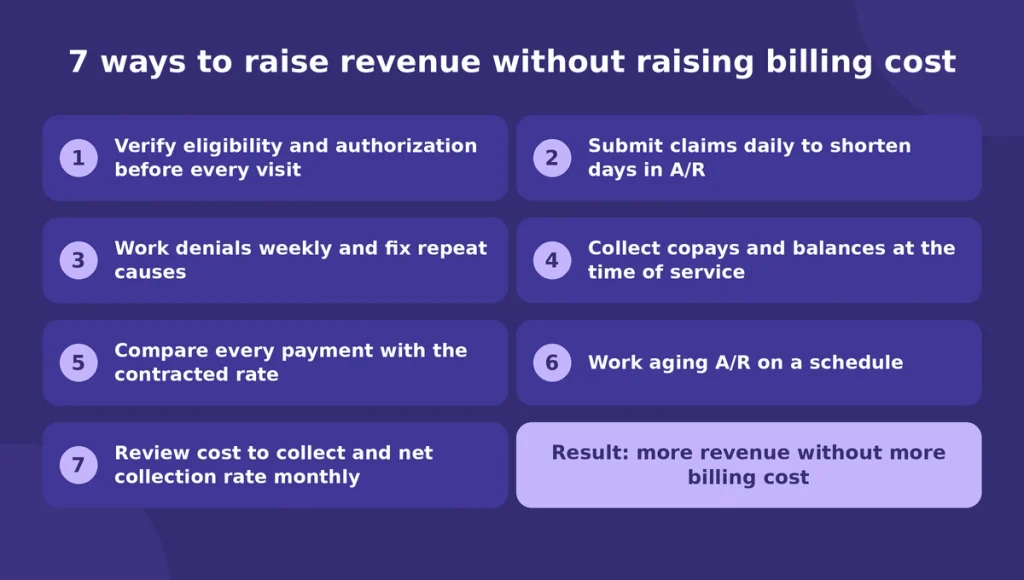
- Verify eligibility and authorization before every visit to cut front-end denials.
- Submit claims daily to shorten charge lag and days in A/R.
- Work denials weekly and fix the root cause of repeat denials.
- Collect copays and estimated balances at the time of service.
- Compare every payment with the contracted rate to catch underpayments.
- Work aging A/R on a schedule through A/R management.
- Review cost to collect and net collection rate every month.
How Does iSolve RCM Balance Billing Cost and Revenue?
iSolve RCM prices medical billing from 2.99% of monthly collections, listed on its pricing page, and reports a net collection rate of 95% or higher for its clients (company reported). Its team works eligibility, coding, claims, denials and A/R together, so the fee is measured against the revenue it brings in. A medical billing audit calculates your current cost to collect and net collection rate as the starting point.

Frequently Asked Questions
What is the average medical billing percentage?
Headline rates for outsourced medical billing are commonly around 4% to 7% of collections. iSolve RCM starts at 2.99%. The real cost depends on what the rate includes and the collection rate it achieves.
What is a good cost to collect for a medical practice?
HFMA cites a best-practice cost to collect of about 2% of collections, set mainly by hospitals. Physician practices often run higher, so compare with similar practices and track your own trend.
What is net patient revenue?
Net patient revenue is gross charges minus contractual adjustments and other deductions: the amount a practice expects to collect for its services.
What is the net collection rate in medical billing?
It is payments divided by charges minus contractual adjustments, times 100. Practice guidance based on MGMA data recommends 95% or higher.
What does a medical billing and coding company charge per hour?
Hourly pricing ranges widely; some offshore vendors publish rates as low as $7 per hour, while the median wage for in-house medical records specialists is about $24 an hour before benefits.
Is flat fee medical billing cheaper?
It can be for practices with steady volume, but flat fees do not rise and fall with collections, so check what happens when volume grows and what services are excluded.