

Medicare is federal health insurance, but the rules change depending on whether you are asking as a beneficiary or billing as a provider. A person needs to know when coverage starts, which part pays for a service and what it will cost. A provider needs to verify eligibility, confirm coverage rules, code the service correctly, submit the right transaction to the right Medicare contractor and act before filing or appeal deadlines expire.
This distinction is important because “Medicare billing” usually refers to Original Medicare fee for service claims under Part A or Part B. Medicare Advantage, also called Part C, is administered by private Medicare-approved plans. Part D prescription drug claims also follow plan and pharmacy benefit processes rather than the standard Part B professional claim workflow.
The guide below follows that full path: what Medicare insurance is, who is eligible, how enrollment works, what Parts A-D cover, what Medicare costs in 2026 and how providers submit, code, track and appeal Medicare claims.
What Is Medicare Insurance?
Medicare is a federal health insurance program for people age 65 or older and for some people under 65 who qualify because of disability, End-Stage Renal Disease (ESRD) or ALS. Original Medicare consists of Part A and Part B. Part C is Medicare Advantage, an alternative way to receive Part A and Part B benefits through a Medicare-approved private plan. Part D provides prescription drug coverage through private plans that follow Medicare rules.
That structure matters when asking how Medicare insurance works. The part of Medicare attached to the service determines the coverage rules, cost-sharing arrangement and billing route. A hospital inpatient stay, an office visit and a retail prescription can all involve Medicare, but they do not move through the same payment system.
Medicare Part A, Part B, Part C and Part D Explained
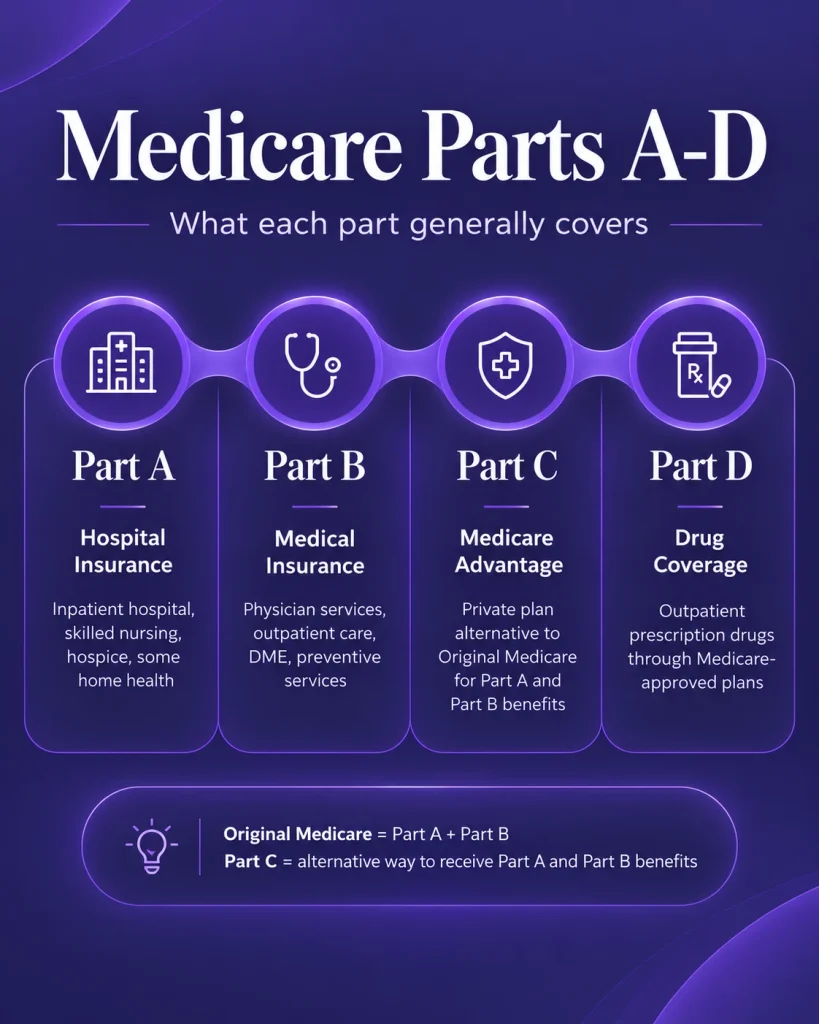
| Part | Common name | What it generally covers | How it fits |
| Medicare Part A | Hospital Insurance | Inpatient hospital care, skilled nursing facility care, hospice and some home health care | Original Medicare when paired with Part B |
| Medicare Part B | Medical Insurance | Physician services, outpatient care, durable medical equipment, many preventive services and certain outpatient drugs | Original Medicare when paired with Part A |
| Medicare Part C | Medicare Advantage | Part A and Part B benefits through a Medicare-approved private plan, usually with Part D and sometimes extra benefits | Alternative to Original Medicare |
| Medicare Part D | Drug coverage | Outpatient prescription drugs covered by the plan formulary and Medicare Part D rules | Standalone plan with Original Medicare or usually built into Medicare Advantage |
A common mistake is to treat Part C as a supplement to Original Medicare. It is usually an alternative way to receive Medicare benefits. A beneficiary in a Medicare Advantage plan generally follows that plan’s network, authorization, cost-sharing and claims rules. That is different from billing Original Medicare through a Medicare Administrative Contractor (MAC).
Who Is Eligible for Medicare?
Medicare eligibility is not based on one universal three-item test. The qualifying route matters. Most people first become eligible at age 65. People under 65 can become eligible after qualifying disability benefits, while ALS and ESRD have separate rules.
| Eligibility route | Core rule |
| Age 65 or older | People who meet Medicare’s citizenship or residency rules can qualify. Premium-free Part A usually depends on sufficient Medicare-covered work history. |
| Disability | Most people receiving qualifying Social Security Disability Insurance or certain Railroad Retirement Board disability benefits get Medicare after 24 months of disability benefits. |
| ALS | People with ALS generally receive Medicare automatically when Social Security disability benefits begin, without the usual 24-month Medicare waiting period. |
| ESRD | People of any age may qualify when permanent kidney failure requires regular dialysis or a kidney transplant and the applicable work or benefit relationship requirements are met. |
For people who must buy Part A and want Part B, CMS lists additional age and residency conditions. A person generally must be at least 65, reside in the United States and be either a U.S. citizen or a lawful permanent resident who has lived in the United States continuously for five years before applying.

How Do Providers Verify Medicare Eligibility?
Providers should verify Medicare eligibility before billing, not after a claim comes back unpaid. CMS uses the HIPAA Eligibility Transaction System (HETS) for real-time Medicare beneficiary eligibility data. The electronic workflow sends a 270 eligibility inquiry and returns a 271 response with coverage information that can help a practice confirm entitlement and beneficiary liability.
As of May 11, 2026, CMS requires a valid HETS EDI enrollment relationship for every NPI submitted in third-party eligibility requests. A practice using a clearinghouse or eligibility vendor should therefore confirm that its HETS enrollment is current, especially if 270/271 transactions begin returning authorization or enrollment errors.
For a broader front end workflow, see iSolve RCM’s eligibility verification process in medical billing, which explains coverage checks before claim submission.
Medicare Eligibility & Enrollment: How and When to Apply
People do not all apply for Medicare the same way. Some people are enrolled automatically because they are already receiving Social Security or Railroad Retirement Board benefits. Others need to sign up through the Social Security Administration for Part A and Part B.
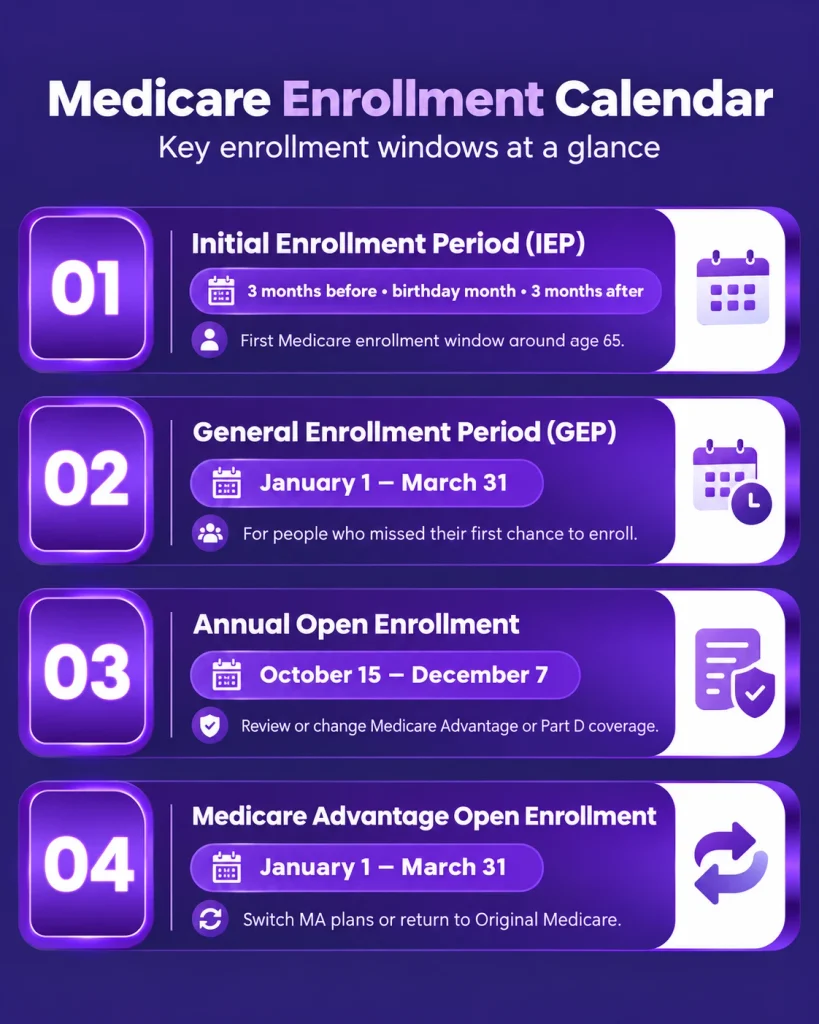
The Initial Enrollment Period is normally seven months: the three months before the month a person turns 65, the birthday month and the three months after. If someone misses that window and does not qualify for another enrollment opportunity, the General Enrollment Period for Part B and premium Part A runs from January 1 through March 31, with coverage starting the month after enrollment. Special Enrollment Periods can apply after certain events such as losing qualifying job-based coverage.
For Medicare Advantage and Part D plan changes, the annual Open Enrollment Period runs from October 15 through December 7. Plan changes made during that period generally take effect January 1 of the next year. Medicare Advantage also has a separate January 1 through March 31 Open Enrollment Period for people already enrolled in Medicare Advantage.
To apply for Medicare Part A or Part B, use the Social Security enrollment process. To join Medicare Advantage or Part D, the beneficiary must first meet the applicable Medicare eligibility rules and then enroll in a plan available in the person’s service area.
How Much Does Medicare Cost in 2026?
Medicare does not have one monthly price. Costs depend on the part of Medicare, work history, income, plan choice and the services a beneficiary uses. The 2026 figures below are the federal baseline amounts for Original Medicare and Part D limits, not a quote for every Medicare Advantage or drug plan.
| Cost item | 2026 rule |
| Part A premium | Most people pay $0. If buying Part A, the 2026 premium is $311 or $565 per month depending on Medicare-covered work history. |
| Part A inpatient deductible | $1,736 per benefit period in 2026. |
| Part B standard premium | $202.90 per month in 2026. Higher-income beneficiaries may pay an income-related adjustment. |
| Part B deductible | $283 in 2026. |
| Part B coinsurance | For many covered services, the beneficiary typically pays 20% of the Medicare-approved amount after the deductible. |
| Part D deductible | A Part D plan may charge less, but no plan may have a deductible above $615 in 2026. |
| Part D out-of-pocket cap | $2,100 in 2026 for covered Part D drugs before catastrophic coverage eliminates further out-of-pocket costs for covered drugs for the rest of the year. |
| Medicare Advantage | Premiums and cost sharing are plan-specific. Plans have an annual out-of-pocket limit for Part A and Part B services. |
Original Medicare itself does not have a yearly out-of-pocket maximum for Part A and Part B services. That is one reason some beneficiaries add Medigap coverage or choose Medicare Advantage, depending on their needs and eligibility.
What Does Medicare Cover?
Medicare coverage depends on the benefit category, the setting and whether the service meets applicable coverage requirements. Part A is centered on inpatient and certain post-acute benefits. Part B covers physician and outpatient services, durable medical equipment and many preventive benefits. Part D covers prescription drugs through plan formularies. Part C must provide Part A and Part B benefits through the Medicare Advantage plan and may include additional benefits.
Coverage is not the same as automatic payment. A service can fall within a Medicare benefit category but still require medical necessity, correct coding, appropriate documentation, provider enrollment or other claim conditions before Medicare will reimburse it.
Medicare Billing Guidelines for Providers
The provider billing rules below apply primarily to Original Medicare fee-for-service. If the patient is enrolled in Medicare Advantage, the claim generally follows the private plan’s billing route and contract rules instead of the standard Original Medicare MAC workflow.
A clean Medicare claim starts before coding. The practice should verify coverage, confirm the provider can bill Medicare, check whether the service is covered in the patient’s situation, code from the documentation and then submit the correct electronic claim transaction.
1. Verify Medicare eligibility and coverage
Use HETS 270/271, a MAC portal or an integrated eligibility tool to confirm Part A and Part B entitlement, effective dates and relevant beneficiary information before service when possible.
2. Confirm provider enrollment and billing identity
The billing NPI, rendering provider, practice information and Medicare enrollment records must support the claim. Enrollment mismatches can stop an otherwise correct claim.
3. Check coverage and medical necessity
Use national and local Medicare coverage rules where applicable. Documentation should show why the service was reasonable and necessary and why the billed level or frequency is supported.
4. Assign current diagnosis and procedure codes
Professional claims generally use ICD-10-CM for diagnoses and CPT/HCPCS for procedures and services. Hospital inpatient coding also uses ICD-10-PCS for inpatient procedures.
5. Apply Medicare coding edits and modifiers correctly
CMS NCCI Procedure-to-Procedure edits prevent certain code combinations from being paid together unless a valid clinical circumstance and permitted modifier support separate reporting. MUEs also limit units for many HCPCS/CPT codes.
6. Submit the correct transaction
Professional claims are normally submitted electronically as 837P transactions. Institutional claims are normally submitted as 837I transactions. Paper CMS-1500 and CMS-1450/UB-04 forms are generally used only when the provider qualifies for an exception to mandatory electronic filing.
7. Read acknowledgments, remittance and claim status
A submission is not finished when the batch leaves the practice. Monitor front-end rejections, MAC claim status and remittance information so errors do not sit unresolved.
8. Correct, resubmit or appeal based on the reason
A rejected transaction, a denied claim and an underpayment are different problems. The response determines whether staff should correct data, submit an adjusted claim, request redetermination or perform payer follow-up.
For practices that need coding support across CPT, HCPCS and ICD-10, iSolve RCM provides medical coding services for multi-specialty claims.
How to Submit a Medicare Claim: 837P, CMS-1500, 837I and UB-04
Most Medicare claims are submitted electronically. For professional services, the HIPAA standard transaction is the 837P. The CMS-1500 is the standard paper professional claim form when a provider qualifies for an exception to electronic filing. For institutional services, the electronic transaction is the 837I, while the CMS-1450, commonly called the UB-04, is the institutional paper form used when an applicable waiver or exception permits paper submission.
| Claim type | Normal electronic format | Paper form when allowed | Coding context |
| Physician or other non institutional professional claim | 837P | CMS-1500 | CPT/HCPCS plus ICD-10-CM diagnosis coding and applicable modifiers |
| Hospital or other institutional claim | 837I | CMS-1450 / UB-04 | Institutional billing data, revenue codes and diagnosis/procedure coding appropriate to the setting |
Accuracy improvement over many generic Medicare guides: CMS-1500 and UB-04 are not the default route for most providers. Medicare generally requires electronic claim submission unless an exception applies.
Medicare Inpatient, Outpatient and Physician Billing Guidelines
Medicare inpatient billing guidelines
Hospital inpatient claims are institutional claims and are normally sent electronically as 837I transactions. The claim must reflect the admission, discharge, diagnoses, procedures, revenue information and other data required for the applicable payment system. Inpatient hospital diagnoses use ICD-10-CM and inpatient procedures use ICD-10-PCS. Payment for many acute inpatient hospital stays is determined under the Inpatient Prospective Payment System rather than by a single physician-style fee schedule.
Medicare outpatient billing guidelines
Hospital outpatient departments also submit institutional claims, but the coding and payment logic differs from inpatient care. Outpatient services commonly use CPT/HCPCS codes with revenue codes and are subject to outpatient claim edits and payment rules. Hospital outpatient payment often falls under the Outpatient Prospective Payment System, while other outpatient provider types may use different Medicare fee schedules.
Medicare physician billing guidelines
Physicians and other practitioners generally submit professional claims as 837P transactions using CPT/HCPCS procedure codes, ICD 10 CM diagnosis codes and required modifiers. The documentation must support the reported service. Code selection, units, place of service, modifier logic and NCCI edits can all affect whether the claim is paid as billed.
How Does Medicare Reimburse Providers?
There is no single Medicare reimbursement rate. Medicare uses different payment systems for physicians, hospitals, laboratories, durable medical equipment, home health, skilled nursing and other provider types.
For services paid under the Medicare Physician Fee Schedule, payment is built from relative value units for physician work, practice expense and malpractice expense, adjusted for geographic cost differences and converted into dollars through a conversion factor. For 2026, CMS finalized two PFS conversion factors: $33.57 for qualifying APM participants and $33.40 for non-qualifying participants. Those figures are not the payment amount for every CPT code. The final allowed amount also depends on the code’s RVUs, geographic practice cost indices and other payment rules.
Medicare Timely Filing Limit
In general, Original Medicare fee-for-service claims must reach the correct Medicare claims processing contractor no later than 12 months, or one calendar year, after the date of service. For institutional claims with span dates, Medicare generally uses the claim’s through date to determine timely filing. For professional claims with span dates, line-level rules can apply.
CMS recognizes four categories of late-filing exceptions: certain administrative errors, retroactive Medicare entitlement, retroactive entitlement involving State Medicaid Agencies and retroactive disenrollment from Medicare Advantage or PACE. These are exceptions, not a general extension policy.
One detail often missed in competitor guides is especially important: when Medicare denies a claim because it was filed after the timely filing period, that denial is not treated as an initial determination and the timely filing decision is not subject to the ordinary Medicare appeal process.
Medicare Billing Codes: CPT, HCPCS and ICD-10
Medicare billing codes describe different parts of the claim and should not be treated as interchangeable. ICD-10-CM describes diagnoses. CPT, which is HCPCS Level I, reports many physician and outpatient procedures and services. HCPCS Level II includes codes for supplies, drugs, ambulance services, durable medical equipment and other items not fully represented by CPT.
For Medicare Part B claims, CMS National Correct Coding Initiative edits are a major coding control. Procedure-to-Procedure edits can deny a code that should not normally be billed with another code, while Medically Unlikely Edits test units of service. A modifier should only bypass an edit when the clinical facts and CMS rules actually support separate reporting.
Providers should not use modifiers simply to force payment. The goal is to report what happened, at the correct level of specificity, with documentation that supports the diagnosis, procedure, units, site and circumstances of the service.
Why Are Medicare Claims Denied?
Medicare claims are denied when the submitted claim does not meet a coverage, coding, documentation, enrollment or filing requirement. The correct response depends on the denial reason. Resubmitting the same claim without correcting the underlying problem can create duplicate-claim issues instead of resolving the account.
| Denial category | What usually went wrong | Best first action |
| Eligibility or coverage mismatch | Part A/Part B status, effective date or payer route does not match the date of service | Verify HETS data and confirm whether the patient had Original Medicare or Medicare Advantage on the date of service |
| Medical necessity or coverage rule | Documentation or diagnosis does not support a covered service under applicable policy | Review the relevant coverage rule and medical record before appealing or rebilling |
| NCCI or coding edit | Codes are bundled, units exceed an MUE or a modifier is missing or unsupported | Review the edit pair, units and documentation. Use a modifier only if CMS rules support it |
| Provider enrollment or identifier issue | Billing or rendering information does not match Medicare enrollment data | Correct the provider or practice enrollment/claim identifiers before resubmission |
| Duplicate claim | The same service was resubmitted before the first claim was resolved | Check claim status before sending a new claim |
| Timely filing | The claim reached Medicare after the filing deadline | Check whether a CMS late-filing exception truly applies. Ordinary appeal rights do not apply to the timely filing determination |
| Missing or inconsistent claim data | Required fields, place of service, units, modifiers or patient data conflict | Correct the specific error identified in the response and resubmit through the proper claim workflow |
If denials are repeating across a payer, code family or provider, the problem is no longer one claim. It is a workflow issue. iSolve RCM’s denial management services focus on root cause correction and prevention rather than isolated resubmission.
How to Appeal a Medicare Claim Denial
For an appealable Original Medicare initial claim determination, the first level of appeal is a redetermination by the Medicare Administrative Contractor. The appellant generally has 120 days from receipt of the initial determination to request redetermination. The request should address the actual reason Medicare denied or reduced the claim and include the documentation needed to support payment.
Do not confuse the 120-day redetermination window with the 12-month claim filing limit. They govern different events. The claim filing limit controls when the original claim must reach Medicare. The redetermination deadline applies after an appealable initial determination has been issued.
How to Check Medicare Claim Status
Providers can check Original Medicare claim status through the MAC’s portal or IVR system and, where supported, through electronic claim-status transactions. The HIPAA 276 transaction requests claim status and the 277 response returns claim-status information. This can reduce unnecessary duplicate claims because staff can see whether a claim is pending, processed or needs correction before resubmitting it.
Outstanding Medicare claims should also feed the practice’s accounts receivable management workflow so unpaid accounts are assigned, aged and followed before deadlines are missed.
How to Avoid Medicare Claim Denials
The most effective Medicare denial prevention happens before the claim is transmitted.
- Verify Original Medicare versus Medicare Advantage coverage for the actual date of service.
- Confirm the billing and rendering provider information matches active Medicare enrollment records.
- Check national or local coverage rules when the service has medical necessity conditions.
- Code from the record, not from the fee schedule or a prior claim.
- Review NCCI edits, units and modifiers before submission.
- Submit 837P or 837I claims to the correct MAC and monitor front-end acknowledgments.
- Track claim status before sending a duplicate.
- Work rejected and denied claims quickly enough to preserve filing and appeal rights.
- Trend denials by reason, provider, code and payer workflow so recurring failures are corrected upstream.
A practice that connects eligibility, coding, claim submission, payment posting, denial work and A/R follow-up is managing Medicare as a revenue cycle rather than as isolated claims. That is the role of a complete revenue cycle management process.
Medicare Billing Checklist for Providers
- Confirm whether the patient has Original Medicare or Medicare Advantage on the date of service.
- Verify Part A and Part B entitlement and effective dates.
- Confirm provider enrollment and claim identifiers.
- Check applicable coverage and medical necessity rules.
- Use current ICD-10-CM, CPT/HCPCS and setting-specific procedure coding.
- Review modifiers, NCCI PTP edits and MUEs before submission.
- Send professional claims as 837P and institutional claims as 837I unless an electronic filing exception applies.
- Monitor acknowledgments, claim status and ERA results.
- Correct rejections before they become aged A/R.
- File Original Medicare claims within the 12-month timely filing period unless a recognized exception applies.
- Use the correct appeal path and preserve the 120-day redetermination deadline for appealable initial determinations.

Final Takeaway
Medicare becomes much easier to understand when eligibility, coverage and billing are kept in the right order. First determine why the person qualifies and which part of Medicare is active. Then identify what the benefit covers, what the beneficiary owes and which payer actually receives the claim. For providers, the same discipline continues through eligibility verification, coding, electronic submission, claim status, reimbursement and denial follow-up.
The biggest billing errors usually happen when one of those relationships is assumed instead of verified. A patient can be Medicare-eligible but enrolled in Medicare Advantage. A covered service can still deny when documentation or coding does not support payment. A correct claim can still fail if it reaches Medicare after the filing deadline.
Healthcare practices that need help managing Medicare and other payer workflows can use outsourced medical billing services to connect eligibility, coding, claims, denials and A/R inside one billing process.
Frequently Asked Questions
What are the three requirements for Medicare?
There is no single three part Medicare eligibility test that applies to everyone. The main routes are age 65 or older, qualifying disability, ALS and ESRD. For some people who must buy Part A and enroll in Part B, CMS also applies age, U.S. residency and citizenship or qualifying lawful permanent-resident requirements.
What is Medicare Part A and Part B?
Medicare Part A is Hospital Insurance and mainly covers inpatient hospital care, skilled nursing facility care, hospice and some home health care. Medicare Part B is Medical Insurance and covers physician services, outpatient care, durable medical equipment, many preventive services and certain drugs.
When can I enroll in Medicare?
For most people becoming eligible at 65, the Initial Enrollment Period lasts seven months, beginning three months before the birthday month and ending three months after it. General, Special, Medicare Advantage and Part D enrollment periods apply in other situations.
How and when do I apply for Medicare?
Part A and Part B enrollment is handled through Social Security for people who are not enrolled automatically. Apply during the Initial Enrollment Period unless you qualify for a later Special Enrollment Period. Medicare Advantage and Part D plans are joined separately after the underlying Medicare eligibility requirements are met.
How much does Medicare cost?
In 2026, the standard Part B premium is $202.90 and the Part B deductible is $283. Most people pay no Part A premium, while people who buy Part A pay $311 or $565 per month depending on work history. Medicare Advantage and Part D premiums vary by plan.
How do providers bill Medicare?
For Original Medicare, providers verify eligibility, confirm coverage, code the documented service and submit an electronic claim to the appropriate Medicare Administrative Contractor. Professional claims normally use 837P and institutional claims normally use 837I.
What is the Medicare timely filing limit?
Original Medicare fee-for-service claims generally must be received no later than 12 months, or one calendar year, after the date of service. CMS recognizes limited exceptions.
How do providers verify Medicare eligibility?
Providers can use CMS HETS 270/271 eligibility transactions through approved connectivity, a vendor or clearinghouse, as well as Medicare Administrative Contractor tools. HETS provides real-time beneficiary eligibility information.
How does Medicare reimburse providers?
Medicare uses different payment systems. Physicians are often paid under the Medicare Physician Fee Schedule, while hospitals and other provider types may be paid under prospective payment systems or separate fee schedules. There is no single Medicare reimbursement rate.
How do I check Medicare claim status?
Providers can use their Medicare Administrative Contractor portal, IVR tools or electronic 276/277 claim-status transactions. Checking status before resubmission helps prevent unnecessary duplicate claims.