

Picture a Tuesday in dermatology. An established patient comes in for a worsening rash, the physician works it up and starts a prescription, then notices a suspicious lesion and does a tangential biopsy before the patient leaves. For years that claim has been simple: 99214-25 plus 11102, both paid in full. On January 1, 2027, the same claim pays less.
Effective January 1, 2027, Medicare reimbursement will apply 100 percent to the highest-valued affected service and 80 percent to every subsequent affected service provided by the same specialty physician or physician group practicing in the same facility during the same calendar date for a separate and distinct office/outpatient E/M service and 0-day global surgery. Modifier 25 remains unchanged for coding purposes. Documentation and claims reporting standards remain consistent; only reimbursement calculations will shift.
Let’s break down what modifier 25 is, exactly which services the 20% reduction reaches, how much revenue the change costs and how to bill modifier 25 correctly under the 2027 Medicare physician fee schedule final rule.
What is modifier 25?
CPT modifier 25 indicates when there is a separate and distinct evaluation and management (E/M) service conducted by the same provider on the same date of service as another procedure or service. CPT modifier 25 applies to a specific E/M code (e.g., 99213 or 99214). Modifier 25 signifies additional complexity associated with the professional component of the E/M visit above what is normally included as part of routine pre-service preparation and post-service follow-up of the procedure.
CPT Modifier 25 Definition: The E/M Services Guidelines and Modifier Selection Criteria provide guidance regarding the use of modifier 25.
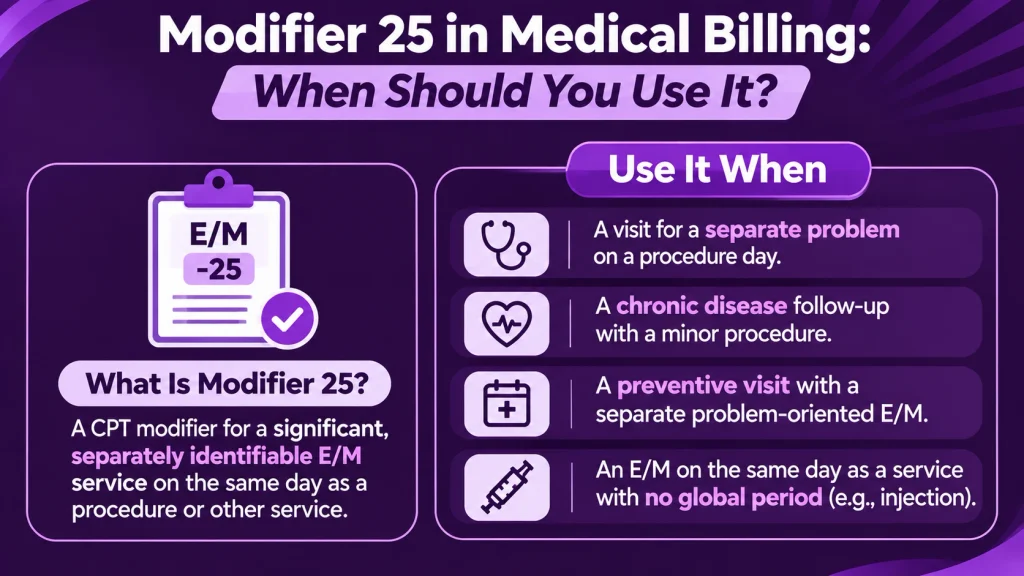
Medical billing modifier 25 allows billing of both a separately identifiable E/M service and the service with a global period on the same day. Every procedure code includes an integral component called the global period during which certain bundled services, like examination of the condition, approval of treatment strategy and patient consent, occur.
What is modifier 25 used for?
Modifier 25 is used to get paid for an E/M visit and a minor procedure performed on the same day when the E/M service stands on its own. Common uses of the 25 modifier in medical billing include the following 4 situations:
- A visit for a separate problem on a procedure day, such as uncontrolled diabetes managed at the same visit where a skin lesion is biopsied.
- A chronic disease follow-up where a separate minor procedure also happens, such as diabetes management plus nail debridement.
- A preventive visit with a separate problem-oriented E/M, such as an annual physical plus evaluation of new chest pain.
- An E/M visit on the same day as a service with no global period that payers still edit, such as an E/M plus a therapeutic injection (96372) under some payer policies.
In each of the 4 situations, the E/M note documents work that the procedure payment does not already cover.
What does modifier 25 mean on a claim?
On a claim, modifier 25 means the E/M line is a separate service that bypasses the same-day bundling edit for the procedure. In 25 modifier medical billing, the modifier goes on the E/M code (for example, 99214-25), never on the procedure code. A different diagnosis is not required for the E/M line, but the documentation shows work beyond the procedure’s built-in evaluation.
What changes for Medicare modifier 25 in 2027?
For 2027, Medicare modifier 25 claims change in one way: the lower-valued of the same-day E/M visit and 0-day global procedure is paid at 80% instead of 100%. CMS finalized the policy in the CY 2027 physician fee schedule. According to the CMS fact sheet on the final rule, “the most expensive service (either surgical or E/M visit) will be paid at 100%” and “the other surgical procedure(s) or O/O E/M visit(s) furnished on the same day will be paid at 80%.”

CMS’s stated reason is that the same practitioner shares resources between the visit and the procedure, so current payment likely duplicates part of the work. The reduction is applied when the claim is processed, so the claim still pays and does not deny.
Which services fall under the 20% reduction?
The 20% reduction applies only when an office or outpatient E/M visit with modifier 25 is billed on the same day as a procedure with a 0-day global period (global indicator 000). The global period of the procedure decides whether the reduction applies:
| Procedure global period | Same-day reduction in 2027? | Examples |
|---|---|---|
| 000 (0-day global) | Yes, lower-valued service paid at 80% | Tangential biopsy 11102, shave removal 11300 to 11313, nail debridement 11720 and 11721, subcutaneous debridement 11042, joint injection 20610, trigger points 20552 and 20553, intravitreal injection 67028, cerumen removal 69210, nasal endoscopy 31231 |
| 010 (10-day global) | No | Destruction 17000 and 17110, excisions 11400 to 11646, incision and drainage 10060 |
| 090 (90-day global) | No (decision for surgery uses modifier 57) | Major procedures such as joint replacement |
| XXX (no global period) | No | Vaccines, ECGs, injection 96372, diagnostic tests |
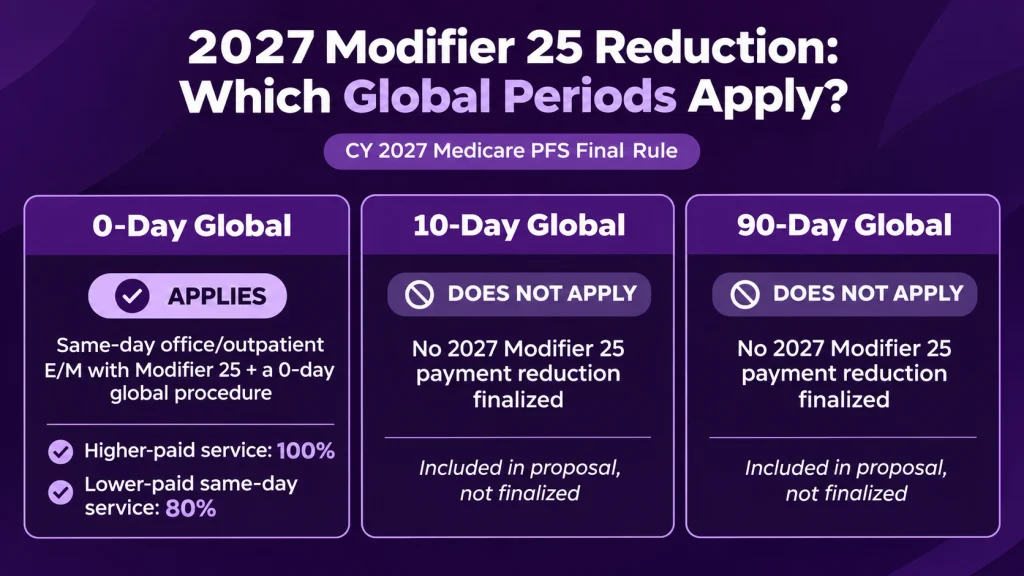
Check the global indicator for each procedure in the Medicare physician fee schedule before assuming a pair is affected, since many dermatology and podiatry procedures sit in different global categories.
How is the lower valued service chosen?
The lower-valued service is chosen by comparing the Medicare fee schedule amounts for the E/M visit and the procedure, not by which service is primary.MGMA’s analysis of modifier 25 in 2027 illustrates this using an estimated CPT 99213 payment of $93, calculated using the 2027 conversion factor before the 2027 practice expense changes. Paired with a nail debridement worth about $44, the procedure is the lower line and loses about $9. Paired with a subcutaneous debridement worth about $130, the visit is the lower line and loses about $19.
Documentation is key: Pairs with close fee schedule amounts can flip from one locality to another, so the reduced line on your remittance may differ from a national example.
Who does the 2027 reduction apply to?
The 2027 reduction applies when the same physician, or physicians of the same specialty within the same group practice, furnish the E/M visit and the 0-day global procedure to the same patient on the same day. MGMA notes that visits furnished the same day by physicians of different specialties in the same group are not subject to the reduction. The policy applies to Original Medicare claims paid under the physician fee schedule.
How did the final rule change from the 2027 proposal?
The final rule cut the reduction from 50% to 20% and limited the policy to 0-day global procedures. The July 2026 proposal was much broader, as the table below shows:
| Policy element | July 2026 proposal | November 2026 final rule |
|---|---|---|
| Lower-valued service paid at | 50% | 80% |
| Highest-valued service paid at | 100% | 100% |
| Procedure global periods included | 0-day, 10-day and 90-day | 0-day only |
| Effective date | January 1, 2027 | January 1, 2027 |
Many articles written before November 2026 still quote the 50% figure. Use the final 80% rate, as confirmed in BakerHostetler’s summary of the final rule.
How much revenue does the 20% reduction cost?
Each affected encounter loses 20% of the lower-valued service, so the annual cost equals the number of same-day pairs multiplied by 20% of the average lower-valued amount. The table below shows the math for 3 illustrative pairs, using national amounts rounded from MGMA’s 2027 examples:
| Same-day pair | Lower-valued line | Loss per encounter | Loss at 1,500 pairs a year |
|---|---|---|---|
| 99213-25 + nail debridement (about $44) | Procedure | About $9 | About $13,500 |
| 99213-25 + subcutaneous debridement (about $130) | E/M visit (about $93) | About $19 | About $28,500 |
| 99214-25 + shave removal (MGMA dermatology example) | Procedure | About $15 | About $22,500 |
To size your own exposure, pull 12 months of Medicare claims with an E/M-25 and a 000-global procedure on the same date, find the lower-valued line for each pair and take 20%.

Which specialties feel the modifier 25 change most?
Dermatology, podiatry, ophthalmology, otolaryngology, orthopedics and pain management feel the modifier 25 change most, because these specialties bill office visits with 0-day procedures every day. OIG audits show how common the pairing is:
Dermatology: OIG’s dermatology modifier 25 audit found that dermatology providers generally met Medicare requirements, yet the specialty bills modifier 25 with same-day minor procedures more than any other, The OIG found that approximately 61.5% of Medicare-paid dermatology E/M claims in 2019 and 2020 included a minor surgical procedure performed on the same day by the same dermatologist.
Podiatry: OIG’s podiatry audit estimated about $39.6 million in improper payments tied to E/M services billed with modifier 25.
Ophthalmology: OIG found same-day E/M services billed with modifier 25 for 42% of intravitreal injections and recommended recovering up to $124 million, in its report on E/M visits with eye injections.
Primary care feels less of the change, since most primary care same-day services, such as vaccines, ECGs and 96372 injections, carry no global period. For dermatology groups, our guide to dermatology medical billing services covers the specialty-specific denial patterns in more detail.
How do you bill modifier 25 correctly in 2027?
Billing modifier 25 correctly in 2027 follows the same 5 rules as before; only the payment amount changes.
- Append the 25 modifier to the E/M code, never to the procedure code.
- Bill the E/M only when the visit is significant and separately identifiable from the procedure’s built-in evaluation.
- Do not bill an E/M for the decision to perform a 0-day or 10-day procedure; that decision is included in the procedure.
- Use modifier 57, not 25, for the decision for surgery on the day before or day of a 90-day global procedure.
- Select the E/M level from the separately identifiable work only, using MDM or time that excludes the procedure.
These 5 rules decide whether the E/M is payable at all. The 2027 policy only decides how much of the lower-valued line Medicare pays.
What documentation supports modifier 25?
Documentation supports modifier 25 when the note separates the E/M work from the procedure work and shows a distinct problem or substantially more evaluation. A strong note has a separate assessment and plan for the E/M problem, the MDM or time for that problem only and a separate procedure note for the 0-day procedure.
Documentation is key: “Patient here for wart removal, warts treated” does not support an E/M. “Psoriasis flaring on elbows and knees, started clobetasol, labs ordered; also 2 verrucae treated with cryotherapy” supports a separate E/M for the psoriasis.
For E/M level selection on the separate service, see our guide to CPT 99213 vs 99214.
Can modifier B1 be billed with modifier 25?
Modifier B1, which replaces G2211 in 2027 and adds 16% to the E/M payment, is generally not paid on an E/M billed with modifier 25. The exception covers E/M visits on the same day as an annual wellness visit, a vaccine administration or a Medicare Part B preventive service. Remove B1 from E/M-25 lines tied to procedures to keep claims clean.
Modifier 25 billing scenarios for 2027
These 5 scenarios show how the 2027 rule plays out on real claims:
Scenario 1: Rash plus biopsy. The physician evaluates a worsening eczema flare and adjusts prescription medication, then performs a tangential biopsy (11102) of an unrelated lesion. Code: 99214-25 and 11102, when the documented E/M work supports moderate MDM. Both services are separately reportable when Medicare requirements are met, with the lower-valued service paid at 80%.
Scenario 2: Knee injection plus a new shoulder problem. A patient returns for a planned knee injection (20610) and also reports new shoulder pain, which the physician examines, orders imaging for and refers to physical therapy. Code: 99213-25 and 20610. The 20% reduction applies to whichever line has the lower fee schedule amount.
Scenario 3: Planned injection only. An established patient returns for a scheduled repeat knee injection with no new complaint. Code: 20610 only. No E/M, no modifier 25 and nothing to reduce.
Scenario 4: Excision visit. The physician evaluates a separate rash and excises a lesion (11402, 10-day global). Code: E/M-25 and 11402. No 2027 reduction, because the excision carries a 10-day global period.
Scenario 5: Different specialties, same group. A primary care physician sees the patient for hypertension, and a dermatologist in the same multispecialty group performs a shave removal that afternoon. Per MGMA’s reading of the rule, the reduction does not apply because the physicians are of different specialties.
What are the most common modifier 25 billing mistakes in 2027?
Most modifier 25 problems in 2027 come from 6 mistakes:
Using the 50% proposed figure. Practices budgeting or posting payments with the July proposal overstate the loss. How to Avoid? Load the final 80% rule into payment posting and contract variance reports.
Treating the reduction as a denial. Staff appeal reduced lines that paid correctly. How to Avoid? Train posting staff to recognize the same-day reduction on the remittance before appealing.
Dropping a supported E/M to avoid the cut. Skipping a separately identifiable E/M loses 100% of that visit to avoid a 20% reduction. How to Avoid? Keep billing every supported E/M.
Adding modifier 25 to the procedure line. The modifier belongs on the E/M. How to Avoid? Build the modifier into the E/M line of the charge template.
Leaving B1 on E/M-25 lines. B1 is generally not paid with modifier 25. How to Avoid? Add a scrubber edit that removes B1 when modifier 25 is present, outside the preventive exceptions.
Cloned E/M notes. Identical E/M notes on every procedure day invite audits. How to Avoid? Document a separate assessment and plan for each E/M problem.
Fixing these 6 mistakes protects both the 80% that Medicare still pays and the audit position of every E/M-25 claim.
Do commercial payers follow the Medicare modifier 25 reduction?
Commercial payers are not required to follow the Medicare modifier 25 reduction, and each payer applies its own contract terms and payment policies. Some commercial and Medicare Advantage plans already have modifier 25 policies of their own, and others may adopt Medicare’s approach after it takes effect. Review payer policy bulletins in early 2027 and compare remittances against contracted rates to catch new reductions.

Conclusion
Medicare modifier 25 rules stay the same in 2027, and the payment changes. When an office E/M with modifier 25 and a 0-day global procedure fall on the same day from the same physician or physicians of the same specialty within the same group practice. Medicare pays the higher-valued service in full and the lower-valued service at 80%. 10-day globals, 90-day globals and services without a global period are untouched. Keep billing every supported E/M, document it separately, remove B1 from procedure-day E/M-25 lines and measure the real exposure from your own claims.
Frequently asked questions
What is modifier 25?
Modifier 25 is the CPT modifier for a significant, separately identifiable E/M service by the same physician or qualified health care professional on the same day as a procedure or other service.
What is the Medicare modifier 25 change in 2027?
Starting January 1, 2027, Medicare pays the lower-valued service at 80% when an office or outpatient E/M with modifier 25 is billed on the same day as a 0-day global procedure by the same physician or physicians of the same specialty within the same group practice. The higher-valued service is paid at 100%.
Does the 20% reduction apply to 10-day and 90-day global procedures?
No. The final rule applies only to procedures with a 0-day global period. CMS proposed including 10-day and 90-day globals but dropped them in the final rule.
Is the E/M visit always the service that gets reduced?
No. Medicare reduces whichever service has the lower fee schedule amount, which can be the E/M visit or the procedure.
Do I still need a different diagnosis to bill modifier 25?
No. A different diagnosis is not required, but the documentation shows E/M work that is significant and separately identifiable from the procedure.
Can I bill modifier B1 with modifier 25 in 2027?
Generally no. B1 is not paid on an E/M with modifier 25 except on the same day as an annual wellness visit, a vaccine administration or a Medicare Part B preventive service.
Do commercial payers apply the 2027 modifier 25 reduction?
Not automatically. Commercial and Medicare Advantage plans follow their own contracts and policies, so check each payer’s policy updates in 2027.