
A nephrologist can see a patient with stage 3 chronic kidney disease in the office, round on four dialysis patients at a clinic and manage a new kidney transplant recipient in the same week. Each of those encounters is billed under different rules: office E/M codes, monthly capitation payments for dialysis, per day codes for partial months and coordination rules that change who pays first. That is why nephrology billing breaks so easily in the hands of a general biller.
The top nephrology medical billing companies in the USA for 2027 are iSolve RCM for independent and growing nephrology practices that want full RCM service at a published price, MBW RCM for large groups that want offshore scale with security certifications and Acumen Physician Solutions for practices that want a nephrology specific EHR. Transcure, Practolytics, I-Med Claims, MediBillMD, eClaim Solution, CureMD and Sirius Solutions Global complete the list for specific practice sizes and needs.
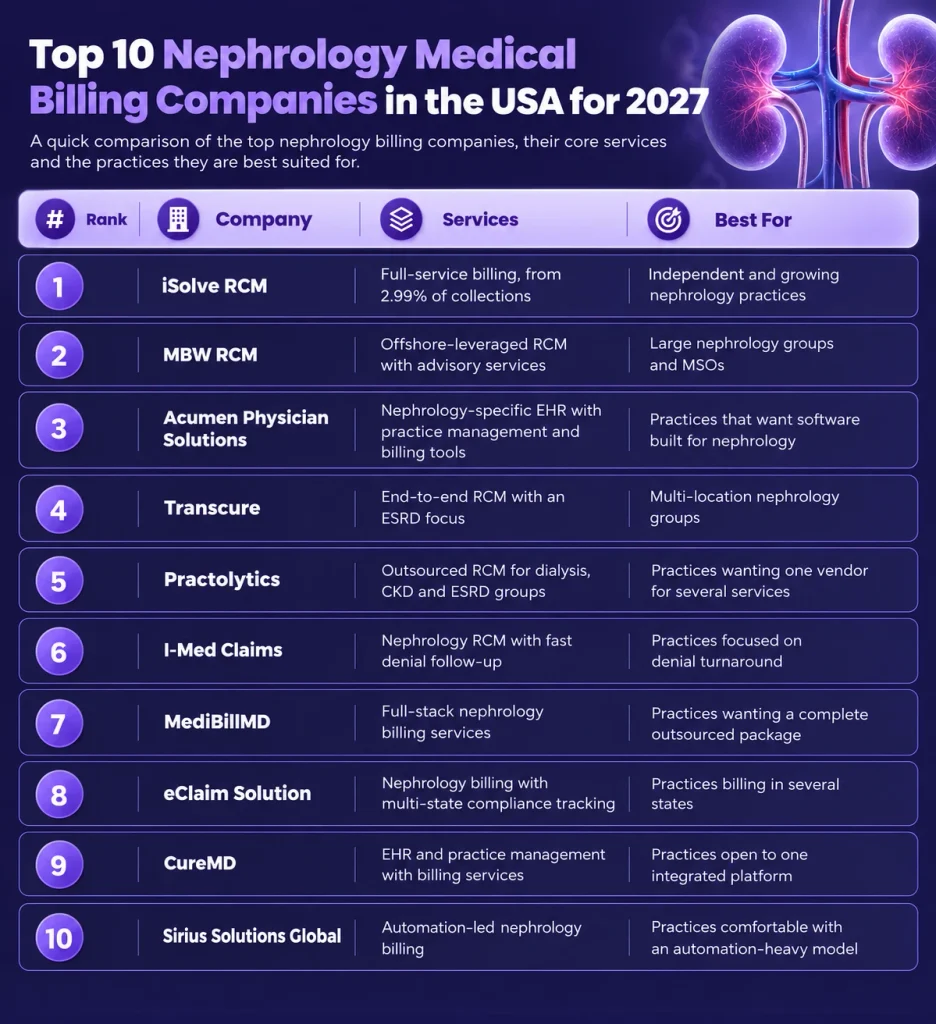
Top Nephrology Billing Companies at a Glance
| Rank | Company | Model | Best For |
|---|---|---|---|
| 1 | iSolve RCM | Full-service billing, from 2.99% of collections | Independent, growing nephrology practices and multi location groups |
| 2 | MBW RCM | Offshore-leveraged RCM with advisory services | Large nephrology groups and MSOs |
| 3 | Acumen Physician Solutions | Nephrology-specific EHR with practice management and billing tools | Practices that want software built for nephrology |
| 4 | Transcure | End-to-end RCM with an ESRD focus | Multi-location nephrology groups |
| 5 | Practolytics | Outsourced RCM for dialysis, CKD and ESRD groups | Practices wanting one vendor for several services |
| 6 | I-Med Claims | Nephrology RCM with fast denial follow-up | Practices focused on denial turnaround |
| 7 | MediBillMD | Full-stack nephrology billing services | Practices wanting a complete outsourced package |
| 8 | eClaim Solution | Nephrology billing with multi-state compliance tracking | Practices billing in several states |
| 9 | CureMD | EHR and practice management with billing services | Practices open to one integrated platform |
| 10 | Sirius Solutions Global | Automation-led nephrology billing | Practices comfortable with an automation-heavy model |
What Is Nephrology Medical Billing?
Nephrology medical billing is the revenue cycle work for kidney care: verifying coverage, coding office visits, dialysis management, vascular access procedures and transplant follow-up, submitting claims, posting payments and resolving denials. It covers patients with chronic kidney disease (CKD), end-stage renal disease (ESRD), acute kidney injury (AKI) and kidney transplants, across the office, the dialysis unit, the hospital and the patient’s home.
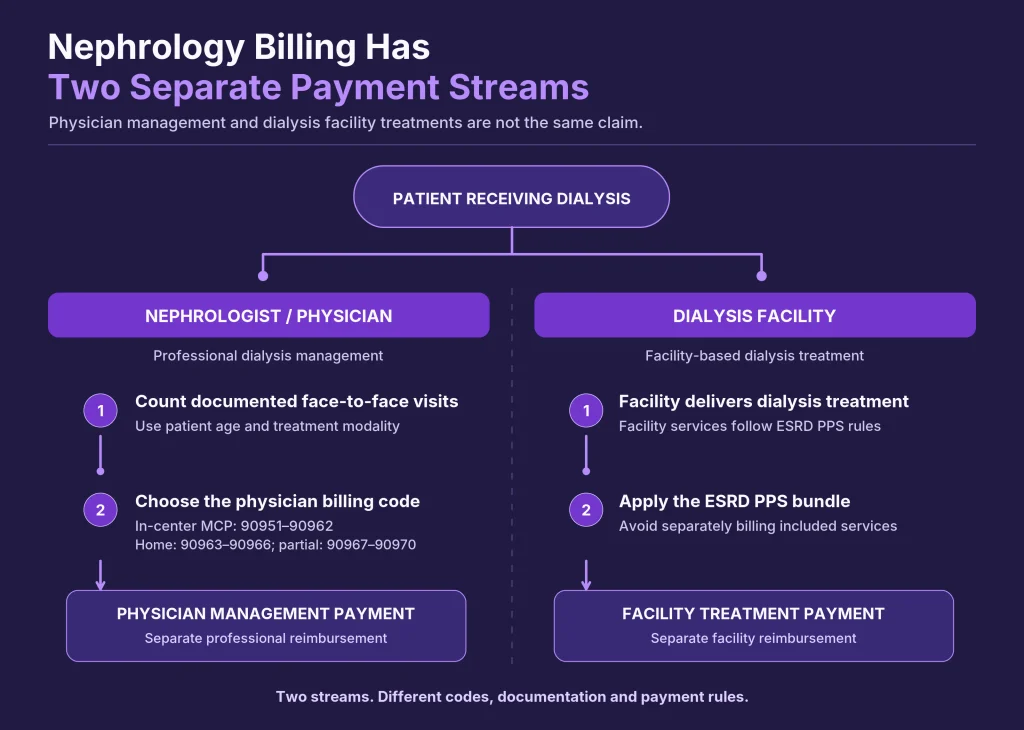
What sets it apart is that Medicare pays nephrologists differently for dialysis patients. Instead of billing each dialysis visit, the physician bills one monthly capitation payment (MCP) code based on the patient’s age and the number of face to face visits that month, while the dialysis facility is paid separately under the ESRD Prospective Payment System. Mixing up those two payment streams is one of the most expensive mistakes in kidney care billing.
The nephrology codes medical billers and coders must know
| Code Family | Codes | What They Cover |
|---|---|---|
| ESRD monthly services (MCP) | 90951 to 90962 | Monthly dialysis management by age group and number of face-to-face visits (one visit, two to three visits or four or more) |
| Home dialysis monthly services | 90963 to 90966 | Monthly management for home dialysis patients by age group |
| Partial-month ESRD services | 90967 to 90970 | Per-day billing when the patient is not under the physician’s care for a full month |
| Dialysis procedures | 90935, 90937, 90945, 90947 | Hemodialysis and other dialysis with physician evaluation, such as inpatient AKI dialysis |
| Dialysis circuit procedures | 36901 to 36909 | Diagnostic and interventional procedures on the dialysis access |
| Office and hospital visits | E/M codes with G2211 where eligible | CKD and transplant follow-up visits |
Diagnosis coding for kidney care
Accurate ICD 10 CM coding drives medical necessity in nephrology. CKD is coded by stage from N18.1 to N18.6, with stage 3 split into N18.30, N18.31 (3a) and N18.32 (3b). ESRD is N18.6, paired with Z99.2 for dependence on renal dialysis.
Because ICD-10 CM guidelines presume a link between hypertension and CKD, most hypertensive patients with CKD are coded with I12.- or I13.-, and diabetic kidney disease uses E11.22 with the CKD stage code. Kidney transplant status is Z94.0.
Pro Tip: Code CKD to the exact stage the nephrologist documents. A generic N18.9 on a dialysis patient or a missing Z99.2 is one of the fastest ways to trigger a medical necessity denial.
Why Do Nephrology Claims Get Denied?
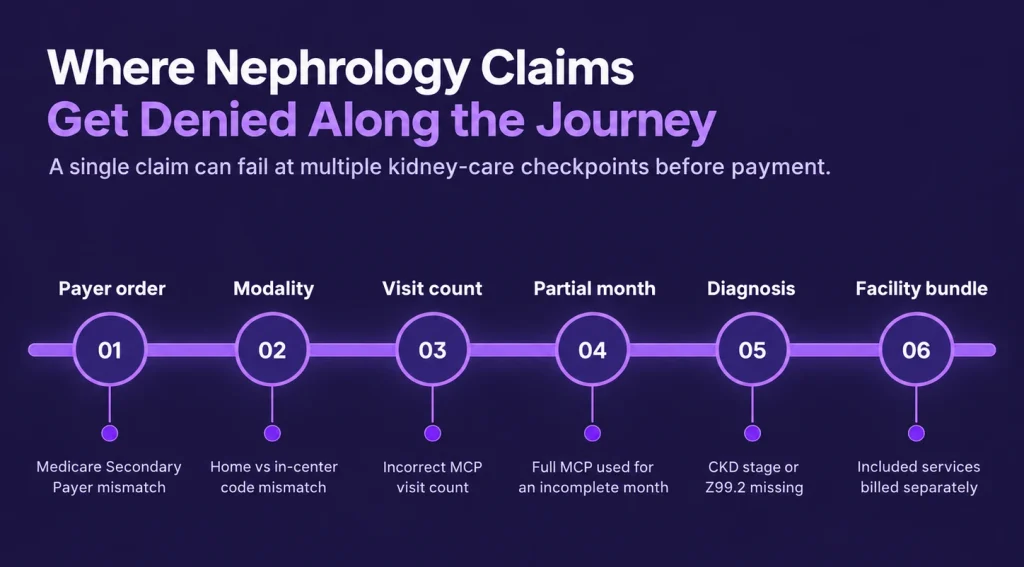
Nephrology denials usually come from a handful of rules that general billing teams rarely see. The table shows the most common patterns, and our guide to common denial codes in medical billing explains the codes payers attach to them.
| Denial Cause | What Goes Wrong | How to Prevent It |
|---|---|---|
| MCP visit count mismatch | The MCP code billed does not match the number of documented face-to-face visits | Track visits per patient per month before billing |
| Wrong code for a partial month | A full MCP code is billed when the patient was hospitalized, transferred or started dialysis mid-month | Use the per-day codes 90967 to 90970 when the month is incomplete |
| Medicare Secondary Payer errors | Medicare is billed first during the 30-month coordination period when an employer plan should pay first | Track each ESRD patient’s coordination period start date |
| Billing items in the facility bundle | Labs or drugs included in the dialysis facility’s ESRD PPS payment are also billed separately | Separate physician services from facility-bundled services |
| CKD stage not specific | Unspecified CKD or missing dialysis status codes | Code the documented stage and add Z99.2 for dialysis dependence |
| Modality mismatch | Home dialysis billed with in-center codes or the reverse | Confirm modality each month |
| Credentialing gaps | A new nephrologist or advanced practice provider bills before enrollment is complete | Finish credentialing and enrollment before the first claim |
Medicare ESRD rules that shape every claim
Medicare coverage based on ESRD usually starts in the fourth month of dialysis, or the first month when the patient trains for home dialysis. For patients with employer group health coverage, Medicare is the secondary payer for a 30-month coordination period, so the employer plan must be billed first. Home dialysis patients can have their monthly visits by telehealth, but they still need a face-to-face visit at least monthly during the first three months of home dialysis and at least once every three months after that.
What Changes for Nephrology Billing in 2027?
Two proposed Medicare rules affect nephrology practices in 2027, and the final versions are expected in November 2026.
ESRD Prospective Payment System (dialysis facilities)
On June 24, 2026, CMS proposed raising the ESRD PPS base rate to $299.55 per treatment for 2027, up from $281.71 in 2026, for an overall payment increase of about 1.1%, according to the CMS fact sheet. The proposal adds $15.96 to the base rate for phosphate binders and estimates that Medicare will pay about $6.2 billion to roughly 7,600 dialysis facilities. Becker’s Hospital Review reported that CMS also proposed raising the low-volume adjustment threshold from 4,000 to 8,000 treatments with six payment tiers and increasing the home and self-dialysis training add-on from $95.60 to $138.22.
Physician Fee Schedule (nephrologists)
For physician services, the proposed 2027 fee schedule would lower the conversion factor to $32.84 for most physicians, turn the G2211 add-on into a modifier worth 16% of the E/M payment (32% for certain ACO participants) and limit remote patient monitoring billing to a practice’s own clinical staff, as Penn State’s rural health office summarized. Nephrology practices that bill CKD office visits and remote monitoring should plan for both changes.
How We Ranked These Nephrology Billing Companies
Each company was scored on six criteria using information it publishes or that independent sources report. Performance claims that could not be checked are labeled as the company’s own figures.
| Criterion | Weight | What We Looked For |
|---|---|---|
| Nephrology and ESRD expertise | 25% | MCP, home dialysis, partial-month and vascular access billing, not just a specialty listing |
| Full revenue cycle coverage | 20% | Eligibility, coding, claims, payment posting, denials, A/R and credentialing |
| Pricing transparency | 15% | Published pricing or a clearly explained model |
| Fit for independent practices | 15% | Services sized for solo to mid-size nephrology groups |
| EHR flexibility | 15% | Works with the practice’s current EHR or requires a switch |
| Verifiable proof | 10% | Certifications, published results or independent sources |
The 10 Best Nephrology Medical Billing Companies in the USA
1. iSolve RCM: Best Overall for Independent and Growing Nephrology Practices
iSolve RCM offers nephrology medical billing services among 50+ specialties that it offers and have qualified team and staff that handles every specialty separately. It ranks first because it covers the full nephrology revenue cycle, from eligibility and MSP coordination to credentialing, at a published starting price of 2.99% of monthly collections listed on its pricing page, and it works inside the EHR a practice already uses.
How iSolve handles nephrology billing. Kidney care revenue depends on getting the same monthly patterns right for every dialysis patient. iSolve’s workflow is built around them:
| Nephrology Need | How iSolve RCM Handles It |
|---|---|
| Monthly capitation billing | MCP codes matched to the patient’s age group and documented face-to-face visit count every month |
| Partial months | Per-day codes when patients are hospitalized, transfer or start dialysis mid-month |
| Home dialysis | Home MCP codes, telehealth visit rules and the required in-person visit schedule tracked per patient |
| Medicare Secondary Payer | 30-month coordination periods tracked so the right payer is billed first, supported by eligibility verification |
| Vascular access and procedures | Dialysis circuit codes reviewed for bundling and documentation |
| CKD and transplant office visits | Stage-specific CKD coding, G2211 tracking and readiness for the proposed 2027 modifier |
| Denials and aging A/R | Root-cause denial management and A/R follow-up before filing deadlines pass |
| New nephrologists and APPs | Payer credentialing and enrollment handled by the same team |
Services included. iSolve covers medical billing, A/R management, medical coding, medical billing audit, provider credentialing and denial management, with HIPAA-compliant processes and a signed business associate agreement. Practices can use the full service or start with one piece, such as a billing audit.
Onboarding. iSolve reports a typical onboarding time of one to two weeks, depending on practice size, billing system and claim volume. Because it works within the existing EHR, nephrologists do not need to change software.
Reported results. iSolve reports a net collection rate of 95% or higher, a 99% claim accuracy rate and a 35% decrease in days in A/R for its clients. These are the company’s own figures; ask for results from nephrology clients during evaluation.
Pricing. Medical billing starts at 2.99% of monthly collections, with no hidden fees, below the 4% to 7% range many practices see in the market, as explained in our guide to average medical billing collection rates.
Best for: Independent nephrology practices and growing kidney care groups that want full-service billing at a known price without changing their EHR.
Keep in mind: iSolve is a billing service, not a software vendor. Practices that want a nephrology-specific EHR should also look at Acumen.

2. MBW RCM: Best for Large Nephrology Groups
MBW RCM offers nephrology medical billing services among 29 specialties. It reports more than 1,500 team members, sales and delivery offices in the US and India, ISO 9001 and ISO 27001 certifications and a SOC 2 Type II audit.
Best for: Large nephrology groups and MSOs that want offshore scale with documented security controls.
Keep in mind: MBW is built for scale. Smaller practices should ask how much dedicated attention their account will receive.
3. Acumen Physician Solutions: Best Nephrology-Specific EHR
Acumen offers an EHR built for nephrology on the Epic platform, with practice management and revenue cycle tools designed for MCP and CKD billing. InterWell Health, a kidney care provider, acquired Acumen from Fresenius Medical Care North America, and more than 2,000 kidney care providers have implemented its Acumen Epic Connect platform, according to Levin Associates.
Best for: Nephrology practices that want clinical documentation and billing tools designed for kidney care.
Keep in mind: Acumen is software first. Practices that want a team to work claims daily may pair it with a billing service.
4. Transcure: Best for Multi-Location Groups
Transcure provides end-to-end revenue cycle management and publishes a guide to nephrology medical billing services, with a stated focus on ESRD billing, prior authorizations and denial management.
Best for: Larger and multi-location nephrology groups.
Keep in mind: Single-site practices should confirm how support scales for lower claim volumes.
5. Practolytics: Best for One Vendor Across Several Services
Practolytics offers nephrology billing services for dialysis centers, CKD practices and ESRD groups as part of a broader revenue cycle outsourcing platform.
Best for: Practices that want billing, coding and related services from one vendor.
Keep in mind: Ask for references from nephrology clients specifically.
6. I-Med Claims: Best for Fast Denial Turnaround
I-Med Claims provides nephrology revenue cycle management with billing analysis and denial management, and it states a claims follow-up window of 24 to 48 hours.
Best for: Practices whose main problem is slow denial follow-up.
Keep in mind: Confirm reporting frequency and format before signing.
7. MediBillMD: Best Complete Outsourced Package
MediBillMD offers a full set of nephrology billing services aimed at accurate claim submission and revenue cycle optimization for kidney care practices, as described in its nephrology billing overview.
Best for: Practices that want a comprehensive outsourced service.
Keep in mind: Ask about the account management structure and escalation paths.
8. eClaim Solution: Best for Multi-State Practices
eClaim Solution offers nephrology billing and coding with attention to state-specific payer policies, code updates and modifier use.
Best for: Nephrology practices billing across several states.
Keep in mind: Request sample reports before signing.
9. CureMD: Best for an Integrated Platform
CureMD combines an EHR and practice management platform with billing services, supporting nephrology workflows inside one system.
Best for: Practices open to switching to an integrated EHR and billing platform.
Keep in mind: Practices on another EHR must weigh the cost of a platform change.
10. Sirius Solutions Global: Best for Automation-Led Billing
Sirius Solutions Global markets nephrology billing that combines automated claim scrubbing with certified billing staff, with a strong Texas presence.
Best for: Practices comfortable with an automation-heavy model.
Keep in mind: Ask how automated decisions are reviewed by a human coder before submission.
How to Choose a Nephrology Billing Company
Use these questions to compare any nephrology billing service:
| Question | A Strong Answer Includes |
|---|---|
| How do you track MCP visit counts? | A monthly reconciliation of documented visits per patient before billing |
| How do you handle partial months? | Clear rules for per-day codes after hospitalizations, transfers and new starts |
| How do you manage Medicare Secondary Payer? | Tracking of each patient’s 30-month coordination period |
| Do you bill home dialysis correctly? | Home MCP codes plus tracking of required in-person visits |
| Are you ready for 2027? | A plan for the G2211 modifier, the conversion factor change and RPM rules |
| What is your pricing? | A written rate with denial work, A/R and credentialing scope spelled out |
| Do we have to change our EHR? | A clear answer, ideally working within your current system |
What Are the Top Medical Billing Companies in the USA?
It depends on who is asking. Hospitals and health systems usually work with enterprise firms such as R1 RCM and Ensemble Health Partners. Physician practices, including nephrology groups, are better served by companies that know their specialty and can work in their existing systems, such as the ten on this list. For nephrology, the top five here are iSolve RCM, MBW RCM, Acumen Physician Solutions, Transcure and Practolytics.
What Are the Leading Dialysis Companies in the USA?
DaVita and Fresenius Medical Care are the two largest dialysis providers in the USA by a wide margin. The country has more than 7,500 dialysis clinics, and Fresenius held about 37% of the market by patients served, according to Stout’s 2025 kidney care industry outlook. Other major operators include U.S. Renal Care, Innovative Renal Care (formerly American Renal Associates) and Dialysis Clinic, Inc., the largest nonprofit provider. Most nephrologists bill MCP services for patients treated in these companies’ clinics, so clean coordination with each facility matters.
What Is the Highest Paying Medical Billing Job?
Leadership and audit roles pay the most. Revenue cycle directors and managers, practice managers and certified auditors earn well above general billers and coders. AAPC’s 2026 salary survey found that credentialed medical records specialists averaged $65,007 in 2025, with specialty credentials such as risk adjustment and auditing earning more, as Judge Group summarized. Nephrology coders who master MCP, dialysis and vascular access coding are also in demand.

Frequently Asked Questions
What is the best nephrology medical billing company in the USA?
iSolve RCM ranks first for independent and growing nephrology practices because it covers the full kidney care revenue cycle at a published starting price of 2.99% of collections and works with the existing EHR. Large groups may prefer MBW RCM, and practices wanting nephrology-specific software may prefer Acumen.
What are the top 10 nephrology billing companies?
This guide ranks iSolve RCM, MBW RCM, Acumen Physician Solutions, Transcure, Practolytics, I-Med Claims, MediBillMD, eClaim Solution, CureMD and Sirius Solutions Global, based on nephrology expertise, revenue cycle coverage, pricing transparency, fit for independent practices, EHR flexibility and verifiable proof.
What does a nephrology billing company do?
It manages the kidney care revenue cycle: eligibility and Medicare Secondary Payer checks, coding of MCP, dialysis, vascular access and office services, claim submission, payment posting, denial management, A/R follow-up and often credentialing.
What are MCP codes in nephrology?
MCP codes (90951 to 90962) are monthly codes nephrologists use to bill ESRD dialysis management. The code depends on the patient’s age and the number of face-to-face visits that month, with separate codes for home dialysis and per-day codes for partial months.
Why should a nephrology practice outsource billing?
Nephrology billing combines monthly capitation rules, Medicare Secondary Payer coordination and facility bundling that general billers rarely see. A specialty billing partner reduces avoidable denials and keeps monthly claims consistent.
How much do nephrology billing services cost?
Most companies charge a percentage of collections, commonly around 4% to 7%, depending on claim volume and services. iSolve RCM starts at 2.99% of monthly collections. Compare what each rate includes.