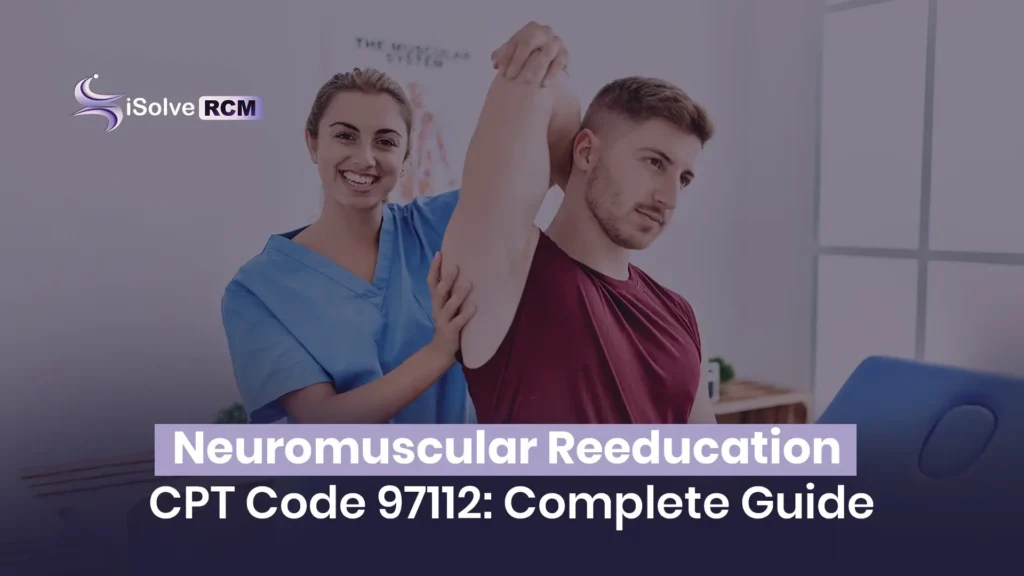

Neuromuscular reeducation is one of the essential components in physical therapy to regain the best movement patterns, awareness, and balance following an injury or neurological impairment. Proper coding of such services guarantees compliance and proper reimbursement, and so understanding of CPT code for neuromuscular reeducation is crucial to clinicians, therapists and billing personnel.
CPT code 97112 is a specific code that is used in the documentation of neuromuscular reeducation procedures, which are standardized to make insurance claims and medical records. Knowledge about the clinical reason, the specifics of billing, and the correct use of this code is likely to maximize the number of patients cared about and comply with insurance policies.
The main purpose of this blog is to explore all aspects of the neuromuscular reeducation CPT code 97112 that cover clinical use, procedural guidelines, and billing best practices commonly handled by medical coding services teams.
Overview of CPT Code 97112
Neuromuscular reeducation performed with licensed healthcare providers, which are normally physical therapists, is assigned CPT code 97112. Such code encompasses therapeutic interventions that enhance balance, coordination, posture and proprioception.
Practically, procedure code 97112 is employed to deal with the neuromuscular impairments caused by injury, surgery, or by neurological diseases. When properly utilized, it ensures the accuracy of billing and helps to establish medical necessity for insurance claims, in line with best practices adopted by medical billing services in the USA.
Clinical Purpose of Neuromuscular Reeducation
Neuromuscular reeducation involves re-training of the nervous system and muscular activity and is aimed at the recovery of efficient, coordinated patterns of movement. This is necessary among the patients who have gone through orthopedic or neurological conditions.
- Enhance the balance and coordination among the patients with neurological deficits.
- Improve the postural control following injury or surgery.
- Reinstate normal moving patterns due to musculoskeletal disorders.
- Motor skills and proprioception should be trained to avoid re-injury.
- Support rehabilitation among stroke, spinal cord injured or peripheral nerve injured patients.
Official 97112 CPT Code Description and Time Requirements
The description of the 97112 CPT code is stated as follows: therapeutic procedures aimed at enhancing the state of the neuromuscular system, balance, coordination, kinesthetic sense, posture, and proprioception; all of them, 15 minutes each. This code is used to give a clear guideline on physical therapy documentation and billing.
The physical therapy using 97112 CPT code is important when time tracking is involved. The units will equal 15 minutes of face-to-face intervention. When documentation of the length of a session is done well, then the reimbursement is done accurately and medical necessity is supported.
Therapeutic Application of CPT Code 97112
Neuromuscular reeducation CPT has been extensively used in the rehabilitation environments and is used to restore functional independence. The code is applied by the therapists in cases whereby a structured exercise and interventions are aimed at neuromuscular deficits, especially following orthopedic or neurological occurrences.
The most frequent are balance training, gait retraining, postural stability, and proprioceptive exercises. The billing code 97112 will be an accurate representation of the intensity and concentration of such individualized treatment sessions.
When and How to Use CPT Code 97112
CPT code for neuromuscular reeducation is to be applied in cases when a patient exhibits neuromuscular impairment, which necessitates a specific intervention to enhance balance, coordination, posture, or proprioception. To ensure that the therapy is personalized to fit the functional deficits, clinicians must ensure that the patient has a condition that warrants neuromuscular reeducation and is an individualized therapy. Ordinary conditions involve post-surgical orthopedic rehabilitation, neurological injury, and recovery, balancing, and chronic musculoskeletal conditions that limit movement control.
Procedure of CPT Code 97112
The process of medical code 97112 CPT code physical therapy entails guided, hands-on or structured physical exercises where the neuromuscular system is involved in active activities. Typical steps include:
Assessment
Assess the overall functional fitness of the patient such as balance, coordination, posture, gait, and proprioception.
Planning
Formulate a personalized treatment program that addresses individual neuromuscular impairment, in accordance with quantifiable objectives of treatment.
Intervention
Administer direct individual therapeutic activities, e.g., balance exercises, postural, gait, proprioceptive neuromuscular facilitation, or motor control exercises.
Monitoring and Feedback
Monitor the movement patterns of the patient, correct in real-time, and change exercises to maximize neuromuscular retraining.
Time Tracking
Document therapy should be in 15-minute blocks where every unit should be based on real face-to-face intervention.
Outcome Documentation
Document patient response, progress towards goals and any alterations in functional ability which confirms medical necessity and true billing under procedure code 97112.
Pro Tip: It is imperative to record each step of the CPT code for neuromuscular reeducation, from the assessment stage to the intervention and response of the patient. This should be done using time-stamped 15-minute intervals to ensure that there are no issues with billing.
Services Covered Under CPT Code 97112
CPT code 97112 or neuromuscular reeducation CPT is aimed at covering therapeutic interventions aimed at restoring neuromuscular functioning. Such services are offered usually in one-on-one sessions by licensed physical therapists, occupational therapists or any other qualified healthcare providers. The processes aim at enhancing coordination, balance, posture and motor control to increase functional ability in general.
Like CPT codes for wound care, neuromuscular re-education (CPT 97112) requires careful documentation of each procedure to ensure proper billing and avoid claim denials.
Following are services covered under CPT Code 97112:
Direct Therapeutic Intervention
Procedure code 97112 contains active therapeutic activities or exercises that involve the neuromuscular system of the patient. The interventions are tailored to the diagnosis, functional limitations and rehabilitation objectives of the patient.
The typical interventions are:
Balance and Co-ordination Exercises
Activities that question stability and control in preventing falls and enhancing gait that include standing on uneven surfaces, one leg stance exercise, or dynamic balance exercises.
Proprioceptive Neuromuscular Facilitation (PNF)
Strategies based on stretch patterns and resistance to improve neuromuscular control and help to coordinate movement.
Motor Control Training
Practices to enhance fine movement patterns, muscle activity, and timing of functional activities, such as reaching, lifting and ambulation.
Postural Training
Treatment focused on enhancing core stability, upright position, and spinal position during both the dynamic and static activities.
Gait Training
Retraining walking activities, such as stepping sequence exercises, treadmill-assisted walking, or task-related mobility skills.
Sensory Integration Training Vestibular
Spatial orientation, head and eye coordination, sensory-motor integration exercises are all designed to help patients with neurological or vestibular disorders.
Patient Education and Functional Training
Even though medical code 97112 is used to record mostly physical interventions, effective neuromuscular reeducation is usually supported by structured education to strengthen the therapy objectives.
Training and education can involve:
Instruction in Movement Patterns
Educating patients on how to engage in their daily activities safely including bending, lifting, or turning around given a sitting posture to standing.
Fall Prevention Strategies
Giving advice on the safe home mobility, assistive gadgets utilization, and surrounding changes.
Exercise Home Programs
Individualized exercises are prescribed to keep or improve intersession gains of therapy.
Functional Task Practice
Mimicking real-life tasks, like walking up and down stairs, reaching somewhere high, or resting and holding something, functional independence can be supported.
Self-monitoring and Patient Feedback
Training patients on how to identify the wrong movement patterns and correct them on the spot to avoid injuries and enhance neuromuscular control.
Effective healthcare revenue cycle management ensures that all the services provided in neuromuscular reeducation are properly documented and coded and billed under CPT code 97112.
Benefits and Expected Patient Outcomes
When the code of neuromuscular reeducation CPT is utilized properly, it not only assists in proper billing but in direct patient function, safety, and general rehabilitation improvement. Interventions that are recorded under 97112 CPT code physical therapy are specifically aimed at retraining the neuromuscular system, improving coordination, and achieving functional independence.
Functional Improvement
Patients with procedure code 97112 have shown to have large improvements in movement efficiency and motor control. These improvements include:
- Improved balance and postural stability, enabling patients to perform their daily routine, i.e. walking, climbing stairs or bending without risks.
- Cultivated muscle movements coordination and timing, which provide easier and more controlled functional motions.
- The range of motion and flexibility in the joints is better, which leads to the increased ease of performing complicated tasks.
- Improvement of fine and gross motor skills, especially essential in patients following neurological disorders like stroke, spinal cord injury or peripheral nerve damage.
Reduced Risk of Injury
Among the most essential benefits of neuromuscular reeducation cpt, one may single out the decrease of the risk of injury due to the enhancement of proprioception and body awareness:
- Body awareness and spatial orientation can be improved to avoid falls and accidents, especially in elderly patients or in patients with a lack of vestibular functioning.
- Having the right, corrected movement patterns will minimize unnecessary strains on the joints and soft tissues, and reduce the likelihood of recurrent strain injuries.
- The patients are empowered to correct themselves whenever they engage in wrong movements that reduce reliance on the attendants and enhances safety in their movements.
Accelerated Rehabilitation
Strategic use of the CPT code for neuromuscular reeducation interventions provides the support of quicker recovery and better patient outcomes in the long term:
- Specific exercises facilitate neuroplasticity so that the nervous system is capable of adjusting to injury or neurological disability and compensating.
- Makes individuals restore their functional independence sooner, enabling patients to resume their daily activities, work, or other recreational tasks in a shorter time.
- Promotes self-esteem and encouragement because patients can observe tangible changes in their strength, coordination, and stability.
- Endorses a full rehabilitation program combining neuromuscular reeducation to other therapeutic interventions to achieve maximum recovery.
Enhanced Quality of Life
Neuromuscular reeducation has broader benefits to patients other than the physical effects:
- Higher self-efficacy in the daily activities on their own.
- Increased involvement in social and work activities, which help in emotional and mental well-being.
- Secondary complications, e.g., chronic pain, or loss of functional ability in poor movement patterns, prevented over a long duration.
Pro Tip: Record and document specific progress made in balance, coordination, and functional independence for each session billed using the 97112 CPT code for physical therapy. Emphasize specific patient progress made, such as a decrease in fall risk or an increase in range of motion, to support both patient outcomes and accurate billing. Incorporating these points into your rehabilitation program will enhance your claims and illustrate the actual effect of neuromuscular reeducation.
Claims Documentation Requirement
Neuromuscular reeducation CPT involves proper documentation with detailed records of intervention carried out, time spent with a patient, reaction of the patient and progress. Medical necessity needs specific notes to back up medical claims on insurance.
The therapists have to record the baseline functional status of the patient, the purpose of the session, and the quantifiable results. This makes sure that there are no problems with the payer policies and that the likelihood of claims being rejected in case of applying CPT code for neuromuscular reeducation is low.
Just as accurate coding is necessary in musculoskeletal diagnoses such as right shoulder pain (M25.511), accurate selection of the ICD-10 code is necessary to properly establish medical necessity for neuromuscular reeducation.
General Billing and Coding Errors
Correct coding of the neuromuscular reeducation CPT code can prevent claim denials, reviews, and compliance issues, making outsource medical coding services a valuable asset for healthcare providers. Errors in coding or documentation may lead to either late reimbursement or even fines. The following is a closer examination of the common mistakes and their prevention.
Inaccurate Time Reporting
- Billing for more than one unit of 97112 cpt code without recording therapy in 15 minutes block. One unit is 15 minutes of face-to-face intervention, and thus misreporting of partial units will initiate audits.
- Any increase or decrease of session time during the round-off process, which is not well documented, may lead to overbilling or underbilling.
Incorrect Code Use
- Applying 97112 cpt code to passive treatment types e.g. heat, ultrasound, or electrical stimulation which are not considered to be neuromuscular reeducation interventions.
- General exercise programs that are not specific to neuromuscular deficits should be billed 97112.
Insufficient Documentation
- The inability to write down the baseline functional state of the patient, the type of interventions carried out, and the quantifiable results.
- Absence of specific notes on progression, frequency, or response to treatment.
- Failure to attach the therapy session to a complementing ICD-10 diagnosis code, which may lead to the denial of claims due to the absence of medical necessity.
Upcoding
- Coding more complex codes (e.g., 97530 of therapeutic activities) in case of only the standard neuromuscular reeducation was administered.
- Excessive overstatement of intensity or length to gain higher reimbursement that may lead to compliance audit or recoup.
Duplicate Billing
- Billing more than once with other codes in the same session without sufficient justification 97112 cpt code Multiple overlapping interventions.
- Billing group and individual therapy to the same patient simultaneously and without consent of the payer.
Misconception Therapy Combinations
- Billing 97112 and other codes like therapeutic exercise (97110) on the same therapeutic goal without the documentation of a different objective of each code.
- Lumping the codes when the therapy is a continuous one thus creating the problem of double-billing.
Lack of Time Tracking for Multiple Units
- When billed with more than one unit, failure to record start and end times of each segment of therapy.
- Failure to determine the types of interventions offered as per each 15-minute interval, which is needed in the payer audits.
Unsupported Medical Necessity
- Making claims on behalf of patients who do not exhibit deficits that necessitate neuromuscular reeducation CPT like healthy people who engage in general fitness exercises.
- Providing a vague and generic description of treatment that is insufficient to support the fact that procedure code 97112 is medically necessary.
Compliance and Audit Considerations
Billing code 97112 must be used accurately to be in compliance with insurance and regulation. Audits would be conducted routinely to verify that claims contain information about what was really given out in terms of therapy, time of session and medical necessity.
Having good documentation reduces the chances of rejection or reimbursement and helps in ethical billing. Accurate ICD-10 coding is an essential part of the reimbursement process and compliance, especially in cases such as abnormal weight gain (R63.5), where accurate diagnosis selection is directly related to claim acceptance.
Pro Tip: Keep clear, time-stamped documentation of all 97112 sessions and ICD-10 codes. Regular reviews help stay audit-ready, reduce denials, and ensure ethical billing.
How iSolve RCM Help with CPT Code
In the complicated healthcare system of the present day, it is of critical importance that the medical code 97112 should be properly coded and billed to comply with all requirements, ensure appropriate reimbursement, and provide efficient patient care. iSolve RCM facilitates the process of coding and billing, supporting the required documents to ensure that the case is properly coded and billed to ensure that it can be reimbursed appropriately and patient care is managed effectively.
Their solutions assist in making sure that every time procedure code 97112 is used, proper justification, timing and billing is performed resulting in fewer errors, denials and audit risks. Through the use of iSolve RCM, the clinics and therapists will be able to concentrate on the provision of high-quality neuromuscular reeducation therapy with correct, efficient, and compliant revenue cycle management.