Bill a 200 mg dose of pembrolizumab as 2 units and Medicare pays for 2 mg. The HCPCS code, J9271, is defined per 1 mg, so the correct claim shows 200 units. One missing pair of zeros turns a drug that costs thousands of dollars into a payment for almost nothing, and the error rarely shows up until the remittance arrives.
That is the core risk in oncology billing. Drugs make up most of the revenue on a chemotherapy claim, and their payment depends on getting the units, the National Drug Code, the waste modifiers and the administration codes exactly right. This guide explains how oncology drug units work, what documentation payers expect and the reimbursement errors that cost oncology practices the most.
Quick answer: To bill oncology drugs correctly, divide the dose administered by the dose in the HCPCS code descriptor to get the billing units, report the 11-digit NDC with its unit of measure, use modifier JW for discarded drug from single-dose vials and JZ when nothing was discarded. Bill the chemotherapy administration codes based on documented start and stop times. Medicare pays most Part B drugs at average sales price plus 6%.
Common Oncology Drug Codes and Units
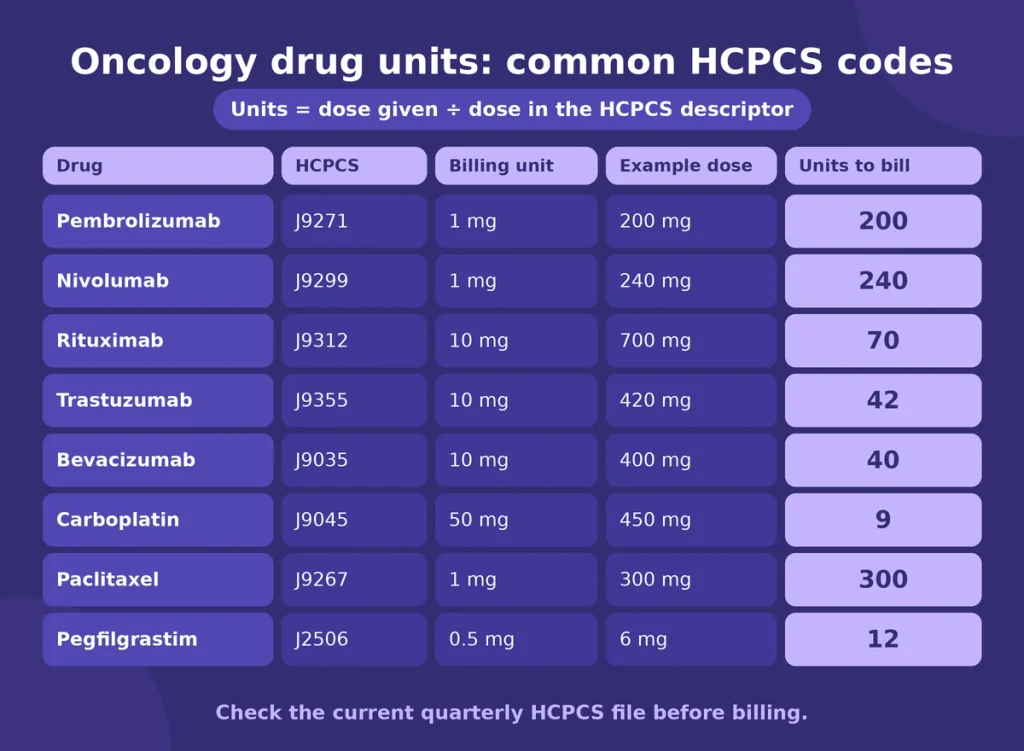
| Drug | HCPCS Code | Billing Unit | Example Dose | Units to Bill |
|---|---|---|---|---|
| Pembrolizumab | J9271 | 1 mg | 200 mg | 200 |
| Nivolumab | J9299 | 1 mg | 240 mg | 240 |
| Rituximab | J9312 | 10 mg | 700 mg | 70 |
| Trastuzumab | J9355 | 10 mg | 420 mg | 42 |
| Bevacizumab | J9035 | 10 mg | 400 mg | 40 |
| Carboplatin | J9045 | 50 mg | 450 mg | 9 |
| Paclitaxel | J9267 | 1 mg | 300 mg | 300 |
| Pegfilgrastim | J2506 | 0.5 mg | 6 mg | 12 |
Source: HCPCS Level II code descriptors. Check the current quarterly HCPCS file, since codes and descriptors change.

What Makes Oncology Billing Different?
Oncology billing combines three things most specialties bill separately: very high-cost drugs, time-based administration codes and complex treatment plans that change from cycle to cycle. A single infusion visit can include an E/M service, several drugs with their own units and NDCs, waste lines, hydration and chemotherapy administration codes. Each drug line is priced by units, so a small error can change payment by thousands of dollars, and payers watch oncology drug claims closely.
| Challenge | Why It Matters |
|---|---|
| High-cost drugs | A unit error on one line can cost more than the rest of the claim combined |
| Prior authorization | Many drugs and regimens need approval for the specific drug, dose and dates |
| NDC reporting | Medicaid and many commercial plans require the NDC on every drug line |
| Waste reporting | Single-dose vials need JW or JZ on Medicare claims |
| Administration hierarchy | Chemotherapy, therapeutic and hydration codes follow ranking and time rules |
| Changing regimens | Dose changes, holds and substitutions must match the order and the authorization |
How Do You Calculate HCPCS Units for Oncology Drugs?
Billing units = dose administered ÷ dose in the HCPCS code descriptor
Read the descriptor every time, because the unit size varies widely: some codes are per 1 mg, others per 10 mg, 50 mg or 0.5 mg. When the dose is not an exact multiple of the billing unit, follow Medicare’s unit instructions (Claims Processing Manual, Chapter 17) and the payer’s own policy. Biosimilars have their own Q-codes, such as the bevacizumab and trastuzumab biosimilars, and each has its own unit size, so a biosimilar cannot be billed under the reference product’s J-code.
Pro Tip: Build a drug master file that lists each drug’s HCPCS code, billing unit, NDCs and package sizes, and have the system calculate units from the dose in the order. Manual unit math is the single most common cause of oncology drug underpayments.
What Are the JW and JZ Modifiers?
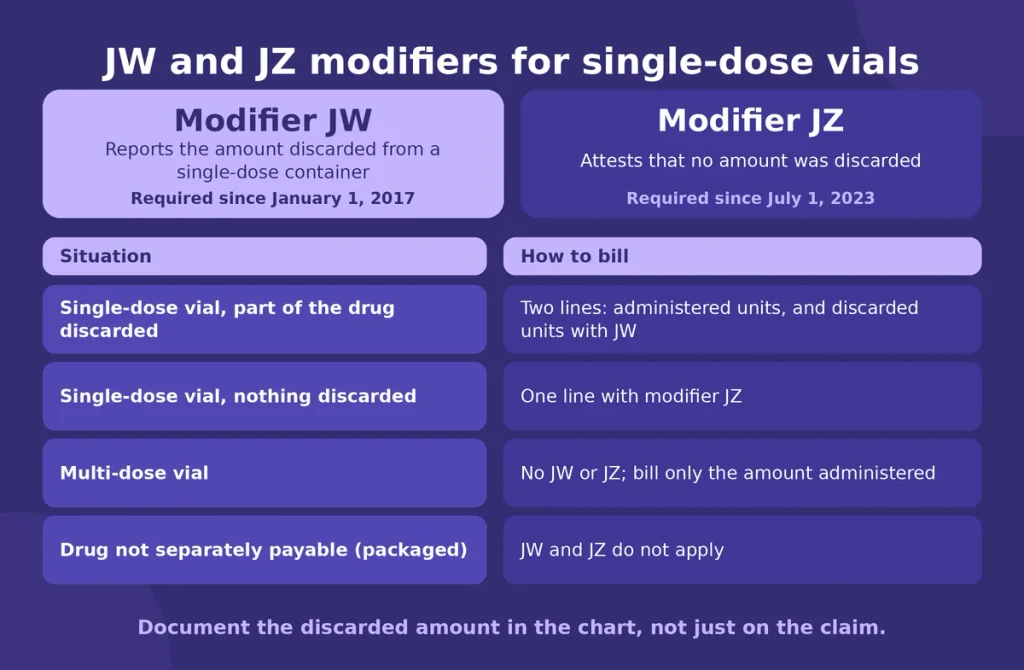
Modifier JW reports the amount of a drug discarded from a single-dose container, and modifier JZ attests that no amount was discarded. Medicare has required JW since January 1, 2017, and has required JZ on claims for single-dose container drugs with no waste since July 1, 2023, according to the CMS JW and JZ modifier FAQs. Claims that omit the modifier can be returned as un-processable.
| Situation | How to Bill |
|---|---|
| Single-dose vial, part of the drug discarded | Two lines: the administered units, and the discarded units with modifier JW |
| Single-dose vial, nothing discarded | One line with modifier JZ |
| Multi-dose vial | No JW or JZ; bill only the amount administered |
| Drug not separately payable (packaged) | JW and JZ do not apply |
Source: CMS FAQs; CMS billing and coding article A53024.
The modifiers also feed a federal refund program. Under the Infrastructure Investment and Jobs Act, manufacturers of certain single-dose container drugs owe refunds to Medicare when discarded amounts exceed 10% of total allowed amounts, as Avalere explains. Documenting the discarded amount in the medical record, not just on the claim, protects the practice on audit.
How Do You Report NDCs on Oncology Drug Claims?
The National Drug Code identifies the exact product and package. On electronic claims, the NDC is reported in 11-digit 5-4-2 format with the N4 qualifier, followed by the unit of measure qualifier (such as UN for unit, ML for milliliter, GR for gram or ME for milligram) and the quantity. Medicaid programs require NDCs on physician-administered drugs, and many commercial plans do as well.
| NDC Element | Example |
|---|---|
| Qualifier | N4 |
| 11-digit NDC (5-4-2) | Add leading zeros so each segment is the right length |
| Unit of measure qualifier | UN, ML, GR or ME |
| NDC quantity | The amount in that unit of measure, which is different from HCPCS billing units |
A common error is copying the HCPCS units into the NDC quantity. A 200-unit J9271 line may correspond to 8 mL of drug, so the NDC quantity must reflect the package measurement, not the HCPCS units.
How Are Chemotherapy Administration Codes Billed?
| Code | Service |
|---|---|
| 96413 | Chemotherapy IV infusion, up to 1 hour, single or initial drug |
| +96415 | Each additional hour of the same chemotherapy infusion |
| +96417 | Each additional sequential infusion of a different drug, up to 1 hour |
| 96409 | Chemotherapy IV push, single or initial drug |
| +96411 | Each additional chemotherapy IV push of a different drug |
| 96401, 96402 | Chemotherapy injection, subcutaneous or intramuscular; hormonal antineoplastic |
| 96365, +96366, +96367, +96375 | Therapeutic, prophylactic or diagnostic infusions and pushes (non-chemotherapy) |
| 96360, +96361 | Hydration infusion, initial and each additional hour |
Source: AMA CPT code set.
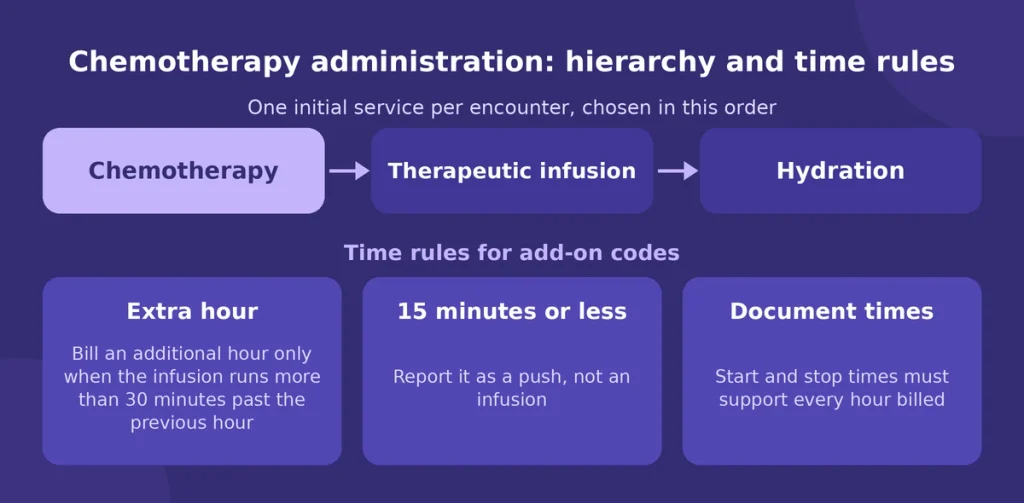
Three rules drive most administration errors. First, only one “initial” service is billed per encounter, chosen by hierarchy: chemotherapy before therapeutic infusions, which come before hydration. Second, time drives the add-on codes: an additional hour is billed only when the infusion runs more than 30 minutes past the previous hour, and an infusion of 15 minutes or less is reported as a push. Third, documented start and stop times must support every hour billed.
What Documentation Supports Oncology Drug Claims?
| Element | What to Record |
|---|---|
| Signed order | Drug, dose, route, frequency and treatment plan |
| Dose basis | Weight or body surface area used to calculate the dose |
| Drug details | Drug name, NDC, lot number and amount administered |
| Waste | Amount discarded from single-dose vials, with the vial size |
| Administration | Start and stop times, route and site for each drug and infusion |
| Supervision | Physician supervision as required for the setting |
| Diagnosis and indication | Diagnosis codes and, where payers require it, line of therapy |
| Authorization | Approval number covering the drug, dose and dates |
How Are Oncology Drugs Reimbursed?
Medicare Part B pays most physician-administered drugs at average sales price (ASP) plus 6%, updated every quarter. Qualifying biosimilars are paid at their own ASP plus 8% of the reference product’s ASP for a period that runs through 2027 under the Inflation Reduction Act. The same law also lowers patient coinsurance in quarters when a drug’s price has risen faster than inflation, and negotiated Medicare prices begin to apply to some Part B drugs in 2028. Commercial plans pay by contract, often as a percentage of ASP or of a fee schedule.
Because payment rates change quarterly, compare every drug payment with the current ASP file or contract rate at posting. An underpayment on a high-cost drug is easy to miss and expensive to leave alone.
What Are the Most Common Oncology Billing Errors?
| Error | What Happens | Fix |
|---|---|---|
| Wrong HCPCS units | Underpayment or overpayment | Calculate units from the descriptor in the drug master file |
| NDC quantity equals HCPCS units | Rejection or denial | Report NDC quantity in the package unit of measure |
| Missing JW or JZ on single-dose vials | Claim returned or denied | Add JZ when no waste; bill waste on a separate JW line |
| Waste billed without documentation | Recoupment on audit | Record the discarded amount in the chart |
| Biosimilar billed under the reference J-code | Denial or incorrect payment | Use the biosimilar’s own Q-code |
| Wrong initial administration code | Underpayment or bundling denial | Apply the chemotherapy, therapeutic, hydration hierarchy |
| Add-on hours not supported by time | Denial or recoupment | Document start and stop times |
| Drug or dose outside the authorization | Authorization denial | Update the authorization when the regimen changes |
| E/M billed without a separate service | Bundling denial | Use modifier 25 only with separate documentation |
| Payment not checked against ASP or contract | Underpayment goes unnoticed | Compare every drug payment at posting |
These usually return as CARC 16, 197 or 97, as our guide to common denial codes in medical billing explains.
How Do Prior Authorization and Oncology Benefits Management Affect Billing?
Many commercial and Medicare Advantage plans use oncology benefits management programs that review chemotherapy and supportive drugs against clinical pathways before approving them. The authorization usually covers a specific drug, dose range, number of cycles and dates, so any change in the regimen needs an updated approval before the claim is billed. CMS has also proposed extending electronic prior authorization requirements to drugs in its proposed CMS-0062-P rule. Verify coverage and benefits before each cycle through eligibility verification.
Which Oncology Billing Metrics Should Practices Track?
| Metric | What It Shows |
|---|---|
| Drug line denial rate | How often drug lines fail, by reason and payer |
| Unit variance rate | Claims where billed units do not match the dose in the order |
| Payment vs ASP or contract | Underpayments on high-cost drugs |
| Authorization turnaround | How long approvals take before treatment can start |
| Waste documentation rate | JW lines with matching chart documentation |
| Patient balance collection | How much patient responsibility is collected on high-cost regimens |
Should You Outsource Oncology Billing?
Outsourcing oncology billing makes sense when drug lines deny for units or NDC errors, when authorizations fall behind regimen changes or when no one checks drug payments against ASP. iSolve RCM’s certified medical coding team reviews drug units, NDCs, waste and administration codes before claims go out, works drug denials through denial management and compares every payment with the expected rate, including for practices that need medical billing services in Texas. Services start at 2.99% of monthly collections.

Frequently Asked Questions
How do you calculate billing units for chemotherapy drugs?
Divide the dose administered by the dose in the HCPCS code descriptor. For example, 700 mg of rituximab billed under J9312 (10 mg) is 70 units.
When do you use the JZ modifier?
On Medicare claims for drugs from single-dose containers when no amount was discarded. It has been required since July 1, 2023.
How does Medicare pay for oncology drugs?
Most Part B drugs are paid at average sales price plus 6%, updated quarterly. Qualifying biosimilars are paid at their ASP plus 8% of the reference product’s ASP through 2027.
What is the difference between HCPCS units and NDC units?
HCPCS units are based on the dose in the code descriptor. NDC units are the quantity in the package’s unit of measure, such as milliliters. They are reported separately and are usually different numbers.
Which code is billed first for chemotherapy administration?
Chemotherapy administration is the initial service when it is given, ahead of therapeutic infusions and hydration, which are reported as subsequent or concurrent services.
What are oncology billing codes?
They include HCPCS J- and Q-codes for drugs, CPT 96401 to 96549 for chemotherapy and infusion administration, E/M codes for visits and ICD-10-CM C and D codes for cancer diagnoses.