

On October 1, 2026, the ICD 10 code most clinics had used for plantar fasciitis for eleven years stopped being billable. M72.2 became a non-billable parent code for plantar fascial fibromatosis, and plantar fasciitis moved to a subcategory of its own, as the 2027 ICD-10-CM tabular listing now shows on their website.
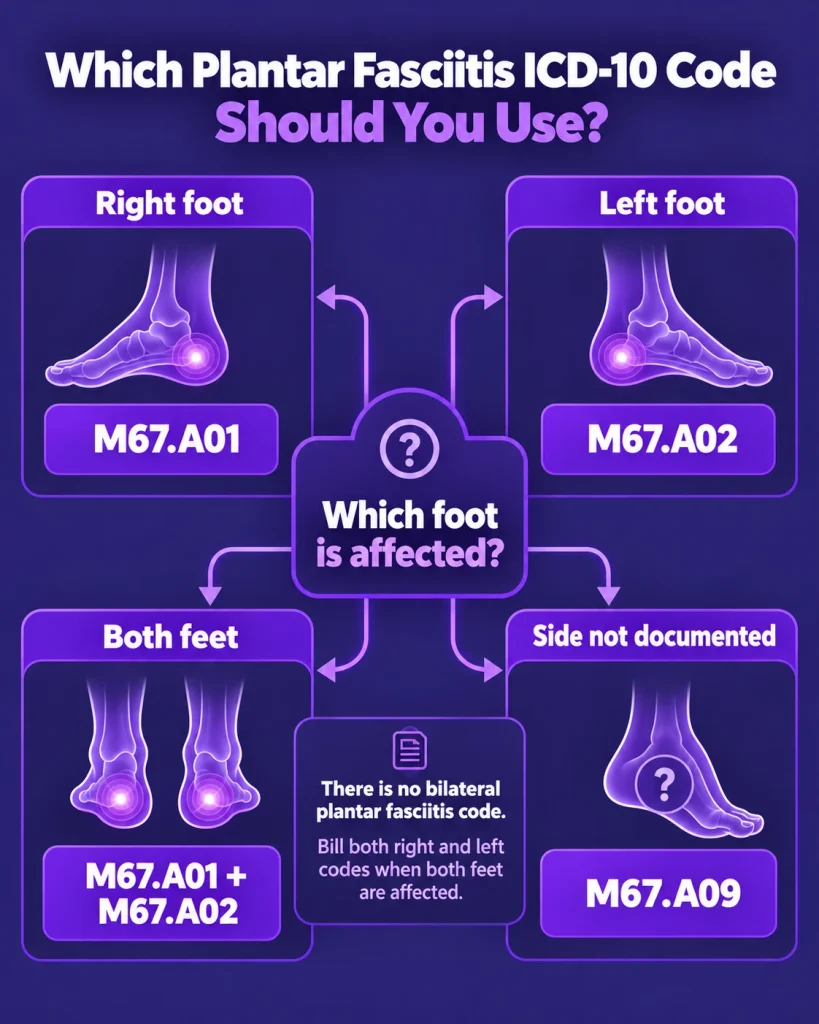
The ICD-10-CM code for plantar fasciitis is M67.A01 for the right foot, M67.A02 for the left foot and M67.A09 when the side is not recorded on the document. These codes apply to dates of service taken on or after October 1, 2026. Claims for earlier dates still use M72.2 as of now.
That is the pattern with this diagnosis. The condition did not change; the classification did. Practices that kept M72.2 in templates, favorites lists or active plans of care are now sending invalid codes, and the new codes add a requirement which the old one never had: laterality. This guide explains the change, how to code every plantar fasciitis scenario while billing this service that goes with it.
What has Changed in Plantar fasciitis Coding in 2027?
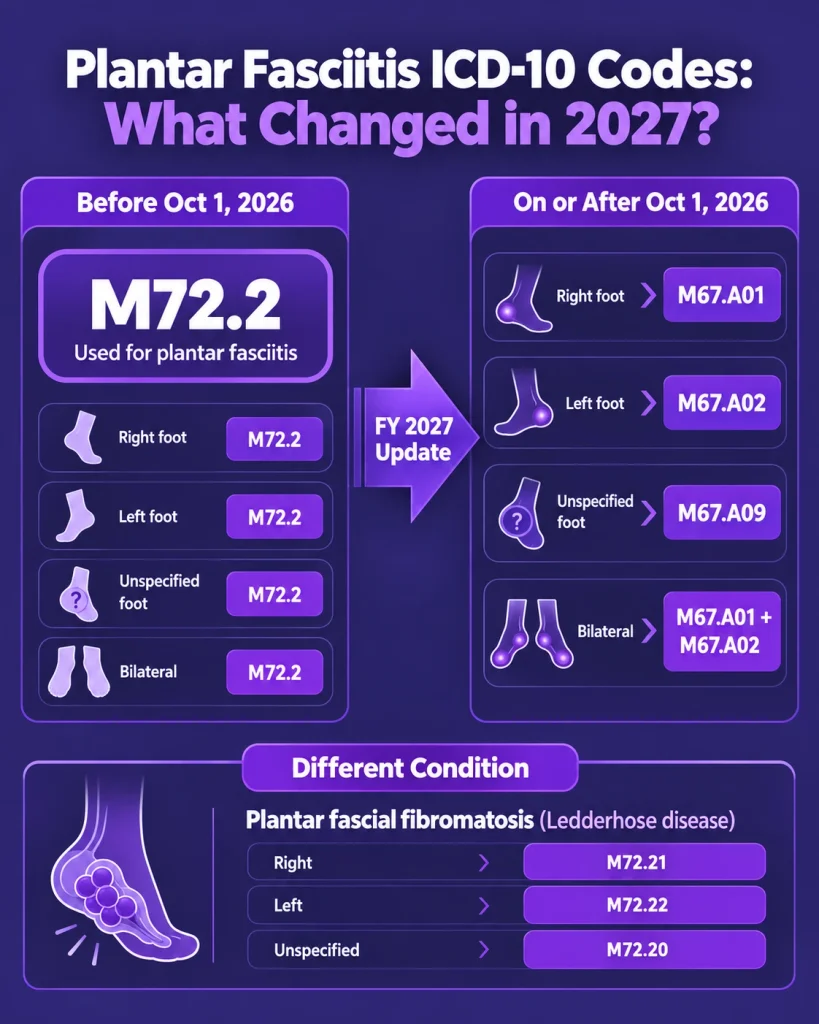
| Documentation | Date of Service Before Oct 1, 2026 | Date of Service On or After Oct 1, 2026 – 2027 |
|---|---|---|
| Plantar fasciitis, right foot | M72.2 | M67.A01 |
| Plantar fasciitis, left foot | M72.2 | M67.A02 |
| Plantar fasciitis, side not documented | M72.2 | M67.A09 |
| Bilateral plantar fasciitis | M72.2 | M67.A01 and M67.A02 |
| Plantar fascial fibromatosis (Ledderhose disease) | M72.2 | M72.21 right, M72.22 left, M72.20 unspecified |
Source: ICD10Data 2027 M67 listing; ICD10Data 2027 M72.2.
What Is the ICD-10 Code for Plantar Fasciitis?
Plantar fasciitis is coded in subcategory M67.A, Plantar fasciitis, under category M67, Other disorders of synovium and tendon. The billable codes are M67.A01 (plantar fasciitis, right foot), M67.A02 (plantar fasciitis, left foot) and M67.A09 (plantar fasciitis, unspecified foot). The code M72.8, Other fibroblastic disorders, now carries an Excludes1 note pointing plantar fasciitis to M67.A0-, according to published ICD10Data.
| Code | Description | Billable |
|---|---|---|
| M67.A | Plantar fasciitis | No (subcategory) |
| M67.A0 | Plantar fasciitis, foot | No (subcategory) |
| M67.A01 | Plantar fasciitis, right foot | Yes |
| M67.A02 | Plantar fasciitis, left foot | Yes |
| M67.A09 | Plantar fasciitis, unspecified foot | Yes |
Why Did the Plantar Fasciitis Code Change in FY 2027?
Since ICD-10-CM began in October 2015, the Alphabetic Index sent plantar fasciitis to M72.2, Plantar fascial fibromatosis, a fibrotic disorder of the same tissue but a different condition. The FY 2027 update separated them. M72.2 became a parent code for plantar fascial fibromatosis with three laterality codes, and plantar fasciitis received the new M67.A subcategory. The NCHS conversion table maps all six new codes back to M72.2, as Orion’s summary of the FY 2027 changes notes.
The financial year 2027 code set applies to all HIPAA covered transactions, not only Medicare and Medicaid, so every payer moved to the new codes on the same day. The code follows the date of service and a visit on September 30, 2026 uses M72.2, and a visit on October 1, 2026 uses M67.A0-, even inside the same episode of care.
What Is the ICD-10 Code for Bilateral Plantar Fasciitis?
There is no single bilateral code for plantar fasciitis. When both feet are affected, report both M67.A01 and M67.A02. ICD-10-CM guidelines direct coders to assign separate codes for the right and left sides when a condition is bilateral and the classification has no bilateral code.
What Is the ICD-10 Code for Plantar Fasciitis, Unspecified?
M67.A09, plantar fasciitis, unspecified foot, is used when the record does not state which foot is affected. It is billable, and plantar fasciitis NOS falls here. But it should be rare: the side is almost always known at the visit, and many payers question unspecified laterality on claims for treatments such as injections or orthotics. If the note is silent on the side, query the provider.
Is There an ICD-10 Code for Chronic Plantar Fasciitis?
No. ICD-10-CM does not separate acute and chronic plantar fasciitis, so chronic plantar fasciitis uses the same M67.A0- codes. Chronicity still matters in the record. Payers often require documentation of how long symptoms have lasted and which conservative treatments failed before they cover procedures such as extracorporeal shock wave therapy or surgery.
What Is Plantar Fasciitis?
Plantar fasciitis is pain and irritation of the plantar fascia, the thick band of tissue that runs along the bottom of the foot from the heel bone to the toes. It typically causes sharp heel pain with the first steps in the morning or after rest. StatPearls describes it as the most common cause of heel pain in outpatient care, as its clinical overview explains. Risk factors include running and prolonged standing, obesity, tight calf muscles and flat or high-arched feet.
What does plantar fasciitis mean?
The term breaks down into plantar (the sole of the foot), fascia (a band of connective tissue) and -itis (inflammation). Research suggests the condition is often degenerative rather than purely inflammatory, which is why some clinicians prefer the term plantar fasciopathy.
What Is Another Name for Plantar Fasciitis?
Plantar fasciitis is also called plantar fasciopathy, plantar fasciosis and, informally, policeman’s heel or jogger’s heel. For coding, the term in the record matters less than the condition it describes: when the provider documents plantar fasciitis by any of these names, it codes to M67.A0- with the right laterality. If the documentation is unclear, check the Alphabetic Index or query the provider.
What’s the Difference Between Plantar Fascia and Plantar Fasciitis?
The plantar fascia is the anatomy: the band of tissue that supports the arch of the foot. Plantar fasciitis is the condition: pain and tissue changes in that band. A second condition of the same tissue, plantar fascial fibromatosis or Ledderhose disease, involves firm nodules in the fascia and now has its own codes.
| Plantar Fasciitis | Plantar Fascial Fibromatosis | |
|---|---|---|
| Also called | Plantar fasciopathy, policeman’s heel | Ledderhose disease |
| Typical finding | Heel pain, worst with first steps | Firm nodules in the arch |
| Codes from Oct 1, 2026 | M67.A01, M67.A02, M67.A09 | M72.21, M72.22, M72.20 |
| Code before Oct 1, 2026 | M72.2 | M72.2 |
Which Related Diagnosis Codes Are Used With Heel Pain?
Plantar fasciitis is often documented with, or confused with, other heel and foot conditions. Code each one only when the provider documents it.
| Condition | ICD-10-CM Code | Note |
|---|---|---|
| Calcaneal (heel) spur | M77.3- (M77.31 right, M77.32 left) | Code separately only if documented; a spur alone is not plantar fasciitis |
| Achilles tendinitis | M76.6- (M76.61 right, M76.62 left) | Posterior heel pain rather than plantar heel pain |
| Tarsal tunnel syndrome | G57.5- | Nerve entrapment; includes a bilateral code |
| Plantar fascial fibromatosis | M72.2- (M72.21, M72.22, M72.20) | Nodular disorder, not plantar fasciitis |
What CPT Codes Are Billed With Plantar Fasciitis?
Treatment for plantar fasciitis ranges from office visits and therapy to injections and, rarely, surgery. These are the codes most often paired with M67.A0-:
| Service | Code | Billing Note |
|---|---|---|
| Office visit | 99202 to 99215 | Separate E/M with an injection needs modifier 25 and a separately documented problem |
| Injection of plantar fascia | 20550 | Single tendon sheath or ligament, aponeurosis (plantar fascia); report the drug separately |
| Strapping of the foot | 29540 | Strapping, ankle and/or foot |
| Physical therapy | 97110, 97140, 97530 | Therapeutic exercise, manual therapy and therapeutic activities, billed in timed units |
| Orthotic management and training | 97760 | Initial orthotic encounter |
| Custom foot orthotic | L3000 | Custom molded foot insert; coverage varies widely by plan |
| Extracorporeal shock wave therapy | 28890 | High energy, requiring anesthesia other than local; often a coverage question |
| Plantar fascia release | 28060, 29893 | Partial plantar fasciectomy; endoscopic plantar fasciotomy |
Source: AMA CPT code set; HCPCS Level II. Check payer policy for ESWT and orthotics before scheduling.
What Documentation Supports a Plantar Fasciitis Claim?
| Element | Why It Matters |
|---|---|
| Laterality | The new codes require right, left or unspecified; both feet need both codes |
| Onset and duration | Supports medical necessity and coverage for procedures |
| Exam findings | Tenderness at the medial calcaneal tubercle, first-step pain and other findings support the diagnosis |
| Conservative treatment history | Stretching, orthotics, therapy or medication tried before procedures |
| Procedure details | Injection site, drug and dose, or the procedure performed and its approach |
| Plan of care | Goals and expected duration for therapy episodes |
What Are the Most Common Plantar Fasciitis Billing Errors?
| Error | What Happens | Fix |
|---|---|---|
| M72.2 billed for dates on or after Oct 1, 2026 | Claim rejected for an invalid diagnosis code | Update templates, favorites and active plans of care |
| One side coded for a bilateral condition | Treatment of the other foot is unsupported | Report both M67.A01 and M67.A02 |
| Unspecified foot used by habit | Payer scrutiny or denial on procedures | Document and code the side |
| Fibromatosis coded instead of fasciitis | Diagnosis does not match the treatment | Use M72.2- only for Ledderhose disease |
| Heel spur coded as the primary reason for fasciitis treatment | Diagnosis does not support the service | Code the condition being treated |
| E/M with modifier 25 on routine injection follow-ups | Bundling denial | Bill E/M only for a separate problem |
An invalid or unsupported diagnosis usually shows up as CARC 16 or CARC 11 on the remittance, as our guide to common denial codes in medical billing explains.
How Should Practices Update Plantar Fasciitis Claims After October 1, 2026?
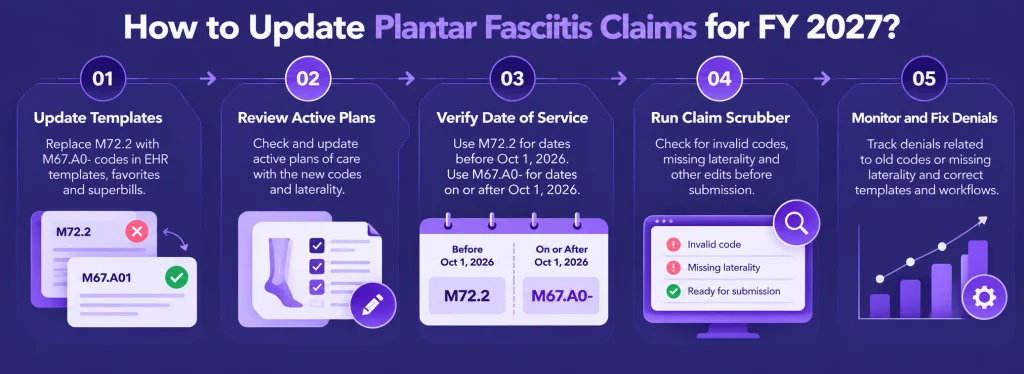
The remap is small, but stale codes hide in predictable places. Work through each one:
| Where M72.2 Hides | What to Do |
|---|---|
| Documentation templates and favorites lists | Replace M72.2 with M67.A01, M67.A02 and M67.A09 |
| Active plans of care that crossed October 1 | Update the diagnosis for every visit on or after October 1 |
| Claims waiting in the queue | Recode any claim with a date of service on or after October 1 |
| Claim scrubber rules | Add an edit that blocks M72.2 for new dates of service |
| Superbills and paper forms | Reprint with the new codes |
How Can iSolve RCM Help With Plantar Fasciitis Billing?
iSolve RCM updates diagnosis code mappings when the code set changes, so podiatry, orthopedic and physical therapy claims carry the right plantar fasciitis code and laterality from the first visit. Our certified medical coding team reviews injections, orthotics and procedures against payer policy, and our medical billing audit catches code set errors before payers do, starting at 2.99% of monthly collections.

Frequently Asked Questions
Is M72.2 still a valid code for plantar fasciitis?
Not for dates of service on or after October 1, 2026. M72.2 is now a non-billable parent code for plantar fascial fibromatosis. Use M67.A01, M67.A02 or M67.A09 for plantar fasciitis.
What is the ICD-10 code for plantar fasciitis of the right foot?
M67.A01, plantar fasciitis, right foot, for dates of service on or after October 1, 2026.
What is the ICD-10 code for plantar fasciitis of the left foot?
M67.A02, plantar fasciitis, left foot, for dates of service on or after October 1, 2026.
What diagnosis code is used for plantar fasciitis when the side is unknown?
M67.A09, plantar fasciitis, unspecified foot. Query the provider when possible, because many payers question unspecified laterality.
How do I code plantar fasciitis in both feet?
Report both M67.A01 and M67.A02, because there is no bilateral plantar fasciitis code.
Does the new code affect claims for visits before October 1, 2026?
No. The code set follows the date of service, so visits on or before September 30, 2026 still use M72.2, including corrected claims for those dates.