

This statistic reflects the level of improper payments made for podiatric services under Medicare Part B: The estimated improper payment rate in 2024 is 11.2%, equating to an amount exceeding $216.9 million, with inadequate documentation accounting for 76.4% of such errors, as stated by CMS Medicare Learning Network podiatry compliance tip.
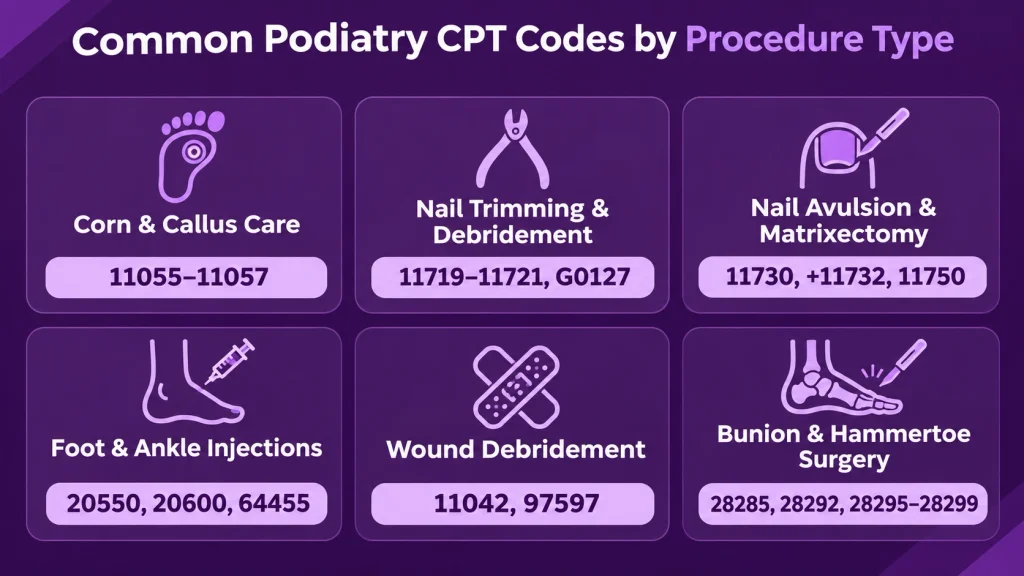
CPT and HCPCS Level II podiatry codes represent procedures for foot and ankle treatment, including routine foot care (11055 to 11057, 11719, 11720, 11721 and G0127), nail procedures (11730 to 11750), injections (20550, 20600, 64455), wound debridement (11042, 97597) and foot surgery (28001 to 28899). For 2027, accurate coding of global periods is critical for reimbursement purposes since Medicare will pay the lesser valued service at 80 percent when an office visit with modifier 25 occurs on the same day as a 0-day global procedure.
Let’s break down the podiatry coding cheat sheet with global periods, Medicare routine foot care regulations, key podiatry CPT codes and modifiers impacting payment determinations, and the latest updates affecting podiatry more significantly than any other specialty beginning in 2027.
What are podiatry CPT codes?
CPT codes for podiatry services indicate the procedures offered to patients by podiatrists or other eligible healthcare practitioners, including nail treatments, skin lesion excisions, corn or callus debridement, hammertoe straightening, bunion removal, flatfoot correction and diabetic foot treatment. These codes consist mainly of the following groups: routine foot care, nails, injections, wound treatment, foot and ankle surgery, and office consultations. HCPCS Level II codes include additional procedures like G0127 for dystrophic nail trimming, G0245-G0247 for LOPS associated with diabetes mellitus, and A5500-A5514 for diabetic footwear and shoe modifications.
Coding podiatry differs significantly from other specialties due to Medicare statutory prohibition against coverage of routine podiatry care. Most commonly billed podiatry CPT codes do not qualify for Medicare payments. Instead, the codes require an exception to coverage based on the diagnosis or examination results. The appropriate use of modifiers becomes equally important along with the CPT code in ensuring proper reimbursement.
Podiatry coding cheat sheet with 2027 global periods
This podiatry coding cheat sheet adds the column most cheat sheets leave out: the Medicare global period, which decides whether the 2027 same-day reduction applies.
| Code | Service (plain language) | Global | 2027 same-day E/M-25 reduction? |
|---|---|---|---|
| 11055 / 11056 / 11057 | Paring of benign hyperkeratotic lesions (corns, calluses): 1, 2 to 4, more than 4 | 000 | Yes |
| 11719 | Trimming of non-dystrophic nails, any number | 000 | Yes |
| G0127 | Trimming of dystrophic nails, any number | 000 | Yes |
| 11720 / 11721 | Debridement of nails: 1 to 5, 6 or more | 000 | Yes |
| 11730 / +11732 | Nail avulsion, simple: first nail, each additional | 000 / ZZZ | Yes (11730) |
| 11750 | Excision of nail and nail matrix (permanent removal) | 010 | No |
| 11042 / 97597 | Debridement: subcutaneous tissue / selective, first 20 sq cm | 000 | Yes |
| 20550 | Injection, tendon sheath, ligament or aponeurosis (plantar fascia) | 000 | Yes |
| 20600 / 20604 | Injection or aspiration, small joint, without / with ultrasound | 000 | Yes |
| 64455 | Injection, plantar common digital nerve (Morton’s neuroma) | 000 | Yes |
| 64632 | Neurolytic destruction, plantar common digital nerve | 010 | No |
| 17110 | Destruction of benign lesions such as warts, up to 14 | 010 | No |
| 28285 | Hammertoe correction | 090 | No (decision for surgery uses 57) |
28292, 28295–28299 | Hallux valgus (bunion) correction | 090 | No (decision for surgery uses 57) |
| 29540 / 29580 | Strapping of ankle or foot / Unna boot | 000 | Yes |
Confirm each global indicator in the 2027 Medicare physician fee schedule before building charge rules, since a single changed indicator moves a code in or out of the 2027 reduction.
When does Medicare cover routine foot care?
Medicare covers routine foot care only as an exception to the statutory exclusion, most often when a systemic condition such as diabetes or peripheral vascular disease makes foot care by a non-professional unsafe. The Medicare Benefit Policy Manual, Chapter 15, Section 290 defines routine foot care as cutting or removing corns and calluses, trimming or debriding nails and other hygienic care, and lists the exceptions.
Conditions typically coded as systemic diseases leading to the loss of use include diabetes mellitus, arteriosclerosis obliterans, Buerger’s disease, chronic thrombophlebitis and peripheral neuropathy due to underlying disorders including malnutrition, alcoholism, multiple sclerosis or uremia.
What are Class A, B and C findings?
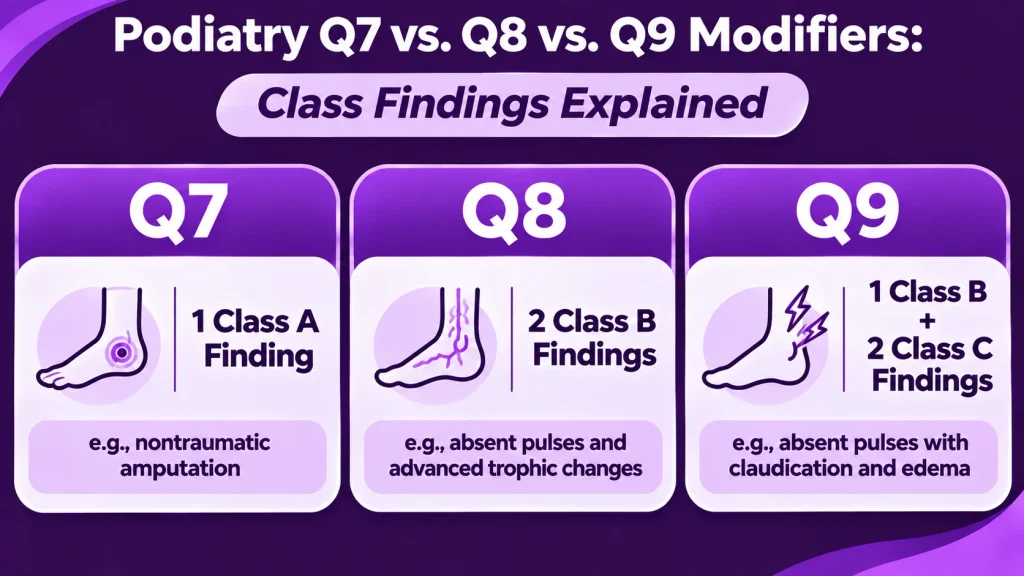
Class findings are the physical signs of severe peripheral involvement that create a presumption of coverage for routine foot care. Noridian’s routine foot care billing and coding article lists them as follows:
| Class | Findings |
|---|---|
| Class A | Nontraumatic amputation of the foot or an integral skeletal portion of the foot |
| Class B | Absent posterior tibial pulse; absent dorsalis pedis pulse; advanced trophic changes (3 required, such as decreased or absent hair growth, nail thickening, pigmentary changes, skin texture changes or skin color changes) |
| Class C | Claudication; temperature changes such as cold feet; edema; paresthesias; burning |
The findings appear in the note for each date of service, not just in the patient’s first visit.

How do the Q7, Q8 and Q9 modifiers work?
Q7, Q8 and Q9 tell Medicare which class findings support the routine foot care claim. Q7 means one Class A finding. Q8 means two Class B findings. Q9 means one Class B finding and two Class C findings. Novitas’s routine foot care billing article requires the matching Q modifier when routine foot care meets an exclusion exception through class findings.
Documentation is key: A Q8 claim with a note that says “pulses diminished” fails. Q8 needs two absent pulses, or one absent pulse plus advanced trophic changes, stated in exactly those terms.
How often does Medicare pay for routine foot care?
Most Medicare contractors consider covered routine foot care medically necessary once every 60 days, though each MAC sets the interval in its own LCD. Palmetto GBA, for example, states that routine foot care services are medically necessary one time in 60 days. Check your MAC’s LCD and count the days from the last paid service before scheduling the next visit.
What are the active care and mycotic nail requirements?
For many qualifying conditions, Medicare covers routine foot care only while the patient is under the active care of an MD or DO, and the claim reports when that physician last saw the patient. Novitas requires the date last seen by the treating MD, DO or qualified NPP in item 19 of the CMS-1500 or its electronic equivalent. Noridian requires that the physician saw the patient for the complicating condition within the 6 months before the service.
Mycotic nail debridement (11720, 11721) follows a separate path. For ambulatory patients, the note documents clinical evidence of mycosis and marked limitation of ambulation, pain or secondary infection, according to the CMS compliance tip.
Which codes cover nail and callus care?
Nail and callus care uses 11055 to 11057 for paring corns and calluses, 11719 and G0127 for nail trimming and 11720 and 11721 for nail debridement. Each code family has its own counting rule:
11055 to 11057: Report one code per date of service based on the total number of lesions pared. Corn and callus removal is not reported with 11305 to 11308 (shaving of lesions).
11719 vs G0127: 11719 is for non-dystrophic nails and G0127 is for dystrophic nails only. Noridian notes that L60.8 pairs with 11719 when a listed systemic condition is present and that L60.8, L84 and L98.7 are not billed with G0127.
11720 vs 11721: 11720 covers 1 to 5 nails and 11721 covers 6 or more. Do not bill both on the same date for the same patient.
Debridement of nails on a leg with a prosthetic limb is not billable, which Noridian states directly in its article.

Which codes cover podiatry procedures and surgery?
Podiatry procedures use the integumentary codes for nails and skin (11042 to 11750), the musculoskeletal codes for injections and foot surgery (20550 to 28899) and the nervous system codes for neuroma treatment (64455, 64632).
Which codes apply to ingrown nails?
Ingrown nails use 11730 for simple avulsion of the first nail plate and +11732 for each additional nail. Permanent removal of the nail and matrix uses 11750, which carries a 10-day global period. Wedge excision of the nail fold uses 11765. Use T modifiers on each line so Medicare can tell the toes apart.
Which codes apply to heel pain and neuromas?
Plantar fascia injections use 20550, and tendon origin or insertion injections use 20551. Morton’s neuroma injections use 64455, and neurolytic destruction of the same nerve uses 64632. For heel pain diagnoses, our guide to the plantar fasciitis ICD-10 code covers the FY 2027 code change from M72.2 to M67.A0-.
Which codes apply to bunion and hammertoe surgery?
Hammertoe correction uses 28285, and hallux valgus correction uses 28292, 28295–28299 by technique. These codes carry 90-day global periods, so follow-up visits are included, the decision for surgery the day before or day of surgery uses modifier 57 and Qualifying staged or related procedures during the postoperative period use modifier 58, unplanned returns to the operating or procedure room for related procedures use modifier 78 and unrelated procedures use modifier 79.
Which podiatry modifiers decide payment under podiatry coding guidelines?
Podiatry CPT codes and modifiers work together, and 5 modifier groups decide most podiatry payments. The table below lists each group and when it applies:
| Modifier | Meaning | When podiatry uses it |
|---|---|---|
| Q7, Q8, Q9 | Class findings for routine foot care | Nail and callus care covered through class findings |
| TA, T1 to T9 | Toe location (TA left great toe, T1 to T4 left toes 2 to 5, T5 right great toe, T6 to T9 right toes 2 to 5) | Nail avulsions, toe procedures, multiple toes |
| LT, RT, 50 | Side of the body or bilateral | Foot and ankle procedures by side |
| 25, 57 | Separate E/M on a procedure day; decision for major surgery | Office visits with procedures |
| GY, GA, GZ | Statutorily excluded; ABN on file; no ABN for an expected denial | Non-covered routine care and frequency limits |
Routine foot care that meets no exception is statutorily excluded, so it takes GY, not GA. GA applies when a covered service is expected to deny for medical necessity (for example, care before the 60-day interval) and the patient signed an ABN.
What changes for podiatry coding and billing in 2027?
Podiatry coding and billing changes in 2027 in 4 ways: the same-day E/M and 0-day procedure reduction, a lower conversion factor, the switch from G2211 to modifier B1 and continued audit focus on modifier 25.
How does the 2027 same-day reduction affect podiatry?
Podiatry is one of the most exposed specialties, because nearly every routine podiatry procedure carries a 0-day global. Under the CY 2027 physician fee schedule final rule, When an office or outpatient E/M service with modifier 25 and a 0-day global procedure are furnished to the same patient on the same day by the same physician or physicians of the same specialty within the same group practice, Medicare pays the highest-valued applicable service at 100% and the remaining applicable services at 80%. When CPT 99213-25 is billed with 11721, the lower-valued service receives the 20% payment reduction based on locality-adjusted fee schedule amounts. CPT 11750 carries a 10-day global period, so a separately payable E/M service billed with 11750 is not subject to this specific payment reduction. Our full breakdown of Medicare modifier 25 changes in 2027 explains how the lower-valued line is chosen.
How much do 2027 payment changes cut podiatry revenue?
CMS estimates a 1% RVU and coding decrease for podiatry in 2027, before the 2.31% conversion factor cut, and the American Podiatric Medical Association estimates an overall podiatry decrease of about 3.2%, according to Becker’s Hospital Review specialty breakdown. The 2027 Medicare physician fee schedule final rule post covers the conversion factor and B1 details.
Why does modifier 25 audit risk matter more in 2027?
OIG’s audit of podiatrists’ E/M claims with modifier 25 found that 44 of 100 sampled 2019 claims did not comply with Medicare requirements, an estimated $39.6 million of the $222.5 million Medicare paid. With payment now reduced on many of those same pairs, an E/M-25 that fails review loses everything, so documentation of the separate problem is the best protection.
Which diabetic foot and DME codes do podiatrists bill?
Podiatrists bill G0245 to G0247 for diabetic patients with loss of protective sensation and A5500 to A5514 for therapeutic shoes and inserts. G0245 reports the initial evaluation of diabetic sensory neuropathy with loss of protective sensation (LOPS), G0246 reports a follow-up evaluation and G0247 reports associated routine foot care. G0247 must be billed on the same date of service as either G0245 or G0246 to qualify for Medicare payment. Medicare covers these evaluations no more frequently than every six months, provided the beneficiary has not seen a foot care specialist for another reason during the intervening period. Therapeutic shoes and inserts go to the DME MAC rather than the Part B MAC. These claims require DMEPOS supplier enrollment and a certifying statement from the physician managing the patient’s diabetes.
Podiatry coding scenarios
These 5 scenarios show how the rules apply on real podiatry claims:
Scenario 1: Diabetic nail care with class findings. A diabetic patient with absent posterior tibial and dorsalis pedis pulses has 7 mycotic nails debrided. Code: 11721-Q8 with the diabetes code and the nail diagnosis, plus the date last seen if the MAC requires it.
Scenario 2: Nail care plus a new problem. A patient with documented absent posterior tibial and dorsalis pedis pulses and a qualifying systemic condition undergoes debridement of seven nails. The patient also reports new heel pain that requires a significant, separately identifiable evaluation. Code: 99213-25 when the documented E/M level supports it and 11721-Q8 when routine foot care coverage requirements are met. In 2027, the lower-valued service is subject to the 20% payment reduction.
Scenario 3: Ingrown toenail, permanent removal. Partial matrixectomy of the right great toe. Code: 11750-T5. No 2027 same-day reduction on a separate E/M, because 11750 is a 10-day global.
Scenario 4: Calluses without a qualifying condition. A healthy patient without a qualifying coverage exception requests routine paring of three calluses. Code: 11056-GY. The service is statutorily excluded and the patient pays.
Scenario 5: Morton’s neuroma injection. Left third interspace neuroma injection. Code: 64455-LT. A same-day E/M is separately billable with modifier 25 when the evaluation and management service is significant and separately identifiable from the procedure. A different diagnosis is not required.
What are the most common podiatry billing errors?
Most podiatry denials and audit findings trace back to these 6 errors:
Missing class findings. Q modifiers without matching findings in the note. How to Avoid? Use a template that records pulses and trophic changes at every routine foot care visit.
Wrong nail code. G0127 billed for non-dystrophic nails or 11719 billed for dystrophic nails. How to Avoid? Tie the code to the nail description in the exam.
Billing too early. Routine foot care inside the MAC’s 60-day window. How to Avoid? Track the last paid date and use GA with a signed ABN when the patient wants care sooner.
GA instead of GY. ABN modifiers on statutorily excluded care. How to Avoid? Use GY for excluded routine care and keep GA for frequency or necessity denials.
Unsupported modifier 25. An E/M service billed without significant, separately identifiable work beyond the procedure’s usual evaluation. How to Avoid? Document the additional E/M work that supports separate billing, even when the diagnosis is the same.
Missing toe modifiers. Multiple nail or toe procedures billed without T modifiers deny as duplicates. How to Avoid? Add a T modifier to every toe-specific line.
Each of these 6 errors maps to the insufficient documentation and incorrect coding categories that drive most of podiatry’s 11.2% improper payment rate.
When does podiatric billing outsourcing make sense?
Podiatric billing outsourcing makes sense when routine foot care denials, modifier 25 audits or 2027 payment reductions take more staff time than the practice can give. A specialty billing team that tracks class findings, MAC frequency limits and global periods prevents the documentation and coding errors behind most podiatry improper payments, and denial management recovers the claims that still deny.

Conclusion
Podiatry CPT codes reward precision in 4 places: the right nail or callus code, the class findings and Q modifier behind it, the MAC frequency limit and the global period that decides 2027 same-day payment. Get those right, document the separate problem whenever you bill modifier 25 and podiatry coding and billing stops being the reason claims come back unpaid.
Frequently asked questions
What are the most common podiatry CPT codes?
The most common podiatry CPT codes are 11720 and 11721 (nail debridement), 11055 to 11057 (callus and corn paring), 11719 and G0127 (nail trimming), 11730 and 11750 (ingrown nail procedures), 20550 (plantar fascia injection) and 99202 to 99215 (office visits).
What is the difference between 11720 and 11721?
11720 is debridement of 1 to 5 nails, and 11721 is debridement of 6 or more nails. Only one of the 2 codes is reported per date of service.
When do you use Q7, Q8 and Q9 modifiers?
Use Q7 for one Class A finding, Q8 for two Class B findings and Q9 for one Class B and two Class C findings when routine foot care is covered through class findings.
How often does Medicare pay for routine foot care?
Most Medicare contractors cover qualifying routine foot care once every 60 days, but each MAC sets the frequency in its own LCD.
Does the 2027 modifier 25 reduction affect podiatry?
Yes. Most routine podiatry procedures, including 11055 to 11057, 11719, 11720, 11721, G0127 and 20550, carry 0-day global periods, so the lower-valued service is paid at 80% when billed with a same-day E/M with modifier 25.
Which modifier do you use for non-covered routine foot care?
Use GY for routine foot care that is statutorily excluded. GA applies when a covered service is expected to be denied for medical necessity and the patient signed an ABN.
What is G0127 used for?
G0127 reports trimming of dystrophic nails, any number. Non-dystrophic nail trimming uses 11719.