

Provider credentialing delays can affect a practice’s revenue and provider onboarding process. Credentialing of providers establishes the education, training, licensures, and certifications of a physician before joining a network and completing payer enrollment. According to the American Medical Association (AMA), the credentialing process may take from 1 to 180 days. The AMA 2025 report, based on AAPPR data, found that about 70% of surveyed organizations experienced credentialing and privileging timelines of three to four months, while the average period between physician contract acceptance and employment was 112 days.
Sometimes such delays are a subtle way to lose money, because when the providers are ready to start their work but not to submit claims to certain payers or get paid for it. Credentialing is quite an expensive process: CAQH discovered that multi-method credentialing cost practices about $2,068 per month, which is $1,249.86 more than single-platform credentialing per month this means that the potential savings are equal to $9,818 per year. Credentialing in the field of healthcare is much more than just paperwork. Working with seasoned medical billing agencies can assist practices in linking credentialing, payor enrollment, claims processing, and payment procedures together so that new providers start earning revenue quicker.
What Is Provider Credentialing?
Credentialing of the provider refers to the act of checking whether a health care practitioner possesses appropriate credentials before being issued clinical or network privileges by any healthcare facility or insurance payer. To put it simply, this practice ensures that a particular healthcare practitioner is credentialed and therefore qualified, licensed and trained to provide care. Credentialing in medicine and healthcare usually entails checking a practitioner’s documentation and verifying information including but not limited to their education, training, licensure, certifications, employment and malpractice insurance coverage.
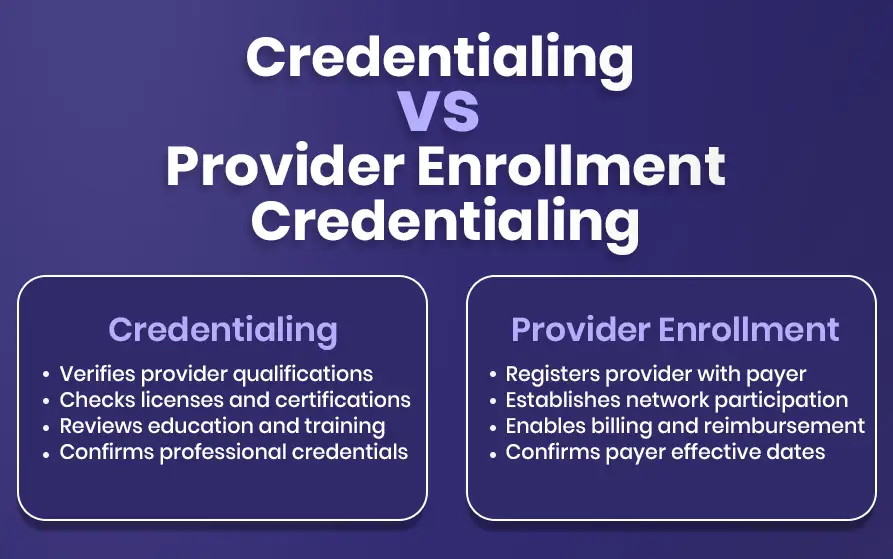
Credentialing is similar yet distinctly different from the process of provider enrollment and payer enrollment. In credentialing, the qualifications of the provider are verified, while the provider’s enrollment signifies the fact that he is associated with the health care plan. For instance, CMS mandates that in order to bill under Medicare, a provider must have an NPI and an enrollment application through PECOS. The onboarding process of a provider is more extensive because it encompasses all aspects of integrating the new physician in an organization. It includes credentialing, enrollment, system access, scheduling, etc. Payers need verification of credentials for the participating physicians.
Common credentialing criteria include medical education and postgraduate experience, current state licensure, board certification if applicable, employment and work experience, malpractice insurance, and an accurate National Provider Identifier (NPI). CMS defines NPI as a unique 10-digit number that can be used to identify health care providers in HIPAA standard transactions. A CAQH profile can also be used to obtain professional credentials as required by payers based on type of payer and provider. These criteria form the basis of the credentialing process for medical providers and allow payers to evaluate the eligibility of providers to participate in their networks.
Expert Guide: Credentialing providers separately from payers is a good idea for your business process. This is because it may happen that while a provider qualifies for credentialing, they cannot bill payers till they are enrolled and the effective date is set.
Why Provider Credentialing Delays Happen
Credentialing issues for providers are not likely to happen because of just one issue. In many cases, there are usually several little things that can go wrong or some combination of issues such as fragmented processes, payer-related problems, lack of administrative capability, or others. According to research conducted by the AMA, it was discovered that about 70% of organizations said that the process took about three to four months.
Incomplete or Incorrect Applications
Incomplete applications constitute one of the major issues that could have easily been avoided to facilitate credentialing processes. Some of the issues that would result in follow-ups include missing licenses, expired documents, gaps in work history, wrong address and inconsistent provider details. According to the AMA, 42% of organizations cited having to wait for physician’s documentation as a factor responsible for delay in start, whereas 30% said they had to wait for verification or references.
NPI Registration and Data Issues
Correct NPI registration is essential for provider enrollment since it links the healthcare provider to the enrollment and billing records using the National Provider Identifier number. One of the data quality problems identified by CMS in Medicare provider enrollment files is missing or invalid NPI numbers. Wrong demographic, organizational, or NPI details, therefore, may lead to inconsistencies in the data that must be resolved before enrollment can take place.
Payer-Specific Requirements
All payers could apply different forms, documentations, verification processes, and submission requirements, thus making the credentialing process complicated to standardize. According to CAQH, the typical doctor’s office holds 20.2 health-plan agreements, each of which has different standards and frequency of data verification. This means that credentialing departments could be required to work with several workflows at a time. Lack of information centralization and tracking would mean small variations could lead to incomplete submission and delays.
Slow Payer Processing
Nonetheless, despite filling in a credentialing and enrollment application accurately, approval will always be contingent on the processes used by the payer or the enrollment contractor, thus extending the total duration. Healthcare organizations cannot control these outside processing times. In the case of Medicare, the CMS notes that MACs may seek further information during the processing of an application for enrollment to take another step before being fully enrolled.
Poor Credentialing Workflows
Ineffective management of the credentialing process can lead even simple administrative chores into becoming ongoing hindrances. Spreadsheets done manually, separate files, non-existent updates, and follow-ups will make it more difficult to determine which applications are still pending and which documents require renewals. According to CAQH, practices using several credentialing processes averaged $2,068 every month, whereas those using only one system cost on average $1,249.86 per month, with the difference being around $818.
Limited Internal Resources
The credentialing specialist is responsible for processing of provider applications, documentation, verifying, payer communication, renewals, and follow-up in various health plans. Bottlenecks tend to occur easily when there are too many providers or payers under one credentialing specialist, especially in cases where there is a high rate of hiring going on. According to studies done by the AMA, 11% of organizations have stated staff shortage in hiring as one of the factors leading to physician delays.
Credentialing vs. Provider Enrollment: What’s the Difference?
Credentialing is the process through which the professional qualifications of the provider are verified, including educational background, training, licensure, board certification, work experience, and malpractice insurance. The provider enrollment is the registration of the provider with the health plan, enabling him/her to be a member of the payer’s network and being reimbursed if needed. Thus, physician credentialing refers to verifying whether the physician has met the professional criteria, while physician enrollment is about linking the physician to the payer. Insurance credentialing is focused on the qualification of the insurance provider, while insurance provider enrollment implies becoming a member of the insurance company. Payer enrollment is the overall process of becoming a member of the health plan. CMS defines Medicare enrollment as the process of providing information and application in order to qualify for Medicare billing privileges.
These functions are independent but closely interrelated; credentialing usually provides the validated data required for the enrollment process, whereas the enrollment process will determine if the provider can be a participant with a certain payer at all. The differentiation between the two processes can help organizations understand where a certain application has really been stuck, say, if documentation is still awaiting validation or if the payer has yet to complete the enrollment process. The distinction is crucial since the demands and procedures of each payer may differ from others. Practices evaluating external revenue cycle support can also compare the top medical billing companies in New York to identify providers with experience in credentialing, payer enrollment, billing, and broader RCM services.
How Credentialing Delays Quietly Block Revenue
There could be a situation where credentialing delays could result in financial losses even though a provider is fully credentialed and prepared to treat the patient. The key thing to remember is that clinical credentialing does not necessarily equal payer enrollment. Even if a provider is fully medically credentialed, he might be waiting on payer enrollment, network certification, or enrollment date. The Centers for Medicare & Medicaid Services note that Medicare enrollment requires an application process carried out by Medicare Administrative Contractors (MAC).
Providers Cannot Bill Certain Payers
A physician can be licensed, credentialized through a healthcare entity, and seeing patients without having an adequate enrollment status with the specific payer. Under such circumstances, the services will not be reimbursable under the expected payer contract until the required conditions for enrollment have been fulfilled. Guidance provided by CMS makes it clear why the effective date is important; claims for services that have been rendered before the billing effective date applicable to Medicare cannot be processed.
Lost Revenue from Delayed Patient Appointments
The process of scheduling may become quite difficult in the case when the provider is not yet able to join the patient’s insurance network. In such a way, the patients may have to either wait for the time when he will be able to join the network, or to use the services of some other physicians who are already included in the network. It should be noted that for the new physician, every appointment that was not fulfilled may become lost income.
Claims Can Be Delayed or Rejected
Enrollment data directly contributes to the administrative processes associated with billing. When there are issues with a provider’s enrollment information such as incomplete, inaccurate, inactive, and non-consistent billing data, further analysis or claim issues will arise. CMS stresses that it is important to keep the enrollment information of Medicare updated and that MACs are responsible for the processing of application for enrollment and answering provider inquiries on claims and enrollment information. When enrollment or provider data issues contribute to claim rejections, denial management services can help identify recurring causes, correct billing issues, and follow up on denied claims to reduce avoidable revenue loss.
New Providers Take Longer to Become Revenue-Producing
Credentialing delays could increase the duration from the time when an organization hires a physician to the point when the latter reaches full productive capacity. Organizations will keep paying the salary, benefits, equipment, technology, and other expenses incurred by the practice even if the provider’s credentialing process remains pending. There are also separate datasets within CMS’s credentialing data that relate to pending enrollment of physicians and non-physicians, which means that enrollment processes could stay in the pending phase.
Contracted Payer Opportunities Can Be Delayed
A payer agreement presents a chance for taking care of covered patients, but the monetary advantage comes in after successful completion of the processes of credentialing and enrollment. According to CAQH, physicians are handling an average of 20.2 payer agreements per physician practice, and each payer will have its standards and how often verification takes place. As such, it is possible that the process of insurance credentialing could stall the involvement of a provider in one or more payer agreements.
Expert Insight: Credentialing, enrollment, and effective date should all be tracked separately. A physician may be clinical-ready but not be able to produce reimbursable revenue, which makes enrollment a revenue cycle milestone that goes beyond being administrative.
The Financial Impact of a Delayed Provider Start Date
When there is a delay in the start date of the provider, it could lead to a revenue gap due to the time between when the organization starts paying for the new provider and when the new provider generates expected revenue. According to AAPPR data collected by the AMA, the average length of time between the acceptance of a contract and the start date of a physician was 112 days, and 70% of the organizations polled reported that credentialing and privilege usually take about three to four months.
A Simple Example of Lost Revenue
Think about a doctor who is set to start seeing patients from September 1st, and is yet to get his/her credentialing from the major payer. Assume there are twenty possible slots for each day. But much of the potential patient flow relies on that payer. Without even putting a figure on the income, every unattended patient slot means an opportunity that was supposed to be turned into income. And with each passing week, the potential loss of income will be quite significant.
Lost Appointment Opportunities
If a newly appointed doctor is not able to treat the patients insured through that particular payer, there will be some appointment times left unutilized or the patients would have to be referred to another doctor. According to AAPPR, it may sometimes happen that due to the slow process of credentialing and licensing of doctors, organizations might be forced to reschedule the appointment times of the waiting patients. For a practice that is running at its capacity level, rescheduling of the missed appointment times could become very hard.
Delayed Reimbursements
Any delay in credentialing and enrolling a provider might cause the delay in becoming fully ready to become part of the payer’s network. This would result in an increased time period between providing the service and receiving payment, which was expected by the company. This problem increases in importance if the provider has a heavy schedule or if several payers have yet to be enrolled in the program. Financially speaking, the practice keeps operating expenses running despite the fact that its revenue is delayed.
Administrative Labor and Rescheduling Costs
Credentialing delays also waste staff’s time. Staff will be required to communicate with payers multiple times, fix documentation, check status of applications, reschedule patients, update provider records, and coordinate activities of the recruitment, credentialing, billing, and scheduling departments. AAPPR says that credentialing is a document-driven, multi-step process and ineffective processes as well as errors result in higher costs for organizations. Such indirect costs can significantly enlarge the real cost of delayed provider credentialing compared to revenue directly observable in financial statements.
Patient Leakage and the Cumulative Effect
A patient who has problems getting an appointment within the network may switch to another doctor or office, which results in what we call “patient leakage.” According to AAPPR, delays in credentialing or licensing may affect the ability of patients to access healthcare services. The financial repercussions become even more significant when several providers face such delays: it is bad enough when one physician faces a 30-day delay, but it becomes an even bigger issue when five or ten do.
Understanding the Provider Credentialing Process
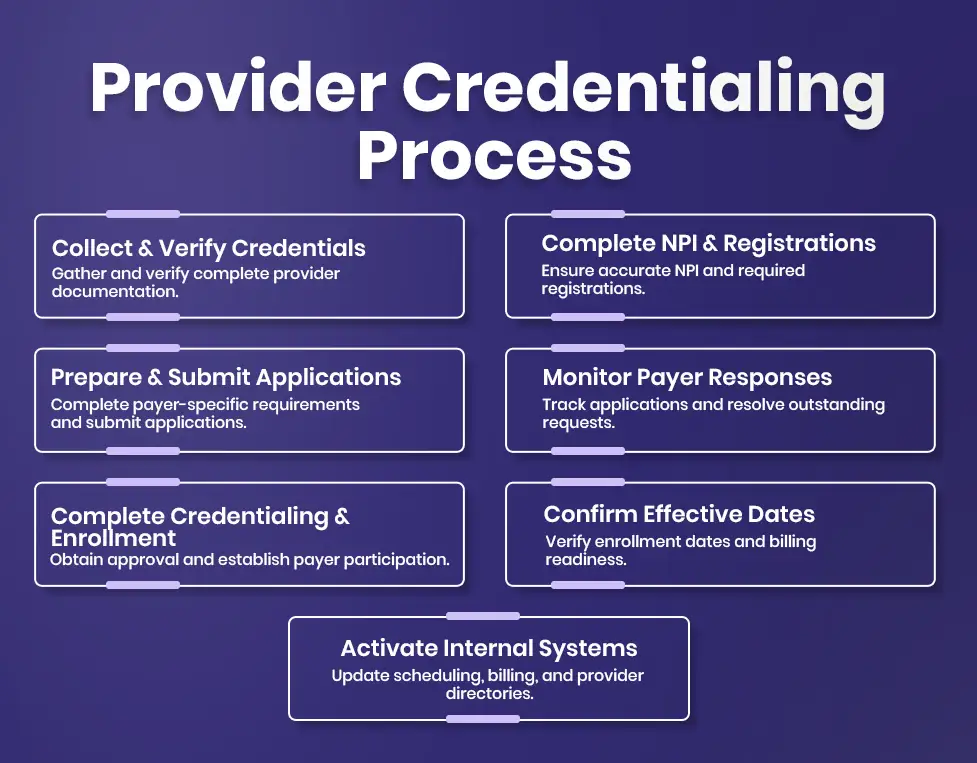
The credentialing process of the provider involves a set of activities such as data gathering, verification, submission of data for payers, review of data, approvals, and system activation. All these processes depend on data generated in the preceding stage, thus if there is any problem in collecting and verifying data at an earlier stage, it would cause problems at the later stage. According to AMA, in 70% of the surveyed organizations, it takes 3-4 months. For official guidance on Medicare provider enrollment, practices can refer to the CMS Medicare Enrollment Guide, which explains the NPI, PECOS, application, and Medicare Administrative Contractor steps.
Collect Provider Information
This involves gathering complete information about the provider that includes personal, educational, training, employment background, licensure and certification, malpractice insurance, and professional references. Incomplete or obsolete information could prevent the application process even before verification takes place. Based on research conducted by the AMA, 42 percent of the surveyed organizations cited lack of information from physicians as one of the reasons behind delays in commencement.
Verify Credentials and Documentation
Once the data is collected, the credentialing team confirms the credentials of the provider using official sources. These can involve checking credentials such as licenses, degrees, training, board certification, job experience, and many others. Verification can create a major bottleneck when there is an organization waiting for information from schools, license issuing authorities, references, or other organizations. According to the survey by the American Medical Association (AMA), 30% of organizations mentioned waiting for verifications/references as a source of delays.
Complete NPI and Related Registrations
Proper NPI data is necessary since it helps identify the healthcare providers in administrative and electronic transactions. CMS advises providers applying for Medicare enrollment to secure their NPI numbers from NPPES prior to filling out their applications. Wrong data regarding names, addresses, taxonomy, or any other identification may cause conflicts. CMS advises the providers to apply for NPIs online since it is more effective.
Prepare Payer Applications
Upon verification of the provider’s details, the credentialing team creates applications for the particular insurance plans. These applications have requirements that may vary from one payer to another depending on the type of the provider, location, and participation agreement, and therefore, each of the applications should be evaluated separately. The process is often slowed down when the documentation is incomplete or information is inconsistent with the payer’s data, or even when more forms are needed.
Submit Applications
After preparation and review, the applications are forwarded to the correct paying or enrollment agency. In Medicare’s case, the CMS has indicated that PECOS is the online Medicare enrollment system and the Medicare Administrative Contractors (MACs) will handle the enrollment application. An incorrectly submitted application, missing information or signature, or any issues with the supporting documentation may result in a delayed enrollment process for the provider.
Monitor Payer Responses
Submission does not mark the end of the credentialing process. Teams need to keep an eye on the status of their applications, respond to messages from payers, and track any outstanding items. According to CMS, the Medicare Administrative Contractors may ask for more information in the course of processing applications and can help with the status of those applications. Delay is often a result of not having a clear picture of pending applications or not following through quickly enough.
Resolve Discrepancies or Requests for Additional Information
The payers may also uncover any errors in the process of reviewing the application. This may include errors related to the address, license number, date, affiliation, ownership, or other information provided in the application. Every request for more information results in another transfer of the application from the provider to the credentialing staff to the payer. The CMS specifies that the Medicare Administrative Contractors may request more information in their process.
Receive Credentialing Approval
The moment when the payer or the credentialing body finishes the review process and finds out that the requirements have been fulfilled, the provider is granted a credentialing approval. But the provider needs to understand that the credentialing approval must not be considered as the last step for billing. Providers still have to verify their enrollment and participation information and effective dates.
Complete Provider Enrollment
Approvals for credentialing and enrollment of providers are related but separate processes. The process of enrollment confirms the affiliation of the provider with a certain payer, as well as with any billing rights, if required. CMS mandates providers to get an NPI number and fill out the enrollment form via PECOS for Medicare; application processing is done by MACs. Delays may happen in case of discrepancies between enrollment and credentialing documents.
Confirm Effective Dates and Billing Readiness
Following the enrollment process, the organization needs to check on the effective dates of the provider’s involvement and ensure that the system has accurate payer data for billing purposes. This is because just having credentials or approval status does not automatically imply that the provider is prepared to handle every aspect of billing. CMS stresses the need for accurate record keeping, and the provider is able to check on his/her data in the PECOS system.
Add the Provider to Internal Systems and Payer Directories
Finally, the last action step is the updating of the internal systems, scheduling systems, billing system, provider directory, and all other pertinent documents. This will guarantee that the new provider is able to be scheduled and billed appropriately. These delays may even continue to happen following the payer approval if there is poor communication between the departments.
Professional Guidance: Treat credentialing as a tracked workflow rather than a one-time submission. Monitoring documentation, payer responses, enrollment status, effective dates, and system activation at every stage helps identify bottlenecks early and gets providers ready for billing faster.
A Practical Provider Credentialing Checklist
A standardized checklist for the credentialing of the provider helps credentialing staff keep track of documentation, payers’ requirements, and gaps in the information before submitting the application. Since the credentialing process is a multistage process of verification and enrollment, having one unified checklist also helps understand where an application is in the process, what the next steps are, and when the application will be ready for billing.
Provider Credentialing Checklist
- Provider demographic information
- NPI registration and verification
- State licenses
- DEA registration, when applicable
- Board certification
- Education and training history
- Complete work history
- Malpractice insurance coverage
- CAQH profile and attestation, when applicable
- Payer-specific applications
- Required supporting documentation
- Application submission dates
- Payer follow-up dates
- Outstanding information or correction requests
- Credentialing approval dates
- Enrollment effective dates
- Enrollment confirmation
- Provider directory verification
- Billing system updates
- Scheduling and internal system updates
- Credential expiration and renewal dates
Reviewing the checklist periodically during the provider credentialing process is much more beneficial than doing so at the time of submission of the application form alone. This will help to determine where the problem lies in the application and helps the various teams to be in the know.
How to Prevent Provider Credentialing Delays
Avoiding credentialing delays is best achieved with an anticipatory, systematic strategy and not by dealing with issues after submitting the applications. Credentialing delays can be avoided through initiating the process from the onset, ensuring documentation is standardized, tracking applications to payers, following up regularly, assigning the right personnel, and use of technology.
Start Credentialing Early
Start the credentialing process for the new provider well in advance of the provider’s intended starting date. The credentialing process can take many months, especially if there are multiple payers. Integrating the credentialing process as part of the provider’s onboarding timeline will give the teams enough time to determine the requirements, gather the documentation, and submit the application.
Standardize Documentation
Maintain a centralized credentialing file for providers, which includes updated licenses, certifications, educational history, employment history, malpractice insurance, NPI number, and other necessary documents. Utilizing standard credentialing documents across all payers minimizes discrepancies, and streamlines the application process. An accurate set of documents in one location will help expedite the process of submitting information to payers.
Track Every Application
Each payer submission should have a date of submission, status, outstanding requirements, follow up date, date of approval, and effective date documented. This will make it easy for the credentialing department to see when an application is delayed so that it can act on it before it becomes urgent.
Establish Follow-Up Procedures
It is advisable not to depend on your payers for regular status updates. Instead, plan to follow up on your applications according to the process followed by each payer. Proper follow-up will enable you to know if there is any missing information or issues that need to be resolved.
Use a Dedicated Credentialing Specialist
A credentialing specialist may take charge of the application process, verifying information regarding the providers, communicating with payers, ensuring that pending tasks have been completed, and taking care of all follow-up work. A dedicated person will definitely come in handy especially when many providers are being taken care of at one go by the organization.
Automate Where Possible
Software and tracking systems can assist in streamlining some of the redundant administrative processes through the maintenance of the documentation of the providers, the status of their applications, deadlines, and expirations of credentials. Technology alone cannot solve credentialing, but it helps to decrease mistakes in entering information and to maintain better visibility to prevent any deadline from being missed.
How a Strong Credentialing Workflow Supports Revenue Cycle Performance
The effective functioning of a credentialing process is important for ensuring that revenue cycle operations work well because it links provider credentialing with scheduling, claim submission, payment, and revenue forecasting. If credentialing and provider enrollment are done efficiently and in a timely manner, then providers can be activated in scheduling and billing processes without any problems. If there are issues with credentialing, then they could influence patient eligibility and claim processing. Credentialing must therefore be considered a component of revenue cycle management, not just an administrative process. Once a provider is credentialed and ready to bill, reliable medical coding services help ensure that documented services are translated into accurate codes that support clean claims and appropriate reimbursement.
When to Outsource Medical Provider Credentialing
The following situations will allow a practice to outsource the credentialing of its medical providers: an increasing backlog of credentialing, fast growth in the number of providers, the existence of multiple payer agreements, re-enrollment issues, inadequate staffing, and provider start delays. Outsourcing the credentialing process allows organizations to leverage expertise in payer requirements along with offloading application processing, documentation, and tracking processes. A dedicated team will be able to facilitate better coordination of the credentialing process, deal with any discrepancies that arise, communicate effectively with payers, and lessen the burden on internal staff members. Practices dealing with limited administrative resources can also outsource medical billing services to reduce the burden of billing, claims follow-up, payment posting, and other revenue cycle tasks while internal teams focus on provider onboarding and credentialing.
Key Metrics to Track Credentialing Performance
Proper monitoring of the key performance indicators of credentialing is important for health care organizations to be able to pinpoint any potential roadblocks and gauge the efficiency of their operations and also learn how credentialing impacts the readiness of the providers as well as their revenues. Some important metrics are the average credentialing turnaround time, number of days it takes for a provider from hiring to submission, days from submission to payer approval, percentage of applications that require revisions, number of applications pending, providers who need to be enrolled, revenue delayed by credentialing and the percentage of providers who have been credentialed prior to their start date.
How iSolve RCM Helps with Provider Credentialing Delays
Credentialing issues can be addressed with the assistance of iSolve RCM, which can help healthcare organizations decrease the time of provider credentialing by facilitating the entire process of credentialing and enrollment. The iSolve RCM team will be able to assist with organizing the provider documentation, applying for payers’ specific credentials, checking the application status, following up, and identifying the missing/inconsistent data before creating new delays. In such a way, using their credentialing experience together with a proper workflow organization and tracking, the iSolve RCM will be able to help practices not only to stay on top of their provider credentialing and enrollment process but also get ready for billing faster.
FAQs
What are provider credentialing delays?
Provider credentialing delays happen due to a delay in the process of verifying, documenting, applying to payers or enrolling. This may affect the ability of a provider to enroll in certain insurance plans, which could impact patient scheduling and billing.
How long does provider credentialing usually take?
Credentialing time frames will differ between payers, types of providers, and complexity of the application. There are reports that many companies experience the process of credentialing to take several months. This might happen due to any of the following reasons: incomplete documentation, verification requirements, delays from the payer side, etc.
What causes provider credentialing delays?
The common reasons for delays may be as follows: incomplete credentialing application forms, inaccuracy of information of the providers, inconsistencies in NPI numbers, insufficient supporting documentation, specific criteria of payers, delay on the part of payers, poor follow-up, poor tracking system, and lack of staff.
How do credentialing delays affect healthcare revenue?
Delays in credentialing could hinder the ability for providers to contract with some payers, resulting in reduced availability of appointments for patients and delayed payment. They may also result in higher administrative costs, delay in productivity for the provider, and patient leakage.
How can practices prevent credentialing delays?
Some strategies to help minimize delays would be the initiation of credentialing early on, keeping accurate records of the providers, using standardized checklists, tracking all applications, following up with payers, and having personnel dedicated to the credentialing process. Centralized credentialing software could also assist with visibility.
Can outsourcing provider credentialing reduce delays?
Outsourcing could be useful in managing the workload associated with credentialing. The professional staff that handles the credentialing services would be able to take care of the documentation, applications, follow-through, and tracking, without placing additional burden on internal administration.