

Provider credentialing is a procedure that confirms the credentials, licenses, education, training, and professional background of the health care provider to become a member of the insurance network. The reason behind that is the payments of medical procedures rely on the completion of credentialing and enrollment process. According to industry knowledge, credentialing usually takes around 60 to 120 days; however, some payers can take more time.
The first thing most providers want to know is, “How long does credentialing take?” The answer depends on several factors such as the requirement of each payer, completeness and accuracy of documentation provided, CAQH credentialing, primary source verification, and provider enrollment into Medicare, Medicaid, and commercial insurance payers. If the documentation is incomplete and inaccurate, this can lead to delays in the credentialing process.
A good choice to streamline the credentialing process is partnering with a professional medical billing company. It will help providers to submit all necessary documents correctly and on time.
What Is Provider Credentialing and Why Does It Take Time?
Credentialing of providers can be defined as the formal verification process of checking the credentials of a healthcare provider in terms of educational background, training, licensing, certification, employment history, malpractice protection, and discipline. In case you may want to ask what is provider credentialing, then it is basically a method used for guaranteeing that the provider meets certain requirements in order to provide safe care to the patients. What is medical credentialing?
In-network status is awarded after thorough screening by the insurance company. The process of healthcare credentialing involves primary source verification in which the licenses are verified from state licensing boards, education and residency are verified, board certifications are verified, sanctions databases are checked and malpractice history is checked. These are often confused, but they are very different. Credentialing is to verify the credentials of the providers, provider enrollment is to register the certified provider with insurance payers to file the claims, insurance credentialing involves joining the network of commercial insurance, while payer credentialing involves the credentialing guidelines set by each insurance company or government payers like Medicare and Medicaid.
The process of crediting and enrolling is much more complicated than submitting one application. Each insurer has its own set of documents that need to be submitted, its own way of evaluation, and its own time frame for approval. The absence of required documents, expired licenses, an incomplete CAQH profile, contradictions within the documents, or delayed primary source verification might prolong the process. Since there are multiple parties involved in the review and the approval of each application, provider credentialing services demand well-prepared and thoroughly documented processes.
Expert Tip: It is best to initiate the process of provider credentialing at least 90 to 120 days prior to the desired start date. It is important that you update your CAQH profile regularly and have all the documents verified before submission.
Average Provider Credentialing Timeline: How Long Does It Really Take?
The average provider credentialing time frame usually spans 60 to 120 days, but the procedure could sometimes last up to 180 days or more based on the payer and provider factors. An average time frame includes preparation of the CAQH profile (1 to 4 weeks), and submission of the application (30 to 120 days). In the meantime, the payers perform primary source verification (2 to 8 weeks), after which insurance panel approval follows (60 to 180 days). The time needed for Medicare provider enrollment usually spans 60 to 120 days, while for Medicaid provider enrollment, the time required is 45 days up to more than 180 days, depending on state regulations.
There are different factors that affect the credentialing process of physicians. Such factors include the insurance payer, type of specialty of the provider, regulations by the state, and completeness of the submission. Providers who have accurate information in their applications, updated CAQH profile, and quick responses to the payers usually get approved quicker than other providers who have incomplete and inaccurate information. Other delays in the process of the credentialing may be caused by the huge volume of applications, lengthy verification process, and the need for further review by some specialties and government agencies. Providers will also need to prepare for re-credentialing every two to three years.
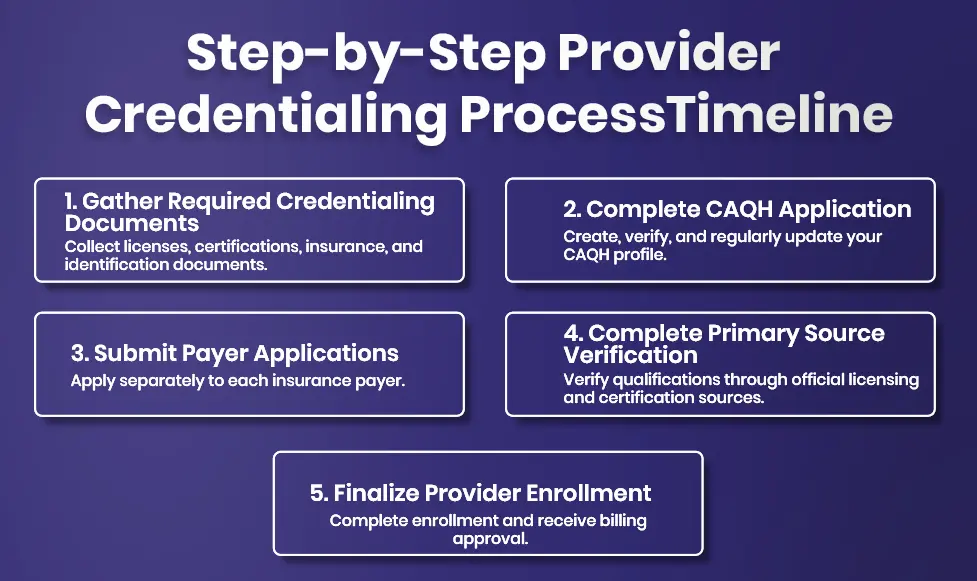
Step-by-Step Provider Credentialing Process Timeline
A structured provider credentialing process allows healthcare facilities to avoid delays, fulfill payer requirements, and enroll in an efficient manner for quick reimbursement.
Step 1: Gather Provider Credentialing Documents
This will be done by compiling a comprehensive checklist for provider credentialing which will include all medical licenses, DEA registration if any, board certification, malpractice insurance, work history, educational credentials, NPI details, and tax forms. Compliance with all medical credentialing standards and physician credentialing standards through physician credentialing checklist helps to avoid any sort of mistake and any delay in processing.
Step 2: Complete the CAQH Application Process
CAQH credentialing starts with the creation of a CAQH profile, upload of documents, completion of attestations, and updating of all information. During the process of applying through CAQH, the insurer will then review your profile after document verification. A well maintained profile will ease the CAQH credentialing process and make CAQH provider credentialing easy.
Step 3: Submit Applications to Insurance Companies
Those providers who wonder about how to be eligible with insurance companies must apply separately to each payer company. The insurance credentialing process is different for each type of payer – commercial, Medicare, and Medicaid. There are separate credentialing processes, which are different from one another in terms of their documentation, evaluation, and approval processes.
Step 4: Primary Source Verification and Credentialing Committee Review
Primary source verification during credentialing involves checking of licenses, educational background, internships and residency programs, board certifications, employment experience, malpractice insurance, and disciplinary actions with original sources. Following verification, the committee in charge of credentialing at the insurance firm examines the application in the context of the credentialing process for medical staff.
Step 5: Provider Enrollment Completion and Effective Date Approval
Approval for credentialing does not mean that you can start billing. The process of provider enrollment should be completed successfully along with finalizing payer contracts, getting an effective date, and adding yourself to the provider directories. By following a provider enrollment checklist, you will ensure successful provider and physician enrollment.
Professional Guidance: Keep a checklist for all your credentialing applications and stay on top of them with regular follow-ups to your payers. Communication, good documentation, and responsiveness to verification will speed up the process.
Factors That Affect the Provider Credentialing Timeline
There are several factors which affect the credentialing of providers, and by knowing about them providers can better anticipate delays, enhance accuracy of applications and get approvals faster.
Incomplete or Incorrect Applications
Incomplete and/or incorrect applications are among the primary reasons why the credentialing of providers takes more time than it needs to. This is due to the absence of documentation, lack of accurate data regarding the provider, or outdated certification/license. Checking all applications prior to submission will be a great way to minimize delays.
Payer Processing Times
Every health insurance organization has its own set of credentialing process, documentation, and timeline. Where some health insurance organizations get their credentialing done within a span of a few weeks, others may take many months. Credentialing delay is also known to impact the payment process, hence making underpayment recovery in medical billing relevant for revenue cycle management as it helps identify and recover underpayments made by the payers.
Provider Specialty and Location
The specialty and practice setting of the provider also influence the credentialing period. Specialty practices that are considered to be high-risk or require further certification will have more intense reviews. Additionally, the licensing regulations of individual states, as well as the requirements of various payers, differ, and thus, some regions will have extended credentialing periods.
CAQH Issues
Outdated or incomplete CAQH profile is another common reason behind credentialing problems. Outdated attestations, lack of document updates, and inconsistent provider information may make it impossible for insurance companies to conduct their investigation. Regular updating of CAQH documents will provide payers with all the necessary information.
Government Program Delays
Enrollment under government payer programs may involve more paperwork and regulatory compliance. Each of Medicare and Medicaid has its own process for enrollees that includes different processing and verification criteria which may lengthen approval times especially at peak enrollment times or when further documentation is required from the provider.
Medicare, Medicaid, and Commercial Insurance Credentialing Timelines
The process of enrolling providers under the Medicare program is accomplished via the Provider Enrollment, Chain and Ownership System (PECOS). It is a web-based system used by Centers for Medicare and Medicaid Services (CMS) to enroll health care providers and suppliers. The Medicare provider enrollment period generally ranges from 60 to 120 days depending on the accuracy of the application, need for verification and number of applications to be processed by CMS. Some of the factors that may delay this process include lack of necessary data, change of ownership and request for additional information.
While Medicare requires a national provider enrollment, Medicaid’s provider enrollment is done at the state level and thus differs widely. This means that it can take between 45 days and even 180 days, based on how the state implements their policies and how busy they are. The same cannot be said for commercial insurances, whose credentialing process involves each individual payer having their application, contracts reviewed and credentials approved by their credentialing committee before being accepted in the network. Since each individual payer has unique policies and processing time, it is wise for providers to get their applications in early.
In order to enhance operational efficiency both during and post-credentialing, several healthcare facilities also employ medical coding services to ensure proper documentation, coding, and claims filing. Along with prompt credentialing, the use of proper medical coding reduces the chances of claim denials and leads to faster reimbursement.
Common Provider Credentialing Mistakes That Delay Approval
These kinds of delays may be largely preventable due to incomplete credentials applications, errors in data entry, or missing administrative paperwork. It will be helpful to learn about these typical mistakes and use a tried-and-true credentialing checklist for physicians. Working with professionals who provide both credentialing and denial management services is an additional way to increase efficiency of revenue cycle and eliminate enrollment delays, claim denials related to credentialing, and underpayment.
Submitting Incomplete Applications
Incomplete application forms have become one of the major reasons for credentialing delays. Unfilled fields, unsigned forms, or incomplete disclosures create the need for extra action by the payer. To make sure that all sections have been filled out, a provider credentialing checklist should be used.
Not Updating CAQH Profiles
CAQH profile is utilized by insurance carriers for obtaining provider data during the process of credentialing. Outdated attestations, license expiration, or lack of uploaded documents may affect application processing. Up-to-date CAQH profile will ensure availability and accuracy of your data.
Incorrect Provider Information
Errors in the name, address, NPI data, or any other personal details of the service providers could result in errors that would have to be manually rectified. All information should be verified prior to submission so as to prevent such delays.
Missing Supporting Documents
Applications that lack necessary credentials such as malpractice insurance certificates, board certification, educational information or employment history cannot be progressed until the necessary information is provided. A complete list of credentials ensures that the provider has submitted all necessary documentation.
Ignoring Payer Follow-Ups
The insurance payers may require additional documentation and clarification during the process of credentialing. Delays in responding will cause applications to be put on hold or even close the process. It is very important to monitor communication and respond on time.
Applying Before Licenses Are Active
Application for credentialing prior to activation of medical license, DEA registration, or certifications will automatically delay or result in denial of application. Providers are expected to verify that all credentials are current and valid before applying for credentialing.
Expert Insights: Make a credentialing schedule for license renewals, CAQH attestations, follow-ups with payers, and expired documentation. It is best to be well organized since that helps avoid unnecessary delays and allows for fewer claim denials.
How to Speed Up the Provider Credentialing Process
Although some factors affecting credentialing are beyond a healthcare provider’s control, following best practices can significantly simplify and accelerate the credentialing process. Many providers also choose to outsource medical billing services to experienced professionals who can assist with credentialing, payer enrollment, and claims management, helping reduce administrative burdens, improve accuracy, and support a more efficient revenue cycle.
Prepare Documents Early
Collect all necessary documentation before applying to make sure that you have medical license, certification, malpractice insurance, DEA number, NPI information, and tax documentation. Having all these documents will help you avoid any unnecessary delays due to lack or expiration of documents.
Keep Your CAQH Profile Updated
Make sure that your CAQH record is always updated by keeping it updated with the provider’s data and uploading new documents. An updated record makes sure that the insurance payers have access to the relevant information without needing extra documentation.
Use a Credentialing Checklist
Having a complete list for credentialing ensures that all necessary documentation is covered prior to submission. This will help in saving time and preventing any kind of mistakes through an easy check by means of a checklist.
Track Payer Application Status
Make sure to check the status of each application made by payers during the review process. This will help in identifying gaps in the required information and ensuring that applications progress through the approval process.
Respond Quickly to Verification Requests
Usually, insurance companies may ask for some extra documentation when going through the credentialing process. Prompt response to those verifications will make sure that your application is not put on hold or delayed.
Consider Professional Credentialing Services
Organizations involved in health care with more than one provider or insurance network can benefit from credentialing or provider credentialing. Credentialing professionals will ensure that the documents required for the processes are prepared, communicated with payers, and applications tracked.
Provider Credentialing Checklist: Documents You Need
An accurate provider credentialing checklist ensures the absence of delays in that all necessary documents will be at hand prior to filling out the applications. The providers may find a physician credentialing checklist as well as a medical credentialing checklist useful in ensuring accuracy and currency of all necessary records.
| Document | Purpose |
| NPI Number | Identifies the provider for billing and claims processing. |
| CAQH Profile | Centralized provider profile used by participating insurance payers. |
| Medical License | Confirms active state licensure to practice medicine. |
| DEA Certificate (if applicable) | Authorizes prescribing controlled substances. |
| Board Certification | Verifies specialty qualifications and professional competency. |
| Malpractice Insurance | Demonstrates active professional liability coverage. |
| Education History | Confirms medical school, residency, and fellowship training. |
| Training Certificates | Supports completion of required clinical education and certifications. |
| Employment History | Documents previous professional experience and identifies any gaps. |
| W-9 Form | Provides taxpayer identification information for reimbursement. |
| Provider Agreements | Finalizes participation terms with insurance payers after approval. |
Credentialing vs. Recredentialing: Understanding the Timeline Difference
The process of initial provider credentialing is done for the very first time in the process of approving a healthcare provider who wishes to be part of the insurance network, hospital or healthcare organization. This includes checking credentials in terms of qualification, license, education, training, experience, malpractice insurance and many others. On the contrary, the process of re-credentialing is a repetitive process where providers are verified whether they meet the standards set by payers after their initial approval.
Updating credentialing data throughout the credentialing process can help ensure there will be no delays in future credentialing efforts. Updating licensing, certifications, CAQH, contact information, and practice data allows the insurance payers to have up-to-date information available for verification purposes. Being proactive about provider credentialing and maintaining credentials makes credentialing efforts less difficult and more efficient.
Should You Use Provider Credentialing Services?
Using professional credentialing services may prove advantageous for newly opened practices, multi-provider organizations, and health organizations dealing with numerous insurance applications. Provider enrollment to several insurance panels may involve cumbersome documentation processes, special requirements of each payer organization, and lengthy evaluation process. Provider credentialing services may assist practice with late enrollment issues through the management of insurance applications, contacts with payers, and completion of requirements.
Some advantages associated with professional credentialing assistance include time-saving application processing, less paperwork, and enhanced record-keeping during the credentialing process. Qualified professionals will oversee the application process and keep track of everything to ensure there is no error which can cause delays in approval of the application. When it comes to dealing with insurance credentialing for a practice, outsourcing will help healthcare practitioners to concentrate on patients.
How iSolve RCM Helps with Provider Credentialing
iSolve RCM assists healthcare professionals in credentialing through the proper handling of complicated administrative work that goes into payer enrollment. iSolve RCM helps in preparing applications, documenting all the information needed for credentialing, submitting the documents and following up with the insurance company. Using their experience in provider credentialing, insurance credentialing, and payer enrollment needs, iSolve RCM will help with CAQH profile setup, credentialing verification, Medicare and Medicaid enrollment and applications for commercial insurances. They assist with credentialing and help with avoiding common mistakes that occur during this process. iSolve RCM enables healthcare providers to concentrate on patients rather than on paperwork by reducing the burden of administrative work and helping with application follow up and tracking.
FAQs
How long does provider credentialing take?
Typically, it would take around 60 to 120 days for a physician to complete his/her credentialing process, but there are several reasons which could affect the process of how long it will take. For instance, the need for the insurance company, specialty, state requirements, etc.
What is the fastest way to get credentialed with insurance companies?
The most efficient way is by submitting complete and accurate applications, updating the CAQH profile, having the required documents ready, replying quickly to the request of payers, and following up on the status of the applications. Credentialing professional organizations may also help minimize administrative delays.
How long does CAQH credentialing take?
Normally, the entire CAQH credentialing process takes between one and four weeks. However, the timeframe for payer reviews will depend on the availability and accuracy of information to the insurance firms that are taking part in this process.
What documents are needed for physician credentialing?
Physician credentialing will include requirements for the medical license, National Provider Identifier (NPI) number, CAQH profile, Drug Enforcement Administration (DEA) certificate, board certification, malpractice insurance, educational documentation, training documentation, work experience, and provider agreements.
How long does Medicare provider enrollment take?
Medicare’s provider enrollment process takes approximately 60 to 120 days before it can be completed. The time it will take depends on whether all documentation is complete and if there is an accurate submission within the PECOS system.
What causes delays in medical credentialing?
The various causes for delayed medical credentialing process are incomplete applications, absence of documentation, CAQH account that is not up-to-date, inaccuracies in provider information, expired licenses, delayed response of payers, problems in verification and other requirements of insurance companies or government bodies.