

Revenue Cycle Management (RCM) is a financial process that supports healthcare providers in receiving payment for the services they deliver. While many practices rely on a trusted medical billing company to manage these complex workflows, RCM is much more than billing alone. It covers the complete financial journey of a patient, beginning with appointment scheduling or registration and continuing through payment collection and posting. It plays a crucial role in ensuring healthcare practices maintain steady cash flow while complying with industry regulations.
RCM supports both organizational efficiency and quality patient care, as the financial backbone of healthcare operations. It modernizes how providers handle claims, reimbursements, and financial reporting, making it indispensable in today’s contemporary multifaceted healthcare environment. Though, applying effective RCM comes with challenges such as evolving regulations, claim denials, and managerial burdens. Medical practices are now improving their revenue management processes, enhancing accuracy, reducing delays, and strengthening inclusive financial performance with the advancement of modern technology.
What Is RCM in Medical Billing?
Revenue Cycle Management (RCM) in medical billing refers to the entire process of financial activities within the healthcare industry from the time a patient books an appointment till the total amount is paid off. In simple terms, RCM in medical billing involves managing patient information, insurance information, coding, billing, and payment in a well-coordinated and effective manner.
Accurate documentation and coding are essential for converting healthcare services into reimbursable claims in medical billing systems. The RCM in the medical billing process confirms that every step including from charge capture to claim submission and denial handling is properly managed. It also supports coordination between medical coding and billing teams, minimizing errors and improving claim approval rates.
RCM plays a vital role in maintaining the stability of healthcare organizations from a financial perspective. Authentic RCM in healthcare practices supports providers modernize operations, advance cash flow, and decrease unpaid claims. Hospitals can accomplish better financial control and long-standing sustainability with the support of modern healthcare RCM tools and enhanced workflows.
Key Components of the RCM Cycle in Medical Billing
Being familiar with the main aspects of RCM allows facilitating the efficiency of billing, as well as enhancing the healthcare revenue outcomes.
Front End Processes
The front-end processes comprise patient entry, eligibility verification and appointments that trigger the billing process. Proper front-end data requirement in the RCM cycle in medical billing is also necessary to avoid misstatements in claims, minimize rejection and ensure that the coordination between the patient, provider and insurance payers is achieved at the outset.
Back End Processes
Back-end operations revolve around making claims, recording payments, handling denials, and reconciling the final accounts. These stages are critical to the efficiency of the RCM billing process because they affect the speed and accuracy with which healthcare providers get reimbursements on the one hand and compliance with the requirements imposed by payers and the risk of revenue leakage on the other hand.
Data Integration Role
Integration of administrative and clinical data has guaranteed smooth communication between billing systems and patient records. Integrated data is used in medical coding services to enhance precision in documenting clinical services into standard codes, reduce discrepancies, aid claim approvals, and improve general transparency of financial processes within healthcare organizations.
Technology in RCM
Technology is a transformative aspect and it automates, lessens errors in manual work, and enhances accuracy in billing. To achieve operational efficiency and financial stability, modern medical RCM solutions operate on AI, analytics, and EHR integration to optimize claim processing, track revenue performance, and aid decision-making by healthcare providers.
Tips for Success: Ensure that all patient information is entered correctly at the time of registration, confirm insurance coverage early on, standardize coding practices, and utilize automated systems to minimize mistakes and facilitate faster claims submission.
Step-by-Step Process of the RCM Cycle
Efficient workflow results in correct billing, speedy payment, and low incidences of claims errors within healthcare organizations. Furthermore, organized workflow supports RCM in medical billing through effective claims processing, payments, low denials, and revenue cycle optimization.
Patient Registration
The key to billing accuracy and successful claims is the failure to obtain the correct information about the patient at the beginning of the visit. The proper coding of demographics and insurance information in RCM cycle medical billing can avoid medical billing errors, minimize claim denials, and provide a smooth flow of information between providers and payers during the revenue cycle.
Insurance Verification & Eligibility
This will ensure that the intended medical services of a patient are covered by his or her insurance before proceeding with the treatment. Eligibility checks in RCM steps in medical billing can prevent financial shock, minimize claims rejection, and achieve appropriate reimbursement of care providers by checking coverage constraints at an early stage in the care cycle.

Charge Capture
Charge capture refers to documenting all the medical services, procedures, and treatments that were given to the patient during the visit. Accurate charge capture in the RCM billing process means that no service is missed or underreported to directly influence revenue generation and enhance the overall financial accuracy of healthcare organizations.
Medical Coding
Medical coding converts clinical records into standardized codes that are employed to make insurance claims and billings. Precision is paramount in RCM medical coding since improper coding may result in denial of claims, compliance and delays in payments, which is a significant measure of revenue integrity.
Claim Submission
After coding has been done, claims are sent to insurance companies where they are processed to be reimbursed. Timely and proper submission of claims in revenue cycle management medical billing also leads to speedy approvals, reduced rejections and better cash flow cycle of the healthcare providers and institutions.
Payment Posting
Payment posting is the process of entering the payment received by insurers and patients into the billing system. This step is a part of RCM in healthcare, which guarantees transparency, assists in monitoring unpaid balances, and enables providers to reconcile accounts correctly without losing financial stability in all patient records.
Denial Management
Denial management is concerned with determining which claims are rejected, the cause of the rejection and rectifying the mistake and resubmitting it. Denial management is vital in the RCM medical billing to recover missed revenue, enhance the accuracy of billings and to eliminate recurring claim problems that affect the profitability of healthcare.
Patient Billing & Collections
This is a final procedure that will create statements of patients and balance that has not been paid after insurance. Effective billing or collection processes will yield consistent cash flow, decrease unpaid accounts and financial stability of healthcare organizations as well as improve communication of patient finances within the context of what is RCM healthcare.
Benefits of Revenue Cycle Management in Healthcare
Effective RCM improves financial performance, reduces errors, and enhances overall efficiency in healthcare organizations.
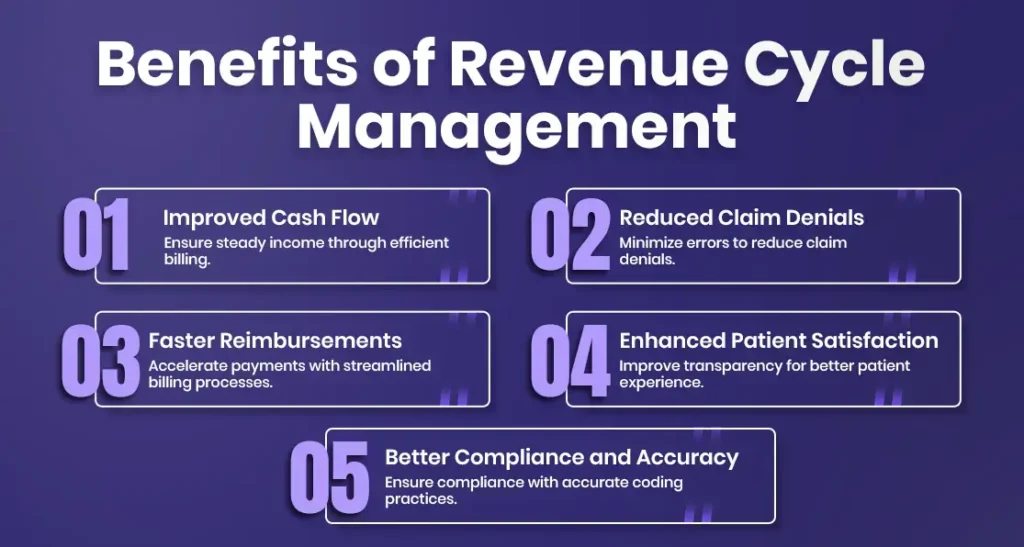
Improved Cash Flow
Billing and quick claim processing guarantee that income flows consistently into the coffers of health care organizations. In terms of revenue cycle management in medical billing, cash flow is made efficient by minimizing claims delay and prompt payment, thereby guaranteeing better financial stability and streamlined day-to-day activities.
Reduced Claim Denials
Proper documentation, coding, and verification greatly lessen the likelihood of claim denial. When it comes to the RCM cycle in medical billing, minimizing errors throughout the process will lead to lessening denials, higher payment rates, and lower costs of resubmitting denied claims.
Faster Reimbursements
The benefit of efficient billing is seen in the ability to speed up claims processing, as well as claims approval and payment on behalf of the insurance providers. In RCM medical billing, speedy reimbursement is guaranteed because of efficient automation and proper submissions.
Enhanced Patient Satisfaction
Transparent billing, correct pricing, and effective communication make for a great experience of patients. More effective financial operations translate into less confusion in RCM healthcare solutions and anxiety on the part of patients, resulting in increased trust and satisfaction.
Better Compliance and Accuracy
Following the guidelines and keeping accurate records leads to seamless billing procedures. Enhanced precision minimizes compliance problems, prevents any form of legal problems, and enables health care institutions to satisfy industry standards with respect to RCM medical coding.
Insights from Expert: Create consistency in documentation, check insurance status ahead of time, provide ongoing training to coders, and implement automation in your revenue cycle management process to minimize mistakes, expedite payments, ensure compliance, and boost efficiency.
Common Challenges in RCM
There exist numerous operational and financial challenges facing medical practices or healthcare organizations that can hinder the revenue cycle process if not well managed through professional billing services for healthcare providers.
Billing Errors and Coding Mistakes
Data errors and mistakes in coding can result in claim denials and financial loss. Even small errors in documentation or coding can have a huge effect on the speed of payment and legal liability in the RCM billing process.
Claim Denials and Delays
Denial of insurance claims and delays in insurance approval can be considered significant barriers in revenue management. Rejection usually happens when there is missing data or non-eligibility, causing further problems for the submission and resubmission of claims in RCM cycle medical billing.

Regulatory Changes
Compliance issues become problematic because of the constant changes in health care laws, coding guidelines, and insurance policies. It becomes important to keep informed with new laws in order to ensure compliance for revenue cycle management in medical billing. Because healthcare regulations change frequently, providers should regularly review guidance from the Centers for Medicare & Medicaid Services (CMS) to stay compliant with Medicare billing requirements, coding updates, and reimbursement policies.
Inefficient Workflows
Improper process designs and insufficient automation result in decreased efficiency and increased time lags. The problems caused by RCM in healthcare may include poor claim handling processes, increased administrative expenses, and poor performance of healthcare companies financially.
Best Practices for Effective RCM Management
Implementing organized strategies assists healthcare practices improve efficiency, minimize errors, and maximize revenue performance.
Automate Processes with RCM Software
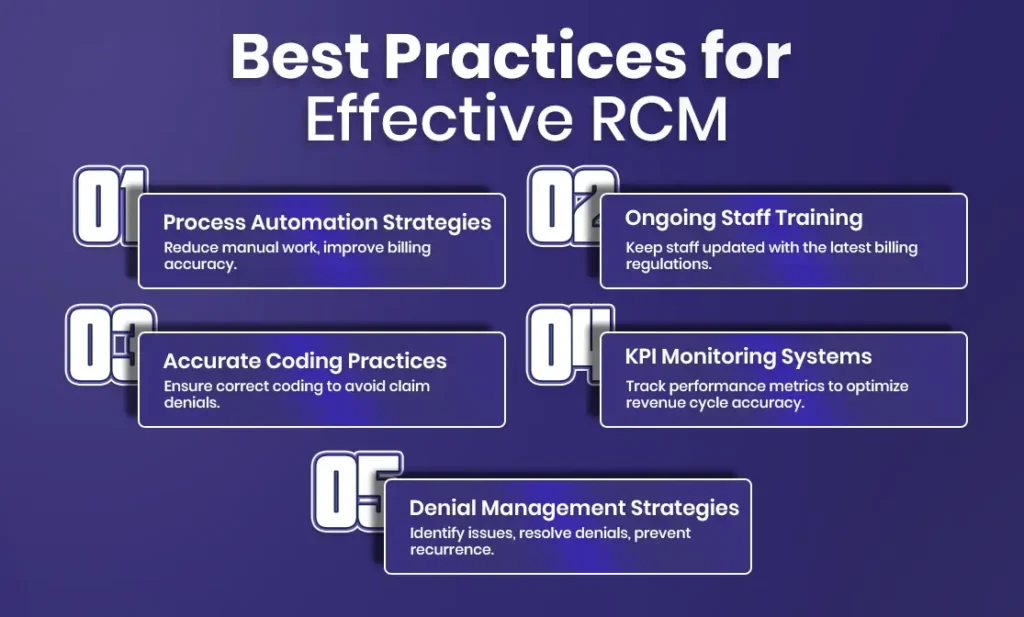
Automation supports decreasing the manual effort compulsory in the billing process while increasing accuracy at the same time. Automation through sophisticated software ensures that claims can be processed more efficiently and with fewer mistakes, thus accelerating payment processes in RCM medical billing.
Regular Staff Training
Constant training supports keeping up-to-date with current trends and laws within the medical billing field. Continuous training plays a noteworthy role in revenue cycle management medical billing process because it helps achieve accuracy and efficiency throughout the revenue cycle.
Accurate Documentation and Coding
Documentation and proper coding play a vital role in obtaining approval for claims. Proper coding in RCM medical coding is crucial since it ensures that there is adherence to the payer’s regulations, minimizes claim denials, and results in timely payments.
Performance Metrics and Monitoring KPIs
Measurement of KPIs is indispensable for evaluating the efficiency of the billing process. As regards the RCM cycle in medical billing, measuring metrics such as claim denial rate and collection time is necessary to detect problems and optimize RCM cycle management.
Strong Denial Management Strategies
Denial management processes ensure that denied claims are resolved and recovered much more quickly. Effective strategies are key in determining the causes of the problem and preventing reoccurrence, leading to high payment rates and stability in RCM billing cycle.
What Need to Know: Utilize automatic RCM systems, train your employees frequently, keep accurate records, monitor KPIs, and create an effective denial management process to increase efficiency, minimize mistakes, and optimize revenue generation.
Role of Technology in Healthcare RCM Solutions
Technology improves efficiency, accuracy, and speed across the complete healthcare revenue cycle.
Use of AI and Automation
AI and automation make the billing process easier by automating repetitive functions and minimizing human errors. AI in medical RCM solutions software empowers efficient claim management, fast processing, and identification of problems that might arise in billing, making payment processes more efficient and faster.
Electronic Health Records (EHR) Integration
The EHR system supports centralizing patient information and harmonizing better between clinical and billing staff. Efficient EHR integration is critical for documenting patient information correctly, avoiding duplicating data, and facilitating quick claim filing in the domain of RCM in healthcare.
Data Analytics for Decision Making
Data analysis offers insight into the performance of revenues, claims, and inefficient operations. Data analytics assists healthcare organizations to make wise decisions, lower denial rates, and adopt effective strategies to enhance revenue cycle performance and sustainability in health care RCM solutions.
Future Trends in Revenue Cycle Management
RCM is speedily evolving with technology, value-based care, and planned outsourcing shaping its future direction.
AI-Driven Billing Systems
Billing will become faster and more accurate with the help of AI in processing complicated financial transactions. Artificial intelligence helps minimize human mistakes, anticipate potential problems related to claims, and improve the overall efficiency of reimbursement processes with respect to RCM medical billing.
Value-Based Care Models
There is an evolution from volume-based payment systems towards outcome-based reimbursement. The value-based approach means that healthcare providers need to ensure that their payments correspond with their results and hence there is a need for precise performance measurement in revenue cycle management medical billing.
Outsourcing RCM Services
It is becoming increasingly common for many healthcare providers to rely on outsourcing as an option to deal with their billing and coding processes. Outsourcing in RCM in healthcare enables providers to enhance efficiency and cut down costs while making sure that specialists are available when needed.
How iSolve RCM Help with RCM in Medical Billing
iSolve RCM can assist in making the process of RCM in medical billing much easier through its end-to-end approach which increases efficiency in claims management processes by enhancing accuracy, minimizing denials, and speeding up reimbursements. By means of automation technology and coding expertise, iSolve RCM ensures an efficient RCM process for health care organizations or medical practices.
FAQs
What is RCM in medical billing?
Medical billing RCM is the overall handling of the patient’s financial flow starting from registration through to final payment, which involves proper coding and claims processing, among other tasks that contribute to good financial management.
Why is RCM important in healthcare?
The RCMS process is essential because it assists in enhancing the cash flow, minimizing claim denials, precise billing, and maintaining financial stability in healthcare settings due to effective administration of clinical and organizational activities.
What are the main steps in the RCM cycle?
Steps which are involved in RCM cycle include patient registration, insurance verification, charge entry, medical coding, claims processing, payments posting, denials management, and patient billing, thus confirming an effective and well-organized revenue cycle process in health care.
How does technology improve RCM?
How technology helps in obtaining better results in RCM includes the improvement of automation in billing, the reduction of errors made by humans, the incorporation of electronic health records, and the application of data analytics for better decisions.
What are common challenges in RCM?
Problems that normally arise include billing errors, claim denials, regulatory updates, and unproductive workflow processes, all of which may cause delays in the payment process and bound revenue optimization opportunities for medical practices.
How can healthcare providers improve RCM performance?
Healthcare practices can improve their RCM operations through the use of automation tools, appropriate coding practices, constant training for their employees, key performance indicator tracking, and active denial management procedures.