
Revenue codes classify hospital services so each charge on an institutional claim is billed and paid correctly. Revenue Code 0636, also written as rev code 0636 or rev code 636, is the pharmacy revenue code for drugs requiring detailed coding. Hospitals report it on the UB-04 for drugs and biologicals that must be identified with a specific HCPCS code and billing units, most often on hospital outpatient claims. Read our guide on Revenue Code 0360 in Medical Billing for Operating Room to learn more about billing for operating room services.
This blog explains when and how to use rev code 0636, how it appears on the UB-04, how Medicare treats it, the mistakes to avoid and the best practices that keep drug claims accurate. It is useful whether you are new to medical coding or improving an existing billing process.
What is a Revenue Code in Medical Billing?
A revenue code in medical billing is a four-digit code that hospitals and other facilities use to identify the department or type of service behind each charge. It does not describe the procedure itself. Instead, it classifies the charge as room and board, laboratory, radiology, pharmacy, operating room or another service area, which tells the payer where in the facility the service was provided.
Revenue codes appear on institutional claims such as the UB-04, on both inpatient and outpatient hospital claims, and they work alongside procedure codes such as CPT and HCPCS. In simple terms, revenue codes keep healthcare revenue cycle management services properly grouped and paid according to payer requirements. For the full structure and list, see our guide to revenue code in medical billing.
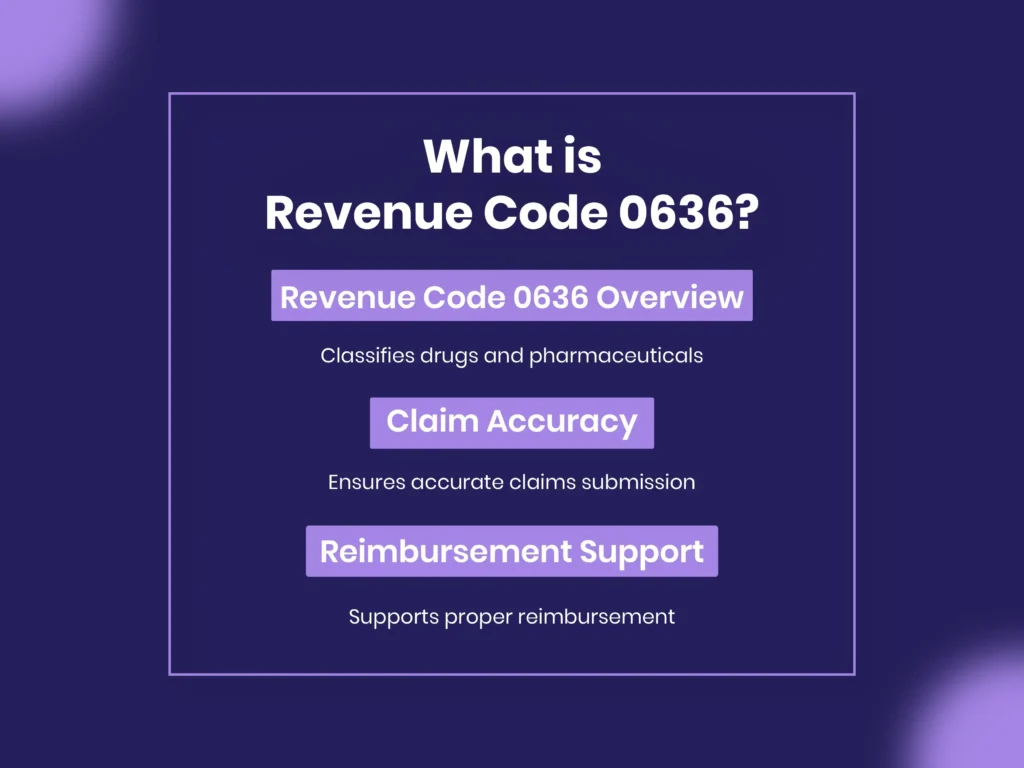
What is Revenue Code 0636?
Revenue Code 0636 is the pharmacy revenue code for drugs requiring detailed coding. It sits in the 063X category, the pharmacy extension of the 025X pharmacy codes, and it tells the payer that the drug on that claim line is identified at the drug level, usually with a HCPCS Level II code and the units that code requires.
Definition and Explanation
The official NUBC description of 0636 is Drugs Requiring Detailed Coding. The Medicare Claims Processing Manual, Chapter 17 states that on claims to A/B MACs (A), the drug is identified by the appropriate HCPCS code for the drug administered and billed under revenue code 0636 unless a specific instruction states otherwise. In other words, 0636 classifies the pharmacy charge, the HCPCS code identifies the drug and the units show how much was given.
What Does “Drugs Requiring Detailed Coding” Mean?
Detailed coding means the payer needs more than a broad pharmacy category. The claim line has to name the exact drug or biological, normally through its HCPCS Level II code, and report the quantity in the units that code defines. A general pharmacy line under 0250 says a drug was given; a 0636 line says which drug and how much.
It does not mean every expensive drug belongs under 0636. The claim setting, the current HCPCS coding and the payer’s instructions decide which pharmacy code applies.
Services or Procedures Associated with 0636
Revenue code 0636 is used for drugs and biologicals that must be reported with a specific HCPCS code, such as injectable and infused drugs given in a hospital outpatient department.
Common examples include chemotherapy drugs, anti-emetics, immunosuppressive drugs and hemophilia clotting factors. Some payers say this directly. Point32Health’s provider manual, for example, requires these drug classes to be billed under revenue codes 0634, 0635 or 0636 with detailed HCPCS coding and states that the general pharmacy code 0250 is not appropriate for them.
Differences Between Similar Codes
Rev code 636 sits next to several pharmacy codes, and each one has its own use. Choosing the wrong one can deny the claim or delay payment.
| Revenue Code | Description | How It Differs From 0636 |
|---|---|---|
| 0250 | Pharmacy, general classification | A broad pharmacy category without drug-level detail |
| 0634 | Erythropoietin (EPO), under 10,000 units | A specific code for EPO doses below 10,000 units |
| 0635 | Erythropoietin (EPO), 10,000 units or more | A specific code for larger EPO doses |
| 0636 | Drugs requiring detailed coding | Drug-level reporting with the HCPCS code and units |
| 0637 | Self-administrable drugs | Drugs the patient usually takes on their own; not interchangeable with 0636 |
Read our article on Revenue Code 0510 in Medical Billing for Outpatient Clinic to learn more about billing for outpatient facilities.
Pro Tip: Confirm the drug’s HCPCS code, its unit definition and the supporting documentation before assigning rev code 0636. Regular internal audits keep 0636 lines aligned with the medication charges in the chargemaster.
Why Revenue Code 0636 is Important
Reporting 0636 correctly gives the payer the drug-level detail it needs to process the claim. It does not guarantee payment on its own, because payment also depends on the HCPCS code, the units, medical necessity, documentation and the payer’s payment method.
For Medicare outpatient claims, complete drug reporting also feeds rate setting. A Palmetto GBA billing article for hospital outpatient drugs (A55913) notes that billing drugs under 0636 with the appropriate HCPCS codes, whether they are separately payable or packaged, gives CMS and the MAC the most complete information for accurate rate setting and claims payment.
0636 also matters for audits and compliance. Accurate drug lines, supported by the medication administration record, are the first thing a reviewer checks in a drug billing audit, which makes 0636 a core part of quality medical coding services.
When and How to Use Revenue Code 0636
Learn when Revenue Code 0636 applies, how to code it correctly and how it appears on the claim, with examples for accurate billing from an experienced medical billing company in the USA.
Who Uses Revenue Code 0636
Hospitals and other institutional providers report 0636 on the UB-04 or its electronic version, the 837I, most often for hospital outpatient drug charges. Pharmacists, billers and coders share the work: pharmacy maps each drug to its HCPCS code in the chargemaster, and coders and billers check the code, the units and the payer rules before the claim goes out. Physician offices bill drugs on the CMS-1500 with HCPCS codes and do not use revenue codes.
Scenarios Where 0636 Applies
0636 applies when a drug or biological given in the facility must be reported with its HCPCS code, which is the standard for Medicare hospital outpatient claims. For inpatient claims and for other payers, check the payer’s billing manual, because some payers handle inpatient drug charges differently. Close collaboration between pharmacy, clinical and billing teams keeps the code right for every drug service.
Step-by-Step Coding Process
Applying 0636 correctly follows the same steps every time. Engaging a medical billing service in the USA can help when volume is high.
- Identify the drug or biological from the order and the medication administration record.
- Confirm the current HCPCS code and read its unit descriptor.
- Convert the documented dose into HCPCS billing units.
- Apply revenue code 0636 when the payer and claim setting call for detailed drug coding.
- Add any payer-required NDC data, modifiers or authorization details.
- Check the diagnosis against coverage policy when medical necessity edits apply.
- Reconcile the claim line with the documentation before submission.
- Review the remittance and sort any denial by root cause before correcting the claim.
UB-04 Fields for a 0636 Drug Line
Revenue Code 0636 is reported on the CMS-1450 (UB-04) institutional claim form or the 837I. A 0636 line uses these form locators:
| UB-04 Field | What Belongs There |
|---|---|
| FL 42 | Revenue code 0636 |
| FL 43 | Description of the drug or service |
| FL 44 | The HCPCS code for the drug or biological, plus any required modifiers |
| FL 45 | Date of service for the line |
| FL 46 | Units, based on the HCPCS descriptor |
| FL 47 | Total charges for the line |
Examples of Correct vs Incorrect Usage
Medicare’s Chapter 17 says drugs are billed in multiples of the dosage specified in the HCPCS code long descriptor. Suppose the HCPCS descriptor defines one unit as 10 mg and the record shows 40 mg was given. The correct line is 0636 with that HCPCS code and 4 units. Reporting 1 unit because there was one dose understates the claim, and reporting 40 units overstates it.
Other incorrect uses include a 0636 line with no HCPCS code, units counted by vial instead of by the code descriptor and non-drug supplies placed under 0636. Partnering with a medical billing firm in the USA helps keep pharmaceutical billing correct.
Is Revenue Code 0636 a CPT Code?
No. 0636 is a revenue code, not a CPT or procedure code. Revenue codes are four-digit UB-04 codes that classify the type of charge. CPT codes are five-character codes that describe procedures, and drugs on hospital claims are usually identified with HCPCS Level II codes. On a 0636 line, the revenue code says the charge is a drug requiring detailed coding, and the HCPCS code next to it says which drug.
HCPCS, NDC and Revenue Code 0636: What Each One Does
Revenue Code 0636 classifies the institutional pharmacy charge. The HCPCS Level II code identifies the billable drug or biological. The National Drug Code (NDC) identifies the specific product and package. Each answers a different billing question, so one cannot stand in for another.
NDC reporting is not the same for every payer. Many Medicaid programs and some commercial payers require the NDC in addition to the HCPCS code, with their own qualifier, format and unit of measure. Follow each payer’s instructions rather than assuming one NDC rule for every 0636 line.
Medicare OPPS Rules for Revenue Code 0636
Medicare hospital outpatient billing separates two questions that are often confused: how a drug is reported and how it is paid. Chapter 17 instructs hospitals to report charges for all drugs, biologicals and radiopharmaceuticals with the correct HCPCS codes, whether the items are paid separately or packaged. Payment status, shown by the status indicator, comes from OPPS Addendum B.
Does Packaged Mean You Should Not Report 0636?
No. Packaging describes how Medicare pays for the drug, not whether it is reported. A packaged drug still belongs on its own 0636 line with its HCPCS code and units, even though Medicare pays for it as part of another service. For non-Medicare claims, follow the payer’s contract and billing manual.
JW and JZ Modifiers on Single-Dose Drugs
For separately payable drugs from single-dose containers, Medicare requires modifier JW on a separate line for the amount discarded, or modifier JZ when nothing was discarded. JZ became required on July 1, 2023, and since October 1, 2023, claims for single-dose drugs without JW or JZ can be returned, as Noridian explains. Neither modifier applies to drugs that are not separately payable, such as packaged OPPS drugs with status indicator N.
Unclassified Drugs and Biologicals
Unclassified drugs need extra care. HCPCS C9399 is only for new drugs and biologicals approved by the FDA on or after January 1, 2004 that have not yet received a specific HCPCS code. Other drugs without a specific code use the not otherwise classified codes J3490 for drugs or J3590 for biologicals. For C9399, Chapter 17 requires the NDC, the total quantity administered and the date given, and the Palmetto GBA article instructs hospitals to bill one line with one unit and report the total dose in the remarks field (FL 80).
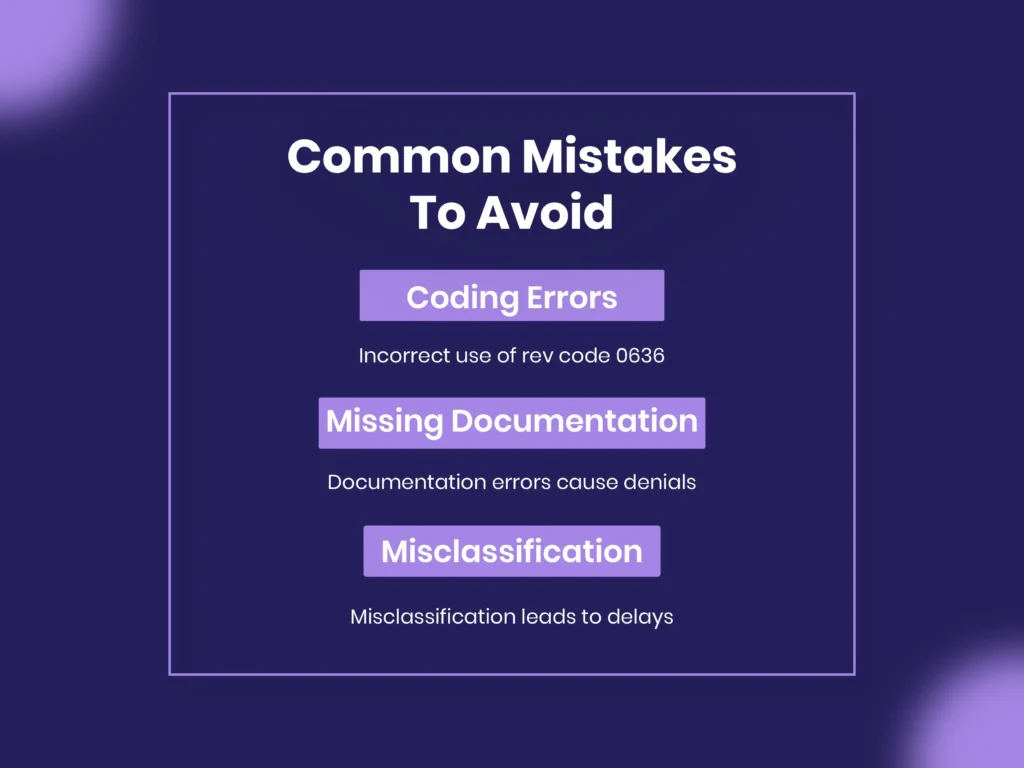
Common Mistakes to Avoid
Understand the common mistakes with Revenue Code 0636, what they lead to and how denial management services help prevent repeat denials and audit findings.
Frequent Errors with 0636 Coding
| Error | What Goes Wrong | What to Check |
|---|---|---|
| Wrong HCPCS code | The revenue code may be right, but the drug is wrong | Current HCPCS file, drug name, route and descriptor |
| Wrong HCPCS units | Billed quantity does not match the dose | Dose given and the HCPCS unit definition |
| 0636 without a HCPCS code | The line lacks the detail the code requires | Chargemaster mapping for every 0636 item |
| Missing payer-required NDC | The payer cannot validate the product | Payer NDC format, qualifier and unit rule |
| Missing JW or JZ modifier | Single-dose drug line is returned | Wastage documentation and separately payable status |
| Diagnosis or coverage mismatch | Medical necessity edit fails | LCD, NCD or payer medical policy |
| Documentation mismatch | Record does not support the billed quantity | Order, MAR, route, dose and wastage |
| Outdated chargemaster logic | A retired code or old unit rule keeps repeating | Quarterly HCPCS and payer updates |
Consequences of Misreporting
Inaccurate 0636 reporting leads to denied claims, delayed payments, underpayments when units are understated and overpayments that must be repaid when units are overstated. Repeated errors also attract payer audits. Knowing the coding rules prevents revenue loss and keeps the practice compliant.
How to Prevent Denials or Audits
Prevent denials by checking documentation, confirming the HCPCS code and units on every 0636 line and running regular claim audits. Clear protocols and coding checklists keep claims compliant and error free.
Pro Tip: Verify the medication documentation, the charge and each payer’s billing requirements before filing claims with 0636. Working with experienced billing and denial management specialists reduces errors and strengthens compliance.
Best Practices for Accurate Billing
Follow these best practices for Revenue Code 0636 to keep drug claims accurate and reduce billing errors:
- Confirm the charge is for a drug or biological before assigning rev code 0636.
- Document every drug billed under 0636, including dose, route and any wastage.
- Map each 0636 chargemaster item to a current HCPCS code with the right unit conversion.
- Use billing software edits that flag 0636 lines without a HCPCS code or with unusual units.
- Run internal audits on high-cost and high-volume drug lines.
- Train staff on 0636 units, NDC rules and JW and JZ modifiers.
- Review each payer’s drug billing requirements, including NDC and authorization rules.
- Keep pharmacy, clinical and billing teams in regular contact about drug changes.
- Update coding logic after each quarterly HCPCS release.
- Work with a professional medical billing service when internal capacity is limited.
How Revenue Code 0636 Affects Insurance Claims
How a payer reads a 0636 line directly affects whether the drug charge is accepted. The payer checks that the revenue code, the HCPCS code and the units describe the same drug, then applies its own payment method. Under Medicare’s outpatient system, that may mean separate payment or packaging into another service, but the drug is reported either way.
Many payers deny 0636 lines that do not carry a matching HCPCS code. Aetna Better Health of Kansas, for example, told providers that when revenue code 0636 is billed and the HCPCS code does not match, the claim line will deny. Accurate 0636 lines lead to fewer denials and faster processing for drug claims.
Compliance and Regulatory Considerations
Using Revenue Code 0636 correctly means following payer rules, preventing errors and keeping precise records for every drug billed.
Medicare, Medicaid, and Private Insurer Guidelines
Medicare sets national claim-processing rules for 0636, but Medicaid and commercial payers can add their own. State Medicaid programs often require NDC information and state-specific formats. Commercial payment can depend on the provider contract, authorization rules and payer-specific edits.
For that reason, do not build one universal 0636 rule into the chargemaster for every payer. Keep the core link between 0636, the HCPCS code and the units, then layer payer-specific edits for NDC formatting, prior authorization and medical necessity on top.
Legal Considerations for Coding Errors
Most 0636 errors lead to denials, underpayments or overpayments that must be returned, not to legal action. Repeated or systematic errors, however, can trigger payer audits and compliance reviews. Complete documentation that matches the billed drug, dose and units is the best protection.
Maintaining Proper Records for Audits
Keep accurate records for every drug billed under rev code 636, including the order, the medication administration record, the dose, the route and any wastage. These records let the facility show compliance if a payer questions a drug claim.
Pro Tip: Monitor payer updates, keep complete drug administration records and audit 0636 lines regularly so audits run smoothly.
Updates and Changes in Coding
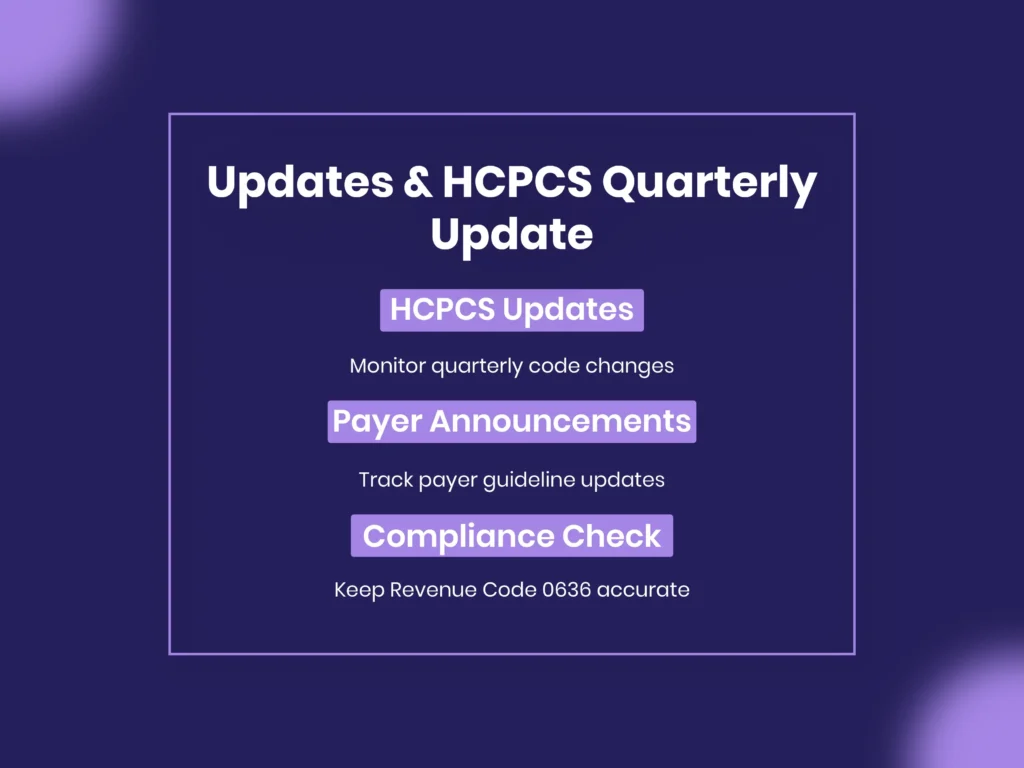
Staying current with drug codes is essential to avoid 0636 errors. CMS publishes the HCPCS Quarterly Update with new, revised and deleted HCPCS codes, and each file lists its effective date in its title. Billing teams should review these files, payer bulletins and coding resources before old mappings turn into denials.
0636 itself keeps changing. CMS implemented NUBC Value Code 92, “Invoice Cost of Drug/Biologic,” for use with revenue category 0636 when federal regulation requires it, through a transmittal issued in November 2024 with an April 7, 2025 implementation date.
Tips for Streamlining Billing Processes
Improve the accuracy and efficiency of drug billing by building Revenue Code 0636 checks into everyday work.
Strategies to Improve Accuracy and Efficiency
Standard procedures for 0636 drug lines, from chargemaster mapping to unit conversion, make billing more accurate and faster to review.
Integrating Coding Checks into Workflows
Adding verification steps for 0636 into the medication billing workflow stops classification errors before claims go out. Regular checks keep pharmaceutical services billed correctly.
Using Automation and AI Tools Responsibly
Automation can map drugs to HCPCS codes, convert doses into billing units and flag 0636 lines that are missing a HCPCS code, an NDC or a JW or JZ modifier. Human review is still needed for unclassified drugs, unusual doses and payer-specific rules, where an automated rule can repeat the same error across many claims.
How iSolve RCM Help with Revenue Code in Medical Billing
Using Revenue Code 0636 correctly depends on the revenue code, HCPCS code, units, documentation and payer rules all agreeing on the same claim line.
iSolve RCM supports facilities with correct code assignment, documentation review and denial management, so drug claims are paid correctly and stay compliant. Our revenue cycle management services connect coding review, claim edits and denial analysis, and our outsourced medical billing services handle claim submission, follow-up and recurring error analysis for organizations that want billing managed externally.
Frequently Asked Question’s
What is Revenue Code 0636?
Revenue Code 0636 is the pharmacy revenue code for drugs requiring detailed coding on institutional claims such as the UB-04. It is reported with the HCPCS code that identifies the drug and the units that code requires, most often for hospital outpatient drugs.
When should Revenue Code 0636 be used?
Use 0636 when a drug or biological given in the facility must be reported with its specific HCPCS code, as Medicare requires on hospital outpatient claims. Check each payer’s manual for inpatient claims and payer-specific rules.
What are common mistakes with rev code 0636?
Common mistakes include a wrong HCPCS code, units that do not match the dose, a 0636 line without a HCPCS code, a missing payer-required NDC, a missing JW or JZ modifier and documentation that does not support the billed quantity.
How does Revenue Code 0636 affect insurance claims?
The payer checks that 0636, the HCPCS code and the units describe the same drug. When they match and the documentation supports them, the drug line processes cleanly. When they do not, the line can deny or be underpaid.
How can denials management services help with 0636?
Denial management services review the denial reason, check the HCPCS code, units and documentation, correct and resubmit the claim and fix the root cause so the same 0636 denial does not repeat.
How do I stay updated on changes to Revenue Code 0636?
Review the CMS HCPCS Quarterly Update, payer bulletins and your MAC’s billing articles regularly. Recent examples of change include Value Code 92 for drug invoice cost on 0636 lines.
What is the official description of revenue code 636?
The official NUBC description of revenue code 0636 is Drugs Requiring Detailed Coding. It is part of the 063X pharmacy extension of the 025X pharmacy codes.
Is 0636 a CPT code?
No. 0636 is a revenue code, not a CPT or procedure code. The drug itself is identified on the same claim line with a HCPCS Level II code.
Does Revenue Code 0636 always mean separate payment?
No. Reporting and payment are separate. Under Medicare’s outpatient system, drugs are reported with their HCPCS codes under 0636 whether they are separately payable or packaged into another service.
What is the difference between revenue code 0250 and 0636?
0250 is the general pharmacy code without drug-level detail. 0636 is used when the drug must be identified with its HCPCS code and units. Payer rules decide which applies, and many payers require 0636 for drugs such as chemotherapy and clotting factors.
What is the difference between revenue code 0636 and 0637?
0636 is for drugs requiring detailed coding. 0637 is for self-administrable drugs, which patients usually take on their own. The two codes are not interchangeable.
Where is revenue code 0636 reported on the UB-04?
Revenue code 0636 goes in form locator 42. The same line carries the HCPCS code in FL 44, the date of service in FL 45, the units in FL 46 and the total charge in FL 47.
Does every 0636 line need an NDC?
Not always. Medicare requires the NDC for certain items, such as C9399 unclassified drugs, and many Medicaid programs and some commercial payers require it more broadly. Follow each payer’s format and unit rules.