

Medical billing is an important component of practice economics as it impacts the process of reimbursement through proper coding, claims submission, and payer follow-ups. For instance, in a time-driven costing analysis by JAMA, it was discovered that billing and insurance took 13 minutes and $20.49 per encounter in primary care, while professional billing expenses were equal to 14.5% of primary care revenue. The same research estimated $99,581 in annual billing expenses per each primary care physician under the described workload.
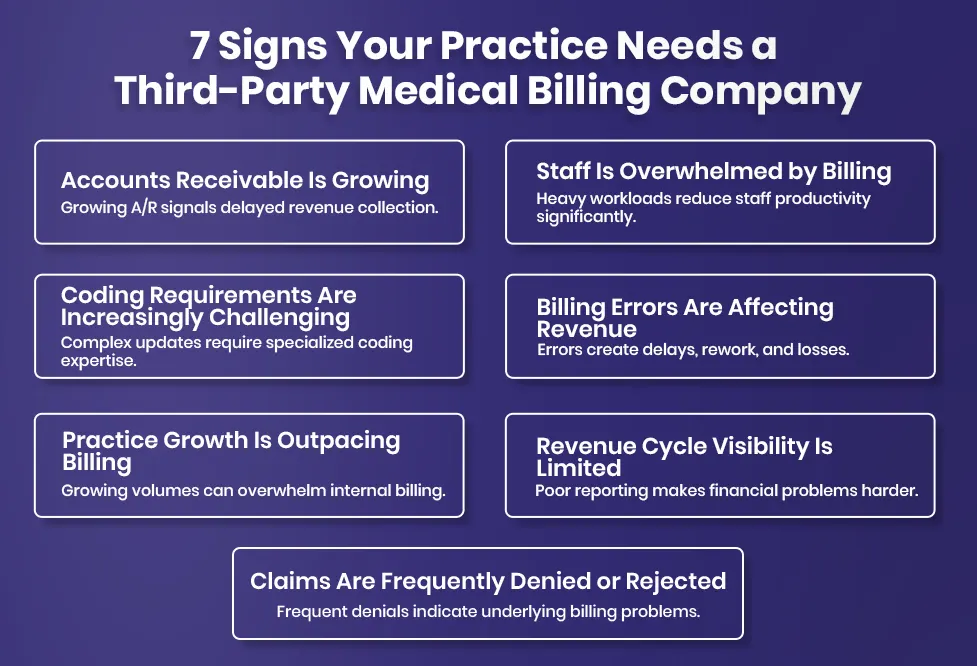
However, even the process of in-house billing requires staff effort for coding, documentation, eligibility determination, denials, appeals, and payments follow-up. According to the 2024 CAQH index, in 2023, the U.S. medical administrative expenditures were equal to $83 billion, while claim-payment expenditures increased by 13%. Medical billing outsourcing allows the transfer of special tasks within the revenue cycle to a dedicated team. According to the AMA survey conducted in 2025, practices perform 40 authorizations per physician weekly and spend 13 hours weekly. There are seven indications of the necessity of outsourcing. Practices seeking consistent revenue-cycle support can assess a third-party medical billing company based on specialty expertise, billing accuracy, denial performance, technology, and reporting capabilities.
For practices considering whether third-party support is the right fit, this guide to third-party medical billing companies in the USA explains what these companies do and how they can support different areas of the revenue cycle.
1. High Claim Rejections Are Delaying Payments
The rejected claim does not meet either payer criteria or electronic submission criteria prior to adjudication and needs to be corrected and resubmitted, while the denied claim has been adjudicated but payer has decided not to pay on the basis of adjudication. Incomplete billing data or coding, incorrect eligibility criteria, incorrect payer routing, incorrect coding, lack of documentation and lack of authorization have been identified by CMS as some of the factors responsible for denial.
Denial is a clear measure of the revenue cycle as it generates rework and delay in payment process. The peer-reviewed revenue cycle review shows that denial rates range from 5%-10% and the high denial rate is associated with demographic error, coding error, documentation error, and billing data error. HFMA suggests monitoring of denial volume and dollars in order to find system-wide issues. The medical billing and coding firm can perform denial analysis and target the root cause. Dedicated denial management services can identify recurring denial patterns, address underlying claim errors, and strengthen follow-up processes to help practices recover outstanding reimbursement.
2. Unpaid Balances Are Continuing to Rise
An increase in accounts receivable (A/R) reflects uncollected revenue that would otherwise be cash used for paying salaries, buying equipment, and operating the business. The American Academy of Family Physicians advises tracking the days in A/R with 30-40 days being ideal and aging receivables needing special attention. It is also important to note that an increased number of days in A/R may indicate submission mistakes, denial and appeal delays, problems with secondary insurance, or payor processing delays.
Having a professional team responsible for billing may help segment the claims into those pending from each particular payor, aged, denied and having balances, thus allowing focusing on problematic claims needing attention. A scientific paper provides recommendations on checking A/R aging since the resubmissions may disguise billing problems. Thus, the medical billing management services may use such control measures.
Key A/R warning indicators
- A sustained increase indicates slower conversion of billed services into cash.
- Aging beyond 90 days can indicate delayed payer processing, unresolved denials, or submission problems.
- These accounts warrant individual review because aging can conceal recurring workflow failures.
- Comparing A/R by payer can reveal insurers or claim categories responsible for payment delays.
- Adjusted collection rate shows how much of the reimbursement a practice was contractually entitled to actually collected.
3. Your Staff Is Overwhelmed by Billing Tasks
Billing operations go far beyond submitting claims and include verification of eligibility, coding, documentation requests, payment processing, appeals processing, and payer follow-ups. JAMA estimated that billing and insurance activities represented 14.5% of professional revenue for primary-care visits. The study also found that physicians themselves spent a median 3 minutes per encounter on billing-related activities, costing approximately $6.36 per visit. It included three minutes of physician’s involvement per visit showing that billing operations do take time even when electronic health records are used.
This situation gets even worse when payer requirements result in follow-up activities. According to the AMA survey of 2025, doctors and their staff spend an average of 13 hours per week on prior authorization and 40 percent of doctors use employees specifically for this purpose. CAQH calculated that administrative work in the healthcare system takes $440 billion per year. Billing services for medical practices may be outsourced in order to delegate to specialists’ certain activities related to claims, coding, denials, and follow-ups.
4. Constant Coding Changes Create Compliance Challenges
This process is characterized by frequent updates since the coding system is modified through the year. In 2025, the American Medical Association has provided 420 changes in the CPT codes 270 new codes, 112 deletions, and 38 modifications. The 2026 ICD-10-CM updates and quarterly National Coverage Determination coding revisions were also released by the CMS. Incorrect use of the old codes or payment policies leads to the creation of inaccurate claims, medical-necessity disputes, and unnecessary reimbursement delays.
The CMS asserts that the ICD-10-CM coding rules must be followed as part of the HIPAA regulations and stresses accurate coding, documentation, and reporting. This adds to the technical burden that can be challenging for small practices to maintain. Coding and billing outsourcing helps practices hire specialists who follow code set updates, payer guidelines, and documentation requirements and enables physicians and expanding practices to keep the uniform coding process. Professional medical coding services can help practices maintain accurate code assignment and adapt to changing coding guidelines, payer policies, and documentation requirements.
Coding and payer-compliance pressures to monitor
- The 2025 CPT release contained 420 total updates, requiring billing teams to identify newly added, revised, and deleted codes.
- CMS and CDC issue updated diagnosis-code files, including changes effective April 1 and October 1, requiring timely implementation.
- CMS issued a July 2026 update containing new and deleted ICD-10 diagnosis codes for National Coverage Determinations.
- CMS-approved guidelines require accurate documentation, diagnosis-code assignment, and reporting, making coder-provider coordination essential.
- A dedicated coding team can systematically track code-set and policy changes instead of relying on front-office staff to identify technical billing updates while managing routine practice operations.
5. Billing Errors Are Affecting Your Revenue
Incorrect coding may result from wrong patient or eligibility information, incorrect diagnosis and procedure coding, services omission, duplicity, or inadequate documentation. CMS estimated that 10.3% of improper payments were associated with Medicare E/M services in 2024, of which 49.1% were due to incorrect coding, 34.1% due to inadequate documentation, and 13.1% due to lack of documentation. These types of errors may interfere with the satisfaction of coverage and payment criteria, hence affecting reimbursements.
It is not only the individual claims that are affected by such errors; rather, they create unnecessary rework, appeals, delays in collections, and underpayment. CMS’s FY2025 Medicare FFS data indicated that $28.83 billion was improperly paid out, most of which were due to inadequate documentation. The medical billing services, when outsourced, can use claim audits, coding validation, documentation verification, and denial analysis to identify these recurring errors prior to submission.
6. Your Practice Is Growing Faster Than Your Billing Operations
As the practice grows, the number of encounters, claims, coding, payments, and payer follow-up that the billing team needs to manage increases. The JAMA study found that billing-related costs varied substantially by encounter type, reaching $61.54 for a discharged emergency-department visit, $124.26 for a general inpatient stay, and $170.40 for an ambulatory surgical procedure. This is something that increases with volume of encounters and can easily overwhelm the internal team with other activities.
Scaling internally entails the hiring, training, supervision, and retention of specialists in medical billing. It is estimated that the amount of money spent annually on health administration in the United States is $440 billion. Staff shortage has led to longer times for doing administrative tasks. Medical billing services for smaller practices allow them to have the ability to scale with the volume of claims without having to hire immediately.
7. You Lack Clear Revenue Cycle Insights
The visibility of the revenue cycle needs to be measured through quantifiable metrics rather than focusing only on the cash flow. According to AAFP, Days In A/R, Adjusted Collection Rate, and Denial Rate are some basic measurements for the financial performance of a medical practice. Likewise, the MAP Keys of HFMA also standardizes KPIs in physician organizations based on objective calculations. Before selecting a billing partner, review 10 important questions to ask before hiring a medical billing company to assess its expertise, pricing, compliance, technology, reporting, and revenue-cycle performance.
Clean Claim Rate
Clean claim percentage is the number of claims that have been processed without needing to make manual corrections. Clean claim rate is defined by HFMA as the ratio of clean claims to the claims that were accepted for processing; according to a peer-reviewed review, 95% or more is the standard.
Denial Rate
Denial Rate is the percentage of claims that are denied and gives direct information about how well the revenue cycle is performing. The average industry denial rate is 5%-10%, according to the AAFP, but a lower rate, less than 5%, is preferred. The HFMA stresses the need for standardization of the denial metric due to its recurrence and increased collection cost.
Days in A/R
A day in A/R is the average number of days needed to recover unpaid bills. According to AAFP, days in A/R should be less than 50 days, with the optimal range being 30–40 days. NFMA considers net days in A/R as a measure of overall effectiveness of the revenue cycle; rising values may indicate slow payment processes.
Collection Rate
The adjusted collection rate measures the difference between collections and reimbursement due based on contractual terms. The AAFP states that the measure reveals revenue losses from bad debts, delayed submission, and noncontractual adjustments. An article in a peer-reviewed journal sets more than 95% as a benchmark for the net collection rate.
Outstanding A/R
Exceptional A/R needs to be aged based on aging categories and not a single balance. HFMA ages receivables in groups such as 0-30, 31-60, 61-90, 91-120, and above 120 days. This is because aging helps to determine collectability and the efficiency of the revenue cycle. The AAFP, however, points out that even if the total A/R looks fine.
How Third-Party Medical Billing Services Improve Visibility
Third-party medical billing companies can combine all these performance measures into a regularly produced report, which will help doctors and office owners track denial trends, claim quality, A/R age, and collection results. According to HFMA, standardizing KPIs is the basis for measuring progress and making changes. More effective reporting thus helps translate billing data into actionable information for making various decisions.
In-House vs. Outsourced Medical Billing: Which Is Right for Your Practice?
The in-house vs. outsourced medical billing decision should be made using metrics, not just vendor costs or preferences for certain people to work within the office. They need to measure themselves relative to their revenue cycle metrics. According to the AAFP, days in A/R should be less than 50, preferably 30–40, adjusted collection ratio should be above 95%, and denial rate less than 5%.
Staffing
The in-house system requires hiring, training, managing, and retaining employees skilled in revenue cycle management. In contrast, outsourcing involves using a wider group of billers rather than an in-house staffing pattern. The importance of this difference becomes apparent when the level of work varies: “CAQH data shows that manual healthcare transactions are significantly more costly than electronic transactions. For example, manually checking claims status costs providers $11.37 versus $4.29 for electronic checks.
Cost
Comparison between the cost of outsourcing and in-house processing should consider salaries, benefits, software costs, training, turnover rates, clearinghouse cost, and time devoted by the manager, not simply the salary of the employee against the percentage of outsourced work. CAQH determined that manual administrative activities incur substantial avoidable costs; for instance, manual verification of eligibility incurs $7.97 compared to $2.18 through electronic processes.
Expertise
While the internal biller will have a good grasp of the procedure itself, there is still a need for someone who can keep himself abreast of the latest in terms of coding, payers, compliance, denials, and collections. The outsourced model will enable one to get hold of people who specialize in different aspects of billing and coding. But expertise must be gauged by actual results.
Scalability
For in-house operations, an increase in claims will usually mean that more people and infrastructure are needed within the organization. The outsource company, however, will normally be able to distribute their workforce based on the workload without needing to hire more staff right away. This may be especially pertinent when there is growth or the addition of new providers or seasonal variations in claims.
Technology
Technology influences both business models since electronic eligibility determination, claims filing, claim status tracking, payments, and reporting might reduce administrative burden. According to CAQH, it would be possible to cut down $43.43 for each encounter by conducting those mentioned above administrative functions electronically instead of manually. The outsourced partner has technology and processes ready, while the in-house company has control over its current technological base.
Denial Management
Denial management is more than just resubmitting claims not paid. It involves identifying the source of the problem and resolving the issue that recurs. According to the American Academy of Family Physicians, the denial rate of industry averages between 5% to 10%, and denial rate less than 5% would be considered better. Denial management can be managed internally by a group if there is adequate staffing and supervision.
Reporting
In-housing billing offers first-hand access to data concerning the operation of the medical practice, yet the quality of reports will depend on the skills of the employees and management control systems. The external companies offer ready-to-use dashboards for the analysis of denial rate, A/R aging, collection rate, and claim results. In particular, the AAFP suggests analyzing days in A/R, adjusted collection rate, and denial rate.
When to Outsource Medical Billing
Outsourcing is an idea worth considering if the billing is failing to meet standards set before it; the team can’t cope with the number of claims; the A/R is getting older; denials are high; and the practice doesn’t have specialized knowledge of revenue cycle management or coding. Outsourcing isn’t necessarily better: a practice with good teams, solid technology, low denials, and reasonable A/R levels may choose to bill on its own. An outsource medical billing company can provide specialized billing expertise and scalable support when an in-house team struggles with claim volume, staffing, or revenue-cycle management.
What Are the Benefits of Outsourcing Medical Billing?
Medical billing can outsource complicated revenue cycle processes to specialized people, but the success of medical billing outsourcing must be assessed based on operational results and not on cost savings alone. JAMA researchers estimated annual billing costs of approximately $99,581 per primary-care physician in the academic health system studied. Their analysis also found that billing costs ranged from 3.1% to 25.2% of professional revenue, depending on the type of encounter. Studies conducted by the American Medical Association have proven that through third party billing, private practice could become more efficient as it would allow for outsourcing the claim submission process, payment and denial follow up to specialists. Yet, it is necessary to consider the hidden expenses, security issues, etc., before doing so.
Reduced Administrative Workload
The billing process includes eligibility verification, claim submission, claims-status checks, payment, and follow-up. CAQH noted that on average, providers take 20 minutes to complete manual eligibility verification compared with 4 minutes through electronic methods and 24 minutes for manual claim-status checks compared to 7 minutes for the same through electronic means. The functions can be outsourced to external teams.
Access to Specialized Billing and Coding Expertise
The process of medical billing entails familiarity with the following: coding guidelines, payer policy guidelines, documentations, claim edits, and denials. An outsourcing company, specializing in such tasks, will assign individuals who will be specifically responsible for performing such functions, instead of the administration. The reason being that the study published in JAMA showed that post-encounter billing played a large part in administrative expenses.
Potentially Faster Reimbursement
Although outsourcing itself does not necessarily mean quick payments, certain revenue cycle processes designed specifically for these situations will ensure reduced delays due to lack of proper claims information, claim status inquiries, and slow follow-up. According to CAQH, manually made claim status inquiries require an average of 24 minutes, whereas electronic inquiries require only 7 minutes on average.
Improved Claims Accuracy
Proper demographic data, coding, documentation, and information from the payers are some of the necessities in order to submit clean claims. Dedicated billers can use standard procedures and pre-claim reviews in order to detect errors in the claims before submitting them to payers. The JAMA analysis found that 63%–77% of total billing costs were attributable to administrative and physician labor, while direct labor represented 46%–57% of total overall costs across the five encounter types examined. This demonstrates that personnel time not simply software or infrastructure is a major component of billing expenditure.
Better Denial and A/R Management
Both denial and receivables management must be conducted on an ongoing basis as opposed to sporadic review. An assigned team can classify denials, identify common reasons, monitor pending amounts, and address payers. Days in A/R, adjusted collection ratio, and denial ratio are the key financial measures that AAFP suggests monitoring. This service can be outsourced to get access to a dedicated resource for this.
Scalable Support
The billing load tends to rise as the practice scales up through the addition of doctors, patients, offices, services, or insurance agreements. In outsourcing, more processing can be done without the need for hiring and training new billing staff members straight away. Such a benefit is especially important in small fast-growing practices. The JAMA study proves why volume is critical as billing operations took 13 minutes per primary care visit.
More Time for Patient Care
Administration may in fact be a direct competitor for clinical effort. According to the JAMA study, physicians actually provided an average of 3 minutes of administration and insurance work per visit, corresponding to $6.36 of physician time per visit. Additional data from the AMA suggest that physicians and their employees spend 13 hours a week on prior authorizations alone for one physician.
Greater Visibility Into Revenue Cycle Performance
Outsourcing must offer metrics and data in lieu of merely offloading billing responsibilities. Practices are able to track denial rate trends, account receivable aging, claim statuses, collections, and payments using reports from the revenue cycle. It is estimated by CAQH that automation would result in savings of nearly $20 billion in healthcare administration expenses. In terms of practice owners, good reporting leads to better decision-making in areas such as staff and payer performance.
How Much Does Medical Billing Outsourcing Cost?
Outsourcing costs for medical billing depend on many factors, which include number of claims, specialty, insurance mix, services covered, complexity of coding, and nature of contracts. Some of the popular pricing methods used by service providers include percentage of collection, per-claim charge, and monthly flat rate. CAQH estimates that healthcare administrative work costs approximately $440 billion annually in the United States. Its 2024 Index identified a $20 billion opportunity to reduce costs by shifting eligible administrative transactions from manual to automated processes, equivalent to approximately 22% of the costs tracked by the Index.
The comparison of costs may not give an accurate economic picture of the billing process. Internal processes incur costs of salaries, benefits, recruiting, training, software, supervision, infrastructure, and turnover. One JAMA study estimated that professional billing expenses are 14.5% of the revenues of primary care and approximately $99,581 per year for each doctor in the modeling situation.
How to Choose a Third-Party Medical Billing Company
Comparing billing companies is more about measuring revenue cycle performance, not picking the least expensive one. A good provider must show proficiency in specialty coding, denial and A/R management, transparent reporting, integration with practice management software and EHR, and security controls. Covered entities are required by HHS to create contracts outlining how PHI will be protected when business associates are used, thus contract compliance is an important element of due diligence.
Make sure the company you want to consider shows specialty experience, coding competency, denial rates and A/R measurements, reports samples, references, prices, and escalation procedures. Technology must be compatible with practice management and EHR software without threatening security. As stated by HHS, business associates are fully responsible for securing their electronic PHI according to the Security Rule. Thus, the best providers must have measurable billing performance, specialty expertise, clear communication, technology integration, and HIPAA protection.
How iSolve RCM help Practices as Medical Billing Company
The iSolve RCM provides physician practices, clinics, and other healthcare organizations with support in managing the complicated revenue-cycle processes via the professional medical billing and coding. The range of services offered by iSolve RCM might include claims submission, coding, payment posting, denials management, follow-up on accounts receivable, as well as revenue cycle reporting. Through the integration of billing expertise, the workflow, and performance tracking, iSolve RCM helps the practices handle persistent billing problems and pay attention to the provision of care.
FAQs
What is third-party medical billing?
Third-party medical billing involves having a physician’s office hire a third party to carry out billing tasks like claims processing and payment management. In contrast with internal medical billing, this is carried out through a business associate outside the practice in accordance with HIPAA regulations.
Is medical billing outsourcing worth it for small practices?
Outsourcing may prove helpful when the practice is experiencing high claims, denials, aging A/R, limited staff, or lack of coding proficiency. The AAFP suggests that days of A/R should be under 50 days and preferably 30 to 40, and the rate of denials should remain under 5%.
What services do third-party medical billing companies provide?
Tasks related to claims preparation and submission, coding, posting payments, denial management, accounts receivable collection, eligibility issues, claim status inquiry, and revenue cycle reports might be done by third-party billing agencies. According to HHS, some tasks like billing, claims processing, practice management, and payment can be performed by healthcare business associates.
What are the benefits of partnering with a third-party medical billing company?
Delegation of medical coding, billing, and denial management functions to an external firm will enable clinics to reduce their administrative functions while benefiting from specialized expertise in these areas. This strategy can also lead to efficient accounts receivable follow-up and flexible staffing.
When should a practice consider hiring a third-party medical billing company?
These problems can signify that internal billing personnel are not sufficient to meet billing needs. Some of these problems include claim denials, growing A/R, overburdened billing staff, coding problems, payer problems, billing mistakes, fast growth, and lack of revenue cycle reporting.
How much does a third-party medical billing company charge?
Third-party medical billers charge fees based on specialty, volume of claims, level of coding difficulty, services offered, and type of fee structure adopted by the company. There are different structures for charging fees, which include percentage of fee structure, fee per claim, and flat monthly fee structure.