

Beginning January 1, 2027, Medicare telehealth claims will need two modifiers most billing teams have never used: BB, for services furnished through a virtual platform owned by an entity the practitioner contracts with, and BC, for telehealth services furnished incident to a physician’s or practitioner’s service. CMS says neither changes payment, according to its updated Telehealth FAQ. They are a sign of how fast telehealth billing keeps moving.
Since October 2025, telehealth flexibilities lapsed during the government shutdown and were restored retroactively, RHCs and FQHCs stopped using G2025, virtual direct supervision became permanent and the frequency limits on inpatient and nursing facility telehealth visits disappeared. Most of these rules now run through December 31, 2027, and several reverse on January 1, 2028.
Quick answer: For Medicare telehealth in 2026, bill the regular CPT code with POS 10 when the patient is at home or POS 02 when they are elsewhere, add modifier 95 for audio-video or 93 for audio-only and document the patient’s location, the modality and why audio-only was used when it was. POS 10 pays the non-facility rate and POS 02 the facility rate. Most flexibilities, including telehealth to the home anywhere in the country, last through December 31, 2027.
Medicare Telehealth Billing Timeline
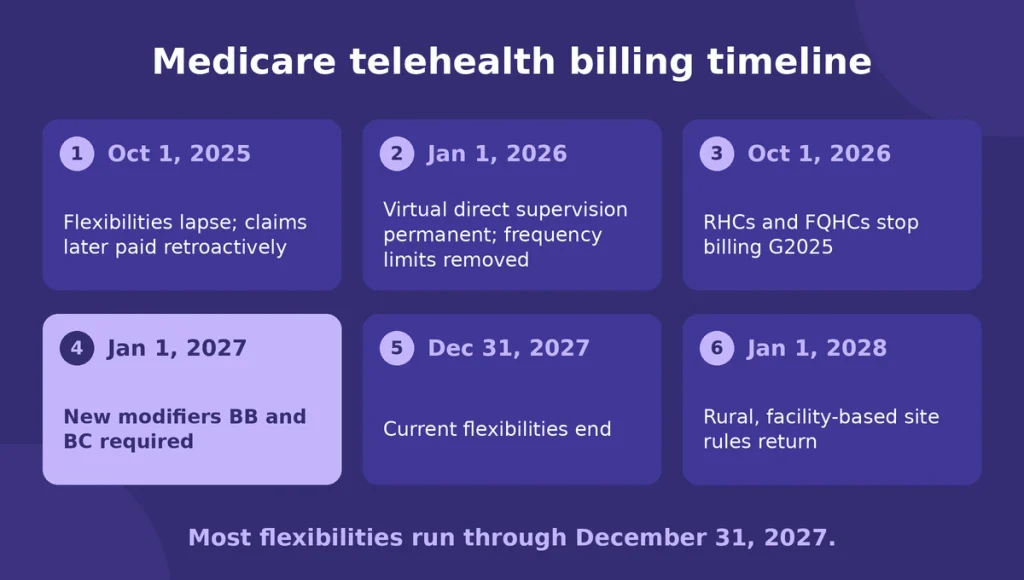
| Date | What Changes |
|---|---|
| October 1, 2025 | Flexibilities lapsed during the government shutdown; CMS later paid those claims as if there had been no lapse |
| January 1, 2026 | CY 2026 fee schedule: virtual direct supervision made permanent (except 010 and 090 global services); frequency limits on subsequent inpatient, nursing facility and critical care telehealth removed; teaching physician virtual presence for telehealth |
| October 1, 2026 | RHCs and FQHCs stop billing G2025 and bill the individual CPT or HCPCS code with a telehealth modifier |
| January 1, 2027 | New modifiers BB and BC required, with no payment effect |
| December 31, 2027 | Current flexibilities end: telehealth anywhere, expanded practitioner types and audio-only to the home |
| January 1, 2028 | Most non-behavioral telehealth again requires a rural, facility-based originating site; PT, OT, SLP and audiology telehealth ends; in-person visit rules apply to new mental health telehealth patients |
Source: CMS Telehealth FAQ (updated October 2026); CMS MM14315.

What Are the CMS Telehealth Billing Guidelines for 2026?
Through December 31, 2027, Medicare telehealth works much as it did after the pandemic. These are the main rules in effect in 2026:
| Rule | What It Means in 2026 |
|---|---|
| Patient location | Patients can receive telehealth anywhere in the United States, including at home, with no rural requirement |
| Practitioners | An expanded range of practitioners, including physical and occupational therapists, speech-language pathologists and audiologists, can bill telehealth |
| Audio-only | Allowed for patients at home when the practitioner can use video but the patient cannot or does not consent |
| Behavioral health | Geographic and site restrictions are permanently removed; audio-only is permitted |
| Virtual direct supervision | Permanent through real-time audio and video for services without a 010 or 090 global period |
| Frequency limits | Permanently removed for subsequent inpatient, nursing facility and critical care telehealth visits |
| Practitioner home | Practitioners can furnish telehealth from home and usually bill from their practice location |
Source: CMS Telehealth FAQ; HHS telehealth policy updates.
Which Place of Service Code Should You Use for Telehealth?
Use POS 10 when the patient is in their home and POS 02 when they are anywhere else, such as work, school or another facility. The difference is not cosmetic: since January 1, 2024, Medicare pays POS 10 at the non-facility rate and POS 02 at the facility rate, as the CMS Telehealth FAQ explains. Billing POS 02 for a home visit leaves money on the table.
| POS | Description | Medicare Rate |
|---|---|---|
| 10 | Telehealth provided in the patient’s home | Non-facility |
| 02 | Telehealth provided other than in the patient’s home | Facility |
Our guide to place of service codes in medical billing covers how POS affects payment across every setting.
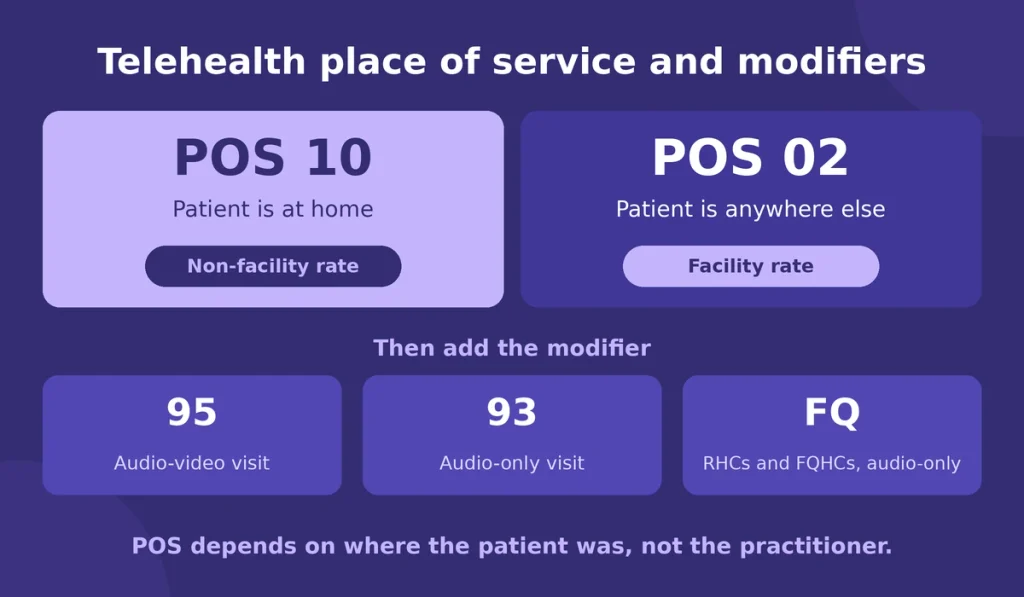
Pro Tip: Make the patient’s location a required field in the telehealth note template. The POS code depends on where the patient was, not where the practitioner was, and it is the field most often picked from habit.
Which Modifiers Are Required for Telehealth in 2026?
Telehealth modifiers tell the payer how the service was delivered. Medicare’s claims processing instructions pair POS 02 or 10 with modifier 95 for audio-video or 93 for audio-only, and Medicare contractors such as First Coast list the full set:
| Modifier | Meaning | When to Use It |
|---|---|---|
| 95 | Synchronous audio-video telemedicine | Live video visits |
| 93 | Synchronous audio-only telemedicine | Phone-only visits when audio-only is allowed |
| FQ | Service furnished using audio-only technology | RHCs and FQHCs, alone or with 93 |
| FR | Supervising practitioner present through audio-video | Services requiring direct supervision met virtually |
| G0 | Telehealth for acute stroke | Telestroke services |
| GQ | Asynchronous (store-and-forward) telecommunication | Federal demonstrations in Alaska and Hawaii |
| GT | Interactive audio and video (older) | Critical access hospitals billing Method II |
| BB, BC | Virtual platform arrangement; incident-to telehealth | Required from January 1, 2027 |
Source: First Coast telehealth modifiers; CMS Telehealth FAQ. Commercial payers set their own modifier rules.
What Are the Telehealth CPT Codes for 2026?
For Medicare, a telehealth visit is billed with the same CPT code as the in-person service, as long as the service is on the Medicare Telehealth Services List. There is no separate Medicare “telehealth visit” code for office E/M.
| Service | Codes | Billing Note |
|---|---|---|
| Office and outpatient E/M | 99202 to 99215 | Medicare: POS 02 or 10 with modifier 95 or 93 |
| CPT telemedicine E/M | 98000 to 98015 | Added in CPT 2025; Medicare does not pay them, but some commercial payers do |
| Brief virtual check-in | 98016 | Recognized by Medicare; replaced G2012 |
| Psychotherapy and diagnostic evaluation | 90791, 90832 to 90838 | Behavioral health telehealth is permanent |
| Online digital E/M (e-visits) | 99421 to 99423 | Patient-initiated portal communication, not real-time telehealth |
| Remote physiologic monitoring | 99453, 99454, 99457, 99458, plus 99445 and 99470 (CPT 2026) | Not telehealth services, so telehealth restrictions do not apply |
Commercial payers vary. Highmark, for example, accepts CPT 98000 to 98016 for telehealth visits with POS 02 or 10, according to its telehealth reimbursement policy, while Medicare uses the regular E/M codes. Check each payer’s policy before choosing the code.
How Do RHCs and FQHCs Bill Telehealth After October 1, 2026?
Through September 30, 2026, RHCs and FQHCs billed non-behavioral telehealth with HCPCS G2025. Beginning October 1, 2026, they bill the individual CPT or HCPCS code that describes the distant site service, with the appropriate telehealth modifier, instead of G2025, as the Telehealth Resource Center and the California Medical Association reported. Behavioral health telehealth by RHCs and FQHCs continues to be paid under the All-Inclusive Rate and PPS, and audio-only services can be reported with 93 or FQ.
What Changes for Telehealth in 2027 and 2028?
2027 is a transition year. The BB and BC modifiers become required on January 1, 2027, and the current flexibilities run through December 31, 2027. On January 1, 2028, unless Congress acts again:
- Patients generally must be in a medical facility in a rural area for non-behavioral telehealth.
- Physical therapists, occupational therapists, speech-language pathologists and audiologists can no longer furnish Medicare telehealth.
- Hospitals can no longer bill outpatient therapy, diabetes self-management training and medical nutrition therapy furnished remotely to patients at home.
- New mental health telehealth patients need an in-person visit within 6 months before the first telehealth service, then at least every 12 months; patients who started before January 1, 2028 are treated as established.
- Audio-only to the home remains available for behavioral health when the patient cannot or does not consent to video.
What Documentation Does Telehealth Billing Require?
| Element | What to Record |
|---|---|
| Patient location | Home or another location, which decides POS 10 or 02 |
| Practitioner location | Needed for enrollment and some payer policies |
| Modality | Audio-video or audio-only |
| Reason for audio-only | That video was available and the patient could not or did not consent |
| Consent | Patient consent where required, such as for virtual check-ins and care management |
| Time or MDM | Support for the E/M level, as for an in-person visit |
| Participants | Anyone else present, such as a caregiver or interpreter |
| Technical issues | Any interruption that changed the modality or length of the visit |
Telehealth platforms that handle patient data are HIPAA business associates, so the platform vendor needs a signed business associate agreement. Practitioners who furnish telehealth from home but have a physical practice location do not need to report their home address on their Medicare enrollment, while virtual-only practitioners must enroll their home as a practice location, which credentialing and enrollment should account for.
How Do Commercial Payers Such as Cigna Handle Telehealth Billing?
Commercial payers, including Cigna, publish their own virtual care reimbursement policies, and they do not always match Medicare. Some require POS 02 or 10 with modifier 95, some ask for the in-person POS such as 11 with modifier 95 and some accept the CPT 98000 to 98015 telemedicine codes. Cost sharing, covered services and audio-only rules also vary by plan. Load each payer’s current telehealth policy into your claim scrubber rather than applying Medicare rules to every claim.
What Are the Most Common Telehealth Billing Errors?
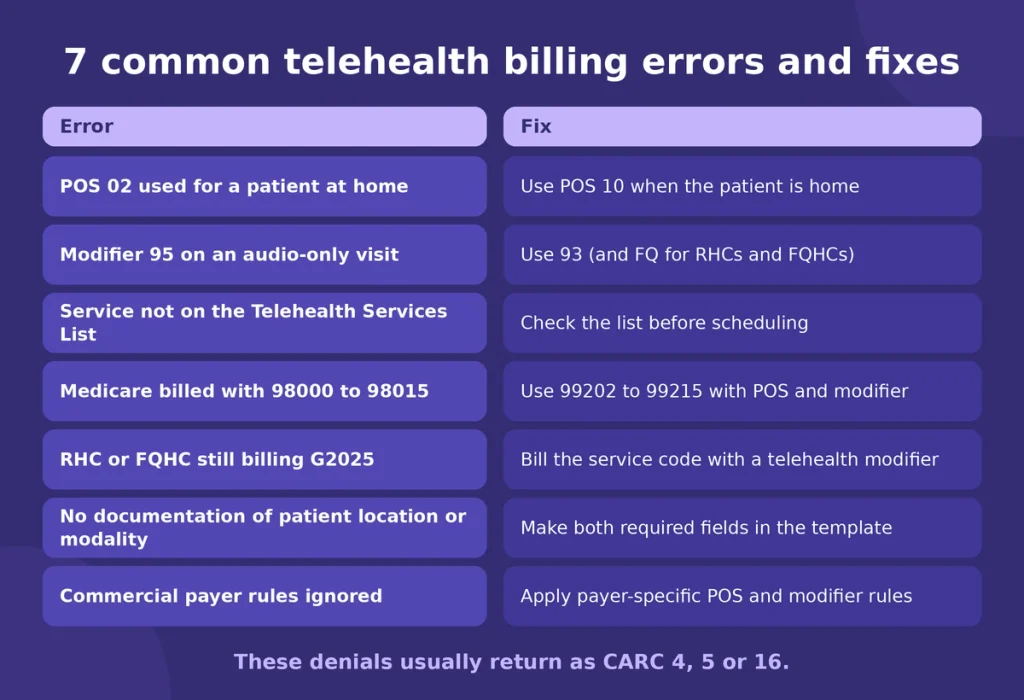
| Error | What Happens | Fix |
|---|---|---|
| POS 02 used for a patient at home | Paid at the lower facility rate | Use POS 10 when the patient is home |
| Modifier 95 on an audio-only visit | Denial or recoupment on audit | Use 93 (and FQ for RHCs and FQHCs) |
| Service not on the Telehealth Services List | Denied | Check the list before scheduling |
| Medicare billed with 98000 to 98015 | Not payable by Medicare | Use 99202 to 99215 with POS and modifier |
| RHC or FQHC still billing G2025 after September 30, 2026 | Rejected | Bill the individual service code with a telehealth modifier |
| No documentation of patient location or modality | Audit risk | Make both required fields in the template |
| Commercial payer rules ignored | Denials and underpayments | Apply payer-specific POS and modifier rules |
These denials usually return as CARC 4, 5 or 16, explained in our guide to common denial codes in medical billing.
How Can iSolve RCM Help With Telehealth Billing?
iSolve RCM builds Medicare and commercial telehealth rules into the claim scrubber, from POS and modifier pairing to payer-specific code choices, and its certified medical coding team reviews documentation for location, modality and audio-only reasons. Before January 1, 2027, we will also update claim templates for the new BB and BC modifiers. Services start at 2.99% of monthly collections.

Frequently Asked Questions
What is the CPT code for a telehealth visit in 2026?
For Medicare, use the same CPT code as the in-person service, such as 99213, with POS 10 or 02 and modifier 95 or 93. Some commercial payers accept the CPT telemedicine codes 98000 to 98015 instead; Medicare does not pay those.
Is modifier 95 required for Medicare telehealth in 2026?
Medicare’s claims instructions pair POS 02 or 10 with modifier 95 for audio-video visits and 93 for audio-only. The POS code decides the payment rate, but include the modifier to show the modality.
Does POS 10 pay more than POS 02?
Yes. Since 2024, Medicare pays POS 10 (patient at home) at the non-facility rate and POS 02 at the facility rate, which is lower for most services.
Can physical therapists bill Medicare telehealth in 2026?
Yes, through December 31, 2027. Starting January 1, 2028, physical therapists, occupational therapists, speech-language pathologists and audiologists can no longer furnish Medicare telehealth unless the law changes.
What are the BB and BC modifiers?
BB identifies telehealth furnished through a virtual platform owned by an entity the practitioner contracts with or pays, and BC identifies telehealth furnished incident to a physician’s or practitioner’s service. Both are required from January 1, 2027 and do not affect payment.
Is remote patient monitoring a telehealth service?
No. Remote monitoring, chronic care management and similar non-face-to-face services are not on the Medicare Telehealth Services List, so telehealth restrictions do not apply to them.