

A Texas provider that sends a patient’s first bill on the first day of the 11th month after the visit has already missed the deadline. Under Chapter 146 of the Texas Civil Practice and Remedies Code, the provider can lose the right to collect the amounts the patient’s plan would have paid and any amount the patient would not have owed if the bill had gone out on time, as the Texas State Law Library explains.
That is the pattern in Texas medical billing. The state layers its own deadlines on top of federal rules, and each one has a different clock: 95 days to file most insurance claims, 30 or 45 days for insurers to pay, about 10 months to bill patients and four years to sue on an unpaid bill. Missing any of them costs revenue that a correctly coded claim cannot recover.
This guide answers the questions Texas providers ask most about billing regulations going into 2027, with every deadline checked against Texas statutes, the Texas Department of Insurance (TDI) and CMS.
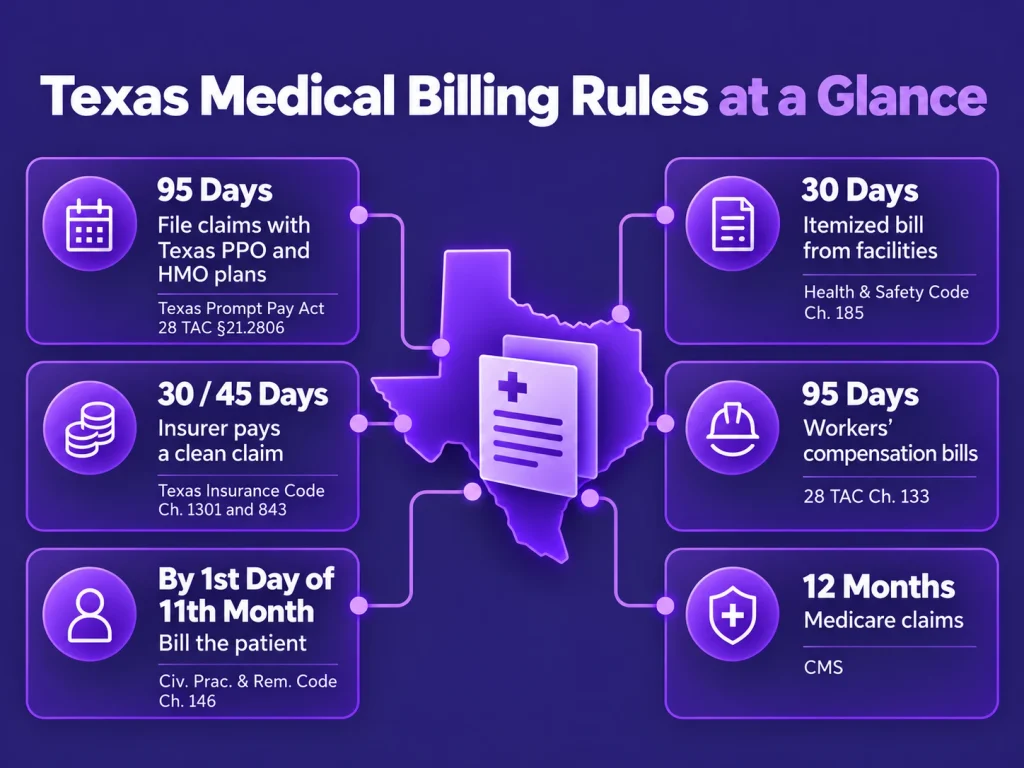
Texas Medical Billing Rules at a Glance
| Rule | Deadline or Requirement | Source |
|---|---|---|
| File claims with Texas PPO and HMO plans | Within 95 days of the date of service (discharge for hospitals) | Texas Prompt Pay Act; 28 TAC $21.2806 |
| Insurer pays a clean claim | 30 days electronic, 45 days paper | Texas Insurance Code Ch. 1301 and 843 |
| Bill the patient | By the first day of the 11th month after service | Civ. Prac. & Rem. Code Ch. 146 |
| Itemized bill from facilities | Within 30 days after final third party payment, before collections | Health & Safety Code Ch. 185 |
| Workers’ compensation bills | Within 95 days of the date of service, electronically | 28 TAC Ch. 133 |
| Medicare claims | Within 12 months of the date of service | CMS |
| Sue on an unpaid bill | Within four years | Texas statute of limitations |
What Are the Main Texas Medical Billing Regulations?
Texas medical billing is governed by six main sets of rules. Each applies to a different relationship: provider and insurer, provider and patient or provider and the workers’ compensation system.
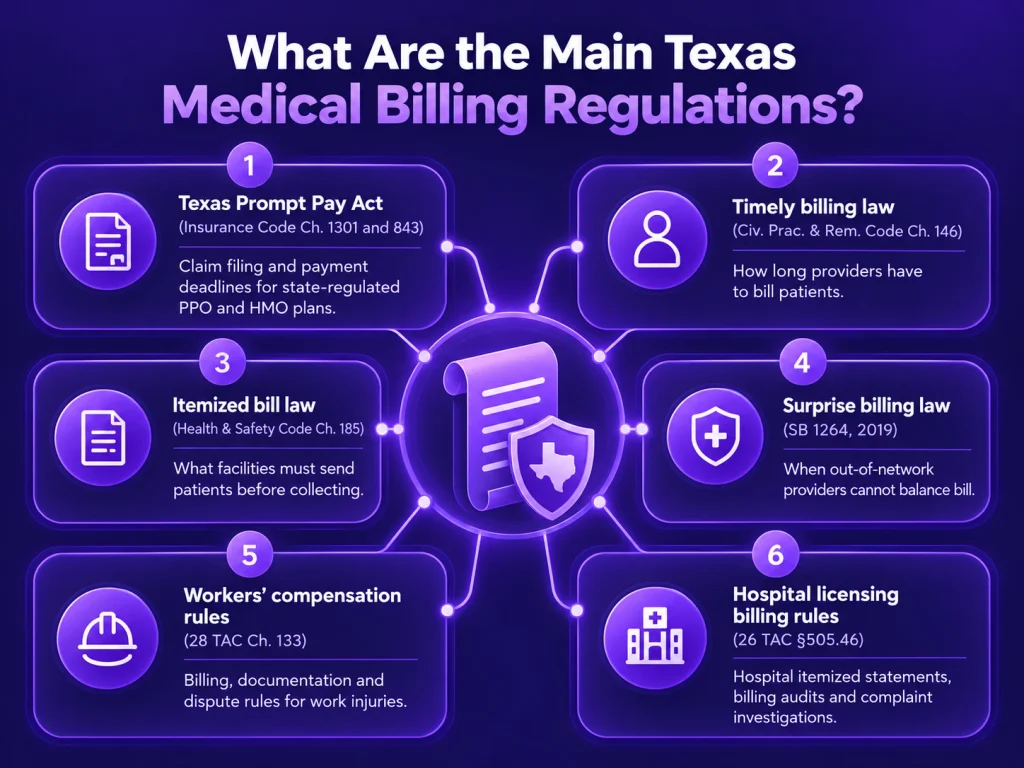
| Regulation | What It Governs |
|---|---|
| Texas Prompt Pay Act (Insurance Code Ch. 1301 and 843) | Claim filing and payment deadlines for state regulated PPO and HMO plans |
| Timely billing law (Civ. Prac. & Rem. Code Ch. 146) | How long providers have to bill patients |
| Itemized bill law (Health & Safety Code Ch. 185) | What facilities must send patients before collecting |
| Surprise billing law (SB 1264, 2019) | When out of network providers cannot balance bill |
| Workers’ compensation rules (28 TAC Ch. 133) | Billing, documentation and dispute rules for work injuries |
| Hospital licensing billing rules (26 TAC $505.46) | Hospital itemized statements, billing audits and complaint investigations |
What Is the Time Limit for Medical Billing in Texas?
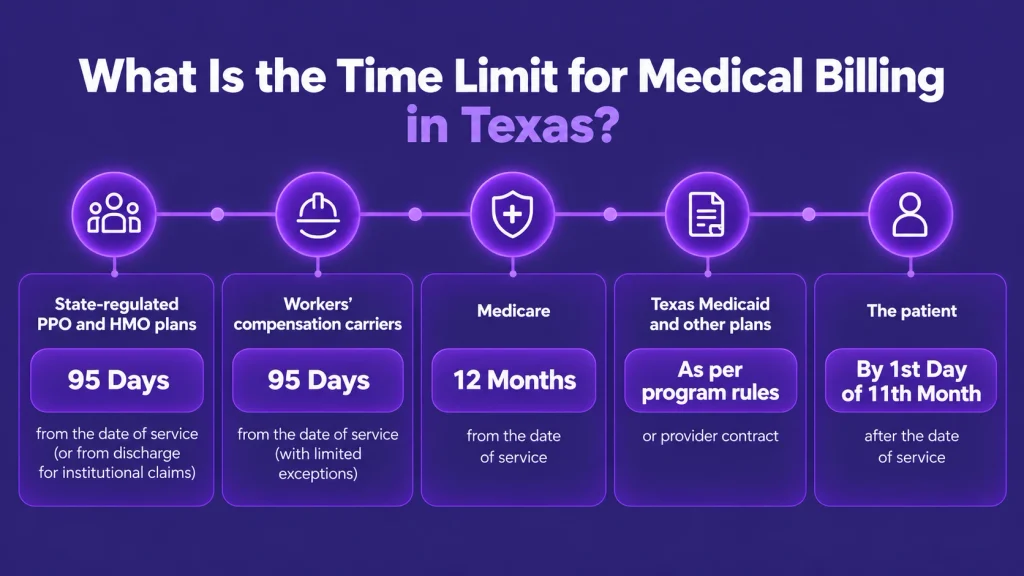
There are two time limits: one for billing the payer and one for billing the patient. Which applies depends on who pays.
| Who You Bill | Time Limit |
|---|---|
| State regulated PPO and HMO plans | 95 days from the date of service, or from discharge for institutional claims |
| Texas workers’ compensation carriers | 95 days from the date of service, with limited exceptions |
| Medicare | 12 months from the date of service |
| Texas Medicaid and other plans | The deadline in the program rules or the provider contract |
| The patient | By the first day of the 11th month after the date of service |
Source: TDI prompt pay rules; TDI workers’ compensation billing; Texas State Law Library.
How Long Does a Hospital or Doctor Have to Bill You in Texas?
Under Texas Civil Practice and Remedies Code $146.002, a health care provider must bill a patient no later than the first day of the 11th month after the date of service, which gives providers about 10 months. When the provider is required to bill an insurer or a government payer first, the deadline in that contract or program rule applies to the claim instead, as The Hadi Law Firm’s summary of Chapter 146 explains.
Billing means mailing the bill to the patient or responsible person, or submitting it to the health plan or third party payer in the way that payer requires. If the provider misses the deadline, it cannot collect the amounts the plan would have paid or any amount the patient would not have owed if the bill had been timely. The law does not add licensing discipline for missing it; the penalty is lost revenue.
For providers, the practical rule is to send the first patient statement as soon as the payer’s remittance arrives and to keep proof of the mailing date. Aging accounts that sit untouched for months are where Chapter 146 losses happen, which is why steady A/R management matters in Texas.
What Are the Texas Insurance Claim Payment Deadlines?
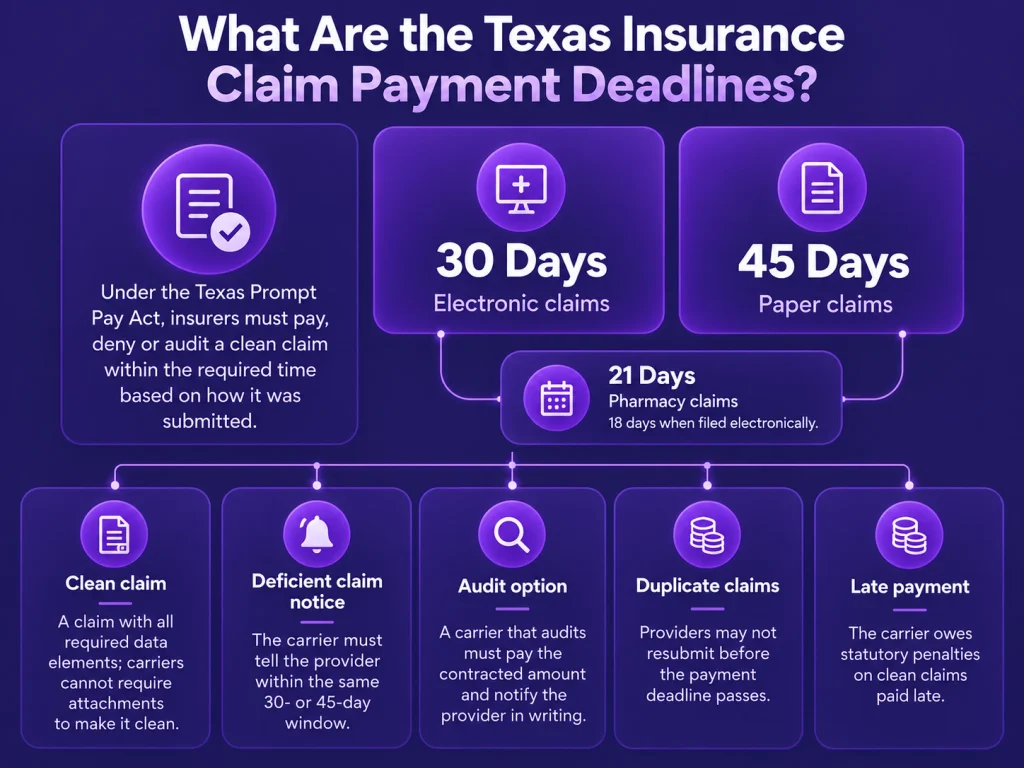
Under the Texas Prompt Pay Act, insurers must pay, deny or audit a clean claim within 30 days if it was submitted electronically and within 45 days if it was submitted on paper. Pharmacy claims have 21 days, or 18 days when filed electronically. Providers must file within 95 days of the date of service or forfeit payment, according to the TDI prompt pay rules.
| Prompt Pay Rule | What It Requires |
|---|---|
| Clean claim | A claim with all required data elements; carriers cannot require attachments to make it clean |
| Deficient claim notice | The carrier must tell the provider within the same 30 or 45 day window |
| Audit option | A carrier that audits must pay the contracted amount and notify the provider in writing within the deadline |
| Duplicate claims | Providers may not resubmit before the payment deadline passes |
| Late payment | The carrier owes statutory penalties on clean claims paid late |
Source: TDI prompt pay rules; TDI claim submission timeline.
The Prompt Pay Act covers state regulated PPO and HMO plans. It does not apply to Medicare, Medicaid, self funded ERISA plans or workers’ compensation, which follow their own rules, as a summary of the Texas prompt pay provisions notes.
What Is the BCBS Texas Timely Filing Limit?
For Blue Cross and Blue Shield of Texas plans subject to the Texas Prompt Pay Act, claims must be filed within 95 days of the date of service, and BCBSTX states in its provider manual that it complies with the Act’s 30 and 45 day payment deadlines. BCBSTX Medicare Advantage, Medicaid and self funded employer plans can set different filing limits in their contracts, so check the product on the member’s card before relying on 95 days.
Is Balance Billing Legal in Texas?
Not in the situations Texas and federal law protect. According to TDI, state and federal laws together ban surprise bills for anyone with health insurance other than Medicare in four situations: emergencies, air ambulance services, care received in an in network hospital and labs and imaging ordered by an in network doctor.
Texas law also bans surprise bills from ground ambulance services for state regulated plans, Employees Retirement System (ERS) plans, Teacher Retirement System (TRS) plans and employer plans that opted into the Texas law. Patients still owe their normal copay, coinsurance and deductible, and they can still choose an out of network doctor when their plan allows it. Payment disputes between out of network providers and state regulated plans go through TDI’s independent dispute resolution process, and Texas hospitals must follow SB 1264 and the related TDI disclosure rules under 26 TAC $505.46.
What Are the Texas Itemized Bill Requirements?
Since September 1, 2023, Senate Bill 490 has required licensed health care facilities, including hospitals, to send patients a written itemized bill before collecting a balance. It does not apply to physician practices, individual providers or federally qualified health centers, as Katten summarized in Legal 500.
| Requirement | Detail |
|---|---|
| When | Within 30 days after the facility receives final payment from a third party, and again on request |
| Format | In writing or through the patient portal |
| Contents | A plain language description of each service and supply, any billing codes sent to a payer, the amounts billed to and paid by the payer and the amount due from the patient for each item |
| Penalty | The facility may not collect the debt until it complies and can face licensing discipline |
Source: Texas Health & Safety Code Ch. 185; Legal 500 (Katten).
What Are the Texas Workers’ Compensation Billing Requirements?
Texas workers’ compensation billing follows 28 TAC Chapter 133, and the TDI Division of Workers’ Compensation sets these core requirements:
| Requirement | What It Means |
|---|---|
| Electronic billing | Texas Labor Code $408.0251 requires electronic bills, with limited paper exceptions |
| 95 day filing deadline | Bills submitted late lose the right to reimbursement, with exceptions in Labor Code $408.0272 |
| Rendering provider | Bill in the name of the licensed provider who gave or directly supervised the care |
| Charges | No more than the provider’s usual and customary charges |
| Codes | The billing codes in the DWC fee guidelines in effect on the date of service |
| Forms | CMS 1500 or 837P for professionals, UB 04 or 837I for hospitals, DWC Form 066 for pharmacy and the ADA form for dental |
| Disputes | Medical fee dispute resolution and medical necessity disputes through DWC processes |
What Is the Statute of Limitations on Medical Debt in Texas?
Four years. A provider generally has four years to sue to collect an unpaid medical bill in Texas. That is separate from the timely billing deadline: a provider can bill on time and still lose the right to sue after four years, or bill late and lose part of the balance even if it sues within four years.
Credit reporting has its own rules. Since 2023, the three national credit bureaus no longer report medical debts under $500, and the 2025 federal rule that would have removed all medical debt from credit reports was vacated by a court in the Eastern District of Texas, as the Texas State Law Library notes.
What Is the 72 Hour Rule in Medical Billing?
The 72 hour rule is Medicare’s three day payment window. When a patient is admitted to a hospital paid under the inpatient prospective payment system, outpatient diagnostic services and related non diagnostic services the hospital provided in the three days before admission are bundled into the inpatient claim instead of being billed separately. For hospitals not paid under that system, such as psychiatric and rehabilitation hospitals, the window is one day. The rule applies to services by the admitting hospital and entities it wholly owns or operates.
What Are the CMS Incident to Billing Guidelines for 2026?
Incident to billing lets a physician bill at the full fee schedule rate for services a nurse practitioner, physician assistant or staff member provides under the physician’s direct supervision in the office. Starting January 1, 2026, CMS permanently allows that direct supervision through real time audio and video, except for services with a 010 or 090 global surgery period, according to the CMS summary of the 2026 fee schedule. Audio only does not count, and incident to still requires an established patient and an existing plan of care.
What Are the Guidelines for Medical Billing?
Across every state, the core guidelines are the same: verify eligibility before the visit, code from complete documentation, bill under the rendering provider, file within each payer’s deadline, follow federal and state balance billing protections and refund overpayments promptly. Texas adds the state deadlines above, so a Texas billing workflow needs separate clocks for payers, patients and workers’ compensation.
What Should Texas Providers Watch for in 2027?
| Date | What to Watch |
|---|---|
| November 2026 | CMS final 2027 Physician Fee Schedule, including the proposed G2211 and modifier 25 changes |
| January 1, 2027 | Federal Prior Authorization API requirement for Medicare Advantage, Medicaid and CHIP plans |
| January 12, 2027 | The 90th Texas Legislature convenes; billing and insurance bills typically take effect September 1 |
| Ongoing | TDI rule updates on prompt pay, surprise billing disputes and network disclosures |
How Can iSolve RCM Help With Texas Medical Billing?
iSolve RCM tracks the Texas deadlines that cost providers the most: the 95 day filing window for state regulated plans and workers’ compensation, prompt pay penalties on late payers and the Chapter 146 window for patient statements. Our medical billing services in Texas cover eligibility, coding, claim submission, denial management and A/R follow up, starting at 2.99% of monthly collections.

Frequently Asked Questions
How can I contact iSolve RCM customer support?
You can reach iSolve RCM by phone at 848-266-5475, by email at [email protected] or through the contact form on the iSolve RCM website. The office is at 180 Talmadge Road, IGO Building 749, Edison, NJ 08817.
What is the Texas timely billing law?
Chapter 146 of the Texas Civil Practice and Remedies Code requires providers to bill patients by the first day of the 11th month after the date of service. Providers that miss it cannot collect amounts the patient’s plan would have paid or that the patient would not have owed with timely billing.
What is the Texas law on unpaid medical bills?
Unpaid medical bills can be sent to collections like other debts, but Texas facilities must first send an itemized bill under Health and Safety Code Chapter 185, and providers generally have four years to sue to collect.
How long do medical providers have to bill insurance in Texas?
For state regulated PPO and HMO plans, 95 days from the date of service. Medicare allows 12 months, and Medicaid, self funded and Medicare Advantage plans follow their own program or contract deadlines.
When are medical bills due?
A medical bill is due on the date shown on the statement, which the provider sets. Texas law controls when the provider must send the bill, not when the patient must pay it, so patients should ask about payment plans if they cannot pay by the due date.
Does the Texas surprise billing law apply to self funded plans?
Texas law covers state regulated plans and certain public and opt in employer plans. Most self funded employer plans are covered by the federal No Surprises Act instead, which offers similar protections.