
Here’s a detail that tells you almost everything about urgent care billing. Starting August 1, 2026, Ambetter plans in several states began paying the urgent care codes S9083 and S9088 only when the claim carries place of service 20. Any other place of service, and the claim is denied. The visit could be perfect, the diagnosis right and the E/M level spot on. One two-digit field decides whether you get paid.
That’s the nature of this work. Urgent care billing doesn’t get faster because your team types faster. It gets faster because a small set of fields is right the first time: eligibility, rendering provider, place of service, E/M level and modifier 25. Every claim that has to be fixed and resubmitted adds weeks. A clean claim on day one is the real shortcut.
If you run an urgent care center, you also know why this is hard. Patients walk in unscheduled. Volume swings with flu season and Monday mornings. Front desk staff are checking in six people while answering the phone. And payers each have their own opinions about what an urgent care visit is and how it should be coded.
This guide walks through how urgent care billing works, which codes and rules matter in 2026 and 2027, and how to speed up urgent care claims without creating new denials. We’ll also answer the questions patients ask, like why they got a bill later, because your front desk hears those every day.
Quick note: payer policies and Medicare rules change often, and some 2027 items below are still proposals. Treat this as a working guide and confirm details with each payer and the final CMS rules.
How does urgent care billing work?
Urgent care billing is the process of turning walk-in visits into paid claims. It starts at check-in with insurance verification, moves through coding the visit and any procedures, applies each payer’s urgent care rules, submits the claim, posts the payment and collects whatever the patient owes.
Most freestanding urgent care centers bill on a professional claim (the CMS-1500 on paper, the 837P electronically). A typical claim is built from four parts:
| Claim element | What it carries | Where it goes wrong |
| Place of service | POS 20 for an urgent care facility, or POS 11 if the payer contract calls for office | Wrong POS drops the claim out of the urgent care rate or denies it outright |
| E/M visit | Office or outpatient codes 99202 to 99215, chosen by medical decision-making or time | Levels the note doesn’t support |
| Procedures and tests | Laceration repair, splinting, injections, X-rays, CLIA-waived tests | Missing modifier 25 or QW, or services that should have been bundled |
| Payer-specific codes | S9083 or S9088 where a contract requires them | Billing them to payers that don’t recognize them |
Independent versus hospital-owned urgent care
This is a distinction a lot of guides blur, so it’s worth getting right.
A freestanding urgent care center bills the professional claim only. A hospital-owned urgent care that operates as a provider-based department usually bills two claims: a professional claim with POS 19 or 22, and a facility claim on the UB-04, commonly under revenue code 0456 for urgent care. That second claim is the facility fee. When people say urgent care centers charge facility fees, they’re usually describing hospital-owned centers, not independent ones.
Urgent care CPT codes you’ll use most
Urgent care coding is mostly about choosing the right E/M level and then accounting for everything else that happened in the room. Here are the urgent care CPT codes that show up most often.
| Service | Codes | Billing note |
| New patient visit | 99202 to 99205 | 99201 was deleted in 2021 |
| Established patient visit | 99211 to 99215 | Many urgent care patients are new to the practice |
| After-hours services | 99050, 99051 | Some commercial payers pay these; Medicare generally doesn’t |
| Simple laceration repair | 12001 to 12007 | A same-day E/M needs modifier 25 and separate documentation |
| Incision and drainage | 10060, 10061 | Simple or complicated abscess |
| Splinting | 29105, 29125, 29515 | Arm, forearm and lower leg splints |
| Injection | 96372 | Plus the drug HCPCS code, such as J1885 for ketorolac |
| Chest X-ray | 71045, 71046 | One or two views |
| CLIA-waived tests | 87880 (strep), 87804 (flu), 81002 (urinalysis) | Medicare requires modifier QW for CLIA-waived tests |
| Vaccine administration | 90471, +90472 | Plus the vaccine product code |
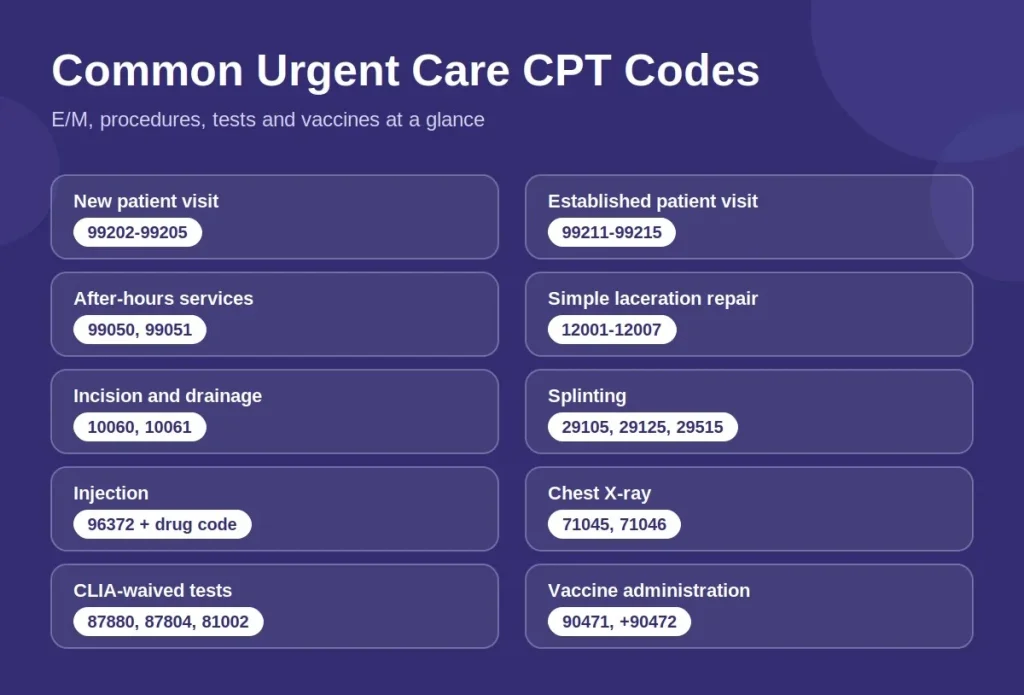
Sources: AMA CPT code set and HCPCS Level II. Always confirm against your current code books.
Codes that don’t belong on urgent care claims
Two mistakes keep appearing in older guides. The first is 99201, which hasn’t existed since January 1, 2021. The second is the emergency department codes, 99281 to 99285. Those describe care in a hospital-based emergency department that’s open around the clock. A freestanding urgent care center billing them invites denials and audit attention.
Coding tip: Pick the E/M level from the medical decision-making in the note, not from how crazy the shift was. Urgent care volume naturally pushes visits toward 99213 and 99214, and payers watch those patterns. Strong medical coding review on higher-level visits is cheap insurance.
Urgent care place of service code: POS 20 versus POS 11
POS 20 is the CMS place of service code for an urgent care facility. CMS defines it as a location, distinct from a hospital emergency room, an office or a clinic, whose purpose is to diagnose and treat illness or injury for unscheduled, ambulatory patients seeking immediate medical attention. Medicare pays POS 20 at the non-facility rate, the same as an office visit.
Where it gets messy is commercial and Medicaid plans. They decide what POS 20 means for payment, and the rules don’t match from payer to payer. Some want urgent care billed with POS 20. Some contracts say POS 11. Some pay S9083 and S9088 only with POS 20, as the Ambetter notice shows. Others don’t reimburse those codes at all.
The takeaway isn’t to memorize every payer’s preference. It’s to build each payer’s POS and code rules into your claim scrubber so a human never has to remember them. A rule in the software fires every time. A rule in someone’s head fires when they’re having a good day.
You can read the official definition on the CMS Place of Service Code Set page.
Global fee for urgent care centers: S9083 and S9088
Two HCPCS codes cause more confusion than almost anything else in urgent care.
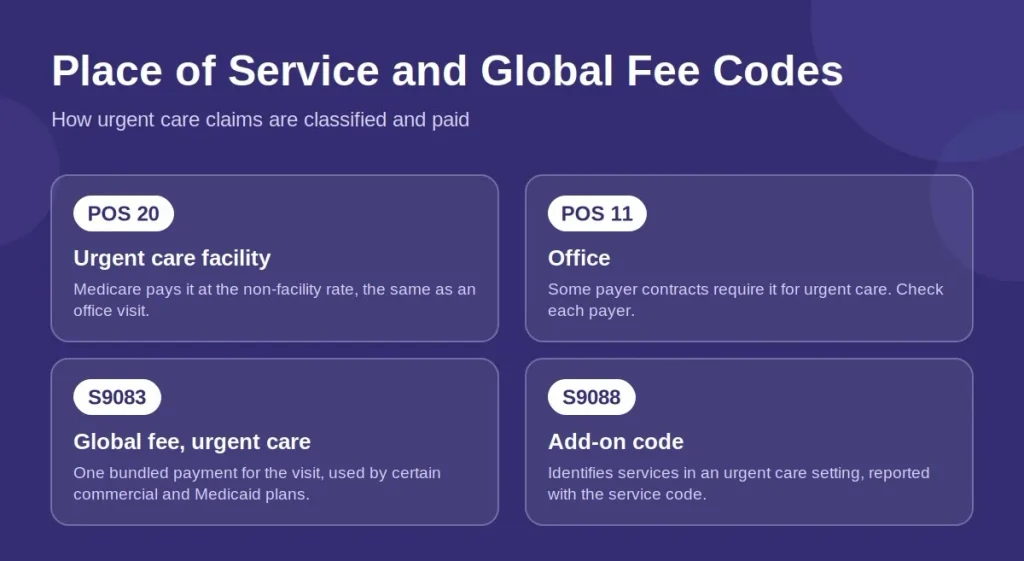
S9083 is the code for a global fee for urgent care centers. It represents one bundled payment for the whole visit. S9088 is an add-on code that identifies services provided in an urgent care setting, reported in addition to the code for the service itself. Both are temporary national S codes that certain commercial and Medicaid plans use.
According to the Ambetter provider bulletin, effective August 1, 2026, those codes become reimbursable only when billed with place of service 20, and claims with any other place of service are denied. Original Medicare doesn’t recognize either code.
Which model pays better depends on the contract. A global fee can work nicely for quick, low-acuity visits. It tends to underpay visits with X-rays, procedures and several tests. So the practical question for any urgent care is simple: which payers pay a global fee, which pay fee-for-service, and which pay S9088 on top? Write that down once, load it into your system and review it every time a contract renews.
What are the CMS urgent care billing requirements?
Medicare has no separate urgent care benefit. It pays urgent care visits like office visits, with a few rules that matter more in urgent care than almost anywhere else.
| Requirement | What it means |
| Bill under the rendering provider | The clinician who saw the patient must be enrolled and appear on the claim |
| Incident-to rarely applies | It’s generally for established patients under an existing plan of care, which most urgent care visits aren’t |
| Modifier QW | Required on CLIA-waived tests billed to Medicare |
| Advance Beneficiary Notice | Needed before a service Medicare may not cover, if the patient is to be billed |
| Telehealth place of service | POS 10 when the patient is at home, POS 02 elsewhere |
Billing under the wrong provider is where honest mistakes become real liability. A new nurse practitioner starts seeing patients before enrollment is finished, someone bills those visits under a supervising physician to keep the schedule moving, and suddenly there’s a compliance problem. Finish credentialing and enrollment before the first shift, not after the first claim.
What 2027 may change for urgent care
Urgent care has one proposed change worth watching. In the CY 2027 Medicare Physician Fee Schedule proposed rule, CMS proposes reducing payment when an office or outpatient E/M visit billed with modifier 25 happens on the same day as a procedure with a 0-, 10- or 90-day global period. Under the proposal, the highest-valued service would be paid at 100 percent, and each additional affected service that day would be reduced by 50 percent. You can read a summary from AAO-HNS, and Holland & Knight’s overview covers the wider rule.
Why does that matter here? An E/M plus a laceration repair, or an E/M plus an incision and drainage, is among the most common urgent care combinations. Physician groups, including the AMA, have urged CMS not to finalize the policy. The proposed rule also lowers the conversion factor for most physicians by about 1.68 percent. CMS typically finalizes these rules in November, so check the final version before you adjust your budgets or your workflows.
How to speed up urgent care claims without increasing denials
Every speed gain below comes with a guardrail. A claim that goes out fast and comes back denied is slower than one that went out right.
| Speed lever | What to do | Denial guardrail |
| Real-time eligibility at check-in | Run insurance eligibility verification for every visit and scan the card | Ask about secondary coverage so coordination of benefits doesn’t deny the claim |
| Same-day coding and charge entry | Close charts and enter charges within 24 hours, with a review for higher E/M levels | Check that every modifier 25 visit has a separately documented problem |
| Payer-rule claim scrubbing | Load each payer’s POS, S code and QW rules into the scrubber | Block claims that break NCCI edits or payer POS rules |
| Daily submission | Submit every day and clear clearinghouse rejections within 24 hours | Fix rejections at the source instead of resubmitting unchanged |
| ERA and EFT for every payer | Enroll in electronic remittance and payment | Post payments the same day so underpayments show up early |
| Credential before the first shift | Finish provider credentialing before any new clinician sees patients | Never bill a non-credentialed clinician under a supervising physician |
| Daily denial queue | Work denials every day through denial management | Track appeal deadlines by payer |
| Collect at the time of service | Collect copays and estimated balances at checkout | Give self-pay patients a Good Faith Estimate |
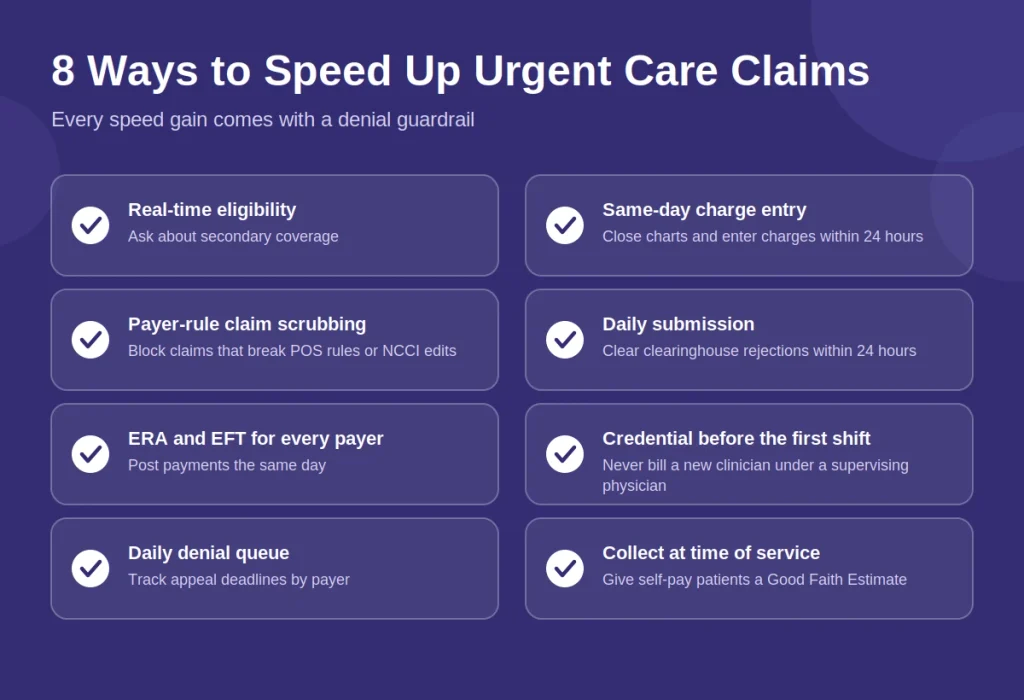
A few of these deserve a closer look.
Eligibility at the door. Urgent care patients often arrive with a card they haven’t used in a year. Verifying before the visit catches inactive coverage, wrong plans and missing secondary insurance. Most urgent care front desks are too busy to do this thoroughly in real time, which is why many centers automate it or hand it to a verification team.
Same-day charge entry. Charge lag is the quiet killer in urgent care. When charts sit unfinished for three or four days, claims go out late, errors pile up and your A/R grows. Set a hard rule: charts are closed and charges entered within 24 hours.
Rejections versus denials. A rejection means the claim failed an edit and never entered adjudication. It’s the easiest money to recover, but only if someone checks the clearinghouse report every day. A denial means the payer processed the claim and didn’t pay it, which usually needs an appeal or more information. Learn the difference and work them in different queues. Our guide to common denial codes in medical billing explains what the codes payers send actually mean.
Daily A/R attention. Urgent care claims are mostly small dollars and high volume, so aging balances are easy to ignore until they add up. Consistent A/R follow-up keeps small balances from becoming write-offs.
Numbers that show speed and quality
| KPI | What it measures |
| Charge lag | Days from visit to charge entry |
| Clean claim rate | Claims accepted on first submission |
| Denial rate | Claims denied, by payer and by reason |
| Days in A/R | How long claims take to get paid |
| Time-of-service collection rate | Patient responsibility collected at checkout |
Track them weekly during the busy season and monthly the rest of the year. If you want to know how your collections compare, our guide to average medical billing collection rates gives a useful frame of reference.
Common urgent care billing mistakes
Most denials trace back to a handful of repeat offenders:
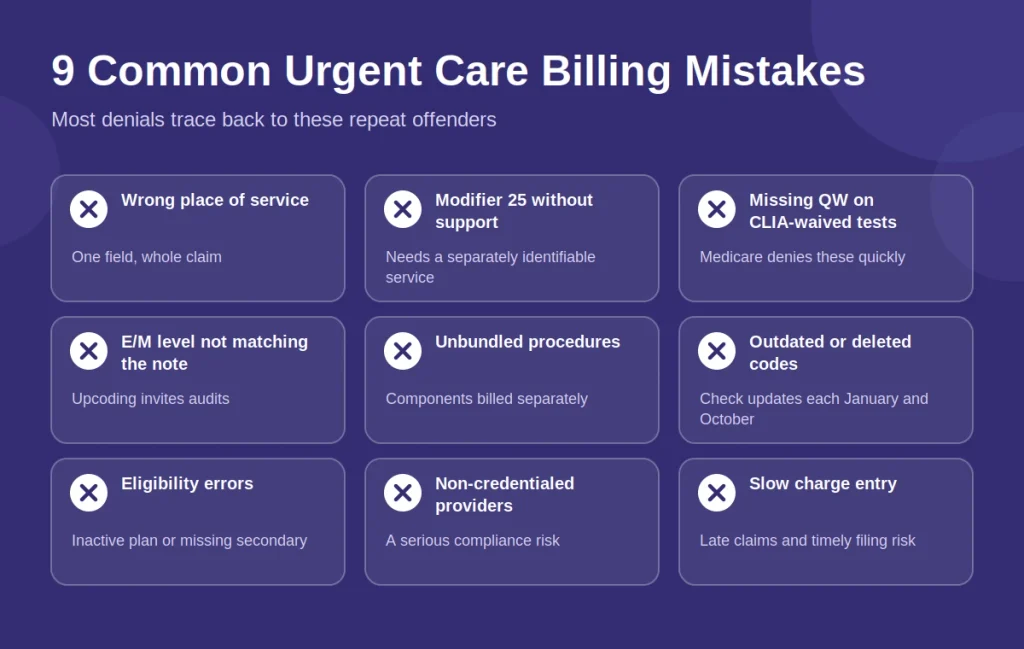
- Wrong place of service. The classic. One field, whole claim.
- Modifier 25 without support. The note needs to show a significant, separately identifiable service.
- Missing QW on CLIA-waived tests. Medicare denies these quickly.
- E/M levels that don’t match the note. Upcoding invites audits, and undercoding leaves money behind.
- Unbundled procedures. Billing separately for components that belong together.
- Outdated or deleted codes. Check annual updates every January and October.
- Eligibility errors. Wrong plan, inactive coverage or missing secondary insurance.
- Non-credentialed providers. One of the more serious compliance risks.
- Slow charge entry. Late claims, more errors and timely filing risk.
A periodic medical billing audit is a good way to find which of these is quietly costing you the most.
Questions patients ask (and your front desk hears daily)
Good billing includes good patient communication. Here are the questions that come up most, with answers you can adapt for your own patient materials.
Does urgent care bill you later with insurance?
Often, yes. Most urgent care centers collect a copay or an estimate at the visit, bill the insurance plan and then send a statement for any remaining deductible or coinsurance after the plan processes the claim.
Do I have to pay upfront at urgent care?
Many centers ask for your copay or an estimated payment at checkout, and self-pay patients often pay at the visit. Policies vary by center, so ask about urgent care payment options before you’re seen. Many centers offer card payments, payment plans or financing.
Why am I getting a bill from urgent care?
Usually because the center collected only the copay at checkout, then billed your plan. Once the plan processed the claim, any leftover deductible, coinsurance or non-covered amount became your balance. A bill can also follow if the center or clinician was out of network, if the plan denied a test or procedure, or if insurance information was missing or wrong at check-in.
How do I dispute an urgent care bill?
Start by asking the center for an itemized bill and comparing it to your insurer’s explanation of benefits. Call the billing office about anything that looks wrong, like a duplicate service or a code for something you didn’t receive. If the insurer denied something you believe should be covered, file an appeal with the plan.
Patients without insurance who got a Good Faith Estimate can use the federal patient-provider dispute resolution process if the final bill is at least $400 more than the estimate. Protections against surprise out-of-network bills apply mainly to emergency care, so urgent care disputes usually start with the center and the insurer.
When to outsource urgent care billing
Plenty of urgent care centers handle billing well in-house. Outsourcing starts to make sense when:
- Charge lag grows during busy seasons
- Clearinghouse rejections sit for days
- Payer POS and S code rules keep changing
- New clinicians start before credentialing is complete
- Your A/R is creeping past 60 and 90 days
- You’re opening a second or third location
- You can’t find or keep experienced billers
A partner that works claims every day keeps the cycle short through flu season and staffing changes, and it gives you consistent coverage when someone is out. If you’re comparing urgent care billing companies, ask these questions:
- Do you have urgent care experience, and how many urgent care clients do you serve?
- How do you handle POS 20, POS 11, S9083 and S9088 rules for each payer?
- What’s your process for modifier 25 and CLIA-waived test claims?
- How quickly do you submit claims and clear rejections?
- Will you work with our current EHR and practice management system?
- What reports will we see, and how often?
- How do you handle credentialing for new providers?
- What are your fees, and what does the rate include?
How iSolve RCM helps urgent care centers get paid faster
iSolve RCM is a U.S.-focused revenue cycle management company based in Edison, New Jersey. According to the company, it supports more than 200 providers across 45+ specialties, including urgent care. For a fast-moving urgent care operation, these services matter most:
- Eligibility and benefits verification before the visit, so inactive coverage and missing secondary plans don’t turn into denials
- Medical coding with attention to E/M levels, modifier 25, CLIA-waived tests and annual code updates
- Clean claim submission with payer rules built into the workflow
- Payment posting and reconciliation, so underpayments show up early
- Denial management with root-cause work on repeat denials
- A/R management to keep aging balances from piling up
- Provider credentialing and enrollment, so new clinicians are billable on day one
- Billing audits to find coding gaps and revenue leaks
- Regular reporting on clean claim rate, denials and days in A/R
- HIPAA-compliant handling of patient information
iSolve RCM advertises service fees starting as low as 2.99% of monthly collections with no hidden fees says onboarding usually takes one to two weeks depending on practice size and complexity, and offers a free revenue cycle assessment so you can see where claims are slowing down before you commit. You can learn more about the full range of revenue cycle management services or compare your options for outsourced medical billing.
As with any partner, bring urgent care-specific questions. A good one will answer them plainly.
Frequently Asked Questions
What is urgent care billing?
It’s the process of turning walk-in urgent care visits into paid claims: verifying coverage, coding the visit and procedures, applying each payer’s rules, submitting claims, posting payments and collecting patient balances.
What is the place of service code for urgent care?
POS 20 is the urgent care facility code. Some payers ask urgent care centers to bill POS 11 under their contracts, and some deny urgent care codes that aren’t billed with POS 20, so check each payer’s policy.
What are the most common urgent care CPT codes?
Office and outpatient E/M codes 99202 to 99205 and 99211 to 99215, laceration repair 12001 to 12007, incision and drainage 10060 and 10061, splinting codes, injection 96372, chest X-rays 71045 and 71046, CLIA-waived tests and vaccine administration codes.
Can an urgent care center bill emergency department codes?
A freestanding urgent care center should bill office or outpatient E/M codes, 99202 to 99215. Emergency department codes 99281 to 99285 describe care in a hospital-based emergency department.
What is the global fee for urgent care centers?
S9083 is the HCPCS code some commercial and Medicaid plans use to pay one global fee for an urgent care visit. S9088 is an add-on code for services provided in an urgent care setting. Medicare doesn’t recognize either, and some commercial plans don’t reimburse them.
How are urgent care centers reimbursed?
Most are paid fee-for-service for each E/M visit, procedure and test. Some commercial and Medicaid contracts pay a global fee per visit with S9083 or add S9088 to the E/M. Medicare pays urgent care visits at the non-facility physician fee schedule rate.
How can urgent care centers reduce claim denials?
Verify eligibility before every visit, build payer POS and code rules into the claim scrubber, code and enter charges within 24 hours, document modifier 25 services clearly, clear rejections daily and work denials by dollar value and deadline.
How much does an urgent care billing company cost?
Most charge a percentage of collections. iSolve RCM’s fees start at 2.99% of monthly collections. When you compare rates, compare what’s included, such as eligibility checks, denial work, credentialing and patient statements.
Does urgent care bill you later with insurance?
Often, yes. Centers commonly collect a copy at the visit, bill your plan and then send a statement for any remaining balance after the claim is processed.
The bottom line
Fast urgent care billing isn’t about rushing. It’s about getting the small things right the first time: the plan is active, the provider is enrolled, the place of service matches the payer, the E/M level fits the note and the modifier is supported. Do that every day, and claims move quickly because nothing has to come back.
Keep an eye on the proposed 2027 modifier 25 policy, build payer rules into your software instead of your memory, and review your numbers regularly. If your team is stretched, a specialist partner can take the daily grind off your plate.