

The Urology CPT codes indicate the diagnostic and surgical procedures that urologists carry out on patients. These procedures include cystoscopy, catheterization, prostate biopsy, urinary tract imaging, and ureteral stenting. It is crucial to have accurate urology medical billing that will involve use of the right procedure code, relevant modifiers and adherence to NCCI edits under Medicare. In 2027, new codes will be in place in addition to changes in modifiers for prostate biopsies.
Accurate urology CPT coding in 2027 involves proper procedure coding, modifier application and adherence to Medicare policy updates concerning reimbursement. There have been revisions of the CPT prostate biopsy codes during 2026, which were then revised again on January 1, 2027. Payment cuts will be made to Medicare reimbursement under the 2027 Medicare Physician Fee Schedule for certain qualified E/M services performed concurrently with procedures having a 0-day global period. Modifiers B1 and B2 have been used to replace HCPCS code G2211.
This urology CPT codes manual is intended as an organized guide for proper coding of diagnoses, surgical operations and imaging services associated with the genitourinary organs and tissues. Code categories, modifier application requirements, procedure specific billing instructions and coding examples are provided in this document to assist urologists in locating coding mistakes, avoiding claim denials and improving reimbursement accuracy.
What is the CPT code range for the urinary system?
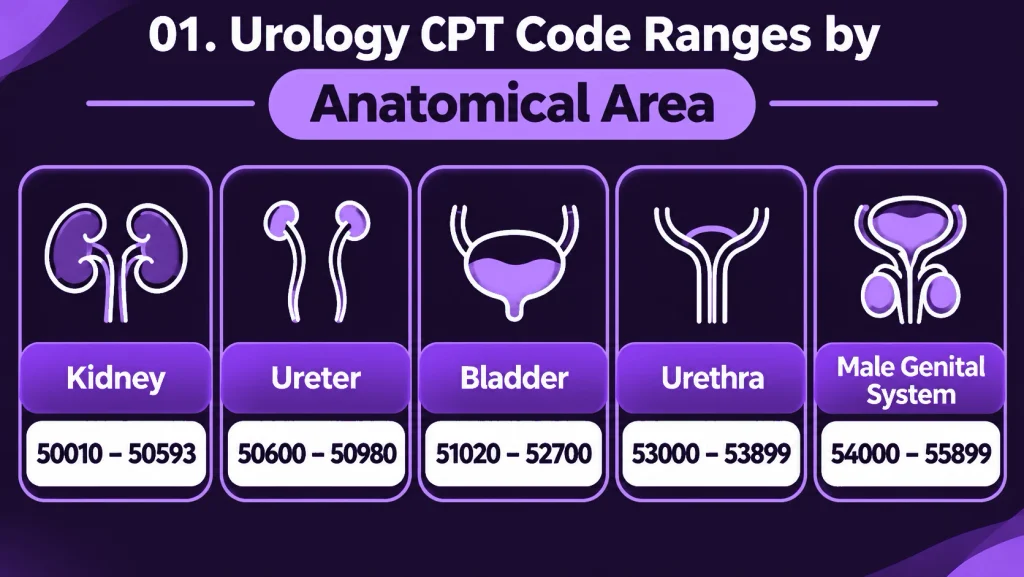
CPT Codes for the Urinary System Range from 50010 to 53899 and Are Organized Within the Surgery Section Based on Anatomic Area. Genitourinary Procedures on Males, Including Prostate Biopsy, Have a Different CPT Code Range (54000-55899), While Urology Imaging Is Categorized in the Radiology Section (70010-79999). Selecting the Appropriate Subsection Is Critical for Urinary System CPT Coding Accuracy.
| Subsection | CPT range | What you will find there |
|---|---|---|
| Kidney | 50010-50593 | Nephrectomy, PCNL, shock wave lithotripsy, renal ablation |
| Ureter | 50600-50980 | Ureterolysis, reimplantation, ureteral repair |
| Bladder | 51020-52700 | Catheters, urodynamics, cystoscopy, ureteroscopy, TURBT, TURP |
| Urethra | 53000-53899 | Urethral dilation, slings, urethroplasty, Rezum |
| Male genital system | 54000-55899 | Circumcision, vasectomy, hydrocele, prostate biopsy, prostatectomy |
Another CPT code surprise is the assignment of cystoscope and ureteroscope procedure codes (52000-52356) within the Bladder category despite their performance on the ureter and kidneys. These procedures utilize a scope inserted into the bladder before accessing the ureter and kidneys.
Common urology CPT codes list
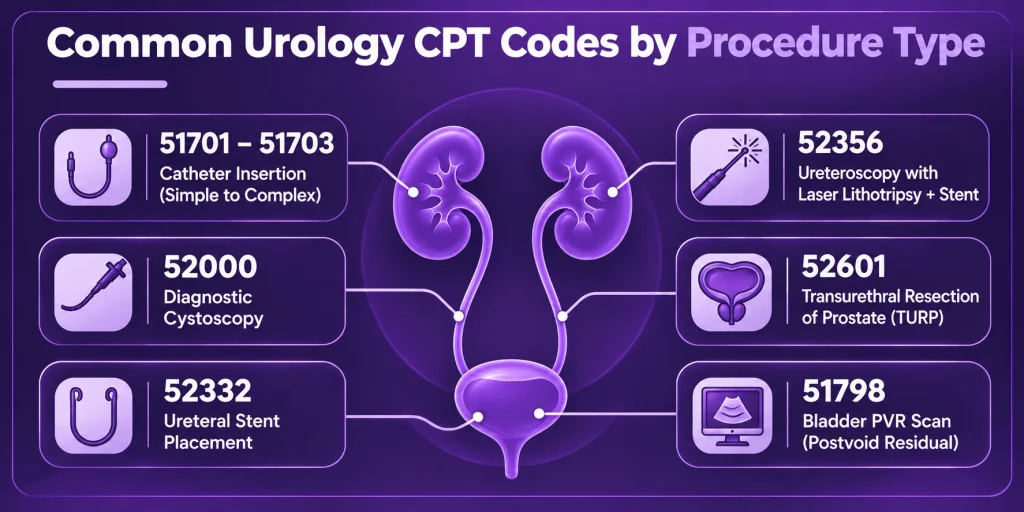
The following is the most frequently encountered CPT codes in urology billing codes, sorted based on a typical day’s workflow within a urology practice.
CPT codes for urology office visits and referrals
A urology office visit should be coded using the appropriate E/M codes, which consist of 99202-99205 for new patients and 99212-99215 for existing patients. Selection of the appropriate E/M code depends on either the level of medical decision making or total time spent during the encounter.
A CPT code does not exist for “referral.” When referring a patient to the urologist, the urologist reports on a visit with the new patient or consult with payers who reimburse them for consultations using CPT codes 99242 through 99245. CPT code 99241 is obsolete as of 2023. Consultation codes are not reimbursed under Medicare since 2010; therefore, Medicare referral visits utilize codes 99202 through 99205 or 99212 through 99215.
Documentation is key: For a consultation code, the note needs the request from the referring provider, the urologist’s opinion and a written report back to the referring provider.
Catheter, bladder and in-office procedure codes
| CPT | Description | Coding note |
|---|---|---|
| 51700 | Bladder irrigation, simple, lavage and/or instillation | Not for routine catheter flushing |
| 51701 | Insertion of non-indwelling bladder catheter (straight cath) | For residual urine or specimen |
| 51702 | Insertion of temporary indwelling bladder catheter; simple (Foley) | Included when part of a surgical procedure |
| 51703 | Insertion of temporary indwelling bladder catheter; complicated | Document why it was complicated |
| 51705 | Change of cystostomy tube; simple | Suprapubic tube change |
| 51720 | Bladder instillation of anticarcinogenic agent (including retention time) | Bill the drug separately, e.g. J9030 BCG |
| 51798 | Measurement of post-voiding residual urine and/or bladder capacity by ultrasound, non-imaging | Bladder scan for PVR |
Urodynamic study CPT codes
Urodynamics CPT codes stack together. Select the proper cystometrogram CPT code and add any components done during the test.
| CPT | Description | Coding note |
|---|---|---|
| 51725 | Simple cystometrogram | Rarely used with modern equipment |
| 51726 | Complex cystometrogram | Calibrated electronic equipment |
| 51727 | Complex CMG with urethral pressure profile | UPP documented |
| 51728 | Complex CMG with voiding pressure studies | Pressure flow study |
| 51729 | Complex CMG with voiding pressure studies and urethral pressure profile | Both components documented |
| 51736 / 51741 | Simple / complex uroflowmetry | Complex uses calibrated electronic equipment |
| 51784 / 51785 | Sphincter EMG, other than needle / needle | Pick by technique |
| +51797 | Voiding pressure studies, intra-abdominal (rectal, gastric, intraperitoneal) | Add-on; report with 51728 or 51729 |
How to avoid? Match every billed component to a tracing or a line in the report. A complex study with no documented urethral pressure profile is 51728, not 51729.
Cystoscopy and ureteroscopy CPT codes
| CPT | Description | Coding note |
|---|---|---|
| 52000 | Cystourethroscopy (separate procedure) | Bundles into any other cystoscopy procedure |
| 52001 | Cystourethroscopy with irrigation and evacuation of multiple obstructing clots | Clot evacuation |
| 52204 | Cystourethroscopy, with biopsy(s) | Bladder biopsy |
| 52224 | Cystourethroscopy with fulguration or treatment of minor (less than 0.5 cm) lesion(s) | With or without biopsy |
| 52234 / 52235 / 52240 | Fulguration and/or resection of bladder tumor: small / medium / large | 0.5-2.0 cm / 2.0-5.0 cm / over 5.0 cm |
| 52287 | Cystourethroscopy with injection(s) for chemodenervation of the bladder | Bill the drug separately |
| 52310 / 52315 | Removal of foreign body, calculus or ureteral stent from urethra or bladder: simple / complicated | Stent removal |
| 52332 | Cystourethroscopy with insertion of indwelling ureteral stent | Add modifier 50 when bilateral |
| 52352 | Cystourethroscopy with ureteroscopy and/or pyeloscopy; with removal or manipulation of calculus | Basket extraction |
| 52353 | Same; with lithotripsy | No stent |
| 52356 | Same; with lithotripsy including insertion of indwelling ureteral stent | Stent is included |
Prostate procedure CPT codes
| CPT | Description | Coding note |
|---|---|---|
| 55707-55716 | Prostate biopsy CPT codes for 2027 | Select based on biopsy approach, regional sampling, image guidance and targeted lesion sampling. Codes 55706, 55712 and 55713 are deleted for 2027. |
| 52601 | Transurethral electrosurgical resection of prostate (TURP) | 90-day global |
| 52441 / +52442 | Cystourethroscopy with insertion of permanent adjustable transprostatic implant; single / each additional | UroLift |
| 53854 | Transurethral destruction of prostate tissue by radiofrequency generated water vapor thermotherapy | Rezum |
| 52443 | Cystourethroscopy with transurethral anterior prostate commissurotomy and drug delivery by drug-coated balloon | New in 2026 |
| 52597 | Transurethral robotic-assisted waterjet resection of prostate | New in 2026 |
| 55866 | Laparoscopic radical prostatectomy, including robotic assistance | Expanded into 55866, 55868 and 55869 in 2026 based on lymph node work |
Male genital and stone procedure codes
| CPT | Description | Global days |
|---|---|---|
| 55250 | Vasectomy, unilateral or bilateral, including postoperative semen examination(s) | 90 |
| 54150 | Circumcision, using clamp or other device with regional dorsal penile or ring block | 0 |
| 54161 | Circumcision, surgical excision other than clamp, device or dorsal slit; older than 28 days of age | 10 |
| 55040 | Excision of hydrocele; unilateral | 90 |
| 50590 | Lithotripsy, extracorporeal shock wave | 90 |
Urology drug and injection codes
Prostate cancer hormone therapy generates substantial income for urology practices. Leuprolide injections are reported using 96402 (Chemotherapy administration; subcutaneous or intramuscular, hormonal anti-neoplastic agent) and the J-code for the medication, including J9217 (leuprolide acetate depot 7.5 mg). BCG intravesically administered involves 51720 and J9030 (BCG live intravesical instillation, 1 mg). Testosterone injections are coded as 96372 and its corresponding J-code, such as J1071 (testosterone cypionate, 1 mg).
Documentation is key: Record the exact drug, dose, lot number and units. J-code units are based on the code’s dosage, not on the number of vials.
Urology imaging CPT codes: KUB, urogram and renal bladder ultrasound
Many urology practices provide their own imaging services. This is an area where incorrect code assignment can cause lost revenues. These are the relevant codes.
| CPT | Description | Coding note |
|---|---|---|
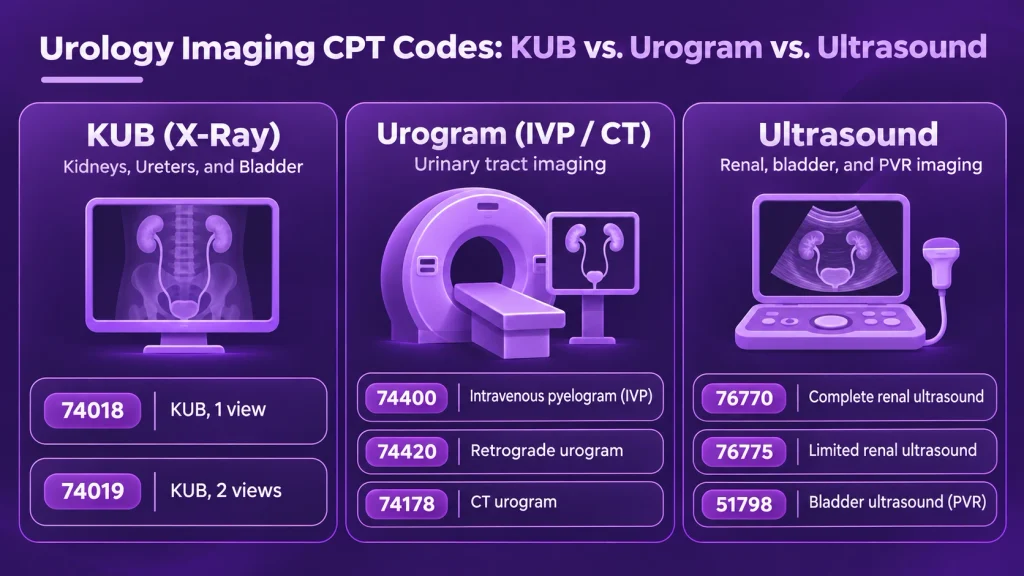
| 74018 | Radiologic examination, abdomen; 1 view | The KUB x-ray code |
| 74019 / 74021 | Radiologic examination, abdomen; 2 views / 3 or more views | Use when extra views are documented |
| 74400 | Urography (pyelography), intravenous, with or without KUB, with or without tomography | IVP; the KUB is included |
| 74420 | Urography, retrograde, with or without KUB | Imaging part of retrograde pyelogram |
| 74178 | CT abdomen and pelvis; without contrast followed by contrast | Used for CT urography |
| 76770 | Ultrasound, retroperitoneal, real time with image documentation; complete | Renal and bladder ultrasound |
| 76775 | Ultrasound, retroperitoneal; limited | Not all complete elements imaged |
| 76857 | Ultrasound, pelvic (nonobstetric); limited or follow-up | Bladder-only imaging |
| 76870 | Ultrasound, scrotum and contents | Separate written report required |
| 76872 | Ultrasound, transrectal | Not billable with prostate biopsy codes since 2026 |
CPT code for kidney ureter bladder x-ray
CPT code 74018 refers to kidney ureter bladder (KUB) radiography involving one view of the abdomen. Effective in 2018, 74018 succeeded 74000 as the standard CPT code for performing a KUB x-ray study. Two views utilize CPT code 74019; three or more views require CPT code 74021.
How to avoid? Don’t bill a KUB on the same session as an IVP. Code 74400 already includes it.
CPT code for urogram
Proper medical coding of urography examinations depends upon the route utilized for the administration of contrast material. Intravenous urography (IVP) is coded using 74400. Retrograde urography involves injection of contrast material via ureteral catheterization performed during cystoscopy and requires two separate procedure codes (74420 + 52005). Computed tomographic urography should be reported using 74178.
US renal and bladder CPT code
Ultrasound of kidney and bladder using code 76770 is utilized based on pertinent history suggesting UTI issues. According to CPT coding guidelines, examination of both kidneys and urinary bladder is considered a comprehensive retroperitoneal ultrasound and therefore no additional pelvic ultrasonogram is required.
The urology ultrasound procedures include bladder ultrasound using CPT 76857. If measuring post-void residual urine volume is the sole medical necessity, then CPT 51798 is used instead of billing another ultrasound procedure, such as pelvic ultrasound. Payer documentation and procedural service provided determine proper code choice.
Documentation is key: Ultrasound diagnostics must be documented using image reports and an official interpretation of the images obtained during the study. Procedures not involving imaging, such as post-void residual volume studies, coded under CPT 51798, require specific documentation that includes rationale, findings and significance of testing. The statement “renal US normal” alone within the progress notes will fail an audit review.
Urology Modifiers and Billing Guidelines
Modifiers are where good urology coding turns into paid claims. Here’s how each one shows up in real urology work.
| Modifier | Meaning | Urology example |
|---|---|---|
| 25 | Significant, separately identifiable E/M on the same day as a procedure | New patient hematuria workup plus same-day cystoscopy |
| 26 / TC | Professional / technical component | Urodynamics or ultrasound when reading and equipment are billed separately |
| 50 | Bilateral procedure | Bilateral ureteral stents (52332-50) |
| RT / LT | Right side / left side | Unilateral ureteroscopy or stent |
| 51 | Multiple procedures | Two procedures in one session; not used on add-on codes |
| 59 / XS / XE | Distinct procedural service / separate structure / separate encounter | Procedures on separate organs that trigger an NCCI edit |
| 58 | Staged or related procedure during the postoperative period | A qualifying staged or more extensive procedure that meets the modifier’s requirements |
| 78 | Unplanned return to the OR for a related procedure | Return for bleeding after TURP |
| 79 | Unrelated procedure during the global period | Cystoscopy for a new problem after vasectomy |
| 24 | Unrelated E/M during a postoperative period | Visit for a kidney stone after vasectomy |
| 52 / 53 | Reduced service / discontinued procedure | Cystoscopy stopped because of a stricture |
| B1 | 2027 Medicare E/M visit-complexity modifier; 16% payment increase | Eligible ongoing or longitudinal care |
| B2 | 2027 E/M modifier; 32% payment increase | Eligible practitioners participating in specified ACO arrangements |
| QW | CLIA-waived test | Some point-of-care urinalysis and lab tests |
Coding Note: Medicare guidelines mandate using modifier 59 or an appropriate X modifier for separate procedures when supporting documentation and the NCCI edit permit. Review the procedural sites, the nature of services rendered, and NCCI instructions prior to overriding bundling edits. Two procedures approached via one approach does not automatically qualify as a separate procedure under CMS guidelines.

What Changed in Urology CPT Coding for 2027?
Four CPT code updates apply on January 1, 2027. Each update affects a common urology claim.
What Are the New Prostate Biopsy CPT Codes for 2027?
CPT codes related to prostate biopsy underwent changes that took effect on January 1, 2027. The American Medical Association revised prostate biopsy code set differentiates between biopsies conducted via the transrectal route versus the transperineal route, as well as imaging-guided, regional sampling and targeted lesion sampling.
CPT codes 55706, 55712 and 55713 have been deleted, while 55716 is a new add-on code. The revisions also affect existing biopsy descriptors and reporting instructions.
| CPT Code | Procedure Category |
| 55705 | Non-imaging-guided prostate biopsy |
| 55707 | Transrectal prostate biopsy with regional sampling and imaging guidance |
| 55708 | Transrectal biopsy with regional and fusion-targeted sampling |
| 55709 | Transperineal prostate biopsy with regional sampling and imaging guidance |
| 55710 | Transperineal biopsy with regional and fusion-targeted sampling |
| 55711 | Fusion-guided prostate biopsy |
| 55714 | In-bore CT- or MRI-guided targeted prostate biopsy |
| +55715 | Additional targeted lesion with in-bore CT or MRI guidance |
| +55716 | Additional fusion-targeted lesion under the applicable add-on coding instructions |
Coding Note: Prostate biopsy CPT codes should reflect the imaging modality utilized, biopsy approach taken and sampling technique used. An image guidance code cannot be reported separately when included within the chosen CPT procedure code. Add-on codes require a qualifying primary procedure code and documentation of additional effort.
Important: The table above is a plain-language overview, not a substitute for the licensed 2027 AMA CPT descriptors and parenthetical instructions.
Source: 2027 Medicare Physician Fee Schedule Final Rule, prostate biopsy services.
How Do Modifiers B1 and B2 Replace G2211 in 2027?
Beginning January 1, 2027, Medicare will use new modifiers B1 and B2 instead of HCPCS code G2211 to report eligible E/M services performed with a procedure that has a 0-day global period. Rather than an additional payment, these new modifiers provide reimbursement at a percentage of the allowable amount for the eligible E/M service.
| Modifier | Payment Increase | Eligibility |
| B1 | 16% | Eligible E/M services involving ongoing or complex patient care |
| B2 | 32% | Eligible practitioners participating in specified Medicare ACO arrangements |
These updates can impact reimbursement for chronic condition management in urology, specifically, benign prostatic hyperplasia, recurrent UTIs and prostate cancer care.
Coding Note: Modifiers B1 and B2 have restrictions based on Medicare eligibility and submission criteria. Typically, B1 and B2 modifiers are not eligible when billed with modifier 25 except for certain preventive services.
Practical Urology CPT Coding Examples
We can start applying these codes. These are brief examples of coding scenarios related to common queries raised by urology coders.
Scenario 1: New patient with hematuria and same-day cystoscopy. A 64-year-old is referred for gross hematuria. The urologist takes a full history, reviews labs, orders a CT urogram and performs cystoscopy the same day. Code: 99204-25 and 52000. Why: the workup and imaging plan go beyond the decision to scope. In 2027, Medicare pays the lower-valued service at 80%.
Scenario 2: Bilateral ureteral stents. Stents are placed in both ureters during one cystoscopy.
Potential coding: CPT 52332 with modifier 50 for bilateral ureteral stent placement when supported by the documentation and Medicare bilateral surgery rules. Verify the current bilateral surgery indicator and payer-specific reporting instructions before submitting the claim. Diagnostic cystoscopy performed as an integral component of stent placement is not separately reported as 52000. Don’t add 52000; it’s bundled.
Scenario 3: Ureteroscopy with laser lithotripsy and stent. A left ureteral stone is treated with laser lithotripsy and a stent is left in place. Code: 52356-LT. Why: 52356 already includes stent insertion, so 52332 is not added for the same side.
Scenario 4: Bladder scan for post-void residual. A BPH patient voids and the MA scans the bladder to measure residual volume. Code: 51798. Why: the purpose was residual urine only. 76857 would need diagnostic bladder imaging with a separate report.
Scenario 5: KUB and IVP on the same day. The physician orders a KUB, then an IVP in the same session. Code: 74400 only. Why: the IVP code includes the KUB.
Scenario 6: Complex urodynamics. The patient has a complex CMG with pressure flow, needle-free sphincter EMG, abdominal pressure measurement and complex uroflow. Code: 51728, 51784, +51797 and 51741. Why: each component is separately documented and the add-on follows its primary code.
Common Urology Coding Errors and Denials
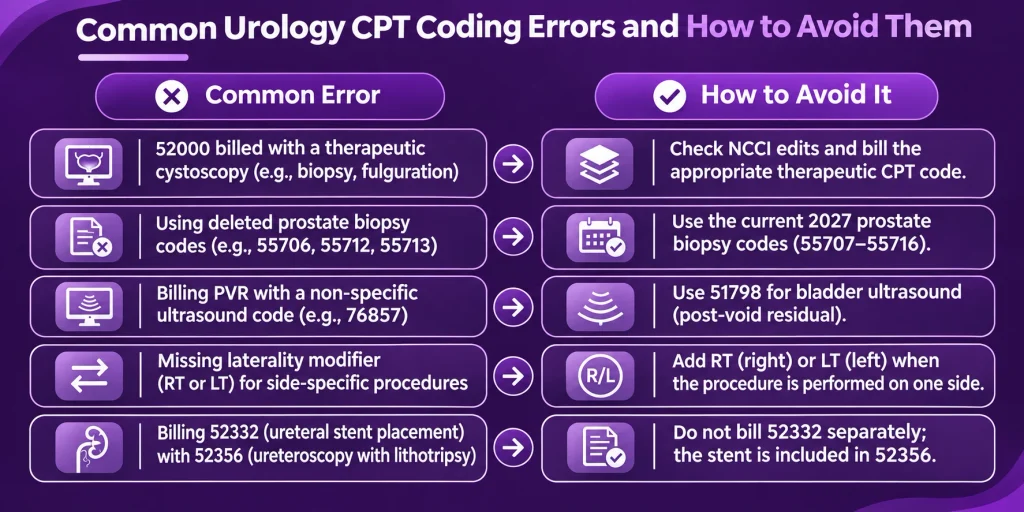
Billing 52000 with another cystoscopy procedure. Diagnostic cystoscopy is a “separate procedure” and is included in any surgical cystoscopy. How to Avoid? Drop 52000 whenever a therapeutic scope code is on the claim.
Using deleted prostate biopsy codes. 55700 has been gone since 2026, and 55706, 55712 and 55713 are deleted for 2027. How to Avoid? Rebuild biopsy charge tickets every January and check each code against the current CPT book.
Adding ultrasound guidance to a prostate biopsy. 76942 and 76872 are not billable with the current biopsy family. How to Avoid? Set an edit in your practice management system to flag these pairs.
Sending consultation codes to Medicare. Medicare doesn’t pay 99242-99245. How to Avoid? Map consult orders to new or established office visit codes for Medicare patients.
Missing laterality. A ureteroscopy with no RT, LT or 50 modifier can deny or underpay. How to Avoid? Make laterality a required field in the procedure note template.
Billing 51702 with a surgical procedure. A Foley placed as part of a procedure is included in that procedure. How to Avoid? Bill 51702 only when the catheter insertion stands on its own.
Coding a PVR as a pelvic ultrasound. A bladder scan for residual volume is 51798, not 76857. How to Avoid? Ask what the scan was for. If the answer is “residual,” it’s 51798.

Conclusion
Effective urology CPT coding is contingent upon developing these three simple habits: identifying the appropriate code family, matching that code to the note and applying the proper modifier. Urologic procedures have codes from 50010 through 53899; male genitourinary procedures range from 54000 to 55899; and urology imaging falls under the Radiology category. Effective urology coding in 2027 will require attention to the revised prostate biopsy codes, the 20 percent Medicare reduction on same day 0-day procedures and replacement of HCPCS code G2211 by modifiers B1 and B2.
Frequently asked questions
What is the code range for the urinary system?
The urinary system CPT code range is 50010-53899. It covers the kidney (50010-50593), ureter (50600-50980), bladder (51020-52700) and urethra (53000-53899). Male genital procedures, including prostate biopsy, are in 54000-55899.
What is the CPT code for a kidney ureter bladder X ray?
A KUB x-ray is CPT 74018, Radiologic examination, abdomen; 1 view. Use 74019 for two views and 74021 for three or more views. Don’t bill it separately with an IVP (74400), which includes the KUB.
What is the CPT code for a urogram?
An intravenous urogram (IVP) is CPT 74400. A retrograde urogram uses 74420 for the imaging, and a CT urogram is reported with 74178.
What is the CPT code for a renal and bladder ultrasound?
A renal and bladder ultrasound is CPT 76770 when urinary tract pathology is suspected. A bladder-only ultrasound is 76857, and a post-void residual scan without diagnostic imaging is 51798.
What is the CPT code for a urology office visit?
Urology office visits use 99202-99205 for new patients and 99212-99215 for established patients. In 2027, Medicare longitudinal care is reported by adding modifier B1 instead of G2211.
What is the CPT code for a urology referral?
There is no CPT code for the referral itself. The urologist bills a new patient visit (99202-99205) or, for payers that accept them, a consultation code (99242-99245). Medicare does not pay consultation codes.
What are the most common urology CPT codes?
Common urology CPT codes include 99202-99215 (office visits), 52000 (cystoscopy), 51798 (post-void residual), 51702 (Foley insertion), 52332 (ureteral stent), 52356 (ureteroscopy with lithotripsy and stent), 51728 and 51741 (urodynamics), 55250 (vasectomy), 96402 (hormone injection) and 76770 (renal ultrasound).
Which modifier is used for bilateral urology procedures?
Modifier 50 is used when the same procedure is done on both sides in one session, such as 52332-50 for bilateral ureteral stents. Use RT or LT for one side.