

Accounts Receivable (AR) in medical billing refers to the unpaid balances owed to the practice for previously delivered medical services. Every medical practice relies on stable cash flow, yet many payments remain pending long after services are delivered. Accounts receivable represents payments your healthcare practice has earned but not yet received. Professional healthcare accounts receivable management often supported by Medical billing services in USA is essential for maintaining financial stability. Delayed payments and unanswered denials cost healthcare practices thousands each year. Managing AR effectively keeps your revenue consistent and your operations secure.This blog will try to explore what is the role of AR and its strategies in medical billing.
What is AR in Medical Billing?
It is the payment owed to your practice for services already delivered. Each submitted claim or unpaid balance becomes part of AR. In broader terms, AR in healthcare refers to outstanding payments from patients or payers after providing care. Tracking AR keeps your revenue cycle steady and guarantees smooth operations.
Common Reasons for Overdue or Unpaid Claims
Even effective healthcare practices face payment delays. Common causes include:
• Incomplete or incorrect claim details.
• Denied claims due to payer policy issues.
• Slow payer processing.
• Unverified insurance coverage.
• Lack of patient follow up.
Resolving these issues early prevents extended receivables that damage cash flow.
Steps in Managing AR Effectively
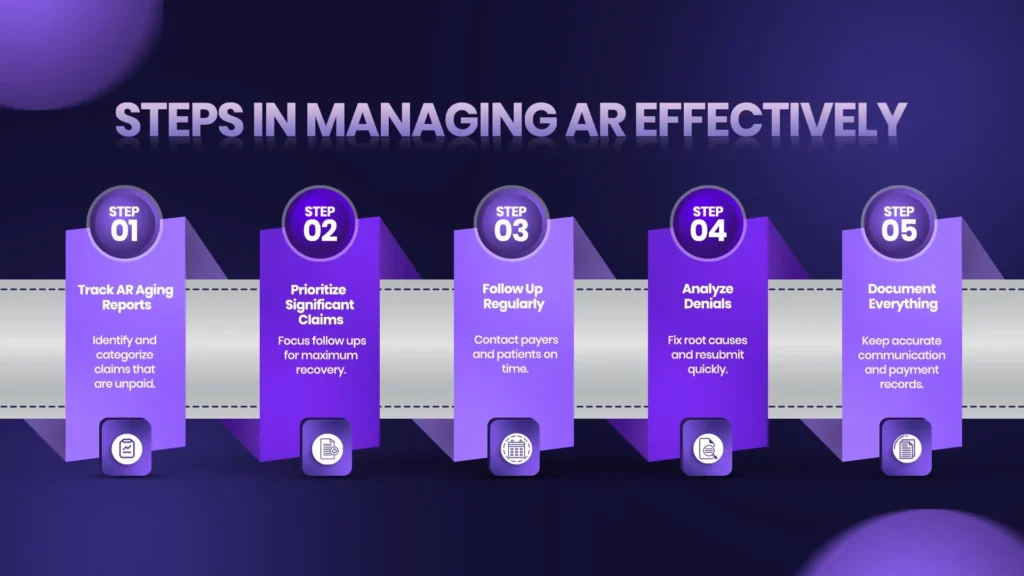
- Track AR Aging Reports – Identify and categorize claims that are unpaid.
- Prioritize Significant Claims – Focus follow ups for maximum recovery.
- Follow Up Regularly – Contact payers and patients on time.
- Analyze Denials – Fix root causes and resubmit quickly.
- Document Everything – Keep accurate communication and payment records.
Professional accounts receivable and collection for the medical practice rely on precision and persistence.
Impact of Poor AR Management on Revenue
Ignoring AR weakens the financial health of healthcare practices. Cash flow is affected by unpaid claims, making it more difficult to pay staff or invest in growth. Poor medical billing accounts receivable tracking also alters planning and frustrates patients through billing errors.
How to Improve AR Days and Collection Rates
Reducing AR days improves cash flow. Key strategies:
- Verify insurance before appointments.
- Submit clean claims the first time.
- Offer affordable payment plans.
- Keep billing teams trained.
- Utilize analytics to find denial trends.
Successful healthcare accounts receivable management means faster payments and better performance.
Tools and Technologies for AR Automation
Modern tools make AR simpler. Billing software can:
- Simplify submissions and follow-ups.
- Flag aging claims.
- Make AR dashboards.
- Decrease manual errors.
Technology and tools alter how accounts payable and receivable affect a medical office, permitting staff to only focus on patients.
Pro Tip: Carefully track AR aging reports while giving attention to highly valuable claims to maintain steady revenue. Guarantee that claims are submitted properly and follow up immediately to reduce denials. Improve collections and increase overall revenue performance through the use of automated technologies and complete documentation.
Turning AR into Stable Cash Flow
Understanding what accounts receivable in medical billing aids reduce delays and strengthen financial consistency. When your medical billing accounts receivable process is organized, it builds confidence, trust, and reliable revenue. Handling AR well turns potential losses into lasting financial stability.
From Claims to Collections | The Role of AR in Medical Billing
In healthcare, every service you deliver starts a financial journey, from treatment to full payment. Accounts Receivable (AR) signifies the part of that journey where payments are still pending. In simple terms, AR in medical billing is the balance due from insurance payers or patients after a claim is submitted. Accounts receivable in medical billing helps measure financial health. When managed well, AR retains revenue flowing. When neglected, it leads to serious cash flow issues.
The Lifecycle of a Medical Claim
A claim moves through five main stages:
- Patient Visit and Documentation – Precise data and coding.
- Claim Submission – Sent to payers for assessment.
- Adjudication – Information is requested, denied, or approved by the payer.
- Payment Posting – Denials are noted and payments are recorded.
- Follow-Up and Collection – Unpaid balances move into AR.
Each step affects accounts receivable and collection for the medical practice, making close monitoring important.
How AR Connects Billing, Payment Posting, and Denial Management
Healthcare accounts receivable management ties all financial processes together. Our team of AR makes sure payments match billed amounts and denials are corrected promptly. Ignored denials cause aging balances and stuck revenue.
Effects of AR Inefficiency
When AR builds up, cash flow slows. Staff spend more time on collections and less on patients. Poor medical billing accounts receivable practices distort reports and hurt planning.
According to MGMA, practices with high AR over 90 days see up to 20% lower net collections, a clear revenue loss and resource strain.
Strategies to Reduce Outstanding AR
To shorten AR cycles:
- Verify insurance before visits
- Submit clean claims using claim-scrubbing tools
- Follow up within 15 days
- Review denials weekly
- Offer online or flexible payment options
Strong healthcare accounts receivable management confirms faster payments and a healthier revenue cycle management.
Better AR Management for Your Practice
Behind every delayed payment lies lost revenue. Many healthcare practices lose thousands yearly due to poor medical billing accounts receivable processes. Missed or weak follow ups let payments slip away. AR in healthcare means realizing it is not just accounting, it is a cash your healthcare practice has earned. Unresolved claims over 90 days can cut collection rates by 25% which turns your earned cash into lost revenue.
Reasons of Delayed Payments
Common issues slowing payments include:
- Coding errors (CPT or ICD-10-CM).
- Missed insurance verification.
- Incomplete claim documentation.
- Slow resubmission after denials.
- Weak follow up on patient balances.
When these issues add up, healthcare accounts receivable management turns reactive and recovery slows. Poor accounts receivable and collection for the medical practice increases admin workload, while imbalanced accounts payable and receivable weaken the entire office system.
Reviewing Aging Reports to Identify Problem Areas
The aging report is a key AR tool, breaking balances into timeframes. Reviewing it weekly helps you:
- Spot insurers or patients who are slow payers.
- Catch frequent claim errors.
- Focus on accounts that are overdue.
Effective medical billing accounts receivable management starts with visibility, knowing where your money is stuck.
AR Follow Up Strategies
Consistency drives results. Successful healthcare practices:
- Set consistent AR follow up schedules.
- Track denial reasons and patterns.
- Communicate clearly with patients about balances.
- Keep billing staff trained on payer updates.
- Reconcile payments daily.
Organized healthcare accounts receivable management turns follow up into routine, keeping revenue cycles smooth and timely.
AR Management | The Backbone of Medical Billing
Medical billing accounts receivable (AR) refers to the payments due to your healthcare practice for services already delivered. The purpose of AR management is to guarantee those earned payments reach your healthcare practice quickly and accurately. Effective healthcare accounts receivable management reduces stress of the providers and allows them to focus on patient care.
What is AR in healthcare
It involves constantly tracking patient balances, claims, and denials in order to make sure no payment is neglected. Better AR reduces denials, accelerates payments, and supports the financial stability of your company.
Efficient AR Workflow
- Accurate Documentation.
- Clean and Timely Claim Submission.
- Constant AR Follow Up.
- Denial Management.
- Payment Posting and Reporting.
Effect on Revenue Cycle and Patient Satisfaction
Effective AR management does not just protect your balance sheet but also improves the patient experience. When claims are handled promptly and billing is clear, patients experience less confusion and fewer payment disputes.
Poor medical billing accounts receivable practices can cause billing errors, delayed statements, and patient frustration. A transparent AR process increases trust, reduces stress, and helps your team focus on what truly matters, quality care.
How Outsourcing AR Can Reduce Revenue Leakage
Outsourcing AR can change financial performance. Professional billing partners specialize in healthcare accounts receivable management, guaranteeing faster claim resolution and fewer denials. They use the latest software and proven strategies to:
- Minimize AR aging.
- Improve collection rates.
- Reduce manual errors.
- Maintain adherence to CMS rules.
Pro Tip: Guarantee that all documentation is complete and correct from the very beginning so you can avoid denials and accelerate payments. To identify the root causes and improve first-pass claim approvals, constantly examine denial trends.
Why AR Metrics Matter
A successful healthcare practice depends on strong, predictable cash flow. The key is understanding how your medical billing accounts receivable (AR) performs.
AR metrics go beyond numbers, they reflect your staff performance, patient satisfaction and efficiency of practice. Knowing what is AR in medical billing helps track payment speed, detect delays early, and maintain a financially healthy, future ready practice.
AR Aging and What It Tells About Your Billing Efficiency
One of the most valuable tools in healthcare accounts receivable management is the AR aging report. It divides outstanding balances into timeframes:
- 0–30 Days: Normal payment window
- 31–60 Days: Minor delay
- 61–90 Days: Possible denials or missed follow-ups
- 90+ Days: High risk of nonpayment
Regular aging review highlights inefficiencies and shows what is AR in healthcare in practice, revenue waiting to be collected.
The Connection Between AR Performance and Revenue Growth
Strong AR performance drives profitability. Quick claims to payment flow keeps cash steady, allowing providers to invest in better care and staff.
Poor accounts receivable and collection for the medical practice slows payroll, vendor payments, and patient services.
Understanding what is A/R in medical billing helps forecast revenue accurately and plan growth confidently.
Common AR Mistakes Clinics Make
Frequent AR mistakes include:
- Missing claim follow ups.
- Ignoring denials or delays.
- Incorrect patient data.
- No regular aging report reviews.
- Late payment posting.
These errors affect cash flow and demonstrate how accounts payable and receivable affect a medical office, leading to financial strain and lost trust.
Best Practices for AR Follow Up and Denial Resolution
Keep AR proactive, not reactive.
Proven steps:
- Track aging weekly.
- Identify denial trends early.
- Communicate balances clearly to patients.
- Document every action.
Applying these healthcare accounts receivable management practices can reduce AR days by up to 40%, per MGMA reports.
How Technology Improves AR Visibility
Modern tools have transformed healthcare accounts receivable management. Expert billing platforms and dashboards now:
- Flag overdue claims instantly.
- Predict payment timelines.
- Automate follow ups.
- Generate real time AR reports.
Technology turns AR into a data driven advantage, showing how medical billing accounts receivable becomes a strategic asset, not a burden.
Turning AR Data into Actionable Insights
AR metrics are the heartbeat of financial health. You can convert data into results by monitoring key AR indicators and using technology effectively. A proven medical billing accounts receivable process confirms faster reimbursements, improves patient experiences and smoother collections, building lasting financial strength for your healthcare practice.
Pro tips: Monitor accounts receivable and look at outstanding balances frequently to find errors before they disrupt cash flow. To safeguard revenue, swiftly resolve claim denials and inform patients. Use innovative billing tools to improve collections and convert AR data into valuable strategies to improve financial health.
Enhancing Practice Revenue Through AR Strategies
Medical billing accounts receivable (AR) plays a key role in successful medical practice. AR in medical billing represents all payments owed to your healthcare practice for services you have already provided. Effective AR optimization directly translates into financial confidence, allowing you to invest more in patient care and staff development.
Identifying Delays That Slow AR Recovery
It is essential to recognize obstacles before improving AR performance. Common issues include:
- Incorrect or incomplete claims.
- Unverified insurance details.
- Slow or inconsistent follow up.
- Unposted payments.
- Lack of visibility.
These issues create hidden financial blockages that avoid a healthcare practice from collecting what it has already earned. Identifying and eliminating them is the first step to understanding what is AR in healthcare from a performance standpoint.
Best Practices for Managing Accounts Receivable
Effective AR management means never letting a claim go unanswered. The most successful practices build efficient claim tracking systems to handle accounts receivable and collection for the medical practice accurately. You also need to have a proper understanding about what is an entity code in medical billing and how this works.
Effective steps include:
- Communicating with payers 14–21 days after submission.
- Maintaining a denial log to identify recurring errors.
- Utilizing root cause analysis to resolve issues permanently.
- Resubmitting corrected claims promptly.
- Tracking response times by payer for accountability.
Improving AR Performance | Reduction in AR Days and Improved Cash Flow
Improving AR means tracking results through remarkable metrics. The two most critical are:
- Average AR Days: How long does it take to receive payment? Lower is better.
- Cash Flow Growth: An increase in collected revenue per billing cycle.
When what is A/R in medical billing is managed strategically, these numbers improve consistently leading to stronger profitability and reduced financial stress.
A Guide to AR | From Billing to Bank
Medical billing accounts receivable (AR) in healthcare finance is the payment your healthcare practice has earned but not yet received. Healthcare providers can observe how payments are made and services provided by understanding AR.
Why AR Is More Than Just Unpaid Claims
AR is not just unpaid bills. What is AR in healthcare reflects the financial rhythm of your practice, how efficiently you process claims, manage denials, and communicate with payers. Strong healthcare accounts receivable management ensures claims are accurate, followed up promptly, and payments posted correctly. It is not just about collecting money; it is about financial stability.
How Delayed AR Affects Cash Flow and Staff Operations
When AR stays pending too long, cash flow slows and staff workloads increase. Delayed claims affect payroll, supplies, and morale.
High AR days force billing teams to chase payments instead of focusing on patients. Understanding what is accounts receivable in medical billing helps you manage not only revenue but also workflow efficiency and sustainability.
Common Payer-Related AR Challenges
Delays related to insurance are a top source of AR problems. Common challenges include:
- Long processing times.
- Requests for added documentation.
- Common denials related to coding.
- Unexpected eligibility or policy changes.
Each issue ties up accounts receivable and collection for the medical practice, disrupting cash flow. Staying updated on documentation requirements and payer policies minimizes these issues.
AR in Medical Billing | The Missing Link to Stable Revenue
Many healthcare practices face financial strain not from lack of patients, but from payment delays. That is where medical billing accounts receivable (AR) becomes crucial. Poorly managed AR quietly drains revenue and weakens financial stability over time. Understanding what is AR in medical billing and managing it effectively ensures predictable income and long-term financial strength.
Key Factors Leading to Aging AR Balances
Aging AR balances signal trouble. It becomes difficult to recover a claim if it remains unpaid for a long time. Common causes include:
- Incomplete or inaccurate claim data.
- Missed follow ups after submission.
- Unverified insurance errors.
- Payer delays or policy updates.
- Poor denial management systems.
These issues slow collections and disturb accounts receivable and collection for the medical practice, creating stress and lost revenue.
Effects of Delayed AR on Practice Sustainability
Delayed AR reduces cash flow, increases financial stress and lowers collection rates over time. When accounts payable and receivable affect a medical office negatively, staff spend less time on patient care and more time on resolving billing issues.
Tactics for Improving AR Recovery Rate
Improving AR requires focus:
- Submit accurate claims.
- Track aging reports weekly.
- Train staff on payer policies.
These steps shorten AR days and improve your medical billing accounts receivable process.
Partnering with Experts for AR Improvement
Many clinics improve performance by outsourcing healthcare accounts receivable management. Expert billing partners provide fewer denials, faster reimbursements and better collection ratios. Outsourcing lets your team focus on patients, while experts strengthen your medical billing accounts receivable.
How iSolve RCM Support with AR in Medical Billing
We know that effective Accounts Receivable (AR) management is the core of a healthy medical practice at iSolve RCM, the best medical billing company in USA. From clean claim submission and denial resolution to patient balance recovery, our experts specialize in improving every stage of your medical billing accounts receivable process. We help practices reduce delays, improve cash flow, and strengthen financial performance by using the latest and innovative technology. With iSolve RCM, you do not just manage AR, you change it into constant revenue growth and the financial stability your healthcare practice needs to focus fully on exceptional patient care.