

Removing secretions from a wound is not debridement. One Medicare contractor’s wound care billing guideline says it in a single line: the mere removal of secretions, or cleansing of a wound, does not represent a debridement service, as the L34587 billing and coding guideline states. A claim for 97597 on a wound that was only cleaned is a denial, and on audit, an overpayment.
That is the pattern in wound care billing. The codes are few, but the rules behind them are strict: what tissue was removed, how deep, over how many square centimeters and whether the wound is improving. 2026 raised the stakes further. Medicare now pays most skin substitutes at a flat rate of about $127 per square centimeter instead of prices that could exceed $2,000, and wound care investigations and recoupments have increased sharply, as a 2026 legal analysis reports.
The most common wound care billing mistakes are billing debridement without devitalized tissue, coding depth wrong, mixing surface areas, unbundling, weak wound documentation and billing skin substitutes under outdated rules. This guide walks through ten of them, why each one is denied and how to prevent it.
| Mistake | Denial Risk | Fix |
|---|---|---|
| Debridement billed without devitalized tissue | Medical necessity denial or overpayment | Document the tissue type removed |
| Depth coded from the wound, not the tissue removed | Wrong code, audit finding | Code the deepest tissue actually removed |
| Surface areas mixed across depths | Wrong add-on units | Sum only wounds at the same depth |
| Surgical and active wound care on the same wound | Unbundling denial | Report one family per wound |
| Bundled or non-payable services billed separately | CO-97 or non-covered denial | Know what is included |
| Deep debridement in the wrong setting | Place of service denial | Check your MAC’s setting rules |
| Thin wound documentation | Medical necessity denial | Measure, describe and track every wound |
| E/M with modifier 25 on routine wound visits | Bundling denial; lower 2027 payment | Bill E/M only for a separate problem |
| Skin substitutes billed under 2025 rules | Wrong payment, audit exposure | Apply the 2026 flat-rate rules |
| Coverage and authorization ignored | Non-covered or authorization denial | Check NCDs, LCDs and plan rules first |
Wound Care CPT Codes You Need to Know
Wound care billing uses a small set of code families. Most mistakes come from choosing between them incorrectly.
| Service | Codes | What Decides the Code |
|---|---|---|
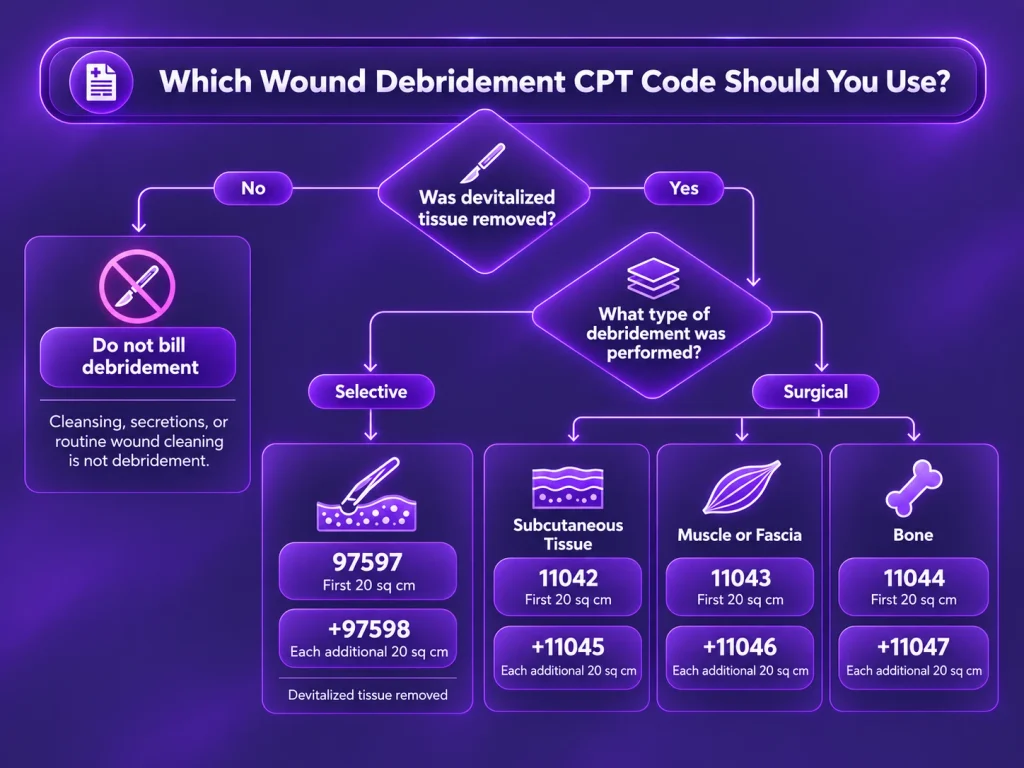
| Surgical debridement | 11042 to 11047 | Deepest tissue removed (subcutaneous, muscle or fascia, bone) and surface area in 20 sq cm units |
| Selective active wound care | 97597, +97598 | Removal of devitalized tissue, first 20 sq cm and each additional 20 |
| Non-selective debridement | 97602 | Not separately payable under Medicare |
| Negative pressure wound therapy | 97605 to 97608 | Durable or disposable device and wound size |
| Skin substitute application | 15271 to 15278 | Wound location and total area |
| Skin substitute product | Q4100 series | Product applied, in square centimeters |
| Compression | 29580, 29581 | Unna boot or multi-layer compression |
| Hyperbaric oxygen | G0277, 99183 | Facility session time and physician attendance |
| Visits | 99202 to 99215 | Only when separately identifiable from the procedure |
Source: AMA CPT code set; HCPCS Level II; L34587 billing and coding guideline.
10 Common Wound Care Billing Mistakes
1. Billing debridement when no devitalized tissue was removed
Why it gets denied: Codes 97597 and 97598 require the presence and removal of devitalized or necrotic tissue. Cleansing a wound or removing secretions of any consistency does not meet that definition.
How to avoid it: Document the tissue removed (slough, eschar, fibrin or necrotic tissue), the instrument used and the wound bed after the procedure. If the visit was a dressing change or cleansing, do not bill debridement.
Source: L34587 guideline, billing guideline 4.
2. Coding depth by the wound instead of the tissue removed
Why it gets denied: Surgical debridement codes 11042 to 11047 are chosen by the deepest level of tissue removed, not by how deep the wound is. A deep wound that only had subcutaneous tissue removed is 11042, not 11043 or 11044.
How to avoid it: Have the provider name the deepest tissue removed in every note (subcutaneous tissue, muscle or fascia, bone). Coders should code from that statement, not from wound depth measurements.
Source: L34587 guideline, coding guideline 1.
3. Mixing surface areas from wounds at different depths
Why it gets denied: When several wounds are debrided, the surface areas of wounds at the same depth are added together, but sums from different depths are never combined. Adding all wounds into one total produces the wrong base code and add-on units.
How to avoid it: Group wounds by depth, total the area for each group and bill each depth with its own base code and add-ons in 20 sq cm units.
Source: L34587 guideline, coding guideline 1.
4. Billing surgical debridement and active wound care on the same wound
Why it gets denied: Codes 11042 to 11047 are not reported with 97597 to 97602 for the same wound. Billing both is unbundling.
How to avoid it: Choose the code family that matches the service for each wound. Different wounds can use different families, documented separately.
Source: L34587 guideline, coding guideline 2.
5. Billing services that are bundled or not payable
Why it gets denied: Several wound care services do not pay on their own. Code 97602 has Medicare status indicator B. Local or topical anesthesia is included in debridement. Whirlpool (97022) is not billed with 97597 or 97598 unless it treats a different body part, and low-frequency ultrasound (97610) is included when other wound care is done on the same wound. These lines lead to CO-97 denials, explained in our guide to common denial codes in medical billing.
How to avoid it: Build these bundling rules into the claim scrubber so the lines never go out.
Source: L34587 guideline, billing guidelines 7, 8, 10 and 12.
6. Billing deep debridement in a setting your MAC does not allow
Why it gets denied: At least one Medicare contractor allows muscle, fascia and bone debridement codes (11043, 11044, 11046 and 11047) only in an inpatient hospital, outpatient hospital or ambulatory surgery center, and lists deep debridement in other settings as a reason for denial.
How to avoid it: Check your MAC’s current wound care policy before billing deep debridement in the office, and record the place of service correctly.
Source: L34587 guideline, coding guideline 3 and reasons for denial. Policies differ by MAC.
7. Thin wound documentation
Why it gets denied: Payers expect each visit to show why the service was needed and whether the wound is improving. Notes that repeat the same description week after week, or leave out measurements, make ongoing debridement look unnecessary.
How to avoid it: Use the documentation checklist below at every visit, with measurements before and after debridement and a clear plan.
8. Billing an E/M visit with modifier 25 on routine wound visits
Why it gets denied: Debridement codes carry a 0-day global period, so the routine evaluation of the wound is part of the procedure. An E/M visit is billable only for a separately identifiable problem. The proposed 2027 Medicare Physician Fee Schedule would also reduce payment for an E/M visit billed with modifier 25 on the same day as a 0-, 10- or 90-day global procedure, as Penn State’s rural health office summarized.
How to avoid it: Bill an E/M only when the provider addresses a different problem, such as a new infection or a change in the patient’s diabetes management, and document it as a separate service with its own diagnosis.
9. Billing skin substitutes under 2025 rules
Why it gets denied: Since January 1, 2026, Medicare pays most skin substitutes that are not licensed biologics as incident-to supplies at a single flat rate. The final rule set about $127.28 per square centimeter, later corrected to $127.14, in both the office and hospital outpatient settings, as WoundReference explains. Products licensed as biologics under Section 351 stay on average sales price payment, according to Reed Smith. The planned skin substitute LCDs for diabetic foot ulcers and venous leg ulcers were withdrawn on December 24, 2025, so each MAC’s existing policy still applies.
How to avoid it: Update the fee schedule for 2026, report the application code (15271 to 15278) and the product in the correct square centimeter units and document wound size, product, lot number and amount applied and discarded.
| Skin Substitute Rule | 2025 | 2026 |
|---|---|---|
| Payment basis for most products | Average sales price plus 6% | Incident-to supply, flat national rate |
| Rate | Varied by product | About $127.14 per sq cm |
| Hospital outpatient | High-cost and low-cost groups | Unpackaged at the same flat rate |
| Section 351 biologics | Average sales price plus 6% | Average sales price plus 6% |
| New DFU and VLU LCDs | Scheduled for January 1, 2026 | Withdrawn December 24, 2025 |
Source: WoundReference; Reed Smith; HMP Global Learning Network.
10. Ignoring coverage rules and authorizations
Why it gets denied: Many wound care services have national or local coverage rules. Hyperbaric oxygen therapy for diabetic wounds of the lower extremities requires a Wagner grade III or higher ulcer that has not shown measurable healing after 30 days of standard wound therapy. In 2026, Original Medicare also added prior authorization or pre-payment review for skin substitutes in six states through the WISeR model, as Baker Tilly explained. Medicare Advantage and commercial plans set their own authorization lists.
How to avoid it: Check the applicable NCD, LCD and plan rules before scheduling, and track authorizations by code and date.
Wound Care Documentation Requirements
Strong documentation is the single best defense against wound care denials. Each visit note should include:
| Element | What to Record |
|---|---|
| Wound location and type | Anatomic site, laterality and wound etiology, such as diabetic, venous, pressure or surgical |
| Measurements | Length, width and depth before and after debridement |
| Tissue | Type of tissue in the wound bed and the deepest tissue removed |
| Wound status | Drainage, odor, infection signs and changes since the last visit |
| Procedure details | Method, instrument, anesthesia and how the wound was left |
| Medical necessity | Why the service was needed today and the treatment goal |
| Progress | Whether the wound is improving and the plan if it is not |
| Products | Skin substitute name, size, lot number and amount applied and discarded |
What Are the CMS Guidelines for Wound Care?
Medicare wound care rules come from local coverage determinations issued by each MAC and from national coverage determinations for specific therapies. The main ones are:
| Guideline | Key Requirement |
|---|---|
| Wound care and debridement LCDs | Debridement only for devitalized tissue; depth by tissue removed; documentation of wound size and progress |
| NCD 20.29 Hyperbaric oxygen therapy | Covered conditions include diabetic lower-extremity wounds of Wagner grade III or higher after 30 days of failed standard therapy |
| NCD 270.1 Electrical stimulation | Chronic stage III or IV pressure, arterial, diabetic and venous ulcers after 30 days of standard care without improvement |
| 2026 skin substitute payment rules | Most products paid as incident-to supplies at a flat rate per square centimeter |
| WISeR model (2026) | Prior authorization or pre-payment review for skin substitutes in six states |
What Are the Most Common Billing Errors and Their Causes?
Across all specialties, the most common billing errors start at the front end. In Experian Health’s 2025 survey, providers named missing or inaccurate claim data as a top cause of denials at 50% and authorization problems at 35%, as Becker’s reported.
In wound care, those errors combine with specialty-specific ones: wrong depth or area, unbundled debridement, thin documentation and outdated skin substitute rules. Their root causes are usually the same: no pre-visit checks, coding from templates instead of notes and payer rules that live in someone’s memory instead of the claim scrubber.
What Are the Top 5 Denial Codes in Medical Billing?
| Code | Meaning | Wound Care Example |
|---|---|---|
| CO-16 | Claim lacks information or has a billing error | Missing units or wound location detail |
| CO-50 | Not deemed medically necessary | Debridement without documented devitalized tissue |
| CO-97 | Included in payment for another service | Whirlpool or anesthesia billed with debridement |
| CO-197 | Authorization absent | Skin substitute without required authorization |
| CO-29 | Time limit for filing expired | Claims held while documentation is chased |
Source: X12 Claim Adjustment Reason Codes. Our denial codes guide covers each in detail.
How to Prevent Wound Care Claim Denials
1. Check coverage before the visit. Confirm eligibility, coverage criteria and authorizations, especially for skin substitutes and hyperbaric oxygen, using eligibility verification.
2. Code from the note, not the template. Code the deepest tissue removed and the measured area, with medical coding review for high-value claims.
3. Put bundling rules in the scrubber. Block 97602, same-body-part whirlpool and anesthesia lines before submission.
4. Audit a sample every month. Compare ten wound care claims to their notes through a medical billing audit, focusing on depth, area and documentation of progress.
5. Work denials to the root cause. Use denial management to fix the documentation or workflow that caused each denial, not just the claim.

Frequently Asked Questions
What are the most common wound care billing mistakes?
The most common mistakes are billing debridement without devitalized tissue, coding depth by the wound instead of the tissue removed, mixing surface areas across depths, billing surgical debridement and active wound care on the same wound and billing skin substitutes under outdated payment rules.
How is wound debridement coded?
Surgical debridement (11042 to 11047) is coded by the deepest tissue removed and the surface area in 20 sq cm units. Selective debridement (97597 and 97598) is coded by surface area when devitalized tissue is removed. Wounds at the same depth are added together; different depths are coded separately.
Can you bill an E/M visit with wound debridement?
Only when the provider addresses a separate, significant problem that is documented on its own. Routine wound evaluation is part of the debridement, which has a 0-day global period.
How are skin substitutes paid in 2026?
Medicare pays most skin substitutes that are not licensed biologics as incident-to supplies at a flat rate of about $127.14 per square centimeter, in both offices and hospital outpatient departments. Section 351 biologics remain on average sales price payment.
What documentation does wound care billing require?
Each note should include wound location and type, measurements before and after debridement, tissue type and the deepest tissue removed, wound status, procedure details, medical necessity, progress and any products used with their lot numbers and amounts.
How can a wound care practice reduce claim denials?
Verify coverage and authorizations before the visit, code from the note, build bundling rules into the claim scrubber, audit a monthly sample against documentation and work every denial back to its root cause.


