
It’s the third week of October, which makes this the perfect time for a year-end medical billing compliance checklist. The holiday schedule is already creeping onto the break room calendar, a few providers have vacation days they haven’t used, and somewhere in your billing system there’s a folder of claims that nobody has touched since August.
That’s the moment to pay attention. Year-end is when small billing problems quietly turn into expensive ones. A claim you could have fixed in September runs into a filing deadline in December. A credit balance you meant to review becomes an overpayment you’re now holding. A coding update you didn’t know about flips a whole batch of January claims into rejections.
The good thing is that you still have around ten weeks left, and ten weeks are enough time, provided you use them wisely. This guide from iSolve RCM will help you with a step-by-step year-end billing compliance checklist, the changes in 2027, and ways to clear your accounts receivable before the clock ticks over. It’s designed for practice owners, office managers, and billing department heads whether you do it all yourself or outsource.
One quick note. As we speak, payer regulations change often and many of those for 2027 are yet to become final. Consider it a draft for your use, and always check CMS, AMA and payer requirements.!
Why Is a Year-End Medical Billing Compliance Checklist Important?
Let’s start with the obvious question, because it’s the one that gets skipped when everyone’s busy. Why is year-end billing compliance important?
Deadlines cluster at year-end. Filing windows, appeal windows and payer audit lookback periods don’t care that it’s the holidays. A claim that’s one week too late is often a claim you can’t collect.
Your benefits reset on January 1. For many patients, deductibles and out-of-pocket maximums start over. That affects how much you can collect from patients and how your cash flow behaves in Q1.
Code sets change. New ICD-10-CM codes took effect October 1. New CPT codes, and new HCPCS codes, arrive January 1. If your systems and staff aren’t ready, claims fail.
Clean books make clean audits. An audit, whether from a payer, Medicare contractor or your own accountant, is far less painful when your records are tidy and your open items are resolved.
It’s your best chance to fix patterns. Year-end is the natural time to look back at twelve months of denials, write-offs and aging, and ask what keeps going wrong.
There is no respite from the compliance risk. The risk becomes more and more dangerous for non-refunded over payments, uncoded claims, or outdated policies the longer it waits.
In summary, the year-end medical billing compliance is more focused on safeguarding your earned money than on filling out paperwork.
What’s changing for 2027: a quick reality check
Before the checklist, here’s what’s on the horizon. These changes shape what you need to do now.
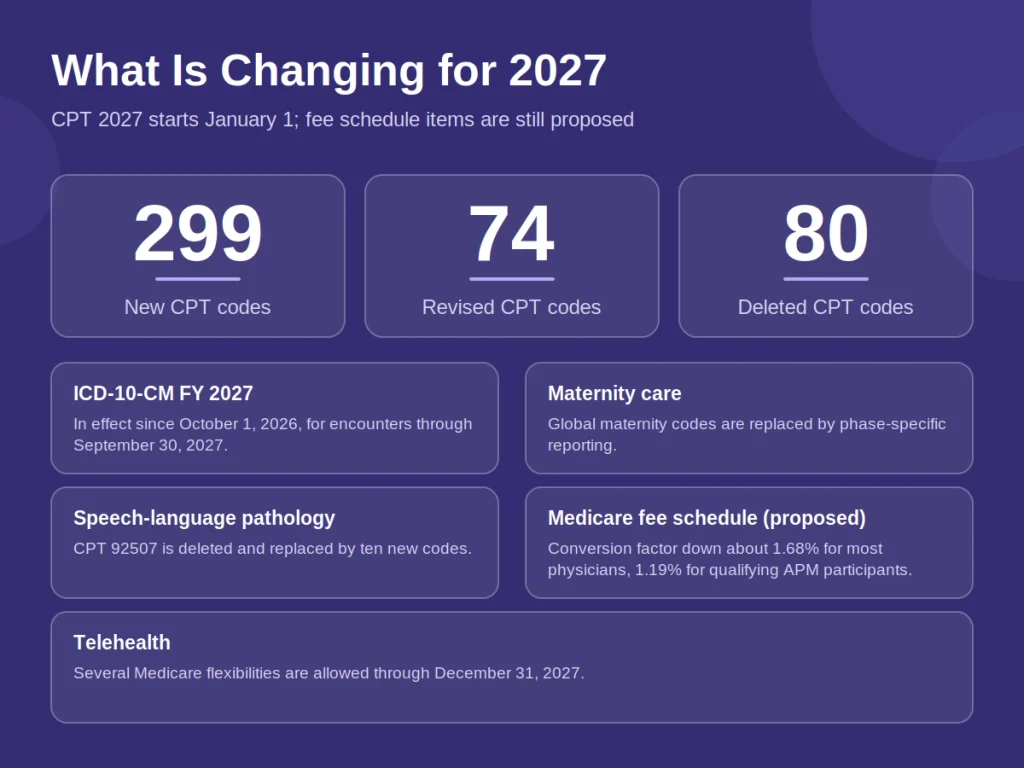
ICD-10-CM FY 2027 (already in effect). The new diagnosis code set took effect October 1, 2026, and applies to encounters through September 30, 2027. Some codes were added, some deleted and some revised. If your encoder wasn’t updated, you may already be submitting outdated codes.
2027 CPT changes (effective January 1, 2027). The AMA released the CPT 2027 code set with 299 new codes, 74 revisions and 80 deletions. A few highlights worth knowing:
- Maternity care. The traditional global maternity codes are being deleted and replaced with phase-specific reporting: antepartum and postpartum care through E/M services, new labor management codes and new delivery codes. OB-GYN practices should treat this as a major workflow change, not a footnote.
- AI-related services. Ten new codes bring the total number of AI-related CPT codes to 43.
- Other areas. Updates also touch ventricular assist device procedures, hernia repair, prostate biopsy, biofeedback, radiology and sleep medicine, including unattended sleep testing.
- Speech-language pathology. CPT 92507 is being deleted and replaced by ten new codes.
Medicare physician fee schedule (proposed for 2027). CMS released its proposed CY 2027 rule in July 2026. As proposed, the conversion factor would drop by about 1.19 percent for qualifying APM participants and about 1.68 percent for others, largely because a temporary 2.5 percent increase for 2026 expires. You can track the latest updates on the CMS Physician Fee Schedule page. The proposal also includes changes to practice expense methodology, efficiency adjustments and remote monitoring policy. The final rule is expected in the fall, so watch for it and adjust your budgets and fee schedules once it lands.
Telehealth. Under the recently passed laws, several Medicare telehealth flexibilities have been allowed until December 31, 2027, and CMS is proposing adding a few more services to the list of telehealth services. This new proposal also contains new modifiers for telehealth for some special arrangements from January 1, 2027.
Putting that together, medical billing changes 2027 are a mix of new codes, shifting payment rates and evolving telehealth rules. That’s exactly why medical billing preparation for 2027 can’t wait until January 2.
What should be included in a year-end medical billing checklist?
Here’s the full medical billing checklist for the new year, grouped so you can assign each section to the right person. Print it, paste it into your task manager or just work through it one block at a time.
Part 1: Clean up your accounts receivable
This is where the money is, so start here. Year-end accounts receivable cleanup isn’t glamorous, but it usually pays for itself.
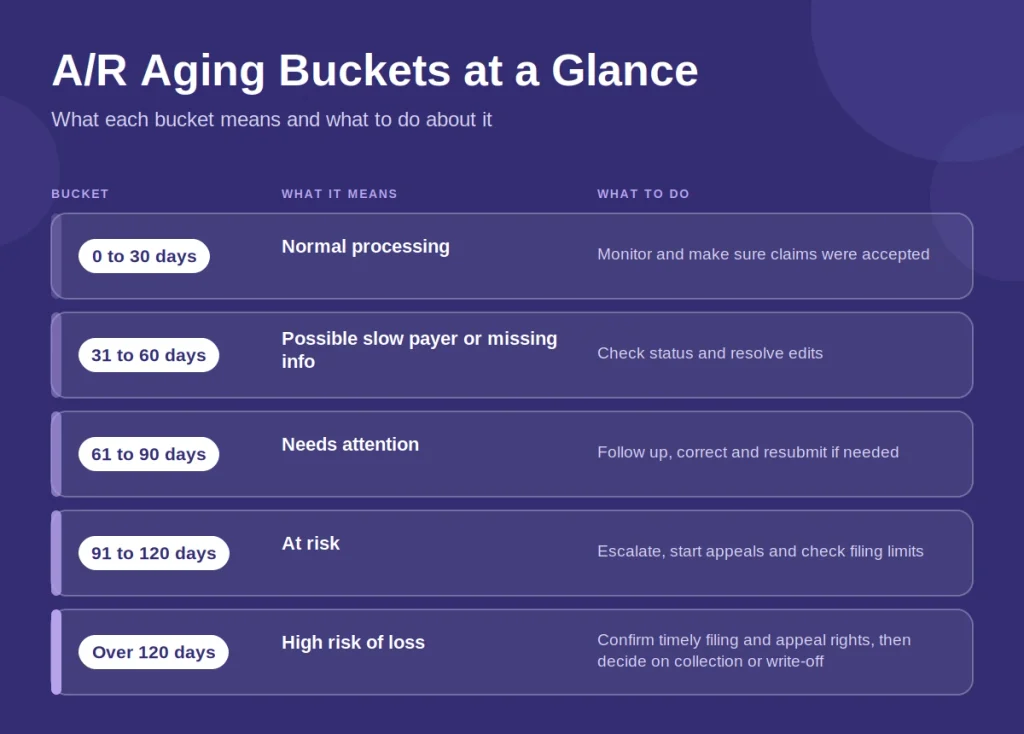
Pull your medical billing aging report. Run it by payer and by age bucket. The usual buckets are 0 to 30, 31 to 60, 61 to 90, 91 to 120 and over 120 days. Look at where the dollars sit, not just the claim counts.
Rank the problems. Sort by balance and by age. Anything over 90 days with a large balance goes to the top of the list.
Work every claim with no activity. A claim that hasn’t been touched in 30 days isn’t “pending.” It’s forgotten. Check status, call or message the payer and document the result.
Identify patterns. If one payer holds 40 percent of your over-90 balance, that’s a process or contract issue, not bad luck.
Review your days in A/R. Compare it to last year. If it’s creeping up, something in the cycle is slowing down.
Decide on write-offs thoughtfully. Write off only what you’ve confirmed is uncollectible, such as contractual adjustments or claims past all appeal rights. Document the reason. Avoid “cleaning up” the report by quietly zeroing out balances that could still be collected.
Check for credit balances. If a payer or patient overpaid, you may owe money back. Review credits, confirm they’re real and process refunds promptly. For Medicare and Medicaid, identified overpayments generally have to be reported and returned within required timeframes, so don’t let credits pile up.
A simple way to think about aging buckets:
| Age bucket | What it usually means | What to do |
| 0 to 30 days | Normal processing | Monitor, make sure claims were accepted |
| 31 to 60 days | Possible slow payer or missing info | Check status, resolve edits |
| 61 to 90 days | Needs attention | Follow up, correct and resubmit if needed |
| 91 to 120 days | At risk | Escalate, start appeals, check filing limits |
| Over 120 days | High risk of loss | Confirm timely filing and appeal rights, decide on collection or write-off |
Part 2: Handle timely filing before it handles you
Nothing hurts like a perfectly good claim that expired. Make timely filing a standing item on your year-end list.
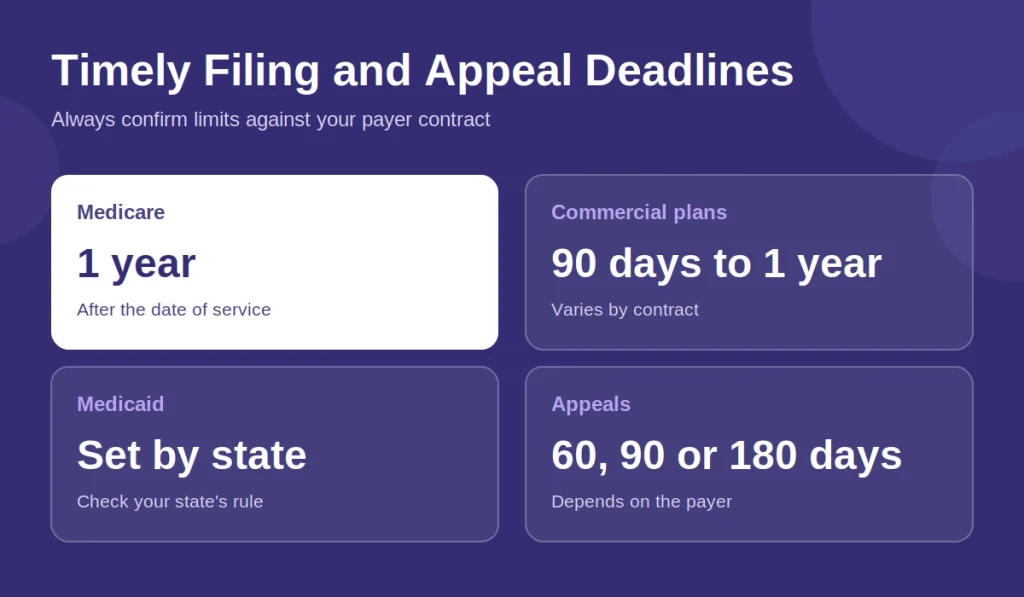
Know your limits. The timely filing deadline for Medicare services is usually one year after the date of service. This deadline varies depending on who the payer is. Commercial insurance plans may have deadlines ranging between 90 days and one year, while Medicaid deadlines are state-dependent. Check your contract instead of assuming.
Run a timely filing sweep. Pull every unbilled encounter, open charge and unsubmitted claim. Anything approaching its limit goes to the front of the line.
Look for “stuck” claims. Claims sitting in a hold queue, awaiting a provider signature, a missing authorization or an unresolved edit are the usual suspects for medical billing timely filing misses.
Track corrected claim and appeal deadlines too. These are separate clocks. A denied claim might have 60, 90 or 180 days to appeal, depending on the payer.
Keep proof of timely submission. Clearinghouse acceptance reports, payer acknowledgments and dated correspondence can save a claim later. Save them.
Part 3: Fix rejected medical claims and denials
Rejected medical claims are the easiest money to recover, because a rejection usually means the claim never entered adjudication. It bounced at the front door.
- Separate rejections from denials. A rejection means the claim failed an edit and needs correction and resubmission. A denial means it was processed and not paid, which usually requires an appeal or additional information.
- Check clearinghouse reports. Make sure no rejected batches are sitting unworked.
- Group rejections by reason. Common ones include invalid member ID, missing or wrong NPI, formatting errors, invalid codes and missing modifiers.
- Fix the cause, not just the claim. If registration errors keep producing the same rejection, retrain the front desk.
- Work denials by dollar value and deadline. Appeal the high-value ones first and watch the clock.
Strong denial management pays off most at year-end, because the cutoff dates are real and the patterns are fresh.
Part 4: Run Your Year-End Medical Billing Compliance Audit
Now for the part that surprises people. A year-end audit isn’t about finding someone to blame. It’s about finding weaknesses while you still have time to fix them.
What should a year-end billing compliance audit include?
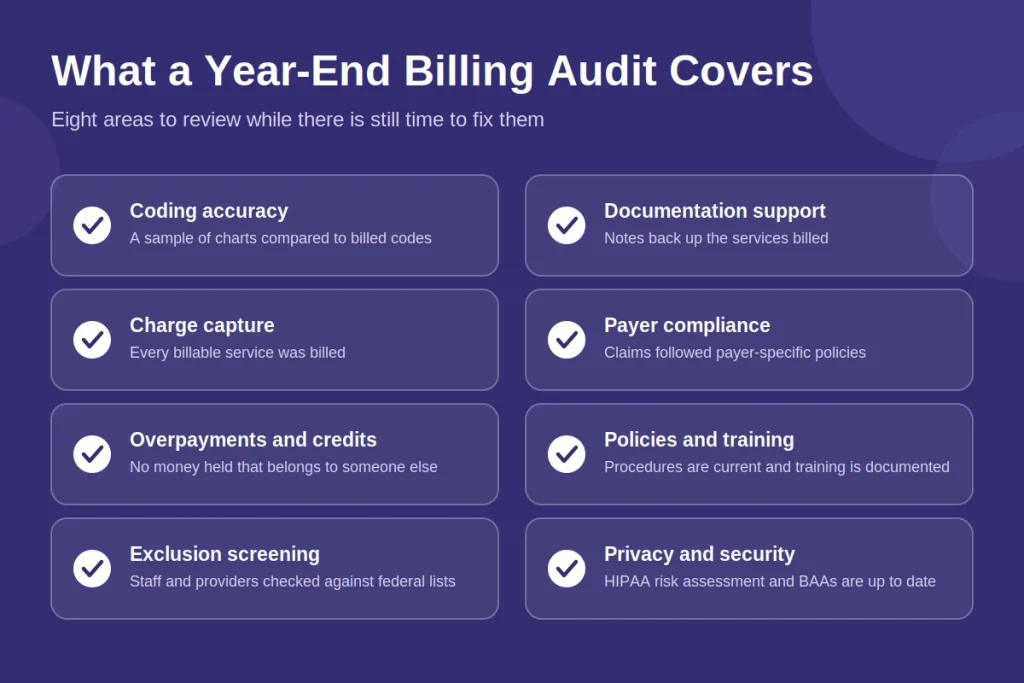
A practical medical billing compliance audit at year-end generally covers:
- Coding accuracy. A sample of charts per provider compared to billed codes.
- Documentation support. Whether notes back up the services billed.
- Charge capture. Whether every billable service was actually billed.
- Payer compliance. Whether claims followed payer-specific policies.
- Overpayment and credit review. Whether you’re holding money that belongs to someone else.
- Policies and training. Whether your written procedures are current and your staff training is documented.
- Exclusion screening. Whether staff and providers were checked against federal exclusion lists.
- Privacy and security. Whether your HIPAA risk assessment and business associate agreements are up to date.
What should be checked during a year-end medical billing audit?
Here’s a working medical billing audit checklist for the audit itself:
- E/M levels. Compare your distribution to what’s reasonable for your specialty. A sudden shift toward higher levels deserves a closer look.
- Modifier use. Review modifier 25, 59 and X modifiers, plus any others you use heavily. Make sure documentation supports each one.
- Unbundling and duplicates. Look for code combinations that trigger NCCI edits or services billed twice.
- Medical necessity. Confirm diagnoses support the procedures billed.
- Time-based codes. Check that documented time supports the code selected.
- Signatures and authentication. Verify providers signed and dated their notes.
- Cloned or templated notes. Spot copy-and-paste text that doesn’t reflect the visit.
- Supervision and billing rules. Make sure services by NPs, PAs or residents were billed under the correct provider rules.
- Telehealth claims. Confirm correct place of service, modifiers and eligibility under current rules.
- Time between service and billing. Measure charge lag, and look for a bunching of claims near deadlines.
Sample size matters. Many practices review a set number of charts per provider and increase the sample where error rates are high. A more detailed medical coding audit is covered in our guide on medical coding services and compliance.
Part 5: Run a medical documentation audit
A medical documentation audit looks at whether the record is complete and supports what was billed. In many ways, this is where compliance is won or lost.
Check for:
- Patient identification and date of service on every note
- Clear reason for the visit
- History, exam, assessment and plan
- Orders, results and follow-up instructions
- Provider signature and credentials
- Medical necessity for tests, procedures and referrals
- Consent forms where required
- Timely completion of notes, since late entries raise questions
- Consistency between the note and the claim
When you find gaps, share the findings with providers in short, specific feedback. “Your notes on follow-up visits don’t show the time spent, which makes the higher-level code hard to defend” works better than a general reminder.

Part 6: Get ready for coding changes
This part is time-sensitive. Medical coding updates have already begun (ICD-10-CM) and more arrive January 1 (CPT and HCPCS).
- Confirm your encoder and PM system are updated with the FY 2027 ICD-10-CM code set. If your software vendor hasn’t pushed it, call them today.
- Order or access the 2027 CPT code set and updated guidelines, and schedule coder training before January.
- Review your charge master and fee schedule. Identify any CPT or HCPCS codes you use that are being deleted, revised or replaced. Update descriptions, codes and fees.
- Map your most common codes. Make a short list of the codes your practice bills most, and check each one against the 2027 changes.
- Focus on affected specialties. If you’re in OB-GYN, speech-language pathology, sleep medicine, radiology, urology or a specialty with major changes, plan dedicated training. CPT code changes like the maternity restructuring affect scheduling, documentation and billing workflows, not just the code list.
- Update templates. EHR templates need to match new documentation requirements.
- Review 2027 ICD-10 updates for your specialty. Even small changes, like a new character requirement, can cause rejections if missed.
- Prepare for deleted codes. Claims for 2027 dates of service must use 2027 codes. Claims for 2026 dates of service use 2026 codes, so keep both sets available during the transition.
If you want a deeper dive, our medical coding team can help you review how these changes affect your top-billed services.
Part 7: Patient balances and medical billing collections
Medical billing collections from patients tend to spike in Q4 and drop in Q1, because patients are more willing to pay before deductibles reset and more likely to stall after.
- Send statements early. Don’t wait until the last week of December.
- Provide payment options that work for everyone. Online payments, payment arrangements, and reminders make things easy.
- Look at the age distribution of your patients. Make sure to collect from those who are most willing to pay.
- Make the patients understand the advantages. Most health care plans start a new year on January 1st. And patients with a flexible spending account or unused benefits will be encouraged to see you.
- Be consistent. Stick to your financial policy and do not discriminate against any of your patients.
- Be in compliance. Follow the rules of collections and No Surprises Act.
Part 8: Credentialing, enrollment and contracts
Billing problems often start with paperwork that expires quietly.
- Check provider enrollment status for every payer, location and provider.
- Calendar revalidation dates for the next twelve months.
- Confirm CAQH profiles are current and re-attested on schedule.
- Verify licenses, DEA registrations and board certifications haven’t expired or are about to.
- Review payer contracts and fee schedules. Check for rate changes, renewals and notice deadlines.
- Update practice locations and tax IDs with payers if anything changed.
Our provider credentialing and enrollment services handle the tracking so renewals don’t sneak up on you.
Part 9: Payroll, reporting and reconciliation
- Reconcile payments. Match payer remittances (ERAs and EOBs) to bank deposits.
- Close out open batches. Make sure every charge entered was posted and billed.
- Review adjustments and write-offs. Confirm each has a reason code and approval.
- Check unapplied cash. Payments sitting without a claim attached are a red flag.
- Prepare year-end financial reports for your accountant, including collections, adjustments and A/R by payer.
- Snapshot your KPIs. Record clean claim rate, denial rate, days in A/R and net collection rate, so you can compare next year.
What medical billing tasks should be completed before year end?
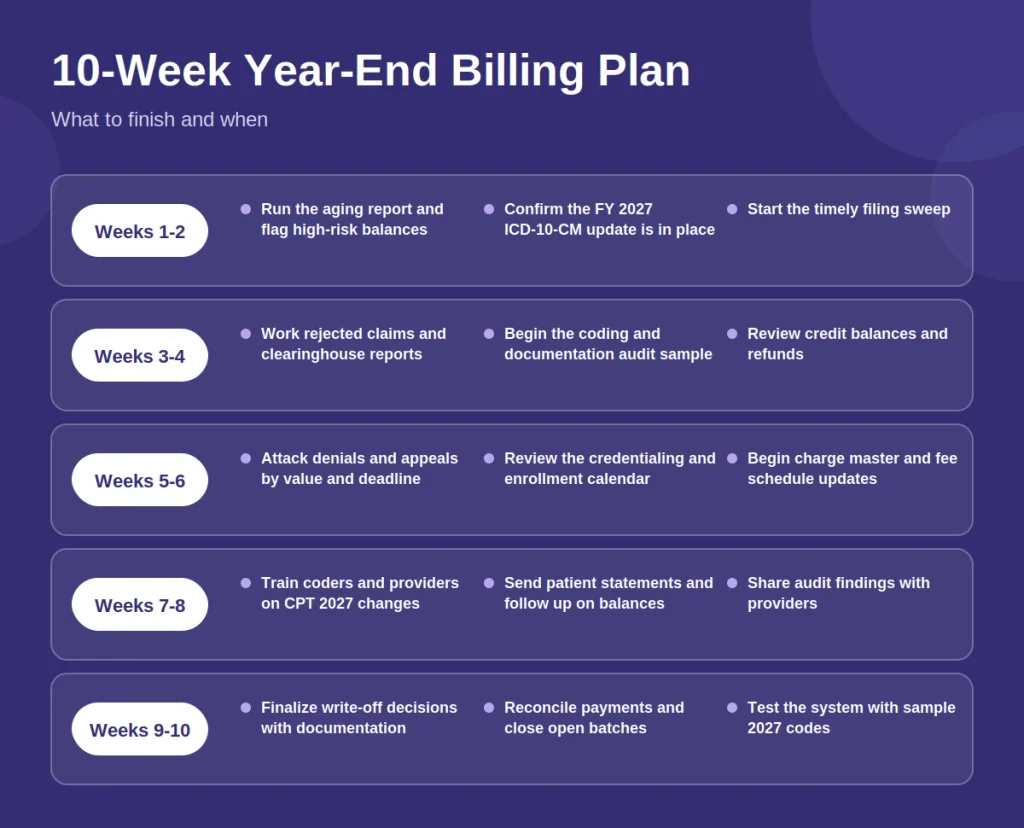
If you want the short version, here’s the answer to what medical billing tasks should be completed before year end. Think of it as a ten-week plan.
Weeks 1 and 2 (now)
- Run your aging report and identify high-risk balances
- Confirm your ICD-10-CM FY 2027 update is in place
- Start the timely filing sweep
Weeks 3 and 4
- Work rejected claims and clearinghouse reports
- Begin the coding and documentation audit sample
- Review credit balances and refunds
Weeks 5 and 6
- Attack denials and appeals by value and deadline
- Review credentialing and enrollment calendar
- Begin charge master and fee schedule updates for 2027
Weeks 7 and 8
- Train coders and providers on CPT 2027 changes
- Send patient statements and follow up on balances
- Share audit findings with providers
Weeks 9 and 10
- Complete write-off decisions with documentation
- Reconcile payments and close open batches
- Test your system with sample 2027 codes
- Review the final Medicare fee schedule when it’s published and update your financial projections
Even if you only get through half of this, you’ll start the year ahead of most practices.
Common year-end mistakes to avoid
A few patterns show up every year:
- Waiting until December. Holiday staffing makes everything slower.
- Ignoring old A/R. The hardest accounts only get harder with time.
- Forgetting the January 1 code changes. Rejections spike in the first weeks of the year.
- Writing off too aggressively. Clean reports aren’t worth lost revenue.
- Skipping the audit. Problems you don’t find, a payer eventually will.
- Not communicating with providers. Coding and documentation issues need provider involvement to fix.
- Overlooking telehealth rules. Policies are extended, but details like modifiers and eligibility can still change.
- Holding credit balances. Unreturned overpayments are a compliance risk.
Should you handle year-end billing in-house or outsource it?
Plenty of practices manage year-end well in-house. Some don’t, and it’s not a character flaw. Year-end simply collides with everything else: PTO, patient volume, staff turnover and the usual pile of daily work.
Consider outside help if:
- Your aging report has grown through the year
- Your team is short-staffed or stretched thin
- You’ve never run a formal audit
- Denial or rejection rates are creeping up
- You’re adding providers or locations in 2027
- You aren’t confident your team is ready for CPT and ICD-10 updates
Your partner can take care of your audit, your aging, your rejects, and get you set for January, all without taking your staff off their patients. You can review some options if you need some help with that; see our guide to accounts receivable management.

How iSolve RCM helps practices finish the year strong
iSolve RCM is a U.S.-focused revenue cycle management company based in Edison, New Jersey. According to the company, it supports more than 200 providers across 45+ specialties. For a year-end cleanup, these services matter most:
- Billing audits. Reviews designed to uncover underpayments, coding gaps and process weaknesses before they turn into bigger problems.
- Medical coding. Coding based on provider documentation, with attention to annual code set updates.
- Denial management and appeals. Root-cause work on denied and rejected claims, aimed at reducing repeats.
- A/R follow-up. Persistent follow-up on aging claims that internal teams rarely have time to chase.
- Eligibility and benefits verification. Fewer surprises as benefits reset in January.
- Payment posting and reconciliation. So your books match your bank.
- Provider credentialing and enrollment. Help tracking revalidations and keeping payer records current.
- Regular reporting. Clear numbers on collections, aging and denials.
- HIPAA-compliant handling of patient information.
iSolve RCM advertises service fees starting as low as 2.99% of monthly collections with no hidden fees (see the pricing details), says onboarding typically takes one to two weeks depending on practice size and complexity, and offers a free revenue cycle assessment, a useful way to spot gaps before year-end.
As with any partner, ask practical questions. How do they sample charts for audits? How do they handle code set updates? What does their aging report look like? How do they prioritize timely filing risks? Good answers should be specific.
Frequently Asked Questions
What Is a Year-End Medical Billing Compliance Checklist?
A list of activities, such as accounts receivable reconciliation, timely filing review, coding documentation audit, credentialing, and other updates, is performed by the practice before the close of the year to help minimize any potential risk and be ready for the next year.
What should be included in a year-end medical billing checklist?
At minimum: an aging report review, a timely filing sweep, rejected and denied claim cleanup, a coding and documentation audit, credit balance review, code set and fee schedule updates, credentialing and contract checks, patient balance follow-up and payment reconciliation.
What should a year-end billing compliance audit include?
Coding accuracy, documentation support, charge capture, modifier use, medical necessity, overpayment review, exclusion screening, policy and training records, and HIPAA privacy and security checks.
What is the Medicare timely filing limit?
Medicare claims generally must be filed within 12 months of the date of service. Other payers differ, so check each contract and state rule.
What’s changing in 2027 for medical billing?
New ICD-10-CM codes took effect October 1, 2026. The CPT 2027 code set, effective January 1, includes 299 new codes, 74 revisions and 80 deletions, with major changes to maternity care reporting. CMS has proposed a lower Medicare conversion factor for 2027 and extended many telehealth flexibilities through the end of 2027. Final policies may differ from proposals.
How do I review my medical billing aging report?
Sort by payer and age bucket, rank by balance, check for claims with no activity in 30 days or more, look for patterns by payer or denial reason, and prioritize anything near a filing or appeal deadline.
Should I write off old balances at year-end?
Only after confirming they’re truly uncollectible and documenting the reason. Don’t write off balances just to make reports look better.
How often should we audit our billing?
Many practices audit quarterly and do a deeper review at year-end. More frequent audits make sense after staff changes, code updates or payer inquiries.
Is it too late to start a year-end cleanup in late October?
No. You have roughly ten weeks, which is enough for a thorough review if you start now and prioritize by risk.
The bottom line
Year-end billing isn’t about perfection. It’s about getting your arms around what’s open, fixing what’s fixable and making sure January doesn’t begin with a pile of avoidable rejections. A little structure goes a long way: clean up the aging, protect your filing deadlines, audit your coding and documentation, and get ready for the 2027 code and policy changes.
Do that, and you won’t just survive the holidays. You’ll walk into the new year with cleaner books, steadier cash flow and a lot less to worry about.