On January 1, 2027, a psychiatrist who bills a 99214 with G2211 will see that the add-on code fails, because Medicare has retired it. That is one of nearly a dozen changes hitting behavioral health billing at once: new adaptive behavior codes, a lower Medicare conversion factor, new telehealth modifiers and higher Collaborative Care values. This guide covers every 2027 update in one place, plus the CPT, HCPCS and ICD-10 codes your team bills every day.
What Changes in Behavioral Health Billing on January 1, 2027
Here is the full list of 2027 updates and who each one affects, before we walk through them in detail.
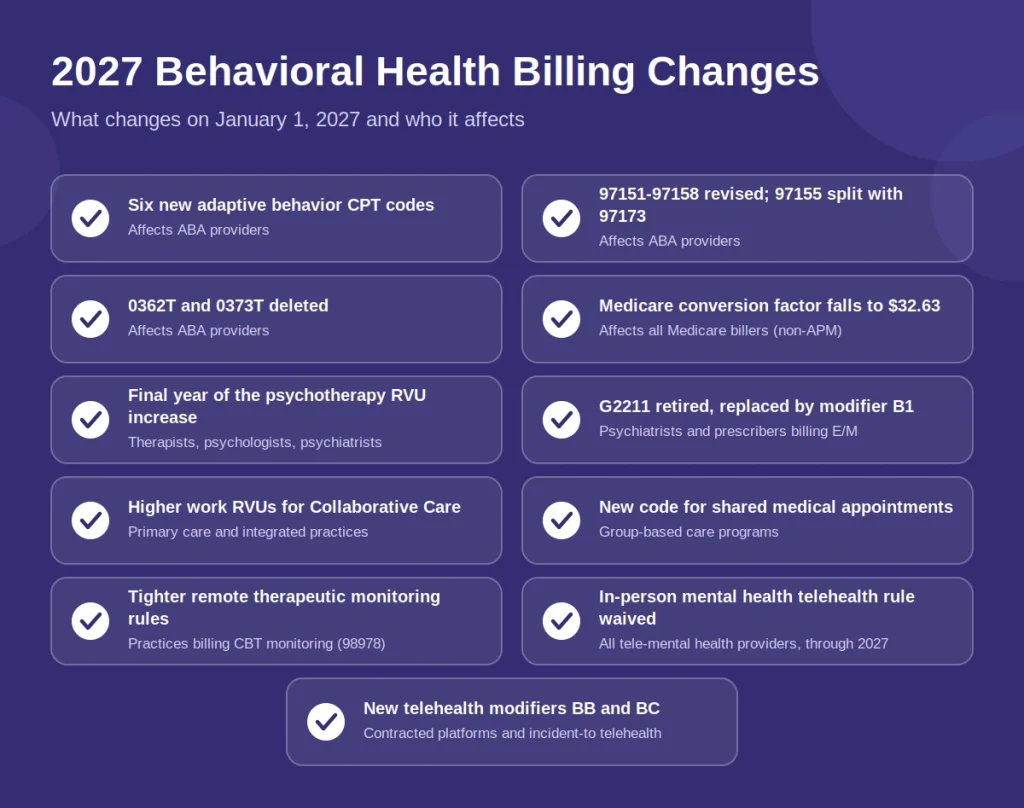
| 2027 Change | Who It Affects | Source |
|---|---|---|
| Six new adaptive behavior CPT codes (97148, 97149, 97159, 97160, 97173, 97180) | ABA providers | AMA CPT 2027 |
| 97151 to 97158 revised; 97155 split with 97173 | ABA providers | AMA CPT 2027 |
| 0362T and 0373T deleted | ABA providers | AMA CPT 2027 |
| Medicare conversion factor falls to $32.63 (non-APM) | All Medicare billers | CY 2027 PFS final rule |
| Final year of the psychotherapy work RVU increase | Therapists, psychologists, psychiatrists | CY 2027 PFS final rule |
| G2211 retired and replaced by modifier B1 | Psychiatrists and prescribers billing E/M | CY 2027 PFS final rule |
| Higher work RVUs for Collaborative Care (CoCM) | Primary care and integrated practices | CY 2027 PFS final rule |
| New code for shared medical appointments | Group-based care programs | CY 2027 PFS final rule |
| Tighter remote therapeutic monitoring rules | Practices billing CBT monitoring (98978) | CY 2027 PFS final rule |
| In-person mental health telehealth rule waived through 2027 | All tele-mental health providers | CAA, 2026 and PFS final rule |
| New telehealth modifiers BB and BC | Practices using contracted platforms or incident-to telehealth | CAA, 2026 |
New and Revised CPT Codes for 2027
The AMA released CPT 2027 on September 9, 2026 with 299 new codes, 74 revisions and 80 deletions. For behavioral health, almost all of the movement sits in the adaptive behavior section, which grows from ten codes to fourteen permanent Category I codes.
Six New Adaptive Behavior Codes
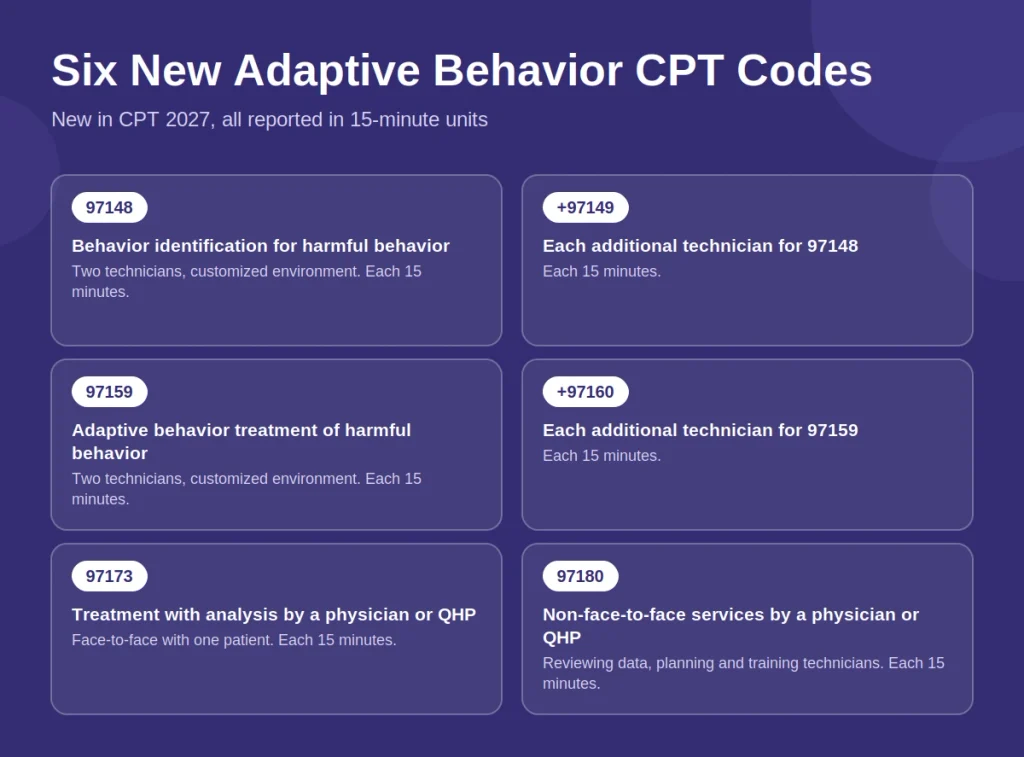
| New Code | What It Reports | Unit |
|---|---|---|
| 97148 | Behavior identification supporting assessment of harmful behavior, two technicians, customized environment | Each 15 minutes |
| +97149 | Each additional technician for 97148 | Each 15 minutes |
| 97159 | Adaptive behavior treatment of harmful behavior, two technicians, customized environment | Each 15 minutes |
| +97160 | Each additional technician for 97159 | Each 15 minutes |
| 97173 | Adaptive behavior treatment with analysis by a physician or QHP, face-to-face with one patient | Each 15 minutes |
| 97180 | Adaptive behavior non-face-to-face services personally performed by a physician or QHP | Each 15 minutes |
97180 is the most important addition for revenue. For the first time, a behavior analyst has a code for the indirect clinical work that fills much of the week: reviewing treatment data and session notes, deciding whether to change targets or protocols, planning discharge or transition and training technicians on revised protocols. Whether each payer will reimburse it, and at what rate, still has to be confirmed contract by contract.
Revised 97151 to 97158 and the 97155 Split
All eight existing adaptive behavior codes have revised descriptors for 2027. The change with the widest impact is 97155. It now covers direction of the technician and analysis by the physician or QHP, while the hands-on treatment component it carried since 2019 moves to the new 97173. A behavior analyst who directs a technician and also works directly with the patient in the same session will now split that time across two codes. Codes 97156, 97157 and 97158 now read “with analysis,” and 97152, 97153 and 97154 drop the phrase “under the direction of.”
Deleted Codes 0362T and 0373T
The two Category III codes for high-acuity ABA services involving multiple technicians are deleted for dates of service from January 1, 2027. The four new harmful-behavior codes, 97148, 97149, 97159 and 97160, take their place with permanent status. Prior authorizations issued this fall under 0362T or 0373T that run into 2027 will need to be updated, so check every open authorization now.
What Did Not Change: Psychiatry and Psychotherapy Codes
The core psychiatry CPT codes keep their 2026 numbers and descriptors in the published 2027 update materials. That includes the diagnostic evaluations 90791 and 90792, individual psychotherapy 90832, 90834 and 90837, the E/M add-ons 90833, 90836 and 90838, family therapy 90846 and 90847 and group psychotherapy 90853. Their Medicare payment does change in 2027, which the next section covers.
Medicare Payment Rules for Behavioral Health in 2027
CMS released the CY 2027 Physician Fee Schedule final rule on November 4, 2026. Six of its policies touch behavioral health directly.
Conversion Factor Drops to $32.63
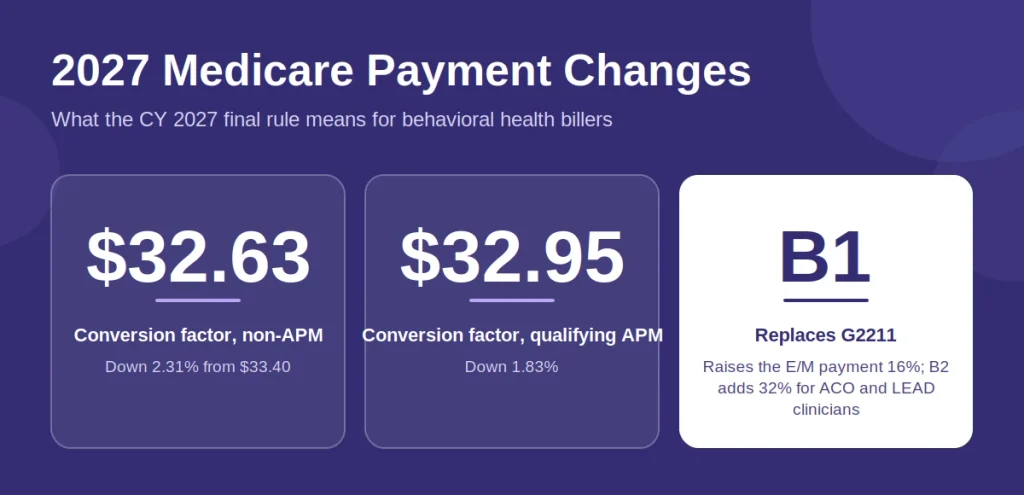
The 2.5% one-year boost Congress added for 2026 expires, so the 2027 conversion factor for practitioners who are not qualifying APM participants falls to $32.63, a 2.31% cut from $33.40. Qualifying APM participants get $32.95, down 1.83%. Every psychiatric service billed under the fee schedule feels this cut before any code-level changes are applied.
Final Year of the Psychotherapy RVU Increase
In the CY 2024 rule, CMS began raising work RVUs for timed behavioral health services, including psychotherapy, over a four-year transition. 2027 is the final step, and CMS has now added smoking and tobacco cessation and SBIRT services to that final step. For 90832 through 90838, this increase offsets part of the conversion factor cut, so check each code in the final RVU file rather than assuming a flat 2.31% drop.
G2211 Becomes Modifier B1
HCPCS G2211, the E/M complexity add-on, is retired for 2027 dates of service. Its replacement is modifier B1, appended directly to the office or outpatient E/M code, which raises that E/M payment by 16% instead of adding a flat amount. Clinicians in a Shared Savings Program ACO or the LEAD Model can use modifier B2 instead, which adds 32%. For psychiatrists who bill a 99214 or 99215 with a psychotherapy add-on, the B1 modifier belongs on the E/M line, not the add-on.
Collaborative Care Gets Higher Values
CMS finalized higher work RVUs for the Psychiatric Collaborative Care Model codes (99492, 99493 and 99494, plus G2214) and updated the clinical labor rates for the behavioral health care manager. Primary care and integrated practices running CoCM programs should see a better return per enrolled patient in 2027.
Shared Medical Appointments Get Their Own Code
Medicare finalized separate coding and payment for shared medical appointments, along with an add-on code for extra time. These are group visits for patients with a common chronic condition, and CMS specifically pointed to their value for social isolation and loneliness. They are not a replacement for group psychotherapy (90853), which still applies when the service is psychotherapy delivered to a group.
Remote Therapeutic Monitoring Rules Tighten
RTM codes, including 98978 for devices that monitor cognitive behavioral therapy, carry three new conditions in 2027. RTM can only be furnished to established patients, a separately reportable initiating visit is required when monitoring begins and the codes are revalued. A fourth rule, limiting payment to clinical staff employed by the practice rather than outside vendors, was delayed to January 1, 2029. Practices that use a monitoring vendor have two years to adjust.
Telehealth Rules for Mental Health in 2027
Tele-mental health remains the most stable part of behavioral health billing for 2027, but two changes still need attention.
In-Person Visit Requirement Waived Through December 31, 2027
Under the Consolidated Appropriations Act, 2026, the in-person visit requirement for mental health services furnished by telehealth does not apply to services through December 31, 2027. That includes RHC and FQHC mental health visits. Patients can keep receiving therapy and psychiatric care from home without an in-person visit in the prior six months, at least for one more year.
New BB and BC Telehealth Modifiers
The same law created two new Medicare telehealth modifiers for 2027. Modifier BB identifies telehealth services furnished through a virtual platform owned by an entity the practitioner contracts with or pays. Modifier BC identifies telehealth billing services furnished incident to another practitioner’s service. Practices that see patients through a contracted platform or bill supervised clinicians’ telehealth incident to a physician need these on their claims from January 1.
Place of Service and Modifier Basics
Nothing changes in the core telehealth coding. Report POS 10 when the patient is at home and POS 02 when the patient is somewhere else, add modifier 95 for audio-video visits and modifier 93 for audio-only visits. Medicare limits modifier GT to Critical Access Hospital Method II claims, so most practices should not use it.

HCPCS Level II Codes Behavioral Health Practices Use in 2027
HCPCS Level II codes cover services CPT does not describe. In behavioral health, they fall into two groups: Medicare G-codes and Medicaid H, S and T codes.
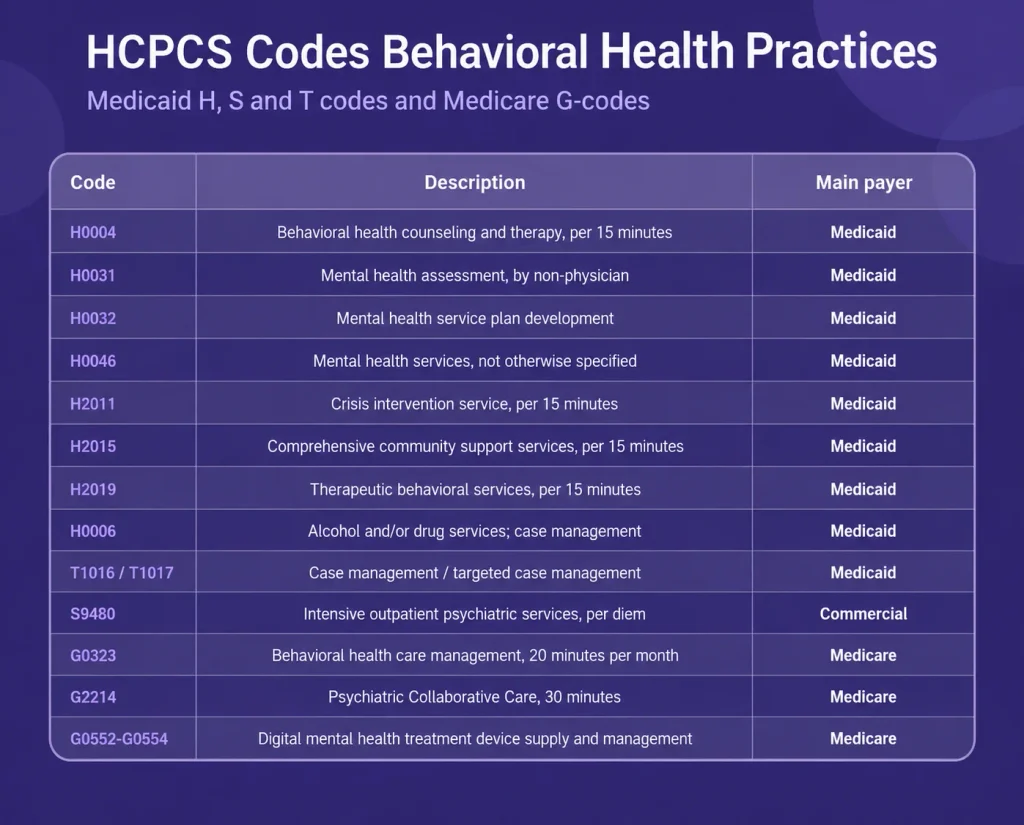
| Code | Description | Main Payer |
|---|---|---|
| H0004 | Behavioral health counseling and therapy, per 15 minutes | Medicaid |
| H0031 | Mental health assessment, by non-physician | Medicaid |
| H0032 | Mental health service plan development, by non-physician | Medicaid |
| H0046 | Mental health services, not otherwise specified | Medicaid |
| H2011 | Crisis intervention service, per 15 minutes | Medicaid |
| H2015 | Comprehensive community support services, per 15 minutes | Medicaid |
| H2019 | Therapeutic behavioral services, per 15 minutes | Medicaid |
| H0006 | Alcohol and/or drug services; case management | Medicaid |
| T1016 / T1017 | Case management / targeted case management, each 15 minutes | Medicaid |
| S9480 | Intensive outpatient psychiatric services, per diem | Commercial |
| G0323 | Behavioral health care management by psychologists, LCSWs, MFTs or MHCs, 20 minutes per month | Medicare |
| G2214 | Psychiatric Collaborative Care, first or subsequent month, 30 minutes | Medicare |
| G0552 to G0554 | Digital mental health treatment device supply and monthly management | Medicare |
Medicaid H-Codes Are Defined State by State
H-codes look national, but each state Medicaid program sets its own definitions, unit rules, modifiers and rates. H2015 might require a specific staff credential in one state and a treatment plan signature in another, while H0046 is often reserved for services a state has not assigned to any other code. Always bill H-codes from your state’s Medicaid manual and the MCO’s own fee schedule, never from a national code list.
Case Management Codes in Behavioral Health
There is no single CPT code for behavioral health case management. Medicaid programs usually use T1016 or T1017, or H0006 for substance use case management. Medicare covers care management work through the BHI and CoCM codes instead: 99484 or G0323 for general behavioral health integration and 99492 through 99494 or G2214 for Collaborative Care. S9480 is mostly a commercial code; Medicare pays intensive outpatient programs through hospital outpatient departments, CMHCs, RHCs and FQHCs on institutional claims instead.
Behavioral Health CPT Codes Cheat Sheet for 2027
These are the CPT codes behavioral health practices bill most often, with the time rules that drive denials.
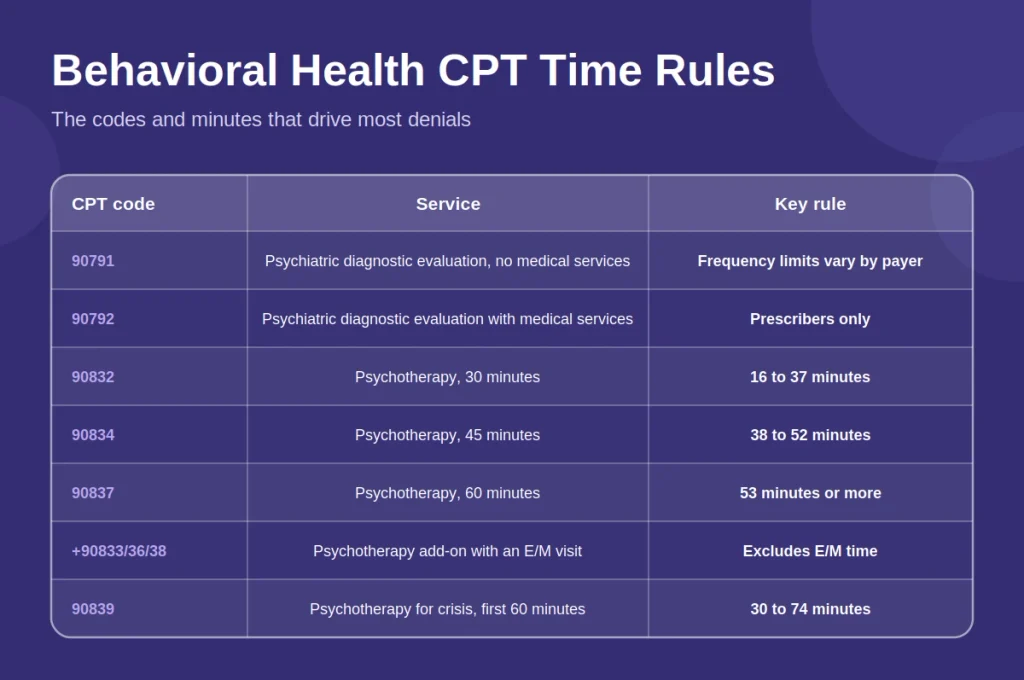
| CPT Code | Service | Key Rule |
|---|---|---|
| 90791 | Psychiatric diagnostic evaluation, no medical services | Frequency limits vary by payer |
| 90792 | Psychiatric diagnostic evaluation with medical services | Prescribers only (includes medical services) |
| 90832 | Psychotherapy, 30 minutes | 16 to 37 minutes |
| 90834 | Psychotherapy, 45 minutes | 38 to 52 minutes |
| 90837 | Psychotherapy, 60 minutes | 53 minutes or more |
| +90833 / +90836 / +90838 | Psychotherapy add-on with an E/M visit (30, 45, 60 minutes) | Psychotherapy time excludes E/M time |
| 90839 / +90840 | Psychotherapy for crisis, first 60 minutes / each extra 30 | 30 to 74 minutes for 90839 |
| +90785 | Interactive complexity | Add-on only; not with E/M alone |
| 90846 / 90847 | Family psychotherapy without / with the patient | 50 minutes |
| 90849 | Multiple-family group psychotherapy | Bill per family |
| 90853 | Group psychotherapy (not multiple-family) | Bill per patient |
| 96127 | Brief emotional or behavioral assessment (PHQ-9, GAD-7) | Per standardized instrument |
| 96130 / +96131 | Psychological testing evaluation services | First hour / each extra hour |
| 96136 / +96137 | Test administration by physician or QHP | First 30 minutes / each extra 30 |
| 99484 | General behavioral health integration | 20 minutes per month |
| 99492 / 99493 / +99494 | Psychiatric Collaborative Care | Monthly time thresholds |
| 98978 | RTM device supply for CBT monitoring | Established patients only from 2027 |
Is There a CPT Code for Cognitive Behavioral Therapy?
No. CBT is a treatment method, not a separate service, so it is billed with the time-based psychotherapy codes: 90832, 90834 or 90837, or an add-on with E/M. The only CPT code that names CBT is 98978, which reports the supply of a remote therapeutic monitoring device used to track CBT between sessions. Billing 98978 does not replace the psychotherapy code for the session itself.
What Happened to CPT 90844?
90844 is a retired code from an older psychotherapy series and is not valid in current CPT. Claims that still use it will be rejected. A 45-minute individual psychotherapy session today is reported with 90834, or with 90836 when it is added to an E/M visit by a prescriber.
ICD-10 Codes That Support Behavioral Health Claims
FY2027 ICD-10-CM took effect on October 1, 2026, and Chapter 5 (F01 to F99) barely moved, with a single new entry in the CMS order file. The bigger risk is specificity. Payers deny behavioral health claims when the diagnosis is unspecified, does not match the documented severity or is a Z code billed as the primary reason for psychotherapy.
Therapy Diagnosis Codes Payers Accept
| ICD-10 Code | Description |
|---|---|
| F41.1 | Generalized anxiety disorder |
| F32.A / F33.1 | Depression, unspecified / Major depressive disorder, recurrent, moderate |
| F43.10 / F43.12 | Post-traumatic stress disorder, unspecified / chronic |
| F43.23 | Adjustment disorder with mixed anxiety and depressed mood |
| F90.0 / F90.2 | ADHD, predominantly inattentive / combined type |
| F84.0 | Autistic disorder (the core diagnosis for ABA authorization) |
| F10.20 / F11.20 | Alcohol / opioid dependence, uncomplicated |
Code to the highest specificity the record supports. A note that documents moderate recurrent depression should never go out as F32.A, and a substance use note that documents dependence should not be coded as abuse.
ICD-10 Codes for Behavioral Problems and Counseling
For behavioral problems, the right code depends on what has been diagnosed. F91.3 reports oppositional defiant disorder and F91.9 an unspecified conduct disorder, while F98.9 covers unspecified behavioral and emotional disorders with childhood onset. When no disorder has been diagnosed, R46.89 (other symptoms and signs involving appearance and behavior) or Z72.810 (child and adolescent antisocial behavior) may apply. Counseling Z codes such as Z71.89 (other specified counseling), Z71.41 (alcohol counseling), Z71.51 (drug counseling) and Z63.0 (problems in relationship with spouse or partner) describe the reason for an encounter. Many payers will not accept them as the primary diagnosis for psychotherapy, so pair them with a qualifying F code whenever the record supports one.
How to Prepare Your Practice Before January 1, 2027
Use this checklist to turn the 2027 changes into system updates before the first claim goes out.
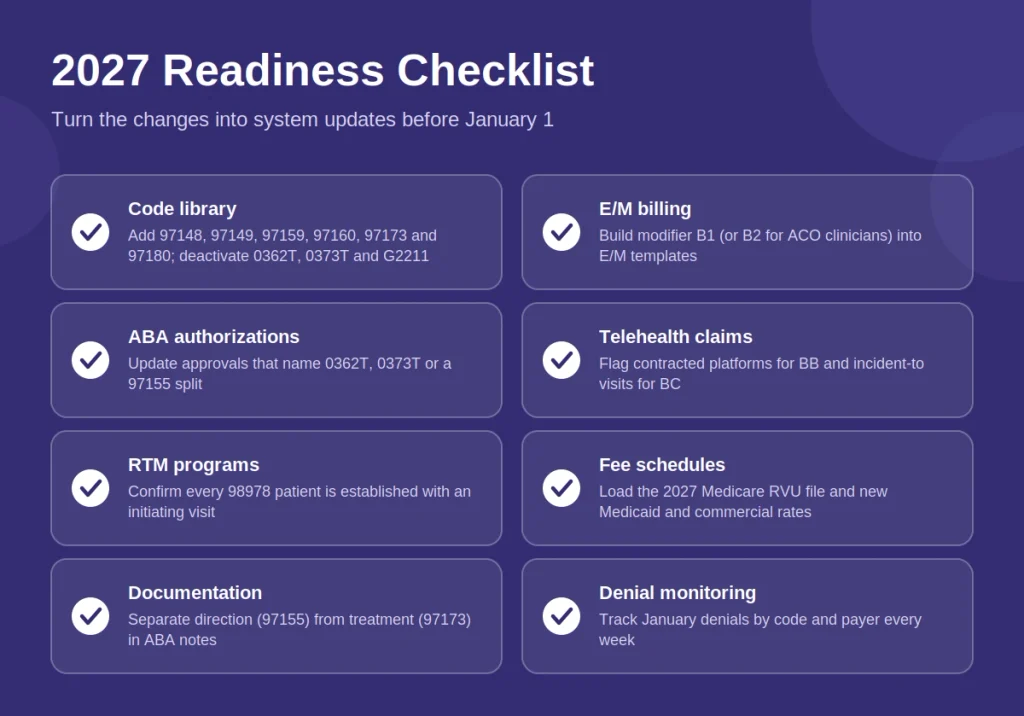
| Task | Action Before January 1 |
|---|---|
| Code library | Add 97148, 97149, 97159, 97160, 97173 and 97180; deactivate 0362T, 0373T and G2211 |
| E/M billing | Build modifier B1 (or B2 for ACO clinicians) into E/M templates for psychiatrists and NPs |
| ABA authorizations | Request updated authorizations for any approval that names 0362T, 0373T or a 97155 split |
| Telehealth claims | Flag visits on contracted platforms for BB and incident-to telehealth for BC |
| RTM programs | Confirm every 98978 patient is established and has a documented initiating visit |
| Fee schedules | Load the 2027 Medicare RVU file and new Medicaid and commercial rates |
| Documentation | Update ABA note templates to separate direction (97155) from treatment (97173) |
| Denial monitoring | Track January denials by code and payer weekly for the first quarter |

Frequently Asked Questions
What are the new behavioral health CPT codes for 2027?
The 2027 CPT update adds six adaptive behavior codes: 97148, 97149, 97159, 97160, 97173 and 97180. They cover assessment and treatment of harmful behavior with multiple technicians, treatment with analysis by a physician or QHP and non-face-to-face clinical work. Codes 97151 through 97158 are revised, 0362T and 0373T are deleted and the core psychiatry and psychotherapy codes keep their 2026 numbers and descriptors.
Is there a CPT code for cognitive behavioral therapy?
No. CBT is billed with the time-based psychotherapy codes 90832, 90834 or 90837, or with an add-on code such as 90833 when it accompanies an E/M visit. The only CPT code that names CBT is 98978, which reports a remote therapeutic monitoring device used to track CBT between sessions. From 2027, Medicare allows 98978 only for established patients after a documented initiating visit.
What is CPT code 90853?
CPT 90853 reports group psychotherapy for a group other than a multiple-family group. Each patient in the group is billed separately with 90853, and the session must be led by a licensed clinician. Multiple-family group therapy uses 90849 instead. Medicare’s new 2027 code for shared medical appointments is a different service and does not replace 90853 when the group service is psychotherapy.
What is CPT 90838?
CPT 90838 is a psychotherapy add-on for 60 minutes of therapy, reported with an evaluation and management visit on the same day by the same prescriber. It requires at least 53 minutes of psychotherapy, and that time cannot include the time spent on the E/M portion of the visit. In 2027, the E/M line may also carry modifier B1, which replaces the retired G2211 add-on code.
What does HCPCS code H2015 mean?
H2015 is the HCPCS code for comprehensive community support services, billed per 15 minutes. It is a Medicaid code, so each state defines which services qualify, who can provide them, the documentation required and the rate. Medicare does not pay H2015. Always check your state Medicaid manual and the managed care plan’s fee schedule before billing it, because unit and credential rules vary widely.
What does HCPCS code H2015 mean?
H2015 is the HCPCS code for comprehensive community support services, billed per 15 minutes. It is a Medicaid code, so each state defines which services qualify, who can provide them, the documentation required and the rate. Medicare does not pay H2015. Always check your state Medicaid manual and the managed care plan’s fee schedule before billing it, because unit and credential rules vary widely.
What is the H0046 code description?
H0046 means mental health services, not otherwise specified. State Medicaid programs use it for behavioral health services that no other HCPCS or CPT code describes, so its meaning and rate depend entirely on the state. Some states require prior authorization or a specific program enrollment to bill it. Because it is a catch-all code, payers review it closely, so documentation must clearly describe the service delivered.
What is the H0031 code description?
H0031 is a mental health assessment performed by a non-physician, such as a licensed counselor or social worker. Medicaid programs use it for intake and reassessment services, and many states set limits on how often it can be billed per year. Medicare and most commercial plans use 90791 for diagnostic evaluations instead, so H0031 should only be billed where the state Medicaid program recognizes it.
What is CPT code S9480?
S9480 is a HCPCS code for intensive outpatient psychiatric services, billed per diem. It is mostly used by commercial payers and some Medicaid plans for structured IOP programs that run several hours a day on multiple days each week. Medicare does not use S9480. Since 2024, Medicare pays intensive outpatient programs on institutional claims through hospital outpatient departments, CMHCs, RHCs and FQHCs.
Is G2211 still billable for psychiatry in 2027?
No. Medicare retired G2211 for dates of service starting January 1, 2027. The replacement is modifier B1, appended to the office or outpatient E/M code, which increases that E/M payment by 16%. Clinicians in a Shared Savings Program ACO or the LEAD Model can use modifier B2 for a 32% increase. Commercial payers may follow their own timeline, so confirm each plan’s policy.
Do I need an in-person visit for Medicare tele-mental health in 2027?
Not in 2027. The Consolidated Appropriations Act, 2026 waived the in-person visit requirement for mental health services furnished through telehealth for services through December 31, 2027, including RHC and FQHC visits. Patients can continue therapy and psychiatric care from home. Practices should still plan for the requirement to return in 2028 unless Congress extends the waiver again. Commercial plans set their own telehealth rules, so verify each one.