

Denied claims are not just a hassle when it comes to processing; they can cause delays in payment, increase the administrative burden, and even mean a loss of revenue. As CAQH reports, in 2023, 12% of medical claims have been denied. Meanwhile, according to one study conducted in the industry, hospitals experienced almost 15% denial rate on average. Moreover, research demonstrates that a provider may need to pay for fixing one denied claim from $43.84 up to $57.23 without taking into consideration the value of lost or delayed payment.
Thus, what is the price of one denied medical claim cost for your practice? It starts with tens of dollars spent on administrative work, and it may end up costing hundreds or even thousands of dollars, depending on the claim’s value and its ability to be recovered. According to CAQH, claim processing takes around 12 minutes on average if performed manually. Partnering with a consistent medical billing company can support practices streamline claims, improve collections, and minimize administrative workload.
What Is a Medical Claim Denial?
Claim denial takes place in the event that an insurer reviews the submitted claim yet denies payments either in full or in part. According to CMS, a denial means a claim that has been processed and adjudicated yet has been declined for any kind of payment. The denial usually results from a coverage issue, medical necessity, coding problem, lack of information, and documentation. After being denied, the medical office should find out what the explanation is behind the denial and decide on how the issue will be handled through an appeal process.
The denial should be distinguished from the rejection because rejection occurs before the claim is adjudicated due to the existence of incomplete or invalid information and can be revised and resubmitted as a new claim. In case of an underpayment, the claim is paid after adjudication yet the payment is less than what was expected by the practice. The above distinctions are significant in medical billing denial management.
How Much Does a Denied Claim Cost?
The cost of a claim denial depends first on the money at stake. With a claim of $500 that has been denied and is not retrieved, the practice could lose the entire amount of $500 along with other costs for the staff and administration.
One formula is: cost of denial rework + amount of claim unrecovered + follow up costs + write off costs.
Administrative rework is not negligible. According to Premier, the cost incurred by the providers for a denied claim was on average $43.84 in 2022 and $57.23 in 2023 – a jump of 30.5%. The largest share, i.e., almost 90%, of these costs is labor, which consists of the activities of searching, documenting, correcting, resubmitting, and appealing. According to CAQH, a provider spends 10-12 minutes to file a claim.
Costs are different for specialties, payers, claim amounts, and complexities. The costs to make a simple change for correcting eligibility could be low, whereas medical necessity and documentation disagreements may need more effort from people involved. According to Premier, the cost to resolve denied claims by healthcare organizations in 2023 is estimated at $25.7 billion. Hence, the cost of medical claim denials should be understood not only through the cost that was lost but also through the efforts to collect it. Knowledge about the difference between medical billing and coding assists in recognizing how proper coding leads to precise billing. Proper billing ensures that those claims are processed properly.
The Hidden Costs of Medical Billing Claim Denials
The financial impact of claim denials does not end at the amount of money which was not received. Each claim denial results in the need for staff to examine remittance advice, find errors, obtain documentation, contact payers, make corrections to the claim, and file appeals. Premier found that providers incurred $57.23 worth of costs per claim denial on average in 2023, out of which about 90% were labor costs.
Continued follow-up also results in opportunity costs. When employees devote considerable time analyzing open claims, they have limited time left to conduct their verification of eligibility, clean claim preparation, coding audit, patient account analysis, and other preventative processes. Delayed payments may concurrently lead to increased accounts receivable and financial strain on practices. In 2023, Premier noted that providers incurred $25.7 billion in claims adjudication process.
Constant denials will eventually lead to inefficiencies within the entire revenue cycle. In the case where similar issues regarding eligibility, authorization, coding, and documentation keep arising, the billing team ends up dealing with individual claims without getting to the root of the problem. The key in dealing with denials of claims is the ability to detect such patterns, fix the flaws in the process, and prevent future denials. Practices can outsource medical billing services to experienced experts to advance billing accuracy, accelerate reimbursement, and minimize operational costs.
Medical Claim Denial Statistics and Denial Rates
Claim denial rate in healthcare is defined as the ratio of claims that are denied among all the submitted claims. According to the figures provided by CAQH, 12% of the medical claims have been denied in 2023, which indicates the importance of monitoring claim denial rate for practices. Remittance denial rate, according to HFMA, is the ratio of denied claims to the number of claims remitted.
A basic formula to calculate the rate of denial in medical billing is: (Total number of denied claims / Total number of claims submitted or remitted) x 100. But having a low rate does not necessarily mean that there is no revenue leakage from the practice. There may be lesser denials, yet losses in revenues may occur if the value of those denied claims is high.
Common Medical Claim Denial Reasons
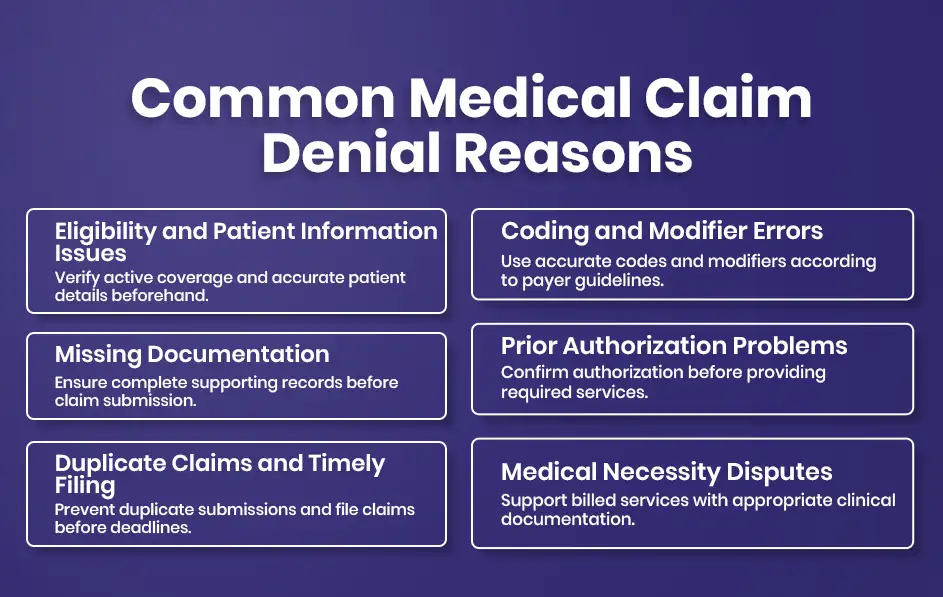
Many reasons exist for claims to be denied in medical practice. However, most claims denials occur due to some common grounds. The common reasons for claim denials in the medical field allow practices to recognize preventable errors and strengthen the process of reimbursement. Eligibility, demographics, coding, authorization, documentation, duplication, filing, and medical necessity problems each need separate prevention methods.
Eligibility and Coverage Issues
A denial can happen if the patient is inactive, there is no coverage on the particular service, he or she has switched to another insurance company, or the benefits have no cover for the service charged. This can be avoided by ensuring that the eligibility and benefits of the service are verified prior to the appointment.
Missing or Incorrect Patient Information
Inaccuracies such as those regarding names, dates of birth, member IDs, addresses, and insurance information can interfere with payers’ ability to match claims with patient data. These inaccuracies are usually avoidable if patient data are correctly entered at the time of registration and insurance verification. This should be done by cross-checking data with the insurance card.
Coding Errors
A claim denial occurs due to wrong diagnoses, procedure or code selected because there is incorrect information in the claim, which is inaccurate in terms of representation of the actual services performed. This can be prevented by making sure that the coding staff is well trained, that proper audits are conducted and the coding knowledge is updated. Professional medical coding services support precise diagnosis and procedure coding, reducing preventable claim errors and denials.
Incorrect Modifiers
Modifiers give more information on how, where, or under what conditions the service was delivered. If used incorrectly or are not required, they will cause payer edits and rejections. These mistakes can easily be avoided when coders know the guidelines and requirements of different payers. They can be detected through audits.
Missing Documentation
Medical records and/or documentation can be requested by the payers to prove that the procedures have been performed and accurately billed. The claims will be denied in case the documentation needed for the claims is not available or it is not consistent with the claims. Good clinical documentation practices and effective communication can save many documentation-based denials.
Prior Authorization Problems
There are some procedures that need authorization from the payer prior to their delivery. Denial of claims is common if there is no authorization, if it is expired, if it is for a wrong procedure, or if it does not coincide with the procedure submitted. Most of the denials of authorizations can actually be avoided.
Duplicate Claims
Duplication of claims happens where the same claim is processed twice for the same patient on the same date of service. Duplication of claims is often detected by the payers using automated claim edits, after which they deny the duplicate claim. The right software and processes can help prevent duplication of claims.
Timely Filing Issues
The deadline for making claims is set by insurers, and claims that are filed past the set deadline will be considered untimely claims. These untimely claims could pose serious challenges since the practice will not receive any compensation for offering services that qualify to be reimbursed. However, timely filing issues are normally avoidable.
Medical Necessity Disputes
The payer may reject the claim because it deems that the procedure fails to satisfy its criteria of medical necessity or that the diagnosis provided is insufficient for the procedure. Such denials may be more complicated than mere administrative mistakes. Proper documentation, right diagnosis code, understanding of payer policies, and clinical evaluation will help prevent such denials and succeed in appeals.
Which Denial Errors Are Typically Preventable?
Many claim denials by insurance companies in the medical field are avoidable as they occur due to procedural issues that cannot be avoided by the insurance company, but the medical professional can do something about them. Some issues include eligibility, demographic errors, coding issues, modifier issues, authorization issues, duplicate billing, documentation issues, and filing errors.
Expert Insight: Instead of only counting the number of denials, figure out why they are being denied. Categorize denials by payer, denial reason, and dollar amount to fix problems where they start. Stopping yourself from making the same mistake more than once can save time and money.
The Impact of Claim Denials on Medical Practices
Claim denials have a direct impact on the revenues of the business because the payments will be delayed or not made at all despite having delivered services. Nearly 12% of health care claims are being denied every year, according to Kodiak Solutions’ statistics cited by the HFMA. The denials lead to higher expenses in collections and can even lower the bottom line if the claims go uncollected.
There is just as much effect in terms of operations. The billing department has to look into denial codes, resolve the claims, gather documentation, appeal the decisions, and continuously communicate with the payers. Premier discovered that providers invested around $25.7 billion in 2023 for processing their claims, with the cost of resolving a denied claim being $57.23 on average. Repeatedly following up takes away the time which could have been spent elsewhere.
The existence of continuous patterns of denial could cause inefficiency within the revenue cycle. Undisposed denials result in high accounts receivable balances, delayed payments, and finally write-offs. The HFMA advises that organizations consider measuring denial rate, denial write-off, appeal process timing, resolution period, and overturned denials to detect any continuous issue. For a medical practice, a good medical billing denial management strategy would require tackling the underlying issues and not just the appeals of the individual denials. If your practice is dealing with frequent denials, delayed payments, or an overloaded billing team, 7 signs that a third-party medical billing company can help you decide whether outsourcing makes sense.
How to Calculate Your Practice’s Revenue Loss from Denied Claims
Denial claim revenue loss calculation involves more than just summing the unpaid claims. The practice needs to consider recovered and unrecovered revenue, labor cost, appeals, follow up, write-off, and administrative costs. The formula can be Total value of denied claims – Recovered amount + Cost of denial operations = Financial impact estimate. This will show the real denied claim cost.
Total Denied Claim Value
Begin with the determination of the dollar amount that is denied in the measurement period. If there are 100 claims, and the amount for each claim denied is $750, then the total amount of dollars denied will be $75,000. Note that we should monitor not only the number of denials but also the value of dollars in them.
Percentage Ultimately Recovered
Now, calculate the portion of denied revenue that was actually recovered. Apply this formula:
Recovery of denied revenue / total denied claim value × 100.
For instance, if $60,000 is recovered out of $75,000 denied claims, the rate of recovery will be 80%, and $15,000 will be left for additional analysis or write-off.
Average Cost of Staff Follow-Up
It is important to include labor that goes into investigating and overturning denied claims. The cost of labor can be calculated by determining how much time it takes for employees to investigate a claim and then calculate how much labor costs for handling those claims. Premier noted the average cost of denied claim rework was $57.23 in 2023.
Write-Offs and Unrecovered Balances
Write-offs indicate the revenue that the practice has finally come to terms with and realized that it is not going to receive. You can include all the write-offs arising from denials and uncollectible balances in your calculation. This can be due to late filing, lack of coverage, failure of appeal process, or any other issue related to documentation.
Additional Administrative Expenses
There are costs associated with the denial process that can be in addition to employee salaries. These include costs for mailing documents, medical records, software, clearinghouse services, outsourced billers, and many other administrative costs. Remember to include these costs in figuring out your denial expense. This will give you an accurate estimate of your costs for resolving these issues.
Compare Monthly and Quarterly Results
Analyze the loss of revenue due to denials not on a case-by-case basis but on a monthly and quarterly basis. Tracking on a monthly basis will help detect sudden spikes in denial volumes, and comparing quarters will uncover payer, coding, authorization, or process issues that occur repeatedly. Analyze denied dollars, recovery rates, write-off amounts, rework cost, and time to resolve denials.
Why Calculating Denied Claim Cost Matters
The denial rate alone does not provide a complete picture of the total financial implications. The calculation of the cost of the denied claim will help link the denied dollars to recovery percentages, effort, write-offs, and costs. For instance, a practice could have a high percentage of recovered denied dollars yet incur high costs for pursuing appeals.
How to Reduce Claim Denials
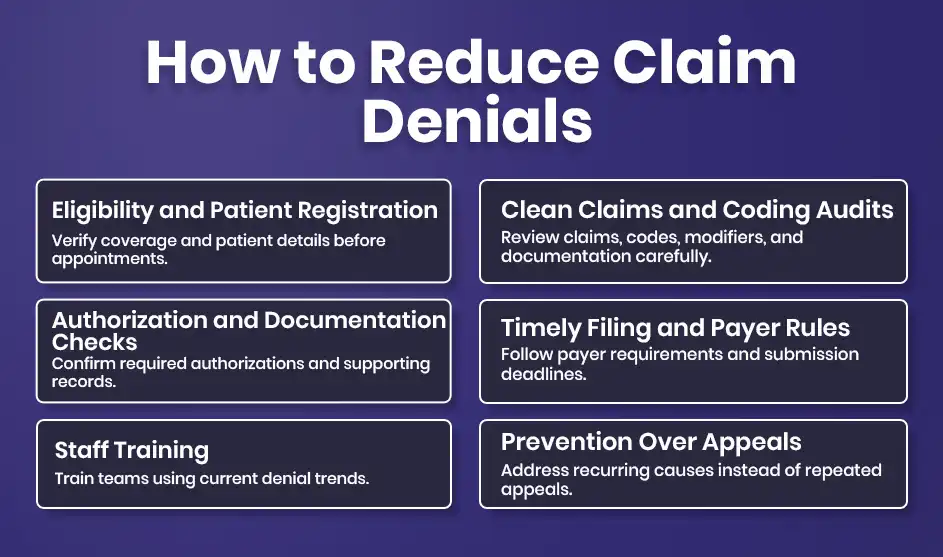
Denial prevention involves finding errors before claims are submitted to the payor. Prevention of denials involves proper registration, verifying eligibility, ensuring correct authorization, correct coding, proper documentation, prompt submissions, and training of personnel. It does not involve relying on appeals after the rejection of claims but rather involves preventing issues from occurring again by analyzing denial trends. Dedicated denial management services support identifies the root causes of rejected claims, recover lost revenue, and prevent recurring billing issues.
Eligibility Verification Before Appointments
The eligibility of the patient under the insurance plan should be verified prior to making any appointments. The verification process should be done to confirm the member identification number, eligibility, effective period, limitations of coverage, and copayment. Rescheduling of any appointment should also be subject to re-verification of the patient’s eligibility under the insurance plan.
Accurate Patient Registration
Registration forms the foundation for making the claim properly. The legal name of the patient, date of birth, address, insurance information, member number, group number, and so on needs to be written down by the staff. Comparing the information from the insurance card and the information given by the payer will help to prevent demographic errors.
Clean Claims and Coding Audits
Claims must be examined prior to submission to ensure the accuracy of the information related to the patient, correct diagnosis code(s), correct procedure code(s), modifier, unit and provider information. Coding audits conducted on a regular basis help in identifying repeated coding issues and areas requiring further education. Setting up a clean claim system avoids any kind of preventable coding errors.
Authorization Verification
Determine if the service needs prior authorization prior to administering treatment. Verify that all of the authorization number, the authorized procedures, the dates, the units, and the providers are appropriate to the procedure you will do. A proper authorization process will help ensure that you have not used an expired or invalid authorization.
Documentation Checks
Ensure that the claims are supported by proper documentation prior to submission if documentation is required for billing purposes. The documentation must properly explain the service provided and the diagnosis associated with the level of care claimed. Proper communication among the provider, clinical staff, coder, and biller will aid in the identification of missing information.
Timely Claim Submission
Claims should be filed promptly following the delivery of the services in order to minimize the chance of timely filing denials. Healthcare practices need to watch out for the deadlines imposed by payers and set up systems for tracking claims that have not been submitted or resolved yet.
Payer-Specific Billing Rules
There will be varying payer requirements for authorization, coding, documentation, modifiers, filing, and claims submission. Payer-specific billing guidelines must be updated, and key updates made known to billing and coding staff. Denial analysis by payers may indicate trends that suggest that customized work flows rather than one-size-fits-all billing procedures should be developed for each payer.
Staff Training
Training ensures that billing, coding, registration, and clinical staff know about evolving payer guidelines and denial trends. Training should be done using actual denial statistics rather than only using general education. In the case of denial for use of modifiers, for instance, training for coding should be conducted. Training should be an ongoing process.
Prevention Over Appeals
Appeals are key to recouping revenue that was justifiably denied, but this does not mean that prevention can be overlooked. The strategy that consistently appeals the denial of certain claims is able to collect revenue while still incurring avoidable expenses in terms of manpower and administration. Good denial management for medical billing involves identifying the underlying cause and fixing the problem.
Professional Guidance: Do not treat denials as only opportunities to appeal; think of them as opportunities to learn and make corrections in your process. If you keep track of what causes denials for payers, departments, and services, you will be able to correct your process. This will lead to less rework on bills and faster payments.
Medical Billing Denial Management: A Proactive Approach
Denial Management in Medical Billing is a comprehensive process of identifying, analyzing, prioritizing, correcting, and preventing claims that insurance companies deny. It is an essential component of revenue cycle management because denied claims become valuable information sources to be managed efficiently. First of all, practices have to classify denials in terms of payer, denial reason, amount, provider, procedure, and aging and prioritize high-dollar denials and those requiring immediate action. Conducting root cause analysis will help determine if there are issues with registration, eligibility, coding, authorization, documentation, and billing processes.
Classification of recurrent denials reasons will allow practices to identify systemic problems and resolve them instead of solving each denied claim separately. For example, constant eligibility denials may require additional efforts to ensure eligibility verification at the front end, while coding denials imply conducting audits and educating billing staff. Automation will facilitate the claim denial management process with eligibility verifications, claim scrubbing, classification of denials, creation of work queue, alerting, and reporting. Complete revenue cycle management services can optimize the entire billing process, from patient registration and claim submission through payment collection and denial resolution.
When Is a Denied Claim Worth Appealing?
Claim denials should usually be appealed if the monetary value of the claim, possibility of recovering the money, and documents available are such that the process will be justified. The practice should evaluate the claim amount, the payer, the denial reason, the filing deadline, documents available, and the cost of filing the claim. While a $5,000 claim that has good documentation should be appealed immediately, a lower claim that needs much research may not be financially feasible.
To manage claim denials effectively, it is essential for practices to keep track of denial rates, dollars denied, recovery rates, success in appeals, average resolution time, write-offs, and denial reasons. Measuring such parameters will enable the practice to track progress in managing claim denials. The practice should always evaluate trends in monthly and quarterly periods because even a downward trend in denial rates can mask substantial revenue leakage due to undetermined high-dollar claims.
Key Metrics to Track for Denial Management
For successful medical billing denial management, counting denied claims is not enough; practices need to monitor denial frequency, value, success in resolving denials, resolution time, and repeat denial reasons. The combination of these factors will reveal how much money is lost, how effectively denials are resolved, and whether prevention measures have any effect on the revenue cycle process.
Medical Claim Denial Rate
Medical Claim Denial Rate is the proportion of claims submitted to or denied by the insurance companies as a percentage. This rate can be calculated using the number of denied claims divided by the total number of claims multiplied by 100. This metric can be used over time to monitor any deteriorating trends, compare payers, and measure prevention efforts.
Initial Denial Rate
The initial denial rate reflects the number of claims that are denied in their first cycle of processing without any correction. It aids in detecting issues prior to the actual payment process. An increasing trend in the initial denial rate might be an indication of deficiencies in any of the above-mentioned processes.
Appeal Success Rate
The appeal success rate is calculated as the percentage of appeals that are overturned and paid. A higher rate may mean that legitimate claims were paid incorrectly but were later appealed. This metric should be reviewed by denial type and payor in order to assess whether there are any problems that are repeatable and preventable through process changes.
Denial Recovery Rate
Denial Recovery Rate indicates the percentage of revenue that is collected after it was initially denied. To compute the metric, divide the dollar amount that was actually collected from denied revenue by the total dollar amount of denied revenue during a specific time period. It offers a financial perspective on the handling of claim denials.
Average Days to Resolution
Average days to resolution is the amount of time it takes for a denied claim to be resolved, starting from denial identification until the claim is either paid, adjusted, or closed out. Shorter resolution times tend to help cash flow, while longer resolution times increase the workload of the staff.
Dollars Denied
The dollars that were denied reveal the monetary impact of claims impacted by payer denials within a reporting period. This indicator must be analyzed in conjunction with denial volume since just looking at the number of claims does not give the complete picture. Few denials in a practice do not necessarily mean small financial risk if the claims involve costly procedures.
Dollars Recovered
Denial recovered refers to the number of dollars recovered from the total dollar amount of denials. Comparison between the recovered dollars and the total amount of dollars denied will help in determining the recovery process. Monthly and quarterly tracking of this metric will help in establishing whether the improvements being made are yielding financial returns.
Write-Off Rate
The write-off ratio refers to the portion of denied or outstanding revenues that are written off and thus not recoverable as accounts receivable. An increasing rate could be an indicator of ineffective follow-up, failure to meet filing deadlines, non-covered services, documentation errors, or recurring payer problems. Recording write-offs arising from denials enables practices to measure their permanent loss of revenue.
Top Denial Reasons
Identifying denial reasons that occur the most frequently assists practices in recognizing issues that are repeated throughout the revenue cycle. Some common denial reasons include eligibility issues, authorizations, coding, documentation, duplication of claims, filing, and medical necessity. Denial reasons should be ranked based on frequency and dollar amount to prioritize the more burdensome issues.
Revenue Loss from Denied Claims
Loss of revenues from claim denials would be an indication of the amount lost after taking into consideration the amounts that have been recovered, written-off, and costs associated with the process of denial. The practices need to look at both the amount of unrecovered revenues as well as the costs of doing business.
Building a Better Denial Prevention Strategy
A good denial prevention strategy or program takes denial data and creates actionable changes to processes. Denial analysis needs to look for patterns according to payer, type of denial, provider, procedure, and department. This is due to the fact that denials can happen anywhere along the line and all practices need to be accountable. They would be able to make corrections, create goals, and measure if these actions decreased errors.
Denial prevention must be ongoing rather than a onetime project. Denials need to have periodic reviews done, comparisons of payer trends, measurement of denial rates and financial impact, and changes to processes when there are new payer requirements. They can do this through their monthly and quarterly performance reviews to see any problems that may arise. This would help to make denial management part of the revenue cycle improvement process.
How iSolve RCM help with Medical Claims and Denials
iSolve RCM assists physicians in handling claims starting from their submission till payment and denial processing. The iSolve RCM team audits the claims for correctness, performs claim scrubbing and billing edits, handles claims rejected by clearinghouses and insurance payers, and files claims once more when required. In case of denied claims, the iSolve RCM team identifies reasons for the denial, fixes problems in coding or documentation, tracks appeals, and monitors the denial trends.
FAQs
How much does a denied medical claim cost a practice?
A denial is more costly than just its monetary amount since it requires labor on the part of the practice, appeals, and resubmissions. According to Premier, the cost for the rework of the denied claims in 2023 was $57.23. There could also be some additional income loss from outstanding claims and write-offs.
What is a good medical claim denial rate?
A good denial rate does not exist as everyone performs at a different level depending on factors such as the specialty, type of payers, services rendered and billing process. Internal benchmarks can be set up by the practices and continuously tracked. A decreasing denial rate is good, but there should be more than that.
What are the most common medical claim denial reasons?
Medical claim denial causes are common and include patient eligibility and coverage issues, inaccurate patient data, coding mistakes, modifier problems, lack of documentation, failed authorization, duplicated claims, filing timely problems, and medical necessity denial. Most administrative and billing denials are avoidable by proper registration, verification, coding audit, documentation validation, and timely claim filing.
How can medical practices reduce claim denials?
There are various procedures that can be employed to avoid denial of claims by ensuring the following: eligibility verification, maintaining accurate information about patients, authorization, clean claims, documentation review, application of the right codes and modifiers, filing on time and training of employees. It is also important to analyze denial patterns regularly.
What is medical billing denial management?
Medical claim denial management is the systematized process of identifying, categorizing, prioritizing, correcting, appealing, and prevention of denials of medical billing claims. This entails denial analysis, denial recovery results measurement, accountability, and revenue cycle optimization. Effective medical claim denial management requires an effort to recover lost revenue as well as prevent future denials.
How do you calculate the cost of medical claim denials?
Denial costs can be calculated using the total cost of unrecovered claims plus the cost of resolving denials. This can be done through a calculation such as: cost of unrecovered denial dollars + labor cost + appeals/resubmissions cost + administration cost + write-off cost.