


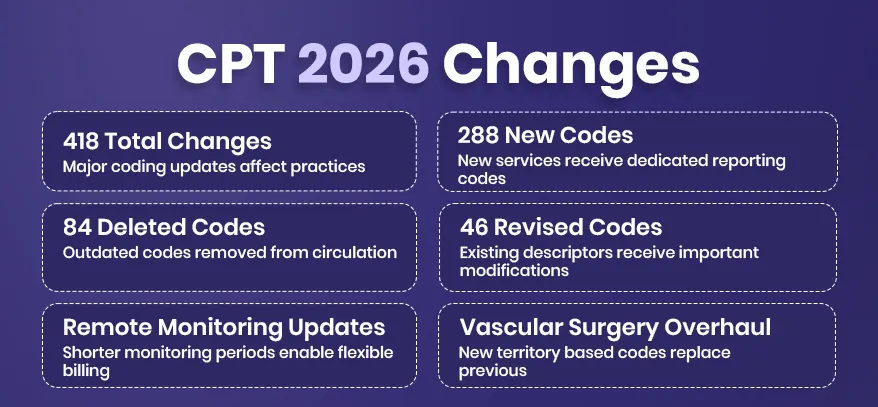
In the month of January, a new version of the coding system that controls the process of medical service documentation and payment in the United States is always released, and the latest cycle, 2026, brings one of the most drastic overhauls in recent years. The American Medical Association introduced as many as 418 total changes in the effective date of January 1, 2026, consisting of 288 additions, 84 deletions, and 46 revisions.
The scope of these changes is such that the CPT 2026 updates mean much more than simple changes in coding; for the practices, billers, and coders, these CPT 2026 updates will mean a fundamental shift in remote monitoring, surgery, audiology, behavioral health, and diagnostic imaging services with the help of algorithms. In this article, we will discuss CPT 2026 changes in detail, including CPT code additions 2026, CPT code deletion 2026, CPT code revision 2026, and all the actions that the practice needs to perform before claims begin to circulate under new regulations. Practices that partner with a medical billing company in USA typically see fewer disruptions during transitions like this, since experienced teams update workflows and payer mappings ahead of the effective date rather than after denials start piling up.
Understanding the Scale of the 2026 CPT Overhaul
CPT code 2026 contains the most codes that have been added within recent years. A total number of 288 codes have been added to evaluation and management, surgery, radiology, pathology/laboratory, medicine, and Category III sections, indicating that current clinical practice has gone far from earlier CPT code descriptions.
A Breakdown of Additions, Deletions, and Revisions
In the total 418 CPT code updates that will take place in 2026, there are 288 additions, 84 deletions, and 46 revisions. Proprietary laboratory analysis codes and Category III codes for emerging services each make up about 27 percent of the additions. This is because most of the new codes come from diagnostic testing and new procedures.
Why the Scope Matters for Medical Billing Teams
Such a change is indicative of the fact that billing teams should not just take last year’s code libraries or claim edits for granted. Those billing processes that will take a shallow look at the CPT 2026 guidelines will inevitably end up using outdated descriptor information, global periods, and even bundling rules which will lead to higher denial rates in Q1.
New CPT Codes for 2026 Across Key Clinical Areas
The CPT codes for the year 2026 are primarily focused on five categories where there have been substantial changes in recent times. These categories include telemonitoring, vascular surgery, audiology, diagnostic radiology assisted by algorithms, and behavioral health access.
Remote Monitoring Codes Get More Flexible Thresholds
Remote patient monitoring has historically required sixteen days of data transmission before a device supply code could be billed, which excluded many patients who monitored intermittently. CPT 99445 now covers device supply for two to fifteen days of transmitted data within a thirty day period, while the original CPT 99454 continues to apply once transmission reaches sixteen days or more, and the two codes cannot be billed together in the same monitoring window. Getting these claims paid correctly depends heavily on accurate documentation, which is where medical coding services play a direct role in matching clinical notes to the correct descriptor before submission.
A New Code for Shorter Monthly Management Time
Alongside the device supply change, CPT 99470 was added to report the first ten minutes of remote physiologic monitoring treatment management in a calendar month, requiring at least one real time interactive communication with the patient. This sits alongside the existing CPT 99457, which continues to cover the first twenty minutes of management time, with CPT 99458 still available for additional twenty minute increments once the twenty minute threshold under 99457 is met.
Leg Revascularization Codes Rebuilt from the Ground Up
One of the most structural changes in the CPT 2026 update is the complete replacement of the previous lower extremity revascularization codes with 46 new territory-based codes numbered 37254 through 37299. This rebuild reflects both technological advances in endovascular technique and the broader shift of these procedures into outpatient settings, and it means any practice performing peripheral vascular interventions needs to remap its entire billing template for these services.
Hearing Device Services Move to a Time-Based Framework
The portion relating to hearing device services now contains 12 new codes, identified by numbers 92628 to 92642, and provides for the whole continuum of care starting from evaluation of candidacy to selection, fitting, training, and follow-up of the device. This new structure recognizes that audiology care is a complex process which requires more extensive coding than was previously available.
Diagnostic Codes Supporting Algorithm Assisted Analysis
A notable category of new codes recognizes services where algorithmic tools assist physicians in interpreting complex diagnostic data, including coronary plaque characterization, perivascular fat based cardiac risk assessment, multispectral imaging for burn wound evaluation, and detection of cardiac dysfunction. Each of these codes explicitly preserves the physician’s role in oversight and interpretation, positioning these tools as a support to clinical judgment rather than a replacement for it.
Expanded Access for Behavioral Health Through Telehealth
Several existing behavioral health codes have been added to the appendices that list services recognized as equivalent whether delivered in person, through audio video connection, or through audio only communication. This expansion gives practices, particularly those serving rural and underserved communities, more flexibility in how behavioral health services are delivered and billed without sacrificing reimbursement parity.
A New Endoscopic Option for Weight Loss Procedures
General surgery also received a notable addition with CPT 43889, covering transoral endoscopic sleeve gastroplasty including argon plasma coagulation when performed. This procedure reduces stomach volume to support weight loss without an external incision, and the new code was placed within the liver and other procedures subsection with a zero day global period assignment.
Deleted CPT Codes 2026 and What They Signal
The removal of codes in the CPT 2026 is not simply an act of deletion but is a result of an intentional effort to remove those codes that are outdated and have been substituted by newer and more precise codes.
Proprietary Laboratory Analysis Codes Removed from Circulation
Some of the CPT codes that will be deleted in 2026 include the proprietary lab analysis codes such as 0450U and 0451U. These codes will become obsolete due to advancements in testing technologies and reporting practices. The laboratories and their reference partners that use these codes should ascertain new codes from their insurers before billing for services delivered.
Outdated Terminology Removed from the Code Set
The use of the term peritoneoscopy has been deleted from all the remaining CPT codes for 2026. In 1996, the term was already eliminated from the descriptions for laparoscopy codes as the two terms referred to the same procedure; however, the term was still used in parentheticals, guidelines, and figure annotations until now.
Revised CPT Codes 2026 and Descriptor Level Changes
Revisions and deletions are different because even though the code number remains the same, the descriptor or reporting criteria may change, making the revision difficult to spot in a quick examination of the revised code set.
Evaluation and Management Descriptor Updates
The most notable evaluation and management revisions for 2026 modernize remote physiologic monitoring by revising CPT 99453, 99454, 99457, and 99458 to align their descriptors with the newly added shorter duration codes, ensuring the entire family of remote monitoring codes reads consistently rather than leaving the original codes describing an outdated framework. Practices relying on outsourced medical billing services often adapt faster to these payer-specific reimbursement gaps, since billing partners track which carriers have adopted the new codes and which still require legacy reporting.
Bundling and Documentation Changes Practices Should Review
Evaluation and management aside, 46 codes in the sections of surgery, radiology, and pathology have been subject to either descriptor edits or bundling modifications for 2026. Such modifications will typically have an impact on the inherent inclusion of a code; hence, what was once included in a code but had to be described using an add-on code may now have been bundled into the code or the other way around.
What These Changes Mean for Claims and Reimbursement
With this volume of change, payer adoption often lags the January 1 effective date, meaning some carriers may still expect older codes for a transition period. Tracking which payers accept which codes, updating fee schedules, and verifying documentation standards all fall under a broader Revenue Cycle Management strategy that keeps claims moving instead of stalling in review. Consistent AR follow-up services also matter more than usual this year, since claims submitted with outdated or mismatched codes are more likely to sit unpaid until someone catches the error.
Reimbursement Implications of the 2026 CPT Coding Guidelines
Coding changes only matter to a practice’s finances once they are translated into relative value units and payer specific reimbursement rates, and the 2026 update carries meaningful shifts in this area for remote monitoring services in particular.
How the New Remote Monitoring Codes Are Valued
According to national averages for the year 2026, the reimbursement amount for the CPT 99445 procedure falls in the vicinity of 47 to 52 dollars, contingent upon the payment model employed, and that of CPT 99470 is around half the rate of CPT 99457 because of the lower ten-minute duration than twenty minutes stipulated in the latter.
Preserved Value for Legacy Remote Monitoring Codes
Importantly, the original remote monitoring codes were not devalued to make room for the new shorter duration options. CPT 99454 and CPT 99457 maintain their existing structure and reimbursement parity, meaning practices that continue to meet the sixteen day or twenty minute thresholds will see no disruption to their current revenue from these services.
Specialty Specific Impact of the CPT 2026 Changes
While remote monitoring and revascularization dominate headlines, the CPT 2026 changes for medical billing touch nearly every specialty differently, and practices should map the update against their own top billed codes rather than relying on general summaries.
General Surgery and Vascular Practices Face the Heaviest Lift
Practices performing lower extremity revascularization procedures face the most significant transition, since the entire previous code family has been deleted and replaced with 46 territory based codes. Vascular surgery groups should treat this as a full template rebuild rather than a simple crosswalk, given how differently the new codes segment anatomical territory compared to the retired set. Because surgical codes carry higher denial risk when specificity is missed, many practices lean on denial management services to catch and correct claims before they’re rejected outright.
Audiology, Behavioral Health, and Chronic Care Programs See Expanded Options
New coding will be seen as an opportunity, not an obligation, by audiology, behavioral health providers, and chronic care management because the hearing device changes, additions to the telehealth appendices, and short-term remote monitoring codes all add to what can be coded rather than limiting existing coding options.
How Practices Should Prepare for the New CPT Codes 2026
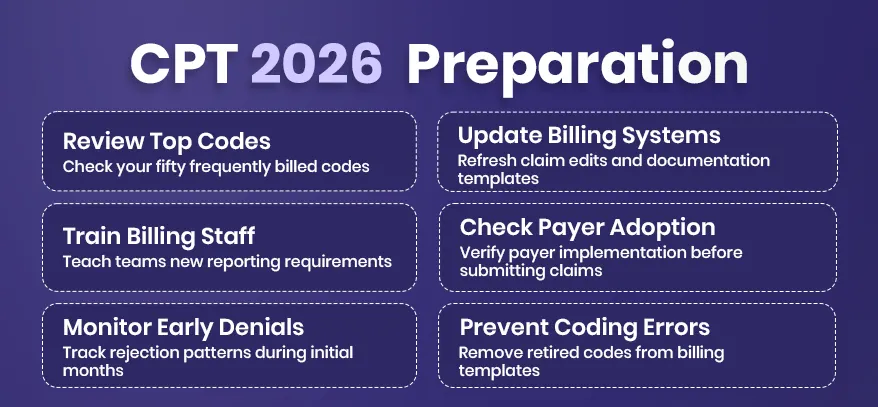
Understanding what changed matters less than having a clear operational plan to implement it before claims start denying, and the strongest preparation strategies share a common structure regardless of specialty.
Cross Reference Your Most Used Codes First
Rather than reviewing all 418 changes line by line, practices should compare their fifty most frequently billed codes against the full list of additions, deletions, and revisions. This targeted approach highlights which changes will actually affect daily claims volume and allows coding staff to prioritize training and system updates around the codes that matter most to that specific practice.
Update Claim Edit Logic and Documentation Templates
Once affected codes are identified, billing systems need updated claim edit rules, bundling logic, and documentation templates that reflect the new descriptors. For remote monitoring in particular, staff need clear internal thresholds so that the correct code, whether 99445 or 99454 for device supply, or 99470 or 99457 for management time, is selected consistently based on actual days monitored and minutes documented.
Monitor Payer Adoption and Early Denial Patterns
Regardless of the fact that the internal systems have been upgraded, the payers take the changes to CPT 2026 on their own time, with some of them even being slower than the required date or placing their own limitations on the use of new codes. It is very important for practices to closely monitor any denial trends in the first quarter of 2023 and identify patterns of rejection associated with the new codes.
Common Billing Errors Following Major CPT Updates
Every major CPT release introduces a predictable set of errors as staff adjust to new descriptors, and 2026 is no exception given how many codes shifted structure rather than simply adding a new number to an unchanged framework.
Billing Retired Codes Out of Habit
The most common early error after any CPT update is continued use of deleted codes simply because staff have not fully removed them from favorites lists or templates within their billing system. With 84 deletions this year, including laboratory analysis codes and the full retirement of the previous leg revascularization set, this risk is elevated and worth a dedicated audit before the first claims batch goes out.
Confusing Mutually Exclusive Threshold Codes
Since some of the new 2026 codes, especially remote monitoring codes, are alternate choices for current codes and not replacements, the billing staff may mistakenly submit claims for both the new and old codes for the same period of service. Internal guidelines regarding the appropriate threshold, in conjunction with system edits that prevent duplicate submissions during the thirty-day time period, would address this issue.
CPT 2026 is an unprecedented annual upgrade with a record-breaking number of changes. Specifically, the upcoming version introduces 288 new codes, deletes 84 old codes, and modifies another 46 to change how remote patient monitoring services, vascular surgery procedures, audiology procedures, behavioral health services, and algorithm-assisted diagnostic procedures are reported. For practice owners and their billing teams, moving forward should not involve trying to memorize all the changes but rather cross-reference frequently utilized codes and update their coding logic. Those practices that will approach the code update as a project and not just an item on a checklist are going to start 2026 with fewer denials and a properly updated coding base. Practices also need to know about Colorado medical billing and payment services for better reimbursement and claim submission.
How iSolve RCM Supports Practices Through the CPT 2026 Transition
Coding changes of this scale rarely stay contained to one department. A missed update in the coding team ripples into claim submission, then into accounts receivable, and eventually into a practice’s monthly collections. iSolve RCM works alongside practices to translate the CPT 2026 updates into day-to-day billing decisions, reviewing frequently used code families, flagging deleted codes without direct replacements, and adjusting documentation expectations before claims go out the door. Rather than leaving physicians and front-office staff to interpret hundreds of pages of coding notes on their own, the team handles the groundwork quietly in the background, so practices can stay focused on patient care while their revenue cycle stays current with 2026’s requirements.
FAQs
What is the biggest CPT change for 2026?
However, the biggest overhaul comes from the update of lower extremity revascularization coding. These codes have been updated by eliminating old codes and adding 46 territory-based codes. E/M and Telehealth codes were also restructured, including 17 virtual care codes replacing telephone codes.
Do all payers accept the new CPT 2026 codes immediately?
Not always. Codes will be effective from January 1, 2026; however, individual payers may take time to upgrade their systems. It is important for practices to check the timeline when adopting the codes before filing the claims.
Will old E/M codes still work for telehealth visits?
No. As of 2026, codes 99202–99205 and 99212–99215 can no longer be reported for telehealth encounters. Practices must use the new 98008–98016 series instead, since payers are expected to reject claims using outdated telehealth reporting codes.
How do the remote monitoring code changes affect billing?
The updated RPM codes allow shorter monitoring periods of 2–15 days within a 30-day cycle, rather than requiring a full month. This gives practices more flexibility in billing but requires closer attention to documented monitoring duration.
What happens if a deleted code is submitted after 2026?
Claims submitted with deleted codes are typically rejected or denied outright, since payers stop recognizing them once the new code set takes effect. Practices should audit their most-used codes early to catch any deletions without direct replacements.
How can practices prepare for future annual CPT updates?
Building a yearly review process helps, checking documentation templates, payer bulletins, and internal fee schedules each fall before the new code set takes effect. Many practices assign this task to teams that specialize in tracking annual coding revisions closely.