


Claim denials can cost a medical practice significantly more than the original unpaid claim because each denial can create additional rework, staff labor, delayed payments, write-offs, and lost revenue. Reworking a denied claim alone can cost approximately $25 to $181, depending on its complexity, making effective denial prevention important for protecting practice revenue.
Every denied claim looks minor when viewed as a single remittance line, yet the pattern behind it tells a different story entirely. According to industry information from 2026, the initial denial rate nationally exceeds 11%, and well over four out of ten providers report initial denial rates in excess of 10%, which is viewed as fiscally unviable by HFMA revenue cycle experts. These figures show how significantly claim denials cost medical practices through lost revenue, rework, and delayed payments. Kodiak Solutions further reports that hospital denials alone drove 48.4 billion dollars in revenue leakage across 2025.
The true price of a denial extends well past the unpaid line item itself. Rework costs run between 25 and 181 dollars per claim according to MGMA benchmarking data, and roughly 60 percent of denied claims are never resubmitted, turning temporary delays into permanent losses. Experian Health’s 2025 State of Claims survey also found that 41 percent of providers now report denial rates once held by only 30 percent of providers in 2022, underscoring how quickly this financial pressure has intensified across practices nationwide. Practices can reduce these revenue risks by working with experienced medical billing services that maintain consistent claims, coding, and denial management workflows.
The Real Financial Weight Behind Every Denied Claim
A single denied claim rarely costs what it appears to cost on paper. Rework alone runs between 25 and 181 dollars per claim depending on complexity, according to benchmarking data cited by MGMA, and that figure only covers the labor to correct and resubmit. It does not include the interest lost on delayed cash, the administrative hours diverted from other billing work, or the risk that the claim is never resubmitted at all.
That risk is larger than most practice owners assume. According to industry surveys, around 60 percent of the claims that have been denied are not resubmitted, thus making a temporary hold into a permanent rejection. For a clinic that submits around 300 claims per month at a denial rate of 11.8 percent, there will be around 35 claims that are denied per month, and even if half of these are not resubmitted.
The financial weight also extends into staff time that is difficult to quantify on a balance sheet but shows up clearly in overtime and burnout. Every hour spent tracing a denial back through payer portals and documentation is an hour not spent on new claims, patient billing questions, or appeals with a real chance of recovery.
Why Denial Rates Are Climbing Across US Medical Practices
There could be no clearer picture than that of the trend line. In 2022, about 30 percent of the payers noted a denial rate of up to 10 percent. In 2025, the same figure was 41 percent according to Experian Health’s State of Claims survey and HFA’s definition of an out-of-bounds denial rate is anything above 10 percent. Hospitals fare no better, with a state of the revenue cycle report from Kodiak Solutions estimating 48.4 billion dollars in revenue leakage tied to denials in 2025 alone.
Payer mix explains much of the variation between practices. Commercial payer denial rates for inpatient claims run near 21 percent, more than four times the traditional Medicare rate of roughly 5 percent, and Medicaid inpatient claims carry an initial denial rate close to 44 percent in some regional data sets. A practice with a heavier commercial or Medicaid mix will show a higher blended denial rate even if its coding and documentation habits have not changed at all.
Regulatory shifts are adding further pressure in 2026. Updated bundling edits and a revised physician fee schedule mean codes that were billable separately in past years now trigger automatic denials when submitted the old way, and payers are enforcing prior authorization rules with less tolerance for missing detail than in previous cycles.
The Hidden Reasons Behind Rising Claim Denials in 2026
Most denials come from the same small number of recurring areas of failure, not just individual failures. Lack or inaccuracy of data gathered at the time of admission continues to be the primary issue, with more than one-quarter of organizations saying that more than 10 percent of denials arise at the time of patient admission. All it takes is a wrong insurance ID or an old address to get denied.
Prior authorization follows closely behind in the list of the top reasons, cited by 35 percent of the respondents in Experian’s most recent poll. The process of prior authorization has become increasingly difficult to manage due to payers requiring pre-authorizations on an ever-increasing number of procedures.
Other common problems include coding and documentation issues; however, their scope may be much greater than expected. For instance, according to some studies, almost half of all denied claims result from coding or documentation problems, indicating that the solution requires more than a single improvement in practice workflow.
Medical Billing Errors That Quietly Reduce Practice Revenue
Other than explicit denials, another form of medical billing errors that silently erode the income from revenue without being reflected in any denied claims is another type of billing errors. They slip into the payer system and get paid at a discounted rate or are absorbed internally without anyone recognizing their existence. The practice may be performing very well financially, but it still loses five to ten percent of its collectible revenues every month. Working with reliable medical coding services will help identify such gaps in your billing process.
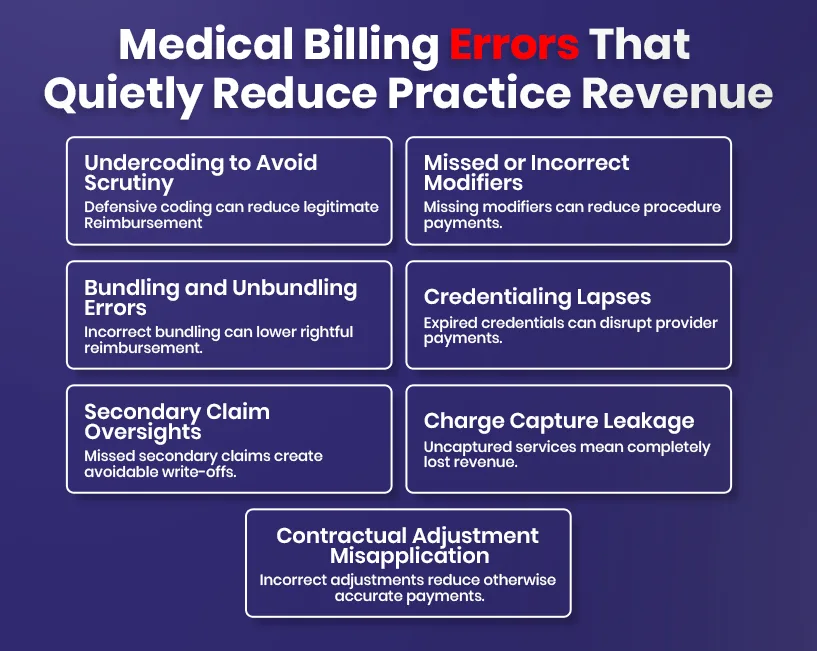
Undercoding to Avoid Scrutiny
There are cases where the practice may code defensively because of audit risk, thereby picking a level of service that is less than what the documentation justifies. Such a practice can lose hundreds of thousands of dollars in one year based on undercoding alone.
Missed or Incorrect Modifiers
The lack of modifier in a bilateral or multiple procedure claim may lead to payment of only one line in lieu of the complete service performed, and such an error will not cause any flag in the billing system.
Bundling and Unbundling Errors
The new bundling edits affect the combinations of codes that can be billed together, and the old logic leads to either denial of payment or payment at a bundled rate that is less than what is actually charged.
Credentialing Lapses
A lapsed enrollment or an expired contract date with a payer can cause every claim tied to that provider to deny or pay at an out of network rate until the credentialing gap is resolved.
Secondary Claim Oversights
Secondary payer claims are often filed late or with incomplete primary payment information, leading to permanent write offs on balances that should have been collectible from a second insurer.
Charge Capture Leakage
Services performed but never entered into the billing system, often supplies, injections, or brief procedures during a visit, disappear from revenue entirely because no claim was ever generated.
Contractual Adjustment Misapplication
Automated posting sometimes applies the wrong contractual write off percentage from an outdated fee schedule, reducing collected revenue on claims that were technically paid correctly by the payer.
Professional Insight: Do not look for denied claims alone. Do audits of your coding, modifier use, charge entry, contract management, and payment posting processes to identify any revenue leakage issues that may be costing you. Even minor billing errors can escalate into bigger problems rapidly, making monitoring and proper coding essential.
How Denied Claims Erode Practice Revenue Over Time
A denial that gets corrected within days looks like a minor delay, but the compounding effect across hundreds of claims each month is what actually damages a practice’s financial position. The description below breaks that erosion into the specific mechanisms that convert a paperwork problem into a measurable revenue gap. AR management services are often the first line of defense against this slow erosion, since aging claims need consistent follow up rather than one time attention.
Accounts Receivable Aging
Every denied claim sits in accounts receivable longer than a clean claim, and once a balance passes 90 days, the likelihood of full collection drops sharply according to standard revenue cycle benchmarks.
Write Off Thresholds
Many practices set an internal dollar threshold below which a denied claim is written off rather than appealed, which means smaller denials accumulate into meaningful losses without ever being individually noticed.
Appeal Cost Economics
Filing a formal appeal costs staff time regardless of the claim amount, so low value denials often get deprioritized even though roughly 70 percent of provider appeals that are filed are ultimately overturned.
Diverted Staff Attention
Time spent reworking denials is time not spent on new claim submission, patient balance collection, or eligibility verification, creating a cycle where today’s rework causes tomorrow’s backlog.
Cash Flow Disruption
Denials delay payment timing even when a claim is eventually paid, and that delay can strain payroll and overhead coverage for smaller practices operating on thin monthly margins.
Patient Collection Spillover
When a claim denial shifts responsibility to the patient, collection rates fall well below what insurers pay, since patients are far less likely than payers to satisfy a balance in full.
Annual Compounding
A denial rate that seems manageable month to month, such as 8 or 9 percent, produces a substantially larger annual revenue gap once every affected claim across twelve months is added together.
Claim Denial Benchmarks Across Payers and Specialties
All the payers or specialties do not have an equivalent risk for denial, and knowing where the holes exist can guide the practice toward prevention. National averages hide meaningful differences that only appear once denial data is segmented by payer type and clinical specialty. Medicare advantage audits in particular deserve close attention, since these plans increasingly mirror commercial denial behavior rather than traditional Medicare leniency.
Commercial Payer Variation
Commercial denial rates range from roughly 10 to 16 percent depending on the carrier, with some national commercial plans running consistently near the top of that range across specialties.
Traditional Medicare
Fee for service Medicare remains the lowest denial payer category in most data sets, generally in the 4 to 6 percent range, largely due to standardized coverage rules and fewer prior authorization requirements.
Medicare Advantage Behavior
Medicare Advantage plans operated by commercial carriers behave far more like commercial payers than like traditional Medicare, often matching or exceeding commercial denial rates on the same service categories.
Medicaid Pressure Points
The rejection rate for inpatient claims under Medicaid is among the highest throughout the country, putting significant financial strain on community health centers that rely almost exclusively on Medicaid.
High Risk Specialties
Behavioral health, surgical specialty groups, and urgent care centers face above average denial rates due to frequent prior authorization requirements and complex, procedure heavy coding.
Payer Specific Gaps
The difference between a practice’s best performing and worst performing payer relationship can exceed 8 percentage points, making payer specific prevention a higher impact investment than broad, generic fixes.
Regional Plan Differences
State level plan variation, particularly among Blue Cross Blue Shield affiliates, means national averages should be treated as a starting reference rather than a precise benchmark for any single practice.
Building a Front-End Denial Prevention Framework
Prevention will always be more cost-effective than remediation, but it is often the case that practices do not devote their energies to preventing denials but instead spend their efforts on correcting denials after submission of the claim. A front-end approach changes the paradigm by identifying these consistent errors at an earlier stage, which is far less costly to correct.
Real Time Eligibility Verification
Checking coverage status at scheduling and again at check in catches lapsed policies and inactive coverage before a service is even rendered, closing the single largest denial category at its source.
Prior Authorization Tracking
A structured log of which procedures require authorization, along with confirmation numbers and expiration windows, prevents the second most common denial cause from slipping through busy front office schedules.
Pre Submission Claim Review
Reviewing claims against payer specific rules before submission, rather than relying only on standard rule sets, catches mismatches that generic scrubbing tools miss during high volume periods. Practices can also reference the medicare claims processing manual for applicable Medicare billing and claims-processing requirements.
Documentation Alignment Checks
Confirming that clinical notes support the billed diagnosis and procedure codes before submission reduces denials tied to medical necessity, a category that continues to grow across commercial and Medicare reviews.
Ongoing Coder Training
Regular training on evolving CPT, ICD, and modifier rules keeps coding staff current with mid-year edit changes that older static rule sets often fail to reflect in time.
Credentialing Calendar Management
Tracking enrollment and contract renewal dates across every payer prevents the entire category of denials caused by lapsed credentialing, which is avoidable with basic calendar discipline.
Registration Quality Control
A second look at demographic and insurance details entered at intake, even a brief one, catches the typos and mismatches responsible for a meaningful share of front-end denials.
Turning Denial Data into a Root Cause Reduction Strategy
Catching individual denials matters less over time than understanding the patterns behind them. A practice that tracks denials only claim by claim will keep fixing the same problem indefinitely, while one that analyzes patterns can eliminate entire categories of future denials. This is the core value that dedicated denial management services bring to a practice that lacks the internal bandwidth for pattern level analysis.
Categorizing by Denial Code
Grouping denials by their claim adjustment reason code reveals which specific issues, such as eligibility or bundling, are responsible for the largest share of lost revenue each month.
Tracking by Payer
Segmenting denial data by payer exposes which carriers require tighter documentation or stricter authorization handling, allowing staff to adjust workflows for the highest risk relationships specifically.
Appeal Timeline Discipline
Missing a payer’s appeal filing window turns a recoverable denial into a permanent loss, so tracking deadlines by payer prevents otherwise winnable appeals from expiring unresolved.
Root Cause Assignment
If it is known which department was the point of origin for the denial, then the appropriate corrective action can be taken rather than just treating the surface problem evident from the remittance advice form.
Monthly Trend Reviews
Monthly review of denial volumes and categories will enable the identification of any developing issues that can be easily resolved before they become major problems.
Staff Accountability Mapping
Matching the types of denials that repeat to the exact step in the workflow process where the denials occurred will enable the right people to be educated and corrected.
Payer Scorecards
Building a simple scorecard of denial rate, overturn rate, and average resolution time by payer gives concrete leverage when negotiating contract terms or escalating recurring disputes.
Revenue Cycle Management as the Structural Fix for Recurring Denials
Individually fixing the problem will do no good; denial of this kind, which keeps happening month after month, often indicates the presence of a structural problem. Revenue cycle management solves this issue by linking up all the stages—scheduling, coding, submitting and collecting payments into one coherent process.
Coordinated Workflow Design
Coordinating the intake, coding, and billing processes to ensure that information is transferred effectively from one department to another eliminates the point in the process where many denials begin. Organizations whose teams do not coordinate can miss key patient or authorization information between the time of scheduling and the time of the billing, causing unnecessary denials.
Standardized Payer Rule Libraries
Maintaining current, payer specific billing rules rather than relying on generic quarterly updates keeps claims aligned with the fastest changing edits and authorization requirements. Payers revise bundling logic and documentation standards throughout the year, and static rule sets updated only occasionally cannot keep pace, leaving practices exposed to denials that were entirely preventable with current information.
Consistent Performance Metrics
Monitoring the combination of denial rate, days in accounts receivable, and clean claims rate is important to get an overall perspective for a medical practice rather than fragmented perspectives on individual metrics. An examination of such metrics in isolation can be misleading; however, by analyzing them as a combination, one can determine whether the preventive measures have worked or not.
Cross Functional Accountability
When the scheduling, coding, and billing staff have access to denial results, prevention becomes an issue for all of them rather than being the responsibility of just the billing staff. This shared responsibility ensures that corrections can be made early enough before an error occurs during the process.
Scalable Capacity Planning
An organized revenue cycle system is able to scale better as the number of claims increase, because it prevents denial spikes caused by having understaffed for the volume of claims being submitted. Practices that open up new offices or lines of service would be the ones who would gain the most from having an organized system.
Financial Reporting Clarity
Accurate revenue cycle reporting makes it easy for practice leadership to understand where revenue is going astray and take action with respect to staffing, training, and payor contracts. In its absence, leadership tends to respond to the issues of cash flow once they surface, without pinpointing the exact workflow where the problem is originating from.
Long Term Rate Stabilization
Where structured revenue cycle processes are in place, the denial rate will be kept in check consistently at levels far below the 10 percent mark, beyond which HFMA does not consider it tolerable for a business to be run. The process will keep compounding itself because lower denials will mean more time available to prevent denials.
Deciding When to Outsource Denial and Billing Management
Not every practice has the staffing depth to build the frameworks described above internally, and recognizing that limitation early often prevents years of avoidable revenue loss. Outsource medical billing services exist specifically to fill that gap for practices that need specialized attention without expanding internal headcount.
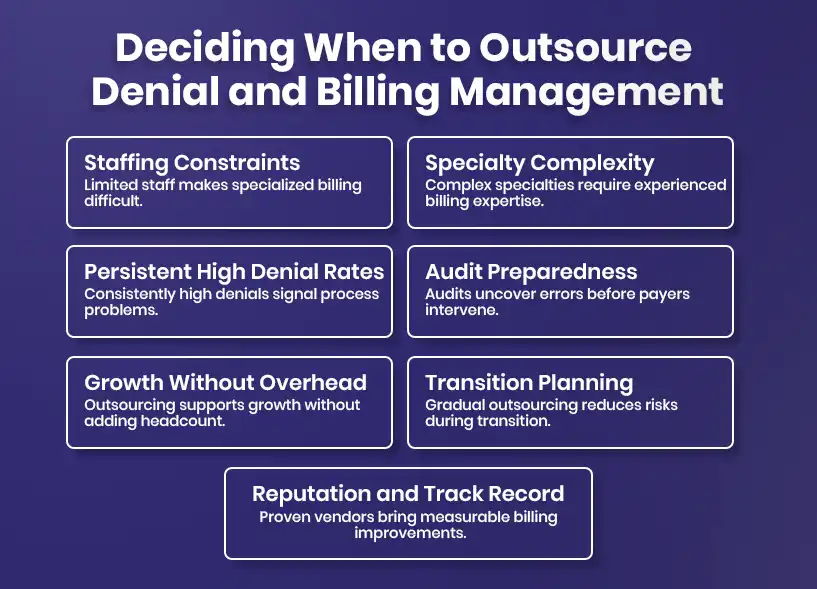
Staffing Constraints
Smaller practices often cannot justify a dedicated denial specialist role, making external support more practical than stretching general office staff across specialized billing functions.
Specialty Complexity
Behavioral health, surgical, and urgent care practices face coding and authorization complexity that benefits from teams with deep, specialty specific billing experience rather than general knowledge.
Persistent High Denial Rates
Any practice that continues to operate above the 10 percent denial level irrespective of the internal initiatives taken by the process indicates that the process requires structural assistance from the external environment.
Audit Preparedness
Working with providers of Medical billing audit services helps a practice identify systemic errors before a payer audit does, reducing both financial and compliance risk simultaneously.
Growth Without Overhead
Outsourcing allows a growing practice to expand claim volume without a proportional increase in internal billing headcount, keeping overhead more predictable during expansion periods.
Reputation and Track Record
A well established medical billing company in the USA typically brings documented denial rate improvements across similar practices, offering a benchmark that internal teams alone cannot provide.
Transition Planning
A transition period, which might start with denial management or coding reviews prior to the full transfer of billing responsibilities, allows for an assessment of the process before fully outsourced.
Insight for Practices: Outsourcing is not a black-and-white choice. Begin by outsourcing your revenue leakage point of maximum concern, such as denial management, coding, or auditing, see the outcomes, and then build on your relationship when there is a definite improvement seen.
How iSolve RCM Helps with Claim Denials
iSolve RCM takes a holistic view when it comes to denying reduction and treats it not as a responsibility of one particular department, but as an entire cycle of activities involving front end eligibility verification, payer specific coding review and systematic appeal follow-up within one process. Instead of reacting to denials and trying to deal with them after their occurrence, the team is working on discovering the exact patterns responsible for revenue losses in every particular practice, either it will be about the need to improve the control of prior authorizations, fix recurring modifier mistakes or reach out to the payer regarding workflow issues.
FAQs
What is considered a high claim denial rate for a medical practice?
A claim denial rate above 10% is generally considered high and financially concerning for a medical practice. Practices consistently exceeding this level should examine their eligibility, authorization, coding, documentation, and claims workflows to identify the main sources of preventable denials.
How much does it cost to rework a single denied claim?
Reworking a denied claim can cost approximately $25 to $181 per claim, depending on its complexity. This primarily reflects the administrative labor involved and does not include delayed cash flow, write-offs, or revenue permanently lost when a claim is not pursued.
Why do most denied claims never get resubmitted?
Roughly 60 percent of denials are never reworked because staff time is limited and low value claims often fall below a practice’s internal threshold for pursuing an appeal, resulting in permanent revenue loss.
Do prior authorization approvals guarantee a claim will be paid?
No, prior authorization does not guarantee final claim payment. A claim can still be denied because of coding errors, missing documentation, eligibility changes, or other payer-specific billing requirements.
Are Medicare Advantage plans more prone to denying claims compared to traditional Medicare?
Yes. The Medicare Advantage Plans that are operated by commercial organizations have higher denials compared to commercial organizations, but Traditional Fee for Service Medicare has the lowest denials.
When should a practice consider outsourcing its billing function?
A practice should consider outsourcing when denial rates remain high despite internal corrective efforts, billing complexity exceeds available staff expertise, or the practice lacks sufficient resources for consistent denial follow-up. External billing support can provide specialized workflows without requiring additional in-house billing staff.