
Small inaccuracies in claims can lead to disproportionate financial impact. The analysis of physician-insurer interactions revealed that billing issues led to revenue losses in amounts equal to 18% of the Medicaid revenue, 4.7% of the Medicare revenue, and 2.4% of the commercial insurance revenue. Such losses account for the uncollected claims and expenses incurred to obtain them, thus making clear the reason why even small medical billing mistakes can become a major source of revenue loss.
Further costs come when a claim is actually submitted. The billing and insurance activities cost roughly $20.49 per visit of a primary care physician and make up 14.5% of professional revenue, whereas the billing expenses during an inpatient surgery can cost around $215.10. It becomes apparent from these numbers why medical billing accuracy is important from a financial perspective since it helps to avoid unnecessary rework and additional costs. Practices experiencing frequent billing problems can consider working with experienced best medical billing companies to support claim accuracy, revenue-cycle workflows, and payment follow-up.
What Are Medical Billing Errors?
The errors that exist in medical billing are those inaccuracies or omissions which take place during the documentation, coding, submission, processing, or payment of healthcare services. Such errors include mistakes in the patient’s personal information, wrong diagnosis or procedure code, modifier, insurance information, claim form, and even the payment amount. It is important to note that medical coding errors are directly related to these errors as coding entails the translation of the documentation process into billable services; whenever there is inaccurate coding, an inaccurate claim is formed.
These errors arise during different points of the revenue cycle where documentation errors leave the clinical information not fully backed up, coding errors entail the wrong diagnosis or procedure code, claim submission errors lead to incomplete and wrong information being sent to the payer, and payment posting errors are characterized by incorrect reimbursement recording. Even a small mistake such as a digit or payer information can lead to inaccurate processing of the claim.
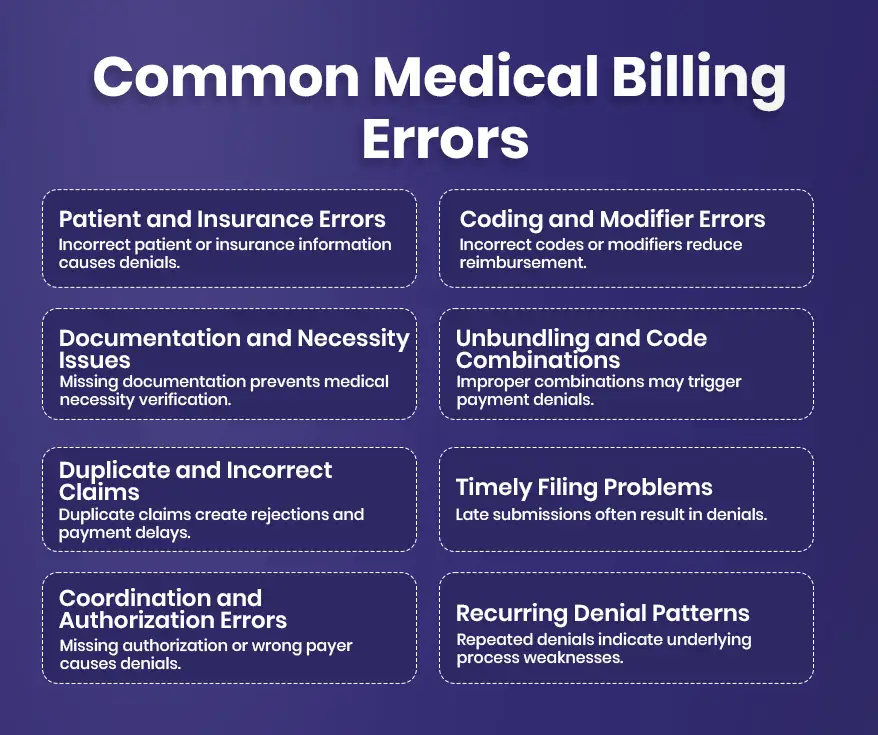
Common Medical Billing Errors and Claim Denial Causes
Errors in medical billing can occur in any of these processes of patient registration, coding, documentation, claims submission, and payment. Knowing how these errors can cause a denial or underpayment helps the clinic recognize their weaknesses and improve control and efficiency in their billing process to prevent revenue loss. Practices with persistent claim denials can use denial management services to analyze denial patterns, prioritize appeals, and address recurrent causes at the process level.
Patient and Insurance Errors
Demographics, ID numbers, policy numbers, and payer data errors will make claims non-matching with the insurance company records. Registration errors may cause denial of eligibility even before the processing of the claim. It is important to confirm patient insurance coverage and verify insurance information prior to submitting the claims.
Coding and Modifier Errors
Improper CPT, HCPCS, and ICD-10 codes may result in under-coding, over-coding, rejection, denial, or improper reimbursement if the information provided is not in accordance with the documentation and service performed. Improper use of modifiers may have the same impact on the reimbursement. The proper review of codes is critical for ensuring proper reporting of services.
Documentation and Necessity Issues
Inadequate documentation will make it impossible for payers to verify whether the services charged have been done appropriately and medically necessary. Incomplete information on treatments, signatures, orders, or other supportive documents could lead to rejections or requests for more documentation. It is imperative that practices confirm all clinical information in relation to the diagnosis and procedures done.
Unbundling and Code Combinations
Unbundling is the process whereby services which, per appropriate coding standards, are required to be combined for billing purposes are improperly billed separately. Likewise, other types of inappropriate code combinations can cause improper reimbursements as well. Due to different criteria by payers, it would be prudent to check on the coding guidelines before submitting bills.
Duplicate and Incorrect Claims
Resubmitting the same service multiple times can result in the editing of claims because of duplication of claims, while the incorrect submission of data regarding date of service, codes, and other claim information can result in rejection and denial. This will cause delays and add to the work burden of the accounts receivable department.
Timely Filing Problems
Typically, payers have deadlines that providers must adhere to when submitting claims or resubmitting corrected claims. If the deadlines are not met, then reimbursement may be denied regardless of whether there is documentation proving the delivery of legitimate services. Filing issues may arise due to late charge posting, claim corrections, and other issues.
Coordination and Authorization Errors
Denials of claims will occur in cases where there is lack of authorization and when there is billing of the wrong payer. Coordination of benefits issues arise when the patient has many different insurance policies and the change of coverage details. Verification of authorization and checking of primary and secondary coverages prior to billing helps avoid denials.
Recurring Denial Patterns
Recurring denials for the same code, documentation, eligibility, authorization or claim submission issue point more towards process weaknesses than individual errors on the part of employees. Organizations need to review their denials by payers, providers, services and categories in order to identify any recurring issues and solve them.
How Medical Billing Errors Create Revenue Leakage
The problem of billing errors leads to revenue leakage in that it disrupts the process of moving from completion of a service to its payment. When a claim contains errors in coding or is incomplete and the recipient is not eligible, it is likely to be denied and require further investigation and resubmission. In such a way, the initial mistake causes a series of problems, namely extra work, delayed payments, higher amounts of accounts receivable, and sometimes even write-offs. It should be noted that the losses caused by recurring errors might add up, since the same inefficient process is applied to hundreds or even thousands of claims. Furthermore, the organization might undervalue its losses because the practice is focused only on identifying denied and unpaid claims but not the full cost of errors in medical billing and revenue leakage. Outsource medical billing services can provide additional expertise and structured revenue-cycle support, for practices struggling with staff workload, recurring errors, or delayed collections.
| Error Type | Immediate Effect | Long-Term Risk |
| Claim rejection | Claim must be corrected | Higher administrative workload |
| Claim denial | Payment is delayed or disputed | Potential write-off |
| Undercoding | Lower payment | Persistent revenue leakage |
| Missed charge | No claim generated | Permanent lost revenue |
| Incorrect payment posting | Account balance becomes inaccurate | Misstated A/R and collections |
| Repeated coding errors | Multiple claims affected | Revenue loss and compliance exposure |
Expert Insight: Look out for billing errors that recur to identify hidden revenue leaks. Conduct audits of the claims process, payment process, and write-offs on a regular basis. Identify the underlying reasons, implement corrective measures, and track your recovery rate.
Medical Coding Errors vs. Medical Billing Errors
It is important to note that medical coding and medical billing are two different parts of the revenue cycle process, but at the same time, they are closely related. Coders convert the clinical documentation into diagnosis and procedure codes; meanwhile, the medical billers take this coded information and combine it with other patient and payer data to file and send the claims. Thus, a certain decision made in the process of coding may influence the amount that will be billed and how the payer will evaluate this claim.
The most frequent mistakes in medical coding include using the unproven diagnosis code, incorrect selection of the procedure code, wrong level of service chosen, lack of proper modifiers, or failure to update the codes according to the new guidelines. The consequences of these mistakes may be underpayment, denied claim, rejected claim, or improper payment. If the wrong codes were simply entered in the claim, then a mistake in coding becomes a mistake in billing that may need correction and resending.
Given the possible overlapping between the coding and billing errors, isolated checks of quality may not be enough. While coders must ensure that the services provided are properly documented, billers must make sure that the claims contain correct information about the patient, payer, provider, and submission of the claim. Professional medical coding services can support practices, advance code accuracy, maintain documentation alignment, and reduce coding-related claim rejections and denials.
Medical Billing Compliance Errors: More Than a Revenue Problem
Billing is not just about money, but it is a compliance issue as well since billing claims have to reflect what has been done and what has been documented. Billing problems such as upcoding, unbundling, undocumented diagnosis, etc. can lead to repaying money, audit, penalties, or other regulatory problems. Therefore, practices need to seek ways to optimize their income through improving their documentation and coding rather than billing at inappropriate levels. Understanding medical claim denials supports practices identifying recurring payer issues and determining whether coding, documentation, eligibility, or authorization problems are affecting reimbursement.
- Reporting a higher-level service than the documentation supports can result in improper reimbursement and potential compliance scrutiny.
- Separately billing services that should be reported together under applicable coding rules can lead to inaccurate payment and compliance concerns.
- When clinical records do not support the services or codes submitted, claims may face denials, repayment demands, or audit findings.
- Errors in diagnosis codes, procedure codes, modifiers, provider details, or other claim information can make reimbursement inaccurate.
- Without regular audits and quality controls, recurring medical billing compliance errors can remain undetected and affect large volumes of claims.
- Increasing collections should never involve aggressive or unsupported coding; sustainable revenue depends on accurate documentation, compliant coding, and truthful claim submission.
Warning Signs Your Practice Has Billing Problems
Inconsistent billing can sometimes manifest itself through inconsistencies in the performance of claims, payment delays, and workload issues. This will help identify the areas of inconsistency before they result in significant losses of medical billing revenue. Regular monitoring will enable clinics to determine whether it is an isolated mistake or a flawed process.
Rising Denial Rates
If a high number of claims continues to be denied, there may be issues with the eligibility determination process, coding, prior authorizations, documentation, and payer-related issues. Analysis of the denial rate according to payers and denial categories may show common trends. If similar denial trends keep occurring, then it is best to examine the process.
Increasing A/R Days
Increases in accounts receivable days indicate that money is taking more time to be received into the office. These delays may be due to claim rejections, undetermined denials, incorrect insurance information, or lack of follow-through. Aging the A/R will help determine what is causing the outstanding money to accumulate. Unresolved billing errors can push unpaid claims deeper into aging, making the 90-Day AR Trap an important revenue-cycle risk for practices that delay follow-up and corrective action.
Frequent Corrected Claims
High levels of corrected claims indicate that there is a possibility of inaccurate data being sent to payers in the first instance of submitting claims. These problems could be due to wrong codes, modifiers, patient data, provider data, or any claim data. Higher levels of corrections lead to increased workload for the staff and lengthy payment cycles.
High Payer Rejections
If rejections are frequent, there is a chance that claims have not met the minimum processing standards even before being adjudicated. Problems related to invalid patient information, field errors, wrong identifiers, and formatting problems may cause such failures. In contrast to clinical denials, most of the rejections are avoidable.
Repeated Documentation Requests
Repeating requests for medical records or documentation may indicate a problem in documentation itself or in coding or payment process. If requests repeat concerning certain providers or types of service, it means that the practice needs to look into the issue. Better documentation rules before submission will help to avoid problems with claims processing.
Unexpected Write-Offs
Write-off surprises may be a result of reduction or dismissal of charges due to causes that should be further investigated. Write-off surprises may arise from late filings, contract problems, uncorrected denials, underpayments, or administration errors. The analysis of write-offs by payer, service, and cause will show if there is an underlying problem of preventable medical billing errors.
Service-Charge Differences
The variance between services performed and charges sent may be an indication that some charges have been missed or that there has not been complete charge capture or even undercoding. Such differences may silently result in loss of revenue as there will be no denial if the services were never charged.
Manual Correction Reliance
The fact that manual billing adjustments are happening too frequently could be an indication that there are problems that happen before the adjustment stage. Staff involvement in the process can increase the risk of errors and the cost of processing. It is important to monitor what kinds of manual adjustments are being made to improve the billing system.
Guide for Practices: Watch for denial percentages, average collection days, corrected claims, denied claims, write-offs, and missed charges. Early detection of common red flags can help a practice recognize process flaws, minimize leakage, maximize collections, and avoid turning small billing mistakes into big money problems.
How to Conduct a Medical Billing Audit
A medical claim billing audit is a process of auditing of claims, documentation, coding, charging, and billing to detect errors and find out where the money could have been lost. This process should start with the formulation of an objective, for instance, assessing coding accuracy, examining denial patterns, or finding under payments. The next step is choosing a sample of claims to analyze from providers, payers, service type, and billing periods.
Then, each chosen claim should be audited against the underlying documentation to verify if the diagnoses, procedures, modifiers, units, and charge amounts reflected on the claim form correspond to those services that were provided. At the same time, one can audit payer response, claims rejected and denied by payer, payment adjustments, and corrected claims. All these activities will help to differentiate mistakes from repeating medical claim billing mistakes.
Once the errors have been found, the practice should quantify their financial consequences, such as how much money may not have been charged appropriately, undercharged, denied, written off, or the administrative costs that could have been avoided. Errors that reoccur should be classified into groups, based on frequency, financial consequence, potential regulatory violations, and ease of solving the problem. Focusing on the high-impact issues first enables the practice to maximize its efforts.
Medical Billing Errors and Solutions
Eliminating medical billing mistakes and ways to deal with them should not be limited to fixing denied claims following a delay in payments. An efficient method should include prevention, early identification, and correction. Practices need to incorporate control mechanisms in their operations, keep track of trends in medical billing, and find out the causes of recurring errors.
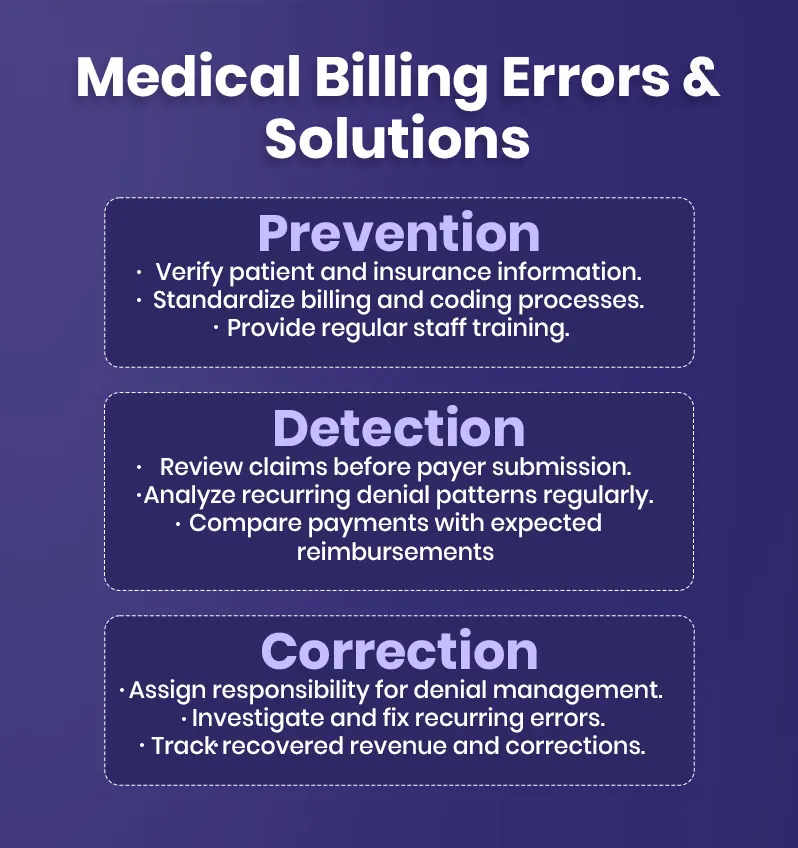
Prevention
Preventive controls minimize the possibility of erroneous claims going to payers. This includes verification, standard processes, guideline updates, documentation, and training for the staff. All of these steps are especially beneficial since prevention of errors at the early stage will save from all subsequent administrative processes related to claim rejections and denials.
- Confirm demographics, insurance eligibility, member IDs, policy numbers, and payer details before claim submission.
- Implement consistent processes for patient registration, coding, charging, claim reviewing and submission to minimize process variance.
- Keep yourself updated with respect to payer guidelines, coding guidelines, reimbursement guidelines, and claim edits.
- It is essential that clinical documentation be adequate for all the diagnoses, procedures, services, units, and modifiers that are being coded in the claim.
- Conduct education as coding guidelines, payer requirements, software changes, or internal billing processes evolve.
Detection
Detection will help identify any mistake in advance so that it can act as a continuous source of income loss. The routine reviews of claims will help in identifying wrong information whereas denial trends will point out the pattern which can be missed by following up on the individual claims.
- Code, document, review, and verify patient, provider, payer, and claim charges.
- Take note of reasons for denials according to payers, providers, and services and determine any patterns that recur.
- Exceptions reporting and billing dashboards might reveal unusual activity, omitted charges, denied claims, and payer discrepancies.
- Compare expected or contracted reimbursements versus payer payments for possible discrepancies. Correction
Correction
The actions taken with regard to solving the problem should focus on eliminating the source of the error as opposed to merely correcting the effect. There is a need for processes to put in place measures to manage denial, provide results of the correction made and monitor the amount recovered in revenue.
- Assign responsibility, deadlines, documentation requirements, and follow-up procedures for each major denial category.
- Investigate why errors occur and modify the workflow, training, technology, or controls responsible for recurring problems.
- Measure corrected claims, recovered payments, outstanding balances, and the financial effect of corrective actions.
- Repeated payer, coding, documentation, or submission problems should be reviewed by the appropriate operational or compliance team for broader resolution.
| Denial Cause | Typical Problem | Prevention |
| Eligibility | Inactive or incorrect insurance | Verify coverage before service |
| Authorization | Required authorization missing | Check payer requirements in advance |
| Documentation | Supporting records incomplete | Strengthen documentation workflows |
| Coding | Diagnosis or procedure code incorrect | Conduct coding reviews |
| Modifiers | Required modifier missing or incorrect | Validate modifiers before submission |
| Timely filing | Claim submitted after deadline | Monitor filing timelines |
| Medical necessity | Documentation does not support service | Review payer coverage criteria |
| Coordination of benefits | Wrong payer billed first | Confirm primary and secondary coverage |
How to Prevent and Reduce Medical Billing Errors with Technology and Performance Metrics
Avoiding billing mistakes demands constant auditing, technology, well-trained staff members, and performance standards. The integration of claims processing, eligibility checking, automation, denial management, and revenue cycle performance metrics can aid healthcare providers in identifying issues early on and avoiding repetitive billing mistakes.
Strengthen Pre-Submission Checks
A systematic pre-submission verification process must ensure eligibility, authority, demographics, payer data, codes, modifiers, documentation, provider data, and submission criteria have been met. The higher-risk claims may be subject to additional review prior to submission. Such safeguards help to eliminate avoidable mistakes that occur right at the beginning, where correcting the mistake is cheaper than dealing with the denial.
Use Automated Claim Scrubbing
Claim scrubbing systems can help find any missing data, coding inconsistencies, duplicate claims, incompatible combinations of data, and other errors prior to claims being sent to payers. This is especially useful since many denials occur as a result of administrative issues. Nonetheless, it is important that these claims still be checked by humans when necessary.
Verify Eligibility Electronically
Eligibility verification done electronically can establish coverage information prior to any billing. Early verification will be able to pinpoint such issues like inactive coverage, incorrect member information, changes in coverage, among others, which can disrupt the process of receiving payment. In addition, it is better to integrate this practice within the scheduling/registration process rather than find out later on that there was an error in the coverage information through a claim denial.
Monitor Denial Performance
The monitoring of denial cannot be confined to computing an average percent of total denials. There is a need for practices to classify denials based on payer, provider, service, cause, and frequency in order to determine recurring issues. It is possible that constant coding and eligibility denials can point to process weaknesses and not errors of the individuals.
Track Revenue-Cycle Metrics
Some key ratios include first pass acceptance, clean claim percentage, denial percentage, number of claims that have been corrected, accounts receivable days, net collection ratio, write-offs, and collected revenue. None of these ratios tells the whole story, but an analysis of multiple ratios will help us understand if our billing process is leading to more accurate claims.
Combine Technology with Expertise
Technology can be used to carry out routine checks, detect any anomalies in the pattern, and even arrange large amounts of billing information; however, technology does not have the ability to automatically interpret all situations. Skilled coders and billers are needed to interpret such instances and make proper decisions in compliance with rules.
Review Trends and Correct Causes
Assessment of performance needs to be carried out over several reporting cycles and not just one. Where there are repeat mistakes, the practices need to find the cause and make changes to workflow, training, technology, or quality control measures to solve the problem. The measurement of fixed claims and recovered revenue will tell whether the fix worked.
Professional Tip: Utilize automated claim validation in conjunction with performance monitoring and evaluation. Analyze the denial rate, clean claim rate, A/R days, correction rate, and write-off to uncover any recurring issues. Find the solutions to your problems by making changes in processes and technology.
A Practical Medical Billing Error-Reduction Strategy
Reduction of billing errors follows several steps. Rather than addressing each claim individually, it is important to identify trends, calculate costs associated with these trends, assign the responsible party to solve the problem, optimize the process and measure the impact of improvements made.
Step 1. Identify High-Volume Errors
First, begin with looking at the denial reports, denied claims, revised claims, audit results, and payment differences to identify the common mistakes. Divide the issues into groups such as eligibility issues, coding issues, documentation issues, authorization issues, and submission issues. Focusing on common issues makes a good starting point for resolving repeated medical billing issues.
Step 2. Measure Financial Impact
It is important to know that frequency does not always determine whether an error needs to be fixed immediately. Each major type of error can be evaluated for its cost by analyzing denied dollars, underpayment, charge capture issues, write-off, delayed collection, and corrections. With this, practices can identify frequent low-dollar errors from less frequent but costly ones.
Step 3. Find Root Causes
If some of the errors are significant enough to warrant concern, then it is necessary to determine what has caused these errors. This involves checking the workflow, the systems setup, staff processes, payer requirements, documentation processes, and interdepartmental communication. For instance, if there are continuous eligibility issues, they may be resulting from registration, not from billing.
Step 4. Assign Corrective Ownership
Each major billing issue needs to have ownership so that there is responsibility for the correction and follow-up process. Ownership creates accountability and ensures that repeat issues are not kicked back and forth between departments. There must be responsibility for implementation, tracking, and reporting on results, and escalation where further assistance is needed.
Step 5. Update Workflows and Training
Such changes might involve adjustments in claim processing, software configurations, documentation protocols, programming, and employee responsibilities. The training should be specific to the identified errors from auditing and performance information as opposed to using general training only. It is also important that the new processes are put into writing so that employees can easily implement the new requirements.
Step 6. Audit Results Regularly
A follow-up audit will help to find out whether the corrections have been implemented successfully. Comparisons will be made of such factors as error percentages, denial categories, corrected claims, payment delays, and others before and after the process has been altered. This will help to understand whether the practice was able to correct the issue or not.
Step 7. Track Revenue Leakage
The last point to look at is if the decrease in mistakes is having an impact on improved financial results. Tracking denied charges, write-offs, under-payments, recoveries, AR, and other metrics will help here. If a strategy to reduce billing errors in the medical industry is working, there will be noticeable changes in its accuracy and revenue collection.
How iSolve RCM Reduces Errors and Enhances Practice Revenue
iSolve RCM aids medical practices in lowering billing errors through the integration of structured revenue cycle processes, claims review, eligibility checking, coding, denial management, and performance tracking. Through pinpointing any errors in claims prior to submitting and examining patterns of denials, this method addresses the problem at its root cause and not just on a case-by-case basis. It can help increase billing efficiency, speed up claims processing, and ensure that practices receive payment for their services rendered.
FAQs
What are common medical billing errors?
The most common billing mistakes in medicine include wrong patient identification data, wrong diagnosis/procedure codes, lack of modifier codes, duplicate claims, missed charges, authorization issues, and wrong payer information. Such errors may lead to claim rejection, claim denial, delayed payment, underpayment, increased workload, and preventable financial loss.
How do billing errors affect practice revenue?
Billing mistakes lower revenues in that they result in claim rejections, denials, underpayments, and write-offs. They also result in increased workloads for employees in that they have to research, fix, and resubmit the claims. If the errors are frequent in high volume claims, the financial consequences may add up.
What causes medical claim denials?
Some common factors are an inactive insurance policy, no authorization, wrong coding, wrong modifiers, inadequate documentation, failure of timely filing, medical necessity problems, and coordination of benefits problems. Analyzing denial trends by payers and by reasons will help clinics identify weaknesses in processes that cause denials due to billing mistakes.
How can practices prevent billing errors?
Billing mistakes can be prevented using practices such as confirming eligibility, following standardized procedures, reviewing high-risk claims, proper documentation, updating coding policies, and performing frequent audits on the bills. Other ways include staff training and checking of claims prior to their submission to the payers.
How does technology reduce billing errors?
Automation through technology is possible with respect to the eligibility verification process, claim scrubbing, coding validation, denial monitoring, and performance measurement. Such tools may help recognize any lack of information or any possible issues with regard to the claims at an early stage of the revenue cycle. Nonetheless, specialists are required to review exceptions.
Why should practices conduct medical billing audits?
A regular audit helps to find out any coding errors, undercharged services, documentation errors, wrong billing errors, and denial trends. This will also help determine how much loss in revenues there could be. Thus, by dealing with high impact areas, one can improve their billing process and minimize any avoidable denials.