
Most practices don’t lose sleep over medical coding until something forces them to. A payer letter asks for 40 charts. A denial pattern appears out of nowhere. A new coder joins and the numbers look different the next month. Then everyone suddenly cares very much about what happens between the exam room and the claim form.
Here’s the thing. Medical coding is the key to the entire revenue cycle. It translates what the service has provided into something the payers, auditors and government officials can understand. If the translation is correct, claims go through without a hitch and nobody is the wiser. If it’s not right, even just a little bit, the consequences follow: claim denials, late payment, overpayment, and in extreme cases, unwanted scrutiny. Practices looking for reliable medical billing services in USA can explore solutions that support accurate claims processing and smoother revenue cycle operations.
This article tells you how medical coding compliance actually works, where most medical coding mistakes lie, what constitutes a proper medical coding audit, and how you can develop habits to protect yourself. It’s aimed at practice owners, billing managers, and anyone else who’s ever said to themselves “who coded this?” while staring at their computer screens.
Just a small point before we begin. The regulations are different depending on payer, specialty and year. So this should be taken as a general guide, and double-checked against the current CPT, ICD-10-CM, CMS and payer regulations.
What Is Medical Coding Compliance?
If someone asked you what coding compliance is at a dinner party, here’s the short answer. It means the codes on your claims match what really happened and what’s really documented, and they follow the official rules for how those codes must be used.
That sounds simple. It has three moving parts:
- Accuracy. The right diagnosis, procedure and modifier codes were chosen.
- Support. The medical record backs up every code you billed.
- Rule-following. You applied the guidelines from the code set owners and payers, including Medicare.
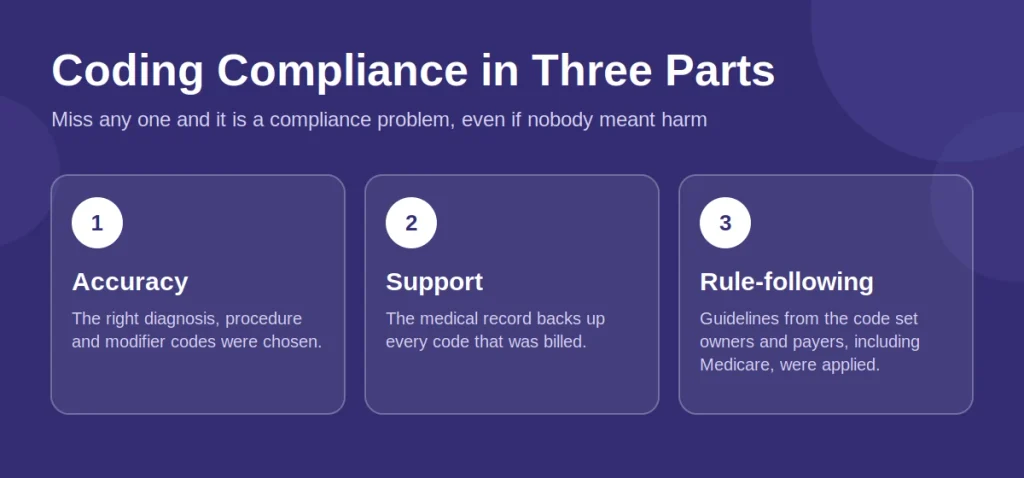
Miss any one of those and you have a compliance problem, even if nobody meant any harm. That’s worth repeating, because it surprises people. Errors in compliance in healthcare coding mainly arise due to unintentional errors, old practices, and lack of documentation rather than any form of fraud. Healthcare coding compliance involves developing a system for identifying unintentional errors before the payor identifies them.
Why Accurate Coding Matters More Than Most People Think
Let’s talk about what’s actually at stake.
Money, in both directions. Undercoding leaves legitimate revenue on the table. Overcoding creates overpayments you may have to return, sometimes years later. Neither one is a good place to be.
Legal & regulatory risks. Submitting claims to government payers makes you subject to laws such as the False Claims Act. Falsified claims where you were aware or should have been aware that the claims weren’t justified can result in repayment requirements, fines and, in severe cases, exclusion from participation in federal healthcare programs.
Payer scrutiny. Payers monitor billing trends. If your E/M levels are way above average for your specialty, you can expect scrutiny. Quality coding keeps you out of their sight.
Patient data integrity. Diagnosis codes help with patient quality measurement, risk adjustment and population health measures. Improper codes create the illusion of more or less ill patients.
Speed. Proper coding saves you the trouble of rejections and resubmissions. Your time in accounts receivable decreases.
Practices that need additional coding support can explore professional medical coding services to help improve coding accuracy, documentation alignment, and claim quality.
Medical Coding Compliance Rules and Standards
Coding isn’t guesswork. The following represent just some of the official references regarding the medical coding standards and medical coding requirements:
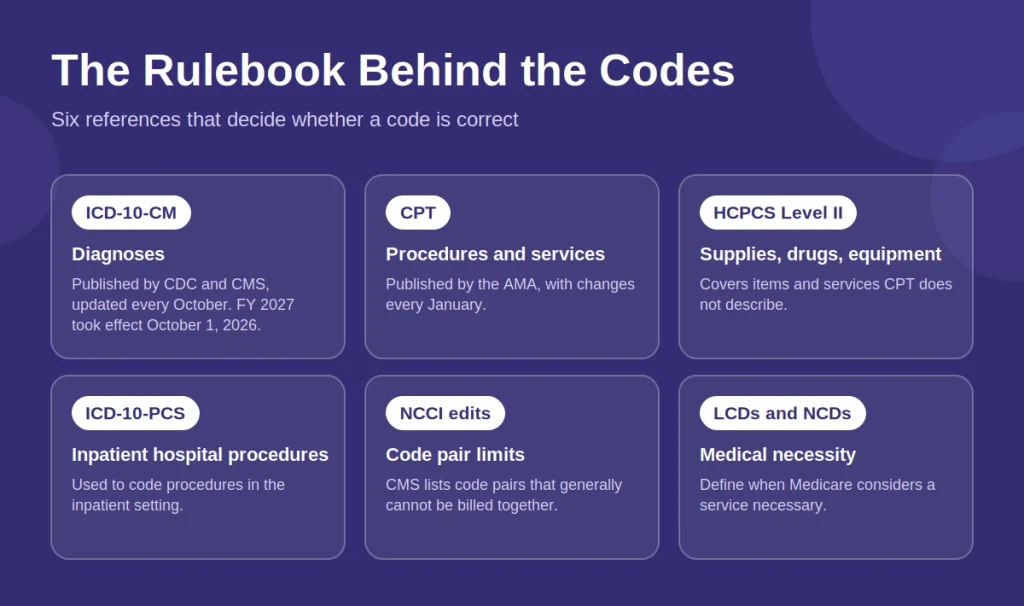
- ICD-10-CM codes the diagnoses. It is jointly published by CDC and CMS, with the code sets being revised every October. The revision for FY 2027 became effective as of October 1, 2026, and therefore claims with encounter dates of that day or later have to utilize the updated set.
- CPT codes the procedures and services. It is published by the AMA, with the revisions being made every January.
- HCPCS Level II codes supplies, drugs, equipment and services not described by CPT.
- ICD-10-PCS is used to code inpatient hospital procedures.
- NCCI edits by CMS list the pairs of codes which generally cannot be claimed at the same time.
- LCD and NCDs determine when Medicare regards the service as medically necessary.
- Payer-specific policies layer extra rules on top.
Because CPT requirements change annually, practices should review the latest CPT coding updates for 2026 to identify revised codes and prepare their billing workflows for applicable changes.
Under HIPAA, these code sets are the national standard for electronic claims. Using the wrong version or a deleted code isn’t a gray area. It’s an error.
ICD-10 Coding Guidelines and Rules That Trip People Up
Diagnosis coding has its own official guidelines, and they’re surprisingly detailed. A few ICD-10 coding rules show up in audit findings again and again:
Code to the highest specificity. If the documentation supports a fifth, sixth or seventh character, use it. Unspecified codes aren’t wrong, but they invite medical-necessity denials and weaken the story the claim tells.
Don’t code uncertain diagnoses in the outpatient setting. Words like probable, suspected, rule out and questionable don’t get coded as if they’re confirmed. Code the signs, symptoms or findings instead. (Inpatient facility rules differ.)
Follow the instructional notes. Excludes1, Excludes2, “code first” and “use additional code” notes aren’t suggestions. Ignoring them is one of the fastest ways to produce a rejected or incorrect claim.
Respect laterality and episode of care. Left versus right matters. So does the seventh character on injury codes, which tells the payer whether this is the initial encounter, a subsequent one or a sequela.
Sequence correctly. The first-listed diagnosis should reflect the main reason for the visit, supported by the note.
Use the code set in effect on the date of service. This is the heart of ICD-10 compliance. A new fiscal year means new codes, deleted codes and changed descriptions. Updating your encoder and your team’s habits in October isn’t optional.
For more diagnosis-coding guidance, review these ICD-10-CM pain diagnosis codes and the importance of selecting codes that match the provider’s documentation.
CPT Coding Guidelines and Rules Worth Keeping on a Sticky Note
Procedure coding follows a different but equally strict logic. Your team’s CPT coding guidelines should cover at least these points:
- Code what was documented, not what was probably done. If the note doesn’t show it, the code isn’t supported.
- Read the full descriptor and parenthetical notes. Many codes include instructions about what else can or can’t be reported with them.
- Understand the global package. Surgical codes often include pre-op, intra-op and post-op work. Billing extras on top is a classic unbundling problem.
- Use modifiers honestly. Modifier 25, modifier 59 and the X modifiers exist for real situations. Using them just to get past an edit is a red flag.
- Pick E/M levels using current rules. Office and other E/M visits are leveled by medical decision-making or total time, depending on the category. Guessing from habit isn’t a method.
- Update every January. New, revised and deleted CPT codes take effect with the new year.
Strong CPT compliance is really a combination of knowing the rules and having documentation that earns the level you billed.
Medical Record Documentation Requirements: The Other Half of the Claim
A code is only as good as the note behind it. Auditors don’t start with the claim. They start with the chart and ask whether it supports the claim.
Solid medical record documentation requirements generally mean each encounter’s note shows:
- The patient’s identity and the date of service
- The reason for the visit or chief complaint
- Relevant history, exam findings and test results
- The provider’s assessment and diagnoses
- A plan of care, including orders and follow-up
- The provider’s legible signature or valid electronic authentication, with credentials
- For time-based codes, the time spent and what it covered
- Support for medical necessity, meaning why the service was needed
A few documentation habits cause trouble repeatedly. Copy-and-paste notes that don’t reflect the actual visit. Templates that auto-fill normal findings nobody examined. Late entries. Missing signatures. Problem lists coded as if every listed condition was addressed at the visit. Good medical coding documentation guidelines discourage all of these.
If you take one idea from this article, take this: coders can’t code what providers don’t document, and providers can’t be blamed for what nobody told them. Feedback loops between the two fix more compliance problems than any software.
Medicare Medical Coding Compliance Requirements
If you bill Medicare, know that there will be more intense scrutiny. The Medicare coding rules require a bit more:
- Medical necessity. The services should be considered reasonable and necessary for the diagnosis under national and local coverage determinations.
- Signature policy. There are certain signature and attestation requirements under Medicare.
- NCCI edits. Code combinations marked as such by NCCI should not normally be billed together, except with valid modifiers, supported by the documentation.
- Risk adjustment for Medicare Advantage plans. Diagnosis codes affect risk scores, which means that unsupported diagnoses come with significant financial risk.
- Repayment requirements. If you discover an overpayment, there is usually a deadline to report it and repay it back, commonly referred to as the 60-day rule. The specifics were changed recently, so you should consult with your compliance specialist about the current requirement.
- Contractors that conduct audits. Medicare Administrative Contractors, recovery auditors and other such agencies are able to request documentation and recoup the payments.
None of it should discourage you from billing Medicare. On the contrary, it should make you want to code better.
Common Medical Coding Errors We See Again and Again
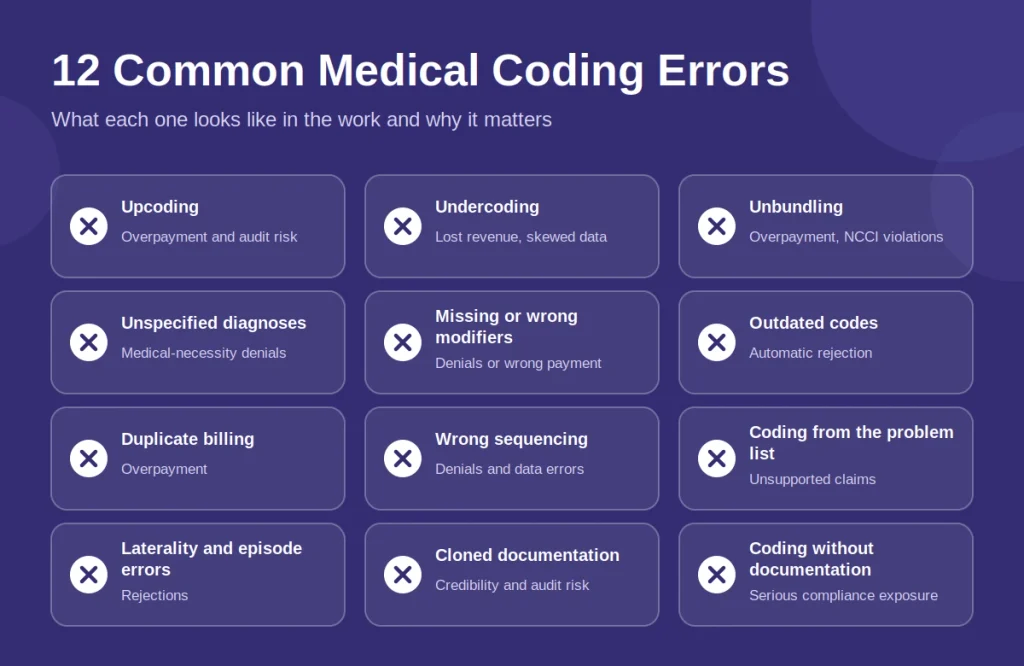
Let’s get practical. Here are the common medical coding errors that show up in nearly every coding compliance audit, along with why they matter.
| Error | What it looks like | Why it matters |
| Upcoding | Billing a higher E/M level or more complex code than documented | Overpayment, audit and fraud risk |
| Undercoding | Billing lower than the work documented | Lost revenue, skewed data |
| Unbundling | Billing separately for services that belong in one code | Overpayment, NCCI violations |
| Unspecified diagnoses | Using vague codes when detail exists | Medical-necessity denials |
| Missing or wrong modifiers | Modifier 25 or 59 used incorrectly, or not at all | Denials or inappropriate payment |
| Outdated codes | Using deleted or old-year codes | Automatic rejection |
| Duplicate billing | Same service billed twice | Overpayment |
| Wrong sequencing | Primary diagnosis doesn’t match the reason for visit | Denials and data errors |
| Coding from the problem list | Diagnoses listed but not addressed | Unsupported claims |
| Laterality and episode errors | Wrong side or wrong 7th character | Rejections |
| Cloned documentation | Identical notes across visits | Credibility and audit risk |
| Coding without documentation | Services billed but not in the note | Serious compliance exposure |
When coding errors result in rejected or underpaid claims, effective denial management can help practices investigate root causes, correct claim issues, and reduce recurring denials.
These medical coding mistakes rarely come from bad people. They come from rushed workdays, vague notes, outdated references and teams that never get feedback. That’s good news, because every one of them is fixable.
Unbundling and Medical Coding Compliance
Unbundling medical coding deserves its own section because it’s one of the most closely watched issues in audits.
Unbundling occurs when individual pieces of a product are billed separately under a code that should really account for the entire product together as one thing. For example, you order your meal bundled, and then ask the restaurant to bill you individually for each component of your meal. That way, you’ll end up paying more than the bundle.
Sometimes unbundling happens by accident, like a coder who doesn’t realize a code includes a certain step. Sometimes it’s built into a template or charge master and nobody notices. And sometimes it’s deliberate. Regardless of the reason, the result is the same: payment for something that wasn’t separately payable.
To protect yourself:
- Use current NCCI edit tools in your coding software.
- Review any modifier used to bypass an edit, and confirm the note supports it.
- Audit your most frequently billed code combinations quarterly.
- Teach coders and providers the global surgical package for your specialties.
Medical Coding Fraud and Abuse: Where Mistakes End and Trouble Begins
It would be wise to consider three different items and to separate them.
- Error. An honest mistake of choosing incorrect codes or omitting a modifier.
- Abuse. Practices that don’t meet certain accepted standards and bring about unnecessary expenses even if there’s no evidence of deception.
- Fraud. Intentional submission of fraudulent claims, like billing for non-existent procedures or deliberate upcoding.
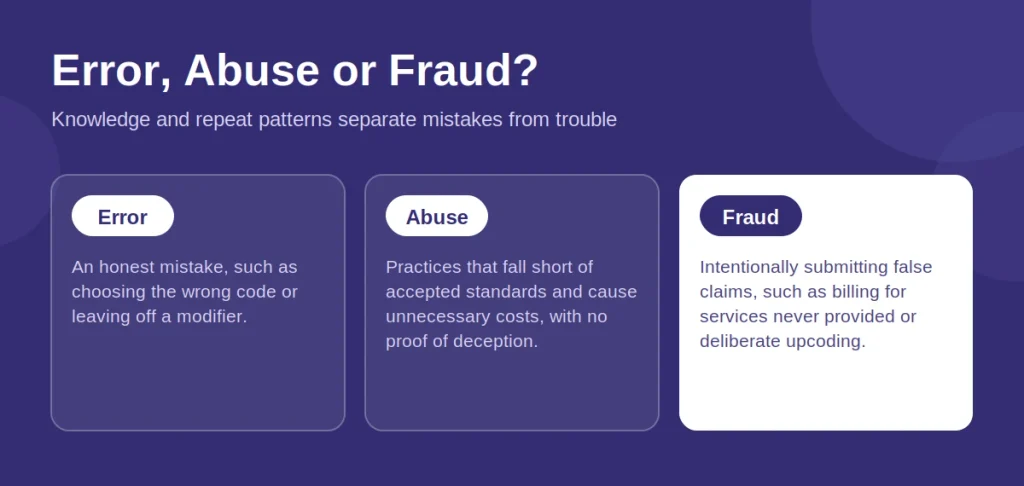
Often it all depends on the amount of knowledge and pattern. An erroneously coded claim may be called an error but the repetition of such an error over and over again knowing about it becomes another matter.
Cases of fraud or abuse in medical coding can include billing for un-rendered services, upcoding, unbundling in order to increase payments, incorrect use of modifiers, billing for non-medically necessary services and cloning notes for more advanced coding.
The consequences may consist of reimbursement of overpaid amounts, civil penalties, exclusion from participating in certain federal health care programs, loss of payer contracts as well as criminal prosecution in serious cases. However, the purpose isn’t to frighten but to illustrate why proper documentation is good protection.
Building a Coding Compliance Program That Actually Works
The elements necessary to create a sound compliance program have been spelled out in federal guidance, including materials published by the HHS Office of the Inspector General. This translates into practice as follows:
- Written policies and standards. Clear coding policies which your staff can access and follow.
- A designated compliance officer. In any size practice there must be someone in charge of this effort.
- Training. Upon initial hire and annually, along with when any significant code changes occur.
- Effective communication. Staff members should feel comfortable reporting concerns without fear.
- Audits and monitoring. Regular audits of coded claims compared to documentation.
- Consistent enforcement. Policy and standards apply to all physicians, regardless of production level.
- Proper response. Once deficiencies have been identified, fix them and return overpayments.
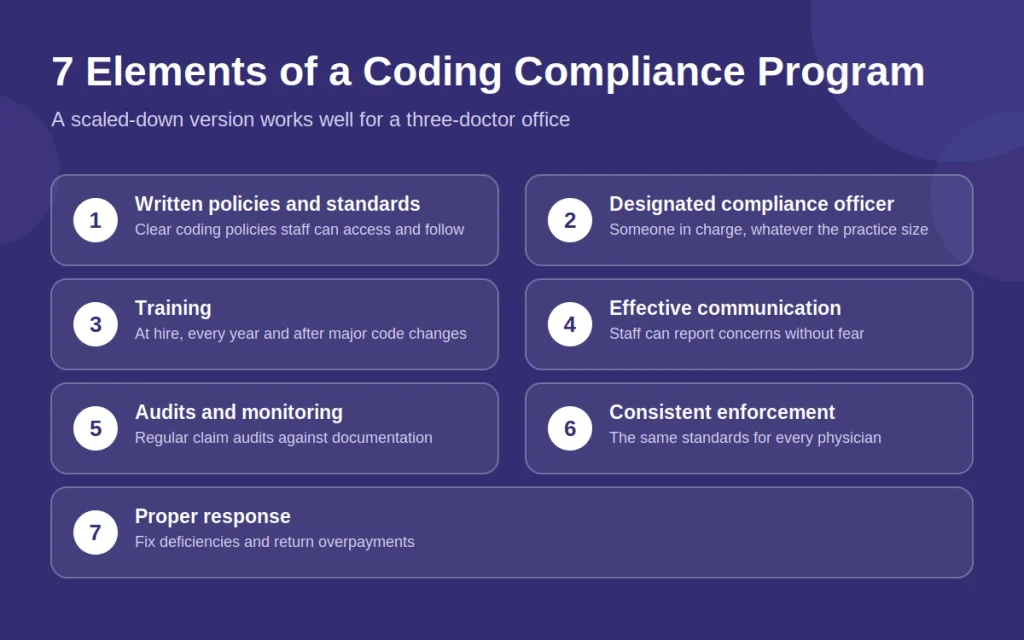
Many small practices mistakenly believe that this is only required for hospitals. Small practices should know that a reduced version of this works well for a three-doctor office. The key here is that it actually gets done.
What a Medical Coding Audit Actually Involves
A healthcare coding audit compares what was billed to what was documented and checks both against the rules. Done well, it’s not a witch hunt. It’s a diagnostic.
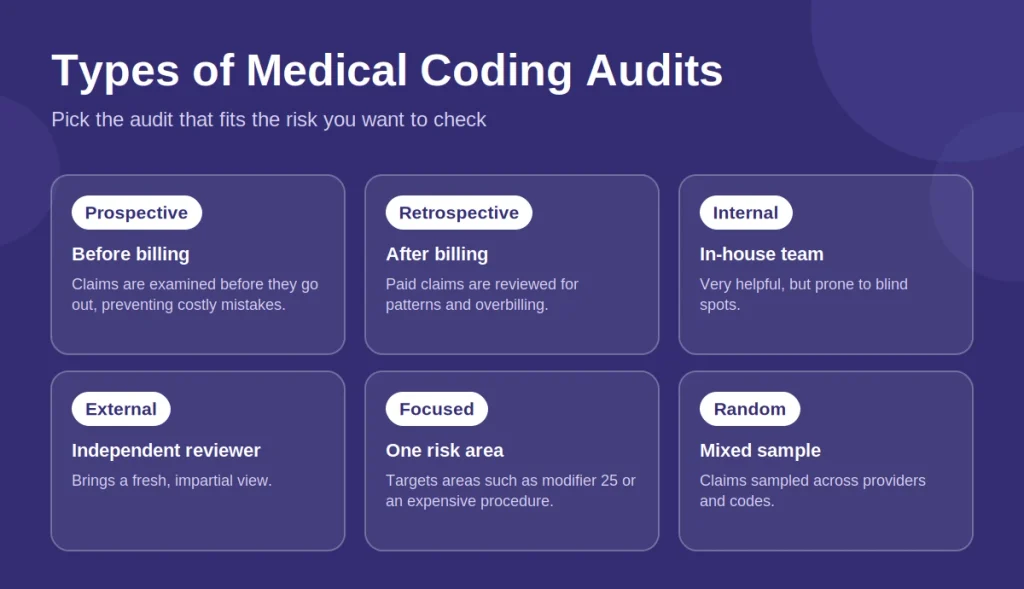
Types of audits:
- Prospective (pre-billing): Claim is examined prior to billing, eliminating possible mistakes that may have a negative financial impact.
- Retrospective (post-billing): Claim already paid is examined for pattern recognition and overbilling.
- Internal: Performed by internal audit department. Very helpful, but prone to blind spots.
- External: Conducted by an external reviewer; brings new look and impartiality.
- Focused: Concentration on the specific area of risks, such as usage of modifier 25 or some expensive procedure.
- Random: Sample of claims examined across various providers and codes.
What auditors usually measure:
- Accuracy rate for coding by providers and code types;
- Documentation deficiencies;
- Usage of modifiers;
- Medical necessity of services provided;
Financial impact of coding errors, both overpayment and underpayment.
Many organizations strive to have 95 percent or higher accuracy, however, exact targets may vary depending on specialty and mix of payers.
Practices that need an independent review of their billing workflows can consider medical billing audit services to identify coding gaps, documentation weaknesses, and potential reimbursement issues.
Frequency: The practice is to examine the sample of patients’ records for each physician at least once a quarter, and more often after hiring a new physician, using a new code set or upon the payer’s request.
A Practical Medical Coding Audit Checklist
Here’s a medical coding audit checklist your team can adapt. Run it against a sample of charts from each provider.
Documentation
- Is the patient identified and the date of service clear?
- Is there a legible, authenticated provider signature with credentials?
- Does the note state the reason for the visit?
- Are history, exam and decision-making documented as needed?
- Is time documented where a time-based code was used?
- Is medical necessity evident?
- Are there signs of cloned or templated text that doesn’t fit the visit?
Diagnosis coding
- Was the correct code set version used for the date of service?
- Are codes as specific as the documentation allows?
- Are uncertain diagnoses avoided in outpatient coding?
- Do sequencing and instructional notes (Excludes, code first, use additional code) check out?
- Do laterality and seventh characters match the note?
Procedure and E/M coding
- Does each CPT or HCPCS code match the documented service?
- Does the E/M level match medical decision-making or documented time?
- Are modifiers valid and supported?
- Were NCCI edits and global period rules respected?
- Was anything billed that isn’t in the note, or left out that is?
Claim and payment
- Do units, place of service and provider information match the record?
- Is the payer’s own policy satisfied?
- Were any overpayments identified, and were they handled within required timeframes?
Follow-up
- Were findings shared with the provider and coder?
- Is there a corrective action plan with dates?
- Will a re-audit confirm the fix?
Medical Coding Best Practices That Keep You Out of Trouble
You don’t need a giant department. A few medical coding best practices go a long way:
- Maintain up-to-date references. Refresh the encoders, codebooks, and payer policies with each code set update.
- Close the loop on education. Offer specific feedback within two minutes of the problem, instead of an all-day training session at the end of the year.
- Query appropriately. If there are questions about the documentation, the coder needs to ask the physician, not make assumptions. Queries need to be non-leading.
- Utilize templates, but not too much. Templates are useful for standardization, but not if they automatically fill in findings that no one reviewed.
- Watch your outliers. Make sure your E/M distribution and modifiers used match specialty-specific averages.
- Documentation is important. When coders have to interpret a rule in a gray area, the decision needs to be documented.
- Use audit results constructively. The purpose of audits is educational, not punitive.
- Educate your coders. Credentials like CPC and CCS indicate training, and continued education keeps them updated.
This is also what medical coding quality assurance looks like in real life: a repeatable cycle of coding, reviewing, correcting and teaching.
In-House Coding Versus Medical Coding Outsourcing Services
Many practices eventually hit the same question. Do we keep building this in-house, or do we bring in professional help?
In-house works well when you have experienced coders, a steady volume, and the time and expertise to run regular audits.
Outsourcing makes sense when:
- You can’t find or keep skilled coders
- Your specialty is complex and rule-heavy
- Your denial rate or error rate is climbing
- You’re growing and adding providers or locations
- Nobody has time to audit, so nobody does
- You want an independent set of eyes on your coding
Medical coding services offered by outsourcing can do medical coding, pre-billing reviews, and even medical coding reviews without requiring additional staffing. Medical coding consulting will also be useful in designing policies, training providers, and preparing for payer audits.
There is another solution that is equally good: keep your coding done in-house, but use the services of an outside medical coding auditing company periodically.
For practices evaluating external support, outsourced medical billing services may help manage billing workloads while allowing internal staff to focus on documentation and compliance processes.
How iSolve RCM Supports Coding Compliance
At iSolve RCM, coding is treated as the foundation of a clean revenue cycle, not an afterthought. iSolve RCM is a U.S focused revenue cycle management company based in Edison, New Jersey. According to the company, it supports more than 200 providers across 45+ specialties.
Here’s how its services connect to the compliance goals in this article:
- Medical coding services. Accurate CPT, ICD-10-CM and HCPCS coding based on provider documentation, aimed at clean first-pass claims.
- Billing audits. Reviews designed to uncover underpayments, coding gaps and process weaknesses before payers find them.
- Denial management. When a claim is denied, the team looks for the root cause, including coding issues, and works to stop repeats.
- Eligibility and benefits verification. Fewer surprises at claim time.
- A/R follow-up and payment posting. So accuracy carries through to collections.
- Provider credentialing and enrollment. Because a perfectly coded claim still fails if the provider isn’t enrolled.
- Regular reporting. So you can see denial patterns and trends instead of guessing.
- HIPAA-compliant handling of patient information.
On the practical side, iSolve RCM advertises service fees starting as low as 2.99% of monthly collections with no hidden fees (see the pricing details), says onboarding usually takes one to two weeks depending on practice size and complexity, and offers a free revenue cycle assessment so you can find revenue and compliance gaps before committing to anything.
As with any vendor, bring your own questions. Ask about coder credentials, how audits are sampled and reported, how documentation queries are handled and how they keep up with annual code updates. A good partner answers directly.
How to Choose a Medical Coding Audit Company or Coding Partner
If you’re shopping around for professional medical coding services or a medical coding audit company, use this list:
- Credentialed coders. Ask about certifications and ongoing education.
- Specialty experience. A cardiology practice and a behavioral health practice don’t code alike.
- Clear audit methodology. Sample sizes, scoring, how findings are reported and how disputes are handled.
- Actionable reports. You want provider-level feedback and corrective steps, not just a score.
- Compliance culture. They should be comfortable saying no to aggressive coding.
- Technology fit. Compatibility with your EHR and practice management system.
- Security. HIPAA compliance, access controls and a business associate agreement.
- Transparent pricing and exit terms. No surprises.
- References. Practices similar to yours who’ll talk about real results.
For authoritative guidance, practices should consult the CMS Medicare coding resources for correct coding policies and NCCI edits. The HHS Office of Inspector General’s physician compliance guidance also explains how internal audits, staff training, written policies, and corrective actions support an effective compliance program.
FAQs
What is medical coding compliance?
The process of coding for diagnoses and procedures where there is no error on the part of either accuracy or documentation. This means that the right coding for each diagnosis has to be done following all the rules and guidelines in place.
What are the most common medical coding errors?
Medical coding errors include upcoding, undercoding, unbundling, unspecified diagnosis codes, improper use of modifiers, outdated coding, double-billing, sequence coding errors and problem list coding errors among others.
What is a medical coding audit?
Medical coding audit entails a thorough review of billed codes with regards to their compliance with the rules and regulations in addition to comparison with the medical record to look into the problems.
How often should we run a coding compliance audit?
Coding compliance audits are conducted frequently based on certain factors such as the number of new employees hired or whenever changes are done in code sets.
What’s the difference between coding errors and fraud?
A mistake is simply an error. But fraud is knowing that one is making a false claim. Mistakes that happen repeatedly without correction begin to smell fishy, hence the importance of audits.
What are the key documentation requirements for coding?
Patient identification, date of service, reason for visit, relevant history and exam, assessment, plan, signature and authentication, support for medical necessity, and time when a code depends on time.
What is unbundling in medical coding?
Billing separately for services that are included in one comprehensive code. It can increase payment improperly and is a common audit target.
Does the ICD-10-CM code set change every year?
Yes. Updates take effect each October 1, and you must use the code set in effect on the date of service. The FY 2027 update took effect October 1, 2026.
How often does CPT change?
Annually, with changes effective January 1.
Is outsourcing medical coding worth it?
For many practices, yes. It can improve accuracy, reduce denials, add independent review and free your staff for other work. It’s especially helpful for growing practices and those struggling to hire experienced coders.
The takeaway
Accurate coding isn’t a back-office detail. It’s the thing that holds up your revenue, your audit readiness and your reputation with payers. And the path to getting it right isn’t mysterious: current references, complete documentation, regular audits, honest feedback and a culture where people can ask questions.
You don’t have to build all of it alone. Whether you tighten your internal process with the checklist above or bring in a partner for medical coding services and medical coding audit services, the goal is the same. Bill what you did, document what you billed and keep proof ready.