Pain is the leading chief complaint bringing a patient to a provider’s office. In addition, it happens to be one of the most frequently miscoded conditions in the American healthcare system. The result is expensive. The practice might perform an ideal visit with proper medical care, yet be denied payment simply because someone has selected R52 despite a chart note reading right knee, or because a code for chronic pain was sequenced incorrectly in relation to another condition. Accurate medical coding services can help practices address these documentation and coding issues before they affect reimbursement.
Pain codes in ICD-10-CM are scattered throughout at least four different chapters of the classification manual. Sequencing of pain codes is unique in the way there is nothing like that anywhere else in the world of ICD-10 coding. Moreover, there was a significant change in 2025 for this category of codes that has not been addressed by many favorites lists of EHR users. Reliable medical billing services also play an important role in ensuring accurately coded claims are submitted, tracked, and followed through to reimbursement.
All of this will be covered in this guide including G89 category, R52, regional pain codes, guidelines for coding pain, FY2026 updates and the documentation practices determining whether the claim will be paid on the first attempt or end up on the aging list.
What Are ICD-10-CM Pain Diagnosis Codes?
ICD-10-CM pain codes describe pain as a reportable diagnosis, either as a symptom in its own right or as a clinically significant condition layered on top of an underlying disease.
The code set does not keep pain in one neat place. Pain codes live in:
- Chapter 6 (G00–G99), Diseases of the Nervous System – the G89 category, which handles acute, chronic, neoplasm-related, and postprocedural pain.
- Chapter 13 (M00–M99), Musculoskeletal System – joint pain (M25.5-), limb pain (M79.6-), back and neck pain (M54.-).
- Chapter 18 (R00–R99), Symptoms and Signs – abdominal and pelvic pain (R10.-), chest pain (R07.-), and the catch-all R52.
- Chapter 19 (S00–T88), Injury and Poisoning – pain from devices, implants, and grafts.
More than 160 codes across the classification describe pain in some form. That is a lot of surface area for error, which is why the ICD-10-CM Official Guidelines for Coding and Reporting devote an unusually long section to pain alone.
Why pain coding accuracy affects revenue
“Pain codes” do not act as neutral placeholders. Pain codes make decisions regarding medical necessity. They make decisions about prior authorization for procedures. They determine whether nerve blocks, epidurals, or radiofrequency ablations will be covered or denied. Payers have taken a new approach as well. Pain codes that passed easily through claim editing five years ago now create an interest in documentation requirements, automated downgrade, and post-payment review. Consistent claim denial management can help practices identify recurring coding and documentation problems instead of addressing each denial in isolation. If a payer’s screening tool comes across M25.50 (pain in an unspecified joint), it raises a red flag right away when associated with a knee injection CPT code.
The Four Questions Behind Every Pain Code
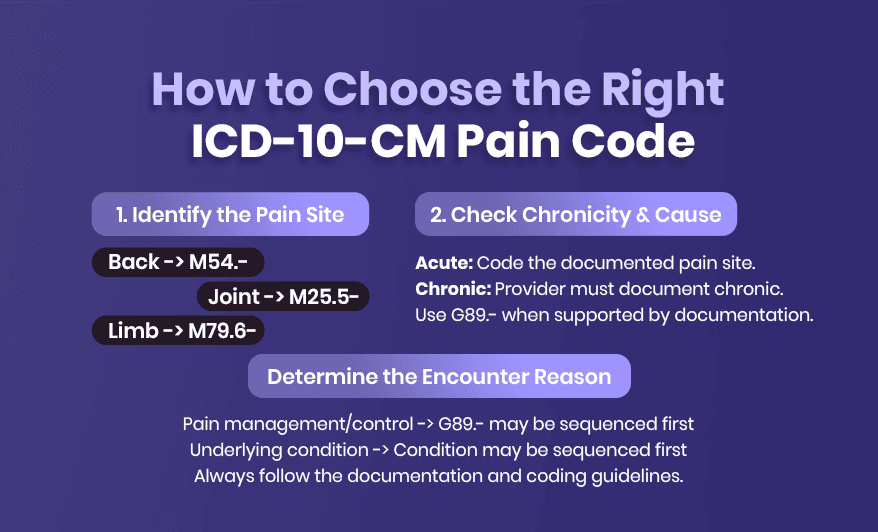
Before selecting any pain code, work through four questions in order. Nearly every pain coding error traces back to skipping one of them.
1. What is the site?
Pain in the left shoulder is not “pain.” ICD-10-CM wants the anatomic location and, where the code family allows it, the side. Laterality is mandatory in the M25.5-, M79.6-, and now the R10.2- families.
2. Is it acute or chronic?
ICD-10-CM does not define acute or chronic by a number of days or months. There is no three-month rule inside the classification. The provider’s documentation controls the answer. If the note does not say, the coder cannot assume.
3. Is there a confirmed underlying cause?
If the pain is a routine, integral symptom of a definitively diagnosed condition, the pain code is usually not reported separately. Abdominal pain in a patient diagnosed with acute appendicitis is part of the appendicitis.
4. What is the reason for this encounter?
This is the question that decides sequencing. An encounter for pain management behaves very differently from an encounter for treating the disease that causes the pain.
G89 Pain Codes: The Category That Trips Everyone Up
Category G89, Pain, not elsewhere classified, is the backbone of ICD-10 pain coding for billing. It is also the category that produces the most denials, because its codes are almost never used alone and almost never used casually.
The rules that govern G89
| Code | Description | When to use it |
| G89.0 | Central pain syndrome | Pain from a central nervous system lesion — post-stroke pain, spinal cord injury pain, MS-related central pain |
| G89.11 | Acute pain due to trauma | Provider documents acute pain resulting from injury |
| G89.12 | Acute post-thoracotomy pain | Acute pain following thoracotomy, beyond expected recovery |
| G89.18 | Other acute postprocedural pain | Acute postoperative pain documented as not routine |
| G89.21 | Chronic pain due to trauma | Chronic pain traced to a prior injury |
| G89.22 | Chronic post-thoracotomy pain | Persistent post-thoracotomy pain syndrome |
| G89.28 | Other chronic postprocedural pain | Chronic pain following a surgical procedure |
| G89.29 | Other chronic pain | The workhorse chronic pain code — chronic pain not otherwise classifiable |
| G89.3 | Neoplasm related pain (acute) (chronic) | Pain caused by primary or secondary malignancy |
| G89.4 | Chronic pain syndrome | Chronic pain with significant psychosocial dysfunction, as documented |
G89 codes describe the nature of the pain, not the location. They almost always need a partner code that supplies the anatomic site. G89.29 alone tells a payer that a patient has chronic pain somewhere, which is not a claim-worthy level of detail.
Do not assign a G89 code when the underlying diagnosis is known and the encounter is directed at treating that condition. If a patient comes in for management of lumbar spinal stenosis and the visit is about the stenosis, you code the stenosis. Adding G89.29 because the patient also hurts is not appropriate.
Assign a G89 code when the encounter is specifically for pain control or pain management. This is the exception that makes the category useful, and it is the situation interventional pain practices live in every day.
R52 and G89 are mutually exclusive. ICD-10-CM carries an Excludes1 note between them. R52 covers pain NOS and generalized pain NOS; G89 covers acute and chronic pain that is classified. They never appear on the same claim line pairing.
G89.4 is not a code for G89.29. The term “chronic pain syndrome” has a specific clinical definition, that of chronic pain with severe psychosocial disability. G89.4 should be used only in those cases where the clinical condition is documented as such. Otherwise, it is an audit risk.
G89.29 in real practice
The most common code within this category is G89.29, and it is the code in the ICD-10 for chronic pain that the billing team commonly chooses. The code will apply to chronic pain that is not caused by any traumatic injury, is not postprocedural in nature, is not associated with a neoplasm, and is not chronic pain syndrome.
Code it along with the site code. Chronic low back pain will become M54.50 (M54.51/M54.59, depending on documentation) + G89.29. Chronic right knee pain will be M25.561 + G89.29. The coding order varies based on the reason the patient came in, as will be explained in the following section.
Sequencing: The Rule That Decides Whether You Get Paid
If you take one thing from this guide, take this. ICD-10 pain coding guidelines put sequencing at the center, and payers enforce it.
Rule 1 – Encounter is for pain control or pain management
The G89 code goes first. The site-specific code goes second.
Example: Patient presents for a lumbar epidural steroid injection to manage documented chronic low back pain from degenerative disc disease. Sequence: G89.29 → M51.36 (or the appropriate site/condition code).
The logic is straightforward. The reason for the encounter was the pain itself, not the disc disease. The first-listed diagnosis has to reflect that.
Rule 2 – Encounter is for treating the underlying condition
The underlying condition goes first. The G89 code may go second if the pain is documented and clinically significant.
Example: Patient presents for evaluation and management of lumbar degenerative disc disease and also has documented chronic pain. Sequence: M51.36 → G89.29.
Rule 3 – Neoplasm-related pain
When the encounter is for pain control in a cancer patient, G89.3 is the first-listed diagnosis, followed by the neoplasm code. When the encounter is for treating the malignancy, the neoplasm leads and G89.3 follows.
This one matters a great deal for oncology and palliative care billing, and it is routinely reversed on claims.
Rule 4 – The site code is enough on its own when chronicity is not documented
If a provider writes “knee pain, right” with nothing about acute or chronic, you code M25.561 and stop. Do not infer chronicity. Do not add G89.29 to strengthen the claim. That is not coding; that is guessing, and it does not survive an audit.
Rule 5 – A definitive diagnosis and a pain code can coexist
If a patient has a confirmed condition and separately documented pain that is not integral to that condition, both may be reported. The reason-for-encounter rule still governs order.
R52: Pain, Unspecified
R52 is the ICD-10 code for pain when nothing more specific is available. It covers pain NOS, acute pain NOS, and generalized pain NOS. It is also the code you should be trying hard not to use. R52 is technically billable, which lulls teams into treating it as safe. It is not. Payers read unspecified pain ICD-10 codes as a documentation gap, and attaching R52 to anything procedural is an invitation to a denial or a records request.
When R52 is genuinely appropriate:
- A patient reports diffuse, generalized pain with no localizable site and no established chronicity
- Triage or intake documentation before any workup narrows the picture
- Initial presentations where the provider truly has not localized the complaint
When R52 is the wrong answer:
- Any time a body region appears in the note
- Any time the provider documented acute or chronic — that moves you into G89
- Any encounter involving a site-directed procedure
The Excludes1 note for R52 is the most valuable map in the entire pain section of ICD-10-CM. You will go straight to the proper site code for the following: abdominal pain to R10.-, back pain to M54.9, breast pain to N64.4, chest pain to R07.1–R07.9, ear pain to H92.0-, eye pain to H57.1, headache to R51.9, joint pain to M25.5-, limb pain to M79.6-, lumbar pain to M54.5-, pelvic/perineal pain to R10.2-, shoulder pain to M25.51-, throat pain to R07.0, tongue pain to K14.6, tooth pain to K08.8, and renal colic to N23. If a member of your team is looking for R52 all too often, the problem is at the top in the documentation.
Site-Specific ICD-10 Pain Codes by Body Region
This is the reference section. Bookmark it, and share it with your providers, because most of what follows is a documentation problem before it is a coding problem.
Back pain ICD-10 codes
Back pain is one of the highest-volume diagnoses submitted to payers anywhere in the country, which makes the M54 category worth knowing about colds.
| Code | Description |
| M54.2 | Cervicalgia (neck pain) |
| M54.6 | Pain in thoracic spine |
| M54.50 | Low back pain, unspecified |
| M54.51 | Vertebrogenic low back pain |
| M54.59 | Other low back pain |
| M54.9 | Dorsalgia, unspecified |
| M54.89 | Other dorsalgia |
| M54.30–M54.32 | Sciatica, unspecified / right / left |
| M54.40–M54.42 | Lumbago with sciatica, unspecified / right / left |
| M54.16 | Radiculopathy, lumbar region |
| M54.17 | Radiculopathy, lumbosacral region |
| M54.81 | Occipital neuralgia |
The trap of low back pain codes. M54.5 was taken out of the code book many years ago and is broken down into three codes. Any coding system that provides M54.5 as a selection is out-of-date and produces denials. Current ICD-10 coding for low back pain would be M54.50, M54.51, or M54.59. The choice is based on documentation.
Code M54.51 is vertebrogenic low back pain. M54.51 is not a catch-all code for low back pain. M54.51 defines anterior column pain resulting from vertebral end plate changes. The payors have identified M54.51 with their basivertebral nerve ablation coverage policies. Utilize M54.51 only if the documentation supports that particular scenario and the imaging studies support it. For chronic back pain ICD-10 coding, M54.5x would be combined with G89.29.
Neck pain ICD-10
The ICD-10 code for neck pain is M54.2, cervicalgia. It is simple, which is exactly why it gets overused. Neck pain with documented radicular findings belongs in M54.12 (radiculopathy, cervical region), and neck pain from a specific cervical condition belongs with that condition’s code. Cervicalgia is for neck pain without a more specific established cause.
Chest pain ICD-10 codes
| Code | Description |
| R07.1 | Chest pain on breathing |
| R07.2 | Precordial pain |
| R07.81 | Pleurodynia |
| R07.82 | Intercostal pain |
| R07.89 | Other chest pain |
| R07.9 | Chest pain, unspecified |
| R07.0 | Pain in throat |
The ICD-10 code for chest pain that most emergency and urgent care claims land on is R07.9, and in that setting it is often defensible; chest pain of unclear etiology is a legitimate diagnosis during a workup. But if the workup concludes with a definitive cause, the definitive diagnosis replaces R07.9. Leaving the symptom code in place after the cause is established is a documentation-versus-coding mismatch that auditors look for.
Abdominal pain ICD-10 codes
The R10 category saw the biggest pain-related expansion in the FY2026 update, effective October 1, 2025.
| Code | Description |
| R10.0 | Acute abdomen |
| R10.10 | Upper abdominal pain, unspecified |
| R10.11 | Right upper quadrant pain |
| R10.12 | Left upper quadrant pain |
| R10.13 | Epigastric pain |
| R10.30 | Lower abdominal pain, unspecified |
| R10.31 | Right lower quadrant pain |
| R10.32 | Left lower quadrant pain |
| R10.33 | Periumbilical pain |
| R10.83 | Colic |
| R10.84 | Generalized abdominal pain |
| R10.85 | Abdominal pain of multiple sites |
| R10.9 | Unspecified abdominal pain |
| R10.A0–R10.A3 | Flank pain — unspecified side / right / left / bilateral |
The ICD-10 code for abdominal pain should be quadrant-specific whenever the note supports it. R10.9 is a fallback, not a default.
New for FY2026: flank pain finally has its own code family (R10.A-). Before this, coders shoehorned flank pain into R10.9 or an adjacent code that did not fit. For emergency departments and urgent care sites running renal colic workups, this is a meaningful improvement — but only if the provider documents the side.
Also new: R10.85, abdominal pain of multiple sites, for patients presenting with pain in two or more distinct abdominal locations.
Tenderness codes remain separate from pain codes: R10.811–R10.819 for abdominal tenderness, R10.821–R10.829 for rebound tenderness, and the new R10.8A1–R10.8A9 family for flank and suprapubic tenderness.
Pelvic pain ICD-10 – read this one carefully
This is the change most likely to be sitting in your EHR as a stale favorite right now.
R10.2 is no longer a billable standalone code. As of October 1, 2025, it converted to a parent code with five children:
| Code | Description |
| R10.20 | Pelvic and perineal pain, unspecified side |
| R10.21 | Pelvic and perineal pain, right side |
| R10.22 | Pelvic and perineal pain, left side |
| R10.23 | Pelvic and perineal pain, bilateral |
| R10.24 | Suprapubic pain |
The ICD-10 code for pelvic pain now requires laterality. Claims still mapped to bare R10.2 will be rejected under a “code requires greater specificity” edit. If your OB-GYN, urology, or urogynecology templates were built before October 2025, audit them. Note also that vulvodynia (N94.81-) carries an Excludes1 against R10.2-. They are not coded together.
Joint pain ICD-10 codes (M25.5-)
| Code | Description |
| M25.50 | Pain in unspecified joint |
| M25.511 / M25.512 / M25.519 | Pain in right / left / unspecified shoulder |
| M25.521 / M25.522 / M25.529 | Pain in right / left / unspecified elbow |
| M25.531 / M25.532 / M25.539 | Pain in right / left / unspecified wrist |
| M25.541 / M25.542 / M25.549 | Pain in right / left / unspecified hand joint |
| M25.551 / M25.552 / M25.559 | Pain in right / left / unspecified hip |
| M25.561 / M25.562 / M25.569 | Pain in right / left / unspecified knee |
| M25.571 / M25.572 / M25.579 | Pain in right / left / unspecified ankle and foot |
The ICD-10 code for knee pain is M25.561 or M25.562. The ICD-10 code for hip pain is M25.551 or M25.552. The ICD-10 code for shoulder pain is M25.511 or M25.512. In every case, the unspecified-laterality option exists as a technical fallback, not as a shortcut, and payers increasingly treat heavy use of the “9” endings as a documentation deficiency.
Limb pain ICD-10 codes (M79.6-)
M79.6 covers pain in the limb, hand, foot, fingers, and toes. It carries an Excludes2 against joint pain (M25.5-), which means both can be reported when both are documented; soft tissue limb pain and joint pain are different things.
| Code | Description |
| M79.601 / M79.602 / M79.603 | Pain in right arm / left arm / unspecified arm |
| M79.604 / M79.605 / M79.606 | Pain in right leg / left leg / unspecified leg |
| M79.609 | Pain in unspecified limb |
| M79.621 / M79.622 / M79.629 | Pain in right / left / unspecified upper arm |
| M79.631 / M79.632 / M79.639 | Pain in right / left / unspecified forearm |
| M79.641 / M79.642 / M79.643 | Pain in right / left / unspecified hand |
| M79.644 / M79.645 / M79.646 | Pain in right / left / unspecified finger(s) |
| M79.651 / M79.652 / M79.659 | Pain in right / left / unspecified thigh |
| M79.661 / M79.662 / M79.669 | Pain in right / left / unspecified lower leg |
| M79.671 / M79.672 / M79.673 | Pain in right / left / unspecified foot |
| M79.674 / M79.675 / M79.676 | Pain in right / left / unspecified toe(s) |
Other pain codes worth keeping close
| Code | Description |
| R51.9 | Headache, unspecified |
| R51.0 | Headache with orthostatic component |
| M79.7 | Fibromyalgia |
| M79.1- | Myalgia |
| G90.50–G90.59 | Complex regional pain syndrome I, by site and laterality |
| G54.6 | Phantom limb syndrome with pain |
| N64.4 | Mastodynia (breast pain) |
| H57.1- | Ocular pain |
| H92.0- | Otalgia |
| K08.89 | Other specified disorders of teeth (dental pain) |
| N23 | Unspecified renal colic |
| F45.41 | Pain disorder exclusively related to psychological factors |
| F45.42 | Pain disorder with related psychological factors |
A note on pain disorder ICD-10 coding: F45.41 and F45.42 are not interchangeable. F45.41 describes pain attributable solely to psychological factors and carries an Excludes1 against both G89 and R52. F45.42 describes pain with contributing psychological factors, and G89 carries a “code also” instruction pointing to it. Getting these two backwards changes the clinical story on the claim entirely.
Acute Pain vs Chronic Pain: How to Code Each
How to code acute pain in ICD-10
There is no acute pain code that stands alone as a general default. R52 includes acute pain NOS, but as discussed, that is a last resort.
For acute pain coding:
- Code the site specifically.
- Add a G89.1- code only when the acute pain is due to trauma (G89.11), post-thoracotomy (G89.12), or other postprocedural causes (G89.18) — and only when documented as such.
- If the acute pain is an expected, integral symptom of a confirmed condition, do not code it separately.
The acute pain diagnosis code question usually has a simpler answer than people expect: most acute pain is coded to the site alone.
How to code chronic pain in ICD-10
Chronic pain coding is where the money is, and where the errors are.
- The provider must document “chronic.” No time threshold in the classification substitutes for that word.
- Select the chronic pain code: G89.21 (due to trauma), G89.22 (post-thoracotomy), G89.28 (other chronic postprocedural), G89.29 (other chronic pain), or G89.4 (chronic pain syndrome, when the syndrome is documented).
- Add the site code.
- Sequence based on reason for encounter.
The chronic pain diagnosis code most practices need is G89.29, and the most common mistake is using it without a site partner.
Documentation tip worth passing to providers: “chronic low back pain, ongoing 14 months, managed with monthly injections” gives a coder everything. “Back pain” gives them M54.9 and a likely denial. The difference in reimbursement between those two notes, over a year of visits, is not small.
Postprocedural Pain ICD-10 Coding
This is a compliance-sensitive area, so be precise. Routine postoperative pain is not separately coded. Expected pain after surgery is part of the surgical episode. Reporting G89.18 on every post-op visit is exactly the pattern that draws audit attention.
Report postprocedural pain only when documentation establishes it as more than routine — unusual severity, unexpected persistence, or a documented complication requiring its own management.
| Code | Description |
| G89.12 | Acute post-thoracotomy pain |
| G89.18 | Other acute postprocedural pain |
| G89.22 | Chronic post-thoracotomy pain |
| G89.28 | Other chronic postprocedural pain |
Device-related pain is different. Pain caused by a prosthetic device, implant, or graft is excluded from G89 and coded to the Chapter 19 complication codes: T82.84- (cardiac and vascular devices), T83.84- (genitourinary), T84.84- (orthopedic), and T85.84- (other internal devices). A patient with pain from a spinal cord stimulator lead is not a G89.28 patient.
The ICD-10 code for postprocedural pain therefore depends on three variables: acute versus chronic, thoracotomy versus other, and device-related versus not.
Neoplasm-Related Pain ICD-10 Coding
G89.3 covers neoplasm-related pain, whether acute or chronic, and whether the pain stems from a primary tumor, a metastasis, or the disease process generally.
Two rules matter:
Sequencing. When the encounter is for pain control or pain management in a cancer patient, G89.3 is reported first, with the neoplasm code following. When the encounter addresses the malignancy itself, the neoplasm leads.
Do not add G89.29 alongside G89.3. Neoplasm-related pain is already classified as acute or chronic within G89.3. Stacking a second chronic pain code is redundant and will be edited.
The ICD-10 code for neoplasm-related pain is used heavily in palliative care, hospice, and oncology pain management billing, and it is one of the clearest examples of why the reason-for-encounter question has to be answered before a code is chosen.
Chronic Pain Syndrome ICD-10 (G89.4)
Chronic pain syndrome is its own clinical condition and not simply another name for “chronic pain.” Code G89.4 should be used in cases where chronic pain is associated with psychosocial dysfunction involving impaired functioning, behavioral change, sleep/mood disturbance, and the general life disturbance seen in the syndrome.
Assign G89.4 when:
- The provider documents “chronic pain syndrome” by name, or
- The documentation clearly describes chronic pain with the associated psychosocial dysfunction
Do not assign G89.4 when:
- The note says only “chronic pain” — that is G89.29
- The coder is inferring dysfunction from context
The ICD-10 code for chronic pain syndrome is frequently over-reported, and because it can influence risk profiles and treatment authorization, over-reporting carries real compliance weight. When in doubt, query the provider. A query is cheaper than a takeback.
Pain Management ICD-10 Coding: Putting It Together
Interventional pain practices live at the intersection of all these rules. Here are work scenarios.
Scenario 1 – Lumbar facet joint injection for chronic low back pain Reason for encounter is pain management. Sequence: G89.29 → M54.50 (or M54.59 if documented as other low back pain).
Scenario 2 – E/M visit for management of cervical spondylosis, patient also reports chronic neck pain Reason for encounter is the underlying condition. Sequence: M47.812 → M54.2 → G89.29 if chronic pain is separately documented and clinically significant.
Scenario 3 – Intrathecal pump refill for cancer pain Reason for encounter is pain control. Sequence: G89.3 → the neoplasm code.
Scenario 4 – Patient presents to urgent care with right-sided flank pain, cause unknown No chronicity documented, no confirmed diagnosis. Code: R10.A1. Nothing else.
Scenario 5 – Post-op visit, day 10, with pain documented as “greater than expected, requiring extended management” Code: G89.18 plus the site code, with the surgical history code as applicable.
Scenario 6 – Bilateral pelvic pain, workup pending Code: R10.23. Not R10.2; that code will reject.
Pain management diagnosis codes rarely stand alone. The pattern is almost always G89 plus site, sequenced by intent, supported by chronicity documentation.
FY2026 Updates You Need to Have Implemented
The FY2026 ICD-10-CM code set took effect October 1, 2025, adding 487 new diagnosis codes, revising 38, and deleting 28. A meaningful share of that expansion landed in the pain categories.
Practices should also review related CPT 2026 changes separately, since CPT updates affect procedure reporting even though they are distinct from ICD-10-CM diagnosis-code changes.
What changed for pain coding:
- R10.2 converted to a parent code. Pelvic and perineal pain now requires a laterality character (R10.20–R10.24), with R10.24 added for suprapubic pain.
- Flank pain got its own family. R10.A0–R10.A3, with laterality.
- Abdominal pain of multiple sites was added as R10.85.
- Flank and suprapubic tenderness codes were added as R10.8A1–R10.8A9.
- Costovertebral angle tenderness expanded under R39.85, and carries an Excludes2 against R10.-.
If your EHR favorites list, superbill, or coding cheat sheet was built before October 2025 and still shows R10.2 as a selectable code, that is a live denial source in your practice right now.
Looking ahead: the FY2027 update takes effect October 1, 2026, with roughly 190 new codes, 30 deletions, and a handful of revised descriptions. Pull the CMS conversion table before the effective date and reconcile it against your active code library rather than waiting for rejections to tell you what changed. There is also a mid-year update cycle each April that practices routinely skip.
The Eight Most Common Pain Coding Denials, and How to Stop Them
Many of these issues can be identified before submission through claim scrubbing, which helps flag coding, documentation, and claim-data inconsistencies.
1. Unspecified laterality on a site-directed procedure A knee injection billed with M25.569 asks the payer to believe you injected an unspecified knee. Fix it at the template level to make laterality a required field.
2. R52 attached to a procedural claim If a procedure targeted a location, the diagnosis has to name that location.
3. G89 reported without a site code Chronic pain somewhere is not a diagnosis a payer can adjudicate.
4. Reversed sequencing on pain management encounters The single most common interventional pain denial. If the visit was for pain control, G89 leads.
5. Deleted codes still in the system M54.5 and now R10.2 are the two biggest offenders. Both reject outright.
6. Chronicity assumed rather than documented Coders adding G89.29 because the patient has been coming in for a year. The chart has to say it.
7. Routine post-op pain reported separately A pattern-level compliance risk, not just a one-claim problem.
8. Symptom code retained after a definitive diagnosis Once appendicitis is confirmed, the abdominal pain code comes off unless there is a separately significant reason to keep it.
Provider Documentation Checklist for Clean Pain Claims
Give this to your clinical team. Every item removes a denial category. Regular medical billing audits can also help practices identify recurring documentation and coding patterns before they lead to larger reimbursement problems.
- Name the site, and the side where sides exist
- State acute or chronic explicitly do not leave it to inference
- Identify the cause where known: trauma, postprocedural, neoplasm, or a specific condition
- State the reason for the encounter pain management versus disease management
- For postprocedural pain, document why it exceeds routine expectations
- For chronic pain syndrome, document the psychosocial dysfunction, not just the pain
- For vertebrogenic low back pain, document the supporting findings
- Note functional impact it supports medical necessity for continued interventional care
A well-documented pain note takes a provider an extra fifteen seconds. A denied claim takes a biller forty minutes and a 30-day delay in cash.
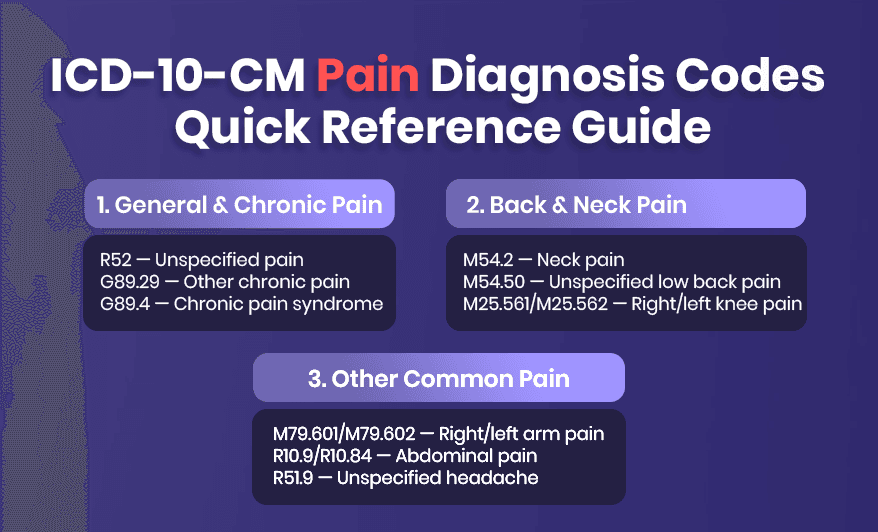
Quick Reference: Common Pain ICD-10 Codes
| Complaint | Code |
| Pain, unspecified | R52 |
| Chronic pain, other | G89.29 |
| Chronic pain syndrome | G89.4 |
| Chronic pain due to trauma | G89.21 |
| Acute pain due to trauma | G89.11 |
| Neoplasm-related pain | G89.3 |
| Central pain syndrome | G89.0 |
| Acute postprocedural pain, other | G89.18 |
| Chronic postprocedural pain, other | G89.28 |
| Low back pain, unspecified | M54.50 |
| Neck pain | M54.2 |
| Thoracic spine pain | M54.6 |
| Chest pain, unspecified | R07.9 |
| Abdominal pain, unspecified | R10.9 |
| Generalized abdominal pain | R10.84 |
| Pelvic pain, unspecified side | R10.20 |
| Flank pain, right | R10.A1 |
| Shoulder pain, right / left | M25.511 / M25.512 |
| Hip pain, right / left | M25.551 / M25.552 |
| Knee pain, right / left | M25.561 / M25.562 |
| Joint pain, unspecified joint | M25.50 |
| Arm pain, right / left | M79.601 / M79.602 |
| Leg pain, right / left | M79.604 / M79.605 |
| Hand pain, right / left | M79.641 / M79.642 |
| Foot pain, right / left | M79.671 / M79.672 |
| Fibromyalgia | M79.7 |
| Headache, unspecified | R51.9 |
Get Pain Coding Right the First Time
Pain coding is not difficult in the way that oncology staging or complex cardiology coding is difficult. It is difficult because it is high-volume, rule-dense, and unforgiving of small habits, a missing laterality character, a stale favorites list, a sequencing reflex nobody ever questioned.
The practices that get paid consistently on pain claims share three traits. Their documentation templates force the variables that matter, their code libraries get reconciled against current CMS files, and their coders treat sequencing as a decision rather than a default. These processes work best when integrated into a broader revenue cycle management workflow.
At iSolve RCM, our certified coders work across pain management, orthopedics, neurology, oncology, and primary care, and we see the same handful of pain coding errors drain revenue from otherwise well-run practices. We audit your current pain coding patterns, correct the templates and code libraries feeding them, and manage the denials already sitting in your AR.
If pain-related denials are showing up in your aging report, schedule a free consultation and we will show you exactly where the leakage is.
Official ICD-10-CM Coding Reference
For the most current coding rules and sequencing guidance, refer to the ICD-10-CM Official Guidelines for Coding and Reporting published by the Centers for Medicare & Medicaid Services (CMS). The guidelines provide specific direction on G89 pain codes, pain-management encounters, site-specific pain codes, and postoperative pain.
FAQs
What is the ICD-10 code for pain?
There is no single code for pain. R52 covers pain unspecified, G89.29 covers other chronic pain, and site-specific codes cover pain by location. Which one applies depends on site, chronicity, cause, and reason for the encounter.
What is G89.29 in ICD-10?
G89.29 is Other chronic pain. It is used when a provider documents chronic pain that is not due to trauma, not postprocedural, not neoplasm-related, and does not meet the definition of chronic pain syndrome. It should be reported alongside a site-specific code.
What is R52 in ICD-10?
R52 is “Pain, unspecified,” covering pain NOS, acute pain NOS, and generalized pain NOS. It carries an Excludes1 against the entire G89 category and should be avoided whenever more specific documentation exists.
What is the ICD-10 code for generalized pain?
Generalized pain NOS falls under R52. Generalized abdominal pain, which is a different thing, is R10.84.
Can G89 codes be used as the principal diagnosis?
Yes, but only when the encounter is specifically for pain control or pain management. If the encounter addresses the underlying condition, that condition leads.
Is there a time rule for acute versus chronic pain in ICD-10-CM?
No. ICD-10-CM does not define a specific duration threshold for classifying pain as acute or chronic. The provider’s documentation should establish the pain’s chronicity, and coders should not assume chronicity based solely on the length of treatment or the patient’s history.
Is R10.2 still valid for pelvic pain?
No. As of October 1, 2025, R10.2 became a parent code. Use R10.20 through R10.24 with the appropriate laterality or suprapubic designation.
What is the ICD-10 code for chronic pain syndrome versus chronic pain?
Chronic pain syndrome is G89.4 and requires documented significant psychosocial dysfunction. Ordinary chronic pain is G89.29. They are not interchangeable.
How do you code pain when the underlying cause is known?
If the pain is an integral symptom of the confirmed condition, code the condition alone. If the pain is separately significant, or the encounter is for pain management, add the pain code and sequence by reason for encounter.
What is the ICD-10 code for postprocedural pain?
G89.18 for other acute postprocedural pain, G89.28 for chronic, G89.12 and G89.22 for post-thoracotomy. Device-related pain goes to the T82–T85 complication codes instead.
Which pain codes are the most audited?
G89.4, G89.18, and heavy use of unspecified-laterality codes. All three signal either over-reporting or documentation gaps.