

Search for “ROI in medical billing” and you will find two different answers. Practice owners and managers mean return on investment: what billing costs compared with the revenue it brings in. Health information teams mean release of information: the process of sharing patient records with patients, payers and others under HIPAA. Both affect revenue, and both get confused.
This guide covers both. The first part shows how to calculate the return on investment of your medical billing with two numbers that matter most: cost to collect and net collection rate. The second part explains release of information, how it works, how long it takes, what it can cost and how it affects the revenue cycle.
Quick answer: Medical billing ROI (return on investment) = (revenue gained from billing improvements − the cost of those improvements) ÷ the cost x 100. To measure it, track cost to collect (total billing costs ÷ cash collected) and net collection rate (payments ÷ collectible charges). In medical records, ROI means release of information: disclosing patient records with a valid authorization or as HIPAA permits, usually within 30 days for patient requests.
The Two Meanings of ROI in Healthcare
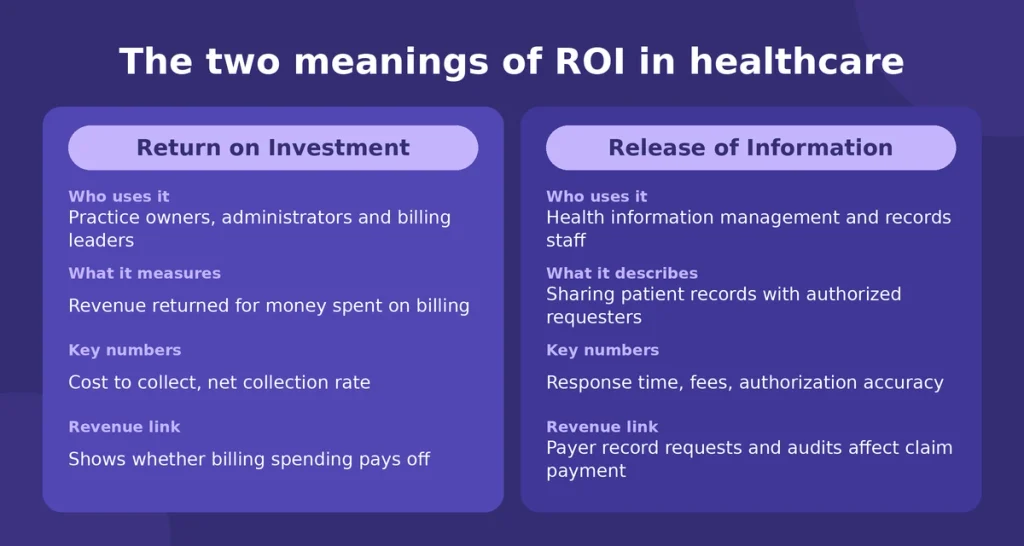
| Return on Investment | Release of Information | |
|---|---|---|
| Who uses it | Practice owners, administrators and billing leaders | Health information management and records staff |
| What it measures or describes | Revenue returned for money spent on billing | Sharing patient records with authorized requesters |
| Key numbers | Cost to collect, net collection rate | Response time, fees, authorization accuracy |
| Revenue link | Shows whether billing spending pays off | Payer record requests and audits affect claim payment |

Part 1: ROI as Return on Investment
What is ROI in healthcare?
In healthcare finance, return on investment measures how much revenue or savings an investment produces compared with what it costs. For billing, the investment can be staff, software, training or an outsourced billing company, and the return is the extra revenue collected and the costs avoided.
How Do You Calculate Medical Billing ROI?
Medical billing ROI = (net revenue gain − investment cost) ÷ investment cost x 100
To use it, you need four numbers for the same period, before and after the change you are measuring:
| Input | Where to Find It |
|---|---|
| Collectible revenue | Charges minus contractual adjustments |
| Cash collected | Payments posted from payers and patients |
| Billing costs | Staff, benefits, software, clearinghouse, statements and any outsourcing fees |
| Write-offs from billing errors | Timely filing, denials not worked and other avoidable losses |
How Do You Calculate Cost to Collect?
Cost to collect = total revenue cycle costs ÷ cash collected x 100
HFMA defines cost to collect as the total expenses of patient access and patient financial services divided by cash collections, as its cost-to-collect guidance explains. For a physician practice, include billing staff and benefits, software, clearinghouse fees, statement printing and postage and any outsourced billing fees. A lower cost to collect means each dollar collected costs less to bring in.
How Do You Calculate Net Collection Rate?
Net collection rate = payments ÷ (charges − contractual adjustments) x 100
If a practice has $1,000,000 in collectible charges and collects $950,000, its net collection rate is 95%. Practice guidance based on MGMA data recommends 95% or higher, as the ACAAI practice guide notes. Net collection rate is the clearest single measure of how much of what you are owed actually arrives. Our guide to average medical billing collection rates covers benchmarks by specialty.
Worked Example: In-House vs Outsourced Billing ROI
A practice with $1,000,000 in collectible charges compares its current in-house billing with outsourcing:
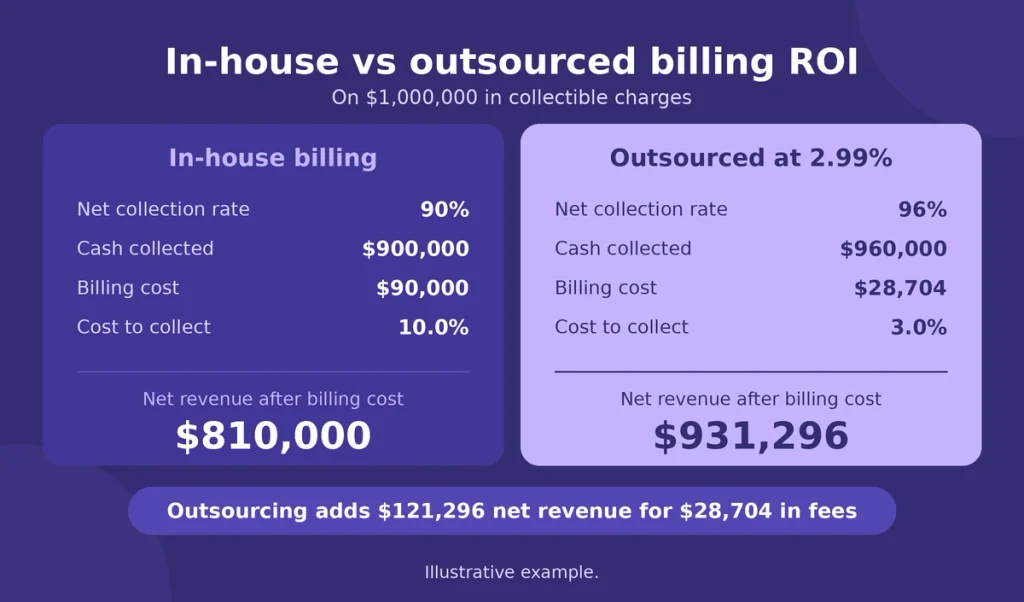
| In-House | Outsourced at 2.99% | |
|---|---|---|
| Net collection rate | 90% | 96% |
| Cash collected | $900,000 | $960,000 |
| Billing cost | $90,000 (staff, benefits, software, clearinghouse) | $28,704 |
| Net revenue after billing cost | $810,000 | $931,296 |
| Cost to collect | 10.0% | 3.0% |
Illustrative example. Your own figures will differ by specialty, payer mix and current performance.
In this example, outsourcing adds $121,296 in net revenue for $28,704 in fees, a return of roughly 4.2 times the fee. The biggest part of the gain comes from the higher net collection rate, not the lower cost, which is why the collection rate matters more than the price.
Pro Tip: Run the ROI calculation over at least six months, and compare the same months year over year. Seasonal swings in volume and deductibles can make a single month look better or worse than it is. Our cost vs. revenue guide explains the other numbers to watch.
How Do You Measure Medical Billing Performance Beyond ROI?
| Metric | What It Shows |
|---|---|
| Days in A/R | How fast revenue turns into cash |
| A/R over 120 days | Revenue at risk; guidance targets 10% or less |
| Denial rate | Where claims fail, by payer and reason |
| Clean claim rate | How often claims pass on the first submission |
| Charge lag | How quickly services become charges |
| Point-of-service collections | How much patient responsibility is collected at the visit |
Part 2: ROI as Release of Information
What does ROI mean in medical terms?
In medical records, ROI means release of information: the process of disclosing a patient’s protected health information to the patient or to another person or organization, as the HIPAA Privacy Rule allows or with the patient’s written authorization.
What Is the Purpose of Release of Information?
Release of information gives patients access to their own records and lets records move where they are needed, such as to another provider for treatment, to a payer for claim review or to an attorney with the patient’s permission, while protecting the patient’s privacy. A good ROI process shares the right records, with the right person, for the right purpose and nothing more.
Who Can Request Release of Information?
| Requester | What Is Required |
|---|---|
| The patient | A right of access request; no authorization needed for their own records |
| A personal representative | Proof of legal authority, such as a parent of a minor or a health care power of attorney |
| Other providers | Permitted for treatment without a separate authorization |
| Payers | Permitted for payment purposes, limited to the minimum necessary |
| Attorneys, life insurers and employers | A valid HIPAA authorization signed by the patient |
| Courts and government agencies | A court order, subpoena or legal requirement, handled under specific rules |
What Should a Valid ROI Authorization Include?
Under 45 CFR 164.508, a valid HIPAA authorization must include:
- A specific description of the information to be disclosed.
- The name of the person or organization authorized to disclose it.
- The name of the person or organization receiving it.
- The purpose of the disclosure (or “at the request of the individual”).
- An expiration date or event.
- The patient’s signature and date, or a representative’s signature with their authority.
- Statements about the right to revoke, whether treatment can be conditioned on signing and that the information may be redisclosed.
What Is the Step-by-Step Process for Releasing Medical Information?
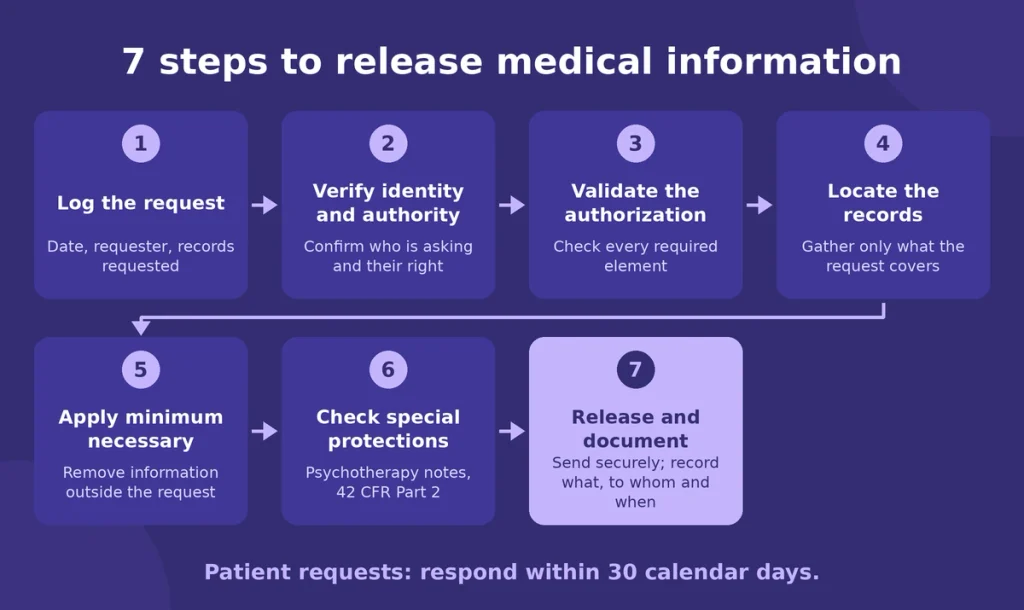
| Step | What Happens |
|---|---|
| 1. Log the request | Record the date received, requester and records requested |
| 2. Verify identity and authority | Confirm who the requester is and their right to the records |
| 3. Validate the authorization | Check every required element, or confirm a HIPAA permission applies |
| 4. Locate the records | Gather only the records covered by the request |
| 5. Apply the minimum necessary standard | Remove information outside the request, where the standard applies |
| 6. Check for special protections | Psychotherapy notes and substance use disorder records under 42 CFR Part 2 need extra care |
| 7. Release and document | Send the records securely and record what was sent, to whom and when |
How Long Does a Release of Information Request Take?
For a patient’s request for their own records, HIPAA requires action within 30 calendar days, with one 30-day extension if the patient is told in writing why and when the records will be provided, under 45 CFR 164.524. State laws can be shorter. Requests from payers, attorneys and other third parties follow contract terms, state law or the deadlines in the request, such as the 45 days Medicare contractors usually allow for additional documentation requests, as CGS notes.
Can Healthcare Providers Charge for Medical Records?
For patient access requests, providers may charge only a reasonable, cost-based fee covering the labor of copying, supplies and postage, and HHS also allows a flat fee of up to $6.50 for electronic copies of records kept electronically, as its right of access guidance explains. Fees for third-party requests, such as attorneys, are generally set by state law. Providers cannot charge patients for searching for or retrieving records.
What ROI Mistakes Can Lead to HIPAA Violations?
- Releasing records with an incomplete or expired authorization.
- Sending more information than the request or the purpose allows.
- Sending records to the wrong person, fax number or email address.
- Missing the 30-day deadline for patient requests.
- Charging patients more than a reasonable, cost-based fee.
- Releasing substance use disorder records without Part 2 consent.
- Not documenting what was released, to whom and when.
HHS has announced dozens of enforcement actions under its Right of Access Initiative, many for slow or incomplete patient record requests. Our guide to HIPAA compliance in medical billing covers the wider rules.
Why Do Speed and Accuracy Matter in ROI Requests?
Slow or inaccurate releases create two kinds of risk. On the compliance side, late patient access requests are one of the most common HIPAA enforcement issues. On the revenue side, payers deny or hold claims when records requested for review arrive late or incomplete. A records request that sits for weeks can turn into a denial that sits for months.
How Does ROI Affect Medical Billing and the Revenue Cycle?
Release of information touches billing every time a payer asks for records. Medical review requests, audits, prior authorization appeals and medical necessity denials all depend on getting the right records to the payer on time. When records go out late, claims stay pending or are denied for missing documentation. When too much is sent, the practice risks a privacy violation. Linking ROI to denial management keeps record requests tied to the claims waiting on them.
What Are the Best Practices to Improve ROI Process Efficiency?
- Use one intake log for every request, with due dates.
- Use a standard authorization checklist for every release.
- Route payer record requests to billing as well as health information staff.
- Release electronically through secure portals or encrypted channels.
- Track turnaround time and backlog every week.
- Train staff on minimum necessary, Part 2 and psychotherapy note rules.
- Audit a sample of releases each quarter.
How Can iSolve RCM Improve Your Billing ROI?
iSolve RCM measures cost to collect and net collection rate from the start, then works the claims, denials and A/R that move them. Payer record requests are routed and tracked so documentation reaches payers on time, and services start at 2.99% of monthly collections, as listed on our pricing page.

Frequently Asked Questions
What is ROI in medical billing?
It usually means return on investment: the revenue gained from billing compared with what billing costs. In health information management, ROI can also mean release of information, the process of sharing patient records.
What is a good cost to collect?
HFMA cites about 2% of collections as best practice for hospitals. Physician practices often run higher, so compare with similar practices and track your own trend.
What is a good net collection rate?
Practice guidance based on MGMA data recommends a net collection rate of 95% or higher.
How long does a provider have to respond to a patient’s records request?
Under HIPAA, 30 calendar days, with one 30-day extension if the patient is told in writing. Some states require faster responses.
Can a payer get medical records without patient authorization?
Yes, for payment purposes, such as claim review, under HIPAA’s treatment, payment and operations permission, limited to the minimum necessary information.
How much can a provider charge a patient for copies of records?
Only a reasonable, cost-based fee for copying labor, supplies and postage, or a flat fee of up to $6.50 for electronic copies of electronic records.