Nursing home visits look simple on a schedule: a physician or nurse practitioner rounds on residents, checks on their conditions and updates orders. On the billing side, though, they’re among the most error-prone services a practice submits.
The reason is that a nursing facility claim depends on several decisions that have nothing to do with the clinical care itself. Was this the first visit of the stay, or a follow-up? Was the resident in a Medicare Part A-covered skilled stay, or a long-term custodial stay? Is the service included in the facility’s bundled payment, or billed separately? Has the facility’s certification paperwork been completed on time? Get any of these wrong, and even a well-documented visit can be rejected, underpaid or recouped later.
This guide covers the core nursing home CPT codes, the 99304–99310 nursing facility E/M family, discharge codes 99315 and 99316, POS 31 vs. POS 32, Medicare SNF certification and recertification, consolidated billing and the documentation each one requires.
Quick answer: Nursing home visits are commonly reported with CPT codes 99304–99306 for initial nursing facility care and 99307–99310 for subsequent nursing facility care. CPT 99315 and 99316 are used for nursing facility discharge management. The correct code depends on the service provided, medical decision making (MDM) or documented total time, and payer rules.
Quick Reference: Nursing Home CPT Codes
| CPT code | Service | MDM level | Minimum total time (if time is used) |
| 99304 | Initial nursing facility care | Straightforward or low | 25 minutes |
| 99305 | Initial nursing facility care | Moderate | 35 minutes |
| 99306 | Initial nursing facility care | High | 50 minutes |
| 99307 | Subsequent nursing facility care | Straightforward | 10 minutes |
| 99308 | Subsequent nursing facility care | Low | 20 minutes |
| 99309 | Subsequent nursing facility care | Moderate | 30 minutes |
| 99310 | Subsequent nursing facility care | High | 45 minutes |
| 99315 | Discharge management | Time-based | 30 minutes or less |
| 99316 | Discharge management | Time-based | More than 30 minutes |
Always verify time thresholds and payer rules against the current CPT code set and Medicare guidance.

What Are Nursing Home CPT Codes?
Nursing home CPT codes are the Evaluation and Management (E/M) codes that physicians and other qualified healthcare professionals (QHPs) use to bill for their professional services to residents of a nursing facility. When a physician, nurse practitioner, physician assistant or clinical nurse specialist evaluates a resident, manages their conditions or plans their discharge, that work is reported on a professional claim (CMS-1500 or 837P) using these codes.
It’s important to separate two kinds of billing that happen in the same building:
- Facility billing. The nursing home or SNF bills for room, board, nursing care, therapy, supplies and other services. For a Medicare Part A skilled stay, this is paid under the SNF Prospective Payment System (PDPM) on an institutional claim.
- Professional billing. The physician or QHP bills separately for their own E/M services using CPT codes like 99304–99310. These services are generally not part of the facility’s payment.
In other words, the CPT codes in this guide describe what the practitioner did, not what the facility provided.
The terms “nursing home,” “skilled nursing facility,” “long-term care facility” and “custodial care” are often used interchangeably, but they mean different things for billing:
- Skilled nursing facility (SNF): Provides skilled nursing or rehabilitation, often after a hospital stay. Medicare Part A may cover the stay when coverage requirements are met.
- Nursing facility (NF): Provides ongoing nursing care, often long-term. Medicare Part A doesn’t cover custodial care, though Medicaid often does.
- Long-term care / custodial care: Help with daily living for residents who don’t need daily skilled care.
Many buildings are dually certified as both SNFs and NFs. That’s why the general label “nursing home” isn’t enough for coding. What matters is the resident’s actual status and coverage on the date of service.
Nursing Home vs. Skilled Nursing Facility CPT Codes
A common misconception is that SNFs and nursing homes use different CPT code families. They don’t. Skilled nursing CPT codes and nursing home CPT codes are the same codes. CPT 99304–99310 are nursing facility E/M codes used in both skilled and non-skilled nursing facility settings, as long as the service meets the code requirements. Medicare applies them to SNFs, nursing facilities, intermediate care facilities for individuals with intellectual disabilities and psychiatric residential treatment centers.
What changes between a skilled and non-skilled stay isn’t the CPT code. It’s the place of service (POS) code and, in some cases, how other services are billed under consolidated billing. We’ll cover both in detail below.
Initial, Subsequent and Discharge Nursing Facility Visits
Nursing facility E/M services fall into three main groups:
- Initial nursing facility care (99304–99306): The practitioner’s first E/M service for the resident during the stay.
- Subsequent nursing facility care (99307–99310): Follow-up visits after the initial service, including routine monitoring and new or worsening problems.
- Nursing facility discharge management (99315–99316): The work involved in discharging the resident, reported by time.
The former annual nursing facility assessment code, 99318, was deleted in 2023. That work is now reported with the appropriate subsequent nursing facility care code.
CPT Codes 99304–99310: Complete Nursing Facility E/M Guide
Since 2023, nursing facility E/M codes follow the same framework as office visits. The level of service is selected based on either MDM or total time on the date of the encounter, and the history and exam only need to be medically appropriate. You don’t need to meet both MDM and time. Use whichever pathway the documentation better supports.
MDM is measured through three elements:
- Number and complexity of problems addressed
- Amount and/or complexity of data reviewed and analyzed
- Risk of complications, morbidity or mortality of patient management
To reach a given MDM level, the encounter must meet or exceed that level in two of the three elements.
Total time includes the practitioner’s face-to-face and non-face-to-face work on the date of the encounter, such as reviewing records, examining the resident, talking with nursing staff and family, ordering tests or medications and documenting. It doesn’t include time spent by facility staff or time on separately reported services.
Initial Nursing Facility Care CPT Codes (99304–99306)
Quick answer: CPT 99304, 99305 and 99306 report the practitioner’s initial E/M service for a resident during a nursing facility stay. 99304 requires straightforward or low MDM (or 25 minutes), 99305 requires moderate MDM (or 35 minutes), and 99306 requires high MDM (or 50 minutes).

| Code | MDM level | Minimum total time when time is used |
| 99304 | Straightforward or low | 25 minutes |
| 99305 | Moderate | 35 minutes |
| 99306 | High | 50 minutes |
When is an initial service appropriate?
CPT and Medicare each have their own rules here, so it’s best to look at them separately.
- CPT reporting: Consider whether the resident has already received professional services during the current stay from the same practitioner, or from another practitioner of the exact same specialty and subspecialty in the same group. If so, the visit is generally reported as subsequent care. A different specialty, such as a cardiologist seeing the resident after the attending physician, may report its own initial visit.
- Medicare reporting: Medicare has its own frequency rules for initial nursing facility visits. Medicare contractors generally describe the initial codes as reportable once per admission, per practitioner, regardless of the length of stay. Because the details can vary by practitioner type and situation, verify the applicable MAC guidance before billing.
The federally required initial comprehensive visit is a separate requirement. Federal nursing facility regulations require an initial comprehensive visit within a set timeframe after admission. For SNF residents, that visit must generally be performed by a physician, while nurse practitioners, clinical nurse specialists and physician assistants may perform other medically necessary visits and, under certain conditions, alternate required visits. This is a regulatory care requirement. It shouldn’t automatically be treated as interchangeable with every practitioner’s first billable E/M visit. Who performs the visit, and when, can affect whether it’s billed as initial or subsequent care and under whose NPI.
CPT Code 99304 Description and Billing Requirements
CPT 99304 is the entry-level initial nursing facility code. It requires a medically appropriate history and/or examination and straightforward or low MDM, or 25 minutes of total time on the date of the encounter.
A typical 99304 scenario is a resident admitted for a stable, well-defined condition, such as recovery after an uncomplicated procedure, with limited data to review and low-risk management.
Documentation should show why the resident was admitted, the problems addressed, the plan of care and either the MDM elements or the total time.
CPT Code 99305 Description
CPT 99305 is the initial nursing facility code for moderate MDM, or 35 minutes of total time.
Moderate complexity often looks like a resident admitted after a hospital stay with two or more chronic conditions, such as heart failure and diabetes, that need medication adjustment, review of hospital records and lab results, and prescription drug management.
This is one of the most common initial nursing facility codes because most post-acute admissions involve several active problems and medication changes.
CPT Code 99306 Definition and Documentation
CPT 99306 is the highest initial nursing facility code. It requires high MDM, or 50 minutes of total time.
High-complexity admissions usually involve:
- A chronic illness with severe exacerbation or a condition that threatens life or bodily function
- Extensive data review, such as hospital records, independent interpretation of tests or discussion with the hospital team
- High-risk management decisions, such as considering rehospitalization, managing drugs that need intensive toxicity monitoring or holding goals-of-care discussions
A longer visit alone doesn’t establish high MDM. If 99306 is supported by time rather than MDM, the documentation must clearly show at least 50 minutes of qualifying total time on that date. A resident with many diagnoses doesn’t automatically qualify either. What counts is what was actually addressed, analyzed and decided at the visit.
Subsequent Nursing Facility Care CPT Codes (99307–99310)
Quick answer: CPT 99307–99310 report follow-up visits during a nursing facility stay. 99307 requires straightforward MDM (or 10 minutes), 99308 low MDM (or 20 minutes), 99309 moderate MDM (or 30 minutes) and 99310 high MDM (or 45 minutes).
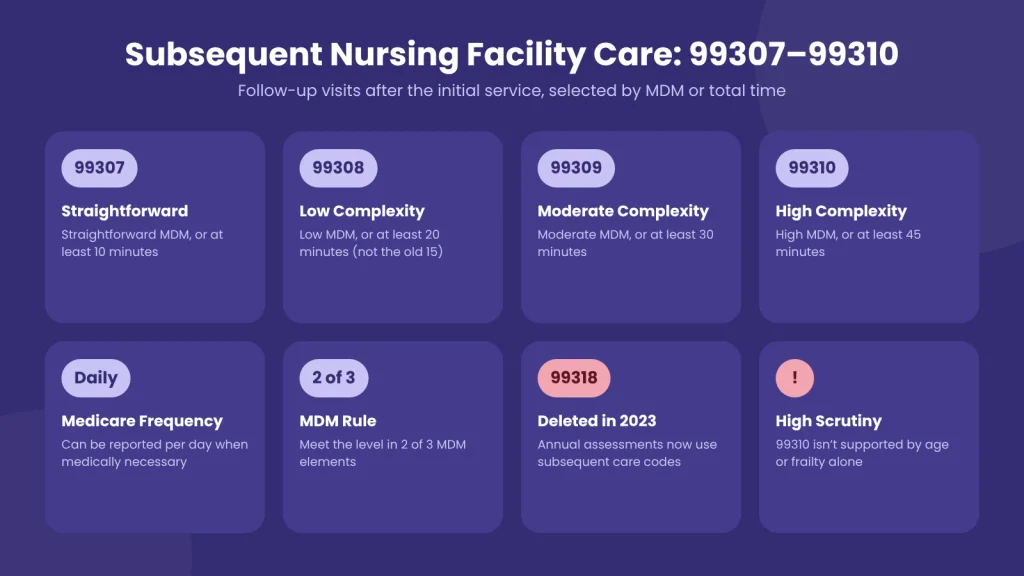
| Code | MDM level | Minimum total time when time is used |
| 99307 | Straightforward | 10 minutes |
| 99308 | Low | 20 minutes |
| 99309 | Moderate | 30 minutes |
| 99310 | High | 45 minutes |
Subsequent visits cover the ongoing work of nursing facility care, including:
- Routine follow-up and monitoring of chronic conditions
- New or worsening conditions during the stay, such as a fall, infection or change in mental status
- Reviewing response to treatment, medication changes and lab results
- Updating the care plan with nursing staff, therapy and family
Medicare allows subsequent nursing facility codes to be reported per day when the visit is medically necessary.
CPT Code 99307 Description
CPT 99307 requires straightforward MDM, or 10 minutes of total time. It fits brief visits for a stable, self-limited or minor problem, such as a quick check of a resolving rash with no change in management.
CPT Code 99308 Description
CPT 99308 requires low MDM, or 20 minutes of total time. It’s often used for follow-up of one stable chronic condition, or an acute, uncomplicated problem, with low-risk management such as over-the-counter medication or minor adjustments.
Some older or secondary resources list 15 minutes for 99308. The current CPT descriptor uses 20 minutes when time is used for code selection.
CPT Code 99309 Description
CPT 99309 requires moderate MDM, or 30 minutes of total time. It’s appropriate for visits managing multiple chronic conditions, a chronic illness with mild exacerbation, or a significant new problem, especially when prescription drug management is involved.
For example, a resident with heart failure who has gained weight and developed new edema, requiring a diuretic adjustment, lab orders and a discussion with nursing staff, may support 99309.
CPT Code 99310 Description
CPT 99310 requires high MDM, or 45 minutes of total time. It’s reserved for complex or unstable situations, such as a resident with sepsis risk, a severe exacerbation of COPD or a sudden decline where the practitioner must decide whether to transfer to the hospital.
99310 is frequently reviewed by payers. It shouldn’t be reported based on the resident’s age, number of diagnoses or general frailty alone.
99304–99310: Key Differences at a Glance
| Feature | Initial care (99304–99306) | Subsequent care (99307–99310) |
| When used | First E/M service by the practitioner (or same-specialty group) during the stay | Follow-up visits after the initial service |
| Frequency (Medicare) | Per Medicare initial-visit rules; verify with MAC | Per day, when medically necessary |
| MDM levels | Straightforward/low, moderate, high | Straightforward, low, moderate, high |
| Time thresholds | 25 / 35 / 50 minutes | 10 / 20 / 30 / 45 minutes |
| Common documentation | Reason for admission, history review, care plan | Interval changes, response to treatment, plan updates |
| Typical scenario | Post-hospital admission with multiple chronic conditions | Monitoring, medication changes, new acute problems |
| Highest level | 99306 | 99310 |
Prolonged services. When the highest-level code (99306 or 99310) is selected based on time and the visit runs well beyond the threshold, a prolonged services add-on may apply. CPT uses 99418, while Medicare uses G0317, with different thresholds. We’ll cover this in the related codes section below.
Nursing Facility Discharge CPT Codes: 99315 and 99316
Discharge management codes describe the practitioner’s work on the day a resident leaves the nursing facility, whether to home, assisted living, another facility or hospice.
Quick answer: CPT 99315 is used for nursing facility discharge management of 30 minutes or less on the date of the encounter. CPT 99316 is used when discharge management takes more than 30 minutes. Both are selected by total time, not MDM.
CPT Code 99315 Description
CPT 99315 reports nursing facility discharge management requiring 30 minutes or less of total time on the date of the encounter. Discharge work can include:
- A final examination of the resident, when performed
- Discussion of the stay with the resident and family
- Instructions for continuing care
- Preparing discharge records, prescriptions and referral forms
- Coordinating with the next care setting
Documentation should describe the discharge-related services provided and, ideally, the total time.
CPT Code 99316 Description
CPT 99316 reports nursing facility discharge management requiring more than 30 minutes of total time. Because the difference between 99315 and 99316 is purely time, the note must clearly document the total time spent on discharge-related work on that date. If the time isn’t documented, payers may only accept 99315.
99315 vs. 99316: What Is the Difference?
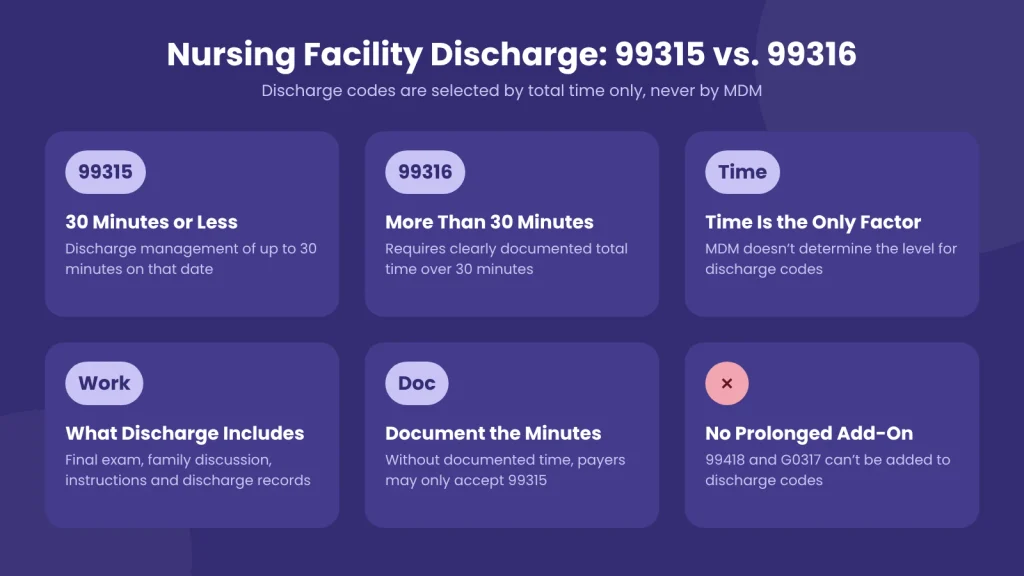
| Feature | CPT 99315 | CPT 99316 |
| Total time | 30 minutes or less | More than 30 minutes |
| Code selection basis | Time | Time |
| MDM used for level? | No | No |
| Key documentation | Discharge services provided | Discharge services plus clearly documented total time over 30 minutes |
| Prolonged services allowed? | No | No |
Unlike initial and subsequent nursing facility codes, discharge codes aren’t leveled by MDM. Prolonged service codes also can’t be added to discharge management.
POS 31 vs. POS 32: Which Place of Service Code Should You Use?
This is one of the most important billing decisions for nursing home visits, and one Medicare now actively edits for.
Quick answer: For Medicare professional claims, use POS 31 when the resident is in a Medicare Part A-covered SNF stay. Use POS 32 when the resident is in a nursing facility, or in a SNF without Part A coverage. The resident’s coverage status, not the facility’s name, determines the POS code.
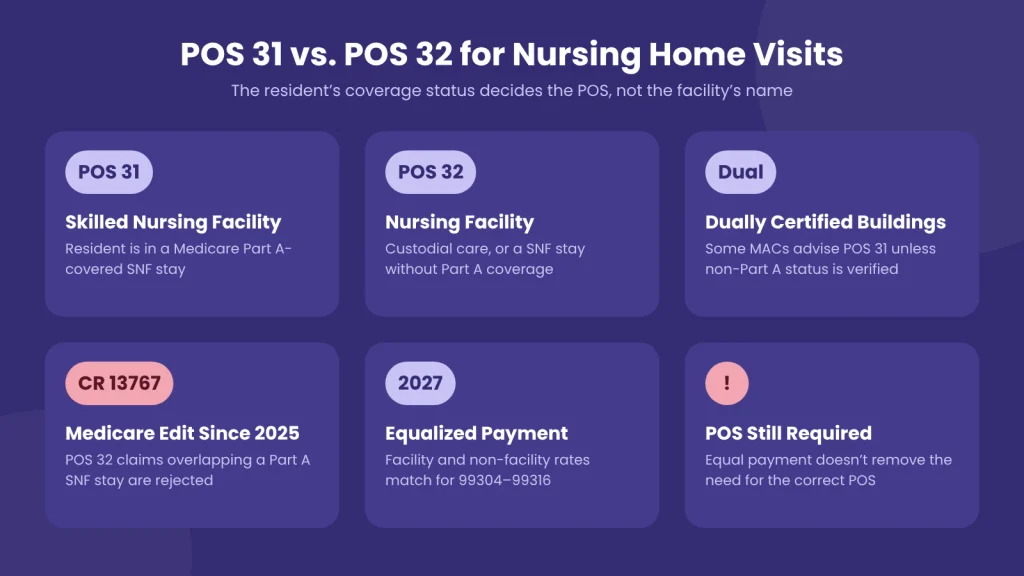
| Place of service | Description | Common Medicare situation |
| POS 31 | Skilled Nursing Facility | Resident is in a Medicare Part A-covered SNF stay |
| POS 32 | Nursing Facility | Resident is in a nursing facility, or in a SNF without Part A coverage (for example, after Part A days are exhausted) |
How POS affects payment, and what changes in 2027: POS 31 and POS 32 identify different Medicare settings and coverage situations. Historically, these settings could result in different physician fee schedule payment rates because POS 31 represented the facility setting and POS 32 the non-facility setting. Beginning January 1, 2027, CMS equalizes the facility and non-facility practice expense RVUs for nursing facility E/M codes 99304–99310, 99315 and 99316 under the CY 2027 Physician Fee Schedule final rule. However, this payment change does not eliminate the requirement to report the correct POS. Practices must still verify the resident’s Medicare Part A coverage status before submitting the claim.
Medicare now edits for POS mismatches. Under CMS implementation of Change Request 13767, effective July 1, 2025, Medicare rejects professional claims reporting POS 32 when they overlap a previously processed covered Part A SNF stay. If a POS 32 claim has already been paid and an overlapping SNF claim is processed later, Medicare may adjust the professional claim. CMS explains this in MLN Matters MM13767.
When to Report POS 31
Report POS 31 when:
- The resident is receiving services during a Medicare Part A-covered SNF stay.
- The resident is in a dually certified facility and you haven’t confirmed that Medicare won’t make a Part A payment. Some MACs advise using POS 31 in mixed SNF/NF buildings unless you’ve verified the stay isn’t Part A-covered.
Before submitting, verify the resident’s admission date, coverage status and any discharge or end-of-coverage date with the facility.
When to Report POS 32
Report POS 32 when:
- The resident is in a nursing facility (custodial or long-term care).
- The resident is in a SNF but doesn’t have Part A coverage, for example because Part A benefits are exhausted, they didn’t have a qualifying stay, or they’re receiving custodial care.
The facility’s name doesn’t decide the POS. A building called “Sunrise Skilled Nursing Center” can have residents in both POS 31 and POS 32 status on the same day.
Common POS 31 and POS 32 Billing Errors
- Reporting POS 32 during a Part A-covered SNF stay
- Choosing the POS from the facility’s name instead of the resident’s coverage status
- Not checking admission and discharge dates, especially at the start and end of a Part A stay
- Not getting coverage updates when a resident’s Part A coverage ends mid-month
- Poor communication between the facility’s billing office and the practice’s billing team
- Assuming that equal 2027 payment rates mean POS no longer matters
Best practice: Set up a regular exchange with each facility, such as a weekly census, that shows which residents are in a Part A stay and when that status changes.
Medicare SNF Certification and Recertification Requirements
It helps to keep two things clearly separate:
- Certification and recertification support Medicare Part A SNF coverage and the facility’s payment. They’re conditions of payment for the SNF’s Part A claim.
- CPT 99304–99310 documentation supports the practitioner’s professional E/M claim.
Certification and recertification aren’t CPT codes. If they’re missing or late, the facility’s payment is at risk, but they’re separate from the practitioner’s visit documentation.
The requirements are set out in 42 CFR 424.20, which governs posthospital SNF care.
Initial SNF Certification Requirements
The initial certification must be obtained at the time of admission, or as soon thereafter as is reasonable and practicable. It confirms that the resident needs, on a daily basis, skilled nursing care or skilled rehabilitation services that can only practically be provided on an inpatient basis in a SNF, for a condition the resident was treated for during the qualifying hospital stay (or that arose while in the SNF for that condition).
Who can sign the certification or recertification:
- The physician responsible for the case, or, with their authorization, a physician on the SNF staff or another physician who knows the case
- A nurse practitioner, clinical nurse specialist or physician assistant who doesn’t have a direct or indirect employment relationship with the facility, and who is working in collaboration with a physician
SNF Recertification Timeline
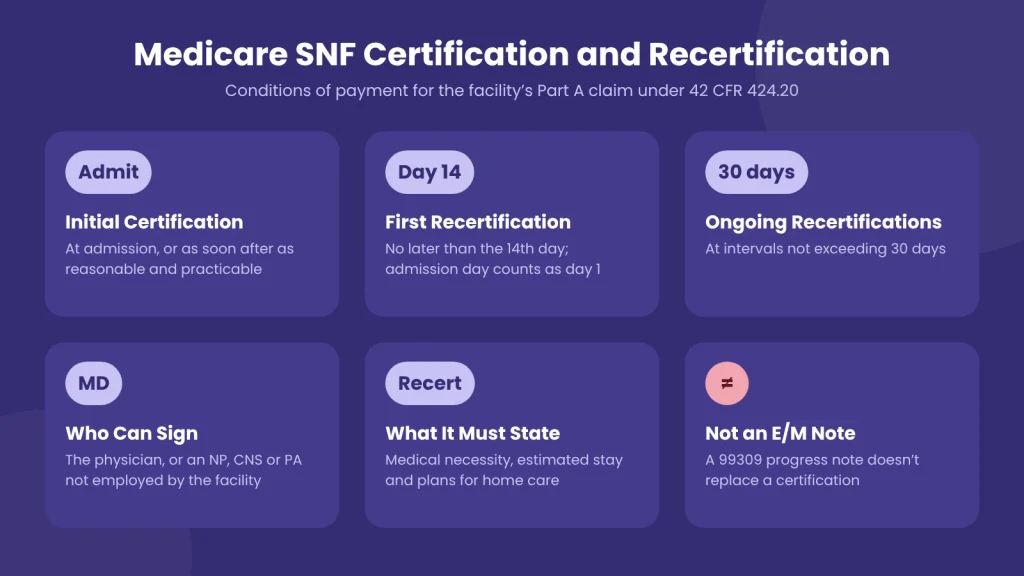
| Requirement | Timing |
| Initial certification | At admission, or as soon after as reasonable and practicable |
| First recertification | No later than the 14th day of posthospital SNF care |
| Subsequent recertifications | At intervals not exceeding 30 days |
Facilities may recertify more often if they choose. A common counting error is forgetting that the day of admission counts as day 1 toward the 14-day deadline.
Facilities should keep a tracking system for due dates, especially when residents leave and return, because interrupted stays can reset or shift the schedule.
What Should SNF Recertification Documentation Include?
Recertification needs more information than the initial certification. It should state:
- Why continued SNF care is medically necessary
- The estimated length of continued stay
- Plans for home care, if any
- When applicable, that the resident needs continued care for a condition that developed during the SNF stay
Medicare doesn’t require a specific form. Contractors look at whether the required content is present, signed and dated on time, not whether a particular template was used.
Common Certification and Recertification Errors
- Missing or late initial certification
- Missed 14-day or 30-day recertification deadlines
- Incomplete medical necessity statements
- Missing signatures, dates or credentials
- Signatures by an NP, CNS or PA who is employed by the facility
- Treating an E/M progress note as if it were the certification
That last point is important. A 99309 progress note documents the practitioner’s visit. It doesn’t automatically satisfy the certification requirement, and a certification statement doesn’t replace E/M documentation. Each has its own purpose.
SNF Consolidated Billing and Physician Services
SNF consolidated billing (CB) means the SNF is responsible for billing Medicare for most services its residents receive during a Part A-covered stay, including many services furnished by outside providers. Those services are paid through the SNF’s per-diem payment, not separately.
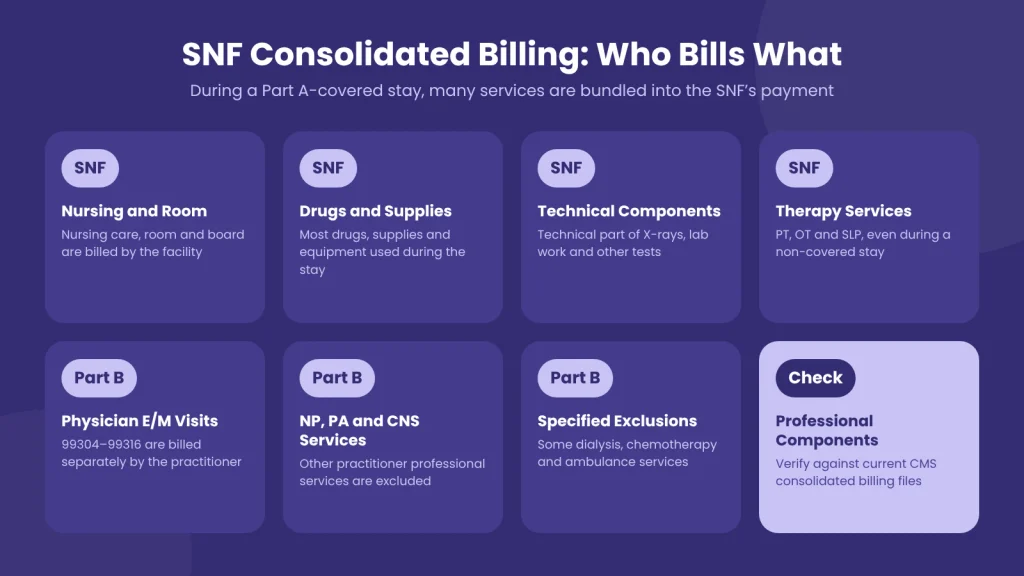
Services generally included in consolidated billing:
- Nursing care, room and board
- Most drugs, supplies and medical equipment used during the stay
- Technical components of many diagnostic tests, such as the technical part of X-rays and lab work
- Physical, occupational and speech-language therapy (these remain subject to consolidated billing even during a non-covered stay)
Services generally excluded from consolidated billing, and billed separately:
- Physician professional services, including nursing facility E/M visits (99304–99316)
- Services of certain other practitioners, such as NPs, CNSs, PAs, certified nurse-midwives, qualified psychologists and certified registered nurse anesthetists
- Certain specified exclusions, such as some dialysis services, some chemotherapy and certain ambulance and outpatient hospital services
Diagnostic tests need extra care. Physician professional services are generally excluded from SNF consolidated billing and may be billed separately to Medicare Part B. However, diagnostic services can have separate professional and technical components. The technical component is generally included in consolidated billing during a covered Part A stay, while certain professional components may be separately billable when they meet CMS exclusion requirements. Verify the applicable service against the current CMS consolidated billing files before submitting a separate claim.
Because the include and exclude lists are updated regularly, practices should check the current CMS consolidated billing files before billing separately for anything other than professional E/M services.
PDPM and ICD-10 Mapping: How It Differs From Nursing Home CPT Coding
The Patient Driven Payment Model (PDPM) is how Medicare pays SNFs for Part A-covered stays. PDPM uses ICD-10-CM diagnosis information, including the primary reason for the SNF stay, to assign the resident to a clinical category and payment group. You’ll often see searches for PDPM ICD-10 mapping, including aftercare codes like Z47.89, because the facility’s diagnosis selection affects its PDPM classification.
CPT 99304–99310, on the other hand, describes the practitioner’s professional E/M services. The two systems serve different billing purposes:
| PDPM | Nursing facility CPT codes | |
| Who uses it | The SNF | The physician or QHP |
| What it determines | Facility’s Part A per-diem payment | Professional E/M payment |
| Main inputs | ICD-10-CM diagnoses, MDS assessment data | MDM or total time |
| Claim type | Institutional claim (UB-04 / 837I) | Professional claim (CMS-1500 / 837P) |
A PDPM clinical category should not be treated as a substitute for selecting a professional CPT code. The practitioner’s diagnosis codes should reflect the conditions addressed at their visit, not the facility’s PDPM grouping.
Other CPT and HCPCS Codes Related to Nursing Home and Facility Care
Several other codes come up in nursing home and long-term care billing. Some are closely related, and others are often confused with nursing facility visit codes.
CPT 99418 and Prolonged Nursing Facility Services
When the highest-level nursing facility code is selected by time and the practitioner spends significantly more time than the code requires, a prolonged services add-on may apply. CPT and Medicare handle this differently:
| Payer | Prolonged code | Base code | First unit threshold |
| CPT / applicable commercial payers | 99418 | 99306 | 65 minutes |
| CPT / applicable commercial payers | 99418 | 99310 | 60 minutes |
| Medicare | G0317 | 99306 | 95 minutes |
| Medicare | G0317 | 99310 | 85 minutes |
A few rules apply to both:
- Prolonged services can only be added when the base code was selected using time, not MDM.
- They can’t be reported with discharge management codes (99315, 99316).
- CPT 99418 counts time on the date of the encounter. Medicare’s G0317 uses its own time-counting rules, including practitioner time from one day before the visit through three days after it.
- Medicare doesn’t pay 99418 for nursing facility services, and some commercial payers don’t recognize G0317. Confirm payer-specific coverage before reporting either add-on.
Assisted Living Facility CPT Codes
Assisted living facilities aren’t nursing facilities, so 99304–99310 don’t apply. Visits to residents in assisted living are generally reported with home or residence E/M codes, with POS 13 (assisted living facility):
- New patient: 99341, 99342, 99344, 99345
- Established patient: 99347, 99348, 99349, 99350
For example:
- 99344 is a new patient home or residence visit with moderate MDM, or 60 minutes of total time.
- 99349 is an established patient home or residence visit with moderate MDM, or 40 minutes of total time.
Since 2023, the old domiciliary and rest home codes have been merged into this home or residence family. These codes aren’t part of the nursing facility code set and shouldn’t be used for nursing home residents.
Home Health and Skilled Nursing Codes: G0299 and 99509
Two codes are often confused with nursing facility services because they include words like “skilled nursing” or “home”:
- G0299 is a HCPCS code for direct skilled nursing services of a registered nurse in the home health or hospice setting, reported in 15-minute increments. It’s billed by home health or hospice agencies, not by practitioners rounding in a nursing home.
- CPT 99509 describes a home visit for assistance with activities of daily living and personal care. It’s a home care service code, not a physician E/M code.
Neither code replaces 99304–99310, and neither should appear on a practitioner’s claim for a nursing facility visit.
Other Related Codes That Should Not Be Confused With Nursing Facility Visits
These codes may appear in nursing home billing in some situations, but they aren’t nursing facility E/M visits:
| Code | What it describes |
| 99446 | Interprofessional telephone/internet/EHR consultation by a consultant (5–10 minutes) |
| 99408 | Alcohol and/or substance (other than tobacco) use structured screening and brief intervention, 15–30 minutes |
| 99367 / 99368 | Medical team conference without the patient present, by a physician (99367) or nonphysician QHP (99368) |
| 99360 | Physician standby service, each 30 minutes |
| 99080 | Special reports, such as insurance forms, beyond usual medical communications |
| 99499 | Unlisted evaluation and management service |
Use these only when the specific service was performed and documented, and check payer coverage. Many have limited or no Medicare payment.
Nursing Home CPT Coding and Documentation Guidelines
Before any nursing facility claim goes out, the practitioner’s note should clearly support the code, the POS and medical necessity. These skilled nursing facility coding guidelines apply to every visit level.
Essential Documentation for Initial and Subsequent Visits
Strong nursing facility documentation usually includes:
- Chief complaint and reason for the visit. For example, “post-hospital admission for CHF exacerbation” or “nursing reports new confusion.”
- A medically appropriate history and examination.
- The conditions assessed and managed, with their status (stable, improving, worsening).
- MDM details: data reviewed (labs, imaging, hospital records), conversations with staff or other providers, and the risk of management decisions.
- Medication and treatment changes, with the reason for each.
- Care coordination, such as discussions with nursing, therapy, the family or the hospital team.
- Total time, when time is used to select the level, with a summary of the activities on that date.
How to Select the Correct Nursing Facility E/M Level
- Identify initial vs. subsequent care. Apply the CPT rule and check Medicare’s initial-visit rules for the practitioner type.
- Review the MDM level. Which two of the three elements are met, and at what level?
- If selected by time, confirm the total qualifying time on the date of the encounter meets the threshold (for example, 50 minutes for 99306 or 20 minutes for 99308).
- Choose the stronger pathway. Use MDM or time, whichever the documentation better supports.
- Verify the code descriptor and payer rules, including POS and any frequency limits.
- Don’t pick a higher level just because the visit was long or the resident has many diagnoses.
Telehealth note: Medicare telehealth flexibilities have been extended through December 31, 2027, and CMS has permanently removed the frequency limits that once applied to subsequent nursing facility telehealth visits. Payer rules still vary, so check each policy. Our guide to telehealth billing in 2026 covers POS codes and modifiers.
Common Nursing Home CPT Coding Mistakes

- Reporting an initial visit code for a subsequent encounter. This is especially common when a second practitioner in the same group sees the resident.
- Choosing 99308 or 99309 without enough MDM or time support. Remember that 99308 now requires 20 minutes when billed by time.
- Reporting 99306 or 99310 based on age or number of diagnoses rather than documented high MDM or the required time (50 or 45 minutes).
- Using POS 32 during a Part A-covered SNF stay.
- Confusing nursing facility E/M services with home health services, such as billing G0299 or 99509 for a nursing home visit.
- Missing discharge management documentation, especially the total time needed for 99316.
- Failing to complete certification or recertification on time.
- Billing services separately that fall under SNF consolidated billing, such as therapy or technical components during a covered stay.
- Using deleted codes or outdated time values, such as 99318, or the older 45- and 15-minute values for 99306 and 99308.
How Accurate Nursing Home CPT Coding Affects Reimbursement
Nursing facility billing errors don’t just affect one claim. They tend to repeat across every resident a practitioner sees, which makes them expensive.
- Incorrect E/M level selection. Undercoding 99309 visits as 99308 leaves revenue on the table every week. Overcoding 99310 invites audits and repayments.
- POS errors. POS 32 claims that overlap a Part A stay are now rejected or adjusted automatically, which creates rework and delays. That’s still true in 2027, even with equalized payment rates.
- Missing documentation. Visits without clear MDM or time support can be downcoded or denied on review.
- Certification and recertification gaps. These put the facility’s entire Part A payment at risk and can strain the relationship between the practice and the facility.
- Consolidated billing mistakes. Services billed to Medicare that should have gone to the SNF are denied, and the practice then has to bill the facility separately.
- Rejections, denials and delayed payments. Each one adds days to accounts receivable.
- Administrative cost. Every correction, resubmission and appeal takes staff time that could have been prevented.
A regular medical billing audit helps practices catch these patterns early. When claims are denied, a structured denial management process identifies the root cause, whether it’s POS, documentation or coverage, and fixes it at the source.
How iSolve RCM Helps Improve Nursing Home and SNF Billing Accuracy
Nursing facility billing requires coordination between the practitioner, the facility and the billing team. iSolve RCM supports practices that round in nursing homes and SNFs with:
- Nursing facility and SNF E/M coding review. Certified coders check 99304–99316 coding against current CPT and Medicare rules through our medical coding services.
- CPT and POS accuracy checks. We verify POS 31 vs. POS 32 against resident coverage status before claims go out.
- Claim submission and follow-up. Clean claims submitted on time, with edits and scrubbing for consolidated billing conflicts.
- Documentation and medical necessity reviews. Gaps in MDM, time or discharge documentation are flagged before submission.
- Denial management and appeals. Denied claims are corrected, resubmitted or appealed with supporting records.
- A/R follow-up and payment posting. Dedicated accounts receivable management keeps unpaid claims moving.
- Ongoing revenue cycle management. End-to-end support through our revenue cycle management services.
We also provide specialty-focused nursing home billing services for long-term and skilled care, and hospice billing services for practices that care for residents at the end of life. You can explore all the healthcare specialties we support. If you’re deciding whether to keep billing in-house, our guide to in-house vs. outsourced medical billing compares the costs and trade-offs.

Frequently Asked Questions About Nursing Home CPT Codes
What CPT codes are used for nursing home visits?
Nursing home visits are reported with CPT 99304–99306 for initial nursing facility care, 99307–99310 for subsequent nursing facility care and 99315–99316 for discharge management. The level is based on medical decision making or total time, except discharge codes, which are based on time only.
What is the difference between CPT codes 99304 and 99305?
Both are initial nursing facility care codes. CPT 99304 requires straightforward or low MDM, or 25 minutes of total time. CPT 99305 requires moderate MDM, or 35 minutes. 99305 is typically used for post-hospital admissions with multiple active conditions and prescription drug management.
What is CPT code 99306 used for?
CPT 99306 is the highest-level initial nursing facility care code. It’s used when the practitioner’s initial visit during the stay involves high-complexity MDM, such as a severe exacerbation or a high-risk decision, or at least 50 minutes of total time on the date of the encounter.
What is CPT code 99308 used for?
CPT 99308 is a subsequent nursing facility care code for low-complexity MDM, or at least 20 minutes of total time. It’s often used for follow-up of a stable chronic condition or a minor acute problem with low-risk management.
What is the difference between CPT 99309 and 99310?
Both are subsequent nursing facility care codes. CPT 99309 requires moderate MDM or 30 minutes of total time. CPT 99310 requires a high MDM of 45 minutes. 99310 is reserved for complex or unstable situations, such as deciding whether to rehospitalize a resident.
What is the difference between POS 31 and POS 32?
POS 31 means Skilled Nursing Facility and is used for Medicare when the resident is in a Part A-covered SNF stay. POS 32 means Nursing Facility and is used for nursing facility residents or SNF residents without Part A coverage. Even with equalized 2027 payment rates, the correct POS must still be reported.
Can CPT 99304–99310 be used for skilled nursing facilities?
Yes. CPT 99304–99310 are nursing facility E/M codes used in both skilled nursing facilities and nursing facilities, as long as the service meets the code requirements. The POS code (31 or 32), not the CPT code, reflects whether the resident is in a Part A-covered skilled stay.
What CPT code is used for nursing home discharge?
Nursing facility discharge management is reported with CPT 99315 when it takes 30 minutes or less, or CPT 99316 when it takes more than 30 minutes. Both are selected by total time on the date of the encounter, and the documentation should describe the discharge services provided.
What is the difference between CPT 99315 and 99316?
The only difference is time. CPT 99315 covers nursing facility discharge management of 30 minutes or less, and CPT 99316 covers more than 30 minutes. Because the level depends entirely on time, 99316 requires clear documentation of total time spent on discharge-related work.
How often does Medicare require SNF recertification?
For posthospital SNF care, the first recertification is required no later than the 14th day of the stay, and subsequent recertifications are required at intervals not exceeding 30 days. Recertifications must state the medical necessity of continued care, the estimated length of stay and any home care plans.
Are physician services included in SNF consolidated billing?
Generally, no. Physician professional services, including nursing facility E/M visits, are excluded from SNF consolidated billing and billed separately to the Part B MAC. Technical components of diagnostic tests and most therapy services are included and billed by the SNF. Some professional components must be checked against CMS files.
What CPT codes are used for assisted living facility visits?
Assisted living visits are generally reported with home or residence E/M codes: 99341–99345 for new patients and 99347–99350 for established patients, usually with POS 13. Nursing facility codes 99304–99310 don’t apply to assisted living residents.
Is G0299 a nursing home CPT code?
No. G0299 is a HCPCS code for direct skilled nursing services by a registered nurse in the home health or hospice setting, reported per 15 minutes. It’s billed by home health or hospice agencies and shouldn’t be used for physician or NPP visits in a nursing home.
Conclusion
Accurate nursing home CPT codes come down to a few key decisions. Is the visit initial, subsequent or a discharge? Does the documentation support the level through MDM or total time? Is the resident in a Part A-covered SNF stay (POS 31), or in a nursing facility or non-covered stay (POS 32)? And has the facility completed its certification and recertification on time?
The 99304–99310 family covers both skilled and non-skilled nursing facility care, with clear MDM and time thresholds for each level: 25, 35 and 50 minutes for initial care, and 10, 20, 30 and 45 minutes for subsequent care. 99315 and 99316 cover discharge based on time alone. POS 31 vs. POS 32 depends on the resident’s coverage, not the building’s name. Medicare still rejects mismatches automatically, even though 2027 payment rates are equalized. Certification and recertification are separate coverage requirements that protect the facility’s payment, not substitutes for the practitioner’s visit note.
If your practice is seeing nursing facility denials, POS rejections or slow payments, iSolve RCM can help. Our team reviews your coding, documentation and claim workflow to find where revenue is slipping and how to fix it.