Neuropathy is one of those diagnoses that shows up across almost every specialty. Primary care sees it, endocrinology manages it, neurology works it up, oncology tracks it during chemotherapy, and podiatry treats its effects on the feet. Because so many providers document it in so many different ways, it’s also one of the most commonly miscoded diagnoses in medical billing.
The problem isn’t that the codes are hard to find. It’s that “neuropathy” can mean many different things. It might be diabetic polyneuropathy, an idiopathic peripheral neuropathy, chemotherapy-induced nerve damage, a single compressed nerve, or simply nerve pain with no confirmed neuropathy at all. Each of these maps to a different part of ICD-10-CM, and picking the wrong one can lead to claim rejections, medical necessity denials or inaccurate patient records.
In this guide, we’ll walk through the most commonly used neuropathy ICD-10 codes, explain how to tell them apart, and show what documentation each one needs.
Quick answer: The most common neuropathy ICD-10-CM codes are G62.9 (polyneuropathy, unspecified), G60.9 (hereditary and idiopathic neuropathy, unspecified), G62.89 (other specified polyneuropathies) and E11.40–E11.42 for neuropathy caused by type 2 diabetes. The correct code always depends on the provider’s documented diagnosis, the type of neuropathy and its underlying cause.
Commonly Used Neuropathy ICD-10 Codes

| Condition | ICD-10-CM Code |
| Polyneuropathy, unspecified | G62.9 |
| Other specified polyneuropathies | G62.89 |
| Drug-induced polyneuropathy | G62.0 |
| Alcoholic polyneuropathy | G62.1 |
| Hereditary and idiopathic neuropathy, unspecified | G60.9 |
| Other hereditary and idiopathic neuropathies | G60.8 |
| Idiopathic progressive neuropathy | G60.3 |
| Hereditary motor and sensory neuropathy (e.g., Charcot-Marie-Tooth) | G60.0 |
| Type 2 diabetes mellitus with diabetic neuropathy, unspecified | E11.40 |
| Type 2 diabetes mellitus with diabetic mononeuropathy | E11.41 |
| Type 2 diabetes mellitus with diabetic polyneuropathy | E11.42 |
| Type 2 diabetes mellitus with diabetic autonomic (poly)neuropathy | E11.43 |
| Neuralgia and neuritis, unspecified | M79.2 |
| Mononeuropathy, unspecified | G58.9 |
Always verify code descriptions, billable status and instructional notes against the current fiscal-year ICD-10-CM code set before submitting claims. The FY 2027 code set is effective for dates of service from October 1, 2026, through September 30, 2027.

What Is the ICD-10 Code for Neuropathy?
Quick answer: There’s no single ICD-10 code for “neuropathy.” When a provider documents polyneuropathy or peripheral neuropathy without further detail, G62.9 is commonly used. When the neuropathy is documented as idiopathic, G60.9 applies. When a cause is documented, such as diabetes or chemotherapy, a more specific code is required.
In ICD-10-CM, most neuropathy codes live in Chapter 6: Diseases of the Nervous System (G00–G99), specifically in the block for polyneuropathies and other disorders of the peripheral nervous system (G60–G65). The main categories are:
- G60: Hereditary and idiopathic neuropathy
- G61: Inflammatory polyneuropathy (such as Guillain-Barré syndrome and CIDP)
- G62: Other and unspecified polyneuropathies (including drug-induced, alcoholic, toxic and unspecified)
- G63: Polyneuropathy in diseases classified elsewhere
- G64: Other disorders of the peripheral nervous system
- G65: Sequelae of inflammatory and toxic polyneuropathies
Mononeuropathies, which affect a single nerve, sit in G56–G59. And when neuropathy is caused by diabetes, the code comes from the diabetes categories (E08–E13) in Chapter 4, not from Chapter 6.
It’s important to understand that unspecified and specified codes are not interchangeable. G62.9 means the provider documented polyneuropathy but didn’t specify its type or cause. If the record says “diabetic polyneuropathy,” “alcoholic polyneuropathy” or “chemotherapy-induced neuropathy,” using G62.9 instead of the specific code is a coding error, even though the patient does have polyneuropathy.
ICD-10 Code for Peripheral Neuropathy
Peripheral neuropathy refers to damage to the nerves outside the brain and spinal cord. Patients commonly describe numbness, tingling, burning, or a “pins and needles” feeling, usually starting in the feet and sometimes spreading to the hands. Clinicians may describe it as a “stocking-glove” pattern, distal symmetric polyneuropathy or length-dependent neuropathy.
Quick answer: When a provider documents peripheral neuropathy without any further specification of type or cause, the Alphabetic Index directs coders to G62.9, Polyneuropathy, unspecified.
The key phrase is “without further specification.” Peripheral neuropathy is not a single code. It’s a description that leads to different codes depending on what else the provider documents. That’s why the provider’s wording matters so much:
- “Peripheral neuropathy” alone → G62.9
- “Idiopathic peripheral neuropathy” → G60.9
- “Diabetic peripheral neuropathy” in a type 2 diabetic → E11.42
- “Peripheral neuropathy due to alcohol use” → G62.1, plus the appropriate alcohol-related code
- “Peripheral neuropathy due to chemotherapy” → G62.0, plus the adverse effect code

Peripheral Polyneuropathy ICD-10
Polyneuropathy means many peripheral nerves are affected, usually in a symmetric pattern. This is different from mononeuropathy, which involves a single nerve, such as the median nerve in carpal tunnel syndrome.
Most “peripheral neuropathy” diagnoses in clinical practice are actually polyneuropathies, which is why the index sends unspecified peripheral neuropathy to the G62 category. Within that category:
- G62.0: Drug-induced polyneuropathy
- G62.1: Alcoholic polyneuropathy
- G62.2: Polyneuropathy due to other toxic agents
- G62.81: Critical illness polyneuropathy
- G62.82: Radiation-induced polyneuropathy
- G62.89: Other specified polyneuropathies
- G62.9: Polyneuropathy, unspecified
G62.89 is used when the provider documents a specific type of polyneuropathy that doesn’t have its own code. G62.9 is the true “unspecified” option, used only when the record doesn’t give enough detail for anything more specific.
Idiopathic Peripheral Neuropathy ICD-10
“Idiopathic” means no cause has been identified, even after a workup. Many patients with peripheral neuropathy fall into this group, especially older adults whose labs and history don’t point to diabetes, alcohol, toxins or another clear cause.
When the provider documents idiopathic neuropathy or idiopathic peripheral neuropathy without further detail, G60.9, Hereditary and idiopathic neuropathy, unspecified, is typically used. Other codes in this category include:
- G60.0: Hereditary motor and sensory neuropathy, which includes Charcot-Marie-Tooth disease and Déjérine-Sottas disease
- G60.1: Refsum’s disease
- G60.2: Neuropathy in association with hereditary ataxia
- G60.3: Idiopathic progressive neuropathy
- G60.8: Other hereditary and idiopathic neuropathies
One common mistake is treating “idiopathic” and “unspecified” as the same thing. They’re not. “Idiopathic” is a clinical conclusion that no cause was found. “Unspecified” means the documentation simply doesn’t say. If the provider writes “peripheral neuropathy” without mentioning that the cause is unknown, coders shouldn’t assume it’s idiopathic and assign G60.9.
Peripheral Neuropathy in the Feet ICD-10
Many providers document neuropathy by location, such as “neuropathy of both feet” or “bilateral foot neuropathy.” This is especially common in podiatry and wound care.
Here’s the key point: there’s no separate ICD-10 code for polyneuropathy of the feet. The body area alone doesn’t determine the code. A symmetric neuropathy affecting the feet is still coded based on its type and cause, such as G62.9, G60.9 or E11.42.
Location does matter in a few situations:
- Mononeuropathies of the lower limb (G57.-) have specific codes, many with laterality. Examples include tarsal tunnel syndrome and Morton’s neuroma (a plantar nerve lesion).
- Diabetic foot complications, such as a diabetic foot ulcer, need their own codes in addition to the neuropathy code.
- Symptom codes such as R20.2 (paresthesia of skin) or R20.0 (anesthesia of skin) apply only when no definitive diagnosis has been documented.
Diabetic Neuropathy ICD-10 Codes
Diabetic neuropathy is one of the most common complications of diabetes, and one of the most frequently coded neuropathy diagnoses. It’s also where coders need to understand a few important ICD-10-CM conventions.
Quick answer: Diabetic neuropathy is coded with a combination code from the diabetes category that matches the patient’s type of diabetes. For type 2 diabetes, that’s E11.40 (diabetic neuropathy, unspecified), E11.41 (mononeuropathy), E11.42 (polyneuropathy), E11.43 (autonomic neuropathy), E11.44 (amyotrophy) or E11.49 (other diabetic neurological complication).

What makes diabetic neuropathy coding different?
1. Combination codes. A single code describes both diabetes and neuropathy. You don’t report E11.9 (type 2 diabetes without complications) plus G62.9. You report one code, such as E11.42, that captures both.
2. The “with” convention. Under the ICD-10-CM Official Guidelines, conditions listed under “with” in the Alphabetic Index are presumed to be linked. Neuropathy and polyneuropathy appear under “Diabetes, with,” so a causal relationship is assumed when both conditions are documented, unless the provider clearly states the neuropathy is due to something else, such as chemotherapy or alcohol.
3. Diabetes type matters. The category changes with the type of diabetes:
| Diabetes type | Category | Example: diabetic polyneuropathy |
| Type 1 | E10.4- | E10.42 |
| Type 2 | E11.4- | E11.42 |
| Due to underlying condition | E08.4- | E08.42 |
| Drug or chemical induced | E09.4- | E09.42 |
| Other specified diabetes | E13.4- | E13.42 |
If the type of diabetes isn’t documented, the guidelines direct coders to default to type 2 (E11).
4. Medication codes. Additional codes are used to show long-term insulin use, oral hypoglycemic use or injectable non-insulin antidiabetic drug use (Z79.4, Z79.84, Z79.85), following the current guidelines on which to report.
Type 2 Diabetes With Neuropathy ICD-10
E11.40, Type 2 diabetes mellitus with diabetic neuropathy, unspecified, is used when the provider documents diabetic neuropathy in a type 2 diabetic but doesn’t specify which kind.
E11.40 is valid, but it’s often used when a more specific code is supported. E11.42 should be assigned when the provider’s documentation and applicable ICD-10-CM Index guidance support diabetic polyneuropathy. Bilateral numbness, tingling or symptoms affecting both feet should not automatically be treated as proof of polyneuropathy. If the provider documents diabetic neuropathy without specifying its type, E11.40 may be appropriate. Coders should review the full note, not just the problem list, and query the provider when the type of neuropathy isn’t clear.
Diabetic Peripheral Neuropathy ICD-10
“Diabetic peripheral neuropathy,” often abbreviated as DPN, is one of the most common phrases in diabetic documentation. Clinically, it usually refers to distal symmetric polyneuropathy.
When a type 2 diabetic patient has documented diabetic peripheral neuropathy, the code is generally E11.42, Type 2 diabetes mellitus with diabetic polyneuropathy. For a type 1 diabetic, it’s E10.42.
Don’t add G62.9 alongside E11.42. The combination code already includes polyneuropathy.
Diabetes With Diabetic Polyneuropathy ICD-10
The difference between E11.40 and E11.42 comes down to specificity:
- E11.40: The provider documents diabetic neuropathy but doesn’t say what type.
- E11.42: The provider documents diabetic polyneuropathy, or diabetic peripheral neuropathy affecting multiple nerves.
Other diabetic neuropathy codes cover different presentations:
- E11.41: Diabetic mononeuropathy, a single nerve affected by diabetes
- E11.43: Diabetic autonomic (poly)neuropathy, such as diabetic gastroparesis or neurogenic bladder
- E11.44: Diabetic amyotrophy
- E11.49: Other diabetic neurological complication
The rule is simple: select the most specific code the documentation supports. E11.40 should be the exception, not the default.
Neuropathic Pain ICD-10 Codes
Neuropathic pain is pain caused by damage or dysfunction in the nervous system. Patients often describe it as burning, shooting, electric or stabbing, and it frequently comes with numbness or tingling.
Quick answer: There’s no single “neuropathic pain” code. When a provider documents nerve pain, neuralgia or neuritis without a more specific diagnosis, M79.2, Neuralgia and neuritis, unspecified, is commonly used. When an underlying neuropathy is documented, code that condition. Chronic pain codes from category G89 apply only in specific situations.
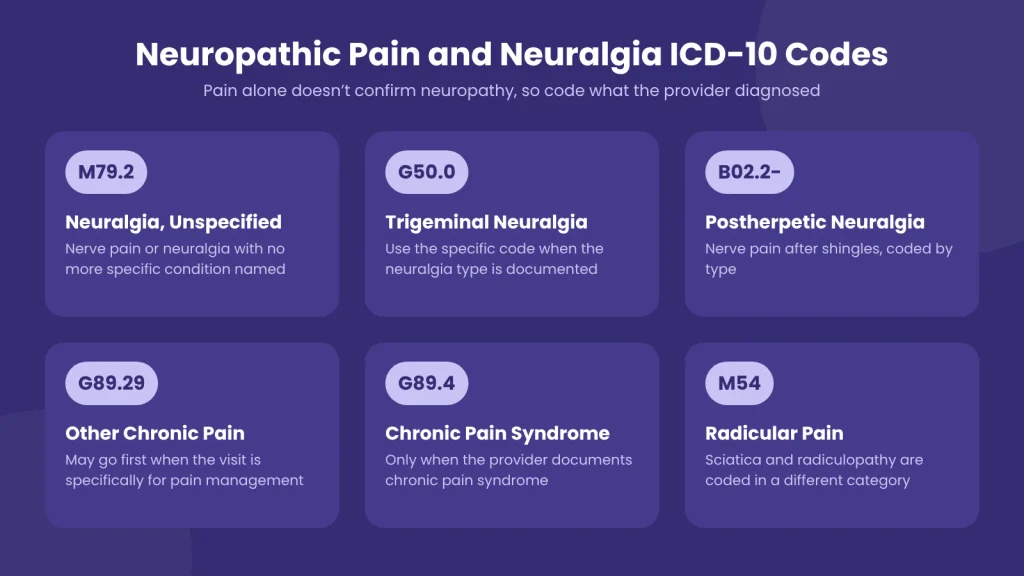
It’s important to separate two things:
- A pain symptom. For example, “burning pain in both feet.”
- A diagnosed neuropathy. For example, “diabetic polyneuropathy causes burning pain.”
If the provider has diagnosed the neuropathy, the neuropathy code captures the condition. Pain alone doesn’t confirm a neuropathy, and a pain code shouldn’t replace a documented neuropathy diagnosis.
ICD-10 Code for Nerve Pain
When the provider documents “nerve pain” or “neuralgia” and no more specific nerve condition is identified, M79.2 is generally used. It’s a billable code in Chapter 13 (Diseases of the Musculoskeletal System and Connective Tissue).
A few points to keep in mind:
- M79.2 is an unspecified code. If the provider names a specific neuralgia, such as trigeminal or postherpetic neuralgia, use that code instead.
- If the record documents an established neuropathy diagnosis, a nerve pain symptom code shouldn’t automatically replace it.
- Radicular pain from a spinal nerve root, such as sciatica or radiculopathy, is coded differently, usually in the M54 category.
Neuralgia ICD-10 Code
Neuralgia is pain along the path of a specific nerve. It’s different from peripheral neuropathy, which is nerve damage that may or may not cause pain. Code selection depends on the specific type:
| Neuralgia type | ICD-10-CM code |
| Trigeminal neuralgia | G50.0 |
| Postherpetic neuralgia (after shingles) | B02.2- (by type) |
| Neuralgia and neuritis, unspecified | M79.2 |
Coders shouldn’t treat “neuralgia” and “neuropathy” as synonyms. A patient can have neuropathy without neuralgia, neuralgia without neuropathy, or both, and the documentation should make clear which one the provider is treating.
Chronic Neuropathic Pain ICD-10
Chronic pain codes in category G89 follow specific ICD-10-CM guidelines. Codes from category G89 may be used with other diagnosis codes to provide additional information about acute or chronic pain when the ICD-10-CM guidelines allow it. However, when a definitive underlying diagnosis is known, a G89 code generally should not be assigned unless the encounter is specifically for pain control or pain management rather than treatment of the underlying condition.
When pain management is the primary reason for the encounter, the appropriate G89 code may be sequenced first, with the underlying condition reported as an additional diagnosis when known. G89.4 (chronic pain syndrome) should only be assigned when the provider specifically documents chronic pain syndrome, not simply chronic pain.
For example:
- A patient with diabetic polyneuropathy seen for diabetes management → E11.42.
- The same patient referred to a pain clinic specifically for chronic neuropathic pain management → G89.29 (other chronic pain) may be sequenced first, followed by E11.42, when documentation supports it.
Pain management coding has more sequencing rules than most specialties, so it’s worth confirming against the current guidelines.
Other Types of Neuropathy and Their ICD-10 Codes
Small Fiber Neuropathy ICD-10
Small fiber neuropathy (SFN) affects the small nerve fibers that carry pain, temperature and autonomic signals. Patients often have burning pain in the feet, sometimes with autonomic symptoms, while standard nerve conduction studies are normal. Diagnosis is usually confirmed with a skin punch biopsy showing reduced intraepidermal nerve fiber density, or with other specialized testing.
ICD-10-CM does not provide a dedicated code specifically titled small fiber neuropathy. Code selection should follow the provider’s documented diagnosis, the Alphabetic Index and the Tabular List. Depending on the documented cause and classification, a code from the applicable diabetic neuropathy, hereditary and idiopathic neuropathy, or other specified polyneuropathy category may be appropriate.
Do not automatically assign G60.8, G60.3 or G62.89 solely because the provider documents small fiber neuropathy. When the correct classification is unclear, consult applicable Coding Clinic guidance or seek clarification.
Because there’s no single answer, practices should follow the Alphabetic Index, check AHA Coding Clinic guidance and apply the same approach consistently. Documenting the cause and the test results (such as skin biopsy findings) is especially important for SFN claims.
Chemotherapy-Induced Neuropathy ICD-10
Chemotherapy-induced peripheral neuropathy (CIPN) is a common side effect of drugs like platinum agents, taxanes, vinca alkaloids and bortezomib. It’s coded as an adverse effect of a drug that was correctly prescribed and properly taken.
The usual coding approach is:
- G62.0, Drug-induced polyneuropathy, to describe the nature of the adverse effect, plus
- Report the appropriate adverse-effect code from the T36–T50 category based on the specific drug involved and the current ICD-10-CM Table of Drugs and Chemicals. T45.1X5- may apply to adverse effects of antineoplastic and immunosuppressive drugs, but coders should verify the applicable drug classification and required seventh character instead of assuming that the same T code applies to every chemotherapy agent, with the appropriate seventh character for the encounter (A, D or S).
- The cancer diagnosis code, if it’s still being treated or monitored, sequenced according to the encounter and guidelines.
G62.0 includes a “use additional code” note to identify the drug. Under the guidelines for adverse effects, the nature of the adverse effect (G62.0) is sequenced first, followed by the T code.
Common mistakes include coding only G62.9 without identifying the drug, leaving out the T45.1X5- code, or using a poisoning code instead of an adverse effect code.
Sensorimotor Polyneuropathy ICD-10
Sensorimotor polyneuropathy affects both sensory nerves (numbness, tingling, pain) and motor nerves (weakness, muscle wasting, reduced reflexes). It’s often confirmed with nerve conduction studies and EMG.
There’s no single code for “sensorimotor polyneuropathy.” Code selection depends on the documented type and cause:
- Hereditary motor and sensory neuropathy, such as Charcot-Marie-Tooth → G60.0
- Diabetic sensorimotor polyneuropathy → E11.42 (or the matching code for the diabetes type)
- Inflammatory types, such as CIDP → G61.81
- Other specified types → G62.89
- Type and cause not documented → G62.9
Nerve conduction findings, such as axonal or demyelinating patterns, help support a more specific diagnosis, so they should be documented when available.
Mononeuropathy ICD-10
Mononeuropathy involves a single nerve. Unlike polyneuropathy, where the code depends mainly on cause, mononeuropathy codes depend heavily on which nerve is affected and which side.
| Category | Examples |
| G56.- Mononeuropathies of upper limb | Carpal tunnel syndrome (G56.0-), ulnar nerve lesions (G56.2-) |
| G57.- Mononeuropathies of lower limb | Meralgia paresthetica (G57.1-), lesion of lateral popliteal nerve (G57.3-), tarsal tunnel syndrome (G57.5-), plantar nerve lesion/Morton’s neuroma (G57.6-) |
| G58.7 | Mononeuritis multiplex |
| G58.9 | Mononeuropathy, unspecified |
| E11.41 | Type 2 diabetes with diabetic mononeuropathy |
Many of these codes require laterality (right, left or bilateral). When the applicable code requires laterality, use the documented right, left or bilateral designation. If laterality is missing, query the provider when clarification is clinically appropriate. If the documentation cannot be clarified, follow the applicable ICD-10-CM code options and payer requirements rather than assuming a side.
G62.9 vs. G60.9 vs. E11.40: What Is the Difference?
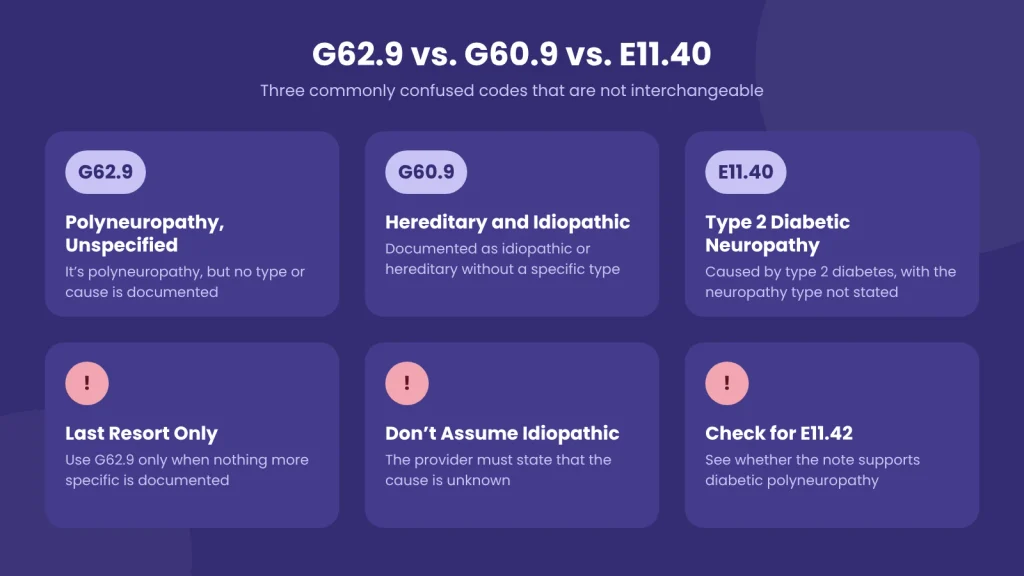
These three codes are the most commonly confused in neuropathy coding. They look similar, but each describes a different clinical situation.
| Code | General description | When it may be used | Key documentation considerations |
| G62.9 | Polyneuropathy, unspecified | Polyneuropathy or peripheral neuropathy is documented without its type or cause | Use only when no more specific type or cause is documented |
| G60.9 | Hereditary and idiopathic neuropathy, unspecified | Neuropathy is documented as idiopathic (no cause found), or hereditary without a specific type | The provider should state that the cause is idiopathic or unknown; don’t assume it |
| E11.40 | Type 2 diabetes mellitus with diabetic neuropathy, unspecified | Diabetic neuropathy is documented in a type 2 diabetic, without the type of neuropathy | Check whether the note supports a more specific code, such as E11.42 |
Why these codes aren’t interchangeable:
- G62.9 says “we know it’s polyneuropathy, but nothing else.”
- G60.9 says “the cause has been looked for and is idiopathic, or it’s hereditary.”
- E11.40 says “the neuropathy is caused by type 2 diabetes.”
For a diabetic patient, E11.40 or E11.42 takes priority over G62.9 because of the “with” convention, unless the provider documents a different cause. For a non-diabetic patient, the choice between G62.9 and G60.9 depends on whether the provider documented the neuropathy as idiopathic.
How to Choose the Correct Neuropathy ICD-10 Code
Use this step-by-step workflow for every neuropathy encounter:

Step 1: Identify the provider’s documented diagnosis.
Start with the assessment and plan, not just the problem list. Look for the exact wording: neuropathy, polyneuropathy, neuralgia, radiculopathy or a specific named condition.
Step 2: Determine the type of nerve disorder.
Is it a polyneuropathy (many nerves), a mononeuropathy (one nerve), a neuralgia (nerve pain along a specific nerve), an autonomic neuropathy or a nerve root problem?
Step 3: Identify the documented cause.
Look for diabetes (and its type), alcohol, chemotherapy or other drugs, toxins, critical illness, radiation, inflammatory disease, hereditary conditions or “idiopathic.” Remember the “with” convention for diabetes.
Step 4: Search the Alphabetic Index.
Look up the main term (such as “Neuropathy” or “Polyneuropathy”) and follow the subterms that match the documentation.
Step 5: Verify in the Tabular List.
Never code from the index alone. Check the code in the Tabular List, and review Excludes1 and Excludes2 notes, “code first” and “use additional code” instructions, laterality and required characters.
Step 6: Confirm against current guidelines.
Make sure you’re using the code set for the date of service, and apply the current ICD-10-CM Official Guidelines for Coding and Reporting, especially for diabetes, adverse effects and pain.
Step 7: Query when documentation is unclear.
If the type, cause or laterality is missing or conflicting, send a compliant query to the provider instead of guessing.
The official code files and guidelines are available from CMS and the CDC National Center for Health Statistics.
Documentation Requirements for Neuropathy Coding
The code can only be as specific as the documentation. For neuropathy, strong documentation usually includes:
- The specific neuropathy diagnosis. For example, “distal symmetric polyneuropathy,” not just “neuropathy.”
- The underlying cause or associated condition. For example, diabetes, chemotherapy, alcohol or “idiopathic after workup.”
- Diabetes type, when applicable. Type 1, type 2, drug-induced or due to an underlying condition.
- The affected nerves or body areas. Especially for mononeuropathies, including laterality.
- Symptoms and relevant clinical findings. For example, reduced vibration sense, absent ankle reflexes or monofilament testing results.
- Diagnostic test results, when available. Nerve conduction studies, EMG, skin biopsy and relevant labs such as A1c or B12.
- Treatment and management details. Medications, referrals, foot care and glycemic control plans.
- Provider clarification when needed. If the record is incomplete or conflicting, a query should be sent and its answer documented.
Neuropathy documentation checklist:
☐ Neuropathy type documented (poly-, mono-, autonomic, small fiber, etc.)
☐ Cause documented, or documented as idiopathic
☐ Diabetes type documented, when applicable
☐ Link to diabetes not contradicted by another stated cause
☐ Drug documented for drug-induced neuropathy
☐ Affected nerve and laterality documented for mononeuropathies
☐ Exam findings and test results support the diagnosis
☐ Assessment and plan show the condition was evaluated or managed at this visit
Common Neuropathy ICD-10 Coding Errors to Avoid
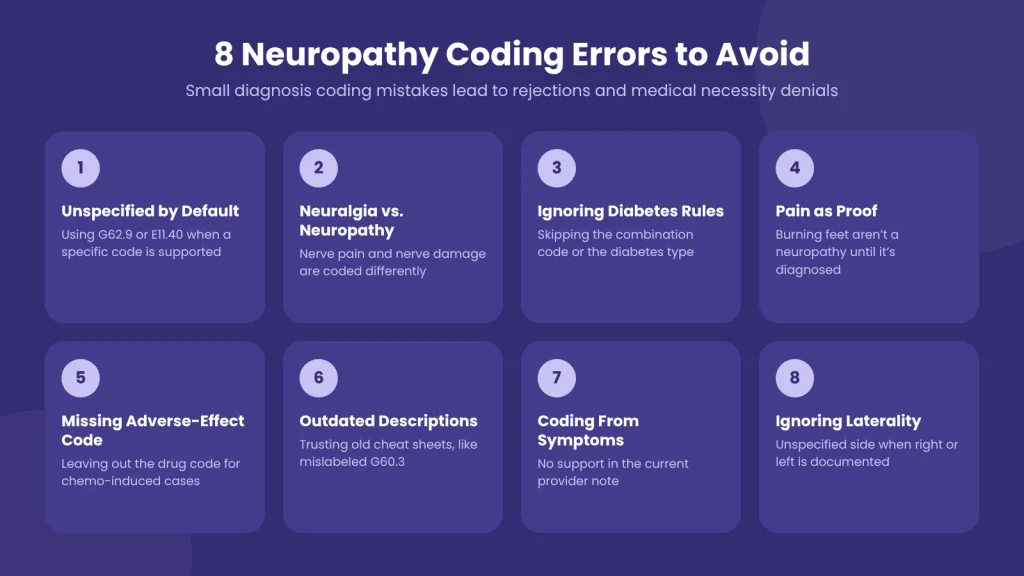
1. Using an unspecified code when a specific diagnosis is documented.
Reporting G62.9 or E11.40 when the record clearly supports E11.42, G62.0 or G62.1 is one of the most common errors.
2. Confusing neuralgia with peripheral neuropathy.
Neuralgia is pain along a nerve. Neuropathy is nerve damage. They’re coded differently, and one doesn’t automatically mean the other.
3. Reporting diabetic neuropathy without following diabetes coding rules.
Examples include coding E11.9 plus G62.9 instead of a combination code, or ignoring the documented diabetes type.
4. Treating nerve pain as confirmation of neuropathy.
A patient with burning feet doesn’t have a coded neuropathy until the provider diagnoses one.
5. Missing the adverse-effect code for chemotherapy-induced neuropathy.
Leaving out T45.1X5- or coding the condition as a poisoning instead of an adverse effect.
6. Using outdated code descriptions.
Relying on old cheat sheets, or copying code tables from websites without checking them. For example, G60.3 is sometimes mislabeled online as hereditary neuropathy, when it’s actually idiopathic progressive neuropathy.
7. Coding from symptoms without adequate provider documentation.
Assigning a neuropathy code based on a symptom list, a medication or a previous visit, without the current note supporting it.
8. Ignoring laterality for mononeuropathies.
Submitting unspecified-side codes when the provider documented right, left or bilateral.
How Accurate Neuropathy Coding Supports Medical Billing and Reimbursement
Diagnosis codes do more than describe the patient’s condition. They support medical necessity for every service on the claim, from office visits and nerve conduction studies to diabetic shoes, pain management procedures and physical therapy.
When neuropathy coding is inaccurate, the effects show up quickly in the revenue cycle:
- Claim rejections from invalid codes, missing characters or incorrect laterality.
- Medical necessity denials when the diagnosis doesn’t support the service billed, such as nerve conduction studies or therapeutic footwear.
- Rework and delays as billing teams correct and resubmit claims.
- Audit risk when codes don’t match the clinical record.
- Inaccurate risk adjustment for value-based contracts and Medicare Advantage, where diabetic complications may affect risk scores. That can lead to underpayment or, if overcoded, repayment.
That’s why practices benefit from:
- Regular coding audits. A periodic medical billing audit helps catch patterns, such as overuse of E11.40 or G62.9, before they become denial trends.
- Annual code-set updates. ICD-10-CM changes every October 1, and billing systems, templates and cheat sheets need to be updated each year.
- Specialty coding expertise. Neurology, endocrinology, oncology and podiatry each document neuropathy differently, so coders familiar with those specialties tend to make fewer errors.
- Strong denial follow-up. When neuropathy-related claims are denied, a structured denial management process identifies the root cause and fixes it at the source.
Improve Neuropathy Coding Accuracy With Professional Medical Coding Support
Neuropathy coding sits at the intersection of several complex rules: combination codes, the “with” convention, adverse effects, pain sequencing and laterality. When one detail is missed, claims slow down or get denied, and practices spend staff time fixing problems that could have been prevented.
iSolve RCM helps practices code neurological and diabetic diagnoses accurately and keep claims moving. Our team supports:
- Coding reviews. Certified coders review neuropathy and related diagnoses against current ICD-10-CM guidelines through our medical coding services.
- Documentation checks. We flag missing diabetes types, unclear causes, missing laterality and other gaps before claims are submitted.
- Claims management. Claims are scrubbed for invalid codes, missing characters and medical necessity conflicts.
- Denial management and A/R follow-up. Denied and unpaid claims are worked, appealed when appropriate and tracked to their root cause, with dedicated accounts receivable management.
- Full revenue cycle support. From eligibility to payment posting through our revenue cycle management services.
We work with specialties that see neuropathy every day, including endocrinology, oncology and neurosurgery, as well as primary care and pain management practices. If you’re weighing whether to keep coding in-house, our guide to in-house vs. outsourced medical billing compares the cost and performance trade-offs.
Frequently Asked Questions About Neuropathy ICD-10 Codes
What is the ICD-10 code for neuropathy?
There’s no single neuropathy code. When polyneuropathy or peripheral neuropathy is documented without its type or cause, G62.9 is commonly used. Idiopathic neuropathy is typically G60.9. Diabetic, drug-induced, alcoholic and other specified types each have their own codes.
What is the ICD-10 code for peripheral neuropathy?
When peripheral neuropathy is documented without further specification, the Alphabetic Index directs coders to G62.9, Polyneuropathy, unspecified. If the provider documents a cause, such as diabetes, alcohol or chemotherapy, a more specific code should be used instead.
What is G62.9?
G62.9 is the ICD-10-CM code for polyneuropathy, unspecified. It’s used when the provider documents polyneuropathy or peripheral neuropathy but doesn’t specify its type or cause. It shouldn’t be used when the documentation supports a more specific code.
What is the ICD-10 code for diabetic neuropathy?
Diabetic neuropathy uses a combination code based on the diabetes type. For type 2 diabetes, E11.40 is diabetic neuropathy, unspecified, and E11.42 is diabetic polyneuropathy. For type 1 diabetes, the equivalent codes are E10.40 and E10.42.
What is the ICD-10 code for neuropathy due to type 2 diabetes?
Use a code from E11.4-. E11.40 applies when the type of neuropathy isn’t specified. E11.42 applies to diabetic polyneuropathy, including diabetic peripheral neuropathy. E11.41 is for mononeuropathy and E11.43 is for autonomic neuropathy.
What is the ICD-10 code for neuropathic pain?
There’s no single neuropathic pain code. M79.2 (neuralgia and neuritis, unspecified) is often used for documented nerve pain without a more specific diagnosis. If an underlying neuropathy is diagnosed, code that condition, and use G89 chronic pain codes only when the guidelines allow.
Is G60.9 the same as G62.9?
No. G60.9 is hereditary and idiopathic neuropathy, unspecified, used when neuropathy is documented as idiopathic or hereditary. G62.9 is polyneuropathy, unspecified, used when polyneuropathy is documented without its type or cause. Coders shouldn’t assume a neuropathy is idiopathic unless the provider says so.
What is the ICD-10 code for chemotherapy-induced neuropathy?
Chemotherapy-induced polyneuropathy is generally coded using G62.0, followed by the applicable adverse-effect code from the T36–T50 category. T45.1X5- may apply to certain antineoplastic and immunosuppressive drugs. Coders should verify the specific drug in the current ICD-10-CM Table of Drugs and Chemicals and assign the appropriate seventh character.
What is the ICD-10 code for small fiber neuropathy?
There is no dedicated ICD-10-CM code specifically for small fiber neuropathy. Code selection depends on the provider’s documented diagnosis, underlying cause, Alphabetic Index and Tabular List. A diabetic neuropathy code or another applicable neuropathy category may be appropriate when supported by the documentation. Do not automatically assign G60.8, G60.3 or G62.89 solely because small fiber neuropathy is documented.
Can neuropathy be coded as unspecified?
Yes, but only when the documentation doesn’t support anything more specific. Unspecified codes like G62.9 and E11.40 are valid, but they shouldn’t replace a specific code when the record documents the type or cause. When details are missing, a provider query is usually the better option.
Conclusion
Choosing the correct neuropathy ICD-10 code starts with one question: what exactly did the provider document? Peripheral neuropathy, idiopathic neuropathy, diabetic polyneuropathy, chemotherapy-induced neuropathy, mononeuropathy and neuralgia all map to different codes, and treating them as interchangeable leads to inaccurate claims and avoidable denials.
The basics stay the same across every case. Read the full note. Identify the type and cause. Follow the “with” convention for diabetes and the adverse effect rules for drugs. Verify every code in the Tabular List. And confirm you’re using the current fiscal-year code set.
If your practice is seeing neuropathy-related denials, or you’re not sure your diagnosis coding is as specific as it should be, iSolve RCM can help. Our certified coders and outsourced medical billing services help practices code accurately, submit clean claims and protect revenue.