
New federal Medicaid work requirements are scheduled to begin on January 1, 2027. With weeks to go, the Centers for Medicare & Medicaid Services (CMS) has given states a way to soften the first six months.
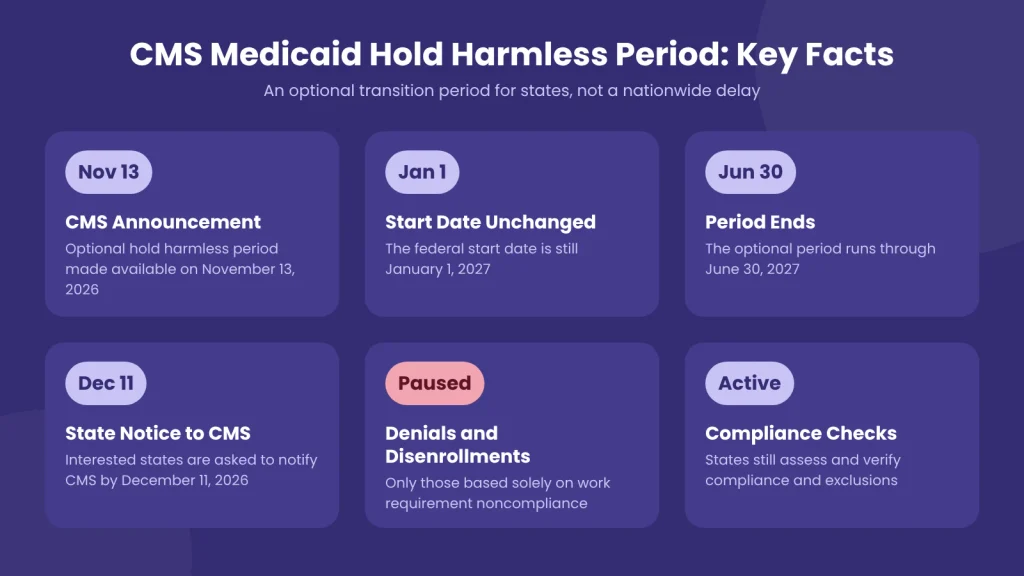
Quick answer: On November 13, 2026, CMS made available an optional hold harmless period that runs through and including June 30, 2027. A state that uses it still checks whether people meet the work requirement, but otherwise eligible people can’t be denied or disenrolled just for noncompliance during that window.
This is one of the most important pieces of state Medicaid news this year, and it’s easy to misread. The work requirement itself hasn’t been cancelled or postponed nationwide. The flexibility is optional, it’s temporary, and each state decides whether to request it.
This guide explains what CMS announced, how the Medicaid work requirement rules operate, who is exempt, how implementation differs by state, and what it all means for Medicaid eligibility in New York. It also covers what healthcare providers should do to protect their billing and revenue while coverage rules change, including how medical billing services can help maintain accurate claims processing and minimize reimbursement disruptions.
| Policy detail | What it means |
| Federal implementation date | January 1, 2027, unless a state implements earlier |
| Monthly activity requirement | Generally 80 hours of qualifying activities |
| CMS flexibility | Optional hold harmless period, approved by CMS through the state’s mitigation plan |
| End of optional period | June 30, 2027 |
| Notification to CMS | CMS asks interested states to notify it by December 11, 2026 |
| What states can pause | Denials and disenrollments based solely on work requirement noncompliance |
| What continues | Assessing and verifying compliance and exclusions |
What Did CMS Announce About Medicaid Work Requirement Flexibility?
Understanding the Optional Hold Harmless Period
“Hold harmless” means a person isn’t penalized during a defined period. In this case, a state that opts in will keep running its work requirement process, but it won’t take coverage away from someone only because they couldn’t show compliance.
CMS framed the option as a transition tool. According to its letter to state officials, the extra time lets states test and refine systems and processes before enforcement starts. The announcement also reflects a practical problem. KFF notes that many states weren’t going to be ready by the January 1 deadline.
Four features define the option:
- It’s optional. Nothing changes in a state that doesn’t request it.
- It needs CMS approval. A state doesn’t simply declare a hold harmless period. It requests the option, and CMS approves it through the state’s mitigation plan, which is the plan a state uses to address gaps in its implementation.
- CMS has asked for notice by December 11, 2026. This is a date CMS set in its letter for states to say they intend to use the option. It isn’t a deadline written into the statute.
- It ends on June 30, 2027. The period can last up to six months.
Does the CMS Announcement Delay Medicaid Work Requirements Nationwide?
No. This is the point most headlines blur. January 1, 2027 remains the start date for the requirement. What can be delayed is the penalty, and only where CMS has approved the option for that state.
| Item | Status |
| January 1, 2027 implementation deadline | Unchanged |
| Assessing who meets the requirement or an exclusion | Continues in every state |
| Denials and disenrollments for noncompliance | Paused only in states with a CMS-approved hold harmless period |
| Full enforcement in hold harmless states | Begins when the approved period ends, no later than July 1, 2027 |
In a state that doesn’t use the option, denials and terminations can begin under that state’s normal process from January 2027. That’s why the same federal rule may feel very different depending on where a person lives.
What States Can Do During the Transition Period
KFF’s summary describes the delay as time for states to update systems, refine verification, train staff and reach out to enrollees and partners. In practice, states can use the months to:
- Improve eligibility systems and fix known defects
- Verify qualifying activities with data they already hold, such as wage records
- Identify people who qualify for exclusions before they’re asked for paperwork
- Rewrite notices so members understand what’s being asked
- Test automated verification and renewal workflows
- Train eligibility workers and partner with community organizations
CMS also encourages states to do four things during the transition: rely on automated verification with data the state already holds before asking people for more information, send clear and timely notices that explain what has been verified and what is still needed, test end-to-end processes such as data matching and eligibility decisions, and work with community partners to connect people with jobs, education, training and volunteering. CMS Deputy Administrator Dan Brillman said people shouldn’t have to track down paperwork when the state can verify work or an exclusion with data.
States still have obligations. CMS’s letter keeps in place the duty to work toward full compliance with the statute.
What Are the New Medicaid Work Requirements for 2027?
The requirement comes from the 2025 budget reconciliation law. H.R. 1 was signed on July 4, 2025 and makes community engagement mandatory for certain Medicaid enrollees. CMS then filled in the operating details. Its interim final rule was issued on June 1, 2026, and that rule is the basis for the Medicaid work requirements 2027 framework described below.
Who Must Meet the Medicaid Work Requirements?
The rule applies to a specific group, which CMS calls “applicable individuals.” These are non-pregnant adults aged 19 to 64 who aren’t entitled to or enrolled in Medicare and who are covered through the Medicaid adult group or certain section 1115 demonstrations.
In plain terms, that’s mostly adults who gained coverage through Medicaid expansion. The law doesn’t reach every Medicaid enrollee, only 19-to-64-year-olds eligible through expansion or similar policies, such as those in Wisconsin and Georgia.
Children, adults 65 and older, pregnant individuals and people who qualify for Medicaid on the basis of disability are outside this group. The requirement doesn’t apply identically to every Medicaid beneficiary.
How Many Hours Must Medicaid Beneficiaries Work?
The general standard is 80 hours per month of qualifying activities. A person can meet it each month through:
- 80 or more hours of work
- 80 or more hours of community service
- 80 or more hours in a qualified work program
- At least half-time enrollment in an educational program
- Any combination of these adding up to 80 hours
- Monthly income of at least 80 times the federal minimum wage
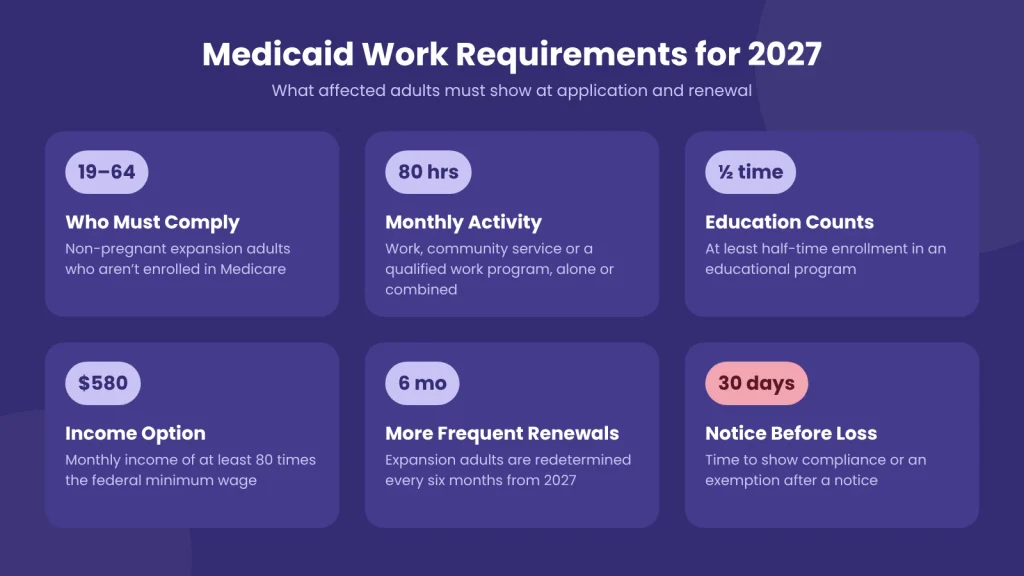
That last option matters for people with irregular hours. For 2026, the CMS fact sheet puts the income figure at $580 a month, with a different calculation for seasonal workers.
The timing rules differ for applicants and current members:
- New applicants: The state chooses a look-back period of one, two or three consecutive months immediately before the month of application. An applicant must show compliance for each month in the period their state has chosen, so the requirement isn’t one month in every state.
- Current enrollees: One or more months between renewals must meet the standard, and the state picks the exact number.
Renewals are also becoming more frequent for this group. From January 2027, eligibility redeterminations for the expansion population happen every six months. That change applies to the adults subject to these rules, not to every Medicaid member aged 19 to 64. People in other eligibility groups keep their existing renewal schedule.
How Will States Verify Medicaid Work Requirement Compliance?
Verification is required at application and at renewal, and a state may check more often. States are expected to use information they already have before asking a person for documents. Common sources include:
- Employment and wage data
- State data matching with other programs
- Education and training enrollment records
- Community service documentation
- Information the beneficiary submits when automated checks aren’t enough
What Happens If Someone Does Not Meet the Work Requirement?
Under the standard framework, there’s a warning step before any coverage loss. When compliance can’t be verified, the state sends a notice of noncompliance and the person gets 30 calendar days to show they comply or qualify for an exemption.
If that doesn’t resolve it, the application can be denied or the person disenrolled, though they can reapply at any time.
In a state with an approved hold harmless period, the assessment and notices still happen, but the denial or disenrollment step is paused until the period ends.
Who Is Exempt From Medicaid Work Requirements?
Individuals Who May Qualify for Exemptions
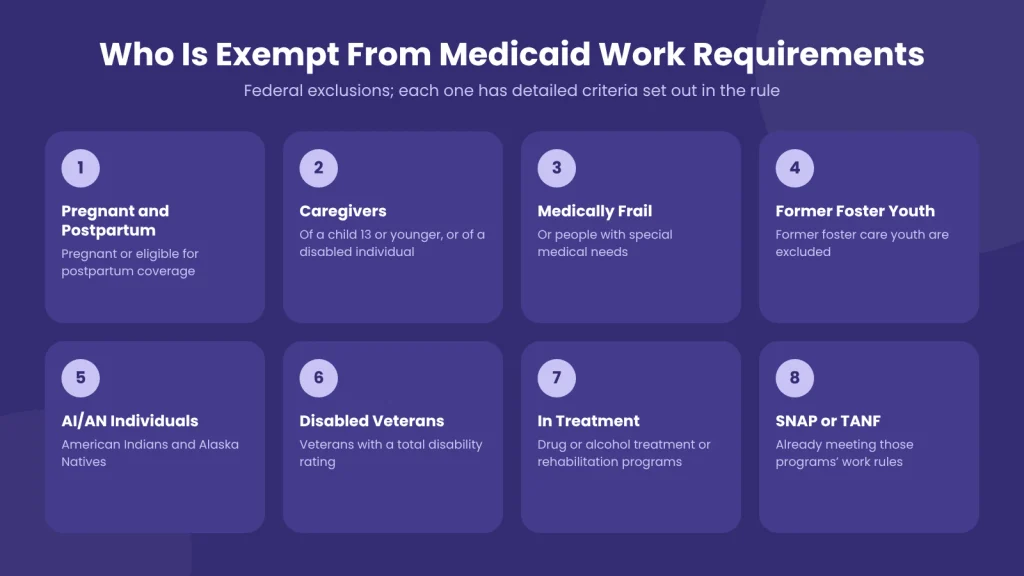
Federal law lists specific exclusions. The CMS fact sheet names these groups:
- Former foster care youth
- American Indians and Alaska Natives
- Parents, guardians, caretaker relatives or family caregivers of a dependent child aged 13 or younger, or of a disabled individual
- Veterans with a total disability rating
- People who are medically frail or have special medical needs
- People already meeting TANF work requirements, or in a SNAP household and not exempt from SNAP work rules
- Participants in drug or alcohol treatment or rehabilitation programs
- Inmates of a public institution
- People who are pregnant or eligible for postpartum coverage
States may also adopt optional short-term hardship exceptions. These cover people receiving inpatient hospital or nursing facility care, residents of counties with a declared disaster or a high unemployment rate, and people traveling for extended medical care.
A note on medical frailty. This exclusion has been in dispute. KFF reports that a recent court ruling removed the interim final rule’s requirement that a person prove their condition limits their ability to work, leaving states to verify only that the person has a condition in one of five statutory categories. Because litigation is ongoing, check your state’s current guidance on how it applies this exclusion.
Each exclusion has detailed criteria. Being in a broad category, such as “caregiver,” doesn’t automatically mean a person is exempt.
How Can Beneficiaries Prove They Qualify for an Exemption?
States will try to confirm many exclusions from existing data. When they can’t, a member may be asked for:
- Medical documentation, where the state requires it
- Proof of caregiving status
- Employment or income records
- School or training enrollment records
- Other verification documents the state accepts
Do Medicaid Work Requirements Apply to Seniors and People With Disabilities?
Generally, no. The requirement covers ages 19 through 64 and excludes anyone entitled to or enrolled in Medicare. CMS also treats people enrolled in another Medicaid eligibility group as meeting the requirement automatically.
Seniors and people who qualify on the basis of disability are usually in eligibility categories with their own income and resource rules. Those separate rules still apply to them.
Medicaid Work Requirements by State: What Is Changing?
Why Medicaid Work Requirement Implementation May Differ by State
Medicaid work requirements by state will not look identical in 2027, for several reasons:
- The federal framework leaves choices to states, including the look-back period, optional hardship exceptions and how often to verify.
- System readiness varies. Some states have automated data matching in place, and others are still building it.
- Some states started early. Arkansas, for example, began running automated processes on July 1, 2026 to determine whether current enrollees are exempt or already compliant.
- The hold harmless option is elective and subject to CMS approval, so enforcement start dates will differ.
- Litigation is active. On June 30, 2026, 25 states and the District of Columbia sued to challenge the interim final rule.
We haven’t included a state-by-state table here. States have been asked to notify CMS by December 11, 2026, so any list published before then would be incomplete.
What States Should Do Before June 30, 2027
- Upgrade eligibility and enrollment systems
- Finalize verification processes and data sources
- Identify potentially exempt individuals in advance
- Improve member communication and outreach
- Reduce administrative errors that cause unnecessary coverage loss
How Can Beneficiaries Check Their State’s Medicaid Work Requirement Rules?
The most reliable sources are official ones:
- The state Medicaid agency’s website
- Official notices mailed or emailed to the member
- The state health insurance marketplace
- The local Medicaid or social services office
New York State Medicaid Eligibility: What Beneficiaries Need to Know
What Is New York State Medicaid?
New York State Medicaid is the state’s public health coverage program for people with limited income and resources. It’s jointly funded by the federal government and the state, and administered by the New York State Department of Health. Eligibility depends on income, household size, age, disability and other factors.
Most members receive care through Medicaid managed care plans. Some remain in fee-for-service Medicaid, where the state pays providers directly.
Who Qualifies for Medicaid in New York State?
The main New York State Medicaid qualifications fall into these groups:
- Adults aged 19–64 with low income
- Children
- Pregnant individuals
- Parents and caretaker relatives
- Adults aged 65 and older
- People who are blind or have a disability
- Other groups defined in New York’s Medicaid rules
Applicants must also be New York residents and meet citizenship or immigration status rules.
New York State Medicaid Income Limits and Eligibility Requirements
New York State Medicaid eligibility is determined under two sets of rules:
- MAGI rules (Modified Adjusted Gross Income) apply to most adults under 65, children, pregnant individuals and parents. MAGI-based programs in New York generally have no asset test.
- Non-MAGI rules apply mainly to people 65 and older and people who are blind or disabled. These rules can include resource limits.
NY State Medicaid income limits are tied to the federal poverty level (FPL) and vary by category and household size. Most adults aged 19–64 qualify with income up to 138% of the FPL. New York’s income standards effective January 1, 2026 set that level at:
| Household size | Monthly income (138% FPL) | Annual income (138% FPL) |
| 1 | $1,836 | $22,025 |
| 2 | $2,489 | $29,864 |
| 3 | $3,142 | $37,702 |
| 4 | $3,795 | $45,540 |
Other groups have higher limits:
| Group | 2026 income limit (percent of FPL) |
| Adults 19–64 | 138% |
| Pregnant individuals and children under 1 | 223% |
| Children 1–18 | 154% |
These figures are a guide only. The Department of Health decides what income counts and who is in the household, so the official chart and an actual application are the final word.
Does New York State Medicaid Have New Work Requirements in 2027?
Yes. New York is an expansion state, so the federal requirement applies. According to NY State of Health, some adults aged 19–64 will need to show work or another qualifying activity starting January 1, 2027.
When it applies to you: The requirement is reviewed when you apply or renew. New applicants are assessed from January 1, 2027. Existing members are assessed at their next renewal, not all at once on January 1.
How to meet it in New York: A member can earn $580 or more a month, complete 80 hours a month of approved activities, or combine income and hours.
Who is exempt in New York: The state’s list includes people 18 or younger, 65 or older, pregnant or recently pregnant, enrolled with a disability, caregivers of a disabled person or a child under 14, American Indian or Alaska Native people, people with a qualifying physical, mental health or substance use condition, current or certain former foster youth, and veterans with a total disability.
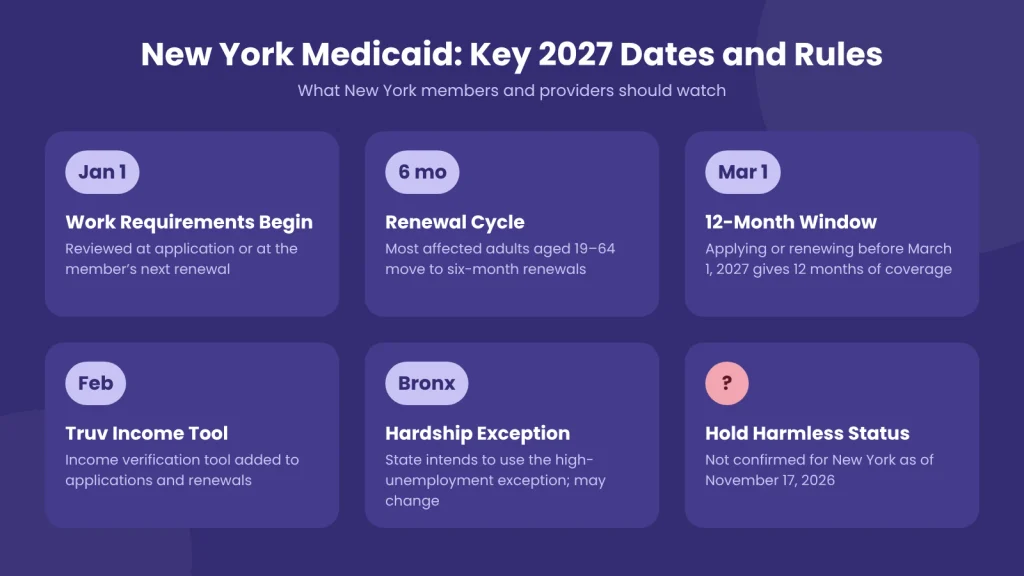
Key New York dates and rules, as listed on the NY State of Health “Stay Covered” page:
| Date or rule | What happens |
| August 14 – September 30, 2026 | Notices about work requirements went out by mail or email |
| January 1, 2027 | Work requirements begin |
| January 1, 2027 | Most adults 19–64 subject to the new rules move to renewals every 6 months |
| Before March 1, 2027 | Applying or renewing before this date gives 12 months of coverage; after it, renewals are every 6 months |
| February 2027 | An income verification tool called Truv is added to the application and renewal process |
State guidance can change, so confirm these dates on the NY State of Health page before relying on them.
The Bronx hardship exception. New York has told the federal government that it intends to use the optional high-unemployment hardship exception for the Bronx. This is one of the short-term hardship exceptions in the federal rule, available for areas with a high unemployment rate. The state notes that this plan may change, and members should make sure the address on their application is correct.
The Bronx exception is not the hold harmless period. They are two separate things:
| Bronx hardship exception | CMS hold harmless period | |
| Basis | High-unemployment hardship exception in the federal rule | Optional transition period announced by CMS on November 13, 2026 |
| Who it covers | Residents of the Bronx | All affected members in a state that uses it |
| What it does | Treats covered residents as excepted from the work requirement | Pauses denials and disenrollments while compliance is still assessed |
| New York’s status | State has indicated its intention to use it | Not confirmed |
Has New York requested the hold harmless period? As of November 17, 2026, New York’s decision is unconfirmed. The state’s public guidance doesn’t address the option. Until New York announces a decision, members should assume the January 1, 2027 rules apply and watch for official updates.
One more point for New Yorkers. Someone who loses Medicaid only for not meeting work requirements isn’t eligible for Advance Premium Tax Credits, so losing coverage this way can make marketplace insurance harder to afford.
How to Apply for New York State Medicaid
There are two main routes for Medicaid in New York State:
- NY State of Health. Most adults under 65, children, pregnant individuals and parents (the MAGI groups) apply through the state’s official marketplace, online or by phone.
- Local Department of Social Services (LDSS). People 65 and older, and people applying on the basis of blindness or disability, generally apply through their county office. In New York City, that’s the Human Resources Administration.
Have proof of identity, residency, income and immigration or citizenship status ready. After applying, check your account and respond to any request for information by the deadline.
What Medicaid Benefits Are Available in New York State?
Common Medicaid Covered Services
New York State Medicaid benefits are broad. Covered services generally include:
- Physician and outpatient visits
- Hospital inpatient and emergency care
- Preventive care and screenings
- Prescription drugs
- Laboratory and diagnostic services
- Behavioral health and substance use treatment
- Rehabilitation services
- Long-term care services for people who qualify
Coverage details can depend on the member’s eligibility category and plan.
How Medicaid Managed Care Works in New York
Most New York Medicaid members enroll in a managed care plan. The plan contracts with a network of providers and coordinates the member’s care. Members usually choose a plan and a primary care provider, and they need to use in-network providers except in emergencies.
In fee-for-service Medicaid, there’s no plan in the middle. The member can see any provider who accepts Medicaid, and the provider bills the state directly. For providers, knowing which arrangement a patient is in determines where the claim goes.
Where Can New York Medicaid Members Get Eligibility Assistance?
- NY State of Health Customer Service: 1-855-355-5777 (TTY 1-800-662-1220)
- The NY State of Health “Stay Covered” page, which includes a work requirements questionnaire
- Certified enrollment assistors and navigators
- The county Local Department of Social Services, for members who enrolled there
How Could Medicaid Work Requirements Affect Healthcare Providers?
Coverage rules that change every six months don’t only affect patients. They change the day-to-day work of every practice that treats Medicaid members.
Increased Medicaid Eligibility Verification Work
- More frequent eligibility checks. Six-month renewals for expansion adults double the number of points at which their coverage can lapse.
- Patient demographic updates. Notices go to the address on file, so outdated contact details lead to missed deadlines.
- Coverage verification at every visit, not only at intake.
- Documentation requests. Patients may ask practices for records that support a medical exemption.
- Renewal tracking for patients with ongoing treatment.
Potential Impact on Medical Billing and Claims
- Coverage-related denials when a patient’s Medicaid ended before the date of service
- Incorrect insurance information when a patient moves between Medicaid, a marketplace plan and being uninsured
- Eligibility discrepancies between the state file and the managed care plan
- Coordination of benefits issues when coverage overlaps or changes mid-month
- More administrative follow-up, including retroactive eligibility questions
New York is also shortening retroactive coverage. From January 1, 2027, it drops to one month for affected adults aged 19–64 and two months for everyone else. That leaves less room to recover payment for services provided before an application was filed.

How Medical Practices Can Prepare for Medicaid Eligibility Changes
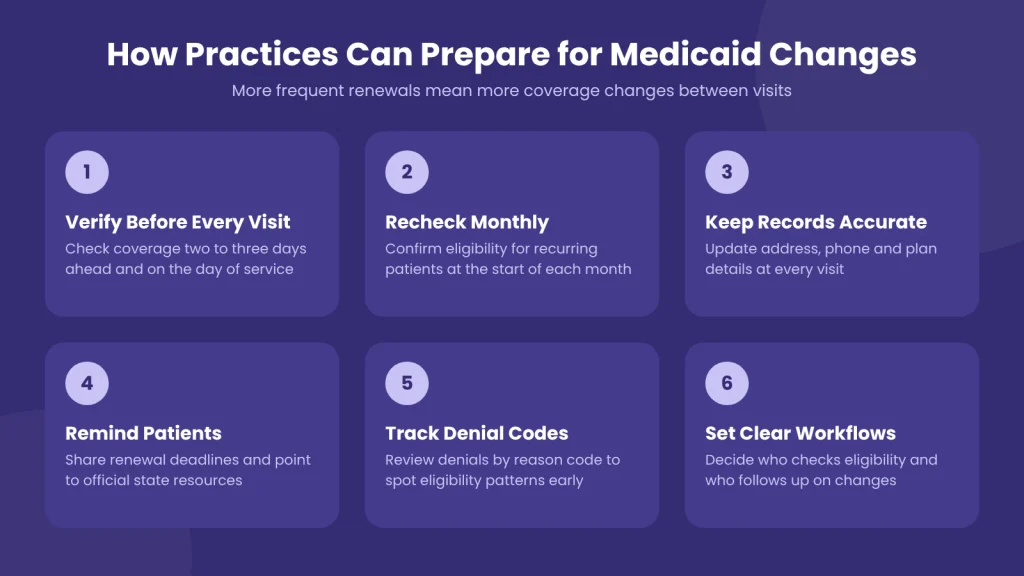
- Verify coverage before every appointment, ideally two to three days ahead and again on the day of service.
- Recheck eligibility for recurring patients at the start of each month.
- Keep patient records accurate, especially address, phone and plan details.
- Tell patients about renewal deadlines and point them to official state resources.
- Review denials by reason code to spot eligibility-related patterns early.
- Set clear workflows for who checks eligibility, who follows up and how coverage changes are recorded.
A periodic medical billing audit can show whether eligibility errors are already costing your practice revenue.
How Outsourced Medical Billing and RCM Support Can Help
iSolve RCM works with practices on the parts of the revenue cycle most exposed to eligibility changes:
- Insurance eligibility verification as part of our revenue cycle management services
- Accurate patient and insurance information at charge entry
- Claims management through our outsourced medical billing services
- Denial management for coverage-related and other denials
- Accounts receivable management to follow up on unpaid claims
- Medical coding services so claims are right when coverage is active
- Credentialing and enrollment support with Medicaid and managed care plans
We support a wide range of healthcare specialties. Practices with a large Medicaid panel, such as family practice and behavioral health, tend to feel eligibility changes first. New York healthcare providers looking for specialized billing support can explore our overview of medical billing companies in New York to understand their options for managing claims, improving reimbursement accuracy, and reducing administrative burdens. If you’re weighing your options, our guide to in-house vs. outsourced medical billing compares the costs. Medicare changes are arriving at the same time, and our CMS 2027 Physician Fee Schedule guide covers those.

How Beneficiaries Can Prepare for Medicaid Work Requirement Changes
Check Your Medicaid Eligibility Status
Log in to your state account and confirm your coverage category and renewal date. In New York, the renewal date appears under the “Plans” tab of the NY State of Health account.
Review Official Notices From Your State
Open every letter, email and text from your Medicaid agency. Notices explain whether the requirement applies to you and what the deadline is. Keep your address, phone number and email current so they reach you.
Keep Employment, Education and Community Service Records
Save pay stubs, school enrollment letters and volunteer hour logs. Most people won’t need them if the state can verify activity from its own data, but having them ready makes a 30-day notice much easier to answer.
Confirm Whether You Qualify for an Exemption
Review the exclusion list for your state. New York offers a work requirements questionnaire that shows whether the rules apply to you.
Contact Your State Medicaid Office if Your Circumstances Change
Report changes in income, household, pregnancy, health or caregiving. A change can move you into a different eligibility group or an exemption.
Final Thoughts: What the CMS Medicaid Flexibility Means for 2027
The federal timeline hasn’t moved. Medicaid work requirements begin on January 1, 2027. What CMS added on November 13 is an optional cushion: with CMS approval, a state can assess compliance through June 30, 2027 without taking coverage away for noncompliance alone.
Whether that cushion applies depends on each state’s decision and CMS’s approval. New York members should keep their contact details current, complete the state’s questionnaire and watch for official announcements. The general Medicaid eligibility requirements for the United States in 2026, including income limits and renewals, continue to apply either way.
For healthcare practices, the takeaway is practical. More frequent renewals and new eligibility conditions mean more coverage changes between visits. Practices that tighten eligibility verification and denial follow-up now will be in a better position when enforcement begins.
Frequently Asked Questions About Medicaid Eligibility and Work Requirements
What are the new Medicaid work requirements for 2027?
Starting January 1, 2027, certain non-pregnant adults aged 19–64 in the Medicaid expansion group must complete 80 hours a month of work, community service, a work program or half-time education, or earn at least $580 a month, unless they qualify for an exclusion.
Did CMS delay Medicaid work requirements until June 2027?
Not exactly. The requirement still begins January 1, 2027. CMS gave states an optional hold harmless period through June 30, 2027. In states where CMS approves it, people won’t be denied or disenrolled solely for noncompliance during that period, but compliance is still assessed.
What is the Medicaid hold harmless period?
It’s an optional transition period, announced by CMS on November 13, 2026. A participating state continues to check work requirement compliance and exclusions but doesn’t deny applications or end coverage for otherwise eligible people on that basis alone. It can last through June 30, 2027.
Can states suspend Medicaid disenrollment through June 30, 2027?
Yes, in a limited way. A state can pause denials and disenrollments based solely on failing to show work requirement compliance if CMS approves the option through the state’s mitigation plan. CMS has asked interested states to notify it by December 11, 2026. Other eligibility rules, such as income limits, still apply.
Who must meet Medicaid work requirements?
Non-pregnant adults aged 19 to 64 who aren’t entitled to or enrolled in Medicare and who are covered through the Medicaid adult expansion group or certain section 1115 demonstrations. Children, seniors and people in other eligibility groups aren’t subject to the requirement.
How many hours do you have to work to qualify for Medicaid in 2027?
Affected adults generally need 80 hours a month of qualifying activities. Work, community service, work programs and at least half-time education all count, alone or combined. Earning at least $580 a month in 2026 also satisfies the requirement. Applicants must show this for one to three months before applying, depending on the state.
Who is exempt from Medicaid work requirements?
Exclusions include pregnant and postpartum individuals, caregivers of a child 13 or younger or of a disabled person, medically frail individuals, former foster youth, American Indians and Alaska Natives, veterans with a total disability rating, people in substance use treatment and people meeting SNAP or TANF work rules.
Do Medicaid work requirements apply in New York State?
Yes. New York’s guidance says some adults aged 19–64 must meet the requirement starting January 1, 2027, reviewed at application for the member’s next renewal. As of November 17, 2026, it’s unconfirmed whether New York will use the optional hold harmless period.
What are the New York State Medicaid eligibility requirements?
Eligibility for Medicaid in New York State depends on residency, citizenship or immigration status, income, household size and category. Most adults under 65 qualify under MAGI income rules with no asset test. People 65 and older or with disabilities follow non-MAGI rules that can include resource limits.
What are the New York State Medicaid income limits?
For 2026, adults aged 19–64 qualify with income up to 138% of the federal poverty level, which is $1,836 a month for one person and $3,795 for a household of four. Pregnant individuals and children under 1 qualify up to 223%, and children aged 1–18 up to 154%.
How do I apply for Medicaid in New York State?
Most adults, children, pregnant individuals and parents apply through NY State of Health online or by calling 1-855-355-5777. People aged 65 and older, or applying on the basis of disability, generally apply through their Local Department of Social Services.
Can I lose Medicaid if I do not meet the work requirements?
Under the standard rules, yes. If the state can’t verify compliance, it sends a notice and gives you 30 calendar days to respond. After that, coverage can end, though you can reapply at any time. In a state with an approved hold harmless period, that loss is paused until the period ends.
Sources:
- CMS: CMS Announces a Hold Harmless Period to Strengthen Medicaid Work Requirement Systems and Improve Beneficiary Experience
- CMS: Hold Harmless Guidance to States (SMD 26-006)
- CMS: Medicaid Community Engagement Requirement Interim Final Rule Fact Sheet (CMS-2454-IFC)
- Federal Register: Medicaid Program; Community Engagement Requirement for Certain Individuals
- KFF: CMS Announces Optional 6-Month Delay for Enforcing Medicaid Work Requirements
- NY State of Health: Stay Covered
- New York State Department of Health: 2026 Income Standards for MAGI Population