
The first thing you will realize as a practice owner is that being an awesome provider is quite different from getting paid for it. You have had that awesome session that went off without a hitch and wrote down the perfect note, but when the claim comes back three weeks after rejection, simply because a modifier wasn’t added or the diagnosis doesn’t match the CPT code. That is why, if you want to make sure your practices are earning their full potential, you need mental health billing services.
The difference between giving quality treatment and getting your claims approved is what behavioral health billing is all about. Let us take a look at behavioral health billing and how it works in 2026 CPT codes, denial guidelines, and everything you need to know to make sure your cash flow is stable instead of always fighting insurance companies for payment.
What Is Mental Health Billing Exactly?
In the most basic terms, billing for mental health is the act of converting a treatment session into a valid claim to be filed with a third-party payer. This means that three different code systems are used in conjunction with each other within a single claim: CPT codes define what the service entails, ICD-10 diagnosis codes establish the medical necessity for the service, and HCPCS Level II codes pertain to the additional services that may need to be billed.
What makes this specialty different from most other areas of medicine is that behavioral health billing is almost entirely time-based. A cardiologist bills largely by procedure. A therapist bills largely by the clock. That one difference is the root of most of the errors, denials, and audit risk that’s unique to this field and it’s exactly why mental health billing has become its own niche inside revenue cycle management (RCM), separate from general medical billing.
Mental health medical billing services typically cover the whole claim lifecycle from start to finish; eligibility verification, coding, electronic claim submission through a clearinghouse, payment posting, denial management, and finally patient billing for whatever balance is left. Some practices handle this in-house. Others hire a dedicated biller. A growing number outsource it entirely to a behavioral health billing company that already knows the payer-specific quirks of this space cold.
Why Behavioral Health Billing Is Harder Than People Expect
Ask any practice manager who’s switched from general medical billing to behavioral health billing, and they’ll tell you it’s a different animal. A few structural reasons why:
Time Literally is the Code
Individual psychotherapy codes are defined by exact minute ranges, not by which technique was used. A CBT session and an EMDR session bill identically if they run the same length but a 52-minute session and a 53-minute session are two entirely different codes with meaningfully different reimbursement.
Payer Rules Multiply Fast
Medicare, Medicaid, and every commercial payer set their own limits on evaluation frequency, telehealth modifiers, and same-day billing combinations. What is allowed under one plan can be a denial trigger under another.
Telehealth Never Really Stabilized
A large share of behavioral health is still delivered virtually, and telehealth billing rules place-of-service codes, modifiers, the newer E/M telehealth code sets keep shifting more than in-person rules do.
Credentialing Quietly Breaks Things
Plenty of claims get denied not because the coding was wrong, but because the provider was not properly enrolled or paneled with that specific payer when the session happened.
Documentation Expectations Keep Rising
Payers increasingly want exact start/stop times, medical-necessity language tied directly to the diagnosis, and periodic treatment plan updates, not just a signed note at the end of the day.
None of that is impossible to manage. But it does explain why mental health billing services have become their own specialty inside RCM rather than a variation on general medical billing. A biller who spends their day on orthopedic or cardiology claims simply isn’t going to have the same gut instinct for a 90834-versus-90837 judgment call, or know off the top of their head which commercial plans still insist on the GT modifier instead of 95. That’s precisely why so many practices, even ones large enough to justify an in-house billing team, still route their behavioral health claims through someone whose entire caseload is this specialty.
A Quick Example of How Small Errors Add Up
Imagine a solo practitioner who sees 20 patients per week, where most visits are about 45 to 50 minutes long. However, one week, three of the patients’ visits last for 53, 54, and 55 minutes each, and by default, they are all billed with the code of 90834 since this is our standard procedure. This results in an average loss of about $30 to $40 for each visit billed using 90834 instead of 90837 under Medicare, which adds up each week without an error message.
Now flip it: a group practice with five clinicians accidentally starts billing 90837 for sessions that consistently run 45–48 minutes, because a template default got set wrong after a system update. That pattern doesn’t just cost the practice money, it’s the exact kind of trend that shows up in a payer’s audit software and triggers a Targeted Probe and Educate review. Neither situation involves anyone doing anything dishonest. Both are avoidable with the same fix: documenting actual session time, every time, and having someone periodically check that the coded time matches the documented time.
The Core CPT Codes for Mental Health Billing
This is the part most people searching for this topic actually want, so let’s get precise. Mental health and behavioral health CPT codes break down into a handful of clear families.
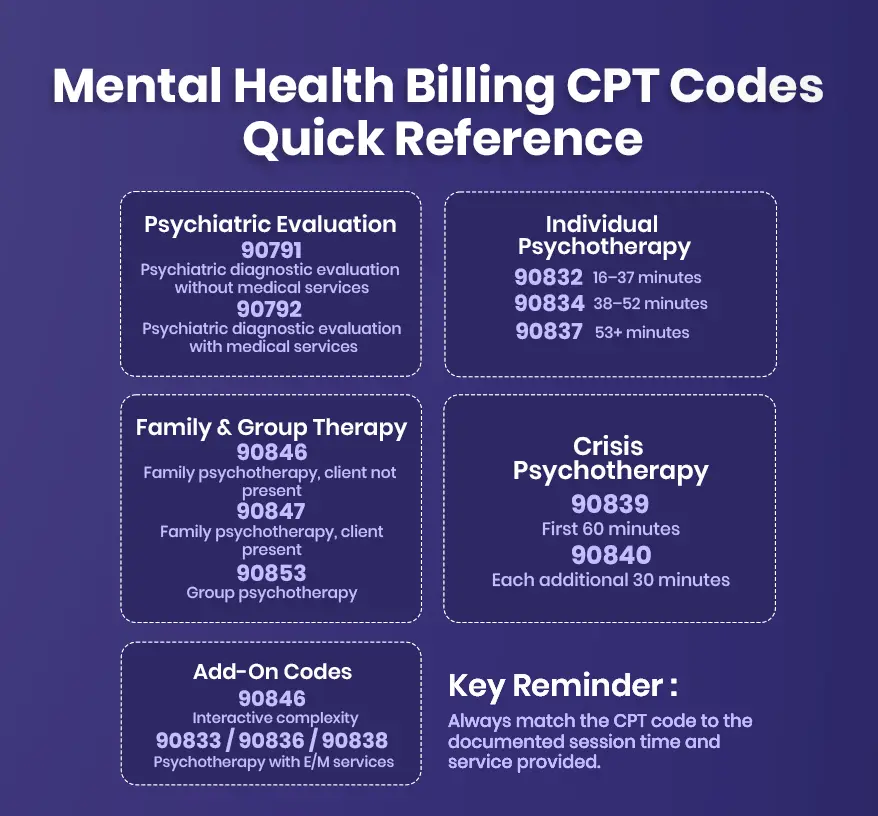
Psychiatric Diagnostic Evaluation
- 90791 – Psychiatric diagnostic evaluation without medical services. The standard intake code for licensed therapists, psychologists, and clinical social workers who don’t prescribe.
- 90792 – Psychiatric diagnostic evaluation with medical services. Used by psychiatrists and psychiatric nurse practitioners when the evaluation includes a medication review or physical assessment.
Most payers, Medicare included, only allow 90791/90792 once every six months per episode of care. Commercial payers often cap it at once a year. Bill an evaluation code more often than that without documenting a genuinely new clinical episode, and you’re inviting exactly the kind of pattern that triggers a Targeted Probe and Educate (TPE) audit.
Individual Psychotherapy – The Time-Based Codes
This family drives the majority of outpatient mental health billing revenue and also the majority of the errors:
- 90832 – Individual psychotherapy, 16–37 minutes (the 30-minute code)
- 90834 – Individual psychotherapy, 38–52 minutes (the 45-minute code, and the one billed most often)
- 90837 – Individual psychotherapy, 53 minutes or longer (the 60-minute code)
Here’s the rule that trips up more practices than anything else in this entire guide: you have to meet the lower threshold of a time range to bill that code. A 52-minute session is 90834, not 90837 billing 90837 for a 52-minute session counts as upcoding, even when it’s an honest mistake. Going the other direction, an undocumented time that actually supported 90837 but got billed as 90834 is quiet revenue loss, since 90837 reimburses roughly 45% more than 90834 under Medicare. The fix isn’t glamorous, but it works: document exact start and stop times, or total face-to-face minutes, on every therapy note, no exceptions.
Family, Couples, and Group Therapy
- 90846 – Family psychotherapy without the client present
- 90847 – Family psychotherapy with the client present (typically the code used for couples therapy)
- 90853 – Group psychotherapy
Crisis Psychotherapy
- 90839 – Crisis psychotherapy, first 60 minutes
- 90840 – Crisis psychotherapy, each additional 30 minutes (an add-on code, always billed alongside 90839)
Add-On and Combination Codes
- 90785 – Psychotherapy add-on to address interactive complexity if a psychotherapy session includes elements such as play therapy with young children, the presence of an interpreter, or other complicating interactive factors
- 90833/90836/90838 – Psychotherapy add-on for prescribers who are conducting medication management and therapy during one office visit, which is added on to the primary evaluation and management code
Telehealth Modifiers and Place-of-Service Codes
Telehealth billing for mental health services layers its own set of rules on top of the CPT code itself:
- Modifier 95 – real-time audio-and-video telehealth
- Modifier 93 – audio-only telehealth
- Some payers still insist on the older GT modifier
- Place of service 10 – patient is at home
- Place of service 02 – patient is somewhere other than home
Using the incorrect modifier with an improper place-of-service code continues to be the most prevalent and most preventable error in behavioral health billing going into 2026, even as CPT expands its E/M codes specific for telehealth.
ICD-10 Codes: Why the Diagnosis Matters Just as Much as the Procedure
The procedure code (CPT code) informs the payer about the event. The diagnostic code (ICD-10-CM) informs the payer of the reason for the event. In behavioral health claims, both of these elements must be in sync, else the claim will fail due to the reason that it lacks the element of necessity, despite the fact that the coding may be technically correct.
ICD-10 codes used in behavioral health claims include mood disorders (codes F30-F39), anxiety disorders (codes F40-F48), post-traumatic stress disorder (PTSD) and other disorders related to trauma and stressors (codes F43-F48) and substance use disorders. The diagnosis listed in the claim should be supported by the actual information contained in the clinical documentation. Accurate medical coding services can also help practices maintain consistency between clinical documentation, ICD-10 codes, and submitted claims. An outdated or vague diagnosis is one of the most avoidable behavioral health billing errors.
The Mental Health Billing Process, Step by Step
Whether it’s handled in-house or by an outsourced partner, the mental health billing process generally moves through the same sequence:
- Eligibility and benefit verification – Prior to the first session being delivered, verify patient eligibility for their behavioral health benefits, co-pay, deductible information, and the coverage of whatever type of care being delivered, whether it be telehealth, group therapy, etc.
- Intake and assessment – The provider delivers the psychiatric evaluation (90791/90792) and determines the initial diagnosis.
- Session documentation. Subsequent sessions are all documented with times and contents, with an eye toward progress toward treatment goals.
- CPT and ICD-10 coding – The correct time-based CPT code gets matched to documented minutes, and the diagnosis code is checked to make sure it’s current and supported.
- Claims scrubbing and submission – Prior to any submission, claims are scrubbed to payer specific edits and are submitted electronically via clearing house.
- Claim Adjudication – The claim is processed by the payer and either paid in full, partially paid, or denied with the release of an EOB or ERA.
- Payment posting – Payments get posted against the correct patient account and claim line.
- Denial management and appeals – Denied or underpaid claims get investigated, corrected where possible, and appealed within the payer’s filing window.
- Patient billing – Whatever’s left copay, coinsurance, deductible gets billed directly to the patient.
Honestly, practices that struggle with cash flow are almost always losing ground somewhere in steps six through eight, not in the earlier steps. That’s the stage where a dedicated behavioral health billing process, rather than a generalist approach, really pays for itself.
How to Bill Insurance for Mental Health Services
If you are setting up billing for a new practice, or bringing a new provider on board, here’s the practical order of operations:
- Get the provider credentialed and paneled first – No amount of correct coding rescues a claim submitted under a provider who isn’t enrolled with that payer yet.
- Verify benefits before the first visit, not after – Behavioral health benefits are frequently carved out to a separate vendor from the patient’s general medical insurance, and missing that carve-out is a surprisingly common cause of denials.
- Bill the evaluation code once, then transition to time-based therapy codes – Do not repeat 90791/90792 more often than the payer allows.
- Match the CPT code to documented time, every session, no exceptions.
- Apply the correct telehealth modifier and place-of-service code whenever a session isn’t in person.
- Submit claims promptly – Most payers have filing deadlines anywhere from 90 days to a full year from the date of service, and claims that are unsubmitted are one of the most preventable sources of lost revenue in this entire process.
- Track every claim through to adjudication – Submitted and paid are not the same thing someone has to actually be watching the difference between the two.
Behavioral Health Reimbursement Rates: What to Expect
There are many different reimbursement rates based on various factors like payer type, license type, geography and even whether the appointment was in person or virtually but here are some Medicare benchmarks for 2026 that can serve as a good baseline:
- Individual psychotherapy (90832, 90834, 90837): around $79 to $158, depending on how long the appointment is
- Psychiatric diagnostic evaluations (90791, 90792): around $174 to $202
90837 pays quite a bit more compared to 90834 usually at the rate of 45% or even more on Medicare and that is precisely the reason why precise time documentation is important.
Rates in commercial payers are generally higher than Medicare, and Medicaid and Medicaid managed-care rates are usually lower and vary greatly by state. Since CMS revises the Physician Fee Schedule annually, it might be best to look up the current rates using the CMS Physician Fee Schedule Lookup Tool instead of using last year’s numbers.
Since CMS revises the Physician Fee Schedule annually, practices should check the current rates using the official Medicare Physician Fee Schedule Lookup Tool instead of relying on previous-year rates.
Common Behavioral Health Billing Errors And the Claim Denials They Cause
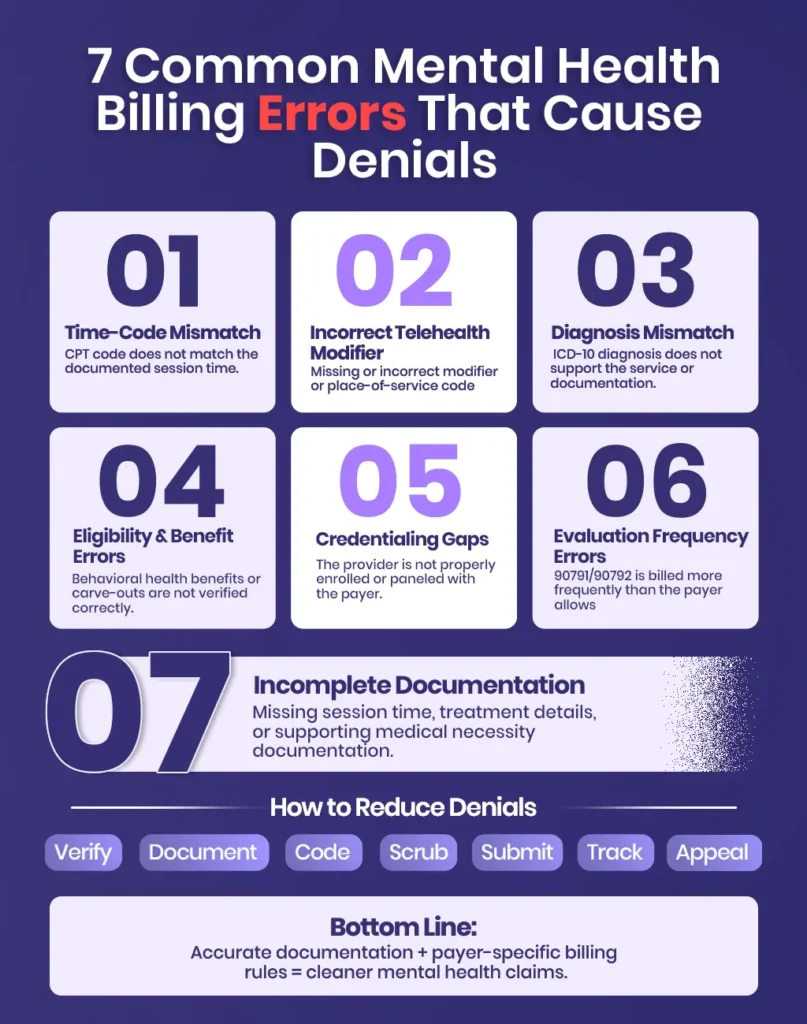
Most mental health billing denials come back to the same small, repeatable set of mistakes. If any of these sound familiar, you’re not alone; they’re the most common issues in the specialty by a wide margin.
Time-code mismatches – Billing 90837 for a session that actually ran 48 minutes is probably the single most common audit trigger in outpatient behavioral health billing. The fix isn’t complicated document exact time on every note but it’s the step practices skip most often when they’re busy.
Frequency violations on evaluation codes – Re-billing 90791 more often than the payer allows, without a documented new clinical episode, reliably triggers denials or recoupment requests down the line.
Missing or mismatched telehealth modifiers – A correct CPT code paired with the wrong modifier or place-of-service code gets treated by most payer systems as an incomplete claim, full stop.
Diagnosis codes that don’t support medical necessity – An ICD-10 code that’s outdated, too vague, or unrelated to what’s actually in the session note is a fast way to get a claim flagged.
Credentialing gaps – Services rendered by a provider who isn’t yet paneled with a given payer or who quietly lost network status and nobody caught it generate denials that have nothing to do with how good the coding was.
Same-day billing without specific documentation – It is acceptable to bill both evaluation and a therapy session on the same day under the conditions of the same-day coding for most insurance companies. However, it should be noted that both services need to have separate and distinct documentation. There are no restrictions from CPT regarding this type of coding, but insurance companies examine it carefully, which results in frequent denials because of non-distinctive notes.
The add-on codes without a valid primary code – The add-on codes such as 90840 (additional time) or 90785 (interactive complexity) can only be used in conjunction with certain primary codes. Otherwise, these codes are denied automatically.
How Can Mental Health Practices Minimize Claim Denials?
This is the question that practice owners ask the most, and the straightforward answer is: denials in behavioral health billing are caused by the failure to tighten a few key controls, each time and again, for every single claim and not looking for a quick solution to the problem.
- Verify eligibility and behavioral health carve-outs before every new episode of treatment, not just at the point of service.
- Make time documentation consistent so that every chart entry will provide exact information on when the session started and ended or how many minutes were spent.
- Make sure you have pre-bill claim scrubbing that will check whether there is consistency between the time and the procedure code, appropriate use of the modifiers and correct matching of diagnosis and procedure.
- Audit evaluation code frequency against actual payer-specific limits instead of one internal rule of thumb applied to everyone.
- Review denial patterns monthly and strengthen your denial management process rather than addressing each claim in isolation. A denial reason that keeps showing up across multiple patients usually points to a fixable process gap, not a one-off clerical slip.
- Appeal within the payer’s filing window every time it’s warranted. A large share of behavioral health denials actually get overturned on appeal but only if someone files it before the deadline.
Using just a few of these on a consistent basis will result in reduced first pass denials in a very short period of time. It is not one major thing that can be done but rather a series of smaller things that are done all the time.
Behavioral Health Billing Guidelines Worth Treating as Non-Negotiable
A few standing guidelines are worth building into policy rather than leaving as case-by-case judgment calls:
- Document time on every time-based code, every session, with no exceptions for “regular” clients you’ve seen a hundred times.
- Confirm telehealth modifiers and place-of-service rules per payer they’re not universal, and a rule that’s correct for one commercial plan can be wrong for the next one.
- Keep diagnosis codes current; update them at treatment plan reviews instead of letting an intake diagnosis ride indefinitely.
- Separate documentation clearly whenever an evaluation and a therapy session happen on the same day.
- Reconcile credentialing status against active payer panels on a recurring schedule, not just once at initial enrollment and never again.
In-House Billing vs. Outsourcing: How to Actually Decide
It is this question that arises with almost all practices at one point, and there is no single answer but a useful way of looking at it. If the practice is small enough that someone can manage every single claim and every single denial as well as the time-bound nature of the credentialing process without the need for a second job, in-house billing makes perfect sense. As soon as the practice expands to having two or three clinicians, the numbers change, for the simple reason that the number of payor-specific regulations increases exponentially.
Outsourcing generally becomes necessary once denial management takes more time than it should, or if unresolved claims pile up for weeks because the practice simply could not find the time to follow up on them. The focus here is not so much on practice size but more on the attention that the billing process requires.
Practices that need additional support can consider outsourced medical billing services to manage claims, payment follow-up, and recurring billing issues.
Why Practices Outsource Mental Health Billing Services
Given how many payer-specific variables are in play time thresholds, modifier rules, frequency limits, credentialing status, plenty of practices eventually reach a point where handling billing internally is quietly costing more in denied and delayed revenue than an outsourced partner would ever charge. A specialized behavioral health billing service brings a few concrete advantages to the table:
- Specialty-specific expertise – A biller who works exclusively in behavioral health already knows the time-code thresholds and payer quirks, instead of treating mental health claims as a minor variation on general medical billing.
- Dedicated denial management – Instead of denials sitting in a queue until someone finally has time, a billing partner works them as a defined daily process, with appeals filed inside payer deadlines rather than after them.
- Credentialing support – Many behavioral health billing companies also handle payer enrollment and re-attestation, closing the gap between provider is licensed and provider is actually billable with a given payer.
- Reporting visibility – A good billing partner gives practice owners a clear, ongoing view of clean claim rate, days in A/R, and denial trends, the numbers that actually reflect financial health, not just a monthly revenue total that doesn’t explain itself.
Mental Health Insurance Billing: Where the Carve-Out Trap Hides
Here is a quirk that catches even experienced billers off guard: a patient’s medical insurance and their behavioral health insurance often are not administered by the same company at all. Large employers and plenty of commercial plans carve out behavioral health benefits to a separate managed care vendor, which means the payer ID printed right there on the medical insurance card can be the wrong one for a mental health claim entirely.
Why does this matter so much? Because an eligibility check run against the wrong payer comes back looking perfectly fine, yes, the patient has insurance while the claim itself later gets rejected because it was sent to the wrong administrator. A behavioral health-specific eligibility check, one that explicitly confirms which entity manages mental health benefits, catches this before the first session instead of after the first denial letter shows up.
A few other mental health insurance billing specifics worth keeping on your radar:
Session Limits
Some plans cap the number of covered therapy sessions per year, separate from any deductible or copay structure. Tracking session counts against plan limits avoids an unpleasant late-year surprise for both the practice and the patient.
Prior Authorization
Certain plans, particularly for intensive outpatient or higher levels of care, require prior authorization before treatment even starts. Skipping this step is one of the costlier behavioral health billing errors, since it can mean the entire episode of care goes unreimbursed, not just one session.
Parity Law Protections
The Mental Health Parity and Addiction Equity Act requires many plans to cover behavioral health services comparably to medical/surgical benefits. But comparable doesn’t mean identical in practice copays, visit limits, and network adequacy still vary enough plan to plan that per-plan verification remains necessary rather than optional.
Medicaid and Behavioral Health: A Category of Its Own
It’s worth calling out Medicaid separately, because behavioral health billing under Medicaid comes with its own layer of complexity on top of everything already covered. Coverage rules, prior authorization requirements, and even which CPT codes are reimbursable at all can vary significantly by state, and many states route behavioral health Medicaid claims through managed care organizations rather than the state directly which functions a lot like a carve-out. HCPCS Level II codes, like H0004 for certain counseling services, show up far more often on the Medicaid side than they do with commercial payers, and mixing up CPT and HCPCS conventions on a Medicaid claim is a common, avoidable source of rejections. If a practice serves a meaningful Medicaid population, it is worth having billing staff or a partner who specifically understands that state’s Medicaid behavioral health rules, not just general Medicaid billing.
Mental Health Billing Tips Worth Keeping on Hand
Below is a brief list of behaviors that consistently distinguish practices with clean claims from those struggling to fight denials on a monthly basis:
- Always treat your notes as billing documents, not only clinical documents after all, the life of the CPT code depends on the actual time notation in the time field.
- Check the patient’s eligibility once again when a new plan year begins, not only upon intake, as sometimes the patient’s insurance benefits or carve-out vendors may be silently changed by the end of December.
- Keep a running log of payer-specific quirks which plans require GT instead of 95, which ones cap 90791 frequency differently rather than relying on institutional memory that walks out the door when staff turns over.
- Don’t let claims sit unsubmitted past a few business days. The longer a claim waits, the more likely a filing deadline turns into a real risk.
- Reconcile ERAs against the fee schedule on a regular basis; underpayments are easy to miss when a claim is technically paid but paid less than the contracted rate.
- When a denial is a close judgment call, appeal it anyway. A meaningful share of behavioral health denials get overturned when the original documentation actually supported the billed code.
What Good Mental Health Billing Services Actually Deliver
When you’re evaluating outsourced mental health billing services, it’s worth judging them against a concrete set of deliverables rather than a vague promise of fewer denials. A strong behavioral health billing partner should be able to show you:
- A clean claim rate is the percentage of claims accepted on first submission without correction tracked and reported monthly, not just described anecdotally.
- Days in A/R kept low, meaning claims aren’t sitting unpaid for months on end.
- A defined denial turnaround process, with an actual stated window for investigating and appealing denied claims, rather than an open-ended one will get to it.
- Credentialing tracking is integrated with billing, so a lapsed panel status gets caught before claims start failing, not after a month of denials piles up.
- Transparent reporting a practice owner can genuinely read collection rate by payer, denial reasons by category, and reimbursement trends over time, not a spreadsheet that requires a translator.
Cost matters too, obviously, but it’s worth weighing against what a practice is currently losing to denials and unbilled sessions rather than judging it in isolation. A billing service that costs a percentage of collections but meaningfully raises the collection rate itself often pays for itself many times over, compared to an internal process that’s stretched too thin to chase every denial down.
How iSolve RCM Supports Mental Health Practices
Mental health practices need more than basic claim submission. They need a billing workflow that keeps coding, documentation, eligibility, payer requirements, and denial follow-up connected. iSolve RCM supports behavioral health providers with specialized revenue cycle management designed to help reduce billing errors and improve payment consistency.
- Mental Health Billing Support – We help manage the billing process from claim preparation and submission through payment posting and follow-up.
- Accurate CPT & ICD-10 Coding – Our billing workflows focus on matching documented services, session times, and diagnoses to the appropriate billing codes.
- Eligibility & Benefits Verification – We help verify coverage and behavioral health benefits before services are billed, including identifying potential payer or benefit issues.
- Denial Management – When claims are rejected or denied, our team reviews the underlying issue, makes appropriate corrections, and supports timely follow-up and appeals.
- Credentialing & Payer Enrollment – Proper provider enrollment is an important part of getting behavioral health claims processed correctly. We help practices maintain accurate payer and provider information.
- Telehealth Billing Support – Mental health practices can receive support with payer-specific telehealth billing requirements, including applicable modifiers and place-of-service considerations.
- A/R & Payment Follow-Up – We monitor outstanding claims and accounts receivable to help practices address unpaid or underpaid claims instead of allowing them to remain unresolved.
- Revenue Cycle Visibility – Ongoing billing and denial information can help practices identify recurring issues and strengthen their overall revenue cycle.
With iSolve RCM, mental health providers can spend less time managing billing complexities and more time focusing on patient care. Our goal is to create a more consistent billing process that supports cleaner claims, timely follow-up, and reliable reimbursement.
FAQs
Which are the most frequently billed CPT codes for mental health?
Commonly billed mental health CPT codes include 90791 and 90792 for psychiatric diagnostic evaluations, 90832, 90834, and 90837 for individual psychotherapy based on session length, 90846 and 90847 for family psychotherapy, 90853 for group psychotherapy, and 90839 and 90840 for crisis psychotherapy.
What is the difference between CPT 90834 and 90837?
They both constitute codes for individual psychotherapy, the only difference between them being the length of sessions. Code 90834 is used when the length of face-to-face time is from 38 to 52 minutes, whereas 90837 is applied if the session is 53 minutes or more.
What is the difference between 90791 and 90792?
Both codes involve a psychiatric diagnostic interview that does not involve any other service. 90791 is employed in cases where the diagnostic interview does not involve any medical service, while 90792 involves medical service.
How often can 90791 be billed?
Medicare generally permits 90791/90792 once every six months per episode of care, with documentation supporting a genuinely new clinical need for re-evaluation. Commercial payers commonly limit it to once per year, though it varies by plan.
Can 90791 and 90837 be billed on the same day?
Yes, if the two services were distinct and separately documented. There is no official edit for not being able to code these two together, but insurers do review same-date billing carefully, so documentation becomes very important in this situation.
Modifiers for telehealth mental health services?
Modifier 95 is used for real-time audio-visual telehealth and modifier 93 is used for audio-only telehealth. The older GT modifier may also be required for some commercial insurance plans. Combine modifier and use place of service 10 for a patient at home and place of service 02 for other patients.
Why do mental health claims get denied so often?
The most frequent causes are time-code mismatches, evaluation codes billed too often, missing or incorrect telehealth modifiers, diagnosis codes that don’t support medical necessity, and credentialing gaps with the billed payer.
How can a mental health practice reduce claim denials?
Standardize time documentation on every note, build a pre-submission claim scrub for modifier and diagnosis alignment, track credentialing status actively, audit evaluation code frequency against payer rules, and review denial patterns monthly rather than claim by claim.
Does 90837 pay more than 90834?
Yes. Because 90837 covers longer face-to-face time, it reimburses at a meaningfully higher rate under Medicare, often around 45% more than 90834 which is exactly why accurate session-time documentation directly affects revenue, not just compliance.
What is the difference between a behavioral health carve-out and standard medical insurance?
A carve-out means the patient’s mental health benefits are administered by a separate company from their general medical insurance. Verifying eligibility against the wrong entity is a common, avoidable cause of denials in mental health insurance billing.