

The patient arrives at the emergency room at 2 am experiencing chest pain symptoms. The technician performs a 12-lead ECG. The ER Physician interprets the result immediately while a cardiologist reinterprets the exact tracing the following day. This results in two readers interpreting the same tracing and two claims for CPT 93010. By default, Medicare will pay the initial submitted claim and reject the latter as a duplicate unless there was an altered interpretation impacting patient management documented in the latter claim.
CPT 93010 describes the physician interpretation and report of a routine 12-lead electrocardiogram (ECG), reported without any ECG tracing. This example highlights how a code valued at under $10 leads to numerous denied claims. The proper application of this code depends on its location, modifier selection and language used in the patient encounter note.
Let’s break down what the 93010 CPT code covers, how it differs from 93000 and 93005, what the report has to show and how to bill it in the office, the hospital and the emergency department.
What is CPT code 93010?
Routine ECG With Interpretation CPT code 93010 describes a standard ECG test with analysis and reporting for 12 or more leads performed by cardiologists. This CPT code describes the professional component of an electrocardiogram examination. The ECG tracing will be billed using another appropriate CPT code. The tracing itself (the technical component) belongs to whoever owns the equipment and employs the technician, which is usually a hospital.
Procedure code 93010 covers cognitive work rather than the technical component of ECG interpretation. Physicians such as cardiologists, ER physicians, hospitalists and other certified trained billers documents the use of CPT 93010 upon interpretation and written reporting of a separately identifiable electrocardiogram reading, based on current Medicare and private payer guidelines.
CPT code 93010 description
The CPT code 93010 description reads: electrocardiogram, routine ECG with at least 12 leads; interpretation and report only. Each part of the 93010 CPT code description matters for billing:
- “Routine ECG” means a standard resting electrocardiogram, not a stress test, Holter recording or rhythm strip.
- “At least 12 leads” means a 3-lead or 6-lead rhythm strip does not qualify. Rhythm strips use 93040 to 93042.
- “Interpretation and report only” means the physician did not perform the tracing and the claim covers only the read.
Combine all three sections above, and the definition of 93010 CPT code clearly states when this code applies and when it does not.
What does “interpretation and report” mean for 93010?
CPT 93010 reimbursement mandates an interpretation of the electrocardiogram results along with the reporting of significant findings. An interpretation is considered to be fully documented if it is present within the record and signed off on as being true to the results obtained from the ECG test performed. However, there is no need for a specific page in the chart dedicated to interpreting an ECG test. A glance at the tracing, a co-signature on the machine’s computer read or a note that says “ECG reviewed” does not meet the cpt 93010 description. The report is the service, so without a report there is nothing to bill.
CPT 93010 vs 93000 vs 93005: which ECG code applies?
The 3 routine ECG codes split one service into its parts. CPT 93000 is the global ECG (tracing plus interpretation), CPT 93005 is the tracing only and CPT 93010 is the interpretation and report only. The table below shows who usually bills each one.
| Code | What it covers | Who usually bills it | Medicare PC/TC indicator |
|---|---|---|---|
| 93000 | Tracing, interpretation and report (global) | A physician office that owns the ECG machine and reads the tracing | 4 (global test only) |
| 93005 | Tracing only (technical component) | The hospital or facility that performs the ECG | 3 (technical component only) |
| 93010 | Interpretation and report only (professional component) | The physician who reads an ECG performed elsewhere | 2 (professional component only) |
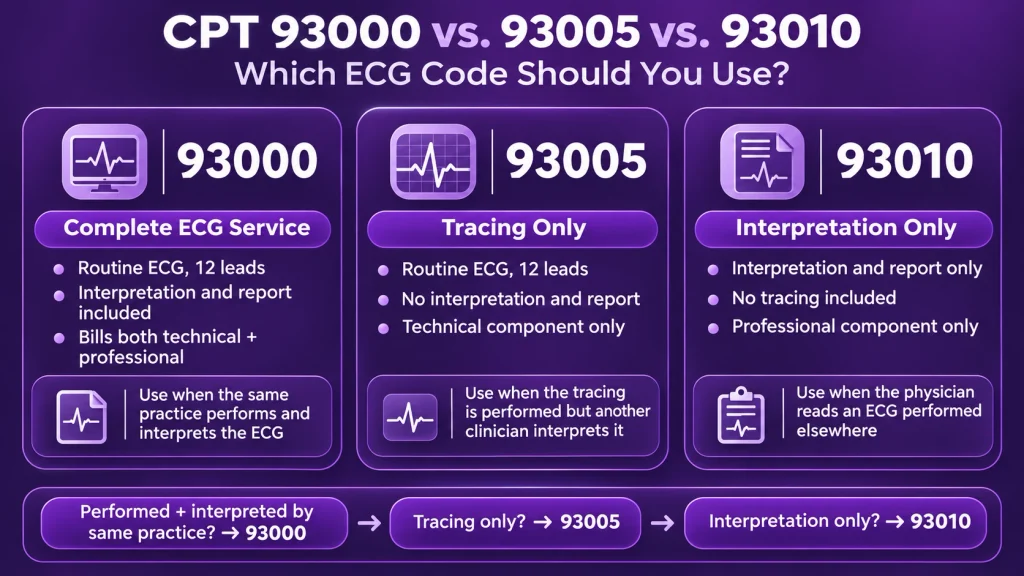
The split matters because 93005 plus 93010 equals 93000. A provider who bills 93000 cannot add 93010 for the same tracing, and a physician who only reads the ECG cannot bill 93000.
Which ECG code does each care setting bill?
The place of service decides the split. Here is how 93010 lines up with the most common settings:
| Setting | Facility or practice bills | Physician bills |
|---|---|---|
| Physician office with its own ECG machine | Nothing separate | 93000 (global) |
| Hospital outpatient or emergency department (POS 22 or 23 for professional claims) | The technical ECG service may be reported using 93005 on the applicable institutional claim, subject to facility and payer billing requirements | 93010 when a separately reportable interpretation and report are furnished |
| Hospital inpatient (POS 21) | Tracing is included in the inpatient payment | 93010 |
| Office physician reading an outside tracing | The office that ran the ECG bills 93005 | 93010 |

If the physician is employed by the hospital and the hospital bills professional services on the physician’s behalf, the 93010 line still goes on the professional claim (CMS-1500 or 837P), not on the facility claim.
Can 93005 and 93010 be billed for the same ECG?
CPT Codes 93005 and 93010 can be assigned to the same electrocardiogram when billed separately as technical and professional components according to payer guidelines. Code 93000 refers to the comprehensive electrocardiogram that consists of tracing, interpretation and reporting performed by an eligible provider of both technical and professional components simultaneously. Hospital electrocardiograms could be charged on separate facility and professional bills despite hospital employment of the rendering physician. Code 93000 should not be billed jointly with 93005 and 93010. The Medi-Cal cardiology manual also limits each component set to once per patient, per day, per occurrence, and caps the combined 93005 and 93010 payment at the 93000 rate.
Does CPT code 93010 need a modifier?
CPT code 93010 does not need modifier 26 or modifier TC, because the code is already professional-component-only. Medicare assigns 93010 a PC/TC indicator of 2, which means the professional component has its own code. Appending 26 to 93010 is redundant, and appending 26 or TC to 93000 is wrong because 93000 is a global-only code with its own component codes. The Medi-Cal cardiology manual states the same rule: 93000 is not reimbursable with a split-bill modifier.
A few commercial payers still publish their own modifier rules, so check the payer policy when a 93010 line rejects with a modifier edit. For Medicare, the clean claim is 93010 with no modifier in most cases.
When do modifiers 76 and 77 apply to 93010?
Two modifiers do come up with 93010, and both relate to more than one ECG read on the same date:
Modifier 76 (repeat procedure by the same physician): Use 76 when the same physician interprets a second, separate ECG on the same day, for example serial ECGs 3 hours apart for a chest pain rule-out. Each tracing needs its own time and its own report. The Medi-Cal manual allows separate payment for multiple ECGs at different times on the same date when billed with modifier 76.

Modifier 77 (repeat procedure by another physician): Use 77 when a different physician interprets the same tracing and that second read directly contributes to diagnosis or treatment. First Coast Service Options requires modifier 77 on second-interpretation claims for 93010 in the emergency room.
A repeat ECG run only because the first tracing was technically poor is not a second service. Bill one 93010 for the usable tracing.
What documentation supports CPT 93010?
A billable 93010 report is a signed, dated interpretation that describes the tracing’s key findings and ends with a clinical impression. Coding guides and payer auditors look for these 7 elements in the report:
- Patient identifiers and the date and time of the tracing.
- Heart rate and rhythm (for example, sinus rhythm at 78 bpm).
- Axis.
- Intervals: PR, QRS duration and QT or QTc.
- ST segment and T wave findings, including any acute changes.
- Comparison with a prior ECG when one is available.
- A clinical impression (normal ECG, or abnormal with the specific finding) and the physician’s signature.
These seven elements provide a useful documentation checklist, but they are not a universal set of mandatory requirements for every ECG interpretation. A separately reportable interpretation must include sufficient findings, relevant clinical information and a documented conclusion. Comparisons with previous ECGs should be included when available and clinically relevant. Documentation must meet the applicable payer’s requirements.
Documentation is key: The computer-generated read printed at the top of the tracing is not the physician’s interpretation. If the physician agrees with it, the report still needs the physician’s own statement, such as “Sinus tachycardia at 112, no acute ST changes, QTc 448, unchanged from 3/14 tracing,” plus a signature.
What does not count as a 93010 interpretation?
These 4 situations look like interpretations but do not support a separate 93010 claim:
- “EKG reviewed” or “ECG unremarkable” written inside the E/M note with no separate report.
- A physician initialing the machine read without adding findings.
- Over-reads done for hospital quality review under hospital policy.
- A second read of a tracing that another physician already interpreted, when the second read did not change care.
Each of these is either part of the E/M visit or not a billable service at all.
Which ICD-10 codes support medical necessity for 93010?
CPT 93010 needs a diagnosis that explains why the ECG was ordered, such as a symptom, a cardiac condition, a drug being monitored or a preoperative evaluation. Medicare does not pay for a routine screening ECG outside the Welcome to Medicare visit, so the diagnosis carries the claim. Common pairings include the following:
| Reason for the ECG | ICD 10 CM examples |
|---|---|
| Chest pain | R07.9 (chest pain, unspecified); R07.89 (other chest pain) |
| Palpitations or abnormal heartbeat | R00.2 (palpitations); R00.0 (tachycardia, unspecified) |
| Shortness of breath | R06.02 (shortness of breath) |
| Syncope or dizziness | R55 (syncope and collapse); R42 (dizziness and giddiness) |
| Known arrhythmia | I48.91 (unspecified atrial fibrillation); I49.9 (cardiac arrhythmia, unspecified) |
| Hypertension or coronary disease | I10 (essential hypertension); I25.10 (atherosclerotic heart disease without angina) |
| Electrolyte imbalance | E87.6 (hypokalemia); E87.5 (hyperkalemia) |
| Preoperative cardiac evaluation | Z01.810 (encounter for preprocedural cardiovascular examination), plus the condition driving surgery |
Code to the highest specificity the documentation supports. A confirmed finding on the ECG, such as atrial fibrillation, can be coded once the physician states it in the interpretation.
For the Initial Preventive Physical Examination (Welcome to Medicare visit), the screening ECG uses HCPCS codes instead of 93000 to 93010: G0403 (global), G0404 (tracing only) and G0405 (interpretation and report only).

How much does CPT 93010 pay?
The 2026 Medicare national payment for CPT 93010 is about $8.35, based on roughly 0.25 total RVUs (0.17 work RVUs) and the $33.4009 conversion factor. Because 93010 is a professional-only service, the facility and non-facility amounts are nearly the same. Your actual payment changes with the geographic adjustment for your locality.
Commercial rates run higher. PayerPrice’s published-rate benchmarks list national averages of $11.07 (BCBS/Anthem), $11.11 (UnitedHealthcare), $12.23 (Aetna) and $13.39 (Cigna) for 93010. Your contracted rate is the number that counts, so pull it from your fee schedule before you set write-off thresholds.
For 2027, the Medicare Physician Fee Schedule lowers the non-qualifying APM conversion factor to $32.6286, a 2.31% decrease from 2026. With CPT 93010 retaining 0.17 work RVUs and approximately 0.25 total RVUs, the calculated national Medicare payment is approximately $8.16 before geographic adjustments. Actual reimbursement depends on locality, provider status and applicable Medicare payment policies.
At about $8 per read, one 93010 denial is rarely worth an appeal on its own. A hospitalist group reading 30 ECGs a day, however, bills more than 10,000 interpretations a year, so a 10% denial rate costs about $9,000 a year at the national rate and is a pattern worth fixing at the source.
How do you bill 93010 in the emergency department?
In the emergency department, the hospital bills 93005 for the tracing and one physician bills 93010 for the interpretation that contributed to the patient’s diagnosis and treatment. CMS guidance in the Medicare Claims Processing Manual (Chapter 13, Section 100.1) pays the interpretation that directly contributes to care, and Medicare contractors usually pay the first claim received.
First Coast Service Options explains the second-read rules in its 93010 emergency room guidance:
- A later claim for the same ECG interpretation on the same date is denied as a duplicate.
- A second interpretation is paid only in unusual circumstances, such as a questionable finding that needs a cardiologist’s expertise or a second read that changes the diagnosis.
- The second claim needs modifier 77, and both physicians document their interpretation and their role in the patient’s care.
- Modifier 77 is not appropriate for over-reads done as hospital quality checks.
- When an appeal of the second claim succeeds, the contractor can recoup the first claim that was paid.
That last point catches emergency groups off guard. A cardiology group that wins an appeal can trigger a recoupment from the emergency physician group, so the two groups need an agreed rule for who reads and who bills ED ECGs.
How to Avoid? Write a written ED ECG policy with the hospital and the reading groups. Name which physician’s interpretation is the billable one (usually the real-time read that guided care) and route cardiology over-reads to a non-billable quality workflow unless they change treatment.
Can you bill 93010 with an E/M visit on the same day?
Yes, a physician can bill 93010 with a same-day E/M visit when the ECG interpretation is a separate, signed report. 93010 is a diagnostic test with no global period, so Medicare does not require modifier 25 on the E/M just because an ECG interpretation is billed the same day. Some commercial payers do ask for it, so check their policy.
According to CPT evaluation and management guidelines, the reporting of ECG professional interpretation with code 93010 by a physician makes the subsequent counting of the same ECG as an ordered, reviewed, analyzed or independently interpreted data element ineligible in determining that physician’s E/M medical decision making. Absent any separate reporting of ECG professional interpretation, an eligible ECG review or interpretation may contribute toward E/M MDM as per the relevant guidelines. Documentation should establish E/M medical decision making or time.
CPT 93010 billing scenarios
These 5 scenarios cover the settings where 93010 most often goes right or wrong:
Scenario 1: Office ECG with the practice’s own machine. A family physician runs and reads a 12-lead ECG for new palpitations. Code: 93000 with R00.2. Not 93010, because the practice performed the tracing.
Scenario 2: Hospitalist reading an inpatient ECG. A hospitalist interprets a morning ECG for a patient admitted with hypokalemia and writes a full report showing U waves and a QTc of 492. Code: 93010 with E87.6, POS 21. The hospital’s tracing is included in the inpatient payment.
Scenario 3: Emergency physician read plus cardiology over-read. The emergency physician’s read guides the chest pain workup. The cardiologist over-reads the next morning for the hospital’s quality program. Code: 93010 for the emergency physician only. The cardiology read is not billable.
Scenario 4: Serial ECGs by the same physician. A chest pain patient in observation gets ECGs at 08:00 and 11:00, both read and reported by the same cardiologist. Code: 93010 and 93010-76, each with its own report and time.
Scenario 5: Preoperative ECG read for an outside surgery center. A cardiologist interprets a pre-op tracing sent from an ambulatory surgery center that performed the ECG. Code: 93010 with Z01.810 plus the condition requiring surgery. The surgery center bills 93005 if it bills the tracing at all.
Common CPT 93010 denials and how to avoid them
Most 93010 denials come from 6 repeat mistakes:
Billing 93010 with 93000. The same provider bills the global code and the interpretation for one tracing, and the 93010 line denies as bundled. How to Avoid? Bill 93000 alone when the practice performed and read the ECG.
Appending modifier 26. Adding 26 to 93010 or 93000 triggers modifier edits. How to Avoid? Bill 93010 without 26 for Medicare and follow the payer’s written policy for commercial plans.
No separate report. “ECG reviewed” inside the progress note fails an audit. How to Avoid? Use an interpretation template that captures rate, rhythm, axis, intervals, ST-T findings, comparison and impression.
Screening diagnosis. Routine exam codes such as Z00.00 do not support a diagnostic ECG for Medicare and lead to medical necessity denials (CO-50). How to Avoid? Link the symptom or condition that prompted the ECG, or use G0403 to G0405 for the IPPE screening ECG.
Duplicate ED claims. Two physicians bill 93010 for the same ED tracing and the later claim denies. How to Avoid? Agree on who bills ED reads and use modifier 77 only when the second read changed care.
ECG billed with a stress test. A resting ECG taken as part of a cardiovascular stress test (93015 to 93018) is included in the stress test. How to Avoid? Do not bill 93000 to 93010 for the baseline tracing of a stress test by the same provider on the same date.
Fix these 6 at the front end and most 93010 claims pay on the first pass.

Conclusion
CPT 93010 covers one thing: the physician’s interpretation and written report of a 12-lead ECG that someone else performed. Bill it without modifier 26, pair it with a diagnosis that explains why the ECG was done and make sure a separate, signed report exists for every read. In a physician office, CPT 93000 generally applies when the practice provides both the ECG tracing and interpretation. CPT 93010 applies when only the professional interpretation and report are separately billed. For hospital-based services, the professional and technical components follow the applicable physician and facility billing arrangements. In the emergency department, agree in advance on whose interpretation is the billable one. Get those 4 decisions right and this small code stops generating outsized denial work.
Frequently asked questions
What is CPT 93010?
CPT 93010 is the code for the interpretation and written report of a routine 12-lead electrocardiogram, billed by the physician who reads an ECG performed by another provider or facility.
What is the CPT 93010 description?
The CPT 93010 description is: electrocardiogram, routine ECG with at least 12 leads; interpretation and report only.
What is the difference between 93000 and 93010?
93000 covers the tracing plus the interpretation and report, while 93010 covers only the interpretation and report. A practice that performs and reads its own ECG bills 93000. A physician who reads an ECG done elsewhere bills 93010.
Do you use modifier 26 with 93010?
No. 93010 is already the professional-component-only code (Medicare PC/TC indicator 2), so modifier 26 is not needed. Check commercial payer policy if a plan publishes a different rule.
How much does Medicare pay for CPT code 93010?
The 2026 Medicare national payment for CPT code 93010 is about $8.35 before geographic adjustment. The 2027 amount depends on the final 2027 RVUs and the lower $32.63 conversion factor.
Can two physicians bill 93010 for the same ECG?
Usually not. Medicare pays the first interpretation received and denies later claims as duplicates. A second interpretation is paid only when it directly contributes to diagnosis or treatment and is billed with modifier 77.
Can I bill 93010 if I only reviewed the ECG during the visit?
No. A review noted in the E/M documentation counts toward medical decision making, not toward 93010. Procedure code 93010 needs a separate, signed interpretation and report.