

For more than 30 years, most obstetric billing in the United States followed one simple model. The practice managed the pregnancy, delivered the baby and provided postpartum care, then submitted one global code, usually 59400 or 59510, after delivery. That model ends on January 1, 2027.
The Medicare maternity care billing changes 2027 come from the American Medical Association’s CPT 2027 code set. The AMA’s CPT Editorial Panel, working with the American College of Obstetricians and Gynecologists (ACOG), deleted the global maternity codes. In their place is a structure that reports each phase of care separately:
- Antepartum care
- Labor management
- Delivery
- Postpartum care
The AMA approved the new CPT maternity coding structure for 2027. CMS addressed the new services and their Medicare payment treatment in the CY 2027 Medicare Physician Fee Schedule, effective January 1, 2027.
It’s important to understand the scope. These are CPT coding revisions that apply across payers, not changes created only for Medicare. Medicare covers relatively few pregnancies, but its fee schedule decisions shape how many Medicaid programs and commercial payers value services. Each payer still sets its own coverage, payment and claim-processing rules, and some have already published their own transition timelines.
For OB-GYN practices, this is one of the biggest coding shifts in years. Billing moves from one claim per pregnancy to many claims across the pregnancy. Documentation for prenatal visits now drives E/M levels. Labor gets its own codes. Pregnancies that span 2026 and 2027 need careful handling.
This guide covers:
- What’s changing and why
- The new, revised and deleted codes
- How each phase of care is now billed
- How to handle the transition
- How to prepare your practice
Quick Answer: What Are the Maternity Billing Changes for 2027?
Starting January 1, 2027, global maternity CPT codes are deleted and maternity care is reported by phase.
- Antepartum and postpartum visits: billed individually with E/M codes
- Labor management: four new codes (59080–59083)
- Delivery: new codes for vaginal birth (59431, 59432) and cesarean birth (59502, 59503)
- Other new codes: third- and fourth-degree laceration repair, cesarean hysterectomy and uterine tamponade
In total, 35 codes changed: 17 deleted, 12 new and 6 revised. Deleted codes leave the CPT code set on January 1, 2027. A temporary CMS transition flexibility may let payers accept 2026 codes for some pregnancies that began in 2026, depending on each payer’s rules.
What Are the Medicare Maternity Care Billing Changes for 2027?
The AMA CPT Editorial Panel restructured the Maternity Care and Delivery section of CPT for 2027. Instead of bundling an entire pregnancy into one code, the new framework reports four phases of care separately.
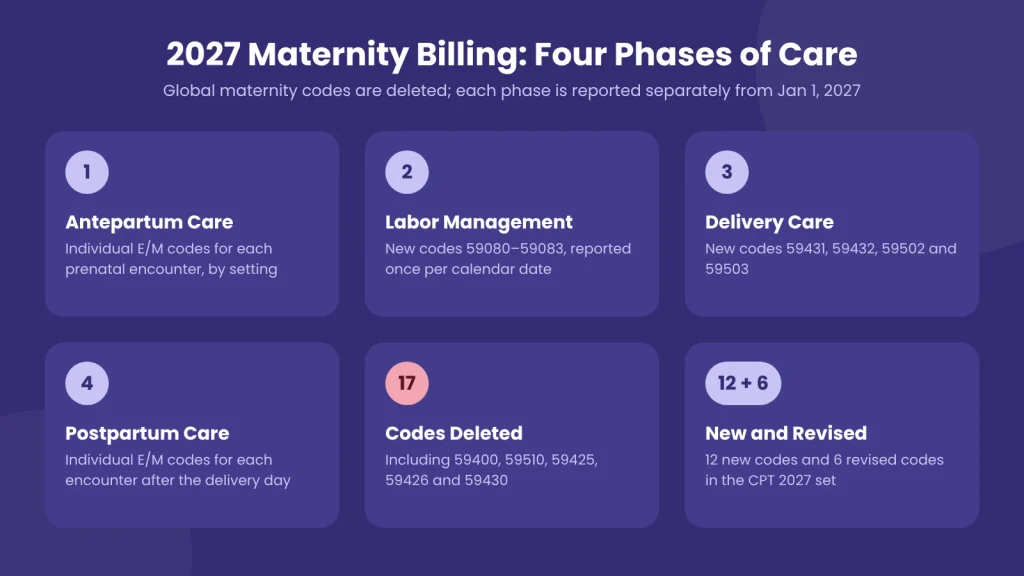
| Phase of care | How it’s reported starting January 1, 2027 |
| 1. Antepartum care | Individual E/M codes for each encounter, based on setting (office, hospital or telehealth) |
| 2. Labor management | New codes 59080–59083, reported once per calendar date |
| 3. Delivery care | New delivery codes: 59431, 59432, 59502, 59503 |
| 4. Postpartum care | Individual E/M codes for each encounter after the delivery day |
The new structure better reflects how maternity care works today. Many pregnancies involve:
- A team of physicians, midwives and advanced practice providers
- Maternal-fetal medicine (MFM) consultations
- Telehealth visits
- Hospital transfers
- Longer, more involved labor management
Separate reporting shows who did what, and when. It also gives payers and public health programs earlier and more detailed data on maternal care.
On the Medicare side, CMS addressed the new maternity services in the CY 2027 Physician Fee Schedule final rule, released November 4, 2026. CMS had also sought comment on creating Medicare-specific HCPCS G-codes to keep a global-style payment alongside the new codes. It didn’t finalize that alternative, so Medicare will use the CPT structure.
Why Is Global Maternity Billing Changing in 2027?
Limitations of the Traditional Global Maternity Package
The global maternity package combined routine antepartum visits, delivery and routine postpartum care into one code billed after delivery. It worked when one obstetrician typically managed the whole pregnancy. It fits poorly with current care patterns:
- Split care is common. One practice may provide prenatal care while a hospitalist group or another practice handles delivery. Practices then had to use partial-care codes and coordinate billing with each other.
- Transfers complicate billing. When a patient moves to another practice, changes insurance or transfers to a higher-level facility, global billing becomes hard to apportion.
- Visit counts drove payment. Antepartum-only billing depended on counting visits (4–6 or 7 or more), not on the complexity of each visit.
- Data was delayed. Payers often saw nothing until after delivery, which limited early identification of high-risk pregnancies.
Moving Toward Separate Reporting of Maternity Services
The 2027 structure addresses these issues:
- Visibility into each phase. Each prenatal visit, labor day, delivery and postpartum visit appears as its own service.
- Encounter-level accuracy. A complex prenatal visit can be coded at a higher E/M level than a routine one.
- Better maternal health tracking. Frequent claims with ICD-10-CM pregnancy codes give payers and states earlier insight into pregnancy risk and postpartum follow-up.
- Recognition of labor management. Labor care, which was buried in the global fee, is now separately reportable.
2027 Maternity CPT Code Changes: New, Revised and Deleted Codes
The 17 global and partial maternity codes are deleted from the CPT 2027 code set effective January 1, 2027. However, CMS issued temporary enforcement discretion allowing HIPAA-covered entities to use 2026 maternity codes for qualifying episodes that began in 2026 and continue into 2027, when permitted by payer-specific business rules. Practices should confirm each payer’s transition instructions before submitting claims.
Deleted Global Maternity CPT Codes
| Deleted CPT code | Previous billing purpose |
| 59050 | Fetal monitoring during labor by a consulting physician (supervision and interpretation) |
| 59400 | Global routine obstetric care, including vaginal delivery |
| 59409 | Vaginal delivery only |
| 59410 | Vaginal delivery with postpartum care |
| 59425 | Antepartum care only, 4–6 visits |
| 59426 | Antepartum care only, 7 or more visits |
| 59430 | Postpartum care only |
| 59510 | Global routine obstetric care, including cesarean delivery |
| 59514 | Cesarean delivery only |
| 59515 | Cesarean delivery with postpartum care |
| 59525 | Subtotal or total hysterectomy after cesarean delivery (add-on) |
| 59610–59622 | Global, delivery-only and delivery-with-postpartum services for vaginal birth or cesarean after a previous cesarean (59610, 59612, 59614, 59618, 59620, 59622) |
For example, CPT 59409 (vaginal delivery only) and CPT 59618 (global care for cesarean after attempted vaginal delivery following a previous cesarean) are both deleted in 2027. Their services are now reported with the new delivery and labor management codes.
New Maternity CPT Codes for 2027
Labor management
| Code | Description (summarized) |
| 59080 | Labor management, initial day, straightforward |
| 59081 | Labor management, initial day, complex |
| 59082 | Labor management, subsequent day, straightforward |
| 59083 | Labor management, subsequent day, complex |
Vaginal delivery
| Code | Description (summarized) |
| 59431 | Vaginal delivery, with or without episiotomy |
| 59432 | Vaginal delivery after previous cesarean (VBAC) |
Cesarean delivery
| Code | Description (summarized) |
| 59502 | Primary cesarean delivery |
| 59503 | Repeat cesarean delivery |
| 59504 | Hysterectomy following cesarean delivery |
Laceration repair and postpartum procedures
| Code | Description (summarized) |
| 59433 | Repair of third-degree laceration or episiotomy |
| 59434 | Repair of fourth-degree laceration or episiotomy |
| 59623 | Uterine tamponade for postpartum hemorrhage |
These are summaries. Use the full descriptors in the CPT 2027 code set and the AMA’s maternity care guidelines when coding.
Revised Maternity CPT Codes
Six existing codes were revised: 59051, 59300, 59412, 59414, 59898 and 59899. They cover services such as:
- Fetal monitoring interpretation by a consulting physician
- Episiotomy or vaginal repair by a clinician other than the delivering one
- External cephalic version
- Delivery of the placenta as a separate procedure
- Unlisted maternity procedures
Don’t assume a familiar code works the same way it did in 2026. Read each revised descriptor and its guidelines. For example, 59300 is now reportable only for first- or second-degree repairs by an unrelated clinician who meets CPT reporting requirements. Repairs by the delivering clinician, or an eligible clinician in the same group, are included in the delivery code.
Quick Crosswalk: Old Model vs. 2027 Model
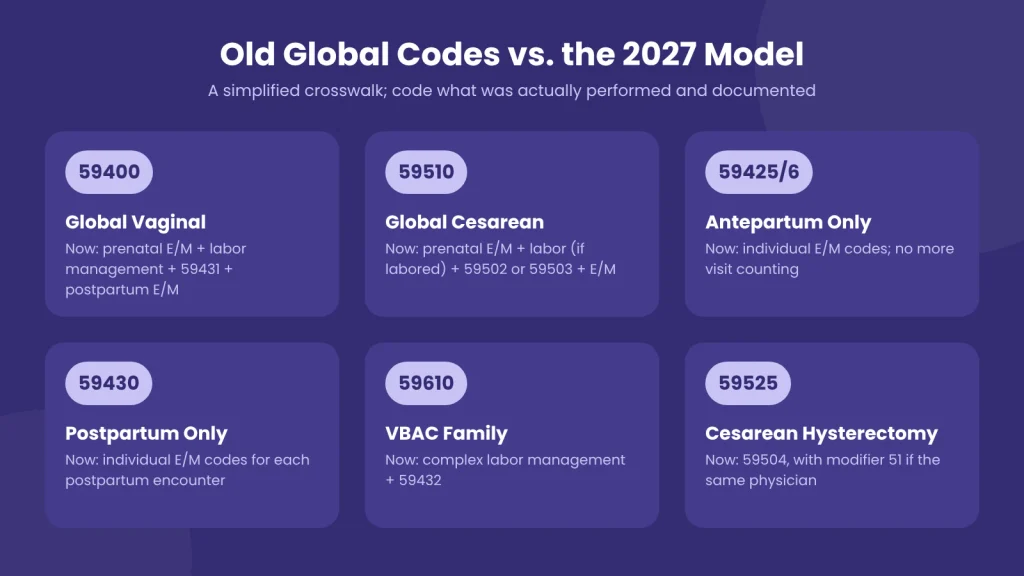
| What you used to bill | What you report from January 1, 2027 |
| 59400 (global vaginal) | E/M for each prenatal visit + labor management (if applicable) + 59431 + E/M for postpartum visits |
| 59510 (global cesarean) | E/M for each prenatal visit + labor management (if labored) + 59502 or 59503 + E/M for postpartum visits |
| 59409 / 59410 | 59431 (plus labor management and postpartum E/M as applicable) |
| 59425 / 59426 | Individual E/M codes for each antepartum encounter |
| 59430 | Individual E/M codes for each postpartum encounter |
| 59610–59614 (VBAC) | 59432 + complex labor management + E/M services |
| 59618–59622 (cesarean after attempted VBAC) | Complex labor management + 59503 + E/M services |
| 59525 (cesarean hysterectomy add-on) | 59504 |
This crosswalk is a simplified guide, not a one-to-one replacement table. Coding always depends on the services actually performed and documented.
How Will Antepartum and Prenatal Care Billing Change in 2027?
Reporting Prenatal Visits With E/M Codes
From January 1, 2027, each antepartum encounter is reported with the E/M code that fits the setting:
- Office or outpatient visit codes (99202–99215)
- Hospital or observation codes when the patient is seen in the hospital
- Telemedicine codes for virtual visits
Standard E/M rules apply. Providers select the level by medical decision making (MDM) or total time on the date of the encounter, and neither method takes priority. When using time, document a single total, not a range.
Each visit is coded on its own merits. A routine visit at 16 weeks won’t necessarily be coded at the same level as a visit at 34 weeks for a patient with gestational hypertension.
The AMA clarifies that normal pregnancy may be counted as a problem addressed for E/M reporting. It is not classified as an acute, uncomplicated illness. For the problem-complexity element of MDM, it best fits the moderate category of a chronic illness with exacerbation, progression, or side effects of treatment. However, the final E/M level must still be supported by the applicable MDM elements or total time.
For more on how E/M levels are chosen, see our guide to CPT 99205.
Clinicians who can’t report E/M services should use the specific code for the service they provide. Examples include genetic counseling and medical nutrition therapy.
For MFM consultations, consultation codes may apply when the patient is referred for an opinion. If MFM takes over ongoing care, a new patient E/M code may apply when the patient hasn’t seen that subspecialty in the group within three years. Check how each payer treats MFM consultations.
What Happens to CPT Codes 59425 and 59426?
CPT 59425 (antepartum care only, 4–6 visits) and CPT 59426 (7 or more visits) were used when a practice provided prenatal care but didn’t deliver the baby. Both are deleted from the CPT code set effective January 1, 2027.
Reporting moves from visit-count bundles to encounter-level E/M codes. For 2027 dates of service, there’s no need to count visits. Each visit is billed as it happens, so practices get paid throughout the pregnancy rather than waiting until delivery.
Documentation Requirements for Prenatal Visits
Under the old global model, many practices relied on abbreviated notes or prenatal flowsheets. Those won’t support E/M levels in 2027. The AMA specifically warns that a flowsheet alone doesn’t support the E/M level billed. Each prenatal visit note should include:
- The patient’s pregnancy-related concerns and the reason for the visit
- Relevant history and risk assessment, including prior pregnancies and medical conditions
- Examination and clinical findings, such as blood pressure, fundal height, fetal heart tones and weight
- MDM elements or total time, whichever is used to select the level
- The care plan and follow-up, including tests ordered and referrals
Diagnosis coding matters too. ICD-10-CM guidelines direct Z34 codes (supervision of normal pregnancy) as first-listed for routine prenatal visits, and Z34 codes aren’t used with Chapter 15 O-codes. Z3A codes can add weeks of gestation. With many more maternity claims each year, accurate diagnosis coding becomes far more visible to payers.
New Labor Management CPT Codes: 59080, 59081, 59082 and 59083

Labor management is the biggest new concept in the 2027 structure. It covers the physician or QHP’s work during labor, which includes:
- Interim exams
- Monitoring and interpreting maternal and fetal data
- Managing induction or augmentation
Labor management applies only when the labor ultimately leads to delivery. A patient evaluated and sent home for false labor or Braxton-Hicks contractions is reported with the appropriate E/M code instead.
Initial-Day vs. Subsequent-Day Labor Management
- Initial day (59080 or 59081): the first calendar date of the facility admission on which labor management begins
- Subsequent day (59082 or 59083): each later calendar date
Each labor management code is reported once per calendar date. For facility reporting, the initial day is generally reported once per admission, similar to inpatient hospital care rules. A clinician who takes over care for medical necessity, such as an MFM physician after an escalation, may report an initial-day code.
When labor care is one continuous visit spanning midnight, it’s treated as one service and reported on one of the two dates. Labor management codes aren’t time-based, so prolonged service code 99418 isn’t used with them.
Once labor management begins, the same physician or QHP generally cannot separately report hospital E/M services for managing that patient on the same calendar day. An office or outpatient E/M service performed earlier that day may still be reportable when it is separately supported.
Multiple providers:
- Consultants: A consultant who doesn’t assume care reports E/M codes instead.
- Coverage: A covering physician’s service is treated as furnished by the physician they’re covering for.
- Escalation or transfer: Multiple labor management codes on one date are appropriate only when care escalates or transfers, not for routine handoffs.
- Hospital transfers: If a patient transfers from one hospital to another, each physician may report labor management for their own documented care.
Straightforward vs. Complex Labor Management
Straightforward labor management requires all of the following:
- A singleton, vertex presentation
- Routine maternal and fetal monitoring
- No physician or QHP intervention needed for fetal monitoring concerns
- Normal labor progression, or routine induction or augmentation
- Stable maternal medical conditions
- No prior cesarean delivery
Any deviation makes labor management complex. Common examples include:
- Twins or other multiples (complex by default)
- Non-vertex presentation
- Deteriorating maternal or fetal conditions
- Interventions for fetal monitoring concerns
- A trial of labor after cesarean (TOLAC)
Claim edits are expected to reject a straightforward and a complex labor code from the same physician on the same date, so pick one level per date.
When Should OB-GYN Practices Report Labor Management?
- Labor followed by vaginal delivery: Report labor management plus the vaginal delivery code. Both may be reported on the same date by the same clinician. CPT doesn’t require a modifier for this, but some payers may want one, such as modifier 51.
- Planned or scheduled cesarean: No labor management code applies. If a patient with ruptured membranes isn’t in labor and is awaiting a planned repeat cesarean, report hospital E/M services and then 59503. If labor starts before the cesarean, labor management may be reported instead of the hospital care code.
- Failed labor followed by cesarean: When a patient labors and then needs a cesarean, labor management can be reported for the labor, and the cesarean is reported with 59502 or 59503.
- TOLAC: A patient with a prior cesarean who attempts a vaginal birth qualifies for complex labor management. If the trial succeeds, report 59432. If it ends in cesarean, report 59503.
Fetal monitoring is included when the managing clinician monitors labor. A consultant’s separate interpretation is reported with 59051. Obstetric ultrasound remains separately reportable. Whether cervical dilation (59200) can be reported separately depends on whether it’s distinct from labor management and on payer rules.
2027 Vaginal and Cesarean Delivery Billing Changes
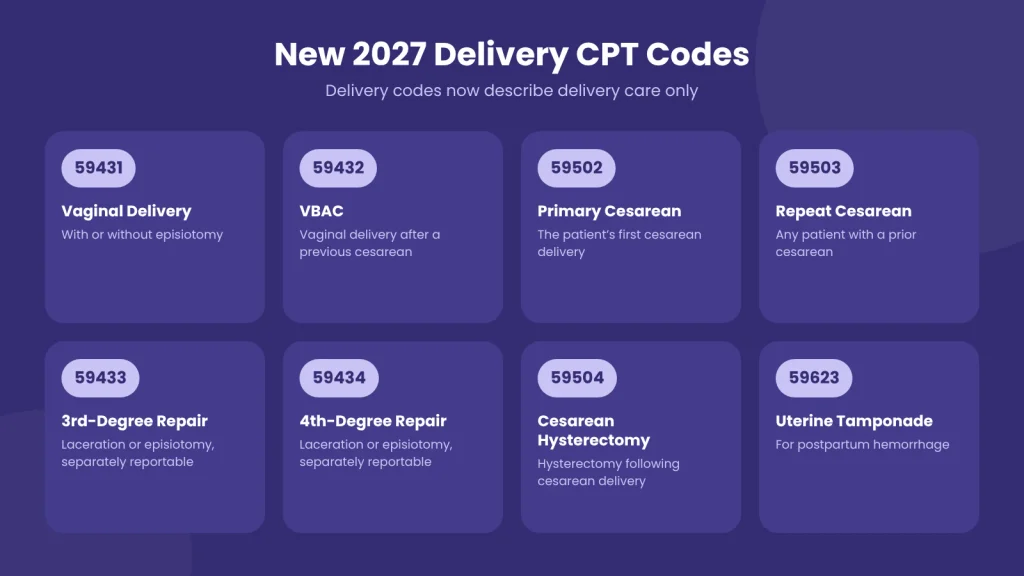
New CPT Codes for Vaginal Delivery
- 59431: Vaginal delivery, with or without episiotomy
- 59432: Vaginal delivery after previous cesarean (VBAC)
Both codes include delivery of the placenta and routine postpartum care on the same calendar day as delivery. Repair of first- or second-degree lacerations by the delivering physician or QHP, or an eligible member of their group, is included in the vaginal delivery code.
Vacuum-assisted deliveries use these same codes. Modifier 22 may be added when the work was substantially greater than usual and the documentation supports it.
Under the new structure, delivery codes describe delivery care only. They don’t depend on whether the same clinician provided prenatal or labor care. For multiple births, report one vaginal delivery code for each baby delivered vaginally.
Primary vs. Repeat Cesarean Section CPT Codes
- 59502: Primary cesarean delivery, the patient’s first cesarean
- 59503: Repeat cesarean delivery, for a patient who has had a cesarean before
Each code includes the incision, delivery of the baby and placenta, and closure. Report one cesarean code per delivery event, regardless of the number of babies. When a twin delivery is partly vaginal and partly cesarean, report one of each, with modifier 51 on the secondary procedure when the same physician performs both.
Labor management may be reported separately when the patient actually labored before the cesarean. Assistant surgeons continue to use modifier 80.
How Will VBAC and Repeat C-Section Billing Work?
The old VBAC-related family (59610–59622) is deleted. In 2027:
- Successful VBAC: complex labor management + 59432
- Cesarean after a failed trial of labor: complex labor management + 59503
- Cesarean in a patient whose only prior births were vaginal: 59502, even if she has delivered before
- Cesarean for a patient whose last delivery was a VBAC: 59503, because she still has a prior cesarean
Laceration Repair and Other Delivery-Related Procedures
| Service | 2027 reporting |
| First- or second-degree repair by the delivering clinician or an eligible clinician in the same group | Included in the delivery code |
| First- or second-degree repair by an unrelated clinician who meets CPT reporting requirements | 59300 |
| Third-degree laceration or episiotomy repair | 59433 (separately reportable) |
| Fourth-degree laceration or episiotomy repair | 59434 (separately reportable) |
| Delivery of placenta | Included in delivery codes; 59414 applies only in specific separate-procedure situations |
| Hysterectomy following cesarean | 59504 (with modifier 51 if the same physician does both) |
How Will Postpartum Care Billing Change in 2027?
Postpartum Visits Will Be Reported Separately
CPT 59430 (postpartum care only) is deleted. Postpartum care is now billed as individual services:
- Inpatient days after delivery: subsequent hospital care codes (99231–99233) for each day after the delivery day, then a discharge code (99238 or 99239). Critical care codes may apply when appropriate.
- Outpatient visits:
- Office visit codes (99202–99215)
- Telemedicine codes (98000–98015)
- Virtual check-ins (98016)
- Home or residence visit codes, when applicable
Is the Postpartum Visit Included in the Delivery Code?
Only routine postpartum care on the same calendar day as delivery is included in the delivery code. Every later postpartum encounter is reported separately. That includes:
- Postpartum blood pressure checks, reported as an E/M service based on who performed it. A nurse-only visit is typically 99211.
- The comprehensive postpartum visit, reported with the E/M code that fits the service and documentation.
- Visits for postpartum complications, such as infection, hypertension or mood concerns.
Coverage periods, such as Medicaid postpartum coverage windows, are set by each program’s policy and are separate from coding rules.
New CPT Code 59623 for Uterine Tamponade
CPT 59623 reports uterine tamponade used to manage postpartum hemorrhage. Tamponade can use a balloon, catheter, vacuum device or packing. Medication-based management is separate and isn’t reported with this code. Existing codes for postpartum curettage and hysterorrhaphy remain available.
Document the type of device, the indication, the time placed and removed, and the clinical response.
How Should OB-GYN Practices Handle the 2026–2027 Transition?
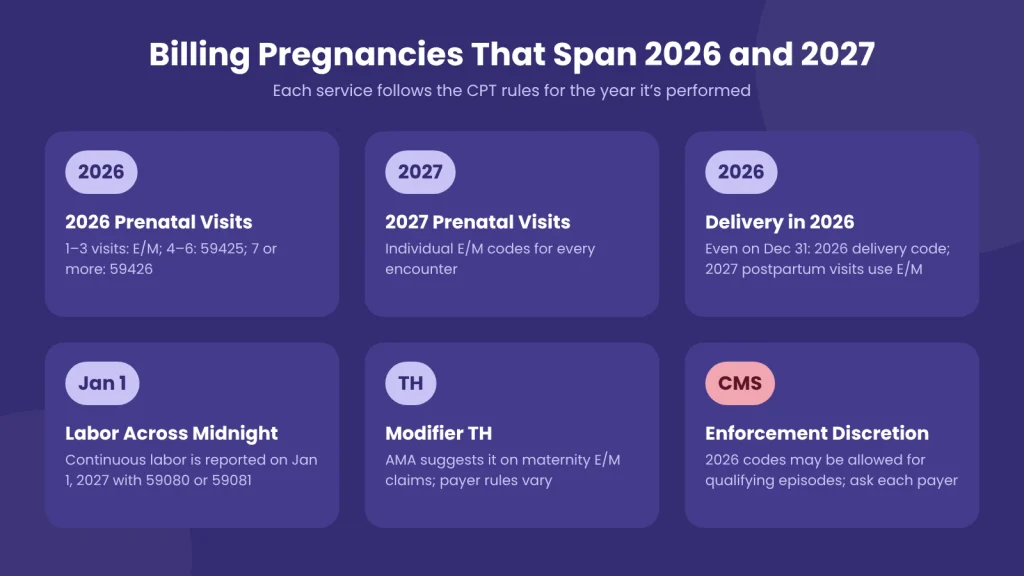
Many patients who are pregnant now will deliver in 2027. The AMA’s guidance is that each service follows the CPT rules for the year it’s performed. Payer transition rules, including any use of CMS’s temporary enforcement discretion, can affect how those services are billed.
Prenatal Care Started in 2026 but Continues in 2027
- 2026 antepartum visits follow 2026 rules:
- 1–3 visits: individual E/M codes
- 4–6 visits: 59425
- 7 or more visits: 59426
- 2027 antepartum visits: individual E/M codes for every encounter
Example: A patient has five routine prenatal visits between August and December 2026 and is due in March 2027.
- 2026 visits: Report the five visits with 59425. This can be billed once the 2026 visit count is final, usually at the last 2026 encounter.
- 2027 prenatal visits: Report each visit with its own E/M code.
- Delivery and postpartum care: Report these with the new 2027 codes.
The AMA notes that you don’t need to wait for delivery to bill the 2026 antepartum services. Submitting promptly helps avoid timely filing problems with payers that have short deadlines. Non-routine visits for unrelated problems are excluded from the 2026 visit count and coded separately.
Delivery in 2026 With Postpartum Care in 2027
If the delivery happens in 2026, including on December 31, 2026, report the 2026 global or delivery code (for example, 59400). Postpartum visits on or after January 1, 2027, are reported with E/M codes. The AMA’s transition guidance suggests adding modifier TH to those postpartum E/M claims, but check each payer’s policy.
Labor That Crosses Midnight on December 31
If labor management is one continuous visit spanning December 31 and January 1, it’s treated as one service. According to the AMA, it’s reported on January 1, 2027, with 59080 or 59081. If care isn’t continuous, the December 31 activity may be reported with an initial hospital inpatient or observation E/M code. The AMA strongly advises checking with the payer in this situation.
What Should Practices Do With Claims Spanning Both Years?
- Review every date of service. The date of the service decides which CPT rules apply.
- Separate 2026 and 2027 encounters in your billing system.
- Check payer-specific transition policies. For example, Highmark began its own transition on October 1, 2026, for patients due on or after January 1, 2027. Some state Medicaid programs have issued their own guidance.
- Understand the CMS enforcement discretion. CMS’s temporary enforcement discretion lets HIPAA-covered entities use 2026 maternity codes for qualifying episodes that began in 2026 and continue into 2027, through December 31, 2027. This applies only where each payer’s business rules allow it. There’s no single national method, so confirm how each of your payers applies it.
- Don’t mix rules automatically. Don’t apply 2027 rules to 2026 services, or 2026 codes to 2027 services, unless a payer specifically instructs you to.
Medicare Reimbursement and Payer Considerations for 2027 Maternity Billing
How Will Medicare Payment Be Affected?
CPT defines the codes, and CMS decides how Medicare pays for them through the Physician Fee Schedule. The AMA/Specialty Society RVS Update Committee (RUC) submitted recommendations for the relative values of the new services to CMS. Those recommendations were designed with budget neutrality in mind, but actual Medicare payment depends on the final CMS-assigned RVUs, conversion factor, geographic adjustments and applicable payment policies.
Practices should review the 2027 Physician Fee Schedule rather than assume that their previous global maternity reimbursement will remain unchanged.
Payment for each service depends on:
- The RVUs assigned to each code
- Geographic adjustments (GPCIs)
- Facility vs. non-facility setting
- The 2027 conversion factor: $32.6286 for most clinicians and $32.9548 for qualifying APM participants
Because Medicare covers few pregnancies, the bigger effect is indirect. Many Medicaid programs and commercial payers use Medicare RVUs as the starting point for their own fee schedules.
Will Commercial Insurance and Medicaid Follow the Same Rules?
The CPT codes are the national coding framework, but each payer sets its own policies:
- Medicaid programs are publishing state-specific guidance, including how they’ll track postpartum coverage and pay under the new structure.
- Medicare Advantage plans may have their own edits and authorization rules.
- Commercial payers are updating fee schedules, policies and claim edits. Some started transitions in 2026.
Before January, get each major payer’s written guidance on:
- Accepted codes
- Required modifiers
- Authorization rules
- Transition handling
What Is Modifier TH in Prenatal Care Billing?
Modifier TH is a HCPCS Level II modifier for obstetrical services, prenatal or postpartum. The AMA recommends using modifier TH with applicable antepartum and postpartum E/M services to help identify maternity-related care and support the appropriate application of preventive-service cost-sharing protections under the Affordable Care Act. Actual claim handling depends on payer policies.
Modifier TH doesn’t replace maternity CPT codes or the Category II codes (0500F–0503F) used for quality tracking. It’s also not universally required. Some payers require it, some ignore it, and some have their own rules. Check each payer’s instructions before applying it.
How Should Practices Handle Global Maternity Fee Agreements?
Many payer contracts include a global maternity rate tied to 59400 or 59510. Those codes are deleted from the 2027 code set, so:
- Review contracts and fee schedules for references to deleted codes.
- Ask how payers will pay each phase, and how rates for the new codes and E/M visits compare with the old global value.
- Confirm new workflows, such as authorizations for labor or delivery, and how payers will apply cost-sharing to prenatal visits.
- Renegotiate where needed. The shift from one claim to many can change cash flow and patient balances.
Common Maternity Billing and Coding Mistakes to Avoid in 2027
- Reporting deleted global codes for 2027 dates of service without payer approval under a transition policy.
- Using visit-count rules (59425/59426) for 2027 prenatal visits.
- Misclassifying labor management. Any deviation from the straightforward criteria makes it complex.
- Reporting labor management for a scheduled cesarean with no labor.
- Billing hospital E/M on the same day once labor management has begun.
- Billing separately for services already included in delivery, such as placenta delivery or first- and second-degree repairs by the delivering clinician or an eligible group member.
- Missing separately reportable services, such as third- and fourth-degree repairs or later postpartum visits.
- Confusing primary and repeat cesareans. 59503 applies whenever the patient has had a prior cesarean.
- Misusing modifier TH, either leaving it off where a payer requires it or assuming every payer wants it.
- Applying 2027 rules to 2026 services, or the reverse.
- Thin prenatal documentation that doesn’t support the E/M level billed.
- Ignoring payer timely filing rules now that maternity care generates many more claims. Our guide to the Molina timely filing limit shows how much deadlines vary by payer and state.
How Can OB-GYN Practices Prepare for the 2027 Maternity Billing Changes?
Update Practice Management and EHR Systems
- Load the CPT 2027 code set and the new maternity codes.
- Deactivate deleted codes for dates of service on or after January 1, 2027. Keep them available for 2026 services and any payer-approved transition claims.
- Update charge-entry screens, superbills, order sets and claim templates.
- Build prenatal note templates that capture MDM or total time.
- Make sure your system can bill each prenatal visit as it happens.
Train Medical Billers and Coding Teams
- Teach the four phases of care and how each is reported.
- Train coders on the labor management criteria, the same-day E/M restriction and the new delivery codes.
- Review E/M documentation requirements with physicians, midwives and APPs.
- Walk through transition scenarios, using real patients due in early 2027.
Review Payer Contracts and Fee Schedules
- Confirm rates for the new codes and E/M visits.
- Get each payer’s transition, modifier and authorization rules in writing.
- Update patient financial counseling, since patients may see cost-sharing on individual visits depending on their plan.
Audit Maternity Claims Before Submission
- Check code selection and documentation for the first wave of 2027 claims.
- Review bundling rules and separately reportable services.
- Track denials and payment differences by payer from January onward.
A focused medical billing audit in the first quarter of 2027 can catch problems early, before they repeat across hundreds of claims.
How iSolve RCM Helps OB-GYN Practices Manage Maternity Billing Changes
The move from one global claim to many phase-specific claims puts new pressure on OB-GYN billing teams. iSolve RCM supports women’s health practices as part of our work across medical specialties, with:
- OB-GYN coding support through our medical coding services, including E/M level selection for prenatal and postpartum visits
- Maternity claim submission and follow-up through our medical billing services
- Denial management and appeals for new code and modifier denials through our denial management team
- A/R follow-up and payment posting as maternity revenue shifts across more claims
- Payer policy and documentation review to align workflows with each payer’s transition rules
- Billing workflow updates for the CPT 2027 requirements, supported by end-to-end revenue cycle management
For a broader look at outside denial support, see our guide to denial management companies in the USA.
Final Thoughts on the Medicare Maternity Care Billing Changes 2027
The Medicare maternity care billing changes 2027 mark the end of global obstetric billing. From January 1, 2027, prenatal and postpartum care are billed visit by visit with E/M codes. Labor management has its own codes, and delivery is reported with new, streamlined codes. Medicare addressed the new services in its 2027 fee schedule, and other payers are following with their own policies and timelines.
The practices that make this transition smoothly will be the ones that prepare now:
- Update systems and templates for the new codes and prenatal documentation
- Train coders and clinicians on the new rules
- Get written guidance from each payer, including how it handles the transition flexibility
- Handle 2026–2027 pregnancies carefully, date by date
The changes add claims and documentation work, but they also make each part of maternity care visible and separately recognized.
If your OB-GYN practice wants help preparing for the transition or managing maternity claims in 2027, iSolve RCM can support your billing team from the first prenatal visit through final payment.
Frequently Asked Questions About 2027 Maternity Care Billing Changes
What are the Medicare maternity care billing changes for 2027?
Starting January 1, 2027, the AMA’s CPT code set deletes global maternity codes and reports care by phase. That means E/M codes for prenatal and postpartum visits, new labor management codes and new delivery codes. CMS addressed Medicare payment for these services in the 2027 Physician Fee Schedule.
When do the new maternity CPT codes take effect?
The new codes take effect January 1, 2027. Services performed in 2026 still follow 2026 rules. CMS’s temporary enforcement discretion and individual payer policies may allow 2026 codes for some pregnancies that began in 2026, so check each payer’s transition rules.
Are global maternity billing codes being deleted in 2027?
Yes. These global and partial maternity codes are deleted from the CPT code set effective January 1, 2027:
59400, 59409, 59410
59425, 59426, 59430
59510, 59514, 59515
59610–59622
In total, 17 codes are deleted, 12 are added and 6 are revised.
What replaces CPT code 59400 in 2027?
No single code replaces 59400. Instead, practices report E/M codes for each prenatal visit, plus labor management codes (59080–59083) when applicable. The vaginal delivery itself is reported with 59431, and each postpartum visit after the delivery day gets its own E/M code.
What replaces CPT codes 59425 and 59426?
Individual E/M codes for each antepartum encounter replace them for 2027 dates of service. Each visit is coded by MDM or total time based on the setting, such as office, hospital or telehealth. Visit counting no longer applies to 2027 visits.
What are the new CPT codes for vaginal delivery in 2027?
The new codes are 59431, vaginal delivery with or without episiotomy, and 59432, vaginal delivery after previous cesarean (VBAC). Both include placenta delivery, same-day routine postpartum care, and first- and second-degree repairs by the delivering clinician or an eligible group member.
What is the new CPT code for primary cesarean delivery?
CPT 59502 reports a primary cesarean delivery, meaning the patient’s first cesarean. It includes the incision, delivery of the baby and placenta, and closure. Labor management may be reported separately if the patient labored first.
What is the new CPT code for repeat cesarean section?
CPT 59503 reports a repeat cesarean delivery for a patient who has had a prior cesarean. That includes a cesarean after a failed trial of labor, and a cesarean in a patient whose last delivery was a VBAC.
What are CPT codes 59080, 59081, 59082 and 59083 used for?
They report labor management that leads to delivery, once per calendar date:
59080: initial day, straightforward
59081: initial day, complex
59082: subsequent day, straightforward
59083: subsequent day, complex
Any deviation from the straightforward criteria, such as twins or a prior cesarean, makes labor complex.
How will prenatal visits be billed in 2027?
Each prenatal visit is billed with the E/M code that fits the setting and level, selected by MDM or total time. Documentation must support the level, because a prenatal flowsheet alone isn’t enough. Some payers require modifier TH on these E/M claims.
How will postpartum visits be billed in 2027?
Routine care on the delivery day is included in the delivery code. Later inpatient days use subsequent hospital care codes and a discharge code. Outpatient visits, including blood pressure checks and the comprehensive postpartum visit, are billed with E/M codes.
What does modifier TH mean in maternity billing?
Modifier TH identifies obstetrical services, prenatal or postpartum. The AMA recommends it on applicable maternity E/M claims to help identify maternity care and support preventive-service cost-sharing protections. It isn’t required by every payer, and claim handling depends on payer policy.
How should OB-GYN practices bill pregnancies that continue from 2026 into 2027?
Under CPT, bill each service under the rules for the year it’s performed:
2026 prenatal visits: 2026 rules (E/M, 59425 or 59426 by visit count)
2027 prenatal visits: E/M codes
Delivery in 2026: the 2026 delivery code, with E/M codes for postpartum visits in 2027
Some payers may allow 2026 codes under CMS’s transition flexibility, so check each payer’s rules.
Will Medicare and Medicaid follow the same maternity billing rules?
Both use the CPT 2027 codes, and CMS addressed Medicare payment in the 2027 Physician Fee Schedule. Each state Medicaid program, Medicare Advantage plan and commercial payer sets its own payment, modifier, authorization and transition rules. Review written guidance from each payer before January 2027.
Sources:
- American Medical Association: CPT 2027 Maternity Care Services Code Changes
- AMA: FAQs, Preparing for the CPT 2027 Maternity Care Services Code Changes
- AMA: FAQs, Coding Maternity Care Spanning the Transition Date
- AMA: FAQs, Coding Antepartum Care (Prenatal)
- AMA: FAQs, Coding Labor Management
- AMA: FAQs, Coding Delivery Care
- AMA: FAQs, Coding Postpartum Care
- AMA: AMA Applauds CMS Adoption of Modernized Maternity Care Codes
- AMA: 2027 Medicare Physician Payment Schedule Final Rule Summary
- Contemporary OB/GYN: CMS Includes AMA’s Obstetric Codes in 2027 Fee Schedule
- Highmark: Guidance on New Coding and Billing Model for Maternity Care
- Healthcare Training Leader: CMS 2027 Maternity Billing Crossover Relief
- Michigan MDHHS: Medicaid Provider Alert on Maternity Care Services (July 15, 2026)