

Evaluation and management (E/M) codes make up a large share of outpatient billing, and they’re also among the most frequently reviewed. Of the new patient office visit codes, the 99205 CPT code sits at the top. It describes the most complex level of new patient office or outpatient visit, so it carries the highest payment in the series and attracts the most scrutiny from payers.
Getting 99205 right means understanding how the code is selected. Providers can choose it based on high-level medical decision making (MDM) or total time on the date of the encounter. These are two separate pathways, not two requirements that must both be met. The documentation has to support whichever pathway is used, and the visit has to be medically necessary at that level.
Common problems with 99205 include:
- Choosing it for patients who aren’t truly new
- Documenting a long note that doesn’t show high MDM
- Counting time that doesn’t qualify
- Confusing CPT and Medicare prolonged service rules
This guide covers what 99205 means, its 2026 requirements, the time rule, documentation, RVUs and Medicare payment, how it compares with 99204 and 90792, and how to bill it correctly.
Quick Answer: What Is CPT Code 99205?
CPT code 99205 is used for an office or other outpatient evaluation and management visit for a new patient that requires a medically appropriate history and/or examination and a high level of medical decision making. When the code is selected based on time, at least 60 minutes of total physician or qualified health care professional (QHP) time must be met or exceeded on the date of the encounter. Providers can select 99205 using either high-level MDM or the time requirement.
In 2026, 99205 had a work RVU of 3.50. Its national Medicare baseline payment is about $236.81 in the office (non-facility) setting and about $160.32 in a facility setting, before geographic adjustment.
1. What Is CPT Code 99205?
CPT 99205 Description
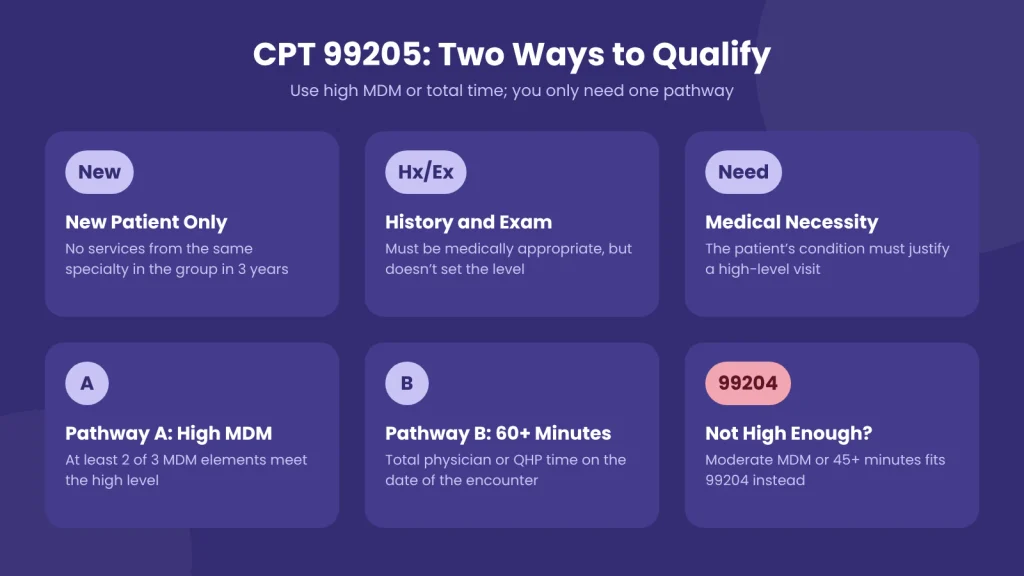
In plain language, CPT 99205 describes a new patient office or outpatient visit that requires:
- A medically appropriate history and/or examination, and
- High-level medical decision making, or
- At least 60 minutes of total time by the physician or QHP on the date of the encounter, when time is used for code selection.
Medicare’s short descriptor for the code reads “Office o/p new hi 60 min.” The minimum time for selecting 99205 is 60 minutes. The base-code time window is 60–74 minutes; when the encounter reaches 75 minutes or more, applicable prolonged-service reporting rules may apply.
Office or other outpatient services include visits in a physician’s office, a hospital outpatient department or another ambulatory setting. They don’t include inpatient or observation stays, emergency department visits or nursing facility visits, which have their own E/M codes.
What makes a patient “new”? Under CPT rules, a new patient is one who hasn’t received any professional services from the physician or QHP, or from another physician or QHP of the exact same specialty and subspecialty in the same group practice, within the past three years. A patient seen by a different specialty in the same group can still be new to you.
Medical necessity still applies. The patient’s condition has to justify a high-level visit. The level isn’t determined by how long the note is or how many systems were reviewed.
What Does 99205 Mean in Medical Billing?
In billing terms, 99205 is the highest-level new patient office visit. It tells the payer that the visit involved serious clinical problems, substantial analysis and higher-risk management decisions, or a substantial amount of provider time.
Because it pays more than 99202–99204, payers watch how often it’s billed. A practice with an unusually high share of 99205 visits compared with peers in the same specialty may trigger audits. Every 99205 claim should be supported clearly enough that an outside reviewer would reach the same level from the note alone.
When Should Providers Use CPT 99205?
99205 is appropriate for genuinely complex new patient encounters, such as:
- A severe exacerbation of a chronic illness, such as a new patient with poorly controlled heart failure showing signs of decompensation
- An acute or chronic illness that poses a threat to life or bodily function, such as a new patient with symptoms suggesting a possible malignancy or serious cardiac event
- Extensive diagnostic work, such as reviewing records from several outside providers and independently interpreting tests
- High-risk management decisions, such as deciding whether to admit the patient, starting drug therapy that needs intensive toxicity monitoring, or deciding on major surgery
A new patient with several stable chronic conditions and a routine medication review usually doesn’t meet this level, even when the visit takes careful work.
2. CPT Code 99205 Requirements in 2026
High-Level Medical Decision Making (MDM)
MDM has three elements. To reach high-level MDM, at least two of the three must meet the high-level criteria.
| MDM element | What high-level looks like |
| 1. Number and complexity of problems addressed | One or more chronic illnesses with severe exacerbation, progression or side effects of treatment; or one acute or chronic illness or injury that poses a threat to life or bodily function |
| 2. Amount and/or complexity of data reviewed and analyzed | Extensive data. Meets at least two of three categories: (1) a combination of three items from reviewing external notes, reviewing test results, ordering tests or obtaining history from an independent historian; (2) independent interpretation of a test performed by another physician or QHP; (3) discussion of management or test interpretation with an external physician, QHP or appropriate source |
| 3. Risk of complications, morbidity or mortality of patient management | High risk, such as drug therapy requiring intensive monitoring for toxicity, a decision about elective major surgery with patient or procedure risk factors, a decision about emergency major surgery, a decision about hospitalization or escalation of hospital-level care, a decision not to resuscitate or to de-escalate care because of poor prognosis, or parenteral controlled substances |

Here’s how this works in practice:
- Problems + Risk: A new patient with a suspected acute coronary syndrome, for whom the provider decides on hospital admission, meets high MDM through problems and risk, even if data review is limited.
- Problems + Data: A new patient with a severe flare of rheumatoid arthritis can meet high MDM through problems and data. In this case, the provider reviews outside records and labs, independently interprets imaging and discusses the case with the referring rheumatologist.
- Data + Risk: Less common, but possible. An example is extensive data review combined with starting a drug that needs intensive toxicity monitoring.
The outcome of the visit doesn’t need to be dramatic. What counts is the decision the provider faced and documented. A considered decision not to hospitalize a high-risk patient can still count toward high risk when the note explains it.
Medically Appropriate History and Examination
Under the current E/M guidelines, history and examination don’t determine the code level. They must be medically appropriate, meaning the provider documents what the clinical situation requires.
- A longer history or a more detailed exam doesn’t raise the level.
- Copy-forward text and template defaults don’t add value and can raise red flags in a review.
- The history and exam should still support the assessment and plan. A reviewer should be able to see how the findings led to the decisions.
Medical Necessity for CPT 99205
Medical necessity is the overarching test. A note can contain many diagnoses, long lists of reviewed data and a detailed plan, but if the patient’s actual condition didn’t call for high-complexity decision making, 99205 isn’t supported.
Connect the record clearly: the patient’s condition leads to the clinical decisions made, which lead to the treatment plan, which supports the level billed. Choosing a level for its reimbursement rather than for the service delivered creates compliance risk, including the possibility of overpayment findings in an audit.
3. CPT 99205 Time Requirement in 2026
How Much Time Is Required for CPT 99205?
When time is used for code selection, 99205 requires at least 60 minutes of total physician or QHP time on the date of the encounter.
The base-code time window for 99205 is 60–74 minutes. Once total time reaches 75 minutes or more, prolonged service reporting may apply. The exact threshold depends on whether the payer follows CPT or Medicare rules, as explained below.
What Activities Count Toward 99205 Time?
Total time includes both face-to-face and non-face-to-face work by the physician or QHP on the date of the encounter, such as:
- Preparing to see the patient, for example reviewing tests
- Obtaining and/or reviewing separately obtained history
- Performing a medically appropriate exam or evaluation
- Counseling and educating the patient, family or caregiver
- Ordering medications, tests or procedures
- Referring and communicating with other health care professionals, when not separately reported
- Documenting clinical information in the medical record
- Independently interpreting results, when not separately reported, and communicating them to the patient
- Coordinating care, when not separately reported
What Time Does Not Count?
- Clinical staff time, such as time spent by nurses or medical assistants
- Time spent on separately reported services, such as a procedure or test interpretation billed with its own code
- Work done on a different date, such as reviewing records the day before
- Travel time
- Teaching time that isn’t part of the patient’s care
- Activities unrelated to the patient’s encounter
When two providers both work with the patient on the same date, only one provider’s time should be counted for any overlapping period. Payer rules on split or shared visits may also apply.
Can You Bill 99205 Without 60 Minutes?
Yes. If the visit meets high-level MDM and the documentation supports it, you can bill 99205 regardless of the time spent. A complex, decisive 35-minute visit can qualify. When using MDM, you don’t need to document time at all.
The reverse also holds. If a visit takes 60 minutes or more and the total time is documented, 99205 can be selected by time even if the MDM is only moderate. The documented activities must still be medically necessary.
CPT 99205 Prolonged Service Billing
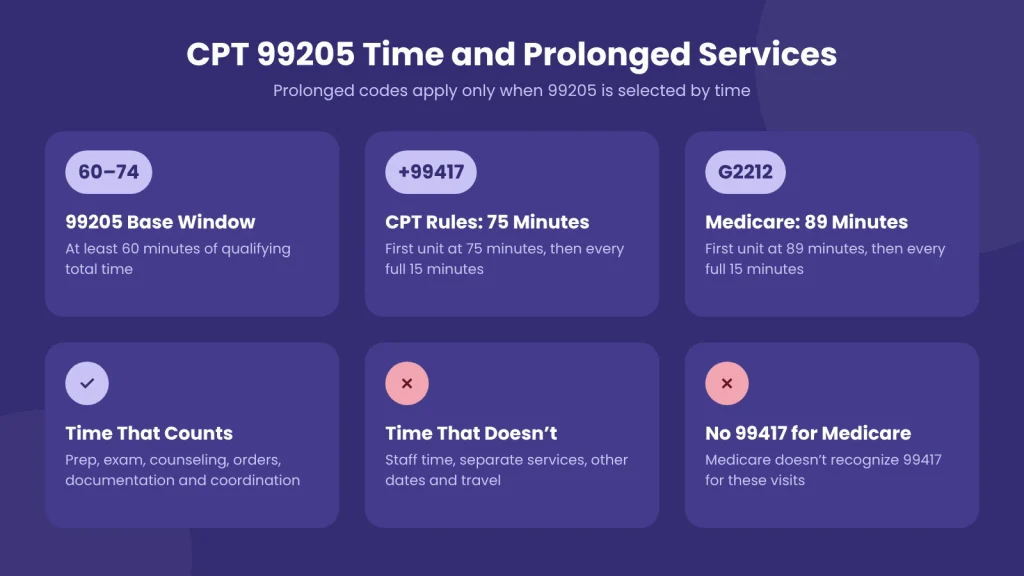
When the total time goes well beyond what 99205 describes, prolonged service codes may apply. Here CPT and Medicare differ:
| CPT (many commercial payers) | Medicare | |
| Prolonged code | +99417 | G2212 |
| First unit with 99205 | At 75 minutes total time | At 89 minutes total time |
| Each additional unit | Every additional full 15 minutes | Every additional full 15 minutes |
Medicare treats 74 minutes as the end of the 99205 time window and requires another full 15 minutes before G2212 can be reported. Under CPT, the first 99417 unit is reportable once 15 minutes past the 60-minute minimum is reached.
| Total time | CPT commercial payer rules | Medicare |
| 60–74 minutes | 99205 | 99205 |
| 75–88 minutes | 99205 + 99417 × 1 | 99205 only |
| 89 minutes | 99205 + 99417 × 1 | 99205 + G2212 × 1 |
| 90–103 minutes | 99205 + 99417 × 2 | 99205 + G2212 × 1 |
| 104 minutes | 99205 + 99417 × 2 | 99205 + G2212 × 2 |
| 105–118 minutes | 99205 + 99417 × 3 | 99205 + G2212 × 2 |
| 119 minutes or more | Apply additional 15-minute CPT units | Apply additional 15-minute G2212 units |
Key rules:
- Prolonged service codes apply only when 99205 is selected by time. If you select 99205 by MDM, don’t add 99417 or G2212.
- Don’t report 99417 to Medicare. Medicare doesn’t recognize it for these visits.
- Check commercial payers. Some follow CPT; others follow the Medicare G2212 approach.
4. CPT 99205 Documentation Requirements
Essential Documentation Elements
A complete 99205 note should include:
- The presenting problems and reason for the visit
- Relevant history, including medical, surgical, family and social history as appropriate
- A medically appropriate examination
- An assessment that names the problems addressed and their severity
- A treatment plan with the management decisions made
- The MDM elements that support high complexity
- The data reviewed: tests, outside records, independent interpretations and any discussions with external providers
- Total time and the activities performed, if time is used for code selection
How to Document High-Level MDM
Write each element so a reviewer can find it quickly:
Problems: State the severity explicitly. “Chronic kidney disease” alone doesn’t show high complexity. “CKD stage 4 with worsening creatinine and hyperkalemia, concerning progression requiring urgent intervention” does.
Data: List what you reviewed and where it came from:
- The outside records reviewed
- Specific test results
- Any independent interpretation, for example “personally reviewed CT images: findings consistent with…”
- Any discussion with external clinicians, including who and the outcome
Risk: Document the decision itself and the reason. For example: “Discussed hospital admission versus outpatient management; given troponin trend and symptoms, recommended admission,” or “Starting methotrexate; baseline labs ordered, will monitor CBC and LFTs every two weeks for toxicity.”
Time (if used): Record the total time on the date of the encounter. For example: “Total time on the date of service: 68 minutes, including record review, history and exam, counseling, ordering tests and documentation.” Avoid phrases like “over 50% counseling,” which come from old guidelines and aren’t needed.
Common Documentation Mistakes
- Choosing 99205 based on the patient’s age or number of diagnoses rather than on the decisions actually made
- No clear evidence of high-risk management, such as a hospitalization decision that’s implied but not written down
- Thin data documentation, for example “labs reviewed” without naming which labs or how they affected the plan
- Selecting by time without documenting total time
- Counting clinical staff time as physician or QHP time
- Billing a high level without supporting medical necessity
- Relying on cloned or template text that doesn’t reflect the actual visit
5. CPT Code 99205 Reimbursement and RVU in 2026
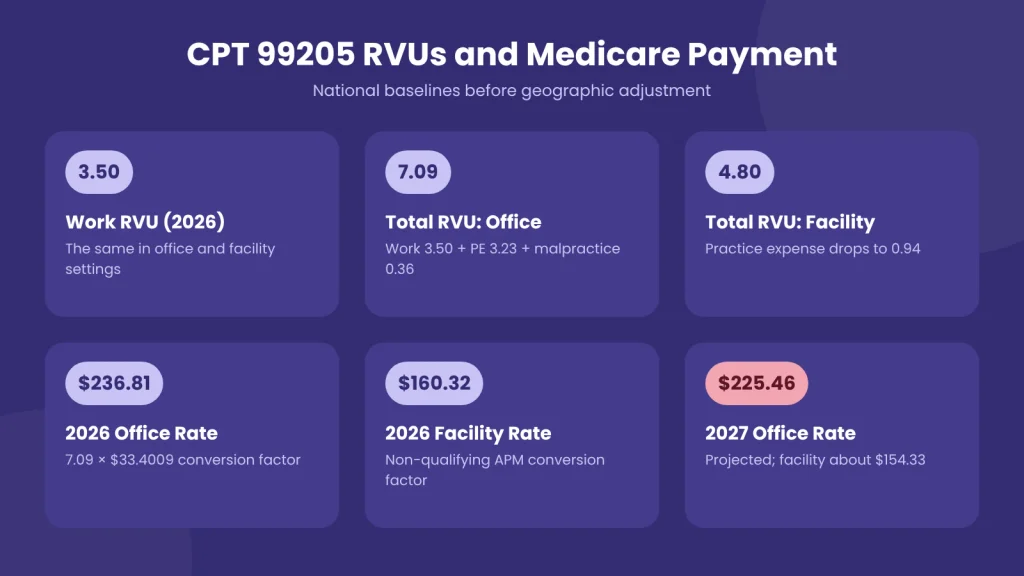
What Is the RVU for CPT 99205?
| RVU component | 2026 value |
| Work RVU | 3.50 |
| Practice expense RVU – office/non-facility | 3.23 |
| Practice expense RVU – facility | 0.94 |
| Malpractice RVU | 0.36 |
| Total RVU – office/non-facility | 7.09 |
| Total RVU – facility | 4.80 |
The work RVU reflects the physician’s time, effort and judgment. It’s the same in every setting. The difference between office and facility totals comes from practice expenses, because in a facility setting the facility bills separately for its own overhead.
How Much Does Medicare Pay for CPT 99205?
| Setting | 2026 national baseline |
| Office / non-facility | $236.81 |
| Facility | $160.32 |
These figures use the 2026 non-qualifying APM conversion factor of $33.4009. Qualifying APM participants use a separate conversion factor of $33.5675, resulting in different national baseline amounts. Actual payment also depends on geographic adjustments and applicable payment rules. These amounts aren’t guaranteed payments, and the patient’s cost-sharing is included in the allowed amount.
Looking ahead to 2027: The CY 2027 Medicare Physician Fee Schedule final rule changes the practice expense RVUs and conversion factors. CPT 99205 has a projected total RVU of approximately 6.91 in the office/non-facility setting and 4.73 in the facility setting. Using the 2027 non-qualifying APM conversion factor of $32.6286, the national baseline payment is approximately $225.46 for office services and $154.33 for facility services. Qualifying APM participants use a separate conversion factor of $32.9548. Actual reimbursement varies by locality and applicable payment adjustments.
How Is CPT 99205 Reimbursement Calculated?
Medicare uses this formula:
Payment = [(Work RVU × Work GPCI) + (PE RVU × PE GPCI) + (MP RVU × MP GPCI)] × Conversion Factor
- Work RVU: the physician’s work for the service
- Practice expense (PE) RVU: overhead such as staff, space, equipment and supplies; different for facility and non-facility settings
- Malpractice (MP) RVU: professional liability insurance cost
- Geographic Practice Cost Index (GPCI): adjusts each component for local costs; higher in expensive areas, lower in less expensive ones
- Conversion factor: the dollar amount Medicare sets each year to turn RVUs into payment
At the national level, where every GPCI equals 1.0, the 2026 office calculation is 7.09 × $33.4009 = $236.81.
The facility vs. non-facility difference matters. If a provider sees a new patient in a hospital outpatient department, the professional claim is paid at the facility rate, and the hospital bills its own facility charge. In a freestanding office, the provider receives the higher non-facility rate.
Factors That Affect CPT 99205 Reimbursement
- Medicare vs. commercial payers: Commercial payers set their own rates by contract, often as a percentage of Medicare.
- Geographic location: GPCIs move payment up or down by locality.
- Place of service: Facility and non-facility rates differ.
- Provider contract terms: Negotiated rates and payment methods vary.
- Participating vs. non-participating status: Non-participating Medicare providers receive a reduced fee schedule amount.
- APM status: Qualifying APM participants use a different conversion factor.
- Claim edits and payer policies: Bundling rules, modifier requirements and medical necessity edits can reduce or deny payment.
- Who performed the service: Some payers pay non-physician practitioners at a percentage of the physician rate.
Medicare rates change every year, so make sure your fee schedule reflects the rates for the date of service. Our article on CPT 99385 explains how preventive visits differ from problem-oriented E/M visits like 99205.
6. CPT 99204 vs 99205: What Is the Difference?
| Feature | CPT 99204 | CPT 99205 |
| Patient type | New patient | New patient |
| MDM level | Moderate | High |
| Time-based selection | At least 45 minutes | At least 60 minutes |
| Work RVU (2026) | 2.60 | 3.50 |
| National office payment (2026) | About $177.36 | About $236.81 |
| Complexity | Moderate | High |
| Documentation | Supports moderate MDM or applicable time | Supports high MDM or applicable time |
When 99204 fits: The visit involves moderate MDM. Examples include:
- Problems: a chronic illness with mild exacerbation, two or more stable chronic illnesses, or an undiagnosed new problem with an uncertain prognosis
- Combined with: moderate data or moderate risk, for example prescription drug management
When 99205 fits: A useful starting point is to assess whether the patient had a serious problem, whether extensive data was reviewed or analyzed, and whether management involved high risk. However, no single factor automatically qualifies a visit for 99205. At least two of the three MDM elements must meet the high-level criteria. If they do not, consider whether the documented total time independently supports 99205.
In every case, choose the code that reflects the service actually provided and documented, not the reimbursement you’d prefer.
7. 90792 vs 99205: Which Code Should Providers Use?
What Is CPT 90792?
CPT 90792 is a psychiatric diagnostic evaluation with medical services. It’s typically used by psychiatrists and other qualified prescribers for an initial psychiatric assessment. Along with the psychiatric evaluation, it includes medical elements such as a physical exam, review of medical conditions, prescription of medications or ordering of labs.
What Is CPT 99205?
CPT 99205 is a general new patient office or outpatient E/M service. It’s selected by high-level MDM or by total time, and it can be used by eligible physicians and QHPs across specialties, including psychiatry.
Key Differences Between 90792 and 99205
| Feature | CPT 90792 | CPT 99205 |
| Service | Psychiatric diagnostic evaluation with medical services | New patient office/outpatient E/M |
| Main purpose | Psychiatric diagnostic assessment | General evaluation and management |
| Code selection | Service-specific requirements | High MDM or applicable time |
| Typical users | Psychiatric practitioners | Eligible physicians and QHPs |
How providers choose: Choose 90792 when the service performed meets the requirements for a psychiatric diagnostic evaluation with medical services. Choose 99205 when the encounter is a new-patient office or outpatient E/M service that meets high-level MDM or the applicable time requirement. The code should reflect the actual service performed and documented, along with applicable payer rules.
Important billing note: These codes aren’t interchangeable, and they shouldn’t be billed together. CMS NCCI policy states that E/M codes 99202–99215 shouldn’t be reported with 90791 or 90792 for the same patient on the same date. Check current NCCI edits and payer policies before reporting either code.
8. Common CPT 99205 Billing Errors and Denial Reasons
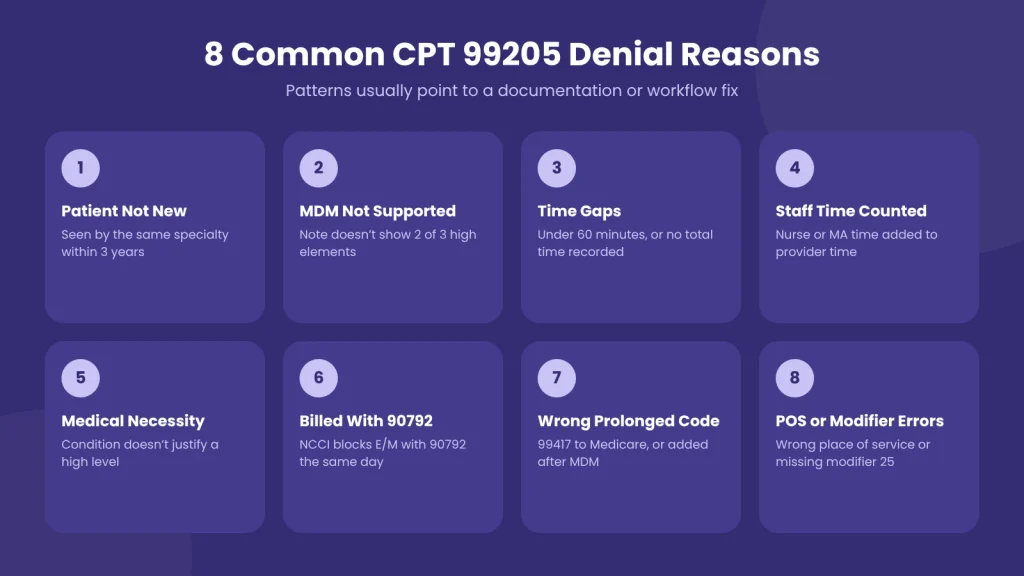
- Incorrect patient status: The patient was seen by the same physician, or the same specialty in the group, within three years.
- Insufficient high-level MDM documentation: The note doesn’t show two of the three MDM elements at the high level.
- Not meeting the time requirement: Time was used, but less than 60 minutes was documented, or no time was documented.
- Counting clinical staff time toward total time.
- Incorrect diagnosis coding: Diagnoses that don’t reflect the severity documented, or aren’t coded to the needed specificity.
- Lack of medical necessity for a high-level visit.
- Duplicate claim submission, often after a corrected claim is sent as a new claim.
- Incorrect provider or place-of-service information, for example billing office POS for a hospital outpatient visit.
- Incompatible services on the same date, such as 99205 with 90792, or prolonged service codes added when the visit was selected by MDM.
- Payer-specific rule errors, such as reporting 99417 to Medicare instead of G2212, or missing modifier 25 when a procedure is also billed.
When these denials happen, track them by reason. Patterns usually point to a documentation or workflow fix. iSolve RCM’s denial management team helps practices find and fix the causes behind recurring E/M denials.
9. How to Bill CPT Code 99205 Correctly
Verify New Patient Status
Check whether the patient has received any professional service within the past three years from the physician or QHP, or from anyone of the exact same specialty and subspecialty in your group. Look at your practice management history, not only the EHR, especially after mergers or provider transfers. If the patient is established, use the established patient codes (99212–99215).
Select the Correct E/M Level
Choose one pathway:
- MDM: Confirm that at least two of the three elements meet the high-level criteria.
- Time: Confirm that total qualifying time on the date of the encounter is at least 60 minutes, and that it’s documented.
If time reaches the prolonged threshold, apply the right code for the payer: 99417 under CPT rules, or G2212 for Medicare.
Review Documentation
Before submitting, confirm that:
- The assessment shows problem severity
- The data reviewed is specific
- The risk decision is written out
- Total time is recorded, if time is used
- The note is signed and dated
Verify Diagnosis and Claim Details
- Diagnosis codes should support the severity and be linked correctly.
- Provider NPI, place of service and modifiers should be correct. For example, modifier 25 is needed when a significant, separately identifiable E/M is billed with a minor procedure.
- Payer-specific requirements should be checked.
Submit and Monitor the Claim
- Run the claim through your scrubber or clearinghouse edits before submission.
- Watch for rejections and correct them quickly.
- Check claim status if there’s no response within the normal processing time.
- Work any denial promptly, and keep an eye on payer filing and appeal deadlines.
10. How iSolve RCM Helps Providers With CPT 99205 Billing
High-level E/M codes are where documentation gaps and coding errors cost practices the most, through denials, downcoding and audit risk. iSolve RCM supports practices with:
- E/M coding and documentation review to confirm each level is supported
- CPT code validation, including new vs. established status and prolonged service rules
- Medical necessity checks before claims go out
- Claim scrubbing and submission through our medical billing services
- Insurance eligibility verification
- Denial identification and follow-up
- Corrected claim processing
- Accounts receivable management
- Revenue cycle performance monitoring, supported by regular medical billing audits
Final Thoughts on CPT Code 99205
The 99205 CPT code represents the most complex level of new patient office or outpatient E/M service. Providers can select it using high-level medical decision making or at least 60 minutes of total time on the date of the encounter. Either pathway works on its own, but the documentation must clearly support the one used, and the visit must be medically necessary at that level.
Reimbursement depends on RVUs, geographic adjustments, place of service, APM status and payer rules. Medicare’s national baseline in 2026 is about $236.81 in the office, falling to about $225.46 for 2027 dates of service. Prolonged services follow different rules under CPT and Medicare, and 99205 shouldn’t be combined with services like 90792 on the same date.
Accurate coding, specific documentation and a careful pre-submission review are the best protection against denials and audit risk. If your practice wants support with E/M coding accuracy or high-level visit billing, iSolve RCM can help. Contact us to get started.
Frequently Asked Questions About CPT Code 99205
What is CPT code 99205?
CPT 99205 is the highest-level new patient office or outpatient E/M code. It requires a medically appropriate history and/or exam and high-level medical decision making, or at least 60 minutes of total physician or QHP time on the date of the encounter.
What is the CPT 99205 description?
The code describes an office or other outpatient visit for a new patient. The visit requires a medically appropriate history and/or examination and high-level MDM. When time is used for code selection, 60 minutes must be met or exceeded. Medicare’s short descriptor is “Office o/p new hi 60 min.”
What are the requirements for billing 99205?
The patient must be new, meaning no professional services from the same physician or same-specialty group member in three years. The visit must meet high-level MDM (two of three elements) or at least 60 minutes of qualifying total time. It must also be medically necessary and documented to support the level.
How many minutes are required for CPT 99205 in 2026?
When selecting by time, at least 60 minutes of total physician or QHP time on the date of the encounter is required. The base-code window is 60–74 minutes. Time includes face-to-face and non-face-to-face work on that date, but not clinical staff time or separately reported services.
Can you bill 99205 without 60 minutes?
Yes. If the visit meets high-level medical decision making and the documentation supports it, 99205 can be billed regardless of time. Time is an alternative way to select the code, not an additional requirement.
What is the RVU for CPT 99205 in 2026?
In 2026, CPT 99205 has a work RVU of 3.50, a practice expense RVU of 3.23 (office) or 0.94 (facility), and a malpractice RVU of 0.36. Its total RVU is 7.09 in the office setting and 4.80 in a facility setting.
How much does Medicare reimburse for CPT 99205?
The 2026 national Medicare baseline is about $236.81 in the office (non-facility) setting and about $160.32 in a facility setting, using the non-qualifying APM conversion factor and before geographic adjustment. Actual payment varies by locality, place of service and payment rules.
What is the difference between CPT 99204 and 99205?
Both are new patient visits. 99204 requires moderate MDM or at least 45 minutes and has a work RVU of 2.60. 99205 requires high MDM or at least 60 minutes and has a work RVU of 3.50. The documented complexity decides which applies.
What is the difference between 90792 and 99205?
90792 is a psychiatric diagnostic evaluation with medical services. 99205 is a general new patient E/M visit selected by high MDM or time. They aren’t interchangeable, and NCCI policy says E/M codes shouldn’t be billed with 90792 for the same patient on the same date.
What documentation is required for CPT 99205?
Document the presenting problems and their severity, a medically appropriate history and exam, specific data reviewed, the management decisions and their risk, and the plan. If selecting by time, document the total time on the date of the encounter.
Can CPT 99205 be billed with prolonged services?
Yes, but only when 99205 is selected by time. Under CPT rules, add +99417 starting at 75 minutes. For Medicare, use G2212 starting at 89 minutes. Add units for each additional full 15 minutes, and check commercial payer rules.
What are common reasons for CPT 99205 denials?
Common reasons include incorrect new patient status, MDM documentation that doesn’t support the high level, missing or insufficient time documentation and counting staff time. Weak medical necessity, incompatible same-day codes, place-of-service errors and using 99417 instead of G2212 for Medicare also cause denials.
Sources:
- American Medical Association: RBRVS and RUC Process (Medicare Payment Calculation and 2026 Conversion Factors)
- American Medical Association: CY 2027 Medicare Physician Fee Schedule Final Rule Summary
- American Academy of Family Physicians: Time and Medical Decision Making Levels for E/M Services
- American College of Surgeons: E/M Education FAQ
- AAPC: Factor in This Coding Advice When Determining Prolonged Services
- CMS: Medicare NCCI Policy Manual