

A denial management company helps healthcare providers find out why claims were denied, correct and resubmit them, appeal incorrect decisions, recover underpayments and fix the root causes so the same denials don’t keep coming back. Some are outsourced service teams, some are software vendors, and some offer both.
Claim denials aren’t a new problem, but they’ve become a stubborn one. Experian Health’s 2026 State of Claims survey found that 40% of providers report 10% or more of their claims being denied. Many denials are preventable, yet they still cost staff time, delay cash and, when nobody works them, turn into permanent write-offs.
That’s why more hospitals and practices are looking at outside help. A good partner doesn’t just send appeals. It works out why denials happen and helps stop them upstream, at registration, authorization, coding and charge entry.
This guide compares 10 companies that providers in the USA often evaluate for denial management in 2027. The list includes outsourced service providers, enterprise RCM firms and software vendors. For each company, it explains what it does, who it fits best and where it may not be the right match. It also covers the services to expect from a denial management partner, common reasons for claim denials, software versus outsourced services, how AI is changing the work and how to choose.
Editorial Disclosure: iSolve RCM is our company and is featured first as our own service. Its placement is editorial and does not represent an independent ranking or third-party certification. Other companies are described based on publicly available information. Please verify services, pricing, and contract terms directly with each provider.
Quick Answer: What Are the Best Denial Management Companies in the USA for 2027?
The best denial management companies help healthcare providers identify denial causes, correct billing errors, manage appeals, recover unpaid revenue and prevent recurring denials. The right choice depends on your size and needs:
- Medical practices and specialty providers often need an outsourced team that handles denials alongside billing, coding and A/R. Example: iSolve RCM.
- Hospitals and health systems often look at enterprise RCM firms. Examples: R1 RCM, Ensemble Health Partners, Optum, Conifer Health Solutions.
- Organizations with in-house teams may want denial prevention software. Examples: Waystar, Experian Health.
- Providers needing outsourced operations at scale may consider tech-enabled RCM service firms. Examples: AGS Health, Access Healthcare.
- Hospitals with complex or specialty claims may need a recovery specialist. Example: Aspirion.
When comparing providers, look at denial expertise, appeal capability, payer knowledge, technology, reporting, scalability and pricing transparency.
1. How We Selected the Top Denial Management Companies
We reviewed each company against the same criteria:
| Evaluation criterion | Weight |
| Denial prevention and resolution capabilities | 25% |
| Appeal and complex claim recovery expertise | 20% |
| RCM and medical billing integration | 20% |
| Technology, automation and analytics | 15% |
| Scalability and healthcare specialization | 10% |
| Pricing transparency and client support | 10% |
These criteria guided which companies we included and how we described them. We didn’t assign independently verified numerical scores to each company, and the order of the list isn’t a scored ranking. Company information comes from official websites, press releases and published industry news. The “Best for” labels are our editorial judgment.
It’s also important to know that these companies have different business models:
- Outsourced service providers supply people who work your denials.
- Software and technology vendors supply tools that your own team uses.
- Enterprise RCM companies take on large parts of a hospital’s revenue cycle.
- Specialty recovery firms focus on difficult claim types.
Not every company on this list is a dedicated denial management outsourcing firm, and we’ve tried to make that clear in each profile.
2. Top 10 Denial Management Companies in the USA for 2027
1. iSolve RCM – Featured Provider for Outsourced Denial Management and Medical Billing Support
Type: Outsourced medical billing, coding and RCM services
iSolve RCM is a US medical billing and revenue cycle management company. It provides outsourced billing, coding, credentialing and denial management to medical practices, clinics and specialty providers. Its approach is to handle denials as part of the full billing process, not as a separate cleanup task.
Denial management capabilities:
- Identifying, prioritizing and tracking denied and rejected claims
- Correcting and resubmitting rejected claims
- Reviewing the coding and documentation behind denials through our medical coding services
- Handling eligibility and authorization-related denials
- A/R follow-up on unpaid and aging claims
Appeal and resolution services: Preparing appeals with supporting documentation, tracking appeal status and following up with payers.
Best for: Independent practices, physician groups and specialty providers that want one partner for denials and the wider billing workflow, with support across multiple specialties.
Considerations: iSolve RCM focuses on practices and outpatient providers. Large hospital systems that need enterprise-scale revenue cycle outsourcing may be better served by the enterprise firms below.
Website: isolvercm.com
2. R1 RCM – Best for Large Health Systems and Enterprise Revenue Cycle Operations
Type: Enterprise, technology-enabled RCM services
R1 RCM is based in Murray, Utah. It began in 2003 as Accretive Health and became privately held in November 2024, when funds affiliated with TowerBrook Capital Partners and Clayton, Dubilier & Rice completed an acquisition worth about $8.9 billion.
R1 runs large-scale revenue cycle operations for hospitals, health systems and physician groups. Its services cover patient access, coding, billing, denials and payment integrity, supported by automation.
Best for: Large health systems that want to hand off major parts of the revenue cycle, including complex denial workflows.
Considerations: Contracts are enterprise-sized and customized, so it isn’t usually a fit for small practices. Pricing isn’t published.
Website: r1rcm.com
3. Waystar – Best for Healthcare Payment Technology and Denial Prevention
Type: Software and technology vendor
Waystar (Nasdaq: WAY) is a healthcare payment software company. Its claims, denial and appeal management tools are part of a wider platform, and its AI suite, Waystar AltitudeAI, focuses on denial prevention and recovery. In 2026, Waystar added agentic AI features, including automated claim correction recommendations and automated clinical appeals.
Waystar reports that its AltitudeAI platform helped clients prevent more than $15.5 billion in claims that would otherwise have been denied. This is a company-reported result, not an independently verified industry-wide figure.
Best for: Hospitals, health systems and practices with in-house revenue cycle teams that want strong denial prevention and appeal software.
Considerations: Waystar is primarily a technology company, not an outsourced denial team. Your staff, or a billing partner, still works the denials.
Website: waystar.com
4. Experian Health – Best for Revenue Cycle Data and Patient Access Workflows
Type: Software and data vendor
Experian Health provides revenue cycle technology focused on patient access, eligibility, claims and denial prevention. Its AI Advantage product works inside its ClaimSource claims management system in two stages. Predictive Denials flags high-risk claims before submission, and Denial Triage helps teams decide which denials to work first. Its Patient Access Curator tool supports registration and coverage checks.
Best for: Hospitals and providers that want to stop eligibility, coverage and data-quality denials at the front end.
Considerations: Like Waystar, Experian Health supplies technology rather than an outsourced appeals team.
Website: experian.com/healthcare
5. Optum – Best for Enterprise Healthcare Revenue Cycle Solutions
Type: Enterprise services and technology
Optum, part of UnitedHealth Group, offers revenue cycle services and technology to hospitals, health systems and large provider groups, along with a wide range of data and analytics products.
Best for: Large organizations that want revenue cycle and denial work connected to broader data and analytics.
Considerations: UnitedHealth Group also owns the insurer UnitedHealthcare. Some providers weigh that relationship when choosing a denial management partner, since denial work means disputing payer decisions. Ask clearly about contract terms and data-use policies.
Website: optum.com
6. AGS Health – Best for Outsourced Medical Billing and Denial Management Operations
Type: Tech-enabled outsourced RCM services
AGS Health provides outsourced revenue cycle services that combine AI-driven tools with a large global delivery team. In August 2026, Black Book Research named AGS Health the top clinical denial and appeal management services vendor for 2026. Its process involves reviewing and classifying denial reasons, finding root causes and submitting appeals with supporting documentation. The company describes this as a physician-led model in which AI supports the work under human review.
Best for: Hospitals, health systems and larger provider groups that want outsourced denial and appeal operations at scale, including clinical denials.
Considerations: AGS Health mainly serves larger organizations. Smaller practices should ask about minimum volumes and fit.
Website: agshealth.com
7. Ensemble Health Partners – Best for Hospital Revenue Cycle Management
Type: End-to-end hospital RCM outsourcing
Ensemble Health Partners, based in Cincinnati, Ohio, specializes in running the full revenue cycle for hospitals and health systems, including denial management and revenue integrity. It received the 2026 Best in KLAS award for End-to-End Revenue Cycle Outsourcing, its sixth such designation.
Best for: Hospitals that want a long-term partner to manage most or all of their revenue cycle, with denials handled as part of it.
Considerations: Ensemble is built for hospital-scale operations, not for independent practices.
Website: ensemblehp.com
8. Conifer Health Solutions – Best for Hospital and Health System RCM Support
Type: Hospital and health system RCM services
Conifer Health Solutions, founded in 2008, is the revenue cycle subsidiary of Dallas-based Tenet Healthcare. It provides revenue cycle and value-based care services to hospitals, physician groups and other clients, including patient financial services and denial-related workflows.
In January 2026, Tenet regained full ownership of Conifer Health Solutions after CommonSpirit exited its ownership stake. Conifer’s revenue cycle services for CommonSpirit were subsequently transitioned during 2026.
Best for: Hospitals and health systems looking for an experienced hospital revenue cycle operator.
Considerations: Prospective clients should confirm the company’s current service capacity and technology investments.
Website: coniferhealth.com
9. Access Healthcare – Best for Technology-Enabled RCM Outsourcing
Type: Tech-enabled outsourced RCM services
Access Healthcare is a Dallas-based RCM provider that combines AI-driven automation and proprietary technology with outsourced operations. It received a strategic growth investment from New Mountain Capital in early 2025 and has added an AI-powered denial management solution. Avasant’s 2026 RCM Business Process Transformation RadarView named it among the “Leaders.”
Best for: Healthcare organizations that want outsourced billing, coding, claims and denial work backed by automation.
Considerations: Ask how much of the work is automated versus handled by specialists, and how quality is reviewed.
Website: accesshealthcare.com
10. Aspirion – Best for Complex Claims and Revenue Recovery
Type: Specialty complex claims and revenue integrity services
Aspirion, headquartered in Columbus, Georgia, helps hospitals and physicians recover revenue from denials, underpayments, aged A/R and complex claims. These include motor vehicle accidents, workers’ compensation, Veterans Affairs/TRICARE and out-of-state Medicaid claims. On its services page, Aspirion lists Best in KLAS recognition for Denials Management in 2024 and 2025, and it offers payment variance (underpayment) recovery.
Best for: Hospitals and health systems with large volumes of hard-to-collect or clinically complex claims.
Considerations: Aspirion focuses on specialty recovery rather than everyday denial work across the whole revenue cycle. Many organizations use it alongside another billing partner.
Website: aspirion.com
3. Denial Management Companies Comparison Table
| Company | Type | Main focus | Best suited for |
| iSolve RCM | Outsourced services | Denial management with billing and coding support | Medical practices and specialty providers |
| R1 RCM | Enterprise RCM services | Enterprise revenue cycle operations | Large health systems |
| Waystar | Software | Payment, claims and denial prevention technology | Organizations with in-house RCM teams |
| Experian Health | Software and data | Patient access, claims and predictive denials | Hospitals and providers |
| Optum | Services and technology | Enterprise healthcare solutions | Large healthcare organizations |
| AGS Health | Outsourced services | Tech-enabled RCM and clinical denial operations | Providers and health systems |
| Ensemble Health Partners | Enterprise RCM services | End-to-end hospital RCM | Hospitals |
| Conifer Health Solutions | Enterprise RCM services | Hospital revenue cycle operations | Health systems |
| Access Healthcare | Outsourced services | Technology-enabled RCM outsourcing | Healthcare providers |
| Aspirion | Specialty services | Complex claims and revenue recovery | Organizations with complex claims |
4. What Services Should a Healthcare Denial Management Company Provide?
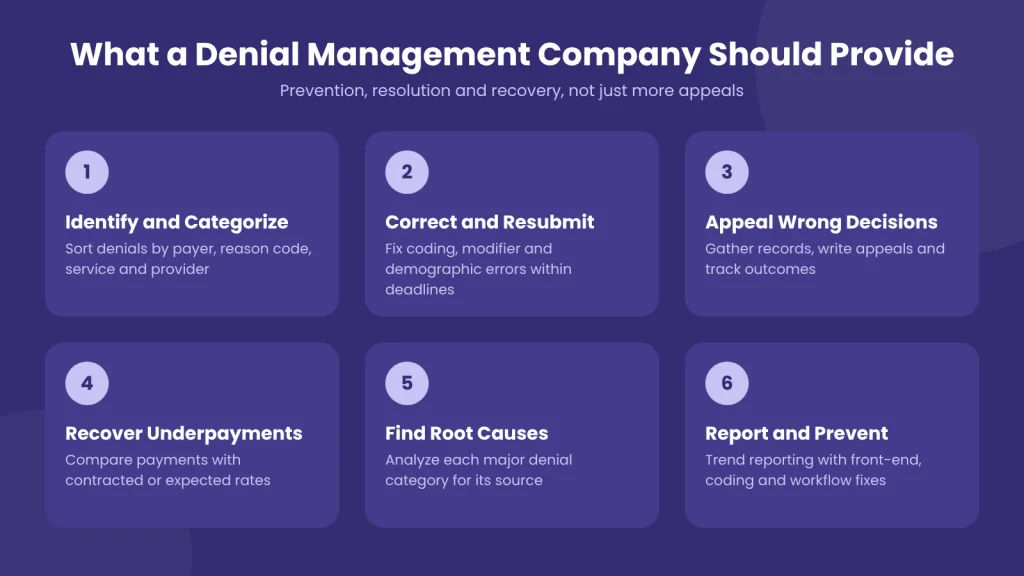
Denial Identification and Categorization
A good partner starts by sorting your denials, not just working them:
- Identifying denied and rejected claims, which are not the same thing
- Grouping denials by payer, reason code, service and provider
- Spotting recurring patterns that point to a root cause
Claim Correction and Resubmission
- Reviewing coding, modifier and demographic errors
- Adding missing information or documentation
- Resubmitting corrected claims within payer deadlines
Appeal and Denial Resolution Services
Appeal and denial resolution services matter most when the payer’s decision is wrong:
- Reviewing the payer’s denial explanation and policy
- Gathering medical records and supporting documentation
- Writing and submitting appeals within the appeal deadline
- Tracking appeal status and outcomes
Underpayment Identification and Recovery
Underpayments are easy to miss because the claim looks “paid.” Strong denial management services that address payer underpayments will:
- Compare payments against contracted or expected rates
- Flag payment variances by payer and service
- Follow up on and appeal underpaid claims
Denial Prevention and Reporting
The goal is fewer denials next month, not just more appeals:
- Root-cause analysis for each major denial category
- Ongoing denial trend reporting
- Recommendations for front-end, coding and workflow fixes
- Tracking of recovery and prevention results
A periodic medical billing audit can support this work by finding the errors behind recurring denials.
5. What Are Five Common Reasons for Medical Claim Denials?
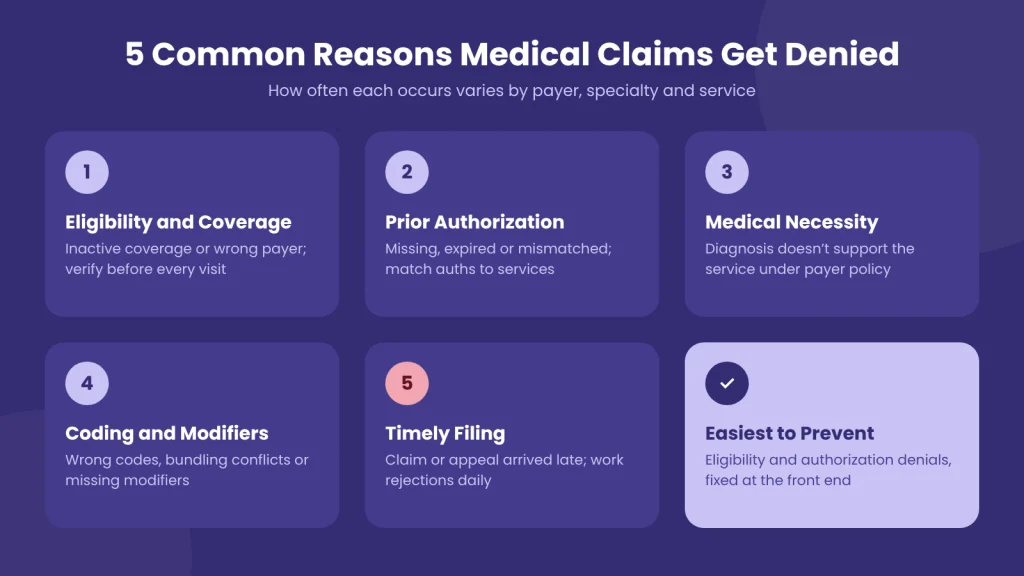
These are five common denial categories that healthcare providers should monitor. The frequency of each category varies by payer, specialty, service type and patient coverage.
1. Eligibility and Coverage-Related Denials
- Common reason: The patient’s coverage was inactive, the plan changed or the wrong payer was billed.
- Example: A patient switches plans in January, but the front desk bills last year’s insurer.
- Prevention: Verify eligibility before every visit, especially at the start of the year.
- Resolution: Confirm the correct coverage, update the account and rebill the right payer.
2. Missing or Invalid Prior Authorization
- Common reason: No authorization was obtained, it expired or it didn’t match the service performed.
- Example: An MRI is authorized for the lumbar spine, but the claim is for the thoracic spine.
- Prevention: Check payer authorization lists and match authorizations to scheduled services.
- Resolution: Request a retro-authorization where allowed, or appeal with clinical documentation.
3. Medical Necessity Denials
- Common reason: The diagnosis or documentation doesn’t support the service under the payer’s policy.
- Example: A test is billed with a diagnosis code that isn’t covered under the payer’s coverage policy.
- Prevention: Check coverage policies, code diagnoses to the highest specificity and document clinical reasons clearly.
- Resolution: Correct the diagnosis if it was miscoded, or appeal with records showing necessity.
4. Coding and Modifier Errors
- Common reason: An incorrect code, a bundling conflict, or a missing or misused modifier.
- Example: A separately identifiable E/M visit on the same day as a minor procedure is billed without the required modifier.
- Prevention: Coding reviews, claim scrubbing and coder training.
- Resolution: Correct and resubmit, or appeal if the original coding was right.
5. Timely Filing Denials
- Common reason: The claim, a corrected claim or an appeal reached the payer after its deadline.
- Example: A rejected claim sits uncorrected until it passes the payer’s filing limit. For Medicare fee-for-service, that limit is generally 12 months from the date of service.
- Prevention: Work rejections daily and track each payer’s filing limits.
- Resolution: Usually limited. Only valid proof of timely submission, or a recognized exception, can overturn these.
Eligibility-related denials and authorization denials are often among the easiest to prevent, which is why so much denial prevention work focuses on the front end.
6. Denial Management Software vs. Outsourced Denial Management Services
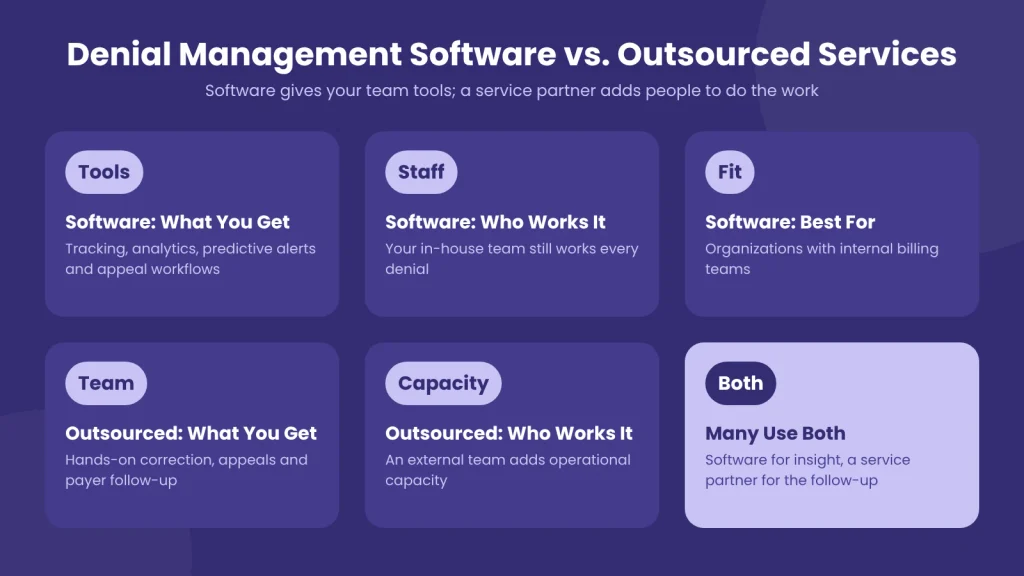
Several companies on this list sell software; others provide people. Here’s how they differ:
| Feature | Denial management software | Outsourced denial management |
| Claim monitoring | Software-supported | Staff and technology-supported |
| Denial categorization | Automated or rule-based | Manual and technology-assisted |
| Appeal preparation | May provide templates or workflows | May include hands-on appeal support |
| Follow-up | Depends on software features and your staff | Team-managed follow-up |
| Staff requirements | In-house staff usually needed | External team provides operational support |
| Best for | Organizations with internal billing teams | Practices seeking extra operational capacity |
Medical billing denial management software helps your team work faster and see patterns. Outsourced denial management adds people who do the work. Many organizations use both. For example, a hospital might use hospital denial management software for analytics while an outsourced team works the appeals.
7. How AI Is Changing Denial Management in Healthcare
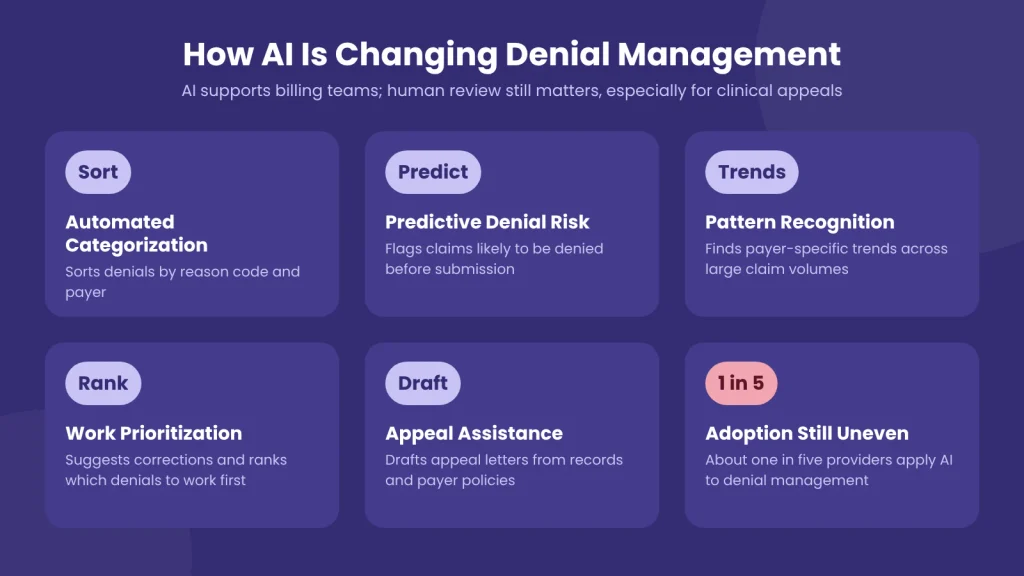
More RCM companies are using AI for denial management, and the tools are improving quickly. Common uses include:
- Automated denial categorization: sorting denials by reason and payer
- Predictive denial risk: flagging claims likely to be denied before submission
- Pattern recognition: finding payer-specific trends across large claim volumes
- Claim edits and work prioritization: suggesting corrections and ranking which denials to work first
- Appeal assistance: drafting appeal letters from records and payer policies
- Underpayment detection: comparing payments with contract terms at scale
Adoption is still uneven. HFMA reported that, according to a 2025 Bain & Company survey, about one in five healthcare providers apply AI to denial management. Experian Health’s research likewise found that many providers still see human oversight as important.
AI supports billing teams but doesn’t replace payer-specific knowledge, coding expertise, documentation review or human judgment. The strongest approach pairs good tools with experienced people who check the output, especially for clinical appeals.
8. How to Choose the Best Denial Management Company for Your Practice
Use this buyer’s checklist:
- ☐ Does the company understand your medical specialty?
- ☐ Does it handle both front-end and back-end denials?
- ☐ Does it provide appeals and complex claim resolution?
- ☐ Can it work with your existing billing software or EHR?
- ☐ Does it provide regular denial analytics and reporting?
- ☐ Can it identify and fix recurring denial causes?
- ☐ Is its pricing transparent, including any extra fees?
- ☐ Can it scale with your claim volume?
- ☐ Does it follow HIPAA and sign a Business Associate Agreement?
- ☐ Can it show relevant client experience and references?
For hospitals, add a few more questions. Can the partner handle high-volume hospital denial appeals and clinical denials? Does it bring hospital-specific experience, and can it integrate with your systems? For complex claim appeals, ask about clinical reviewers and how appeals are prioritized.
9. Why Healthcare Providers Outsource Denial Management Services
Providers outsource denial management services for practical reasons:
- To reduce the load on in-house billing staff, who often can’t keep up with denial queues
- For consistent follow-up, so denials don’t sit untouched
- To bring down aging A/R before claims pass filing and appeal deadlines
- For better appeal workflows, with tracking from submission to outcome
- To find recurring billing errors that internal teams may not have time to analyze
- For clearer revenue visibility through regular reporting
- To let providers focus more on patient care
Outsourcing works best when it’s part of a coordinated revenue cycle management strategy rather than a standalone fix.
10. Why Choose iSolve RCM for Denial Management Services?
Denials rarely start in the denial queue. They start with a missed eligibility check, a missing authorization, an unclear note or a coding mistake. That’s why iSolve RCM works on denials as part of the whole billing process.
Our team supports practices with:
- Denial identification, prioritization and follow-up based on claim status, payer requirements and recovery opportunities
- Rejected claim correction and timely resubmission
- Appeal and resolution support, with documentation gathered and appeals tracked
- Medical coding review to fix coding-related denials at the source
- A/R management to work aging claims before deadlines pass
- Eligibility verification to prevent coverage denials
- Claims management through our medical billing services
- Revenue cycle support across multiple specialties
When the same team handles denials, coding and billing, it can spot a pattern in the denials and fix the step that caused it. Handling every denial as an isolated issue doesn’t allow that.
We also keep our clients informed about coding changes that can trigger denials, such as the December 2026 HCPCS brace classification update.
Final Thoughts: Choosing the Right Denial Management Partner for 2027
Effective denial management has three parts: prevention, resolution and recovery. Prevention stops denials at registration, authorization and coding. Resolution corrects and appeals the denials that still happen. Recovery chases underpayments and complex claims that would otherwise be lost.
When you compare denial management companies, look at both technology and operational expertise. Software can show you where denials come from, but someone still has to work on them. A service partner can do that work, but it needs good tools and a clear view of your data. Payer knowledge, coding accuracy, disciplined appeal management and honest reporting matter more than any single feature.
If you run a medical practice or specialty group and want a partner that handles denials alongside billing and coding, iSolve RCM can help.
Frequently Asked Questions About Denial Management Companies
What is a denial management company?
A denial management company helps healthcare providers identify, correct, appeal and prevent claim denials. It reviews why claims were denied, fixes and resubmits them, appeals incorrect payer decisions, recovers underpayments and reports on root causes so recurring denials can be stopped.
What are the best denial management services in the USA?
The best choice depends on your practice size, specialty, claim volume, payer mix and appeal complexity. Practices often choose outsourced partners like iSolve RCM. Hospitals often consider enterprise firms such as R1 RCM or Ensemble, while teams with in-house staff may prefer software like Waystar.
Why should healthcare providers outsource denial management services?
Outsourcing adds operational capacity, consistent denial follow-up, appeal support and revenue recovery without hiring more staff. It also brings denial analysis that internal teams often lack time for, helping prevent the same denials from recurring.
What is the difference between denial management software and denial management services?
Software provides tools, such as denial tracking, analytics, predictive alerts and appeal workflows, that your own staff use. Services provide an external team that does the work. Many organizations combine both, using software for insight and a service partner for hands-on follow-up.
What are common reasons medical claims get denied?
Common causes include eligibility or coverage problems, missing or invalid prior authorization, medical necessity issues, coding and modifier errors, and timely filing. How often each occurs varies by payer, specialty and service. Most can be reduced with front-end verification, accurate coding, clear documentation and daily follow-up.
Which denial management company is best for hospitals?
Hospitals usually need enterprise scale, clinical appeal expertise, strong analytics, system integrations and hospital-specific experience. Companies such as R1 RCM, Ensemble Health Partners, AGS Health and Conifer serve hospitals, while Aspirion specializes in complex claims. Compare them against your denial mix and goals.
What should healthcare providers look for in a denial management partner?
Look for experience in your specialty, both front-end and back-end denial expertise, strong appeal capabilities, useful reporting, compatible technology, HIPAA compliance with a signed BAA and transparent pricing. References from similar organizations are especially valuable.
Can denial management companies help reduce payer underpayments?
Yes. Many denial management companies run payment variance reviews that compare payments with contracted rates. When a claim is underpaid, they follow up with the payer or appeal. This recovers revenue that’s easy to miss because the claim appears paid.
How does AI help with healthcare claim denial management?
AI helps by predicting which claims are likely to be denied, categorizing denials automatically, spotting payer patterns, prioritizing work queues and drafting appeals. It works best with human review, since payer rules, coding and clinical judgment still require expertise.
How much do outsourced denial management services cost?
There’s no standard market rate. Pricing depends on claim volume, scope, complexity, specialty and pricing model. Common models include a percentage of collections or recoveries, a flat monthly fee or per-claim pricing. Ask each vendor for a written quote based on your actual volume.