
Every claim submitted in the United States now moves through a system under measurable strain. Claim denial rates have risen for three consecutive years, with the national initial denial rate reaching 11.8 percent and 41 percent of providers reporting denials above 10 percent. Hospital denials drove revenue leakage past 48 billion dollars in a single recent year. Coding requirements grow more detailed each January, while administrative workload keeps outpacing staffing. iSolve RCM has tracked this pattern across specialties and states.
Artificial intelligence is often presented as a single solution to these pressures, yet current data tells a far narrower story. Recent benchmarks show AI assisted coding reaching 92 to 97 percent accuracy on structured encounters, compared with 95 to 98 percent for trained coders after review, while claim validation tools help address the roughly four in ten denials linked to preventable coding and data errors. Other applications remain unproven outside marketing claims. This article examines what the evidence actually supports. A medical billing company in USA can help healthcare providers manage claims, coding, payments, and reimbursement processes more efficiently.
What Is AI in Medical Billing?
Artificial intelligence in medical billing is an area which deals with systems that have the ability to use machine learning, natural language processing and rule-based reasoning to interpret clinical documentation, suggest codes, and find patterns in payments and denials data, going beyond the rigid reasoning used by earlier automated billing systems. Outsourced medical billing services help in decreasing administrative burden while enabling the healthcare provider to concentrate on their business.
Understanding AI-Powered Billing Systems
AI medical billing refers to technology that understands unstructured clinical documentation, such as notes, operative and discharge reports, and turns this unstructured data into structured billing codes. Different from the traditional rules-based system, AI coding is trained on vast amounts of coded data and can therefore understand context and not only match specific words to the codes.
AI vs Traditional Billing Automation
Traditional billing automation follows predefined rules and performs repetitive tasks well when data is already structured, such as posting a payment against a known fee schedule. AI powered systems go further. They identify patterns across thousands of prior claims, process unstructured documentation, interpret clinical language such as negated findings, and prioritize accounts based on the likelihood of denial or delay rather than a fixed queue order.
Where AI Fits Within the Revenue Cycle
The use of AI is no longer limited to one or two points along the revenue cycle but instead encompasses virtually every step, from eligibility determination to charge capture, coding, claims submissions, denial resolution, account receivables, and even reporting. The modern medical billing firm in the US will often incorporate AI at multiple points along this revenue cycle instead of using it as a stand-alone solution.
How AI Is Used in Medical Coding
Medical coding is the area where AI has produced the most measurable results, largely because coding is a language interpretation task with a defined, auditable output. Medical coding services help ensure that diagnoses and procedures are accurately translated into appropriate billing codes.
AI Assisted Code Identification
The AI tools analyze the data in the medical documentation and assign the right codes that may include ICD 10, CPT, and HCPCS codes along with their modifiers. According to the latest benchmarks that have been made up to 2025 and 2026, the accuracy rate of AI generated coding suggestions for the high volume structured documentation is between 92% to 97% in cases like emergencies and radiology notes of outpatient, but if we talk about complex inpatient cases where there are multiple comorbidities, then the accuracy rate is 82% to 90%. In addition to this, some changes are also included in the CPT 2026 changes and therefore, it becomes necessary for billing teams to update themselves.
Natural Language Processing for Clinical Documentation
NLP technology helps in mining relevant information in clinical terms from doctors’ notes, surgical notes, and medical health records. In the context of clinical writing, there is a frequent occurrence of negations like when a patient denies the chest pain problem and speculation like a diagnosis. It is a matter of course that standard text analysis tools get confused with these concepts.
AI Medical Coding Software
Today’s coding software packages have the ability to point out missing documentation, detect contradictions between the diagnosis code and the billed procedure, and even offer suggestions for the codes to be used by the coder. Various independent estimates put the percentage of errors in the US medical bill as high as 80 percent, and it is believed that coding-related problems lead to many claim rejections.
How AI Improves Coding Workflows
If used properly, such systems save time reviewing charts and provide more consistent suggestions for codes across the coding department while allowing personnel to concentrate on more difficult and complex cases. This is probably one of the more obvious examples of increased efficiency mentioned during 2025 and 2026 in industry data.
What AI Cannot Reliably Do Alone
There will always be an ambiguity in the documents which will require interpretation by humans, the coding guidelines keep changing each year, and if the suggestion made by the computer is wrong, it will carry the same risk as any other human error if it is not detected. For this very reason, all reliable implementations will include a certified coder as the last decision-making point.
Professional Guidance: AI should be used as a code-assistant and not as a replacement for qualified coders. The use of artificial intelligence can assist with identifying codes, reviewing documents, and detecting any errors but the involvement of human beings is vital.
Automated Claims Processing: Where AI Delivers Real Value
AI is capable of making the process of automation of claims processing simple through streamlining the billing process, identifying any mistakes, validating the claims, and making sure that the process of submission is sped up. AI will be vital in reducing delays and improving efficiency in health care facilities.
What Is AI Claims Processing?
AI claims processing applies machine learning to the full submission pathway, moving beyond fixed validation rules to assess a claim’s likelihood of acceptance based on patterns learned from prior payer behavior.
How Automated Claims Processing Works
A simplified workflow moves from clinical and administrative data collection through AI assisted validation, coding review, claim creation, automated error detection, submission and ongoing status monitoring. Each stage produces data that improves the accuracy of the next claim processed.
AI Powered Claim Scrubbing
Before submission, AI systems can identify missing information, inconsistent patient or provider data, coding conflicts, documentation gaps and duplicate claims. Because roughly four in ten claim denials trace back to preventable data or coding issues rather than coverage disputes, this stage carries disproportionate financial weight.
Predictive Claim Analysis
By analyzing historical claim outcomes, AI models can flag claims that share characteristics with previously rejected or delayed submissions before they are sent to a payer. Given that the national initial denial rate has climbed toward 12 percent, with some specialties such as behavioral health and orthopedics running considerably higher, this predictive step allows staff to correct a claim proactively rather than reactively.
Automated Claim Status Monitoring
Instead of manually checking the status of all open claims, the AI program does that automatically and finds out where the claim is stuck, routing any exceptions to the employees. Thus, the manual effort required by the process is significantly reduced.
The Real Benefit
Realistic expectations of automated claims processing are reduced errors and rework and not full automation of billing. Billing departments which automate scrubbing and have experienced professionals overseeing the process invariably achieve higher first-pass clean rates than when either approach is used alone.
AI for Denial Management: One of the Highest Value Use Cases
AI for denial management in healthcare allows companies to recognize denial trends, predict claims at high risk of denials, focus on recovery activities, and find out why there are denials and underpayments. The use of AI for these purposes is expected to minimize workload, increase recovery rate, and enhance the efficiency of the entire revenue cycle process. Denial management solutions are designed to analyze rejected claims.
Why Denials Matter
Denials cause loss of revenues and more effort in administrative tasks as well as in the account receivable process. In recent years, some figures from hospitals reveal that the net revenue leakage due to denials increased by about 25 percent within one year to reach tens of billions of dollars. This is the reason why this category gets more funding than many others.
How AI Denial Management Works
AI systems analyze historical denial data to identify patterns tied to specific payers, providers, procedures, codes and documentation types. Denial rates vary considerably by payer category, with Medicare Advantage plans now denying claims at more than double the rate of traditional Medicare fee for service, which makes payer specific pattern recognition especially valuable. Providers offering denial management services increasingly rely on this pattern analysis to prioritize which accounts need attention first.
Predicting Denials Before Submission
Pre submission denial prediction flags claims likely to encounter problems before they reach the payer. This shifts denial handling from a reactive appeals process to a preventive one, which matters given that reworking a single denied claim typically costs between 25 and 181 dollars in staff labor depending on complexity.
Automating Denial Categorization
The technology can segregate the incoming denial into different root causes like eligibility, authorization, coding, or documentation and direct them to different workflows instead of treating all of them as one single job in a generalist’s queue.
AI Assisted Appeals
AI is able to categorize the incoming denials into the reasons for those denials like eligibility, authorization, coding/documentation, and direct them to the correct workflows instead of putting all denials in one basket and making it a generalist job.
AI Revenue Cycle Management: Connecting the Entire Billing Workflow
Revenue Cycle Management powered by AI links important billing processes such as patient registration, eligibility verification, coding, claims filing, payment, denial management, and accounts receivable management. Using the information gathered through the process, AI allows for the discovery of bottlenecks and better coordination of tasks, automation of tasks, and enhanced visibility of financial performance. Revenue Cycle Management (RCM) supports the complete financial process from patient registration and billing through payment collection and account resolution.
What Is AI RCM?
AI revenue cycle management refers to the coordinated use of predictive and pattern based tools across registration, eligibility, coding, claims, denials, accounts receivable and reporting, rather than a single point tool applied to one task.
AI Across the Revenue Cycle
| Revenue Cycle Stage | Typical AI Application |
| Registration | Data validation |
| Eligibility | Coverage verification |
| Coding | Code recommendations |
| Claims | Error detection |
| Submission | Workflow automation |
| Denials | Prediction and categorization |
| Accounts receivable | Account prioritization |
| Payments | Reconciliation |
| Reporting | Predictive analytics |
From Point Solutions to Connected Workflows
Organizations generally see greater value when these tools share data across stages instead of operating as isolated systems. A denial pattern identified at the claims stage, for example, becomes far more useful when it also informs coding review upstream. This connected approach is central to how revenue cycle management is now structured across mid sized and large practices.
Predictive RCM Analytics
Predictive analytics applied across the full revenue cycle can surface revenue trends, accounts receivable risk, denial patterns by payer, workflow bottlenecks and accounts that require immediate attention, giving leadership visibility that a monthly report cannot match.
What Actually Works in AI Medical Billing in 2026?
Efficient artificial intelligence-based medical billing in 2026 will entail practical applications like coding assistance, claim processing, prediction of denials, accounts receivable management, and workflow analysis. Best outcomes can be realized through the use of specialized software together with appropriate data, proper integration, performance measurement, and human oversight. Accounts receivable management services assist health care institutions to track overdue payments and ensure payment collection.
AI Assisted Medical Coding
Performs well when documentation is reasonably structured, coders review every recommendation and the system integrates directly with existing clinical workflows. It performs less reliably when documentation is incomplete or when a case requires nuanced clinical judgment that has not been well represented in training data.
Automated Claim Validation
This is consistently one of the strongest use cases because many claim errors are repetitive and rule based, meaning historical patterns combined with current payer rules can catch a high share of issues before submission, well before a claim ever reaches a payer’s adjudication system.
Denial Prediction
Effective when an organization has enough historical claims data, denial reasons are accurately categorized in the source system and the underlying model is monitored and retrained over time. Smaller practices with limited claim volume see less reliable predictions than larger groups with years of denial history.
Workflow Prioritization
AI can help billing teams focus first on high value claims, time sensitive accounts, claims likely to be denied and aging accounts receivable that need immediate follow up, which is often a more realistic and immediate benefit than any single automated task.
RCM Analytics
Predictive analytics that surface where revenue is actually being lost across the cycle frequently deliver more durable value than generative features built primarily for marketing appeal, since analytics inform decisions that compound over many billing cycles.
What Does Not Work as Well
Fully autonomous coding without human review, one clicks revenue optimization claims, generic AI tools without healthcare specific training data, and systems that do not integrate with existing practice management or clearinghouse platforms all show a consistent pattern of underperformance relative to their marketing claims.
Benefits of AI in Medical Billing
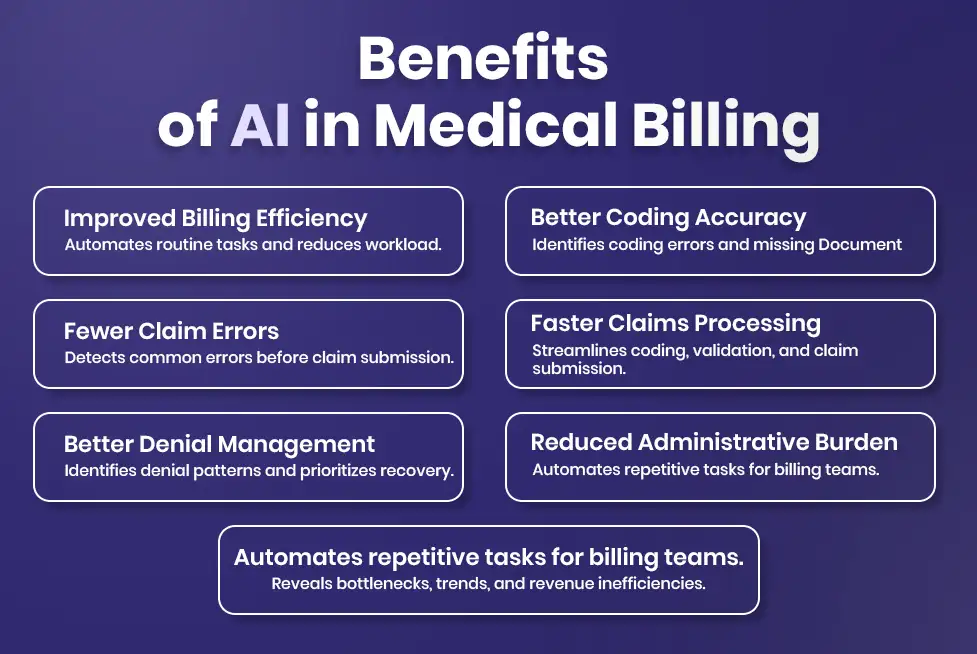
There are various advantages that AI technology brings to the medical billing process through automation of routine work, improvement in coding, reduction in claim mistakes, faster processing, denial management, and better visibility in the revenue cycle.
Improved Billing Efficiency
AI enhances the billing efficiency in the healthcare sector through the automation of tedious processes like data entry, filing of claims, eligibility check, and documentation check. The automation process decreases the burden of work for the billing team to do the work faster. This gives the staff an opportunity to attend to more challenging and complicated cases.
Potentially Better Coding Accuracy
AI can be used to ensure the precision of coding through the analysis of the documentation made by clinicians and detection of errors, discrepancies, or missing information. Automated tools can detect any problems with coding and send them for verification to a coder. This way, it is easier to avoid sending inaccurate codes to insurance companies.
Fewer Avoidable Claim Errors
Validation processes for claims that use AI technology will be able to recognize some common mistakes associated with claims even before submission. Such systems might analyze patient data, code combinations, mandatory fields, format, and other elements of claims according to certain standards. Early recognition of any mistakes will help to eliminate them before submission.
Faster Claims Processing
There is an opportunity for AI to increase the speed at which claims can be processed by automating a few tasks from the time of treatment to the time when the claim is submitted. Data extraction, validation, coding, and claim validation are just some of the processes that can be automated.
Better Denial Management
Denial management tools will also be able to use information from the past denials to recognize patterns, payer-specific problems and reasons why claims have been denied. It is possible to rank denials based on their possibility to be recovered and therefore, the efforts of employees will be focused in the right direction.
Reduced Administrative Burden
The use of AI helps to reduce administrative burden in terms of carrying out routine billing processes which normally consume a lot of time from the workforce. These include activities like data entry, claims verification, documentation verification, and status verification among others. This will enable the workers to focus more on dealing with exceptions.
Better RCM Visibility
Revenue cycle management processes are enhanced by AI-driven analytics for healthcare institutions. Analysis of large sets of operational data by AI reveals bottlenecks, delays, trends in denials, and inefficiencies. Thus, managers receive factual insight into operations and make decisions based on the reality of things, rather than on anecdotal accounts from employees.
AI Medical Billing Challenges and Risks
Medical billing using AI is efficient, yet it poses several dangers relating to privacy of data, cyber security, costs of implementation, inaccuracies of results, integration issues, resistance by employees, and compliance with regulations. Companies will need to exercise control through humans, maintain data quality, measure performance, train staff, and institute good governance.
AI Medical Billing Errors
The AI system can provide false code suggestions, false positives, or a wrong interpretation of ambiguous documentation in a medical record. This is likely to pose even greater challenges when dealing with complicated inpatient cases with multiple diagnoses and procedures. Errors need to be fixed prior to finalizing and submitting claims. Medical billing errors that quietly reduce practice revenue can include incorrect coding, missed charges, eligibility problems, claim errors, and delayed follow-ups that gradually impact financial performance.
Compliance Risks
Billing with AI assistance raises the issue of compliance because automated suggestions may impact the coding or the claims submitted by the organization. It is necessary to set up proper controls for ensuring the accuracy of coding, documentation, data management, and privacy requirements as well as human responsibility for auditing.
Data Quality
It is worth noting that the efficiency of an AI-based medical billing system largely relies on the accuracy of the data provided. Irrespective of how advanced the AI technology may be, it can still provide faulty recommendations owing to inaccurate, incomplete, outdated or conflicting data. There are therefore a number of areas that need improvement before adopting AI systems.
Integration Challenges
It is possible for there to be complications in the integration of AI technology into the current health care technology infrastructure. These might include the requirement to integrate the AI technology with electronic health records, practice management software, clearinghouses, and the revenue cycle technology that is currently in use.
Change Management
The successful integration of AI technology necessitates good change management, since staff members need to know how the new technology impacts their duties. The necessary training, along with the process for evaluating, correcting, and approving AI recommendations needs to be established. Without this, the AI will be neglected, improperly used, and regularly overridden without being documented.
Overreliance and Governance Risk
Overuse of AI can pose risks to operations and compliance if employees adopt recommendations without proper examination. Lack of transparency, variable performance of models, privacy issues, and security threats can pose such risks. Organizations need to undertake regular internal audits and review system performance in order to detect any risks that may arise. Medical Billing Audit Services help identify coding inaccuracies, billing inconsistencies, compliance issues, and other problems that may negatively affect practice revenue.
Expert Insight: AI must be treated as an enabling resource rather than as an independent billing engine. Measures such as review, audit, quality control measures, training, security controls, and continuous performance measurement must be put into place to minimize mistakes, compliance issues, and even revenue loss.
AI Medical Billing Compliance: What Organizations Need to Consider
AI technology for medical billing requires that the organization should be able to protect the patients’ data, comply with the rules in the healthcare industry, maintain an accurate billing system, and make use of AI technology safely. There are several things that can help reduce the compliance issues faced by organizations.
Human Oversight
Human oversight is critical whenever AI is employed in billing and coding within the medical field. There must be a clear designation of those tasked with reviewing the AI’s advice and making the ultimate decisions. The outputs must be reviewed by professional billers to deal with any possible errors that may occur.
Data Privacy and Security
It is necessary for there to be a certain confidentiality in the information of the patients while working on AI-driven medical billing software. It is necessary that there are adequate measures taken to make sure that none of the information becomes accessible to anyone in any form whatsoever. There must be adherence to privacy laws and system vulnerability testing.
Audit Trails
The audit trail of any artificial intelligence system that is utilized in medical billing should capture recommendations made, any changes made, any approvals received, and the billing decisions that are eventually made. This is important as it will help the organization find out how some specific results were achieved and by whom.
Coding and Billing Regulations
Medical billing through artificial intelligence technology should be consistent with the current regulations of coding and billing. AI software must always be updated with regard to annual code set changes and payer rules. The update of 2026 included 418 changes altogether, of which 288 codes were added, 84 codes were deleted, and 46 codes were revised.
Vendor Due Diligence
Prior to implementing any AI-based medical billing software, it is necessary to perform due diligence for the following aspects of the product and services provided by the vendor: security controls, data handling process, system integration and performance. Proper due diligence of the vendor will help to reveal possible problems and not rely only on promotional statements.
How to Choose AI Medical Billing Software
Selecting AI-based medical billing software depends on analyzing healthcare-related functions, integration with the current software, supervision by humans, the performance of the solution, its security, and compliance. The following steps should be taken to choose the right AI software for the company.
Look for Healthcare-Specific Training
AI billing software should be selected with the healthcare industry in mind. Healthcare-specific AI solutions can better comprehend the language of medicine, coding standards, and other specific factors that might be required when billing patients and insurance companies. The generic AI might not be able to understand the nuances of healthcare billing.
Evaluate Integration
Before selecting the AI-based billing system, it is important that the organization is able to determine whether the new tool can be integrated with existing systems like the electronic health records software, practice management system, clearinghouses, and revenue cycle system. This would mean that there will be no duplicate entry of data and that the billing department does not have to abandon its current system.
Ask About Human-in-the-Loop Workflows
It should always be possible for people to interact with AI software developed for the purpose of billing within medicine. There must be room for human beings to review, modify, accept, reject, or override the outputs generated by the AI when appropriate. Human intervention within the system is crucial for various reasons.
Measure Actual Performance
It is necessary for organizations to measure the performance of AI software through certain criteria within a specified pilot phase. Relevant criteria might be coding accuracy, claim acceptance ratio, denial ratio, accounts receivable days, processing time, and employee efficiency. Comparison of these performance indicators with current ones offers actual proof regarding the impact of the technology.
Check Security and Compliance Capabilities
Security and compliance should play an integral role in determining what AI-based medical billing software to use. The following factors should be evaluated: data governance policies, access control, data encryption, privacy controls, auditability, and any compliance-related documents. Instead of applying generic business security policies, vendors need to show specific healthcare security policies.
How to Implement AI in Medical Billing Successfully
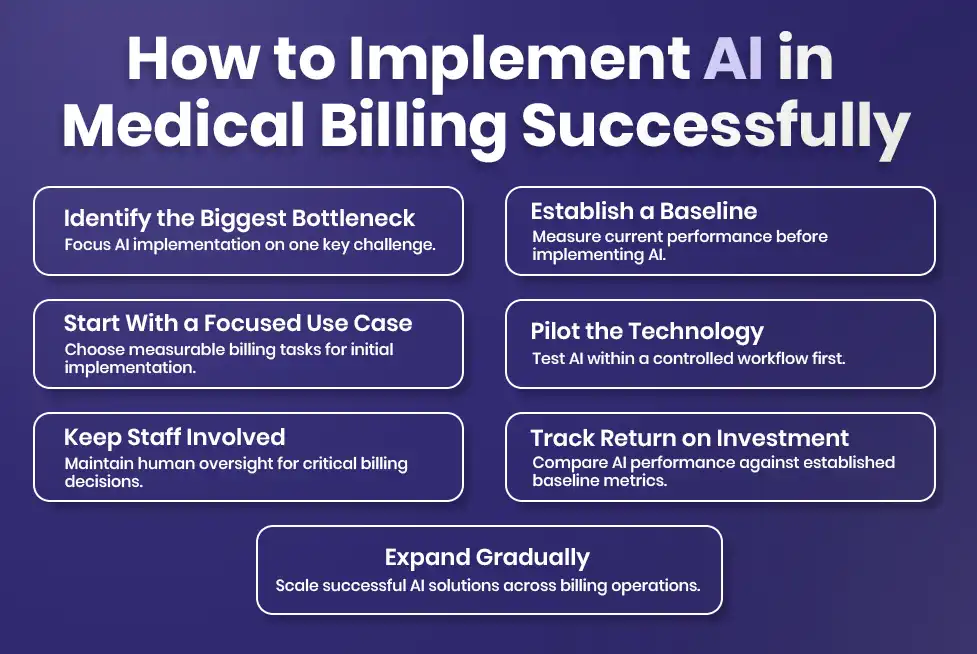
Implementation of artificial intelligence in medical billing involves a well thought-out and systematic process. This involves problem identification, setting benchmarks, testing the AI on selected use cases, engagement of the right people, performance measurement, return on investment analysis, and scaling up of successful solutions.
Step 1: Identify the Biggest Bottleneck
The organization should start by recognizing the biggest challenge in its medical billing processes. Rather than adopting AI in many different areas at once, the organization should concentrate on resolving one particular challenge. This will make it easier for the organization to implement AI and evaluate its effectiveness.
Step 2: Establish a Baseline
Prior to implementing any form of AI, it is crucial that a business sets up a benchmark on performance. Some of the performance measures include current error rate, denial rate, coding productivity, performance of accounts receivable, processing time, and so forth. Having these benchmarks set makes it easier to gauge improvements using AI.
Step 3: Start with a Focused Use Case
Organizations need to start out with an AI use case that is easily quantifiable. Appropriate use cases might consist of coding support, claims scrubbing, denial predictions, or even prioritizing accounts receivable. Choosing a well-defined use case simplifies the implementation process and provides organizations with the opportunity to measure success before implementing more AI in other billing functions.
Step 4: Pilot the Technology
Under a pilot study, organizations are able to experiment with AI in a small section of their workflow or in a specific department or set of claims prior to a complete implementation. Through the pilot study, employees would be able to recognize any technical issues, workflow problems, erroneous recommendations, and training requirements.
Step 5: Keep Staff Involved
Human involvement is critical for the success of AI implementations since billers need to provide their judgment. Companies need to have a review process and correct any mistakes found. Human involvement through assigning of human reviewers makes it possible to identify any mistakes and still hold humans responsible for crucial decisions in billing.
Step 6: Track Return on Investment
The return on investment for the use of artificial intelligence should be evaluated based on performance after AI implementation compared to the pre-established benchmark. Performance metrics like processing time, coding accuracy, denial rates, productivity of staff, and performance of accounts receivable could show the impact of using the technology financially and operationally.
Step 7: Expand Gradually
It is recommended that organizations scale the implementation of AI technology gradually following verification of the success of its early implementations. Early successes may be scaled to other departments depending on recorded results. Scaling gradually will minimize risks while allowing people to adjust to the technology rather than implementing several billing processes at once.
The Future of AI in Medical Billing and Coding
The direction of the technology points toward more sophisticated coding assistance, deeper automation across the revenue cycle, earlier denial prevention rather than after the fact appeals, more advanced payer specific analytics and closer integration between clinical documentation systems and financial systems. Governance and explainability are also receiving more attention as adoption grows, since organizations investing in these tools need to demonstrate how a given recommendation was produced. The most likely outcome for the coming years is a combined model of experienced staff supported by AI, rather than a fully unattended billing department.
How iSolve RCM Helps with AI Medical Billing
iSolve RCM applies these principles directly to client workflows, pairing AI assisted coding and claim validation with experienced billing staff who review every recommendation before submission. Rather than treating automation as a replacement for expertise, iSolve RCM uses it to prioritize denial prone claims, shorten accounts receivable cycles and keep practices current with annual coding changes, while outsource medical billing services remain overseen by staff who understand payer specific requirements across every state. This combination is designed to give practices measurable improvement without asking them to give up the human judgment that compliance sensitive billing still requires.
FAQs
Will AI replace medical coders in 2026?
No. Currently, the performance standards indicate that AI is capable of achieving an accuracy of 92 percent to 97 percent in structured interactions and less accuracy in complicated patient scenarios, whereas certified coders achieve an accuracy of 95 percent to 98 percent upon review. AI helps coders in expediting the process of reviewing charts.
How much does AI reduce claim denials?
The results vary from one organization to another, and it also depends on the quality of data. However, organizations that use predictive denial tools and make sure that there is proper follow-up tend to have few preventable denials compared to organizations that rely on manual claims reviews alone.
What are the biggest CPT 2026 changes practices should know?
In 2026, the update involved 418 updates in total which included 288 code additions, 84 deletions, and 46 revisions. Some of the highlighted fields are leg revascularization codes, codes for hearing devices, and addition of codes for AI assisted diagnostic services.
Is AI in medical billing compliant with healthcare regulations?
The AI technologies themselves are not always compliant. Whether the AI recommendations are compliant depends upon the way the organization implements human review, audit trail, data security, and coding standards compliance in respect of each AI recommendation.
How long does provider credentialing typically take in 2026?
Although, most of the payers still have approval times ranging from 60 to 180 days. Delay periods of 90 to 120 days result in deferring tens of thousands of dollars of billable revenue for the provider. This is the reason why credentialing is now more viewed as a revenue function and not just an administrative one.
What should a practice measure before adopting AI billing tools?
First, establish a benchmark for error rate, denial rate, coding productivity, and days in accounts receivable. Performance comparison between pre- and post-implementation of the technology, using identical measures, is the only way to prove the efficiency of the tool.