
CMS has proposed adding 618 procedures to the list of surgeries Medicare will pay an ambulatory surgery center to perform in 2027, the largest expansion in years, as part of its plan to phase out the inpatient-only list, according to McDermott+. For ASCs, that is new volume. For their billing teams, it is 618 more codes that need the right payment indicator, claim form and documentation before the first case is scheduled.
Ambulatory surgery center billing is the process of getting paid for the facility side of outpatient surgery: the operating room, nursing, recovery, supplies and many drugs and devices. It is billed separately from the surgeon’s and anesthesiologist’s professional services, follows its own Medicare payment system and uses a different claim form depending on the payer.
Quick answer: ASCs bill Medicare on the CMS-1500 or 837P with place of service 24 and the facility’s NPI, using CPT and HCPCS codes from Medicare’s ASC covered procedures list. Many commercial and Medicaid payers instead require the UB-04 or 837I with revenue codes such as 0490. Medicare pays a facility fee based on the ASC conversion factor, proposed at $57.766 for 2027, times each procedure’s relative weight, with a 50% reduction on lower-paid secondary procedures.
ASC Billing at a Glance
| Element | Medicare | Many Commercial and Medicaid Plans |
|---|---|---|
| Claim form | CMS-1500 or 837P | UB-04 or 837I (check each contract) |
| Place of service or bill type | POS 24 | Type of bill 083X |
| Codes | CPT and HCPCS on the ASC covered procedures list | CPT and HCPCS with revenue codes such as 0490 and 0360 |
| Payment basis | ASC conversion factor x relative weight, by payment indicator | Contracted rates, often a percentage of Medicare or case rates |
| Multiple procedures | 100% for the highest-paid, 50% for others with the discount indicator | Per contract |
| Patient share (Original Medicare) | 20% coinsurance after the Part B deductible | Per plan |
Source: CMS ASC payment page; Noridian ASC resources.

What Is an Ambulatory Surgery Center?
An ambulatory surgery center (ASC) is a facility that operates only to provide surgical services to patients who do not need to be admitted to a hospital, with an expected stay of no more than 24 hours. Medicare-certified ASCs must meet federal conditions for coverage, and many states license them separately. They are also called outpatient surgery centers or surgical centers.
A specialty surgery center focuses on one field, such as ophthalmology, gastroenterology, orthopedics or pain management, while a multispecialty ASC hosts several. Ambulatory care centers is a broader term that also covers urgent care, clinics and other outpatient settings that do not perform surgery. For billing, the distinction matters: only an ASC billing as an ASC uses the ASC payment system.
How Do You Bill for an Ambulatory Surgery Center?
An ASC case produces at least two claims: the facility claim from the ASC and the professional claims from the surgeon and, when used, the anesthesia provider. Each follows its own rules.
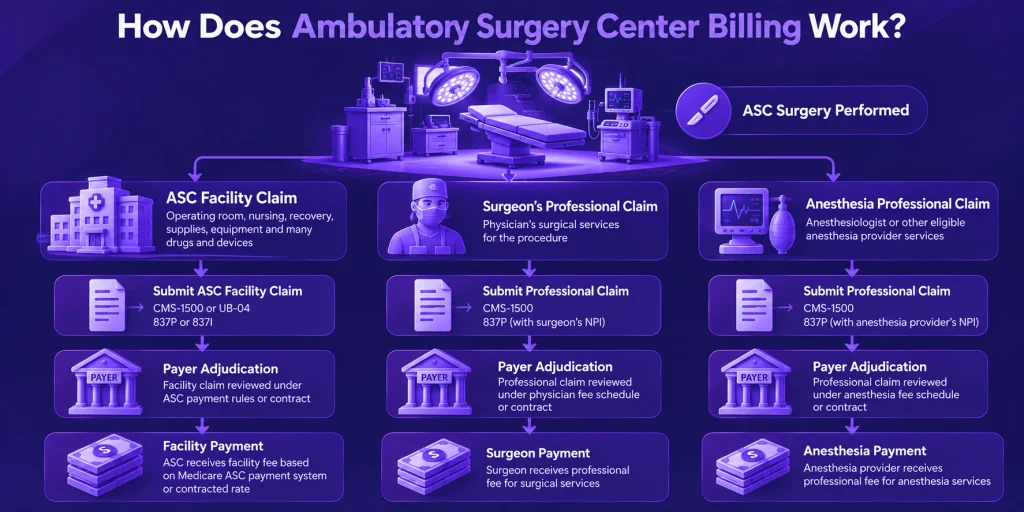
| Step | What the ASC Billing Team Does |
|---|---|
| 1. Verify coverage | Confirm eligibility, benefits, network status and prior authorization for the scheduled procedure |
| 2. Confirm the procedure is covered | Check that each planned CPT code is on the payer’s ASC list, including Medicare’s covered procedures list |
| 3. Code from the operative note | Assign CPT and HCPCS codes, modifiers and diagnoses after the case |
| 4. Capture implants and drugs | Record device and drug details, invoices and separately payable items |
| 5. Build the facility claim | Use the payer’s required form (CMS-1500 or UB-04) and place of service or bill type |
| 6. Scrub and submit | Check NCCI edits, payment indicators and payer rules before submission |
| 7. Post and follow up | Post payments, compare them with expected rates and work denials |
Do Ambulatory Surgery Centers Bill on the UB-04 or CMS-1500?
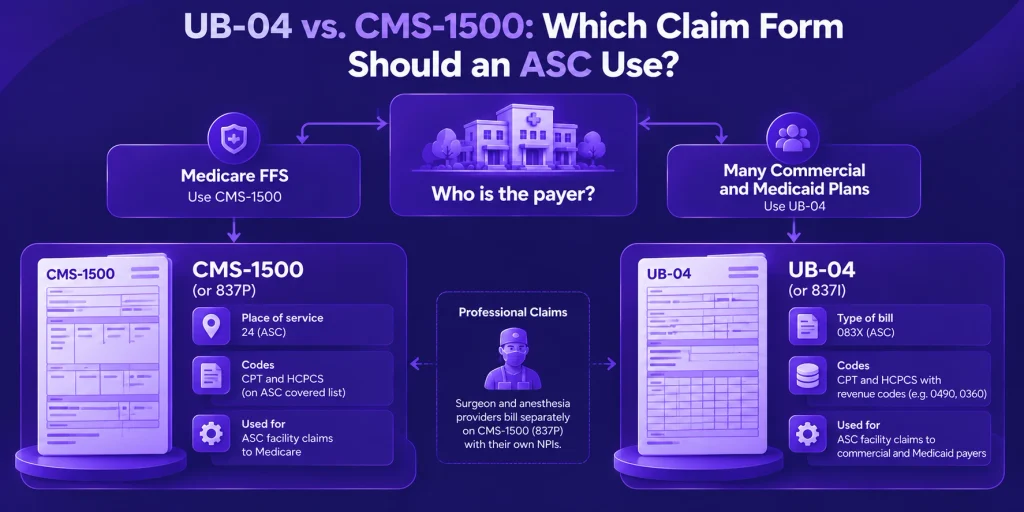
Both, depending on the payer. Medicare requires ASCs to bill the facility claim on the CMS-1500 or its electronic equivalent, the 837P, with place of service 24, even though it is a facility claim, as Noridian’s ASC guidance explains. Many commercial insurers, Medicaid programs and workers’ compensation payers instead require the UB-04 or 837I with type of bill 083X and revenue codes. The surgeon’s professional claim always goes on the CMS-1500.
| Pro Tip: Build a payer grid that lists the required claim form, bill type, revenue code rules and implant invoice requirements for every payer you contract with. The wrong form is one of the fastest ways to get an ASC claim rejected. |
What Does the ASC Facility Claim Bill For?
The facility claim pays the ASC for the resources used in the surgery: the operating and recovery rooms, nursing and technical staff, routine supplies, equipment and many drugs and devices. Medicare packages most of those items into the procedure payment. Items such as certain separately payable drugs and biologicals, devices with pass-through status and some radiology services can be paid separately, and each code’s Medicare payment indicator tells you which.
| Payment Indicator | Meaning |
|---|---|
| A2 | Surgical procedure on the ASC list in 2007; payment based on the OPPS relative weight |
| G2 | Non-office-based surgical procedure added in 2008 or later |
| P2, P3, R2 | Office-based procedures; payment based on the OPPS relative weight or the physician fee schedule non-facility practice expense, whichever applies |
| J8 | Device-intensive procedure; payment includes the device cost portion |
| K2 | Drug or biological paid separately when provided integral to a covered procedure |
| N1 | Packaged service or item; no separate payment |
| Z2, Z3 | Radiology service paid separately when integral to a covered procedure |
Source: CMS ASC payment system addenda (Addendum AA and BB) on the CMS ASC payment page.
Do ASCs Charge a Facility Fee?
Yes. Every ASC case has a facility fee, billed by the ASC, in addition to the surgeon’s professional fee and any anesthesia fee. What differs is the amount. Medicare pays ASCs less than hospital outpatient departments for the same procedure, so the patient’s 20% coinsurance under Original Medicare is usually lower in an ASC as well. Under the proposed 2027 rule, the ASC conversion factor is $57.766, while the hospital outpatient conversion factor is $102.004, as the ASIPP analysis of the proposed rule shows.
How Does Medicare Pay Ambulatory Surgery Centers in 2027?

CMS released the CY 2027 OPPS and ASC proposed rule (CMS-1850-P) on July 2, 2026, and the final rule is expected in November. The proposals that matter most for ASC billing are:
| Proposal | Detail |
|---|---|
| Payment update | 2.4% (3.2% hospital market basket minus a 0.8-point productivity adjustment) |
| ASC conversion factor | From $56.322 in 2026 to $57.766 in 2027 for ASCs that meet quality reporting requirements |
| Quality reporting penalty | ASCs that miss ASC Quality Reporting Program requirements lose 2.0 percentage points of the update |
| Covered procedures list | 618 procedures added, mostly codes leaving the inpatient-only list |
| Inpatient-only list | 637 procedures removed in the second year of a three-year phase-out |
| Office-based procedures | Still paid at the lower of the ASC rate or the physician fee schedule non-facility practice expense amount |
Source: Ropes & Gray; ASIPP; McDermott+; National Law Review.

Medicare’s ASC payment for a procedure is the conversion factor times the procedure’s ASC relative weight, adjusted for local wages. When more than one procedure subject to discounting is performed, Medicare pays 100% of the highest-paid procedure and 50% of each additional one.
What Is on the ASC Covered Procedures List?
The ASC covered procedures list is the set of surgical procedures Medicare will pay an ASC to perform. A procedure must be on the list, with a payment indicator, for the ASC facility claim to pay. Procedures not on the list are denied even when the surgery itself was appropriate. Commercial payers keep their own lists, often broader than Medicare’s, so check each contract.
The list is changing quickly. CMS finalized the multi-year elimination of the inpatient-only list in its 2026 rule, and the 2027 proposal adds 618 procedures to the ASC list. Before your surgeons schedule a newly added procedure, confirm its payment indicator, any device-intensive status and the payer’s prior authorization rules.
Which Revenue Codes Are Used for Ambulatory Surgery Center Claims?
When a payer requires the UB-04, ASC claims use revenue codes to show where each charge was incurred. These are the most common, and our guide to revenue codes in medical billing explains how they work:
| Revenue Code | Description |
|---|---|
| 0490 | Ambulatory surgical care |
| 0360 | Operating room services |
| 0370 | Anesthesia |
| 0710 | Recovery room |
| 0270, 0272, 0278 | Medical and surgical supplies, sterile supplies and other implants |
| 0250, 0636 | Pharmacy, and drugs requiring detailed coding (see our revenue code 0636 guide) |
| 0320 | Radiology, diagnostic |
Source: NUBC revenue code set. Payers may require specific codes; follow each contract.
What CPT Codes and Coding Guidelines Apply to ASCs?
ASCs use the same CPT and HCPCS codes as other settings, drawn from the surgical sections of CPT. What changes is how they are paid and which ones are allowed. Common ASC procedures by specialty include:
| Specialty | Common ASC Procedures | Example CPT Codes |
|---|---|---|
| Ophthalmology | Cataract surgery | 66984, 66982 |
| Gastroenterology | Colonoscopy and upper endoscopy | 45378, 45380, 45385, 43239 (see our colonoscopy CPT guide) |
| Orthopedics | Knee arthroscopy and carpal tunnel release | 29881, 64721 |
| Pain management | Epidural and facet injections | 62323, 64483, 64493 |
| Urology | Cystoscopy | 52000 |
| Gynecology | Hysteroscopy | 58558 |
ASC coding guidelines
- Code from the operative report, not the schedule, since the procedure performed often differs from the one booked.
- Report procedures in order of payment, with the highest-paid first, so multiple procedure discounting applies correctly.
- Use modifier 73 when a procedure is discontinued before anesthesia and 74 when it is discontinued after anesthesia begins; use 52 for reduced services.
- Report laterality with RT and LT, and follow each payer’s rule for bilateral procedures.
- Apply distinct procedure modifiers such as 59 or XS only when documentation supports a separate site or session.
- Add PT (Medicare) or 33 (commercial) to screening colonoscopies that become diagnostic or therapeutic.
ASC coding examples
Cataract surgery, right eye: CPT 66984-RT on the ASC facility claim with the cataract diagnosis; the intraocular lens is packaged into the Medicare ASC payment.
Knee arthroscopy with meniscectomy: CPT 29881-RT on the facility claim; diagnostic arthroscopy (29870) is not billed separately because it is included.
Two procedures in one session: List the higher-paid procedure first; Medicare pays it at 100% and the second, if subject to discounting, at 50%.
How Is ASC Billing Different From Hospital Outpatient Surgery Billing?
| Ambulatory Surgery Center | Hospital Outpatient Department | |
|---|---|---|
| Medicare payment system | ASC payment system | Outpatient Prospective Payment System (APCs) |
| Medicare claim form | CMS-1500 or 837P, POS 24 | UB-04 or 837I, type of bill 13X |
| Proposed 2027 conversion factor | $57.766 | $102.004 |
| Medicare prior authorization for certain services | Separate ASC demonstration in selected states | Required for listed services such as facet joint interventions |
| Typical patient cost share | Lower for the same procedure | Higher for the same procedure |
CMS is also running a prior authorization demonstration for certain ASC services in ten states, separate from the hospital outpatient program, as the American Bar Association noted. Check whether your state is included before scheduling affected procedures.
What Are the Most Common ASC Billing Errors?
| Error | What Happens | Fix |
|---|---|---|
| Procedure not on the payer’s ASC list | Facility claim denied | Check the covered procedures list before scheduling |
| Wrong claim form for the payer | Rejection | Follow the payer grid: CMS-1500 for Medicare, UB-04 where required |
| Packaged items billed separately | No payment for those lines (N1) | Use payment indicators to decide what to bill |
| Missing implant invoice | Underpayment or denial for device-intensive cases | Attach invoices when the payer requires them |
| Procedures out of payment order | Wrong multiple procedure discount | List the highest-paid procedure first |
| Missing authorization | CARC 197 denial | Verify authorization for every scheduled code |
| Discontinued case coded as complete | Overpayment risk | Use modifiers 73 or 74 with documentation |
These denials usually return as CARC 16, 97, 197 or 204, explained in our guide to common denial codes in medical billing.
What Are the ASC Billing Guidelines to Follow on Every Claim?
- Eligibility, network status and authorization verified for every scheduled procedure.
- Each CPT code confirmed on the payer’s ASC list with its payment indicator.
- The payer’s required claim form, place of service or bill type and revenue codes used.
- Codes assigned from the signed operative report.
- Implants, drugs and invoices captured for separately payable or device-intensive items.
- Procedures listed in payment order with correct modifiers.
- Payments compared with contracted and Medicare rates to catch underpayments.
How Do You Choose an Ambulatory Surgery Center Billing Company?
Look for an ASC billing company that knows facility billing, not just professional billing. Ask how it tracks covered procedures list changes, which payers it bills on the UB-04, how it handles implant invoices and device-intensive cases, how it checks multiple procedure discounting and how it reports underpayments by payer. Ask for references from ASCs in your specialty.
How Can iSolve RCM Help Your ASC?
iSolve RCM bills both sides of the surgical case, the ASC facility claim and the surgeon’s professional claim, with eligibility verification before the case, certified medical coding from the operative report and denial follow-up after it. Services start at 2.99% of monthly collections, and a medical billing audit can show where your current ASC claims lose money.

Frequently Asked Questions
What is ASC in medical billing?
ASC stands for ambulatory surgery center. In medical billing, it refers to the facility claim an ASC submits for outpatient surgery, separate from the surgeon’s and anesthesia provider’s professional claims.
What place of service code is used for an ASC?
Place of service 24, ambulatory surgical center, on the CMS-1500 for both the Medicare facility claim and the surgeon’s professional claim.
What revenue code is used for ambulatory surgery?
Revenue code 0490, ambulatory surgical care, is the main revenue code when a payer requires the UB-04, often with 0360 for operating room services and other codes for supplies, implants and drugs.
How much does Medicare pay an ASC in 2027?
Under the proposed 2027 rule, the ASC conversion factor is $57.766 for ASCs that meet quality reporting requirements, a 2.4% update. Each procedure’s payment is the conversion factor times its relative weight, adjusted for local wages. The final rule is expected in November 2026.
Can an ASC bill for procedures not on Medicare’s covered list?
Not to Medicare as an ASC facility service. The facility claim is denied if the procedure is not on the ASC covered procedures list, so check the list before scheduling.
Do ASCs bill separately for implants?
It depends on the payer. Medicare packages most implant costs into the procedure payment, with device-intensive procedures paid at a higher rate. Many commercial contracts pay implants separately at invoice cost plus a percentage, so invoices must be captured.


