Around 55,230 deaths are anticipated in 2026 due to colorectal cancer in the United States, and according to the American Cancer Society, there will be 158,850 new cases of the disease diagnosed during the same year. Incidence is increasing by 3 percent annually for people aged between 20 and 49 years. Thus, young people are starting to make appointments alongside elderly patients for endoscopic procedures. There are procedure notes, pathology orders, billing codes, and quality data generated each time patients come. Gastroenterology EMR software can handle all these tasks efficiently or contribute to revenue leakage and compromise patient safety.
Policy guidelines put additional burden on physicians and practices. CMS has set a threshold of 75 points for 2026, and practices that score below that threshold can receive penalties of up to 9 percent. Moreover, the initial claims denial rate in 2024 was 11.8 percent. Working with specialized gastroenterology billing services can also help practices manage the coding, claims, and reimbursement challenges associated with GI procedures. Thus, choosing the right gastroenterology EMR software becomes both a financial and clinical decision. This guide discusses the capabilities that differentiate the best gastroenterology EMR systems from average options based on the latest clinical research, regulations, and quality criteria.
Why a Specialty Built Record Matters in Endoscopy
A gastroenterology EHR has to handle more than office visits. Endoscopy suites produce images, specimens, sedation records and quality measures within a single appointment, and each item feeds a different downstream task. Generic records force staff to rebuild that information by hand, which slows the schedule and invites errors. An EMR for gastroenterology practice work should mirror how endoscopists actually document, order and follow patients.
The financial stakes are equally specific. The guidelines now indicate that average-risk screenings begin at age 45, and adult screenings aged 45-49 increased by 62 percent from 2019 to 2023, thereby increasing the number of procedures and payer mixes. Physicians who partner with a medical billing company in USA familiar with the codes and guidelines for endoscopy will be able to avoid a lot of issues that arise.
How the Patient Mix Is Changing Practice Demands
Changing patient profiles exist. Almost 50% of all new colorectal cancer patients are under 65 years of age, up from 27% in 1995, and only 37% of patients between 45 and 49 years have been currently on screening as of 2023. GI EMR systems must have more capabilities in terms of referral types, including both initial screening and symptomatic diagnosis.
Administrative limitations are in place. In 2025, 41% of all providers have had their denial rates to be at least 10%, against 30% in 2022. Most medical practices outsource their medical billing needs while having clinical documentation performed internally, and they rely on gastroenterology EHR software to provide proper data without re-typing.
Handoffs That Quietly Cost Endoscopy Practices Revenue
Gaps usually appear at handoffs. Reported inadequate bowel preparation rates center on a median of about 25 percent, and a screening exam that turns therapeutic can change the billed code the moment a polyp is removed. Gastroenterology practice software that ignores these transitions leave staff reconciling notes, orders and charges after the fact. The best gastroenterology EHR options treat each transition as a designed step.
Coding rules add another layer. Screening and diagnostic pathways use different code families, and modifier mistakes are among the most common and most fixable gastroenterology denial triggers. Practices that lack certified coders in house often rely on medical coding services to review procedure notes before claims leave the building. That review works only when the record captures indications, findings and specimens in a consistent format.
10 Best Gastroenterology EMRs for Practices in 2026
Selecting a gastroenterology EMR depends on much more than the typical features offered by an EHR. The practice will require documentation of procedures, workflows for endoscopy, imaging, quality measures, coding, recall procedures, scheduling, and revenue cycle tools. These EMRs have been chosen from your list and characterized according to 2026 vendor literature and professional society guidelines. Following are the leading Gastroenterology EMR systems:
1. ModMed (gGastro)
ModMed’s gGastro combines GI-specific EHR, endoscopy reporting, practice management, billing, analytics, and patient engagement. Its MIPS Quality Module supports GIQuIC reporting, while the endoscopy report writer provides customizable templates, nursing documentation, imaging, and ASC workflows. The current platform also includes AI-powered gScribe and mobile access. ModMed reports gGastro 5.0 can be up to 20% faster.
2. NextGen Healthcare (NextGen Gastro Suite)
NextGen Gastro Suite overlays gastroenterology-specific workflows onto NextGen Enterprise EHR. Its documented capabilities include smart lists, configurable in-office testing and procedures, pre-certification workflows, repeat-colonoscopy tracking, endoscopy scheduling, PACS integration, and liver-disease workflows. NextGen also highlights AI-powered documentation, cloud hosting, interoperability, and integrated financial management for GI practices.
3. Provation MD
Provation MD is purpose-built for GI procedure documentation and supports structured notes, native image capture, automated CPT and ICD-10 coding, and GIQuIC quality reporting. Provation says more than 15,000 physicians and endoscopists use its solutions, while its MD platform supports over 35 GI procedures and more than 100 standard reports for benchmarking and business intelligence.
4. Epic Systems
Epic’s Lumens is an endoscopy reporting application designed for gastrointestinal and pulmonary procedures. It supports scheduling, procedure documentation, findings, image association, reporting, and quality-metric evaluation. Epic’s FHIR documentation also describes image-transfer workflows, including a benchmark of sending 30 image files or messages in under 50 seconds. This makes Lumens particularly relevant to integrated health systems.
5. athenaOne (athenahealth)
athenaOne comprises EHR, practice management, revenue cycle management, and patient engagement in one cloud platform. The current statistics for 2026 include a clean claim submission rate of 98.4% and over 277,000 direct clinical integrations. Furthermore, athenahealth claims 80+ AI-native revenue cycle capabilities launched in 2026. Its varied specialty configuration makes it flexible for multispecialty practices.
6. EndoSoft
EndoSoft’s EndoVault is an ONC-certified EHR designed around endoscopy workflows, with procedure documentation, image/video capture, PACS, quality reporting, pathology, recall management, and analytics. Its Argus AI can use voice commands for documentation, image labeling, and specimen labeling. EndoVault supports DICOM and integrates with major EHR/PACS environments, including Epic.
7. eClinicalWorks
eClinicalWorks is an e-Gastroenterology EHR with practice management capabilities in scheduling, documentation, laboratories, medications, billing, follow-up, and patient communications. eClinicalWorks refers to itself as a certified GIQuIC vendor that offers quality benchmarking for colonoscopies and endoscopies. Smart Macros, Templates, Endoscopy Reports, and Voice-enabled Scribe could be additional options for GI Documentation.
8. DocVilla
DocVilla is an EHR which is a combination of electronic medical record, telemedicine, e-prescribing, patient engagement, scheduling and revenue cycle management. The DocVilla cloud based platform is HIPAA compliant and comes with a patient portal which includes patient communications, payment and scheduling options. The billing component covers eligibility checks, claim submission and patient billing.
9. Praxis EMR
Praxis uses a template-free approach based on its Concept Processing technology. According to Praxis, the system learns from individual physicians’ usage and progressively adapts to their documentation style. Its platform supports personalized workflows rather than conventional fixed templates and is marketed across specialty and telemedicine settings. For GI practices, its key distinction is adaptive documentation rather than a dedicated endoscopy-first architecture.
10. DrChrono
Access from mobile devices is one of the key features of DrChrono. Documentation indicates that providers are able to create patients, schedule appointments, view the schedule, and even reschedule appointments using the mobile application, where the information will be synchronized on the cloud. This feature is beneficial for smaller GI practices which are focused on mobile access, although GI-specific functionality must be verified.
What GI Practices Should Verify Before Choosing
The most important evaluation criteria should reflect current endoscopy-quality requirements. The 2024 ASGE/ACG colonoscopy indicators identify adenoma detection rate (ADR), sessile serrated lesion detection rate, bowel-preparation adequacy, and adherence to recommended screening/surveillance intervals as priority measures. ASGE also identifies a ≥95% cecal-intubation target and ≥90% adequate bowel-preparation target for relevant colonoscopy populations.
Therefore, during demonstrations, practices should specifically verify:
- GI procedure documentation and customizable end writer functionality.
- Image/video capture and association with procedure findings.
- Automated or structured CPT/ICD-10 coding.
- GIQuIC and other quality-registry reporting.
- ADR, bowel-prep, cecal-intubation, and surveillance tracking.
- Pathology and specimen workflows.
- Colonoscopy recall and follow-up management.
- Prior authorization and pre-certification workflows.
- Billing, claims, and revenue-cycle integration.
- Interoperability with laboratories, hospitals, PACS, and existing EHRs.
- Mobile access, patient engagement, and telehealth.
- Scalability across office, ASC, hospital, and multi-site environments.
Documentation Capabilities That Protect Clinical Quality
Procedure documentation is where quality, compliance and payment meet. Strong gastroenterology EMR colonoscopy documentation and EGD records give endoscopists speed at the point of care and give coders the detail needed for accurate claims. The capabilities below define what dependable documentation looks like in practice.
Structured Colonoscopy Findings
Free text notes hide the details that quality programs measure. A capable gastroenterology EMR captures polyp size, location, number and removal technique in discrete fields. That structure matters because detection rates vary widely, from 7.4 percent to 52.5 percent across physicians in one large study, and each one point gain in adenoma detection lowered interval cancer risk by three percent.
Bowel Preparation Quality Capture
Preparation quality determines whether an exam counts. Inadequate preparation affects a median of about 25 percent of colonoscopies, and it can push a ten year screening cycle closer to 7.8 years across a population. Recording a standard preparation score in every report lets the practice decide on repeat timing consistently and protects the exam from later payer questions about necessity.
EGD Documentation Depth
Upper endoscopy notes need the same rigor. For suspected Barrett’s esophagus, guidance suggests at least eight biopsies during screening, with the Seattle protocol for segments longer than four centimeters. Gastroenterology EMR EGD documentation should prompt for segment length, biopsy count and sampling pattern, since compliance with those steps is described as poor in practice and gaps weaken care and claims.
Reusable Procedure Templates
However, templates only offer time savings when they remain flexible. Gastroenterology EMR templates for procedures need to incorporate screening, surveillance, diagnostics, and treatment protocols and allow doctors to modify their findings without compromising the integrity of the underlying template. Individual templates for colonoscopy, EGD, and sigmoidoscopy address frequent omissions, whereas preset indications and sedation fields guarantee consistent and reviewable entries from each and every endoscopist at a large practice.
Endoscopy Reports for Referrers
Completed reports need to be delivered promptly. Referring doctors and patients alike want a report on findings and what the next steps are. An endoscopy report for Gastroenterology EMR needs to create that report using the structured report and add relevant images to deliver that report to the referring physician automatically, reducing time taken in decision-making and status calls.
Indication and Necessity Language
Payers make their determination based on the indicated purpose of the procedure. If the colonoscopy was done following a positive stool test result, as surveillance or due to symptoms, they all have different coverage criteria and hence the purpose has to be clearly stated. Indications pick list, family history and prior findings pick list ensure the use of proper terminology and denial management evidence.
Sedation and Post Procedure Records
Safe sedation records and discharge instructions complete the encounter. The record should log medications, monitoring intervals, recovery status, discharge readiness and any complications, then generate patient instructions in plain language that match the exam performed. Complete entries support facility billing, protect the practice during payer or legal review, and ensure the next clinician sees exactly what happened during the procedure.
Coding and Claims Accuracy for Endoscopy Services
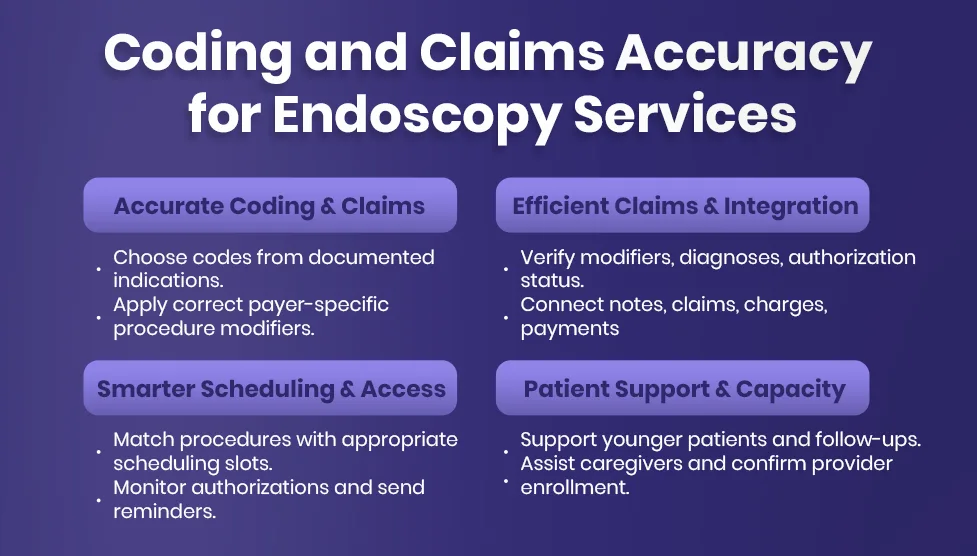
Reimbursement for endoscopic procedures hinges on fine details that separate screening, diagnosis, and treatment services. Appropriate gastroenterology EMR coding methodology and claims edits eliminate common mistakes before transmission, ensuring both practice revenue protection and patient copayment protection. Every one of the following capabilities is a rule worth testing.
Screening and Diagnostic Code Families
Medicare screening claims use G0121 for average risk beneficiaries and G0105 for high risk beneficiaries, while diagnostic colonoscopy relies on the 45378 family. Gastroenterology EMR CPT coding should choose the correct family from the documented indication, since the wrong choice changes payment and patient liability. Frequency limits differ too, and Medicare covers average risk screening only once every ten years. Moreover, you may need to know about family practice billing services that include medical coding, claims submission, eligibility verification, payment posting, denial management, and accounts receivable follow-up.
Modifier PT and Modifier 33
When a screening exam becomes therapeutic, Medicare expects modifier PT on the procedure code, while commercial and Medicaid plans expect modifier 33. This covers biopsy and polypectomy codes. Using one in place of the other triggers automatic denials. A gastroenterology EMR should apply the correct modifier from the payer type on the encounter, so billers stop guessing at claim assembly.
Follow On Colonoscopy After a Positive Stool Test
The Medicare system from 2023 recognizes the colonoscopy following the positive fecal test as one screening encounter, where the G code must be modified by modifier KX. Without it, the claim is considered nonprocessable. The coding logic requires the identification of the previous positive result before the procedure takes place, so the modifier is added in advance.
Cost Sharing Estimates for Patients
The patient usually gets the details regarding the cost of removing polyps only after the procedure is performed. Coinsurance of 15% is charged by Medicare from 2023 through 2026 for a screening procedure that becomes therapeutic; coinsurance drops to 10% between 2027 through 2029 and becomes zero by 2030. The billing process for gastroenterology EMR allows front desk staff to give the percentage to be paid upfront.
Diagnosis Sequencing
Claim logic should also list the screening diagnosis first and the finding second. Code Z12.11 leads to a screening colonoscopy claim, with the finding code following once pathology confirms it. A record that reliably enforces this order avoids costly diagnosis and procedure mismatches that payers commonly cite when denying submitted claims, especially when pathology results return several days after the exam.
Claims Management Before Submission
Claims management needs to identify issues while the patient record is still open. The initial denial rates averaged 11.8 percent in 2024, with missing or inaccurate documentation and lack of authorization being identified as the leading causes. EMR claims management for gastroenterology with verification of modifiers, diagnosis ordering, and authorization status prior to transmission ensures that corrections can be made in one attempt rather than in multiple attempts.
Billing Integration from Note to Claim
The charge must stem from the procedure note which is already signed directly into the claim without retyping. The gap that arises between clinical documentation and financial documentation is the reason why the data is not available or correct for the payers and is being rejected. Good integration helps in revenue cycle management where the note, order, charge, and payment can be easily tracked.
Scheduling and Patient Access Capabilities
Endoscopy schedules depend on preparation, transport, anesthesia and authorization all lining up. The right gastroenterology EMR scheduling and portal features reduce cancellations, keep suites full and give patients the guidance needed to arrive ready for their procedure. Each feature below closes gaps that waste capacity.
Scheduling by Procedure Type
Scheduling should reflect procedure length, room and equipment needs, sedation type and the endoscopist’s availability. Gastroenterology EMR scheduling that assigns slots by procedure type prevents overbooked rooms and idle gaps. It also links each booking to a preparation protocol and authorization check, so staff see missing requirements at the time of booking rather than on the morning of the exam.
Capacity for Younger Screening Patients
The age group targeted for screening is shifting towards younger adults. Screenings for colonoscopy in adults from the age group 45 to 49 increased by 43%, and stool tests increased by over five times from 2019 to 2023, which generates demand for follow up procedures. It is essential to have flexible recall lists and openings for scheduling of patients with a positive stool test.
Authorization Timing
The quicker payers’ schedules will shift. Starting from January 2026, federally mandated health plans must respond to all routine pre-authorizations within seven days and urgent ones within 72 hours and justify their denials. The schedule workflow that monitors the date of submission and deadlines of decisions enables the staff to easily replace any request not timely or denied.
Patient Portal Adoption
Patients increasingly expect digital access. In 2024, 77 percent of individuals were offered online access and 65 percent used it, while 87 percent of those encouraged by a clinician logged in, against 57 percent of those not encouraged. A gastroenterology EMR patient portal should be easy to activate at booking so patients see preparation steps and results without phone calls.
Preparation Instructions and Reminders
Repeat exams are expensive for patients and practices. Portal messages that deliver diet instructions, medication holds and reminder notices in the days before a procedure give patients time to comply. The portal can also collect completed preprocedural questionnaires, so nurses review risk factors, blood thinner use and transport plans early and correct problems before a patient arrives fasting for nothing.
Caregiver and Proxy Access
Many endoscopy patients depend on a family member for transport, sedation escort and instructions. Proxy access to online records more than doubled over four years, from 24 percent in 2020 to 51 percent in 2024, so portal permissions should let a designated caregiver receive preparation steps and discharge directions while the practice still protects privacy and documents the patient’s consent.
Provider Availability and Enrollment
A schedule is only usable when every endoscopist is enrolled with the payers filling it. New physicians, locum coverage and added facility sites need approvals before their first claim, and delays leave capacity unbookable. Provider credentialing services keep those approvals moving on schedule, and scheduling rules should block payer specific appointment slots until the enrollment status is confirmed in writing.
Professional Insight: Embed billing and scheduling validations in your process flow for gastroenterology to identify any mistakes related to coding, modifiers, authorization, and preparation requirements. Linking up clinical documentation, claims, scheduling, and patient communication will help you reduce unnecessary denials and increase procedure preparation.
Pathology Tracking and Follow Up Care
Endoscopy rarely ends at the procedure. Specimens, laboratory results and recall dates decide whether a finding becomes a treatment plan or a missed opportunity. Effective gastroenterology EHR pathology tracking connects each collected specimen to a result, an interpretation and a documented and timely patient notification.
Pathology Integration with Laboratories
Gastroenterology EMR pathology integration lets laboratory results return directly to the patient record instead of arriving as faxed paper. Electronic results attach to the original order and procedure, which removes manual matching and speeds interpretation. Because pathology findings decide diagnosis codes, surveillance intervals and billing, a direct laboratory connection protects both clinical decisions and claim accuracy at the same time. This can also help with mental health billing services that include specialized coding, claims processing, insurance verification, denial management, payment posting, and reimbursement follow-up.
Tracking Pending Specimens
Every specimen needs an owner and a deadline. A tracking list that shows collected, sent, received and reviewed status exposes samples that have gone quiet, which matters because delays in completing follow up after a positive screen raise the risk of advanced stage cancer. Pathology tracking should escalate overdue results to a responsible nurse or physician rather than waiting for a patient to call back.
Surveillance Interval Recall
Recall dates should come from findings, not memory. Appropriate follow up interval is a tracked colonoscopy quality measure, and inadequate preparation is a recognized reason for repeating the exam within a year. A record calculates the next due date from the pathology result and the preparation score, then places the patient on a recall list that scheduling staff review and act on monthly.
Completing Colonoscopy After Abnormal Results
Timing matters after an abnormal stool test. One analysis found only 56 percent completed colonoscopy within one year, and waiting seven to twelve months brought 37 percent higher odds of colorectal cancer than acting within 30 days. Practices need referral tracking that flags unscheduled patients, records outreach attempts and measures time to procedure against national goals of 80 percent completion.
Barrett’s Esophagus Surveillance
Barrett’s esophagus needs disciplined biopsy and recall tracking. The risk of developing yearly esophageal adenocarcinoma is about 0.33% if there is no dysplasia, 0.54% if there is low-grade dysplasia, and 6.58% if there is high-grade dysplasia. It is very important that the record correlates each biopsy to its pathology level and makes an appointment for the next endoscopy.
Communicating Results to Patients
Results are only useful when patients understand them. Recorded notification, whether by portal message, letter or call, protects the practice and starts the next step promptly. Because most portal users check laboratory results and clinical notes, a reviewed and explained result should reach the patient with clear next steps rather than as a raw laboratory report that invites unanswered questions.
Pathology Billing and Open Balances
Pathology adds separate charges that often involve outside laboratories and split billing. Unmatched specimens, late reports and missing payer details leave balances open for weeks. AR management services help practices work those aging accounts by payer and age bucket, and the record should show which specimen, laboratory and claim each unpaid balance belongs to, so collectors avoid repeated payer calls.
Quality Reporting for MIPS and GIQuIC
Quality measures have an impact on reimbursement on an annual basis, and the best way for EMR MIPS to report on gastroenterology is to have it pull information from the same documentation of procedure as the registry. There is no need for doctors to enter in duplicate entries or maintain spreadsheets.
Understanding the 2026 Scoring Rules
MIPS will maintain the performance standard for 2026 at 75 points, where Quality and Cost are both rated 30 percent, Interoperability 25 percent, and Improvement Activities 15 percent. Below-threshold scores will be penalized up to minus 9 percent. Reporting must be assessed on a monthly basis, not annually, so that practices have an opportunity to rectify issues still possible.
GIQuIC Registry Participation
Gastroenterology EMR GIQuIC connectivity matters because the national registry holds more than 10 million colonoscopies and benchmarks over 12 colonoscopy measures, plus a separate group of upper endoscopy measures. It has offered MIPS reporting as a qualified clinical data registry since 2014. Direct submission from the procedure record spares staff from rekeying each completed exam and reduces manual transcription errors.
Adenoma Detection Reporting
AD (adenoma detection rate) is the key performance indicator of colonoscopy. Recommendations call for a minimum goal of 35% for patients over the age of 45 years; 40% for men and 30% for women. Average rates have been achieved up to 38% by 2018. The report must allow an endoscopist to view his own statistics, not averages.
Measure Selection and Value Pathways
Measure choice deserves annual review. Federal rules for 2026 added five quality measures, removed ten and revised thirty, and 27 value pathways are available, including a gastroenterology care pathway. Practices should test with real cases whether the record supports the chosen measures before the year begins, since a measure that cannot be captured cleanly yields lost points and wasted effort.
Cecal Intubation and Withdrawal Time
Registry benchmarks also depend on cecal intubation rate and average withdrawal time. Cecal intubation confirms the exam reached the start of the colon, while withdrawal time reflects inspection effort. Making both required fields before a report can be signed improves data completeness and gives physicians reliable numbers when they compare themselves with peers instead of relying on memory or impressions.
Data Completeness Requirements
Data completeness still carries real weight. For large practices with more than 15 clinicians, the three point floor is removed for measures that meet completeness and case minimums, so weak performance is scored as it is. An EMR should show completeness by measure and by physician during the year, allowing office managers to close gaps in time to change results.
Audit Readiness for Reported Data
The claimed actions have to coincide with the performed ones. The medical billing audit is an audit service which compares the procedure notes, coding, registry information, payment amounts, and finds inconsistencies like documented polypectomy charged as diagnostic examination. Auditing a random sample of recent cases quarterly is necessary for preventing repayments and non-compliance claims, and ensures that the quality scores are based on correct documentation.
Interoperability, Practice Management and Selection
However, a specialty record is never an independent entity. Rather, it interfaces with hospitals, laboratories, ambulatory surgery centers, and insurance payers, as well as serving the front office. The last part deals with issues of connectivity, practice management requirements, payer updates, and a systematic approach to vendor evaluation.
Interoperability With Hospitals and Surgery Centers
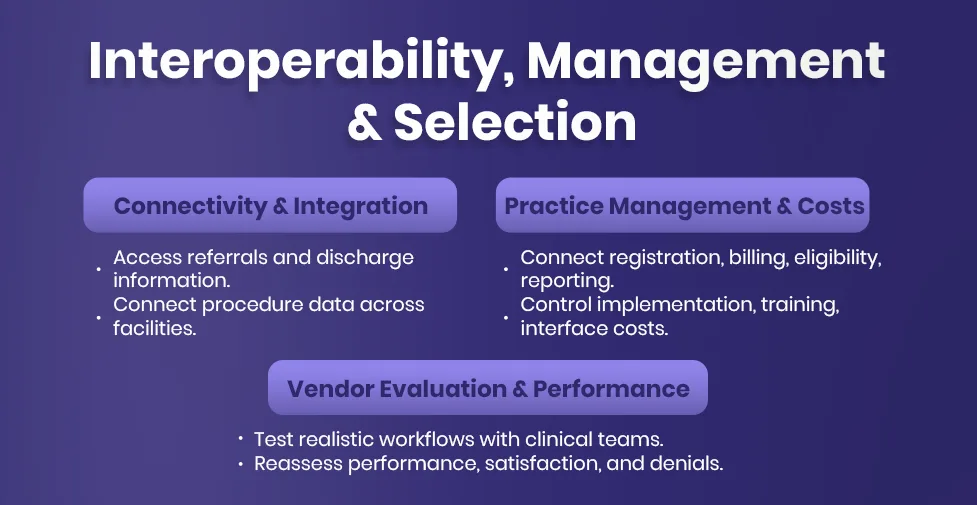
Interoperability of Gastroenterology EMR will determine whether the referral letter, discharge summary from the hospital, or surgery center information is available for the endoscopist prior to the appointment. The Federal Cures Act standards were designed in order to increase the exchange of health information between patients, family members, and providers. Vendors should show the ability of exchanging information with local hospitals, labs and referring clinics using current examples.
Practice Management Fit
Gastroenterology practice management software covers registration, eligibility checks, payer contracts, patient statements and reporting, and it must connect smoothly with the clinical endoscopy record. Check that eligibility results appear before procedure day, that payer specific rules are stored once, and that financial reports can be filtered by endoscopist, facility and procedure type for accurate managerial decisions about staffing and capacity.
Endoscopy Suite Connections
Image and equipment connections affect both documentation and speed. Endoscope processors, image capture stations and patient monitors should place images and vital sign data into the correct patient case without manual transfer. Test with a full day of scheduled procedures before purchase, since a connection that works for one case may slow the room when volume rises and turnover tightens.
Payer Rule Changes Ahead
Payer requirements are moving toward electronic exchange. Standardized connections for prior authorization, provider access and payer to payer data sharing are due by January 2027 for regulated plans, after the process changes that began in 2026. Practices should ask vendors for a dated plan showing how they will support these connections and how the practice will be notified of changes.
Needs of Smaller Groups
Smaller groups feel every implementation cost. A two or three physician practice may evaluate medical billing software for small business alongside its clinical record, and should confirm that both share patient demographics, charges and payments. Fees for training, interfaces and data transfer should be written into the quote, since hidden extras erode the savings that made a smaller system attractive.
Evaluation With Real Cases
Demonstrations should use your own cases. For gastroenterology EMR software 2026 comparisons, ask each vendor to document a realistic screening colonoscopy that becomes a polypectomy, order pathology, code the claim and report quality data. Score every step for speed and accuracy, and include physicians, nurses and billers in the scoring so each group judges the workflow it will actually use.
Ongoing Review After Go Live
Selection is not the last phase of the decisionmaking process. Only 56 percent of vendors in 2025 felt that their claimed technology met their requirements, compared to 77 percent in 2022, showing how fast the needs outstrip the tools. An EHR chosen for gastroenterology practice management has to be evaluated every year on the grounds of denial rate and physician satisfaction.
Expert Guidance: Select an EMR for gastroenterology that works smoothly with your clinical, billing, scheduling, and outside systems. Check interoperability with hospitals, labs, insurance companies, and endoscopy devices prior to implementation. Also look at cost, workflow, support, and overall performance to make sure that the software stays practical and scalable.
Choosing With Confidence
The strongest choice is the record that fits how endoscopy work actually flows, from booking and preparation through pathology, coding and quality reporting. Practices that test real cases, insist on structured data and review results yearly protect both patient outcomes and revenue. Accuracy matters beyond this specialty too, as guidance on Left Leg Pain ICD 10 Code Medicare shows when symptom diagnoses must be supported by documented necessity. Use the criteria in this guide to compare options with confidence in 2026.
How iSolve RCM Supports Gastroenterology Practices
iSolve RCM supports gastroenterology practices with billing and coding teams trained in endoscopy rules. Specialists evaluate procedure notes, apply the accurate screening and therapeutic codes, submit clean claims, work denials to root cause and follow unpaid accounts until payment posts. Practices gain stronger reporting, faster reimbursement and more time for patient care, although physicians keep control of documentation and clinical decisions. Support extends to payer follow up and monthly reviews.
FAQs
What should a gastroenterology EMR include for colonoscopy documentation?
It should capture indication, preparation quality, cecal intubation, withdrawal time, findings and removal technique in structured fields. Templates should also generate the report, link images and pass details to coding. Structured entries improve accuracy, support quality measures and reduce avoidable payer disputes over medical necessity.
How does a gastroenterology EMR support MIPS reporting?
It should collect measure data as physicians document, track completeness by clinician during the year and support registry reporting for colonoscopy measures. Monthly review helps because lower scores bring negative payment adjustments, and gaps found after the year closes are simply too late to fix.
Why is pathology integration important for a GI practice?
Pathology integration returns laboratory results to the patient record and attaches them to the original procedure. That connection supports accurate diagnosis coding, timely patient notification and correct surveillance intervals, and makes overdue specimens visible to staff instead of relying on faxed paper or personal memory.
Which modifiers matter when a screening colonoscopy becomes therapeutic?
Medicare expects modifier PT on the procedure code when a screening colonoscopy becomes therapeutic, while commercial and Medicaid plans expect modifier 33. Medicare also requires KX on the G code for a colonoscopy after a positive stool test. Payer policies differ, so verify each contract.
How does a patient portal help endoscopy practices?
A portal lets patients receive preparation instructions, consent forms and results without phone calls, and it allows caregivers to help with transport and instructions. Reminder messages sent before the procedure give patients time to follow dietary steps, which lowers the risk of a repeat exam.
How should a practice choose the best gastroenterology EMR?
Test each vendor with your own cases, from scheduling and documentation through pathology, coding, claims and quality reporting. Confirm exchange with local hospitals and laboratories, and request clear written pricing for training and connections. Choose the option that removes duplicate entry without limiting clinical judgment.