

Medical billing denial codes directly impact healthcare providers’ cash flow, operational efficiency, and time required to process reimbursement claims. Effective denial management within Revenue Cycle Management (RCM) helps organizations minimize claim rework, improve clean claim rates, and avoid revenue shortfall caused by preventable billing and submission errors.
The denial code CO-18 is one among common denial codes which indicates a duplicate claim or service submission that frequently result from workflow gaps, resubmission errors, or delayed payer processing. A dependable medical billing company in USA can help healthcare providers reduce such errors through accurate claim tracking and denial management support. This blog explains the causes, resolution approaches, prevention procedures, and interrelated denial codes to help medical billers manage CO-18 denials efficiently.
What Does CO-18 Denial Code Mean?
The CO-18 denial code is a Claim Adjustment Reason Code (CARC) which is applied in medical billing to show that a claim or service has already been submitted and processed by the insurance payer. Its official description is “Duplicate claim or service,” which means the insurer believes the provider billed the same procedure, patient encounter, or service more than once. This denial normally appears when identical claim information matches a formerly received submission.
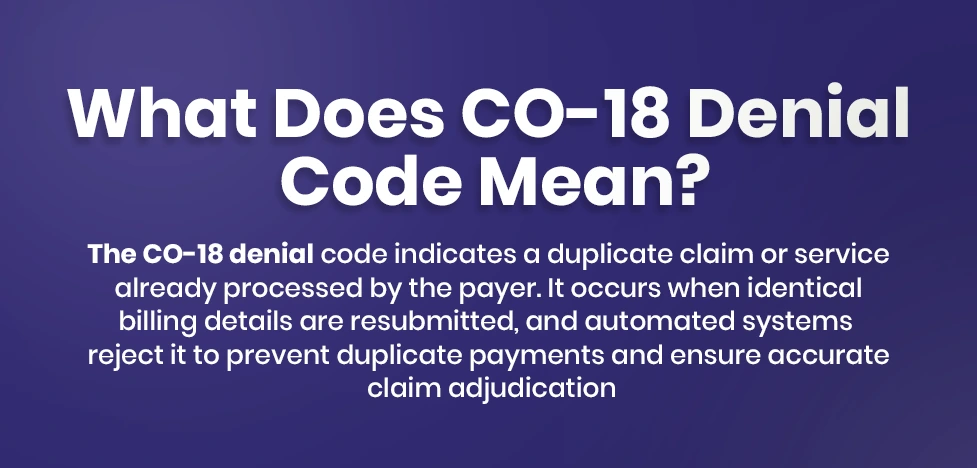
Insurance companies issue CO-18 denials to prevent repeated reimbursements for the same claim and maintain payment accurateness within claims processing systems. Payers use automated software to verify details against each other such as patient demographics, dates of service, provider identifiers, CPT codes, and charges applied. The repeated submissions are subject to rejection automatically to avoid administrative inefficiencies and overpayment if the system detects identical information from a pending claim or an earlier process.
According to the Centers for Medicare and Medicaid services, the duplicate claims issue highlights overpayments caused by multiple claims for the same beneficiary, CPT/HCPCS code, and service date. It is governed by SSA, 42 CFR rules, Medicare manuals, and MUE guidelines to prevent duplicate billing errors.
It is important to avoid confusion between duplicate claims from corrected and replacement claims. A duplicate claim replicates the same billing information without required changes, whereas a corrected claim is resubmitted to fix errors in the original submission, such as coding mistakes or missing modifiers. A replacement claim, normally submitted with the correct frequency code which formally substitutes the previously submitted claim. Inappropriate use of corrected or replacement claims can also activate CO-18 denials.
Common Causes of CO-18 Denials
Denials for CO-18 can usually arise due to inefficiency in the billing process, submission errors, processing delays by payers, and duplicate claims submission. Many providers also rely on outsource medical billing services to improve accuracy and reduce such billing errors.
Duplicate Claim Submission
Duplicate claims submission is one of the leading causes of CO-18 denials code in medical billing. The resubmission of the same claim might be caused by an inadvertent error on the part of the provider, who sends the same claim due to delay on the part of the payers or lack of claim status confirmation.
Incorrect Claim Frequency Codes
When incorrect claim frequency codes are used, the denial code CO-18 arises because the payer does not know whether the claim is a corrected claim or a replacement claim. When the corrected claim indicator is missing or when incorrect claim frequency codes are used, the payer treats the claim as a duplicate claim.
Clearinghouse Resubmission Errors
Resubmission errors in Clearinghouse might lead to duplication of claims in case of transmission errors while submitting claims electronically. At times, claims are resubmitted without waiting for an acceptance report from the Clearinghouse. This may cause duplications in the payer’s system and consequently lead to CO-18 denials.
Delayed Insurance Processing
Late payment by insurers results in the resubmission of claims even before the initial claim is processed. In cases where there is delay in processing of medical billing claims by the insurer, employees may think that the claim has been lost or rejected. This leads to duplicate claims or services denial through CO-18 code.
Human Billing Errors
Manual billing errors by humans continue to be an important cause of CO-18 denial codes in health care institutions. Several individuals processing billing for one particular case may unintentionally file duplicate bills. Communication problems, absence of claim monitoring programs, and poor billing processes lead to the filing of duplicate claims.
Expert Guide: Make sure you check the status of your claims at the clearinghouse or payer website before re-submitting, use the right codes for claim frequency, and keep a central system for tracking to avoid duplicates and CO-18 denials.
How to Identify a CO-18 Denial
Identifying a CO-18 denial code initiates with carefully reviewing ERA and EOB observations provided by the insurance payer. These documents regularly indicate “duplicate claim or service” and include claim reference details describing why the submission was not accepted. Medical billers should also check payer claim status portals to approve whether the original claim is processed, pending, or previously reimbursed before implementing corrective measures.
Precise verification involves matching ICN or DCN numbers associated with the original and duplicate or repeated submissions. Billing teams should perform a comparison of essential claim information that include CPT codes, dates of service (DOS), modifiers, billed charges, patient information, and provider identifiers. Even minor overlaps across claims can activate automated duplicate claim identification systems and result in a CO-18 denial from the payer.
How to Resolve CO-18 Denial Code
Resolving CO-18 denials requires accurate claim verification, timely communication, proper resubmission methods, and effective denial management services workflow practices consistently.
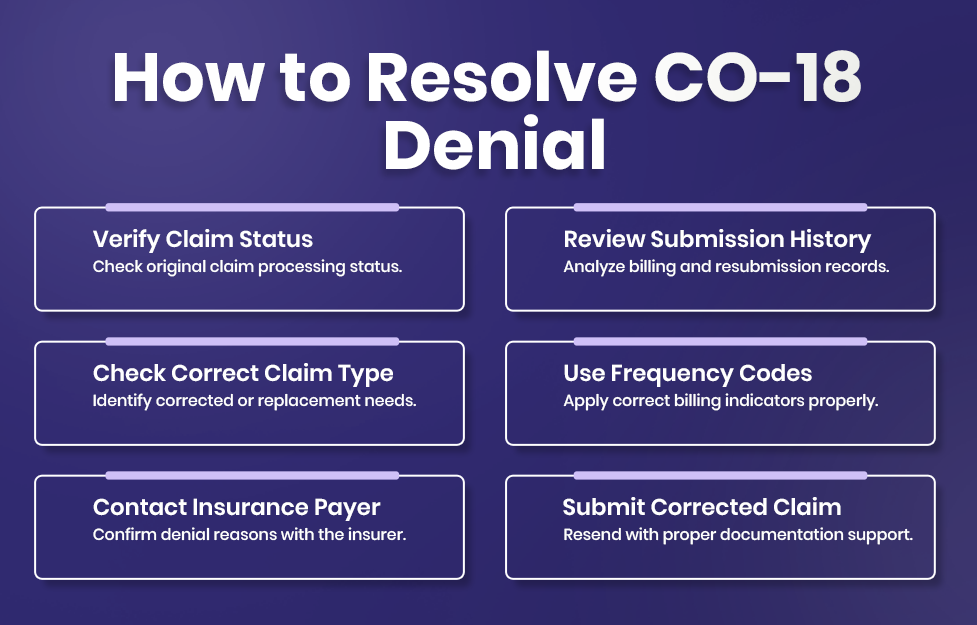
Step 1: Verify Original Claim Status
The first thing that needs to be done when dealing with a CO-18 denial code is checking the status of the claim originally. The medical biller must check whether the claim has been paid, denied, pending, or partially managed or processed. Checking the settlement status will help avoid submitting the same claim twice.
Step 2: Review Claim Submission History
Billing teams should carefully review the complete claim submission history to identify duplicate transmissions or workflow errors. This process includes checking submission dates, clearinghouse acceptance reports, payer acknowledgments, and resubmission records. Analyzing claim activity helps determine whether the denial resulted from repeated billing or processing misunderstandings.
Step 3: Determine Whether a Corrected Claim Is Required
It is imperative that medical billers establish if the denied claim is to be considered a corrected claim or not. In cases where there are complications such as coding mistakes, missing modifiers, imprecise patient data, or any other billing errors, then it is substantial for the healthcare provider to submit a corrected claim.
Step 4: Use Correct Frequency Type Codes
Using accurate frequency type codes is essential for preventing repeated CO-18 denial code issues during claim resubmission. Corrected and replacement claims require specific frequency indicators that inform payers the submission updates a previously billed claim. Incorrect or missing codes can cause insurers to classify the claim as duplicate billing.
Step 5: Contact the Insurance Payer
It would be prudent for billing personnel to contact the insurance payers directly to seek clarity, in case there is any uncertainty regarding the denied duplicate claims. It will enable them to know whether the initial claim was processed properly, why the claim was denied, and how the correction claim needs to be done.
Step 6: Submit Appeal or Corrected Claim
After confirming the claims details, the provider might have to file an appeal or corrected claim based on the payers’ directions. The supporting documents, corrected billing, and the claim reference number must be submitted along with the new filing. A well-prepared appeal will increase chances for reimbursement and reduce denial code problems.
Professional Advice: Prior to initiating any corrective steps regarding the CO-18 denial, make sure that you verify the status of the original claim, note down all the details of the submission, and adhere to the payer guidelines for corrected claims.
Sample Workflow Showing CO-18 Denial Occurrence
An example of the use of CO-18 denial code arises in case a healthcare provider submits a medical billing claim for a patient visit but does not get an immediate response from the payer. If the claim did not go through, the billing department submits the same claim with the same CPT codes, dates of service, provider information, and charges.
The insurance company then evaluates both claims and designates the latter as a duplicate claim or service denial based on CO-18. As per the corrected claim process, healthcare providers should start by checking the status of the original claim and, if there are any errors, submitting the corrected claim using the appropriate frequency type code.
Related Denial Codes You Should Know
Understanding related denial codes like CO-45 and CO-29 helps medical billers improve reimbursement accuracy, reduce payment delays, and strengthen overall Revenue Cycle Management performance.
CO-29 Denial Code – Timely Filing Limit Expired
The CO-29 denial code happens when claims are submitted after the payer’s timely filing deadline which result in automatic rejection. These deadlines vary by insurance plan and are firmly enforced. Primary causes include claim submission, missing documentation, or workflow inadequacies in billing departments. Submit claims promptly, and maintain appropriate documentation to support timely filing appeals when necessary to prevent CO-29 denials, providers must implement strong claim tracking systems.
CO-45 Denial Code – Charges Exceed Fee Schedule
The CO-45 denial code signifies a contractual obligation adjustment where billed charges exceed the payer’s negotiated pricing terms. Insurers reduce payment amounts based on previously negotiated provider fees. Common contributing factors include incorrect charge entry, out-of-date fee schedules, or billing above permissible limits. Providers can minimize CO-45 denials by ongoing updates to contracted rates which ensure accurate charge capture, and perform routine billing audits to align claims with payer agreements.
Difference Between CO-18, CO-45, and CO-29
The significance of knowing the difference between CO-18, CO-45, and CO-29 denial codes cannot be underestimated when it comes to denial management in the medical billing process and Revenue Cycle Management. This is because each code refers to a particular problem in claim submission.
| Denial Code | Meaning | Main Issue |
| CO-18 | Duplicate claim/service | Same claim billed twice or resubmitted without verification |
| CO-45 | Charges exceed fee schedule | Contractual adjustment where billed amount is higher than allowed rate |
| CO-29 | Timely filing limit expired | Claim submitted after payer’s deadline resulting in denial |
Best Practices to Prevent CO-18 Denials
CO-18 denial prevention involves having well-structured billing processes, accurate claim tracking, staff training, medical coding services, automation technology, and monitoring of duplicate submission trends.
Verify Claim Acceptance Before Resubmission
The verification of claim acceptance before re-submission avoids CO-18 denials by confirming that the status of the initial claim has been verified from either clearinghouse or payer systems. The billing department should avoid sending out the claim again without verifying the acknowledgment report. This improves clean claim rate efficiency.
Use Clearinghouse Reports Daily
Daily use of clearinghouse reports ensures that the billing department is able to keep track of the claim acceptance, rejection, and status of processing. This helps determine if the claim has been submitted previously or not. It increases visibility, avoids duplication of billing, and makes medical billing more accurate.
Automate Claim Tracking
The automation process in claims tracking prevents any mistakes arising due to human error, which may result in CO-18 denial codes. The automated process will be able to monitor the status of claims from when they are submitted until the time they are paid. This will prevent duplication in billing, improve efficiency and accuracy.
Train Billing Teams on Corrected Claims
Staff training on the correct resubmission of claims will enable the billing team to know the difference between duplicate, corrected, and replacement claims. The billing team will be aware of how to resubmit claims correctly without violating the frequency code and other payer policies that may result in CO-18 denial.
Perform Regular Denial Audits
Conducting routine denial audits aids in the identification of repetitive denial patterns related to CO-18 denial and the problems that exist in the workflow processes. Audit processes review claim information in order to identify any duplications, errors in the systems, or human errors. This facilitates taking necessary corrective measures like training and system upgrades.
Monitor Duplicate Billing Trends
Through the monitoring of duplication in billing, health care organizations will be able to determine the pattern that causes denial claims under CO-18 denials. Through analysis of past claims data, it becomes possible for teams to recognize common patterns of submission mistakes. This ensures that health care financial operations improve in performance.
Expert Tip: Adopt a real-time claim monitoring system with payer and clearinghouse integration in order to be able to identify any duplications, minimize human error, and increase CO-18 denial prevention and overall revenue cycle efficiency.
Tools That Help Reduce Duplicate Claim Denials
The use of advanced billing tools and automated systems will help health care providers to identify mistakes earlier, avoid duplications, enhance claim accuracy and reduce CO-18 denial codes.
Practice Management Software
The practice management software is helpful in reducing denials that may be associated with CO-18 through the organization of billing information for the patients, submission of claims, and documentation of encounters. The use of the software enables the billing department to check on the status of the claims before resubmission.
Claim Scrubbing Tools
Claim scrubbing software detects mistakes made in the billing process before the claims are sent to the insurance companies. Claim scrubbing software searches for any duplicates, coding errors, missing modifiers and format problems that might cause a CO-18 denial. The use of scrubbing software greatly enhances clean claims rates.
RCM Automation Platforms
Automation platforms for RCM make the whole revenue cycle efficient by ensuring that claims are submitted, tracked, and followed up automatically. Automation reduces manual interference, thereby reducing mistakes made by humans that may lead to duplicate claims. Automation makes it possible for the exact status of claims to be determined.
Clearinghouse Validation Systems
The clearinghouse validation process is a gateway that checks for formatting of claims and duplication before submitting the claims to the insurance company. It offers a report either indicating the acceptance or the rejection of the claim in real time. This helps the billing department to determine if the claim has been filed.
AI-Powered Denial Prevention Software
Denial Prevention Software Using AI technology, denial prevention software makes use of predictive analytics to spot patterns that result in duplicate claims and CO-18 denials. The software constantly monitors the billing process for any irregularities and sends out notifications to staff members before mistakes happen.
Impact of CO-18 Denials on Revenue Cycle
CO-18 denials negatively affect cash flow, increase claim rework, delay reimbursements, and reduce overall efficiency in healthcare revenue cycle management processes.
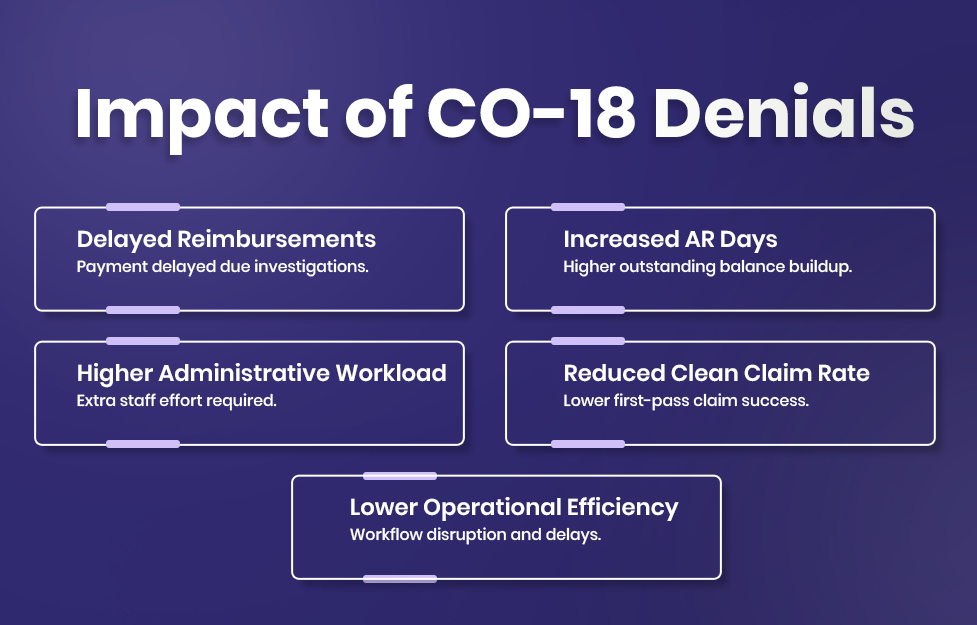
Delayed Reimbursements
Denials from CO-18 result in delayed reimbursements since it is necessary to investigate the cause of duplicate claims prior to any payments being made. It will take time for the billing staff to check the status of the original claim, fix mistakes, and then re-submit the claim.
Increased AR Days
AR Days are bound to rise substantially in case of CO-18 denials becoming frequent. Each denial will mean that further processing and resubmission is needed, causing delays in payment. This will result in high outstanding balances and unpredictable finances, thereby placing pressure on the billing department for faster collection.
Higher Administrative Workload
The denial of CO-18 raises administrative burden as the billing department will need to research duplicate claims, determine the submission history, and correspond with the payer. Such an ongoing process involves a lot of manual labor which takes up time that should otherwise have been spent on processing other claims.
Reduced Clean Claim Rate
High denial rates for CO-18 claims decrease the clean claims ratio, a significant performance measure in medical billing. Duplicates decrease first pass claim acceptance effectiveness, resulting in more processing and reprocessing of claims. This affects accuracy in billing and indicates inefficient processes in claim submission.
Lower Operational Efficiency
CO-18 rejections will negatively impact the efficiency of the process due to disruption of efficient billing processes and an increased number of error corrections. The personnel are forced to solve avoidable problems rather than engaging in revenue-producing processes. It leads to inefficiency in claim processing and poor performance of the revenue cycle management process.
How iSolve RCM support with Denial Codes
iSolveRCM provides healthcare professionals with assistance in dealing with denial codes by providing end-to-end Revenue Cycle Management solutions with a preventive approach towards dealing with claim denials like CO-18, CO-45, and CO-29. This is done through advanced claim scrubbing, real-time claim tracking, and clearinghouse validation to minimize duplicate claims and ensure clean claims at the initial stage itself. The team of experts at iSolve RCM studies the pattern of claim denials, rectifies any coding or submission errors, and focuses on resubmission of claims as well as appeals to optimize reimbursement.
FAQs
What does CO-18 mean in medical billing?
A CO-18 code under the medical billing category is referred to as a Claim Adjustment Reason Code, which signifies a duplicate claim or service. This means that the payer has received the claim information twice and processed it, which would result in duplicate payment.
Is CO-18 a rejection or denial?
CO-18 is a denial code and not a rejection code. This denial happens after processing of the claim by the insurance company as opposed to rejections that occur prior to claim processing. Denial codes are claims that need to be reviewed.
Can corrected claims cause CO-18 denials?
Yes, corrected claims can lead to CO-18 denials when filed improperly or without using appropriate frequency codes. In case the insurance company is unable to differentiate among original, corrected, or duplicate claims, it will regard the corrected claim as a duplicate service request.
How do I avoid duplicate claim submissions?
To prevent duplication of claims, you should check for the status of claims before resubmitting by means of reports from clearinghouses or payer portals. Proper tracking of claims is important, as well as communication between billing personnel to prevent resubmitting of claims.
Can CO-18 denials be appealed?
Absolutely, appeals for denial of CO-18 claims can be done where the claim is not really a duplicate or due to the mistake of the payer. The provider needs to provide documentation and evidence that he submitted the claim originally.
What frequency code should be used for corrected claims?
Claims that have been revised should be assigned the right frequency code, usually showing that there is a replacement or revision of claims submitted by the payer. This makes sure that the payer is able to identify revisions and does not consider them duplicate claims.