
Triglycerides show up on almost every lipid panel, and abnormal results are common in primary care, cardiology, endocrinology and diabetes care. When a provider documents high triglycerides, the coder has to decide which lipid disorder code fits. The choice usually comes down to two codes that are easy to confuse: E78.1 and E78.2.
The hypertriglyceridemia ICD-10 code for pure hypertriglyceridemia is E78.1, Pure hyperglyceridemia. When the provider documents a mixed lipid disorder, E78.2, Mixed hyperlipidemia, is usually the right code. A few other E78 codes apply to more specific conditions, such as hyperchylomicronemia and familial combined hyperlipidemia.
Getting this right matters beyond the code itself. The lipid diagnosis supports medical necessity for lipid panels and follow-up visits, and it becomes especially important when very high triglycerides lead to acute pancreatitis.
This guide explains E78.1 and E78.2, the related E78 codes, how pure and mixed disorders differ, how to code hypertriglyceridemia-induced pancreatitis, what documentation supports each code, and how to avoid the medical billing errors that most often follow lipid claims.
Quick Answer: What Is the ICD-10 Code for Hypertriglyceridemia?
The ICD-10-CM code for pure hypertriglyceridemia is E78.1, Pure hyperglyceridemia. When the provider documents mixed hyperlipidemia, or elevated cholesterol with elevated triglycerides, the code is E78.2. Hyperlipidemia without a specified type is E78.5.
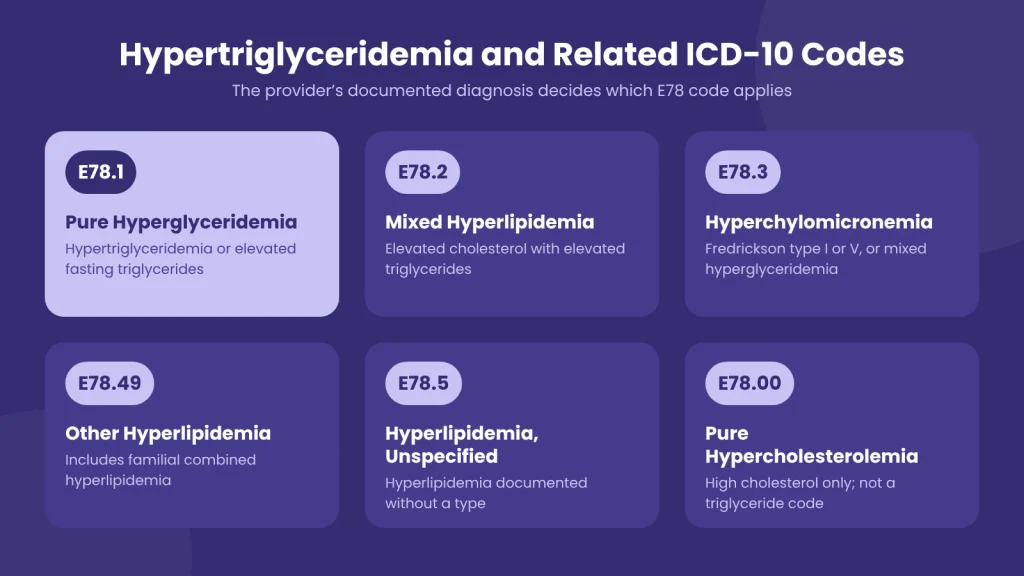
| ICD-10-CM code | Description | When to use |
| E78.1 | Pure hyperglyceridemia | Pure hyperglyceridemia or hypertriglyceridemia is documented |
| E78.2 | Mixed hyperlipidemia | Mixed hyperlipidemia or a combined lipid disorder is documented |
| E78.3 | Hyperchylomicronemia | Hyperchylomicronemia, Fredrickson type I or V, or mixed hyperglyceridemia is documented |
| E78.49 | Other hyperlipidemia | Familial combined hyperlipidemia or another specified hyperlipidemia is documented |
| E78.5 | Hyperlipidemia, unspecified | Hyperlipidemia is documented without a type |
| E78.00 | Pure hypercholesterolemia, unspecified | Pure hypercholesterolemia is documented |
All of these are billable codes in the FY 2027 ICD-10-CM code set, which applies to encounters from October 1, 2026 through September 30, 2027. The category heading E78 isn’t billable.
What Is Hypertriglyceridemia?
Triglycerides vs. Cholesterol
Triglycerides and cholesterol are both lipids carried in the blood, but they do different jobs.
| Triglycerides | Cholesterol | |
| What it is | The main form of stored fat in the body | A waxy substance used to build cells and hormones |
| Main source | Excess calories, especially from sugar, refined carbohydrates and alcohol | Produced by the liver and absorbed from food |
| Carried by | Mainly very-low-density lipoproteins (VLDL) and chylomicrons | Mainly LDL and HDL |
| Main clinical concern | Cardiovascular risk and, at very high levels, acute pancreatitis | Cardiovascular risk |
Hypertriglyceridemia means the level of triglycerides in the blood is higher than normal. Patients and providers also call it high triglycerides, elevated triglycerides or hyperglyceridemia. When elevations involve both triglycerides and cholesterol, the broader term hyperlipidemia is often used, and the coding may change.
Common Causes of Elevated Triglycerides
Hypertriglyceridemia can be primary (genetic) or secondary to another condition or exposure. Common secondary causes include:
- Obesity and metabolic syndrome
- Poorly controlled diabetes
- High alcohol intake
- Diets high in refined carbohydrates and sugar
- Hypothyroidism
- Chronic kidney disease
- Certain medications, such as some diuretics, beta-blockers, steroids, retinoids and estrogens
- Pregnancy
The cause matters for coding. If the provider links hypertriglyceridemia to another condition, that condition may need its own code, and some causes, such as pregnancy or a medication adverse effect, follow their own sequencing rules.
Why Providers Monitor Triglyceride Levels
Clinicians group triglyceride levels into ranges, such as normal, borderline high, high and very high, and different clinical guidelines define these categories in slightly different ways. Most patients with mild or moderate elevations face long-term cardiovascular risk. At severe elevations, the risk of acute pancreatitis rises, which is why very high levels are managed urgently.
These severity categories and pancreatitis risk thresholds are clinical concepts. They help explain why providers document what they do, but coding follows the documented diagnosis, not a lab threshold.
ICD-10-CM Code E78.1: Pure Hypertriglyceridemia
E78.1 Code Description
The official description of E78.1 is Pure hyperglyceridemia. “Hyperglyceridemia” is the classification’s term for elevated glycerides, which in practice means elevated triglycerides. “Pure” means the disorder is isolated, rather than a mixed lipid disorder.
The Tabular List includes these terms under E78.1:
- Elevated fasting triglycerides
- Endogenous hyperglyceridemia
- Fredrickson’s hyperlipoproteinemia, type IV
- Hyperlipidemia, group B
- Hyperprebetalipoproteinemia
- Very-low-density-lipoprotein-type [VLDL] hyperlipoproteinemia
The whole E78 category carries an Excludes1 note for sphingolipidosis (E75.0–E75.3).
When to Use E78.1
E78.1 is appropriate when the provider documents pure hyperglyceridemia, hypertriglyceridemia, or elevated triglycerides as a clinically relevant finding or diagnosis, and the documentation supports the code. Follow the applicable coding guidelines when reporting abnormal laboratory findings.
E78.1 applies to documented pure hyperglyceridemia, including elevated fasting triglycerides and hypertriglyceridemia indexed to this code. If the provider documents a mixed lipid disorder, verify the applicable code using the Alphabetic Index and Tabular List.
In the Alphabetic Index, the terms “Elevated, triglycerides,” “Elevated, fasting triglycerides” and “Hyperglyceridemia” (including endogenous, essential, familial and hereditary) lead to E78.1.
Related Terms and Search Phrases
People search for this code in many ways. These phrases usually point to E78.1 when the provider’s documentation supports a pure triglyceride disorder:
- Pure hypertriglyceridemia ICD-10
- Pure hyperglyceridemia ICD-10
- Elevated triglycerides ICD-10
- High triglycerides ICD-10
- E78.1 diagnosis code
Documentation Requirements for E78.1
A strong note supporting E78.1 includes:
- The provider’s diagnostic statement, such as “hypertriglyceridemia” or “elevated fasting triglycerides”
- Relevant lipid panel results, including the triglyceride level and the other lipid values
- The clinical assessment, including any known cause and the provider’s view of severity
- The treatment plan, such as lifestyle changes, medication or treatment of an underlying cause
- Follow-up monitoring, such as a repeat lipid panel
ICD-10-CM Code E78.2: Mixed Hyperlipidemia
E78.2 Code Description
E78.2 is the ICD-10-CM code for mixed hyperlipidemia. Its inclusion terms cover conditions such as combined hyperlipidemia NOS and elevated cholesterol with elevated triglycerides. Code assignment should follow the provider’s documented diagnosis and the classification’s Index and Tabular List instructions.
The full list of inclusion terms under E78.2 is:
- Broad- or floating-betalipoproteinemia
- Combined hyperlipidemia NOS
- Elevated cholesterol with elevated triglycerides NEC
- Fredrickson’s hyperlipoproteinemia, type IIb or III
- Hyperbetalipoproteinemia with prebetalipoproteinemia
- Hypercholesteremia with endogenous hyperglyceridemia
- Hyperlipidemia, group C
- Tubo-eruptive xanthoma
- Xanthoma tuberosum
E78.2 has an Excludes1 note for:
- Cerebrotendinous cholesterosis (E75.5)
- Familial combined hyperlipidemia (E78.49)
When to Use E78.2
E78.2 is appropriate when:
- The provider documents mixed hyperlipidemia or combined hyperlipidemia
- The provider documents elevated cholesterol with elevated triglycerides
- The provider documents dysbetalipoproteinemia (Fredrickson type III) or Fredrickson type IIb
In the Index, “Elevated, cholesterol, with high triglycerides” and “Elevated, triglycerides, with high cholesterol” both lead to E78.2.
Pure vs. Mixed Hyperlipidemia: Key Differences

| E78.1 | E78.2 | |
| Official title | Pure hyperglyceridemia | Mixed hyperlipidemia |
| Typical lipid pattern | Triglycerides | Cholesterol and triglycerides |
| Fredrickson types | Type IV | Types IIb and III |
| Typical documentation | “Hypertriglyceridemia,” “elevated fasting triglycerides” | “Mixed hyperlipidemia,” “combined hyperlipidemia,” “elevated cholesterol and triglycerides” |
| Basis for code selection | Provider’s documented diagnosis and the Index | Provider’s documented diagnosis and the Index |
Elevated triglycerides alone shouldn’t be coded as mixed hyperlipidemia. If the provider documents “hypertriglyceridemia” and doesn’t document a mixed disorder, E78.2 isn’t supported, even if the patient has other cardiovascular risk factors.
Three “Mixed” and “Combined” Traps
The words “mixed” and “combined” appear in more than one place in the E78 category, which causes errors:
- “Mixed hyperglyceridemia” isn’t E78.2. It’s an inclusion term under E78.3, Hyperchylomicronemia, which covers Fredrickson types I and V.
- “Familial combined hyperlipidemia” isn’t E78.2. It’s excluded from E78.2 and coded to E78.49, Other hyperlipidemia.
- “Combined hyperlipidemia NOS” is E78.2. Without the word “familial,” combined hyperlipidemia stays in E78.2.
Always look up the exact documented term in the Index instead of matching on a single word.
Other Related Hypertriglyceridemia and Hyperlipidemia ICD-10 Codes
The table below separates the non-billable subcategories from the billable codes beneath them.
| Code | Description | Billable? |
| E78.0 | Pure hypercholesterolemia | No (subcategory) |
| E78.00 | Pure hypercholesterolemia, unspecified | Yes |
| E78.01 | Familial hypercholesterolemia | No (subcategory) |
| E78.010 | Homozygous familial hypercholesterolemia | Yes |
| E78.011 | Heterozygous familial hypercholesterolemia | Yes |
| E78.019 | Familial hypercholesterolemia, unspecified | Yes |
| E78.1 | Pure hyperglyceridemia | Yes |
| E78.2 | Mixed hyperlipidemia | Yes |
| E78.3 | Hyperchylomicronemia | Yes |
| E78.4 | Other hyperlipidemia | No (subcategory) |
| E78.41 | Elevated Lipoprotein(a) | Yes |
| E78.49 | Other hyperlipidemia | Yes |
| E78.5 | Hyperlipidemia, unspecified | Yes |
| E78.6 | Lipoprotein deficiency | Yes |
| E78.7 | Disorders of bile acid and cholesterol metabolism | No (subcategory) |
| E78.70–E78.79 | Specific bile acid and cholesterol metabolism disorders | Yes |
| E78.8 | Other disorders of lipoprotein metabolism | No (subcategory) |
| E78.81 | Lipoid dermatoarthritis | Yes |
| E78.89 | Other lipoprotein metabolism disorders | Yes |
| E78.9 | Disorder of lipoprotein metabolism, unspecified | Yes |
E78.3 – Hyperchylomicronemia
E78.3 covers disorders where chylomicrons, the particles that carry dietary fat, build up in the blood. Its inclusion terms include chylomicron retention disease, Fredrickson’s hyperlipoproteinemia type I or V, hyperlipidemia group D, and mixed hyperglyceridemia. These disorders, including familial chylomicronemia syndrome, typically produce very high triglyceride levels and carry a high risk of pancreatitis.
Very high triglyceride levels may raise clinical concern for chylomicronemia, but coders should not infer chylomicronemia solely from the triglyceride value. Assign E78.3 when the documented diagnosis and applicable ICD-10-CM classification support hyperchylomicronemia. Follow the Alphabetic Index and Tabular List for the exact documented condition.
E78.49 – Other Hyperlipidemia
E78.49 includes familial combined hyperlipidemia, a genetic condition where family members can have high cholesterol, high triglycerides or both. Because it’s specifically excluded from E78.2, the word “familial” makes a real difference.
E78.5 – Hyperlipidemia, Unspecified
E78.5 is used when the provider documents “hyperlipidemia” without saying which type. It’s one of the most heavily used lipid codes, and often overused. If the provider documents a more specific disorder for the encounter, such as “hypertriglyceridemia,” the specific code should be used instead.
E78.41 – Elevated Lipoprotein(a)
E78.41 is a separate code for elevated lipoprotein(a), an inherited cardiovascular risk factor. It isn’t a triglyceride disorder, but it’s often documented in the same patients. When both are documented, both can be coded.
ICD-10 Code for Elevated Triglycerides and High Triglycerides
What the Index Says
Searches for the “ICD-10 code for elevated triglycerides,” “ICD-10 code for high triglycerides” or simply “triglycerides ICD-10” all lead to the same part of the Index:
- Elevated, triglycerides → E78.1
- Elevated, fasting triglycerides → E78.1
- Findings, abnormal, inconclusive, without diagnosis, triglycerides, high → E78.1
- Triglycerides, high, with high cholesterol → E78.2
The classification doesn’t send high triglycerides to a general abnormal-lab code such as R79.89. Even when documented as an abnormal finding, high triglycerides index to E78.1.
Although the Alphabetic Index directs high triglycerides to E78.1, coders must still follow the applicable reporting guidelines for abnormal findings. The Index does not eliminate the requirement to review the documentation and determine whether the finding is clinically significant and reportable for that encounter.
Lab Result vs. Provider Documentation

There’s an important difference between a lab value and a documented diagnosis:
| Situation | Can it be coded? |
| The lab report shows a high triglyceride value, but the provider doesn’t mention it | No. Coders don’t assign diagnoses from lab values alone |
| The provider documents and addresses “elevated triglycerides” or “high TG” | Yes, E78.1, per the Index |
| The provider documents “hypertriglyceridemia” | Yes, E78.1 |
| The provider documents mixed hyperlipidemia, or high triglycerides with high cholesterol | Yes, E78.2 |
The ICD-10-CM Official Guidelines address the reporting of abnormal findings based on clinical significance. In practice, the provider has to document the finding or diagnosis and indicate why it matters. If a lab result seems significant but the provider hasn’t addressed it, the right step is a provider query, not a code.
Screening vs. a Known Disorder
A lipid panel ordered to screen a patient with no known lipid disorder is typically linked to a screening code, such as Z13.220, Encounter for screening for lipoid disorders.
When screening identifies an abnormal lipid result, coding depends on the encounter’s purpose, the provider’s documentation and applicable coding guidelines. If a lipid disorder is subsequently documented and evaluated, report the appropriate diagnosis code when supported. Don’t automatically assign screening and diagnostic codes together without reviewing the circumstances of the encounter.
Once the patient has a documented lipid disorder, later lipid panels are generally ordered for monitoring and linked to the disorder code, not a screening code. Our CPT 99396 preventive visit guide explains how screening and diagnostic diagnoses are linked on preventive visit claims.
Hypertriglyceridemia and Pancreatitis: Coding the Link
Severe hypertriglyceridemia is one of the recognized causes of acute pancreatitis. When it’s documented as the cause, coding requires two parts: the pancreatitis and the lipid disorder.
There’s No Combination Code
ICD-10-CM doesn’t have a single code for “hypertriglyceridemia-induced pancreatitis.” The pancreatitis and the lipid disorder are coded separately.
Coding the Pancreatitis
Acute pancreatitis codes are in category K85 and are organized by cause:
| Subcategory | Cause |
| K85.0- | Idiopathic |
| K85.1- | Biliary (gallstone) |
| K85.2- | Alcohol-induced |
| K85.3- | Drug-induced |
| K85.8- | Other acute pancreatitis |
| K85.9- | Unspecified |
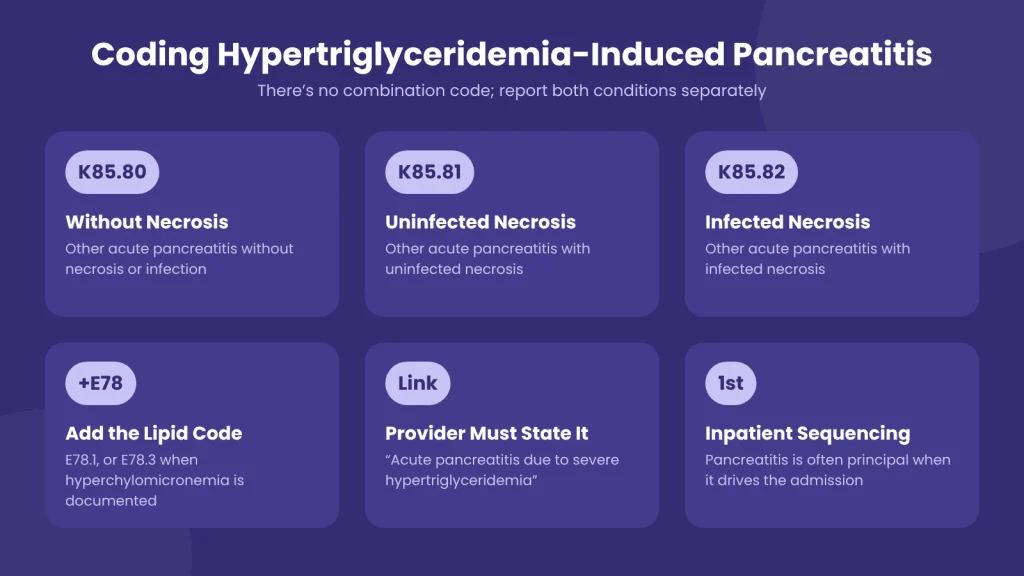
Hypertriglyceridemia-induced acute pancreatitis is generally coded in K85.8-, Other acute pancreatitis, when the provider documents hypertriglyceridemia as the cause. The fifth character shows whether there’s necrosis or infection:
| Code | Description |
| K85.80 | Other acute pancreatitis without necrosis or infection |
| K85.81 | Other acute pancreatitis with uninfected necrosis |
| K85.82 | Other acute pancreatitis with infected necrosis |
Chronic pancreatitis that isn’t alcohol-induced is generally coded to K86.1, Other chronic pancreatitis.
Confirm the code by looking up the documented term in the Index. If the provider doesn’t name a cause, the pancreatitis may go to K85.9- (unspecified) instead.
Coding the Lipid Disorder
Add the E78 code that matches the documented lipid disorder:
- Hypertriglyceridemia → E78.1
- Hyperchylomicronemia or familial chylomicronemia syndrome, when documented → E78.3
- Mixed hyperlipidemia → E78.2
Sequencing
Sequencing depends on the setting and the circumstances of the encounter:
- Inpatient admission. Sequence the principal diagnosis according to the official inpatient coding guidelines and the circumstances of the admission. When acute pancreatitis is the condition chiefly responsible for the admission, it may be reported as the principal diagnosis, with the documented underlying lipid disorder reported as an additional diagnosis when appropriate.
- Outpatient follow-up for the lipid disorder after pancreatitis. The lipid disorder may be first-listed if it’s the main reason for the visit, with a history code if the pancreatitis has resolved.
Documentation Needed for the Link
The coder can’t assume the cause. The provider needs to state it, for example: “acute pancreatitis due to severe hypertriglyceridemia.” Helpful documentation includes:
- The triglyceride level at presentation
- The provider’s statement linking the pancreatitis to hypertriglyceridemia
- Whether other causes, such as gallstones and alcohol, were considered
- The presence or absence of necrosis and infection
- The treatment plan for both conditions
When high triglycerides and pancreatitis are both documented but the note doesn’t say whether one caused the other, a provider query is appropriate.
Hypertriglyceridemia ICD-10 Coding Examples
Example 1: Pure Hypertriglyceridemia
A 47-year-old’s lipid panel shows triglycerides of 420 mg/dL with normal LDL and total cholesterol. The provider documents “pure hypertriglyceridemia, start lifestyle changes, recheck in three months.”
- Code: E78.1
- Why: The provider documented a pure triglyceride disorder.
Example 2: Mixed Hyperlipidemia
A 58-year-old with high LDL and high triglycerides is seen for follow-up. The provider documents “mixed hyperlipidemia, continue statin.”
- Code: E78.2
- Why: The provider documented mixed hyperlipidemia.
Example 3: Elevated Triglycerides Noted but Not Addressed
A patient is seen for a sprained ankle. A routine lab from last week shows high triglycerides, but the provider’s note doesn’t mention lipids.
- Code: Don’t code a lipid disorder for this encounter.
- Why: The provider didn’t document or address the finding. If it’s clinically important, the provider may document it at a future visit.
Example 4: Elevated Triglycerides Documented as a Finding
The provider writes “elevated TG on recent labs, discussed diet, recheck” without using the word “hypertriglyceridemia.”
- Code: E78.1
- Why: The provider documented the finding and addressed it, which indicates clinical significance, and the Index sends “elevated, triglycerides” to E78.1.
Example 5: Hyperlipidemia, Unspecified
The provider documents “hyperlipidemia, continue current medication,” with no type mentioned.
- Code: E78.5
- Why: No type is documented. If the provider’s records suggest a more specific disorder, a query may support a more specific code.
Example 6: Familial Combined Hyperlipidemia
The provider documents “familial combined hyperlipidemia, strong family history.”
- Code: E78.49
- Why: Familial combined hyperlipidemia is excluded from E78.2.
Example 7: Pancreatitis Due to Hypertriglyceridemia
A patient is admitted with acute pancreatitis. Labs show markedly elevated triglycerides, and imaging shows no necrosis. The provider documents “acute pancreatitis secondary to severe hypertriglyceridemia.”
- Codes: K85.80, E78.1
- Why: The provider linked the pancreatitis to hypertriglyceridemia, which places it in “other acute pancreatitis,” and the lipid disorder is reported separately. Here the pancreatitis is chiefly responsible for the admission, so it may be the principal diagnosis. If the provider had documented hyperchylomicronemia, E78.3 would replace E78.1.
Hypertriglyceridemia ICD-10 Coding and Documentation Guidelines
For Coders
- Start with the provider’s diagnosis. The assessment and plan decide the code, not the lab report.
- Distinguish pure from mixed based on the documented diagnosis.
- Use lab results as supporting documentation, not as the basis for a code.
- Look up the exact term in the Alphabetic Index, then verify it in the Tabular List.
- Watch for “familial,” “mixed hyperglyceridemia” and “chylomicronemia,” which change the code.
- Apply Excludes1 notes, including familial combined hyperlipidemia under E78.2.
- Follow the guidelines for abnormal findings, even when the Index points to a specific code.
- Code the cause and complications the provider documents, such as pancreatitis, diabetes or a medication adverse effect.
- Query the provider when the type, cause or significance is unclear.
- Use the code set in effect on the date of service.
For Providers
A few words in the note make a big difference to the code:
| Instead of | Document |
| “Lipids abnormal” | “Hypertriglyceridemia” or “elevated triglycerides,” with the plan |
| “Hyperlipidemia” when only triglycerides are high | “Pure hypertriglyceridemia” |
| “Hyperlipidemia” when both are high | “Mixed hyperlipidemia” |
| “Pancreatitis, TG high” | “Acute pancreatitis due to hypertriglyceridemia” |
| “Lipid disorder, family history” | “Familial combined hyperlipidemia” or “familial chylomicronemia syndrome,” if that’s the diagnosis |
Recording the triglyceride value, the cause if known and the treatment plan also helps support medical necessity for follow-up testing and visits.
Common Hypertriglyceridemia Medical Billing and Coding Errors
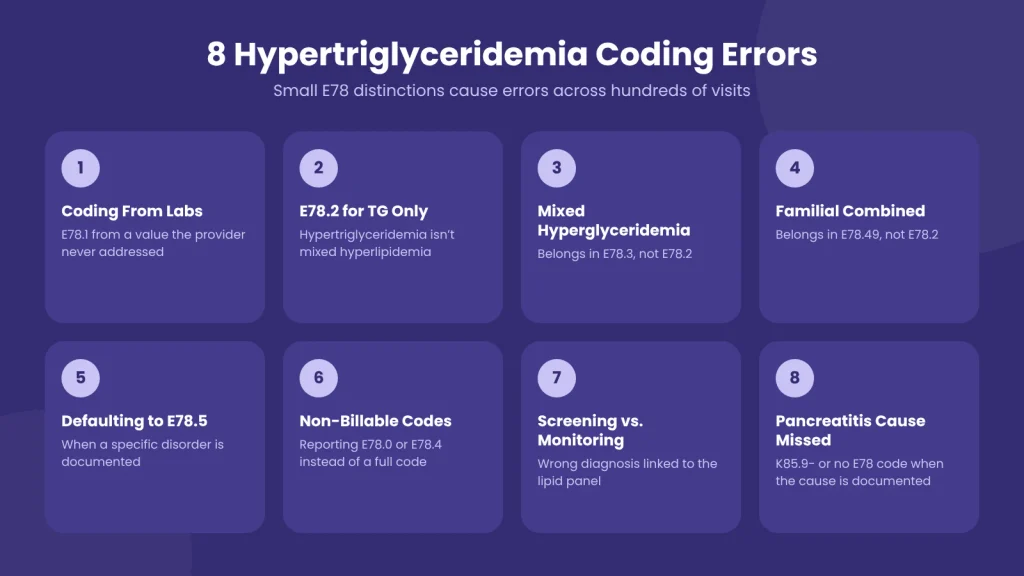
[ ] Assigning E78.1 from a lab value the provider never documented or addressed
[ ] Using E78.2 when the provider documented only hypertriglyceridemia
[ ] Coding “mixed hyperglyceridemia” as E78.2 instead of E78.3
[ ] Coding familial combined hyperlipidemia as E78.2 instead of E78.49
[ ] Assigning E78.3 based on a very high triglyceride value without a documented chylomicronemia diagnosis
[ ] Defaulting to E78.5 when the provider documented a specific disorder
[ ] Reporting a non-billable subcategory, such as E78.0 or E78.4, instead of a complete code
[ ] Confusing hypertriglyceridemia (E78.1) with hypercholesterolemia (E78.00)
[ ] Linking a monitoring lipid panel to a screening code, or a screening panel to a disorder code with no documented disorder
[ ] Coding pancreatitis as idiopathic or unspecified when the provider documented hypertriglyceridemia as the cause
[ ] Missing the lipid disorder code when coding hypertriglyceridemia-induced pancreatitis
[ ] Using outdated code references after the annual code-set update
A periodic medical billing audit is one of the most reliable ways to find these patterns, especially overuse of E78.5.
Hypertriglyceridemia Billing: How Accurate Coding Supports Reimbursement
Lipid disorder codes rarely drive large payments on their own, but they support a steady stream of services: office visits, lipid panels, triglyceride tests, medication management and referrals. When the diagnosis is wrong or vague, those services become harder to justify.
Diagnosis Coding for Lipid Tests
Lipid testing is commonly reported with codes such as 80061 (lipid panel) and 84478 (triglycerides). Payers check the linked diagnosis to decide whether the test is covered:
- Screening panels are linked to screening codes and are subject to the plan’s preventive frequency rules. Medicare, for example, covers cardiovascular screening blood tests at set intervals.
- Monitoring panels for a known lipid disorder are linked to the E78 code. Medicare and many payers have coverage policies for lipid testing that list which diagnoses support monitoring and how often.
A specific, documented E78 code makes these claims easier to support than E78.5 with no detail.
Medical Necessity and Diagnosis Linkage
Each service on a claim should point to the diagnosis that justifies it. A follow-up visit for triglyceride management should be linked to E78.1, not to an unrelated diagnosis or a screening code. When pancreatitis and a lipid disorder are both treated, each service should link to the condition it addresses.
Audits and Compliance
During an audit, the reviewer checks that each diagnosis on the claim is supported by the provider’s documentation for that date of service. A lipid code copied forward from the problem list, with no mention in the note, is a common finding. Documented, addressed diagnoses hold up.
How Medical Billing Companies Help With ICD-10 Coding Accuracy
Lipid coding looks routine, but the small distinctions between E78.1, E78.2, E78.3, E78.49 and E78.5 are exactly where errors slip in across hundreds of visits. A dedicated coding and billing team helps by applying the same rules every time.
iSolve RCM supports practices with:
- ICD-10-CM code verification against the current Tabular List and Index, through our medical coding services
- Documentation review and provider queries when the type or cause of a lipid disorder isn’t clear
- Documentation audits that measure how often unspecified codes are used and why, through our medical billing audit service
- Claim submission with diagnosis linkage checked before the claim goes out, through our outsourced medical billing services
- Denial management for medical necessity and coding-related denials
- Accounts receivable management to follow up on unpaid lab and visit claims
- Revenue cycle reporting across the full revenue cycle
Lipid disorders are managed across many specialties. Practices treating diabetes and metabolic disease can explore our endocrinology billing services, and primary care teams will find related guidance in our family practice billing and claim denials article. For another example of how diagnosis codes depend on provider documentation, see our ICD-10 code for fatigue guide.
If you’re deciding whether to manage coding in-house, our guide to in-house vs. outsourced medical billing compares the options, and you can review our pricing.
Conclusion
The hypertriglyceridemia ICD-10 code is E78.1 when the provider documents pure hyperglyceridemia or hypertriglyceridemia. E78.2 applies when the provider documents mixed hyperlipidemia or elevated cholesterol with elevated triglycerides. A few terms move the code elsewhere: mixed hyperglyceridemia and documented hyperchylomicronemia go to E78.3, and familial combined hyperlipidemia goes to E78.49.
When severe hypertriglyceridemia is documented as the cause of acute pancreatitis, both conditions are coded, usually K85.8- for the pancreatitis with the matching E78 code, sequenced according to the guidelines and the circumstances of the encounter.
In every case, the code depends on the provider’s documentation, the Index and Tabular List instructions, the guidelines for abnormal findings and the code set in effect on the date of service, not on lab values alone.
Frequently Asked Questions
What is the ICD-10 code for hypertriglyceridemia?
The ICD-10-CM code for hypertriglyceridemia is E78.1, Pure hyperglyceridemia, when the provider documents a pure triglyceride disorder. If the provider documents mixed hyperlipidemia, E78.2 applies. Documented hyperchylomicronemia is coded to E78.3.
What is E78.1?
E78.1 is the ICD-10-CM code for Pure hyperglyceridemia, a lipid disorder involving elevated triglycerides. Its inclusion terms include elevated fasting triglycerides, endogenous hyperglyceridemia and Fredrickson type IV hyperlipoproteinemia. It’s a billable code.
Is E78.1 the same as pure hypertriglyceridemia?
Yes, in practice. The official title is “Pure hyperglyceridemia,” and “glycerides” in this context means triglycerides. Documentation of pure or isolated hypertriglyceridemia is coded to E78.1.
What is the ICD-10 code for high triglycerides?
When the provider documents high triglycerides as a clinically significant finding, the Alphabetic Index leads to E78.1. If the provider documents high triglycerides with high cholesterol, the code is E78.2. A lab value alone, without provider documentation, isn’t coded.
What is the ICD-10 code for elevated triglycerides?
“Elevated triglycerides” and “elevated fasting triglycerides” both index to E78.1, Pure hyperglyceridemia. “Elevated triglycerides with high cholesterol” indexes to E78.2. The provider must document the finding and its significance for it to be reported.
What is the difference between E78.1 and E78.2?
E78.1 is pure hyperglyceridemia, a triglyceride disorder. E78.2 is mixed hyperlipidemia, which includes combined hyperlipidemia and elevated cholesterol with elevated triglycerides. The provider’s documented diagnosis and the Index decide which applies, not the coder’s reading of lab results.
What is the ICD-10 code for mixed hyperlipidemia?
Mixed hyperlipidemia is E78.2. It also includes combined hyperlipidemia NOS, elevated cholesterol with elevated triglycerides and Fredrickson types IIb and III. Familial combined hyperlipidemia is excluded from E78.2 and coded to E78.49.
What is the ICD-10 code for hypertriglyceridemia, unspecified?
ICD-10-CM doesn’t have a separate “unspecified” code for hypertriglyceridemia. Documented hypertriglyceridemia without further detail goes to E78.1. If the provider documents only “hyperlipidemia” without a type, the code is E78.5, Hyperlipidemia, unspecified.
Can elevated triglycerides be coded without a provider diagnosis?
No. A coder can’t assign a code from a lab value alone. The provider must document the finding or diagnosis and indicate its clinical significance. If the result seems significant but isn’t addressed in the note, a provider query is appropriate.
What is the ICD-10 code for pure hyperglyceridemia?
Pure hyperglyceridemia is E78.1. It’s the official ICD-10-CM title for a pure triglyceride disorder. Note that “mixed hyperglyceridemia” is a different term, classified to E78.3, Hyperchylomicronemia.
Is E78.1 a billable ICD-10-CM code?
Yes. E78.1 is a billable, specific ICD-10-CM code in the FY 2027 code set, effective October 1, 2026 through September 30, 2027. Coverage for related services still depends on payer rules and supporting documentation.
What ICD-10 code is used for hyperlipidemia?
It depends on the type. Pure hypercholesterolemia is E78.00, pure hyperglyceridemia is E78.1, mixed hyperlipidemia is E78.2 and familial combined hyperlipidemia is E78.49. Hyperlipidemia without a documented type is E78.5.