

Medicare Advantage (MA) now covers 55% of eligible Medicare beneficiaries. In 2026, approximately 35.2 million of the 64.2 million people enrolled in both Medicare Part A and Part B had Medicare Advantage coverage. With that much of the Medicare population in private plans, the way CMS pays MA plans has a direct effect on physicians, hospitals and clinics. Plan revenue shapes the contracts plans offer, the benefits they design, where they operate and how closely they manage utilization.
The finalized Medicare Advantage payment changes for 2027 were more favorable to plans than the industry initially expected. In its 2027 Rate Announcement, released April 6, 2026, CMS projected an average 2.48% increase in payments to MA plans, or more than $13 billion.
There’s an important distinction, though. The 2.48% figure is an increase in what CMS pays MA plans. It isn’t an automatic 2.48% increase in what plans pay providers. Provider reimbursement depends on each practice’s contract with each plan. Practices working with medical billing services can also benefit from accurate reimbursement tracking and billing management.
CMS also tightened risk adjustment rules for 2027. It finalized the exclusion of diagnoses from unlinked chart review records from Part C risk score calculations. Members who switch from one Medicare Advantage organization to another are an exception. Diagnoses from audio-only encounters are also excluded when the applicable encounter record contains no other risk-adjustment-eligible service. Separately, the Contract Year 2027 final rule changed Star Ratings, supplemental benefits and several administrative requirements.
This guide explains:
- What CMS finalized and why the numbers changed
- What the risk adjustment changes mean for documentation
- How the changes could affect your contracts, claims and revenue cycle
- What to do now
Quick Answer: What Are the Medicare Advantage Payment Changes for 2027?
CMS finalized an average 2.48% increase in Medicare Advantage plan payments for 2027, more than $13 billion. The 2.48% figure is CMS’s finalized average payment update. When CMS adds its estimated 2.50% underlying risk-score trend, the projected increase is approximately 4.98%.
CMS will keep using the 2024 risk adjustment model. It will exclude diagnoses from unlinked chart review records and from certain audio-only encounters when calculating risk scores. This is a plan-level average, not a guaranteed increase for every plan, county or provider.
What Are the Medicare Advantage Payment Changes for 2027?
How CMS Sets Medicare Advantage Payment Rates
Every year, CMS sets the rates it pays MA plans in two steps:
- The Advance Notice, released early in the year, proposes payment methods and estimates the change in plan payments. The public can comment on it.
- The Rate Announcement, released by early April, finalizes the payment rates and policies for the next calendar year.
MA plans are paid through capitation, a fixed monthly amount per enrollee. That amount is based on:
- A county benchmark
- The plan’s bid
- Quality bonuses tied to Star Ratings
- Each member’s risk score, which reflects their expected health costs
The risk score comes from risk adjustment, which uses diagnoses grouped into Hierarchical Condition Categories (HCCs) to estimate how costly each member is likely to be.
The 2027 Payment Components

Here’s how CMS built the 2.48% figure, compared with its January proposal:
| Payment component | 2027 Advance Notice | 2027 final Rate Announcement |
| Effective growth rate | +4.97% | +5.33% |
| Rebasing/repricing | To be determined | −0.17% |
| Star Ratings changes | −0.03% | −0.03% |
| MA coding pattern adjustment | 0% | 0% |
| Risk model revision and normalization | −3.32% | −1.12% |
| Sources of diagnoses | −1.53% | −1.53% |
| Overall expected average change | +0.09% | +2.48% |
| Overall including estimated risk score trend | Not stated | +4.98% |
A few terms to know:
- Effective growth rate reflects expected growth in Medicare spending per person. It’s the main driver of benchmark increases.
- Rebasing/repricing updates county benchmarks to reflect current fee-for-service costs and geographic adjustments.
- Normalization adjusts risk scores so the average stays at 1.0 as coding and population patterns change over time.
- Sources of diagnoses is the effect of excluding certain diagnoses from risk score calculations.
How Much Will Medicare Advantage Payments Increase in 2027?
CMS Finalized a 2.48% Average Payment Increase
CMS estimates its final 2027 policies will raise MA plan payments by 2.48%, or more than $13 billion, compared with 2026. That’s the finalized base update. Separately, CMS expects MA risk scores to rise about 2.50% from underlying coding trends. Adding that trend brings the projected increase to about 4.98%, but the 4.98% figure isn’t the finalized payment update itself.
In January, the Advance Notice had proposed just 0.09%, roughly $700 million. The gap between the proposal and the final rate is one of the largest in recent years.
Why the 2027 Increase Is Different From the Initial Proposal
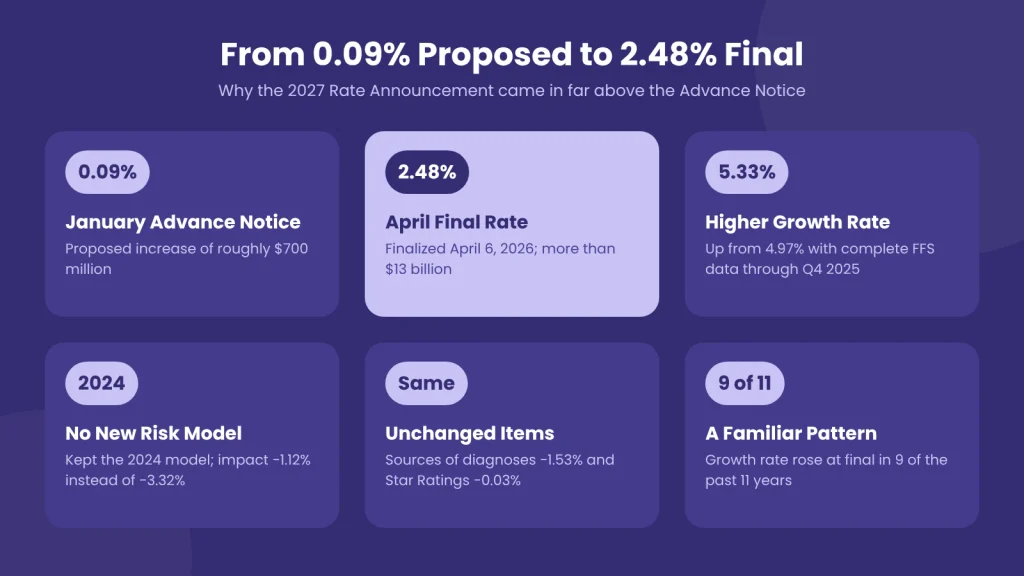
Three things moved the number:
- A higher effective growth rate. The growth rate rose from 4.97% to 5.33% after CMS added more complete fee-for-service spending data through the fourth quarter of 2025.
- No new risk model. CMS had proposed recalibrating the Part C risk model with newer data. In the final announcement, it decided to keep the 2024 model. That changed the combined risk model and normalization impact from −3.32% to −1.12%, which now comes entirely from the normalization update.
- The rest stayed largely the same. The sources-of-diagnoses impact (−1.53%) and the Star Ratings impact (−0.03%) were unchanged from the proposal. Rebasing came in at −0.17%.
It’s common for the final rate to come in above the proposal. Georgetown University’s Center on Health Insurance Reforms notes that the effective growth rate was higher in the Rate Announcement than in the Advance Notice in 9 of the past 11 years.
Why Payment Increases May Differ by Plan and County
The national average hides wide variation. Plan payments depend on:
- County benchmarks. According to Avalere’s analysis, 2027 county benchmarks range from about $686 to $2,735 per member per month. Year-over-year changes within counties range from a 4.5% decrease to a 19.8% increase.
- Plan bids: how each plan prices its benefits against the benchmark
- Quality bonus payments, based on Star Ratings
- Member risk scores, which depend on the health and documented diagnoses of each plan’s members
- Geographic factors, such as local fee-for-service costs
CMS publishes county-level rates in its 2027 MA rate book, available with the Rate Announcement materials on CMS.gov.
Medicare Advantage Risk Adjustment Model Changes for 2027
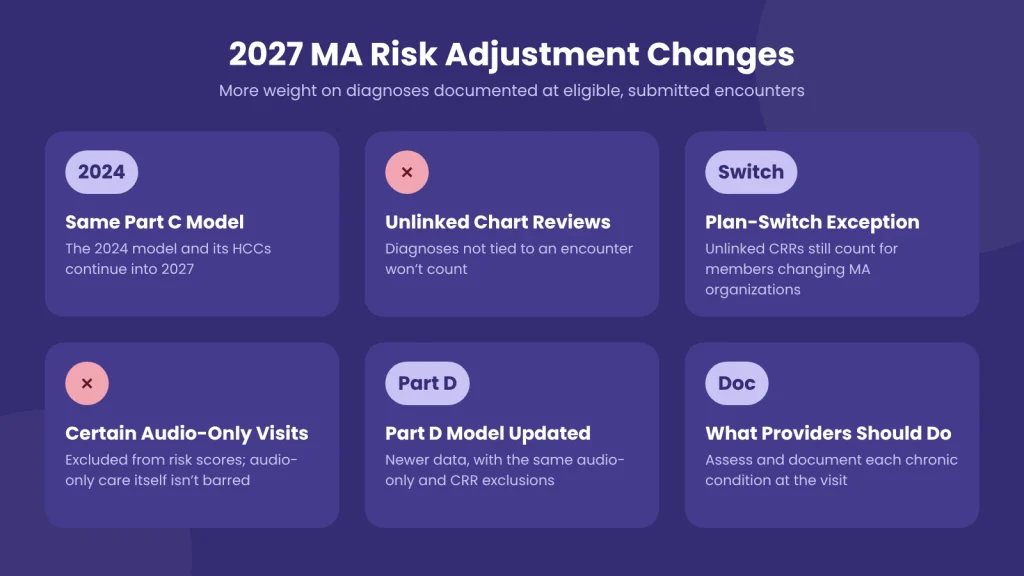
CMS Will Continue Using the 2024 MA Risk Adjustment Model
In the Advance Notice, CMS proposed an updated Part C risk model calibrated on 2023 diagnoses and 2024 expenditures. In the final Rate Announcement, CMS chose to keep the 2024 MA risk adjustment model for 2027. That model is calibrated on 2018 diagnoses and 2019 expenditures and was fully phased in for 2026.
CMS said continuing the 2024 model gives the MA market more time to adjust to the recently completed phase-in. For providers, the HCC structure used in 2026 continues into 2027, so there’s no new set of condition categories to learn this year.
Exclusion of Diagnoses From Unlinked Chart Review Records
Chart review records (CRRs) are diagnoses that MA plans add after reviewing medical records. An unlinked CRR isn’t tied to a specific encounter record, such as a claim or encounter submitted for a visit.
Starting with 2027 payment, diagnoses from unlinked CRRs generally won’t count toward Part C risk scores. Plans may still submit them, but they won’t affect payment. Chart review records that are linked to an encounter aren’t affected by this exclusion.
CMS finalized one exception. For beneficiaries who switch from one MA organization to another, unlinked CRR diagnoses can still count. Without that exception, CMS estimated the payment impact at −1.78%. With it, the impact is −1.53%.
Exclusion of Audio-Only Diagnoses From Risk Score Calculations
CMS also finalized excluding diagnoses from audio-only encounters from risk score calculations. The exclusion applies when the encounter record contains no other risk-adjustment-eligible service. Audio-only services are identified on claims through modifiers, such as 93 or FQ depending on the claim type. CMS estimated this change has an average payment impact of about 0%.
This policy is about risk adjustment eligibility only. It doesn’t prohibit audio-only care or stop providers from billing audio-only services where a plan covers them.
Separately, CMS finalized updates to the Part D risk adjustment model using more recent diagnosis and expenditure data. Like the Part C policy, the updated Part D model excludes diagnoses from audio-only services and unlinked chart review records.
What the Risk Adjustment Changes Mean for Providers
These changes put more weight on diagnoses documented and submitted from eligible encounters. For practices, that means:
- Accurate, specific diagnosis documentation. Each chronic condition should be assessed and documented in the visit note, not just listed in a problem list.
- Diagnoses supported by eligible encounters. Face-to-face and video visits remain the main source of risk adjustment-eligible diagnoses.
- Complete, timely encounter data. Diagnoses need to reach the plan on a claim or encounter record tied to the visit, so submission accuracy matters.
- Coding accuracy. Unsupported or overstated diagnoses create audit risk, including in Risk Adjustment Data Validation (RADV) reviews.
Plans may also adjust their retrospective chart review programs and put more emphasis on prospective documentation, such as annual wellness or assessment visits. Read any plan requests for record access or documentation support carefully.
2027 Medicare Advantage Final Rule: Other Important Changes
The Rate Announcement covers payment. A separate document, the Contract Year 2027 MA and Part D final rule released April 2, 2026, covers program policy.
Medicare Advantage Star Ratings Changes
- Measures removed: CMS finalized removing 11 Star Ratings measures that focus on administrative processes or where plan performance is too similar to separate plans meaningfully. Some removals start with the 2028 ratings and others with 2029.
- New Depression Screening and Follow-Up measure: This Part C measure starts with the 2027 measurement year and affects the 2029 Star Ratings.
- Reward structure: CMS didn’t implement the Excellent Health Outcomes for All reward (formerly the Health Equity Index reward) for the 2027 Star Ratings. The historical reward factor continues.
Star Ratings drive quality bonus payments and plan competitiveness. These changes may influence the quality measures that MA plans emphasize in their provider networks. Practices may receive additional requests for gap-closure outreach, depression screening documentation, patient experience reporting and quality improvement.
Changes to Special Supplemental Benefits for the Chronically Ill
- Clearer eligibility requirements for Special Supplemental Benefits for the Chronically Ill (SSBCI)
- Public posting of each plan’s SSBCI eligibility criteria
- Tighter debit card rules:
- Cards must be electronically linked to plan-covered items and services.
- Eligibility must be verified in real time at the point of sale.
- Cards are limited to the plan year.
- Clarification that cannabis products illegal under state or federal law aren’t allowable SSBCI
Changes to Medicare Advantage Administrative Requirements
- Mid-year notice rescinded. Plans no longer have to send the mid-year unused supplemental benefits notice.
- UM committee rules relaxed. The requirement for a health equity expert on MA utilization management (UM) committees was eliminated, along with the annual health equity analysis and its public posting.
- Disparity reduction is no longer required. MA quality improvement programs no longer must include activities to reduce health disparities.
- No new special enrollment period. CMS didn’t finalize a proposed special enrollment period for members whose providers leave a plan’s network.
These are operational changes for plans and don’t directly change provider reimbursement. Still, changes to UM committee rules and supplemental benefits can affect how authorizations and patient benefits work in practice.
How Medicare Advantage Payment Changes Could Affect Healthcare Providers
Physician Practices and Specialty Clinics
Higher plan payments don’t automatically mean higher physician rates. Your MA reimbursement is set by your contract. That contract may use any of these payment methods:
- A percentage of the Medicare Physician Fee Schedule
- A negotiated fee schedule
- Capitation or another value-based arrangement
If your MA contract links reimbursement to the Medicare Physician Fee Schedule, review how the contract incorporates annual PFS updates. For 2027, CMS finalized two PFS conversion factors: $32.95 for qualifying APM participants and $32.63 for non-qualifying clinicians. These are Original Medicare PFS figures, not automatic Medicare Advantage reimbursement rates. The effect on your practice depends on the specific terms of your MA contract.
Avalere notes that 2027 plan revenue growth is less than half of 2026’s, and that plans may seek to hold down provider rates. Before renegotiating, practices should:
- Review contract terms, renewal dates and escalators
- Compare each plan’s actual payments with contracted rates
- Confirm network participation for 2027 products
Hospitals and Health Systems
For hospitals, MA contracts often involve large volumes and complex payment terms. Review:
- Managed care agreements for rate updates, escalators and termination clauses
- Plan enrollment shifts in your service area as plans exit or enter counties
- Utilization management trends, such as authorization denials, inpatient vs. observation decisions and post-acute placement
- Revenue forecasts, adjusted for MA payer mix and benefit design changes
Medical Billing and Revenue Cycle Management
The revenue cycle is where MA changes show up first:
- Eligibility verification. Confirm each patient’s 2027 plan, product and network status, especially in January.
- Authorization requirements. Track each plan’s 2027 authorization lists and referral rules.
- Claim submission rules. Follow payer-specific edits, modifiers and timely filing limits.
- Coding and documentation. Accurate diagnoses matter more under the updated risk adjustment rules.
- Reimbursement monitoring. Compare payments with contracted rates to catch underpayments.
Medical Billing Challenges Providers Should Monitor in 2027
- Medicare Advantage claim denials, especially for authorization, medical necessity and coding
- Prior authorization delays and documentation gaps
- Incorrect patient-plan selection after plan changes, mergers or exits
- Coding and encounter-data inconsistencies that affect diagnosis capture
- Underpayments and contract discrepancies
- Timely filing and appeal deadlines, which vary by plan
What Providers Should Do to Prepare for Medicare Advantage Changes in 2027

- Review MA payer contracts and reimbursement terms. Know your rate basis, escalators and renewal dates.
- Verify 2027 plan participation and network status for each plan and product.
- Update eligibility and benefits verification workflows. Re-verify every MA patient in January.
- Review coding and clinical documentation practices, so chronic conditions are assessed and documented at each visit.
- Make sure diagnoses are supported by eligible encounters, keeping the audio-only exclusion in mind.
- Monitor authorization and referral requirements for each plan’s 2027 updates.
- Audit claim denials, underpayments and reimbursement trends. A medical billing audit can show where MA revenue is leaking.
- Train billing and coding teams on payer-specific 2027 changes.
- Review CMS guidance and payer instructions, including each plan’s provider manual and bulletins.
Medicare Advantage Payment Rates 2027 vs. 2026
| Comparison point | 2026 | 2027 |
| CMS payment announcement | 2026 Rate Announcement | 2027 Rate Announcement (April 6, 2026) |
| Average payment change (without risk score trend) | +5.06% | +2.48% |
| Part C risk adjustment model | 2024 model (fully phased in) | 2024 model continues |
| Diagnosis data requirements | Applicable 2026 rules | Unlinked chart review and certain audio-only diagnoses excluded from risk scores (with a plan-switch exception for unlinked CRRs) |
| Star Ratings | 2026 program measures | Measure removals phased in; new depression screening measure from the 2027 measurement year |
CMS projected a 5.06% average increase in MA plan payments for 2026, compared with 2.48% for 2027. The smaller 2027 increase may put additional pressure on some plans’ benefit and market decisions. Payment growth is only one factor influencing those decisions.
Will Medicare Advantage Plans Change or Leave Markets in 2027?

According to KFF’s analysis of 2027 plan data, the market shows more pullback than expansion:
- Plan choices: The average beneficiary can choose from 28 MA prescription drug (MA-PD) plans.
- Counties with no plans: 193 counties have no MA-PD plans available for general enrollment, up from 123 in 2026.
- Insurer choices: The average beneficiary can choose from seven insurers, one fewer than in 2026.
- Exits and entries: Several large insurers are exiting hundreds of counties, while a few, such as Devoted Health, are expanding.
- Full market exits: Molina Healthcare and Clear Spring Health are exiting the general-enrollment MA-PD market for 2027. Molina will continue offering certain Special Needs Plans in some counties.
What this means for providers:
- Expect patient movement. Some patients will switch plans, return to Original Medicare or move into new MA plans in January.
- Check plan-specific notices. Plans that leave a county send nonrenewal notices to members. Don’t assume a plan has left your area without confirmation.
- Watch network changes. A plan exit can end contracts you rely on, and a new entrant may want to contract with you.
- Plan for runout claims. When a plan exits, confirm how it will process remaining claims. Our guide to the Molina timely filing limit explains why each plan’s deadlines need tracking.
Medicare Advantage isn’t ending in 2027. Plan availability depends on each insurer’s decisions in each service area.
Prepare Your Practice for Medicare Advantage Changes With Better Revenue Cycle Management
Practices that review contracts, re-verify eligibility, tighten documentation and watch denials closely will be in the best position for 2027. iSolve RCM supports providers with:
- Accurate coding and documentation review through our medical coding services
- Clean claim submission and follow-up through our medical billing services
- MA denial follow-up and appeals through our denial management team
- End-to-end revenue cycle management, including payer contract and reimbursement monitoring
Related reading:
- 2027 maternity care billing changes, for practices that provide obstetric care
- CPT 99205 guide, for E/M documentation tips that support accurate diagnosis capture
- Denial management companies in the USA, if you’re considering outside support
Frequently Asked Questions About Medicare Advantage Changes in 2027
What are the Medicare Advantage payment changes for 2027?
CMS finalized an average 2.48% increase in MA plan payments for 2027, more than $13 billion. The main drivers are:
A 5.33% effective growth rate
A −1.12% normalization update
A −1.53% impact from excluding certain diagnosis sources
CMS also kept the 2024 risk adjustment model.
How much will Medicare Advantage payments increase in 2027?
The finalized average update is 2.48%, more than $13 billion. With CMS’s estimated 2.50% risk-score trend added, the projected increase is about 4.98%. Individual plans will see different changes.
What is the CMS Medicare Advantage final rate increase for 2027?
The final 2027 Rate Announcement set an average increase of 2.48%, up from 0.09% in the January Advance Notice. A higher growth rate and CMS’s decision not to adopt a new risk model drove the change.
What changes did CMS make to the Medicare Advantage risk adjustment model for 2027?
CMS kept the 2024 Part C model. It also excluded diagnoses from unlinked chart review records and from certain audio-only encounters from risk score calculations. For unlinked chart reviews, there’s an exception for members who switch MA organizations.
Will Medicare Advantage plans use a new risk adjustment model in 2027?
No. CMS will continue using the 2024 Part C risk adjustment model for 2027 rather than the updated model it proposed.
Are Medicare Advantage plans going away in 2027?
No. Some insurers are leaving certain counties or the general-enrollment MA-PD market, while others are entering. Availability depends on each insurer and service area.
Will Medicare Advantage benefits change in 2027?
Benefits vary by plan. The 2027 final rule tightened rules for chronically ill supplemental benefits and debit cards, and some plans adjusted benefits and service areas. Members should review their Annual Notice of Change.
Do the 2027 Medicare Advantage payment increases mean providers will receive higher reimbursements?
Not automatically. The 2.48% increase applies to CMS payments to MA plans. Provider rates depend on each contract’s terms, so review your contracts directly.
Where can providers find the official Medicare Advantage payment rates for 2027?
Find the 2027 Rate Announcement, fact sheet and rate book on CMS.gov, under Medicare Advantage Rates & Statistics, Announcements and Documents. Plan-specific provider rates are in your contracts.
Sources:
- CMS: 2027 Medicare Advantage and Part D Rate Announcement Fact Sheet
- CMS: CMS Finalizes 2027 Medicare Advantage and Part D Payment Policies (Press Release)
- CMS: CY 2027 Rate Announcement (Full Document)
- CMS: Medicare Advantage Rates and Statistics, Announcements and Documents (Rate Book)
- CMS: Contract Year 2027 Medicare Advantage and Part D Final Rule Fact Sheet
- Federal Register: Contract Year 2027 Policy and Technical Changes Final Rule
- CMS: 2027 Medicare Advantage and Part D Star Ratings Fact Sheet
- AMA: 2027 Medicare Physician Payment Schedule Final Rule Summary
- Avalere Health: 2027 Medicare Advantage Payments and Market Implications
- KFF: Medicare Advantage Plan Availability Varies Widely by County for 2027
- Georgetown CHIR: Analysis of the CY 2027 Medicare Advantage Rate Announcement
- Healthcare Dive: CMS Finalizes Higher Medicare Advantage Rates for 2027
- Fierce Healthcare: CMS Locks In MA Star Ratings Overhaul