

Put modifier 26 in the second modifier field and a Medicare claim can be processed wrong, because Medicare instructs that the TC and 26 modifiers must be reported in the first modifier field, as CGS reminds providers. It is a small detail, and it is typical of radiology billing: most delayed imaging payments come from who billed which part of the study, where and how, not from the study itself.
Almost every radiology service has two parts. The technical component pays for the equipment, the technologist and the supplies. The professional component pays for the radiologist’s interpretation and report. Billing the wrong part, both parts when you own only one or the right part in the wrong place leads to denials, recoupments and duplicate-payment edits. This guide explains each component, how place of service decides what you bill and the errors that most often delay payment.
Quick answer: The technical component (modifier TC) covers performing the imaging study: equipment, staff and supplies. The professional component (modifier 26) covers the physician’s interpretation and written report. When one provider does both, such as an imaging center that owns the equipment and employs the radiologist, it bills the global code with no modifier. When the study is done in a hospital, the radiologist bills only modifier 26 and the hospital bills the technical part on its facility claim.
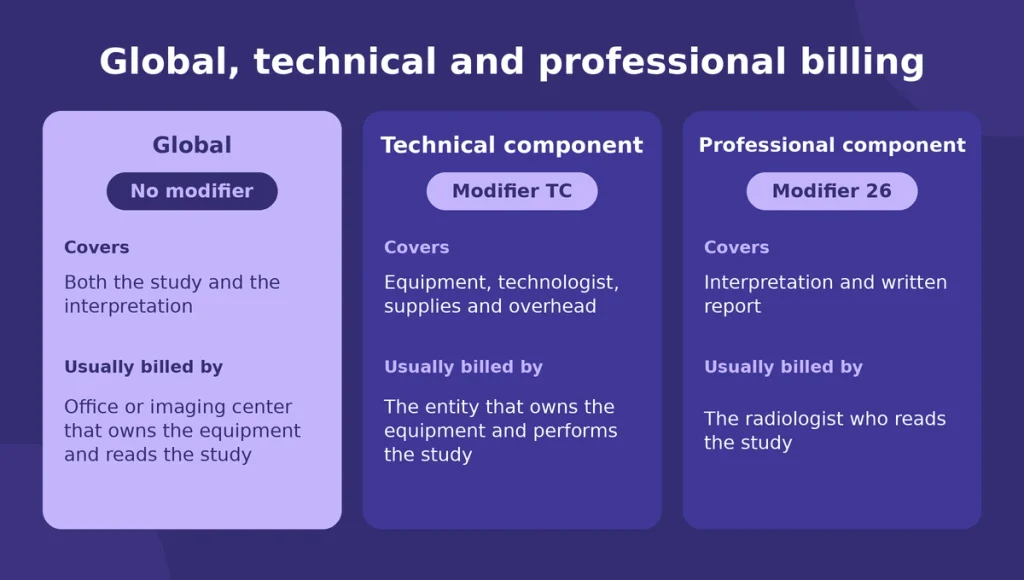
Professional, Technical and Global Billing at a Glance
| Billing Option | What It Covers | Modifier | Who Usually Bills It |
|---|---|---|---|
| Global | Both the study and the interpretation | None | Office or imaging center that owns the equipment and reads the study |
| Technical component | Equipment, technologist, supplies and overhead | TC | The entity that owns the equipment and performs the study |
| Professional component | Interpretation and written report | 26 | The radiologist who reads the study |

What Is a Technical Component?
A technical component is the part of a diagnostic service that covers performing the test: the imaging equipment, the technologist’s time, supplies, contrast handling and facility overhead. In medical billing, the technical component is reported with modifier TC when the provider performs the study but someone else interprets it.
What does “technical component” mean in medical billing?
It means billing only the “doing” part of a test. CMS defines modifier TC as the technical component, used when the physician or entity performs the test but does not do the interpretation, as CGS summarizes. An independent diagnostic testing facility that scans a patient and sends the images to an outside radiologist bills the technical component.
What Is a Professional Component?
The professional component is the physician’s work on a diagnostic service: supervision where required, interpretation of the images and the signed written report. It is reported with modifier 26. A radiologist who reads a CT scan performed in a hospital bills the CT code with modifier 26, because the hospital owns the scanner and bills the technical part separately.
What Is the Difference Between Technical and Professional Components?
| Technical Component | Professional Component | |
|---|---|---|
| What it pays for | Performing the study | Interpreting the study |
| Modifier | TC | 26 |
| Who bills it | Equipment owner (office, imaging center, IDTF) | Interpreting physician |
| In a hospital | Billed by the hospital on its facility claim | Billed by the radiologist with 26 |
| Date of service | The date the patient had the study | The date the interpretation was completed, or the study date for global billing |
| Documentation | Order, images and technologist record | Signed interpretation report |
Source: CGS, Billing the Professional and Technical Components (reviewed August 2026); Noridian.
What Are Modifier TC and Modifier 26?
Under CMS guidance, modifier 26 is the professional component: the physician’s service, which may include supervision, interpretation of results and the written report, used when the physician interprets but does not perform the test. Modifier TC is the technical component, used when the physician or entity performs the test but does not interpret it, per the Medicare Claims Processing Manual, Chapter 13. Both must go in the first modifier position. Commercial plans follow similar rules but publish their own policies, such as BCBS North Dakota and Premera.
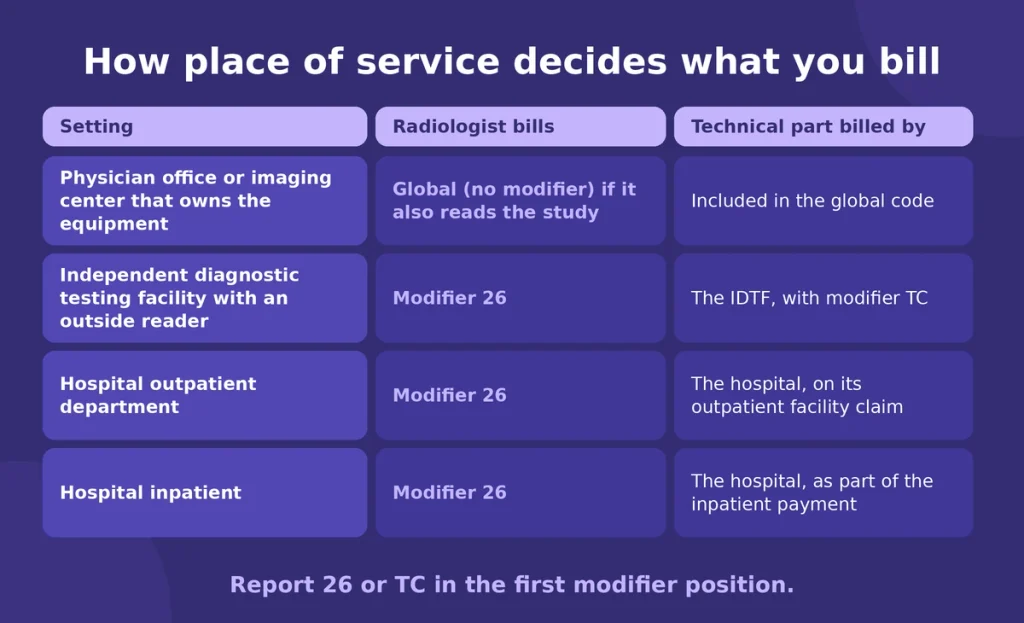
How Does Place of Service Decide What You Bill?
| Setting | Radiologist Bills | Technical Part Billed By |
|---|---|---|
| Physician office or imaging center that owns the equipment | Global (no modifier) if it also reads the study | Included in the global code |
| Independent diagnostic testing facility with an outside reader | Modifier 26 | The IDTF, with modifier TC |
| Hospital outpatient department | Modifier 26 | The hospital, on its outpatient facility claim |
| Hospital inpatient | Modifier 26 | The hospital, as part of the inpatient payment |
A global claim for a study done on a hospital inpatient is a common and costly error: only the inpatient facility may bill the technical component, and the claim returns with remark code M96. For hospital outpatients admitted within three days, Medicare’s payment window bundles related outpatient diagnostic services, including the technical part of imaging, into the inpatient claim.
Pro Tip: For split billing, report the place of service where the patient received the technical component, not where the radiologist read the images, as CMS instructs in MM6731. A remote reader billing POS 11 for a hospital study is a frequent mismatch.
What Are PC/TC Indicators in the Medicare Fee Schedule?
Every CPT code in the Medicare Physician Fee Schedule carries a PC/TC indicator that tells you whether modifiers 26 and TC can be used. Checking it prevents most modifier errors:
| Indicator | Meaning | Example |
|---|---|---|
| 0 | Physician service; the PC/TC concept does not apply | E/M visits |
| 1 | Diagnostic test with separate PC and TC; 26 and TC allowed | Most radiology codes, such as 73030 |
| 2 | Professional component only code; modifier 26 not used | 93010 (ECG interpretation) |
| 3 | Technical component only code; modifier TC not used | 93005 (ECG tracing) |
| 4 | Global test only code; no 26 or TC | 93000 (ECG global) |
| 5 | Incident-to service; no 26 or TC | Codes furnished incident to a physician |
| 9 | Not applicable | Codes outside the PC/TC concept |
Source: CMS Medicare Physician Fee Schedule Relative Value File; CGS.
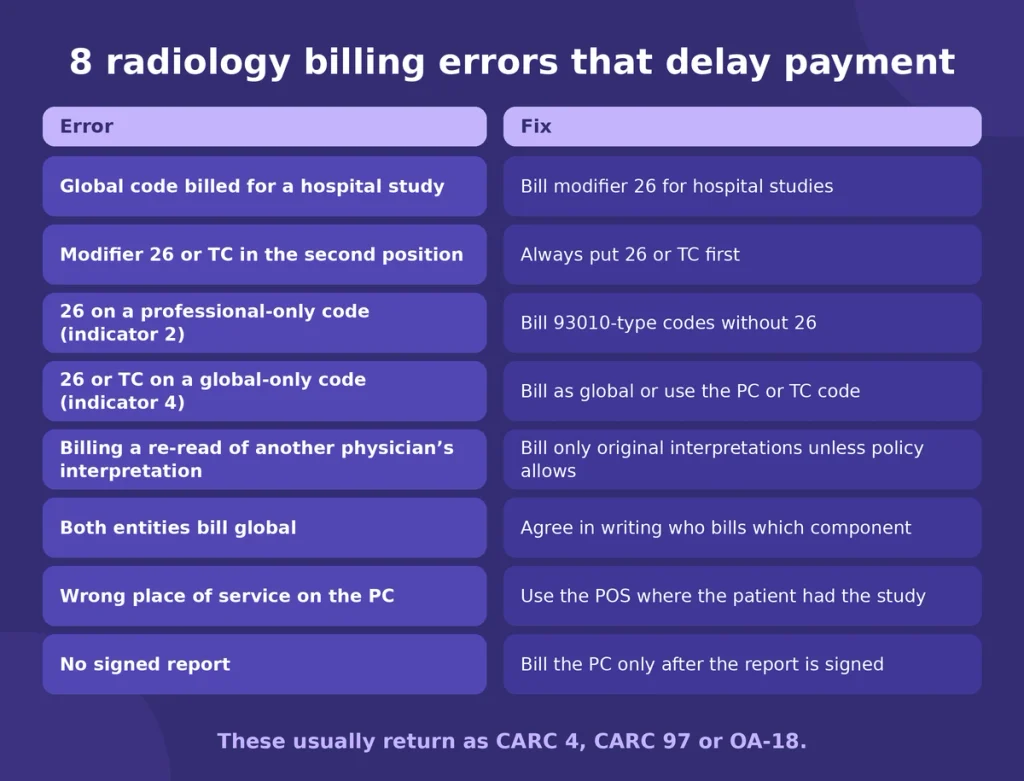
Which PC/TC Errors Delay Radiology Payment Most Often?
| Error | What Happens | Fix |
|---|---|---|
| Global code billed for a hospital study | Denial or recoupment; RARC M96 for inpatients | Bill modifier 26 for hospital studies |
| Modifier 26 or TC in the second position | Claim processes incorrectly or denies | Always put 26 or TC first |
| 26 on a professional-only code (indicator 2) | Denied; the code already means PC | Bill 93010-type codes without 26 |
| 26 or TC on a global-only code (indicator 4) | Denied | Bill the code as global or use the PC or TC code |
| 26 on an E/M or anesthesia code | Denied; the modifier does not apply | Remove the modifier |
| Billing a re-read of another physician’s interpretation | Denied as duplicate or not payable | Bill only original interpretations unless policy allows a second read |
| Both entities bill global | Second claim denied as a duplicate | Agree in writing who bills which component |
| Wrong date of service | Mismatch with the facility claim | TC on the study date; PC on the interpretation date |
| Wrong place of service on the PC | Paid at the wrong rate or denied | Use the POS where the patient had the study |
| No signed report | PC denied on review | Bill the PC only after the report is signed |
These usually return as CARC 4 (modifier inconsistent with the procedure), CARC 97 or OA-18, as our guide to common denial codes in medical billing explains.
How Is the CPT Radiology Section Organized?
Radiology codes run from 70010 to 79999 and are grouped by type of service:
| Code Range | Subsection |
|---|---|
| 70010 to 76499 | Diagnostic radiology (X-ray, CT, MRI, angiography) |
| 76506 to 76999 | Diagnostic ultrasound |
| 77001 to 77022 | Radiologic guidance |
| 77046 to 77067 | Breast mammography |
| 77071 to 77086 | Bone and joint studies |
| 77261 to 77799 | Radiation oncology |
| 78012 to 79999 | Nuclear medicine |
Source: AMA CPT code set.
What Are Common Radiology CPT Codes?
| CPT Code | Description | PC/TC Split |
|---|---|---|
| 71046 | X-ray, chest, 2 views | Yes |
| 72100 | X-ray, lumbosacral spine, 2 or 3 views | Yes |
| 73030 | X-ray, shoulder, complete, minimum of 2 views | Yes |
| 73502 | X-ray, hip, unilateral, with pelvis when performed, 2 or 3 views | Yes |
| 73610 | X-ray, ankle, complete, minimum of 3 views | Yes |
| 70450 | CT, head or brain, without contrast | Yes |
| 74177 | CT, abdomen and pelvis, with contrast | Yes |
| 70551 | MRI, brain, without contrast | Yes |
| 76700 | Ultrasound, abdomen, complete | Yes |
| 77067 | Screening mammography, bilateral, including CAD when performed | Yes |
What is CPT 73030?
CPT 73030 is a radiologic examination of the shoulder, complete, with a minimum of two views. In a hospital, the radiologist bills 73030-26; in an office that owns the X-ray equipment and reads the film, 73030 is billed globally. Use RT or LT where the payer requires laterality.
What is the CPT 73502 code description?
CPT 73502 is a radiologic examination of the hip, unilateral, with pelvis when performed, two or three views. It is common in hip fracture work-ups, where accurate diagnosis codes matter as much as the component billing; our hip fracture ICD-10 guide covers those codes.
Are T-Codes Paid by Medicare?
No. HCPCS Level II T-codes are national codes created for state Medicaid agencies and are not valid for Medicare. Some private payers accept them, but Medicare claims must use CPT or other HCPCS codes. Do not confuse T-codes with the TC modifier, which Medicare does use for technical components.
What Changed for Radiology Billing in 2026?
| Change | Effect on Radiology Billing |
|---|---|
| Efficiency adjustment | A 2.5% reduction to work RVUs for non-time-based services, which includes most imaging interpretation codes, under the 2026 Physician Fee Schedule |
| Practice expense shift | Lower indirect practice expense for services billed at the facility rate, which affects hospital-based radiologists billing modifier 26 |
| Hospital outpatient data | CMS began using hospital outpatient data to set certain technical rates, including radiation treatment |
| Appropriate Use Criteria | The AUC program for advanced imaging was rescinded, so AUC modifiers and decision support codes are no longer required on Medicare claims |
| Commercial prior authorization | Still required by many plans for CT, MRI, PET and nuclear studies; the authorization must match the code performed |
Our guide to the CMS Physician Fee Schedule 2026 explains the efficiency adjustment and practice expense change in more detail.
Radiology Billing Guidelines Checklist
- Confirm who owns the equipment and who reads the study before choosing global, 26 or TC.
- Check the code’s PC/TC indicator before adding a modifier.
- Put 26 or TC in the first modifier position.
- Use the place of service where the patient received the study.
- Date the TC on the study date and the PC on the interpretation date.
- Bill the PC only after the report is signed.
- Confirm authorization matches the code performed for advanced imaging.
- Agree in writing with hospitals and IDTFs on who bills which component.
How Can iSolve RCM Help With Radiology Billing?
iSolve RCM bills radiology professional, technical and global claims with place of service and component rules built into the claim scrubber, so hospital studies go out with 26, office studies go out global and every modifier sits in the right position. Our certified medical coding team reviews interpretation reports before billing, and a medical billing audit shows where your imaging claims are losing money, with services starting at 2.99% of monthly collections.

Frequently Asked Questions
What is the CMS definition of modifier TC?
CMS defines modifier TC as the technical component, used when the physician or entity performs the test but does not do the interpretation.
What is the professional component modifier?
Modifier 26. It reports the physician’s interpretation and written report, used when the physician interprets a test but does not perform it.
Can a radiologist bill global for a hospital study?
No. In hospital settings the hospital bills the technical part on its facility claim, so the radiologist bills the professional component with modifier 26.
What happens if both the hospital and the radiologist bill globally?
The second claim is denied as a duplicate or the technical portion is recouped. Agree in advance who bills which component.
Do all radiology codes split into professional and technical components?
Most do, with a PC/TC indicator of 1 in the Medicare fee schedule. Some codes are professional-only, technical-only or global-only, so check the indicator before adding a modifier.
What CPT codes are used for X-rays?
X-ray codes are in the 70010 to 76499 diagnostic radiology range, such as 71046 for a two-view chest X-ray, 73030 for a complete shoulder X-ray and 73502 for a unilateral hip X-ray.