

For the first time since Medicare began paying physicians under the fee schedule in 1992, there are two conversion factors. In 2026, clinicians who qualify through an Advanced Alternative Payment Model are paid with a conversion factor of $33.57, and everyone else with $33.40, according to the CMS fact sheet on the CY 2026 final rule. Both are higher than 2025’s $32.35, but the increase is not the same for every practice, and some services pay less despite it.
That is because the 2026 Medicare Physician Fee Schedule (PFS) did more than raise the conversion factor. It cut work values for many procedures through a new efficiency adjustment, shifted practice expense payment toward office-based care, made virtual supervision permanent and changed how skin substitutes are paid. This guide explains each change, how to look up your own rates and what practices should do before the 2027 rule takes effect.
Quick answer: The CMS Physician Fee Schedule 2026 raised the conversion factor 3.26% to $33.40 for most clinicians and 3.77% to $33.57 for qualifying APM participants, including a one-year 2.5% statutory increase. It also applied a 2.5% efficiency reduction to work RVUs for non-time-based services, lowered indirect practice expense for facility-based services and made virtual direct supervision permanent for most services.
2026 Medicare Physician Fee Schedule at a Glance
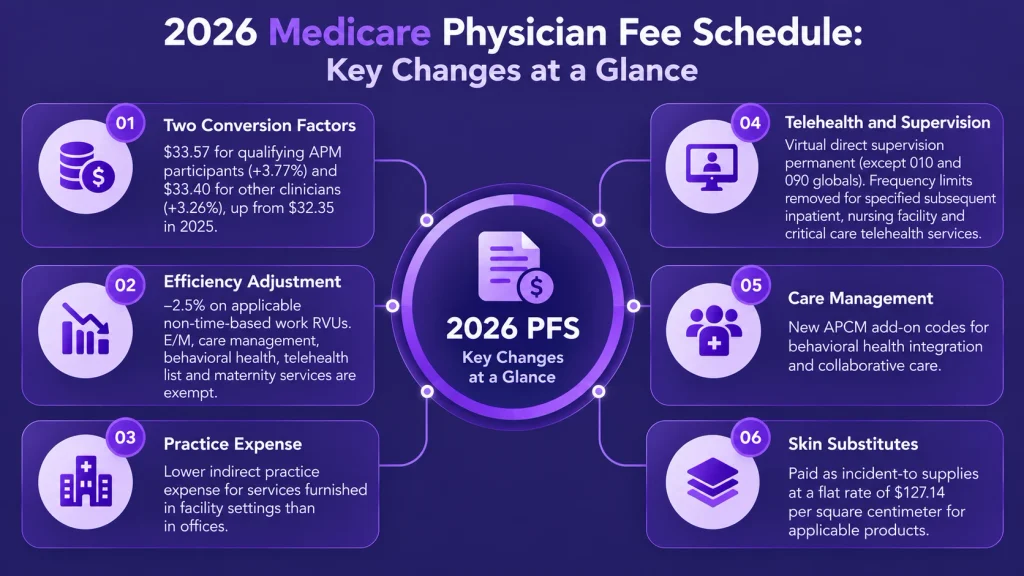
| Change | What It Means for Billing |
|---|---|
| Two conversion factors | $33.57 for qualifying APM participants (+3.77%) and $33.40 for others (+3.26%), up from $32.35 |
| Efficiency adjustment | −2.5% to work RVUs for non-time-based services; E/M, care management, behavioral health, telehealth list and maternity services are exempt |
| Practice expense | Lower indirect practice expense for services furnished in facility settings than in offices |
| Telehealth and supervision | Virtual direct supervision permanent (except 010 and 090 globals); telehealth frequency limits removed |
| Care management | New APCM add-on codes for behavioral health integration and collaborative care |
| Skin substitutes | Paid as incident-to supplies at a flat rate of about $127 per square centimeter |
Source: CMS CY 2026 PFS final rule fact sheet (CMS-1832-F).

What Is the Medicare Physician Fee Schedule?
The Medicare Physician Fee Schedule is the list of payment amounts Medicare Part B uses to pay physicians and other billing practitioners for their services, from office visits to surgery to diagnostic tests. CMS has used it since 1992. Each service has relative value units (RVUs) for physician work, practice expense and malpractice, which are adjusted by geographic practice cost indices (GPCIs) and converted to dollars with the conversion factor. CMS publishes the full rate files on its physician fee schedule page.
Office services are paid at the non-facility rate, which covers the full cost of the service. Services in a hospital outpatient department or ambulatory surgery center are paid at the lower facility rate, because the facility is paid separately for its share. For many diagnostic tests, the professional and technical components are paid separately.
What Is the 2026 Medicare Conversion Factor?
| 2025 | 2026 (Non-Qualifying APM) | 2026 (Qualifying APM) | |
|---|---|---|---|
| Conversion factor | $32.35 | $33.40 | $33.57 |
| Change from 2025 | n/a | +3.26% | +3.77% |
| Statutory update | n/a | +0.25% | +0.75% |
| One-year statutory increase | n/a | +2.50% | +2.50% |
| Budget neutrality for work RVU changes | n/a | +0.49% | +0.49% |
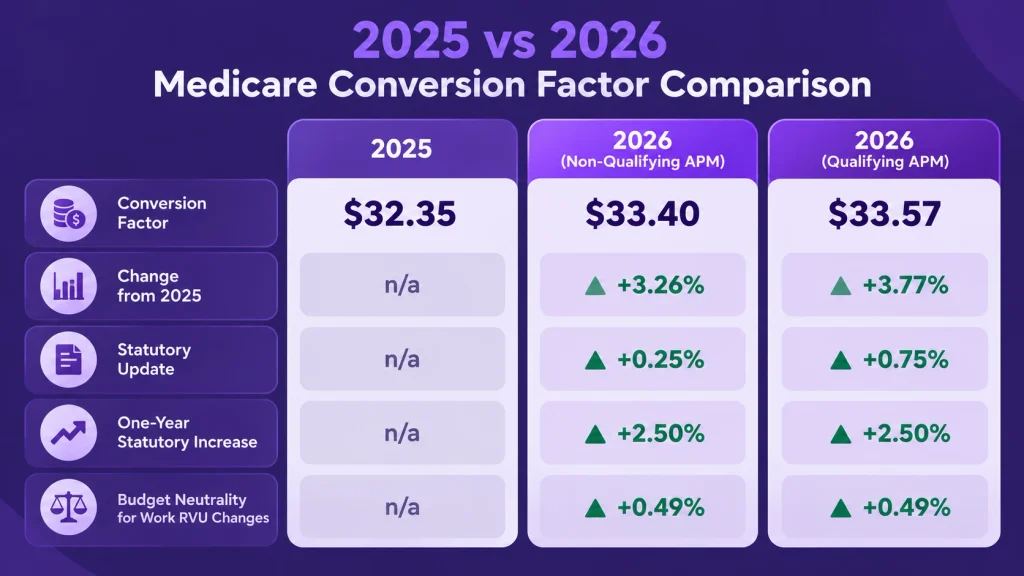
Source: CMS fact sheet. Qualifying APM participants are clinicians who meet the thresholds for participation in an Advanced APM.
The 2.5% increase applies to 2026 only. That is why the proposed 2027 conversion factor is lower again, as the 2027 section below explains.
How Are Medicare Allowable Rates Calculated?
Payment = [(Work RVU x Work GPCI) + (PE RVU x PE GPCI) + (MP RVU x MP GPCI)] x Conversion factor
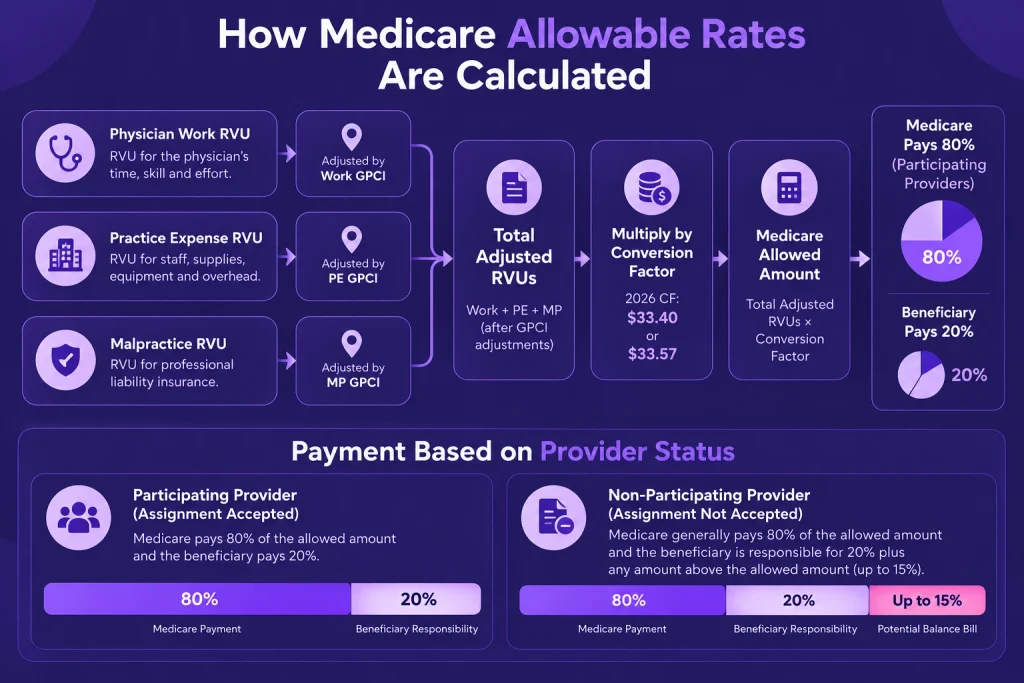
For example, a service with 2.00 geographically adjusted RVUs pays about $66.80 at the 2026 non-qualifying conversion factor (2.00 x $33.40). Medicare pays 80% of that allowed amount after the Part B deductible, and the patient owes the 20% coinsurance.
| Provider Status | Medicare Allowed Amount |
|---|---|
| Participating provider | 100% of the fee schedule amount; must accept assignment |
| Non-participating provider accepting assignment on a claim | 95% of the fee schedule amount |
| Non-participating provider not accepting assignment | May charge up to the limiting charge, 115% of the non-participating amount |
Pro Tip: Many commercial contracts pay a percentage of Medicare, such as 120% of the Medicare rate. When the Medicare fee schedule changes in January, check whether your commercial contracts update automatically or stay on an older year’s rates.
How Do You Use the Medicare Fee Schedule Lookup?
CMS offers a Physician Fee Schedule look-up tool and downloadable rate files, including the PFS dataset on data.cms.gov. To find a rate:
- Choose the year (2026) and the type of information, such as pricing.
- Enter the CPT or HCPCS code, or a range of codes.
- Select your Medicare Administrative Contractor and locality, since payment varies by geography.
- Choose the modifier when it applies, such as 26 for the professional component or TC for the technical component.
- Read the non-facility and facility amounts and use the one that matches your place of service.
Rates are updated during the year when CMS corrects the rule or Congress changes payment, so recheck the tool before loading a new fee schedule.
What Is the 2026 Efficiency Adjustment?
The efficiency adjustment is a 2.5% reduction to work RVUs and intraservice time for non-time-based services, based on the Medicare Economic Index productivity adjustment over a five-year look-back. It exempts time-based services, including E/M visits, care management, behavioral health, services on the Medicare telehealth list and maternity codes with an MMM global period, as the CMS fact sheet explains.
In practice, the adjustment shifts payment from procedures and tests toward visits and care management. A procedural specialty can see the conversion factor rise 3.26% while the work value of its main procedures falls 2.5%, leaving a much smaller net increase or a cut for some codes.
How Does the 2026 Practice Expense Change Affect Payment?
CMS changed how it allocates indirect practice expense, recognizing greater indirect costs for office-based services than for facility-based services. The old method assumed physicians who worked in hospitals also kept separate offices. With more physicians now employed by hospitals and health systems, CMS lowered indirect practice expense for services billed at the facility rate.
The result is a payment shift toward independent, office-based practices and away from services billed in hospitals and ASCs. CMS also began using hospital outpatient data to set rates for radiation treatment services and some remote monitoring services, which changes those technical service rates.
What Telehealth and Supervision Rules Changed in 2026?
| Change | Detail |
|---|---|
| Virtual direct supervision | Permanent through real-time audio and video (not audio-only) for incident-to services, many diagnostic tests and cardiac and pulmonary rehabilitation, except services with a 010 or 090 global period |
| Telehealth frequency limits | Permanently removed for subsequent inpatient visits, subsequent nursing facility visits and critical care consultations |
| Teaching physicians | Virtual presence allowed permanently in all teaching settings when the service is furnished virtually |
| Telehealth Services List | Review process simplified; no more provisional and permanent categories |
Our guide to telehealth billing in 2026 covers place of service, modifiers and the telehealth timeline through 2028.
What Is New for Care Management and Behavioral Health?
CMS created three new add-on G-codes that let a practice bill behavioral health integration or psychiatric collaborative care when it also bills Advanced Primary Care Management (APCM) in the same month. RHCs and FQHCs can use them too. CMS also extended payment for digital mental health treatment devices to devices used for ADHD, furnished incident to behavioral health treatment.
How Are Skin Substitutes Paid Under the 2026 Fee Schedule?
Since January 1, 2026, Medicare pays most skin substitutes as incident-to supplies when used in a covered application procedure, at a single rate of about $127.28 per square centimeter, later corrected to $127.14, as WoundReference explains. CMS reported that Part B spending on skin substitutes rose from $252 million in 2019 to more than $10 billion in 2024. Our guide to wound care billing mistakes covers the coding.
How Does the 2026 Fee Schedule Affect Different Specialties?
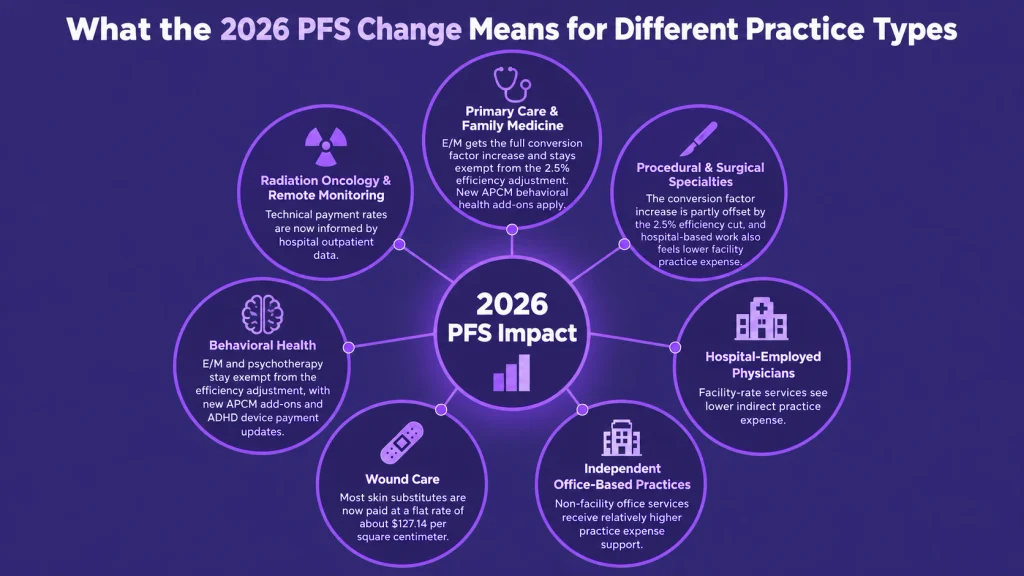
| Practice Type | Main 2026 Effects |
|---|---|
| Primary care and family medicine | Full conversion factor increase on E/M, which is exempt from the efficiency adjustment; new APCM behavioral health add-ons |
| Procedural and surgical specialties | Conversion factor increase partly offset by the 2.5% efficiency cut; lower facility practice expense for hospital-based work |
| Hospital-employed physicians | Lower indirect practice expense on facility-rate services |
| Independent office-based practices | Relatively higher practice expense on non-facility services |
| Wound care | Skin substitute payment cut to a flat per-square-centimeter rate |
| Behavioral health | E/M and psychotherapy exempt from the efficiency adjustment; new APCM add-ons; ADHD device payment |
| Radiation oncology and remote monitoring | Technical rates now informed by hospital outpatient data |
What Should Medical Practices Do About the 2026 Fee Schedule?
- Load the 2026 Medicare rates for your locality into your practice management system and payment posting rules.
- Confirm whether each clinician qualifies for the higher APM conversion factor.
- Check which of your top codes are subject to the efficiency adjustment.
- Review commercial contracts tied to a percentage of Medicare and confirm which year’s rates they use.
- Compare posted Medicare payments with expected rates to catch underpayments early.
- Update templates for virtual supervision, APCM add-ons and skin substitute billing.
- Plan for the lower proposed 2027 conversion factor in your budget.
A medical billing audit that compares payments with expected 2026 rates is the fastest way to find codes that are paying less than they should.
What Changes in the 2027 Physician Fee Schedule?
The proposed 2027 rule lowers the conversion factor to about $32.84 for most clinicians, a 1.68% decrease, largely because the one-year 2.5% increase expires. It would also turn G2211 into a modifier that raises the E/M payment by 16%, or 32% for certain ACO participants, and reduce payment for an E/M visit billed with modifier 25 on the same day as a 0-, 10- or 90-day global procedure, as Penn State’s rural health office summarized. CMS also finalized a new mandatory Ambulatory Specialty Model in the 2026 rule. The final 2027 rule is expected in November 2026.
How Can iSolve RCM Help Practices Under the 2026 Fee Schedule?
iSolve RCM loads each year’s Medicare fee schedule into payment posting, compares every Medicare and Medicare-linked commercial payment with the expected rate and flags underpayments for follow-up. Our certified medical coding team updates templates for new codes and policy changes, from APCM add-ons to skin substitutes, and our pricing starts at 2.99% of monthly collections.

Frequently Asked Questions
What is the Medicare fee schedule for 2026?
It is the set of Medicare Part B payment rates for physician and practitioner services in 2026, based on RVUs, geographic adjustments and a conversion factor of $33.40 for most clinicians or $33.57 for qualifying APM participants.
What was the Medicare conversion factor in 2025?
The 2025 conversion factor was $32.35. The 2026 factors are $33.40 and $33.57.
What is Medicare fee for service?
Medicare fee-for-service, or Original Medicare, pays providers separately for each covered service using fee schedules such as the Physician Fee Schedule, rather than through a private Medicare Advantage plan.
What is the Medicare Part B fee schedule?
The Medicare Part B fee schedule usually means the Physician Fee Schedule, which pays physicians and other practitioners. Part B also uses separate fee schedules for clinical laboratory services, durable medical equipment and ambulance services.
What does Part A Medicare cover?
Medicare Part A covers inpatient hospital care, skilled nursing facility care after a qualifying hospital stay, hospice care and some home health care. Physician services are paid under Part B and the Physician Fee Schedule.
Where can I look up Medicare allowable rates?
Use the CMS Physician Fee Schedule look-up tool or the downloadable PFS files on CMS.gov, selecting the year, code, Medicare contractor and locality.


