
CPT code 99215 is the highest-level office or outpatient visit code for an established patient. It’s often called a “Level 5” visit, and it’s reserved for encounters that involve high-complexity medical decision making (MDM) or at least 40 minutes of total practitioner time on the date of the encounter.
It’s also one of the most misunderstood codes in medical billing.
Some providers almost never bill it, even when their visits clearly qualify, because they’re worried about audits. Others bill it too often, based on how hard a visit felt rather than what the documentation actually shows. Both mistakes cost money, which is why accurate coding and reliable medical billing services matter. Undercoding quietly leaves revenue on the table with every visit. Overcoding invites denials, downcoding and, eventually, audits with repayment demands.
The good news is that the rules for the CPT code 99215 are clearer than most people think. Since the AMA’s office visit overhaul in 2021, and its time descriptor update in 2024, there are just two ways to qualify for 99215:
- High-complexity MDM, or
- At least 40 minutes of total qualifying time by the physician or other qualified healthcare professional on the date of the encounter.
You only need one of the two. History and exam still need to be “medically appropriate,” but they no longer decide the level of the visit.
In this guide, we’ll walk through the CPT 99215 descriptor, high-complexity MDM, the 40-minute time rule, documentation requirements, 99214 vs. 99215, reimbursement and RVUs, modifiers and G2211 (including the 2027 changes), common denial reasons and best practices to keep your E/M coding accurate and defensible.

What Is CPT Code 99215? Description and Definition
Quick answer: CPT 99215 is an Evaluation and Management (E/M) code for an office or other outpatient visit with an established patient. The visit requires a medically appropriate history and/or examination and either high-complexity MDM or at least 40 minutes of total practitioner time on the date of the encounter.
CPT Code 99215 Description
CPT 99215 sits at the top of the established-patient office visit family (99211–99215). In plain language, the descriptor says the code covers an office or outpatient visit for the evaluation and management of an established patient that requires:
- A medically appropriate history and/or examination, and
- A high level of medical decision making, or
- When time is used to select the code, 40 minutes or more of total time on the date of the encounter.
That last point matters. Before 2024, the descriptor listed a time range of “40–54 minutes.” The AMA removed the ranges effective January 1, 2024. Today the threshold for 99215 is simply 40 minutes met or exceeded. If you still see “40–54 minutes” in an article or a payer manual, it’s outdated.
Because it’s the highest level in the family, 99215 is often called a Level 5 established-patient visit.
Who Can Bill CPT Code 99215?
CPT 99215 can be reported by physicians and other qualified healthcare professionals (QHPs) who are allowed to bill E/M services independently under their state scope of practice and payer rules. That typically includes:
- Physicians (MD/DO)
- Nurse practitioners (NPs)
- Physician assistants (PAs)
- Clinical nurse specialists (CNSs)
- Certified nurse-midwives, where E/M services fall within their scope
Clinical staff, such as nurses and medical assistants, can’t report 99215 on their own, and their time doesn’t count toward the 40-minute threshold.
Payment can also vary by provider type. Medicare, for example, generally pays NPs and PAs at 85% of the physician fee schedule amount when they bill under their own NPI, unless “incident to” requirements are met.
When Should Providers Use Code 99215?
Use 99215 when the patient is established and the visit meets either high MDM or the 40-minute time threshold. Typical examples include:
- A patient with a chronic illness that has severely worsened, where the provider is weighing hospital admission.
- A patient on a drug that needs intensive monitoring for toxicity, such as certain chemotherapy agents, immunosuppressants or high-risk anticoagulation, where the provider is reviewing labs and adjusting therapy.
- A complex visit that takes 40 minutes or more of the provider’s total time that day, including review, exam, counseling, ordering and documentation.
99215 is not meant for routine follow-ups, stable chronic disease checks or visits that simply took a while because the schedule ran late.
Difference Between CPT Code 99215 and CPT Code 99205
CPT 99205 is the new-patient equivalent of 99215. Both require high-complexity MDM, but they apply to different patients and have different time thresholds.
| Criteria | CPT 99215 | CPT 99205 |
| Patient type | Established | New |
| MDM level | High | High |
| Time threshold | 40 minutes or more | 60 minutes or more |
| Typical use | Complex follow-up | Complex first visit |
A patient is considered new if they haven’t received any professional services from the same physician or QHP, or from another physician or QHP of the exact same specialty and subspecialty in the same group, within the past three years. If they have, they’re established, and 99205 isn’t an option.
CPT 99215 Requirements and Eligibility Criteria
Quick answer: To bill 99215, the patient must be established, the visit must be medically necessary, the record must include a medically appropriate history and/or exam, and the documentation must support either high-complexity MDM or at least 40 minutes of qualifying practitioner time on the date of service.

High-Complexity Medical Decision Making Requirements
High MDM is the clinical pathway to 99215. To reach it, the visit must meet the high level in at least two of the three MDM elements:
- Number and complexity of problems addressed
- Amount and/or complexity of data reviewed and analyzed
- Risk of complications, morbidity or mortality of patient management
We’ll break these down in detail in the next section.
Total Time Requirement for CPT 99215
The time pathway is simpler: the physician or QHP must spend at least 40 minutes of total time on the patient’s care on the date of the encounter. That includes both face-to-face and non-face-to-face work, as long as it’s performed by the billing provider and isn’t part of a separately reported service.
Medical Necessity and Patient Complexity
Meeting the MDM or time threshold isn’t enough on its own. The level of service also has to be medically necessary. Medicare is explicit that medical necessity is the overarching criterion for choosing a visit level. A 45-minute visit for a minor, stable problem may meet the time threshold on paper, but if the time isn’t clinically justified, it may not hold up in an audit.
Established Patient vs. New Patient Requirements
The three-year rule decides which code family applies:
- Established patient: Seen by the same provider, or a provider of the exact same specialty and subspecialty in the same group, within the past three years → 99211–99215.
- New patient: No professional services from that provider or same-specialty group in three years → 99202–99205.
Billing 99215 for a new patient (or 99205 for an established one) is one of the easiest errors for payers to catch. Their systems compare it against claims history automatically.
CPT 99215 MDM Criteria: Understanding High-Complexity Medical Decision Making
Quick answer: A visit qualifies for 99215 based on MDM when at least two of three elements reach the high level: problems addressed, data reviewed and analyzed, and risk of patient management.
Number and Complexity of Problems Addressed
For high complexity, the provider must address at least one of the following:
- One or more chronic illnesses with severe exacerbation, progression or side effects of treatment. For example, a patient with heart failure who now has worsening shortness of breath, edema and weight gain despite medication.
- One acute or chronic illness or injury that poses a threat to life or bodily function in the near term without treatment. For example, chest pain with concerning features, or a suspected stroke symptom.
A problem counts only if it’s actually addressed, meaning the provider evaluates or treats it during the visit. Simply listing a diagnosis in the chart, or noting that another specialist is managing it, doesn’t count.
Amount and Complexity of Data Reviewed
For high complexity (“extensive” data), the visit must meet at least two of these three categories:
Category 1: Any combination of three of the following
- Review of prior external notes from each unique source
- Review of the result of each unique test
- Ordering of each unique test
- Assessment requiring an independent historian (such as a family member, when the patient can’t give a reliable history)
Category 2: Independent interpretation of a test
- Personally interpreting a test performed by another physician or QHP, such as reviewing an ECG tracing or imaging yourself, when you’re not separately billing for that interpretation
Category 3: Discussion of management or test interpretation
- Discussing the patient’s management or test results with an external physician, QHP or appropriate source (for example, a case manager or teacher), not just exchanging notes
Data is often the element that’s hardest to document well. Providers do the work, but the note says “labs reviewed” without saying which ones, or leaves out the phone call with the cardiologist entirely.
Risk of Complications, Morbidity, or Mortality
High risk relates to the management decisions made during the visit, including the options considered but not chosen. Examples of high-risk management include:
- Drug therapy requiring intensive monitoring for toxicity
- A decision regarding hospitalization or escalation of hospital-level care
- A decision regarding elective major surgery with identified patient or procedure risk factors
- A decision regarding emergency major surgery
- A decision not to resuscitate or to de-escalate care because of poor prognosis
- Parenteral controlled substances
Note that the decision itself counts. If a provider seriously considers admitting the patient and decides against it, documenting that reasoning still supports high risk.
How to Determine Whether a Visit Meets High MDM Criteria
Remember the rule: two out of three elements must reach the high level.

| MDM element | Moderate (99214) | High (99215) |
| Problems | Chronic illness with mild exacerbation; 2+ stable chronic illnesses; new problem with uncertain prognosis | Chronic illness with severe exacerbation; illness posing a threat to life or bodily function |
| Data | Moderate: 1 of 3 categories | Extensive: 2 of 3 categories |
| Risk | Prescription drug management; minor surgery with risk factors | Intensive monitoring for toxicity; decision about hospitalization or major surgery |
Practical documentation example:
A 68-year-old established patient with COPD and heart failure presents with three days of worsening shortness of breath, increased oxygen needs and 2+ leg edema. The provider reviews a recent BNP and chest X-ray report, independently reviews today’s ECG, and calls the patient’s cardiologist to discuss diuretic changes. The provider discusses hospital admission with the patient. The patient prefers outpatient care. After weighing the risks, the provider increases the diuretic, orders labs within 48 hours and schedules close follow-up, with clear return precautions.
Here’s why this supports 99215:
- Problems: Chronic illness with severe exacerbation → High
- Data: Tests reviewed and ordered (Category 1), independent ECG interpretation (Category 2) and discussion with the cardiologist (Category 3) → Extensive (High)
- Risk: Decision regarding hospitalization → High
All three elements reached the high level, but only two were needed.
The AMA’s E/M guidance explains how medical decision making is assessed through the problems addressed, data reviewed or analyzed, and risk of patient management. For 99215, the documentation must support a high level of MDM in at least two of these three elements. For more detail, see the AMA E/M documentation and MDM guidance.
CPT Code 99215 Time Requirements: How Many Minutes Are Required?
Quick answer: CPT 99215 requires at least 40 minutes of total physician or QHP time on the date of the encounter when time is used for code selection. There is no upper limit. The old “40–54 minutes” range was removed in 2024.
This is the most common source of confusion, so it’s worth repeating: 40 minutes is a floor, not a range. A visit that takes 50, 60 or 70 minutes still reports 99215, and time beyond certain thresholds may support a prolonged services code (more on that below).
Also, “total time” isn’t the same as appointment length. It’s the time the billing provider personally spends on the patient’s care that day, both with the patient and away from them. A 30-minute appointment slot can still support 99215 if the provider spends another 15 minutes reviewing records and documenting that same day. On the other hand, a patient who spends an hour in the clinic, mostly with staff, may only support a lower level.
What Activities Count Toward 99215 Time?
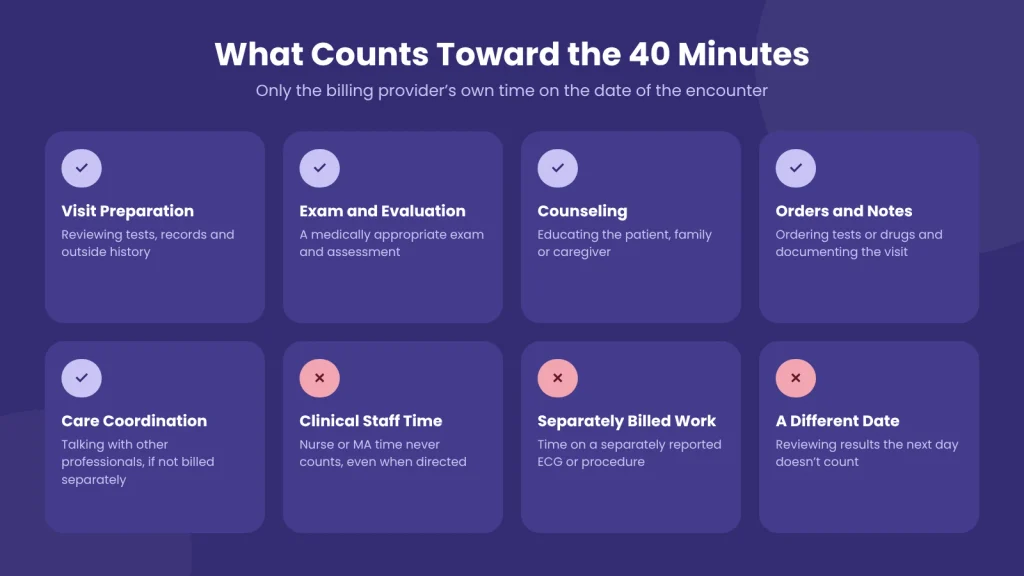
On the date of the encounter, these activities by the physician or QHP count:
- Preparing for the visit, such as reviewing tests, records and history
- Obtaining or reviewing a separately obtained history
- Performing a medically appropriate exam and evaluation
- Counseling and educating the patient, family or caregiver
- Ordering medications, tests or procedures
- Referring to and communicating with other healthcare professionals (when not separately reported)
- Documenting clinical information in the medical record
- Independently interpreting results (when not separately reported) and communicating them
- Care coordination (when not separately reported)
What Activities Cannot Be Counted Toward 99215 Time?
These activities don’t count:
- Time spent by clinical staff, such as nurses or medical assistants, even if the provider directed the work
- Staff-only administrative tasks, such as scheduling or prior authorization paperwork
- Time spent on separately reported services, such as an ECG interpretation billed on its own, or a procedure
- Travel time
- Teaching that’s general in nature and not specific to the patient’s care
- Any work performed on a different date, such as reviewing results the next day
How to Document 40 Minutes for CPT 99215
When billing by time, the note should clearly show the total time and give a general sense of what it was spent on. Here’s an illustrative attestation:
“I spent a total of 46 minutes on this patient’s care on the date of service. This included reviewing outside hospital records and recent labs, obtaining history, performing the examination, counseling the patient and her daughter on the new heart failure regimen and warning signs, coordinating with home health, and documenting the encounter. This time does not include separately reported services.”
A few rules of thumb:
- The time must reflect actual work performed. Template statements copied into every note are a red flag for auditors.
- Record the specific number of minutes, not just “over 40 minutes.”
- Don’t count the same minutes twice, for example by billing an ECG interpretation separately and also counting the time spent interpreting it.
What Happens When a Visit Exceeds 40 Minutes?
When a 99215 visit is coded by time and runs well past 40 minutes, a prolonged services add-on code may apply. This is where CPT and Medicare rules differ, and the two codes are not interchangeable:
| Payer | Prolonged code | When it applies to 99215 |
| CPT / most commercial payers | 99417 | Each full 15 minutes beyond 40 minutes; first unit at 55 minutes |
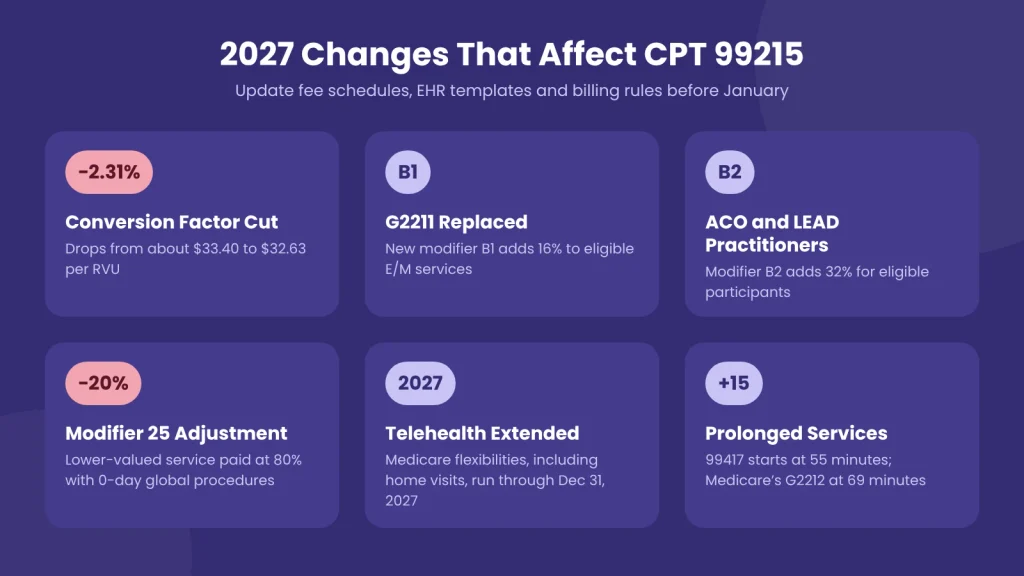
| Medicare | G2212 | Each full 15 minutes beyond Medicare’s 54-minute benchmark; first unit at 69 minutes |
A few points to keep in mind:
- Prolonged services can only be reported when the primary E/M code is selected based on time, not MDM.
- Medicare doesn’t accept 99417, and many commercial payers don’t accept G2212. Check each payer’s policy.
- Some Medicaid and commercial plans follow their own thresholds, so build payer-specific rules into your billing system.
For time-based E/M reporting, the practitioner must document the total qualifying time spent on the date of the encounter. The documented time should meet the applicable CPT threshold and include only activities permitted under the E/M time rules. Medicare also has separate thresholds for reporting prolonged services with HCPCS code G2212. Refer to the CMS E/M time-based coding guidance in the CMS Evaluation and Management Services Guide for Medicare-specific details.
CPT Code 99215 Documentation Requirements: What Must Be Included?
Quick answer: 99215 documentation must clearly support either high-complexity MDM or at least 40 minutes of total time, along with a medically appropriate history and exam, the problems addressed, data reviewed, management decisions and medical necessity.
Good documentation isn’t about writing more. It’s about writing what an auditor needs to see.
Patient History and Clinical Assessment
The history and exam must be medically appropriate for the problems addressed. They don’t determine the code level anymore, but they still need to support the clinical picture. A severe exacerbation should be visible in the history and exam findings, not just in the assessment.
Medical Decision-Making Documentation
The assessment and plan should show the provider’s thinking. Strong notes explain:
- Each problem addressed and its status, using terms like “worsening,” “severe exacerbation” or “threat to bodily function” when they’re clinically accurate
- Differential diagnoses being considered
- Why a particular treatment was chosen, and which options were rejected
Diagnostic Data and Test Interpretation
Be specific. Instead of “labs reviewed,” write “reviewed CMP from 11/2: potassium 5.8, creatinine up from 1.2 to 1.9.” Name the external records reviewed and their source. If you personally interpreted an image or tracing, document your interpretation. If you discussed the case with another provider, note who and what you discussed.
Treatment Plans and Risk Assessment
Document management decisions that reflect risk: hospitalization considered or recommended, drugs requiring intensive toxicity monitoring (and what monitoring is planned), surgical decisions and goals-of-care discussions. Include the patient’s preferences when they shape the decision.
Total Time Documentation
If you’re coding by time, include the total minutes and a summary of activities, all on the date of service, all by the billing provider.
Medical Necessity and Supporting Records
An ICD-10-CM diagnosis code does not independently determine whether an encounter qualifies for CPT code 99215. The E/M level must be supported by the documented medical decision making (MDM) or qualifying total practitioner time, along with medical necessity.
The diagnosis should accurately represent the patient’s condition and the problems addressed during the encounter. For a high-level E/M service, the medical record should clearly demonstrate the complexity of the problems evaluated, the data reviewed or analyzed, and the risk involved in patient management. A diagnosis code by itself cannot replace the documentation needed to support high-complexity MDM.
Make sure orders, results and referral letters are in the chart and accessible if the claim is reviewed.
99215 documentation checklist:
☐ Patient is established (seen within 3 years by same provider or same specialty in the group)
☐ Medically appropriate history and/or exam documented
☐ Each problem addressed is clearly identified, with its severity or status
☐ Data reviewed is specific: which tests, which records, from which source
☐ Independent interpretations and external discussions are documented
☐ Management decisions and their risk level are explained
☐ At least 2 of 3 MDM elements reach high, or total time is 40+ minutes and documented
☐ Diagnosis codes accurately reflect the problems addressed in the note
☐ Note is signed and dated by the billing provider
CPT 99215 vs. 99214: Key Differences in MDM, Time and Billing
Quick answer: 99214 requires moderate-complexity MDM or at least 30 minutes of total time. 99215 requires high-complexity MDM or at least 40 minutes. 99215 pays more and draws more payer scrutiny.

| Criteria | CPT 99214 | CPT 99215 |
| Patient type | Established | Established |
| E/M level | Level 4 | Level 5 |
| MDM complexity | Moderate | High |
| Time threshold | 30 minutes or more | 40 minutes or more |
| Documentation | Supports moderate MDM or time | Supports high MDM or time |
| Typical problem | Chronic illness with mild exacerbation; 2+ stable chronic illnesses | Chronic illness with severe exacerbation; threat to life or bodily function |
| Typical risk | Prescription drug management | Intensive toxicity monitoring; decision about hospitalization |
| 2026 Medicare national rate (non-facility) | About $135 | About $192 |
| Audit risk | Moderate | Higher |
When Should Providers Bill 99214 Instead of 99215?
Bill 99214 when:
- The patient’s chronic illness is worsening, but only mildly, and is managed with routine medication changes.
- The provider manages prescription drugs but doesn’t need intensive toxicity monitoring or a hospitalization decision.
- The data reviewed is moderate, for example a few labs and an outside note, but nothing else.
- Total time falls between 30 and 39 minutes.
When Is CPT 99215 More Appropriate?
99215 is the better fit when:
- The illness is severely exacerbated or threatens life or bodily function.
- The provider makes high-risk decisions, such as hospitalization, major surgery or toxicity monitoring.
- The data work is extensive, such as independent interpretation plus discussion with an outside physician.
- Or the provider’s total time on that date reaches 40 minutes or more.
Common Documentation Differences Between 99214 and 99215
In practice, the difference often comes down to wording and detail:
- Severity language: “Diabetes, uncontrolled, A1c 8.4, adjusting metformin” fits 99214. “Diabetic ketoacidosis risk, glucose 480, ketones present, evaluating need for admission” fits 99215.
- Data specificity: A 99215 note usually documents independent interpretation or an external discussion, not just results reviewed.
- Risk reasoning: A 99215 note explains the high-risk decision, including options considered and rejected.
CPT Code 99215 Reimbursement, RVU and wRVU Explained
Quick answer: In 2026, Medicare’s national non-facility payment for CPT 99215 is about $192, and the facility rate is about $126. Actual payment varies by location, payer and setting. The work RVU is 2.80.
How Much Does CPT 99215 Pay?
For 2026, Medicare’s national rate for 99215 is about $192.39 in a non-facility setting (such as a physician office) and about $125.59 in a facility setting (such as a hospital outpatient department). That’s an increase of roughly 9.5% from 2025. These figures are based on the CMS 2026 PFS Relative Value Files before any local adjustment.
A few things shape what you’ll actually receive:
- Facility vs. non-facility: The office rate is higher because the practice carries its own overhead. In a facility setting, the hospital bills separately for those costs.
- Geographic adjustments: Payment is adjusted by locality, so the same visit pays more in high-cost areas than in lower-cost regions.
- Commercial payers: Private insurers set their own rates by contract. Some pay above Medicare, some below, and many tie their fee schedules to a percentage of Medicare.
Looking ahead to 2027: The CY 2027 Physician Fee Schedule final rule cuts the non-APM conversion factor from about $33.40 to $32.63 per RVU, a 2.31% reduction, effective January 1, 2027. Unless the RVUs for 99215 change, Medicare payment for this code will drop slightly next year. Always confirm the current rate in the CMS relative value files or your MAC’s fee schedule before you update your own fee schedule.
CPT 99215 RVU and Work RVU
Medicare payment is built on Relative Value Units (RVUs), which have three parts:
- Work RVU (wRVU): The provider’s time, skill and effort. For 99215, the work RVU is 2.80.
- Practice expense (PE) RVU: Overhead such as staff, space and equipment. This differs between facility and non-facility settings.
- Malpractice (MP) RVU: The cost of professional liability insurance.
The basic formula is:
Payment = (Work RVU × Work GPCI + PE RVU × PE GPCI + MP RVU × MP GPCI) × Conversion Factor
The wRVU is not a dollar amount. It’s a productivity measure. Many practices and health systems use wRVUs to track provider productivity and set compensation, which is why accurate E/M coding affects both practice revenue and provider pay. A provider who undercodes 99215 visits as 99214 is also undercounting their own productivity.
Factors That Affect CPT 99215 Reimbursement
- Medicare Physician Fee Schedule: Updated every year, including the conversion factor and RVUs.
- Geographic Practice Cost Index (GPCI): Adjusts each RVU component for local costs.
- Payer contracts: Commercial and Medicare Advantage rates depend on negotiated terms.
- Place of service: Facility vs. non-facility, and telehealth POS codes.
- Provider type: NP and PA services billed under their own NPI are generally paid at 85% by Medicare.
- Modifiers and payment adjustments: For example, the 2027 same-day payment adjustment for certain modifier 25 claims, or the new B1 modifier that replaces G2211.
CPT 99215 Billing Guidelines and Modifier Considerations
How to Submit a CPT 99215 Claim
- Verify eligibility and benefits before the visit.
- Confirm established-patient status using the three-year rule.
- Select the level based on MDM or time, whichever the documentation better supports.
- Assign accurate ICD-10-CM codes that reflect the problems addressed in the note.
- Add modifiers only when they apply.
- Use the correct place of service (for example, POS 11 for office, POS 10 or 02 for telehealth).
- Scrub the claim for edits, such as NCCI conflicts, before submission.
- Submit on the CMS-1500 or the electronic 837P.
Common Modifiers Used With E/M Services
- Modifier 25: A significant, separately identifiable E/M service on the same day as a procedure or other service. The E/M must go beyond the usual pre- and post-procedure work.
- Modifier 95: Synchronous audio-video telehealth (when the payer requires it).
- Modifier 93: Audio-only telehealth.
- Modifier 24: An unrelated E/M service during a postoperative global period.
- Modifier 57: A decision for surgery made during an E/M visit, when the surgery has a 90-day global period.
2027 update on modifier 25: Starting in 2027, Medicare will apply a payment adjustment to certain same-day services reported with modifier 25 when the related procedure has a 0-day global period. Under this policy, the higher-valued service will be paid at 100% of its applicable rate, while the other eligible service will be paid at 80% of its applicable rate, resulting in a 20% payment reduction for the lower-valued service.
This adjustment does not apply to every claim submitted with modifier 25. It is limited to eligible same-day services associated with procedures that have a 0-day global period. Providers should continue documenting the significant, separately identifiable E/M service and verify payer-specific billing instructions. Practices that frequently bill 99215-25 with minor procedures should model the impact now. For full details, see the CMS 2027 modifier 25 payment policy.
Can You Bill G2211 With CPT 99215?
In 2026: Yes, when the requirements are met. HCPCS G2211 is Medicare’s visit complexity add-on for office and outpatient E/M visits. It recognizes an ongoing, longitudinal relationship in which the practitioner is the continuing focal point for the patient’s care, or provides ongoing care for a single serious or complex condition. It can be added to 99215 in those situations. G2211 generally isn’t payable when the E/M is billed with modifier 25, except when the same-day service is an annual wellness visit, vaccine administration or a Medicare Part B preventive service.
In 2027: G2211 is being replaced. Beginning in 2027, CMS is transitioning from the G2211 add-on payment approach to new modifiers. Modifier B1 applies to eligible E/M services and provides a 16% payment increase. Modifier B2 provides a 32% increase for eligible practitioners participating in qualifying Shared Savings Program ACOs or the LEAD model. Eligibility and reporting requirements should be checked against CMS guidance, including the CMS 2027 E/M payment updates in the final rule. Update your EHR templates and billing rules before January claims go out.
CPT 99215 Telehealth Billing Considerations
99215 can be billed for telehealth visits when the MDM or time requirements are met. For Medicare:
- Use POS 10 when the patient is at home and POS 02 when the patient is somewhere else.
- Add modifier 95 for audio-video or modifier 93 for audio-only visits, when applicable.
- Document the patient’s location, the modality and, for audio-only visits, why video wasn’t used.
Medicare’s telehealth flexibilities, including telehealth to the patient’s home anywhere in the country, have been extended through December 31, 2027. Commercial payers follow their own rules, so check each payer’s policy. Our guide to telehealth billing in 2026 covers POS codes and modifiers in more detail.
Medicare vs. Commercial Payer Billing Rules
| Topic | Medicare | Commercial payers |
| Prolonged services | G2212 (first unit at 69 min with 99215) | Usually 99417 (first unit at 55 min) |
| Complexity add-on | G2211 in 2026; modifier B1/B2 in 2027 | Often not recognized |
| Telehealth | Flexibilities through Dec 31, 2027 | Varies by plan |
| High-level E/M reviews | Medical review and audits | Many plans review 99214/99215 claims more closely |
Claims reporting a high-level E/M service may receive additional payer scrutiny when the diagnosis, clinical documentation and reported level of service appear inconsistent. However, ICD-10-CM codes alone do not determine the E/M level. Providers should ensure that the documented clinical problems, MDM or qualifying time, and medical necessity support the code billed.
Common CPT 99215 Billing Errors That Lead to Denials and Audits
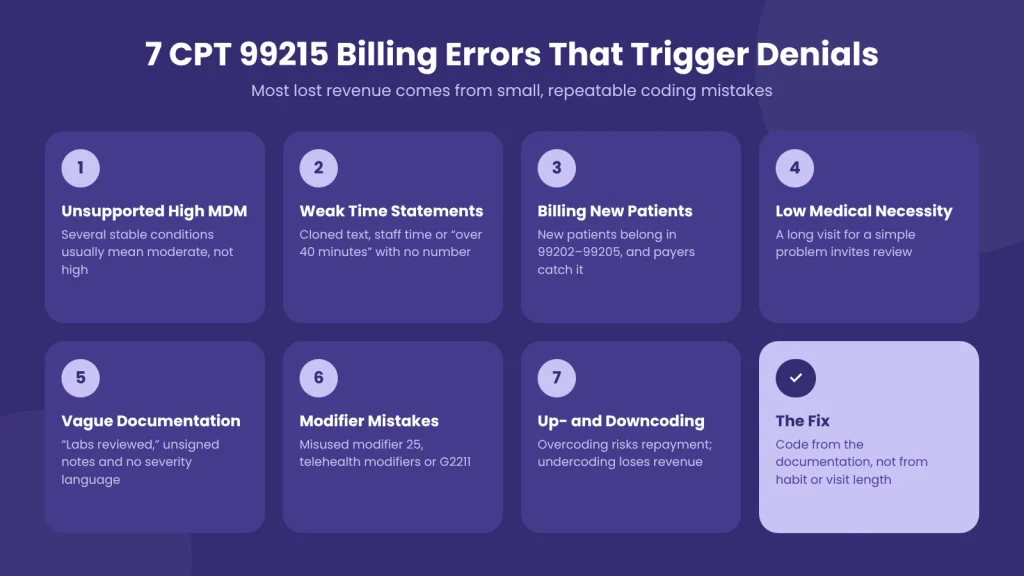
Billing 99215 Without Supporting High MDM
The most common error. The visit was busy, the patient had several problems, but the note doesn’t show two high-level MDM elements. Multiple stable chronic conditions usually support moderate, not high, complexity.
Incorrect Time Documentation
Common time mistakes include counting clinical staff time, counting time from another day, using cloned time statements, writing “spent more than 40 minutes” without a specific number, or counting time spent on separately billed services.
Using 99215 for New Patients
If the patient hasn’t been seen by the provider or the same specialty in the group within three years, the visit belongs to the new-patient family. Payers catch this automatically.
Insufficient Medical Necessity
Even when time or MDM is met, the level must fit the clinical situation. A long visit for a simple problem, or a note where the documented problems, data and risk don’t match the level billed, invites review.
Incomplete Clinical Documentation
Missing signatures, unsigned addenda, vague phrases like “labs reviewed,” and assessments that don’t describe severity all weaken a 99215 claim on review.
Incorrect Modifier Usage
Adding modifier 25 when the E/M isn’t truly separate from the procedure, using telehealth modifiers that don’t match the modality, or billing G2211 when it doesn’t apply all lead to denials or repayments.
Upcoding and Downcoding Errors
Upcoding, meaning billing 99215 when the record supports 99214, exposes the practice to repayments and, in serious cases, False Claims Act liability. Downcoding, meaning billing 99214 when 99215 is supported, is safer from a compliance standpoint but costs real revenue on every visit. Both point to the same fix: code from the documentation, not from habit.
What happens if a 99215 claim is denied or downcoded? Start with the remittance advice and the reason code. If the documentation supports 99215, submit a reconsideration or appeal with the relevant notes, highlighting the MDM elements or time statement. If it doesn’t, correct and resubmit at the right level, and use the finding to train providers. Our denial management team handles this process from start to finish.
CPT 99215 Billing Best Practices for Healthcare Providers
- Review MDM before choosing the level. Ask: which two elements are high, and where does the note show it?
- Pick the stronger pathway. If the MDM is moderate but the provider spent 42 minutes, time may be the better option, and the reverse is also true.
- Document time accurately. Record actual minutes and activities, on the date of service.
- Keep diagnoses accurate and consistent with the note. ICD-10-CM codes should reflect the problems addressed. Remember that the diagnosis doesn’t set the E/M level; MDM or time does.
- Set up a coding review process. Review a sample of 99215 claims each month before or after submission.
- Monitor denials and downcoding. Track which payers downcode 99215 and why.
- Run regular coding audits. A quarterly medical billing audit helps you compare your 99215 rate with specialty benchmarks and catch problems early.
- Train providers and billing staff. E/M rules change, and 2027 brings G2211’s replacement, the same-day modifier 25 payment adjustment and a new conversion factor.
How Professional Medical Billing Services Help Practices Improve CPT 99215 Reimbursement
Most practices don’t lose money on 99215 because of one big error. They lose it through dozens of small ones, such as visits billed a level too low, time statements missing a number, or a payer downcoding claims that no one appeals. An experienced revenue cycle partner closes those gaps.
Accurate E/M Coding and Documentation Review
Certified coders review E/M documentation against current AMA and CMS guidelines, confirm whether MDM or time better supports the visit and flag documentation gaps before claims go out. Our medical coding services cover E/M coding across 45+ specialties.
Medical Necessity and Compliance Checks
Pre-bill reviews make sure the documented MDM or time supports the visit level, diagnoses accurately reflect the problems addressed, modifiers are used correctly and payer-specific rules, such as prolonged service codes, are applied.
Clean Claim Submission
Claims are scrubbed for NCCI edits, POS errors, modifier conflicts and eligibility issues before they reach the payer, which raises first-pass acceptance rates.
Denial Management and Appeals
When a 99215 claim is denied or downcoded, the billing team reviews the reason, prepares a documentation-based appeal and tracks root causes so the same issue doesn’t keep coming back.
Accounts Receivable Follow-Up
Dedicated accounts receivable management keeps unpaid and underpaid E/M claims moving, especially with payers that delay high-level E/M payments for review.
Payment Posting and Reimbursement Analysis
Accurate payment posting shows whether payers are paying 99215 at the contracted rate, or quietly paying it as 99214. Underpayments are identified and pursued.
If you’re deciding whether to keep billing in-house, our guide to in-house vs. outsourced medical billing breaks down the costs and trade-offs. For specialty-specific E/M challenges, see our articles on family practice preventive and E/M claim denials and mental health billing, CPT codes and denials.
Improve Your E/M Coding Accuracy With Expert Medical Billing Support
Choosing the right E/M level isn’t about billing as high as possible. It’s about billing exactly what the documentation supports. For CPT 99215, that means high-complexity MDM in at least two of three elements, or at least 40 minutes of the provider’s own time on the date of the encounter, backed by clear, specific and medically necessary documentation.
With the 2027 changes ahead, including a lower conversion factor, G2211 becoming modifier B1, and a new same-day payment adjustment for certain modifier 25 claims, now is a good time to review how your practice codes and bills E/M services.
iSolve RCM helps practices get E/M coding right with certified coders, pre-bill documentation reviews, denial management, A/R follow-up and regular coding audits, all within a HIPAA-compliant workflow that works with your existing EHR. Our full revenue cycle management services and outsourced medical billing services come with transparent pricing based on a percentage of monthly collections.

Frequently Asked Questions About CPT Code 99215
What is CPT code 99215 used for?
CPT 99215 is used for an office or outpatient E/M visit with an established patient that involves high-complexity medical decision making or at least 40 minutes of total practitioner time on the date of the encounter. It’s the highest level in the established-patient office visit family.
What is the time requirement for CPT 99215?
When time is used to select the code, the physician or QHP must spend at least 40 minutes on the patient’s care on the date of the encounter. There’s no upper limit. The old “40–54 minutes” range was removed effective January 1, 2024.
Does CPT 99215 require high-complexity MDM?
Not always. High-complexity MDM is one of two pathways. A visit can also qualify based on time alone, if the provider’s total time on the date of the encounter is 40 minutes or more. You only need to meet one pathway.
What are the documentation requirements for 99215?
The record must show a medically appropriate history and/or exam, the problems addressed and their severity, the data reviewed and analyzed, the management decisions and their risk, and medical necessity. If billing by time, it must also include the total minutes and the activities performed on that date.
What is the difference between 99214 and 99215?
99214 requires moderate-complexity MDM or at least 30 minutes of total time. 99215 requires high-complexity MDM or at least 40 minutes. 99215 pays more and is reviewed more closely by payers.
Can CPT 99215 be billed based on time alone?
Yes. If the physician or QHP spends at least 40 minutes on the patient’s care on the date of the encounter and documents it, 99215 can be billed based on time, even if MDM is moderate. The visit must still be medically necessary.
How much does CPT code 99215 reimburse?
In 2026, Medicare’s national rate is about $192 in a non-facility setting and about $126 in a facility setting. Actual payment varies by locality, payer contract and provider type. Medicare’s conversion factor drops 2.31% in 2027, so check the updated fee schedule.
What is the work RVU for CPT 99215?
The work RVU for CPT 99215 is 2.80. Total RVUs, which also include practice expense and malpractice, are higher and vary between facility and non-facility settings.
Can CPT 99215 be billed with G2211?
In 2026, yes, when the visit is part of an ongoing, longitudinal relationship or ongoing care for a serious or complex condition, and the E/M isn’t billed with modifier 25 (with limited exceptions). In 2027, CMS replaced G2211 with modifier B1, which raises the E/M payment by 16%, or modifier B2 (32%) for eligible ACO and LEAD model practitioners.
Can CPT 99215 be used for new patients?
No. CPT 99215 is only for established patients. For a new patient visit with high-complexity MDM or at least 60 minutes of total time, use CPT 99205.
What happens if a 99215 claim is denied?
Review the denial or downcoding reason on the remittance advice. If the documentation supports 99215, file a reconsideration or appeal with the relevant notes. If it doesn’t, correct and resubmit at the appropriate level, and use the result to improve future documentation.
Does CPT 99215 require a 40-minute face-to-face visit?
No. The 40 minutes is total time on the date of the encounter, including both face-to-face and non-face-to-face work by the physician or QHP, such as reviewing records, ordering tests and documenting. Time spent by clinical staff doesn’t count.