

January 1, 2027 is a busy date for pain coders. Medicare’s conversion factor drops, CMS’s mandatory Ambulatory Specialty Model starts measuring pain specialists on low back pain care, CPT revises the SI joint fusion and paravertebral block rules, and code 27279 gets an office payment rate for the first time. None of that changes the basics, though. Most pain claims still come down to picking the right injection, ablation or stimulator code, counting levels correctly and proving medical necessity.
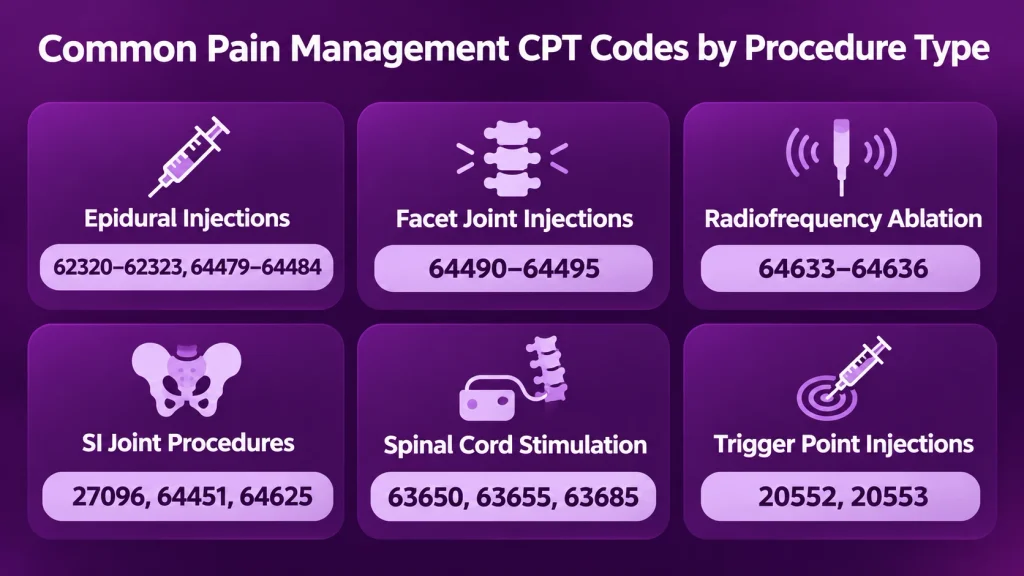
Pain management CPT codes describe interventions performed by pain specialists in office settings or hospitals, including epidural injections (62320-62327, 64479-64484), facet joint injections (64490-64495), radiofrequency nerve ablation (64633-64636), spinal cord stimulation (63650-63688) and trigger point injection therapy (20552, 20553). This article defines CPT pain codes, identifies pain management coding considerations, and discusses pain evaluation and management billing practices.
Let’s break down each code family, the Medicare rules that decide whether these claims pay, the 2027 changes and the coding mistakes that cause most pain management denials.
What are pain management CPT codes?
Pain Management CPT codes describe as procedures and encounters conducted by pain specialists, including epidural steroid injections, nerve blocks, peripheral nerve stimulation and radiofrequency ablation therapy. Pain management CPT coding involves proper procedure coding, modifier usage and understanding of various CPT level guidelines specific to each procedure group. Each pain management procedure code specifies the modality used, site or area treated and spinal region, when necessary. One pain practice may use multiple procedure groups, potentially eight or more, during a given week. Therefore, pain claims cannot usually be coded under one single set of guidelines.
Most interventional codes in this guide already include fluoroscopic or CT guidance in the descriptor. That one detail drives a large share of bundling denials, so we flag it in every section.
Pain management CPT codes cheat sheet (2027)
Use this table as a quick reference for the CPT codes pain management practices report most often:
| Service | CPT codes | Key coding note |
|---|---|---|
| Interlaminar or caudal epidural | 62320 to 62323 | Separate codes without and with imaging; caudal reports as lumbar/sacral |
| Epidural via indwelling catheter | 62324 to 62327 | Continuous infusion or intermittent bolus |
| Transforaminal epidural | 64479, +64480, 64483, +64484 | Fluoroscopy or CT guidance included; per level |
| Facet joint injection or medial branch block | 64490 to 64495 | Imaging included; add-on for 2nd and 3rd+ levels |
| Facet radiofrequency ablation | 64633 to 64636 | Per joint, imaging included |
| Sacroiliac joint | 27096, 64451, 64625 | Injection, nerve block and RFA, each with imaging |
| SI joint fusion | 27278, 27279 | Descriptor and guideline revisions for 2027 |
| Genicular nerve | 64454, 64624 | Block and RFA of genicular nerve branches |
| Basivertebral nerve ablation | 64628, +64629 | Lumbar/sacral vertebral bodies |
| Spinal cord stimulation | 63650, 63655, 63685, 63688, 63661 to 63664 | Leads, generator, revision and removal |
| Neurostimulator programming | 95970 to 95972 | Analysis without programming, simple and complex |
| Trigger point injection | 20552, 20553 | By number of muscles, not number of injections |
| Joint and bursa injection | 20600 to 20611 | By joint size; CPT codes 20604, 20606 and 20611 include ultrasound guidance. |
| Office visits | 99202 to 99215 | MDM or total time; modifier 25 with same-day procedures |
| Chronic pain management | G3002, G3003 | Monthly Medicare codes based on time |
The sections below explain how each code family works and where it most often goes wrong.
Which CPT codes are used for epidural steroid injections?
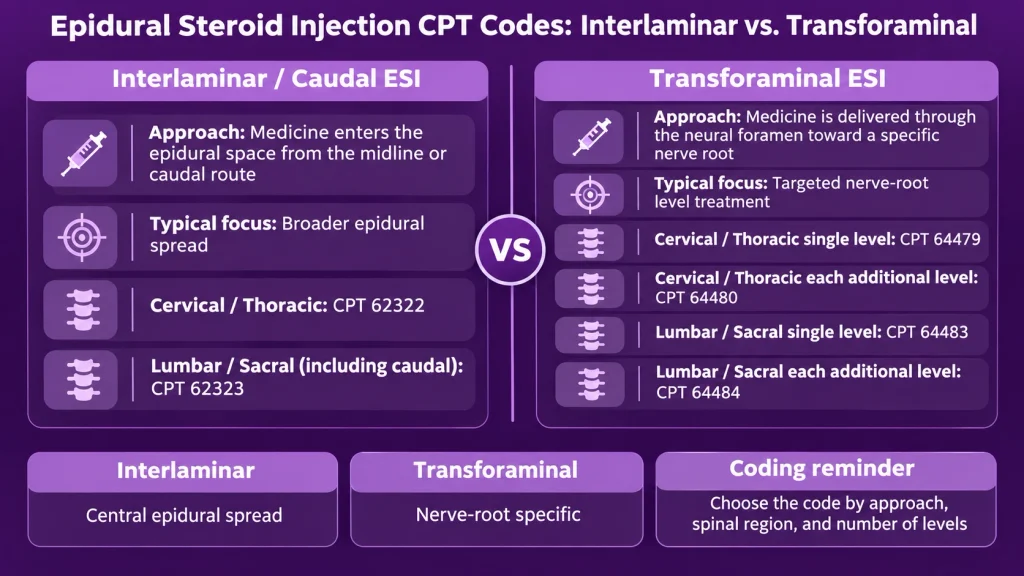
Epidural steroid injections use 62320 to 62327 for interlaminar, caudal and catheter-based approaches and 64479 to 64484 for transforaminal injections. The approach, the spinal region and imaging guidance decide which code applies.
Interlaminar and caudal epidural codes (62320 to 62323)
These 4 codes split by region and by imaging:
| CPT | Region | Imaging |
|---|---|---|
| 62320 | Cervical or thoracic | Without imaging guidance |
| 62321 | Cervical or thoracic | With imaging guidance (fluoroscopy or CT) |
| 62322 | Lumbar or sacral (caudal) | Without imaging guidance |
| 62323 | Lumbar or sacral (caudal) | With imaging guidance (fluoroscopy or CT) |
When fluoroscopy is used, the code is 62321 or 62323. Reporting 62322 plus 77003 for the same injection is a bundling error. Codes 62324 to 62327 follow the same region and imaging split for injections through an indwelling epidural catheter.
Transforaminal epidural codes (64479 to 64484)
Transforaminal codes are reported per level, and imaging (fluoroscopy or CT) is part of every code. 64479 is the first cervical or thoracic level, with +64480 for each additional level. 64483 is the first lumbar or sacral level, with +64484 for each additional level. Bilateral injections at the same level take modifier 50. Ultrasound-guided transforaminal injections are not reported with these codes; CPT directs them to Category III codes 0228T to 0231T.
Which CPT codes cover facet joint injections and medial branch blocks?
Facet joint injections and medial branch blocks use 64490 to 64495, split by region and level, with fluoroscopy or CT guidance included.
| Level | Cervical or thoracic | Lumbar or sacral |
|---|---|---|
| Single (first) level | 64490 | 64493 |
| Second level (add-on) | +64491 | +64494 |
| Third and any additional level (add-on) | +64492 | +64495 |
The same codes cover intra-articular facet injections and blocks of the medial branch nerves that supply the joint. Facet injections done with ultrasound guidance use Category III codes 0213T to 0218T instead.
How do you count facet levels?
A level is one facet joint, which is innervated by two medial branch nerves. Blocking the L3 and L4 medial branches treats one joint (L4-L5), so it is one level, not two. The third-level add-on codes (+64492, +64495) are reported once no matter how many additional levels are injected, and Medicare’s facet LCDs allow only one or two levels per session anyway.

Documentation is key: Name the joint levels (L4-L5, L5-S1), the side and whether the injection was intra-articular or a medial branch block. “Lumbar facet injections x4” tells an auditor nothing about levels or sides.
How are bilateral facet procedures reported?
Bilateral injections at the same level take modifier 50 on the primary code and on each add-on. Medicare professional claims generally report bilateral facet procedures on one line with modifier 50 and one unit of service. ASC facility claims report bilateral procedures on separate lines using RT and LT, with one unit on each line, according to applicable billing instructions. Follow your MAC’s published billing instructions and set the claim template once so staff don’t guess.
Which CPT codes are used for radiofrequency ablation?
Radiofrequency ablation of the facet joint nerves uses 64633 and +64634 (cervical or thoracic) and 64635 and +64636 (lumbar or sacral), reported per joint with imaging included. Other ablation targets have their own codes:
| Target | CPT |
|---|---|
| Facet joint nerves, cervical or thoracic | 64633, +64634 (each additional joint) |
| Facet joint nerves, lumbar or sacral | 64635, +64636 (each additional joint) |
| Nerves innervating the sacroiliac joint | 64625 |
| Genicular nerve branches (knee) | 64624 |
| Basivertebral nerve (lumbar/sacral vertebral bodies) | 64628, +64629 |
| Other peripheral nerve (neurolytic destruction) | 64640 |
Use the specific code whenever one exists. 64640 is for peripheral nerves without a named code, not a substitute for SI joint or genicular RFA.

What does Medicare require before a facet RFA?
Medicare’s facet joint intervention LCDs require 2 diagnostic medial branch blocks, each producing at least 80% relief, before the first radiofrequency ablation at that level. The note for the ablation needs to reference both blocks, their dates and their relief percentages.
How often can an RFA be repeated?
Medicare allows no more than 2 RFA sessions per spinal region in a rolling 12 months. A repeat ablation at the same level also needs documented, lasting improvement from the prior RFA, which the LCDs measure in percent relief and duration. Commercial payers often set their own intervals, so check the policy before scheduling a repeat.
Which CPT codes are used for sacroiliac joint procedures?
Sacroiliac joint procedures use 27096 for an image-guided SI joint injection, 64451 for an SI joint nerve block, 64625 for SI joint RFA and 27278 or 27279 for minimally invasive SI joint fusion. 27096, 64451 and 64625 all include imaging guidance.
For fusion, 27278 describes intra-articular device placement without cortical piercing, and 27279 describes transarticular or intra-articular devices that pierce the cortices of the ilium and sacrum. CPT already told coders in 2026 not to report 27278 with 27279 for the same SI joint and to use 27279 for hybrid fusions. For 2027, CPT revises 27278, 27279 and the arthrodesis guidelines again to clarify SI joint fusion reporting, so read the 2027 descriptors before coding these cases.
Which CPT codes cover spinal cord stimulation and other neuromodulation?
Spinal cord stimulation uses 63650 for percutaneous electrode placement, 63655 for paddle electrodes placed through a laminectomy, 63685 for the generator and 63688 for generator revision or removal. Lead revision and removal use 63661 to 63664.
A percutaneous trial is reported with 63650 for each lead placed. The permanent implant is reported with 63650 or 63655 plus 63685. Programming visits use 95970 (analysis without programming), 95971 (simple programming) and 95972 (complex programming). Peripheral nerve stimulation leads use 64555. Implanted pump refills and analysis use 62367 to 62370, 95990 and 95991, depending on whether reprogramming and refill are performed.
Documentation is key: Medicare requires prior authorization for implanted spinal neurostimulators performed in hospital outpatient departments. Keep the trial results (percent relief and functional change) and the psychological evaluation in the record, since most payers ask for both before the permanent implant.
Which CPT codes cover trigger points, joint injections and nerve blocks?
Trigger point injections use 20552 (1 or 2 muscles) and 20553 (3 or more muscles), joint injections use 20600 to 20611 by joint size and nerve blocks use 64400 to 64530 by nerve.
Trigger point codes are reported once per session based on the number of muscles, not the number of needle sticks. Joint codes split into small (20600, 20604), intermediate (20605, 20606) and major (20610, 20611) joints. CPT codes 20604, 20606 and 20611 include ultrasound guidance with permanent recording and reporting. For 2027, CPT revises the intermediate joint codes to clarify carpometacarpal aspiration and injection.
Common pain nerve blocks include 64405 (greater occipital), 64454 (genicular), 64505 (sphenopalatine ganglion), 64510 (stellate ganglion), 64520 (lumbar or thoracic sympathetic) and 64530 (celiac plexus). Paravertebral blocks use 64461 to 64463. For 2027, CPT deletes the parenthetical note that limited add-on code 64462 to once per day.
Which E/M and chronic pain management codes apply?
Pain office visits use 99202 to 99205 for new patients and 99211 to 99215 for established patients, and Medicare’s monthly chronic pain management codes are G3002 and G3003.
An E/M on the same day as an injection needs a significant, separately identifiable service and modifier 25. Deciding to do the planned injection is not enough. G3002 covers the first 30 minutes of chronic pain management personally furnished by a physician or other qualified healthcare professional per calendar month and requires an initial face-to-face visit of at least 30 minutes. G3003 covers each additional 15 minutes of qualifying chronic pain management services. In 2027, Medicare replaces the G2211 add-on code with modifier B1 on the E/M line, and B1 is not used when modifier 25 is on the claim except for a few preventive services.
Drug testing uses 80305 to 80307 for presumptive tests. Medicare definitive drug testing uses HCPCS G0480 to G0483 or G0659, depending on the testing methodology and applicable coverage requirements. Commercial payers may use CPT 80320 to 80377 or applicable HCPCS codes according to their billing policies.

Which ICD-10 codes support pain management procedures?
Pain procedures need a diagnosis that matches the procedure and the payer’s LCD, such as radiculopathy for transforaminal epidurals and spondylosis without radiculopathy for facet procedures. These are the codes most often paired with pain management CPT codes:
| Condition | ICD-10-CM | Usual procedures |
|---|---|---|
| Lumbar radiculopathy | M54.16, M54.17 | Transforaminal or interlaminar epidural |
| Lumbar disc disorder with radiculopathy | M51.16, M51.17 | Epidural injections |
| Lumbar spinal stenosis with neurogenic claudication | M48.062 | Interlaminar epidural |
| Lumbar spondylosis without myelopathy or radiculopathy | M47.816 | Facet injections, medial branch blocks, RFA |
| Cervical spondylosis without myelopathy or radiculopathy | M47.812 | Cervical facet procedures |
| Sacroiliitis | M46.1 | SI joint injections when applicable coverage criteria are met; SI joint RFA is noncovered under applicable Medicare LCDs |
| Unilateral primary osteoarthritis, right knee | M17.11 | Genicular block or RFA |
| Low back pain, unspecified | M54.50 | Evaluation; rarely sufficient alone for procedures |
| Postlaminectomy syndrome | M96.1 | Spinal cord stimulation |
| Chronic pain syndrome | G89.4 | Chronic pain management, G3002 |
| Myalgia, other site | M79.18 | Trigger point injections |
Two old codes still cause denials. M54.5 was replaced on October 1, 2021 by M54.50, M54.51 and M54.59, and M51.36 has been invalid since October 1, 2024. Code to the 6th or 7th character the documentation supports.
What are the key pain management billing and coding guidelines?
Pain management billing and coding depends on 4 rules: correct modifiers, no separate imaging when it is bundled, LCD frequency limits and prior authorization where required.
Which modifiers matter in pain management coding?
Modifier 50 reports bilateral procedures at the same level. RT and LT identify the side for unilateral injections. Modifier 25 separates a same-day E/M from a procedure, and 59 or XS identifies a distinct site when NCCI edits bundle two procedures. Drug lines for single-dose vials need JW for the discarded amount or JZ when nothing was discarded, under Medicare Part B rules.
When is imaging guidance billed separately?
Almost never for spine injections. 62321, 62323, 64479 to 64484, 64490 to 64495, 64633 to 64636, 27096, 64451 and 64625 all include fluoroscopy or CT. Billing 77003 or 77012 with them leads to an NCCI bundling denial.
What frequency limits does Medicare apply?
Medicare’s facet joint intervention LCDs allow one spinal region per session and one or two levels per session. They allow up to 4 diagnostic and 4 therapeutic intra-articular facet sessions per region in a rolling 12 months and no more than 2 RFA sessions per region in a rolling 12 months. Moderate sedation or monitored anesthesia care is not routinely covered for facet injections and medial branch blocks. Epidural steroid injection LCDs also limit sessions per region per rolling 12 months and require documented response before repeats.
How to Avoid? Count every prior session for the same region in the last 12 months, including sessions billed by other providers, before the procedure is scheduled.
Which pain procedures need prior authorization?
Medicare requires prior authorization for facet joint interventions and implanted spinal neurostimulators done in hospital outpatient departments. Commercial and Medicare Advantage plans keep their own lists, which usually include epidurals, RFA, stimulator trials and SI joint fusion. Check authorization for every scheduled procedure, not just new patients.
What changes for pain management coding in 2027?
Pain management coding in 2027 changes in 6 ways: CPT revisions for SI joint fusion and paravertebral blocks, a lower Medicare conversion factor, an office rate for 27279, the G2211 switch to modifier B1, finalized ASC payment cuts for common injections and the start of the Ambulatory Specialty Model.
CPT 2027 revisions: 27278, 27279 and the arthrodesis guidelines are revised again to clarify SI joint fusion reporting. The parenthetical limiting paravertebral block add-on 64462 to once per day is deleted. Intermediate joint codes are revised for carpometacarpal injections, and the autonomic nervous system function testing codes are overhauled for practices that do those tests.
Lower conversion factor: The CY 2027 Physician Fee Schedule final rule reduces the conversion factor by 2.31% to $32.63 for non-qualifying APM participants and by 1.83% to $32.95 for qualifying APM participants. Actual payment changes vary by procedure and RVU adjustments.
Office rate for 27279: 27279 had a facility rate only in 2026. For 2027, Medicare sets a national non-facility (office) amount of about $19,441, according to device maker PainTEQ’s summary of the final rule.
G2211 becomes modifier B1: Pain practices that billed G2211 for longitudinal care append B1 to the E/M code instead.
ASC payment pressure: The CY 2027 ASC final rule reduces payment for CPT 64483 and 64493 from $485.51 to $467.67, a decrease of $17.84 per procedure. Check the final 2027 ASC rates before updating facility contracts. Separate payment for qualifying non-opioid pain products is scheduled to end after 2027.
Ambulatory Specialty Model: This mandatory CMS model starts January 1, 2027 and includes anesthesiology, pain management, interventional pain management and physical medicine and rehabilitation in its low back pain cohort. Selected clinicians are scored on quality, cost and other measures, with adjustments to all Part B pay starting in the 2029 payment year, so low back pain documentation and imaging and injection utilization now carry financial weight.
Pain management coding scenarios
These 5 scenarios show how the rules above come together on real claims:
Scenario 1: Bilateral lumbar medial branch blocks. Diagnostic blocks at L4-L5 and L5-S1 on both sides, with fluoroscopy, for lumbar spondylosis. Code: 64493-50 and 64494-50 with M47.816. No 77003. Check your MAC’s format for bilateral units.
Scenario 2: Right two-level transforaminal epidural. Right L5-S1 and S1 transforaminal injections under fluoroscopy for lumbosacral radiculopathy. Code: 64483-RT and 64484-RT with M54.17.
Scenario 3: Lumbar RFA after positive blocks. Bilateral RFA at L4-L5 and L5-S1 after 2 diagnostic medial branch blocks with 85% and 90% relief. Code: 64635-50 and 64636-50 with M47.816. The note cites both blocks, dates and relief percentages.
Scenario 4: Trigger points in 4 muscles. Injections in the right and left trapezius, right rhomboid and right levator scapulae. Code: 20553 x1 with M79.18. Not 20552 x2 and not one unit per muscle.
Scenario 5: Spinal cord stimulator trial. Two percutaneous leads placed for a 7-day trial in a patient with postlaminectomy syndrome. Code: 63650 x2 with M96.1. Programming during the trial uses 95971 or 95972 based on complexity.
What are the most common pain management coding errors?
Most pain management denials trace back to the same 7 errors:
Billing imaging separately. 77003 added to an injection code that already includes fluoroscopy. How to Avoid? Check the descriptor; if it says “with imaging guidance,” imaging is included.
Counting nerves instead of joints. Two medial branch nerves reported as two facet levels. How to Avoid? Count joints, not nerves.
Repeating the third-level add-on. +64492 or +64495 reported once per extra level. How to Avoid? Report the third-level add-on once per side per session.
RFA without qualifying blocks. Ablation billed with no record of 2 blocks with at least 80% relief. How to Avoid? Build the block results into the RFA template.
Over the frequency limit. A fifth diagnostic facet session, a fifth therapeutic facet session or a third facet RFA session in the same spinal region within a rolling 12-month period exceeds the applicable Medicare frequency limit. How to Avoid? Track sessions per region in the scheduling system.
Invalid diagnosis codes. M54.5 or M51.36 still in templates. How to Avoid? Audit EHR favorite lists each October when ICD-10-CM updates.
Missing drug modifiers. Steroid lines without JW or JZ for single-dose vials. How to Avoid? Add the modifier prompt to the charge entry screen.
Fixing these 7 errors at charge entry prevents many of the CO-97 (bundling), CO-151 (frequency) and CO-50 (medical necessity) denials pain practices see.

Conclusion
Pain management CPT codes reward precision. Pick the code family by approach and target, count levels by joint, leave imaging off when the descriptor includes it and match every procedure to a diagnosis the LCD accepts. Then layer on the 2027 changes: revised SI joint fusion and paravertebral rules, modifier B1 instead of G2211, a lower conversion factor and the Ambulatory Specialty Model. Get those right and pain management billing and coding stops being the biggest source of denials in your practice.
Frequently asked questions
What are the most common CPT codes for pain management?
The most common CPT codes for pain management are 62321 and 62323 (interlaminar epidurals), 64483 and 64484 (lumbar transforaminal epidurals), 64490 to 64495 (facet injections), 64633 to 64636 (facet RFA), 20552 and 20553 (trigger points) and 99202 to 99215 (office visits).
What is the CPT code for pain management office visits?
Pain management office visits use 99202 to 99205 for new patients and 99211 to 99215 for established patients. Medicare also pays G3002 and G3003 for monthly chronic pain management based on time.
What is the procedure code for a lumbar epidural steroid injection?
A lumbar interlaminar or caudal epidural with fluoroscopic or CT guidance is reported with CPT 62323. CPT 62322 describes the procedure without imaging guidance, which is generally not covered under Medicare epidural steroid injection LCDs unless applicable exceptions are met. A lumbar transforaminal epidural is 64483 for the first level and +64484 for each additional level.
Can you bill fluoroscopy separately with pain injections?
Usually not. Most spine injection codes, including 62321, 62323, 64479 to 64484, 64490 to 64495 and 64633 to 64636, include imaging guidance, so 77003 is not billed separately with them.
How many facet levels can be billed per session?
Medicare’s facet joint LCDs allow one or two levels per session in one spinal region. CPT add-on codes cover additional levels, but Medicare does not pay beyond two levels per session.
What changed for pain management codes in 2027?
CPT 2027 revises SI joint fusion codes 27278 and 27279 and removes the once-per-day limit on paravertebral block add-on 64462. Medicare’s 2027 rules lower the conversion factor, add an office rate for 27279, replace G2211 with modifier B1 and start the Ambulatory Specialty Model for low back pain specialists.
Should a pain practice outsource billing and coding?
Outsourcing helps when level, laterality or frequency denials keep repeating, when authorizations are missed or when A/R ages past 60 days.