

Accounts receivable (AR) is money that a healthcare organization is owed for healthcare services delivered but not yet paid. The older claims get, the longer money is held back and the harder to collect. According to benchmarking data, one health care data set had 53.2 days on average in accounts receivable. Another healthcare organization had 22.1%-33.9% of payer specific AR that were older than 90 days. This clearly shows that aged claims are a key metric to cash flow and why healthcare organizations pay much attention to aged AR over 90 days.
The reason why 90 days are such a relevant threshold is that the claims that old usually have a denial, lack of documentation, eligibility problem or payer delay. Medical billing aged AR follow-up prior to reaching the 90-day threshold will reveal such issues and resolve them. However, if balances are older than that, aged medical billing AR recovery takes more effort. Partnering with a consistent medical billing company in USA can strengthen claim submission, AR monitoring, and timely follow-up.
What Is AR in Medical Billing?
The AR in medical billing refers to the total outstanding amount that a health care practitioner is entitled to receive for services rendered and has not been received yet. When the patient or the insurance company has not made payments for the claims that have been made, the outstanding amount forms the accounts receivable in medical billing. The current AR includes all the recently submitted amounts, whereas the aging AR includes all the amounts that have not been settled over various time frames.
A typical account receivable in medical billing is divided into the following periods: 0–30, 31–60, 61–90, 91–120, and 120+. The different time frames indicate the period that revenue has been outstanding and provide insights on where there has been a problem with the payments. This implies that the medical billing AR is one of the financial performance measures, which means that the increasing amount in the aging AR may be an indication of problems such as claim denials or delayed payments.
What an Accounts Receivable Aging Report Reveals
The accounts receivable aging statement is a control mechanism whereby the outstanding balances are arranged in accordance to how long the balances have been outstanding. As far as medical billing is concerned, claims are usually classified into categories of 0-30, 31-60, 61-90, 91-120 and 120+ days. This is a medical billing aging statement that provides more insightful information for the billing team compared to one outstanding-AR amount as it informs on whether the outstanding revenues are relatively new, moderately overdue, or old.
It is important to note that while the total AR may inform on the amount that is outstanding, the AR aging will inform on how this amount is distributed in relation to risks. For instance, $500,000 AR will mean totally different things if $400,000 are within 60 days versus $400,000 being outstanding beyond 120 days. The medical billing aging of AR enables the identification of claims for eligibility corrections, denial resolutions, documentation, appeal, payer and patient follow-up.
The increasing 90+ day balance should be attended to right away since older claims typically demand more scrutiny and will have to meet other payer, submission, or appeal criteria. Medical billing aging allows such accounts to be segregated while they are still relatively easy and cost-efficient to collect. Instead of looking at the 90-day bucket as merely a reporting classification, medical billing personnel can use it as an alert to review the status of the claim, determine why there is a delay, designate responsibility, and take a defined course of action.
Why Claims Become Harder to Collect After 90 Days
As the days advance after 90 days, collection becomes increasingly difficult due to the buildup of problems such as documentation problems, payer issues, denial of claims, balances from patients, and workflow issues. Older claims in medical billing are hence not just old claims but unresolved issues that demand increasing efforts to be fixed.
Documentation and Information Gaps
If any medical records, authorization forms, referral information, operating reports, or other documents are not available, then the payer will be unable to process or reconsider the claim. This issue may have to be resolved by piecing together information from various sources if the problem persists. Moreover, delays create another problem as well; as time goes on, it becomes harder to figure out what had been requested initially.
Payer Deadlines and Filing Limitations
The deadline criteria for timely filing, corrections, reconsideration, and appeals are determined by payers, and the requirements differ depending on the nature of the contract and type of claim. As the claims get older, such deadlines become very critical, since there may be a need to show some earlier filing or appeal. Thus, aging medical claims make recovery of money more difficult.
Denial Follow-Up Gets Delayed
A denial is not automatically written off, but inaction on it may convert it into an aged account. The lack of investigation into why the denial occurred means that follow-up actions to remedy it may prove ineffective, thus wasting more resources with no result. It follows that a denial in aged medical billing may take many touches without resulting in any payment.
Patient Balances Become Harder to Recover
It is also harder to collect the balance owing from the patient over time. The patient may move from one address or telephone number to another. Also, the patient might change his insurance coverage or financial standing. In this case, the balance owing becomes unfamiliar to the patient after a few billing periods. It is important to communicate effectively with the patient on such an account.
Staff Attention Shifts Toward Newer Claims
Bills teams always have to function under pressure of high claim volumes, deadlines, denial and new submissions. Accounts that are recently added always get priority because they have workflow of payers and the next actions clearly identified. In absence of aging management processes, old accounts slowly become lower priorities. This is how the process of medical claim aging happens.
Expert Insight: Consider the 90-day time period as something that will escalate the problem rather than help to recover it. Look at your claims well ahead of time, keep documentation for all payers involved, ensure proper assignment of responsibility, and focus on high balance items.
Understanding Days in Accounts Receivable
Days in AR is the number of days, on average, between billing and receiving payment. Days in AR represents the dollar amount of accounts receivable in terms of days’ revenue. Suppose a clinic’s accounts receivable amounts to $600,000, and it earns an average of $20,000 in daily net revenue from patient services. In that case, its days in AR are 30 days.
The equation to calculate days in AR is: Days in AR = Total AR / Average Daily Net Patient-Service Revenue.
Days in AR Medical Billing should be looked at based on the medical practice’s operations, not a set of good or bad numbers. Payer mix, specialty, regulation, approval requirements, claim complexity, and patient payment responsibilities may all affect the payment schedule. A low number means that the cash is turning over fast, but it will only create the illusion of good AR if the number of days is driven down by aggressive collection tactics such as early adjustments or write-offs. The important benchmark is then a sustainable one.
Increasing AR days in medical billing could mean that the outstanding receivables are taking more time to be turned into cash. This will especially happen if the rise in AR days happens in the older aging buckets. If 61-90 and 90+ day balances are increasing along with AR days, then the reasons for that may be denied claims, claim entry mistakes, slow payers, poor follow-ups, or increased balances from patients.
The Hidden Cost of Aged Medical Billing AR
The effects of aged AR go beyond the balance sheet because outstanding claims prevent generated income from becoming cash on hand. With aging, the personnel involved in processing claims need more time for researching, contacting payers, requesting documents, correcting claims and appealing. Despite the extra effort, there might not be more money collected from these repeated touches to the claims. At the same time, denied payments become unresolved for a longer period of time which means the probability of adjusting or writing off the collectible balance increases.
The task of recovering aged AR gets bigger and bigger as time goes by. The recovery of old AR medical billing can include the process of reconstruction of all past actions with claims, verification of claims submittals, searching for missing documents and deciding whether the deadlines have passed for the payer or the appeals. All this research of old AR takes away the resources that would be used to prevent newer denials or to take care of claims that are approaching age limit.
Opportunity costs are of particular significance, as old AR balances will lead to distorted use of resources by the billing team. Whereas a billing team can recoup revenue from aged AR, the number of actions required to prevent an account from aging to 120+ days is usually smaller than those required to salvage an old aged account. Hence, in order to effectively manage aged AR, both recovery and prevention should be considered, that is, salvaging aged high-value accounts while still doing claim reviews.
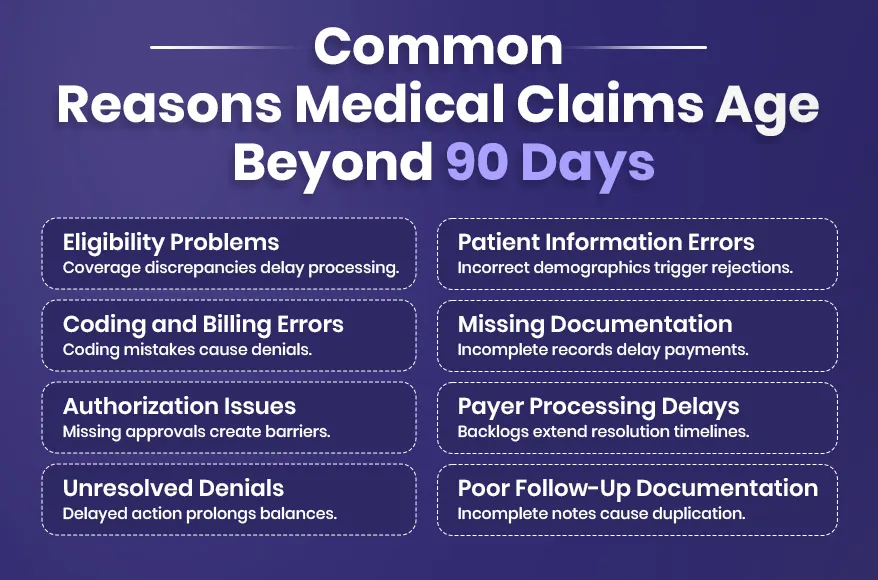
Common Reasons Medical Claims Age Beyond 90 Days
Medical claims aging is seldom caused by one problem alone. Claims may be delayed due to eligibility problems, demographic issues, coding errors, lack of documentation, lack of authorization, payer delay, and ineffective follow up. When one can identify the exact reason for each aging claim, then they will be able to deal with the underlying problem rather than repeatedly sending and calling without success. Expert denial management services can identify recurring denial causes, prioritize unresolved claims, and support faster recovery of outstanding revenue.
Insurance Eligibility Problems
Inconsistencies with eligibility could cause a denial of a claim even before processing for reimbursement. It could be that coverage was stopped, altered, or transferred to another plan on the date of service. Failure to check eligibility correctly could lead to either a denial or the wrong routing of the claim. For aged claims in medical billing, proper coverage correction followed by resubmission is necessary to avoid needless aging.
Incorrect Patient or Subscriber Information
Patient names, birthdays, ID numbers, group numbers, and subscriber information errors can lead to medical claims being rejected and not being associated with the appropriate payers. Even small demographic errors can hinder automated processing of claims. If they are not corrected, then they can cause the account to be put through repeated rejection and resubmission cycles. Correct registration demographics directly affect the aging process of medical claims.
Coding and Billing Errors
When there are inaccuracies in coding for diagnoses, procedures, modifiers, units, place of service information, or billing information, claims are bound to be denied or rejected. In some cases, claim denial or rejection requires recording of the claim before resubmission. Without proper identification of the problem, resubmissions would have the same effect. It can help minimize aged claims in medical billing due to inaccurate billing information. Accurate medical coding services can reduce preventable claim errors and help keep receivables from aging due to coding-related denials.
Missing Documentation
Payment may be pending the provision of medical record, surgical report, referral details, or any other document that is requested prior to processing the claim. Failure to provide requested documentation or its delay in provision may cause payment to be held up. The older cases become even more complicated when it becomes hard for employees to determine what was asked earlier.
Prior Authorization Issues
Where the prior authorization process has been bypassed, any payments for the service may be difficult if there was no authorization, or there was an expired, inaccurate, or partial authorization. It becomes necessary to conduct a verification process to determine how to proceed with the appeal or reconsideration process, depending on the payer. Such processes may be done only after a denial, resulting in delays in payment.
Coordination-of-Benefits Problems
When patients have several insurance policies, finding out which is the primary and which is the secondary insurance company may create a problem that may delay the whole process of claims adjudication. Claims may be routed to the wrong insurance company and may need information about other insurance companies as well. If there are changes in the insurance, then this problem can also apply to older accounts.
Payer Processing Delays
But all aging claims are not necessarily the result of mistakes made by the health care providers. Insurance carriers can suffer from delays due to backlog of their work, need for more information, problems with their system, or lengthy time period required for adjudication. But still there is no excuse for a claim to be left as it is.
Unworked or Incorrectly Worked Denials
Denials need to be diagnosed and addressed; they do not need another submission. In case the denial code is misunderstood, the correction that is submitted might be inappropriate or there might even be failure to appeal where necessary. It is important for effective aging of medical claims to have denials categorized, ownership identified, and specific actions attached to each denial.
Patient Responsibility Balances
There are some cases where the ultimate liability lies with the patients after the insurance processes the claim. There may be delays that happen due to inaccurate statements, ambiguous balances, outdated addresses, and failed attempts at communicating. The patient balances could therefore play a role in the aging of the receivables after the insurance has processed the claim.
Poorly Documented Follow-Up Activity
If the accounts cannot be properly documented with dates of submission, communications with the payer, reference numbers, denial reasons, documents requested, and next steps, then it becomes an inefficient process. With no proper history kept, another employee can simply duplicate the efforts done before and not progress the account further. Effective documentation ensures efficiency in medical billing accounts receivable follow-up through accountability and history keeping.
Professional Guidance: Not all aged claims should be treated the same way. It is important to pinpoint what is causing each aged claim—whether it’s an eligibility problem, coding issue, authorization issue, documentation, payer lag time, denials, or patient liability—and then assign the right actions for each one.
Why Traditional AR Follow-Up Often Fails
Traditional medical billing AR follow-up will not work where activity is determined based on the number of payer contacts as opposed to accounts that are resolved. Payer contact is confirmation only while resolving an issue involves identifying the blockage, taking appropriate action, documenting the action taken, and creating an action item. This problem is further compounded by lack of consistent follow-up schedule especially where claims are being handled according to chronological order instead of value, risk of denials, and accounts that are aging close to critical points.
A fragmented process may also cause repeat touches without much happening. A claim may be moved between the billing department, coding department, authorization team, and collections group with no clear account owner while lack of notes necessitates contacting the payers on the same issues multiple times. Medical billing AR follow-up necessitates the need for central documentation of reference numbers, denial reasons, payer comments, timelines, and next steps. Understanding CMS emergency room billing guidelines 2026 can help billing teams apply current requirements accurately and avoid preventable payment delays.
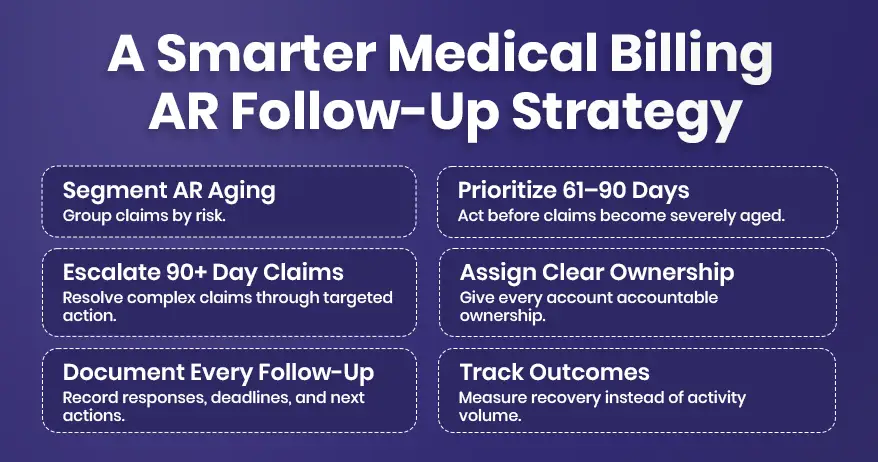
A Smarter Medical Billing AR Follow-Up Strategy
AR follow-up that is effective is not necessarily done by calling the most accounts; rather, it involves efforts towards those cases where immediate action can make the difference. The system of doing things involves grouping of receivables, focusing on those that are nearing 90 days, establishing responsibility, keeping records of the processes, and evaluation of results. Outsource medical billing services can help practices maintain consistent AR follow-up while reducing the administrative burden on internal teams.
Step 1: Segment the AR Aging
Begin by segregating the outstanding claims based on age, payer, amount, status of the claim, and reason for denial of the claim. This will help in knowing which categories pose more financial risk. An outstanding claim of $200 and another claim of $20,000 do not need to be treated equally. Segmentation helps the follow-up team in the billing department to spot the high risk claims.
Step 2: Prioritize the 61–90-Day Bucket
This is one bucket that requires particular attention since these claims are on the verge of being critically old. It’s better to evaluate the situation, see what obstacles are there, and take necessary action, instead of waiting till the claim ages beyond 90 days. This will enable avoiding aging of the claims to a serious level and make the process of AR follow up easier.
Step 3: Escalate 90+ Day Claims
Claims that have exceeded 90 days require review to determine the underlying reason why the payment is still pending. Depending on the account in question, the next step will entail filing an appeal, resubmission of the claim, submission of the medical record, eligibility verification, or payer follow-up. Segregating the two will avoid general follow-up. A medical billing AR follow-up process must also determine claims with no recourse for recovery.
Step 4: Assign Clear Ownership
All unresolved accounts must have an owner and action to take next. There is no owner, and thus claims may stay in queue for all time as each team believes someone else is doing the work. Accountability ensures that deadlines and results are achieved. Ownership of the issue must be relevant, i.e., coding problems for coders and payers for follow-up staff.
Step 5: Document Every Follow-Up
Each follow-up needs to result in an account history that can be used rather than just a notation saying that the contact was made. The payer’s response, call reference number, documentation requested, submission date, due date, denial reasons, and action items need to be documented. Good documentation makes sure that someone else is able to take over the account and does not have to duplicate efforts.
Step 6: Track Outcomes
The success of follow up activities is finally to be judged by the results of its financial and operations, not by its volume of actions. Monitor payments collected, adjustments, denials solved, wins on appeal, claim corrections, outstanding balance, and write-offs by age of receivables. This comparison will reveal the effectiveness of each of the follow up methods from the point of view of revenue recovery.
Guidance for Practices: Focus your AR on recovery potential rather than just on age. Take into account claim age, balance value, denial code, payor, and the ability to collect in deciding what to do next. This will enable your team to concentrate their efforts on the accounts where it makes the most difference.
How to Reduce AR Days in Medical Billing
AR reduction depends on reducing delays before they become old account balances. The best way to accomplish this is by ensuring that the process of claim filing, denial resolution, follow-up, documentations, automation, and aging analysis is done properly. It should be achieved without making early adjustments or write-offs. Provider credentialing delays can hold up otherwise collectible claims, making proactive credentialing management an important part of preventing AR from aging.
Work Clean Claims
Claim submissions should be prompt and as error-free as possible following service delivery. Any mistakes related to patient demographics, coding, modifiers, coverage and claim information can lead to avoidable denials. The elimination of these issues upfront will enhance first-time processing while helping with the goal of lowering days of accounts receivable.
Manage Denials
Develop a process for denial management where the denial is categorized by cause, ownership of the denial is identified, and a deadline for rectification or appeal is set. The reason for recurring denials will also point out any issues in registration, coding, authorization, or documentation. This way, denials can be addressed early to ensure that they do not age.
Follow Up Early
It is important not to wait until the claim is 90 days old to investigate it. Set up follow-up points for claims that have not been resolved, especially if they fall into the 61 to 90 day category. Early intervention gives the employees more chances to rectify the mistake or dispute the claim while the claim details are still available.
Tailor Payer Schedules
Different payers may process their transactions differently and at various speeds. Create follow-up schedules based on each individual payer’s behavior and not one set schedule for all payers. Pay close attention to the delays in the payment processing by different payers to find out when the claims get delayed so that you can take necessary steps.
Prioritize High-Value Claims
Every past due balance does not necessarily have to be treated equally. Prioritize your accounts based on the size of the balance, age of the account, whether the balance is denied, whether it can be collected on, and the chance of collecting the balance. An account that has some correctable problems may have more value than smaller ones.
Monitor Claims Daily
Regular monitoring ensures that unresolved accounts do not get lost in the large queue of work. Claims nearing significant aging limits can be identified by the teams and then the required follow-up can be assigned to prevent any serious delay. Daily exception basis monitoring is far more realistic than monitoring each account equally with the same rigor.
Strengthen Billing Accuracy
Proper coding and registration, documentation, authorization, and claims data avoid unnecessary claims processing delays. One must analyze common mistakes rather than fixing each individual claim over time. When the same problem persists because of incorrect coding or documentation, solving the source of the problem can save hundreds of future claims from going into collections.
Automate Repetitive Tasks
Automation will be useful for repetitive tasks like creating worklists, giving aging notices, verifying claim status, assigning tasks, and giving reminders where necessary. Automation should not be used to eliminate judgment, but it will help eliminate administration tasks that waste employees’ time. With automation, one will be able to give attention to claims approaching 90 days while making recovery judgments.
Review Aging Trends
A review of the AR aging report should be done on a consistent basis according to buckets, payers, denial reasons, balances, and service lines. The downward trend of the total AR balance may hide an underlying problem if the 90+ days AR balances keep growing. Analyzing trends will yield more accurate information than simply looking at one period.
Building an Effective Aged AR Recovery Process
Senior AR should get special care if balances have moved out of normal review procedures, especially after 90 days or if deadlines, recurring denials, or outstanding documentation problems put recovery at risk. Collection strategies for aged Accounts Receivable in the revenue cycle management process should include categorizing senior AR medical billing into 90–120, 121–180, and 180+ days, then classifying each balance according to the next logical action: payment recovery, correction and resubmission, appeal, record request, patient billing, adjustment, or write-off when recovery is no longer possible.
A successful aging AR recovery system also requires clear escalation procedures and measurable outcomes. Senior accounts, recurring payer issues, approaching deadlines, and ongoing disputes need to be escalated to specific aging AR recovery categories rather than left in regular queues for normal work. Monitor recovery percentages separately for each aging bucket to find out where efforts are actually paying off. Analysis of the past will uncover common reasons for old AR recovery medical billing; denial types, payer delays, coding issues, or documentation problems—that require addressing the cause rather than the effect.
Metrics to Monitor Alongside Your AR Aging Report
The AR aging report provides information on where the uncollected revenues stand, but it is individual metrics that tell you why there are balances piling up and how well the collections have been performing. The collection of financial, quality of claim, denials, and recovery metrics can provide a clearer picture of your operations.
Total AR
Total AR refers to the entire dollar amount of receivables outstanding at a particular time. Total AR acts as the starting point in assessing the efficiency of the company in collecting money, but the figure by itself is very deceiving. The decrease in total AR could mean a decrease in collections, adjustments, or billings.
AR by Aging Bucket
When the AR is split up into categories of 0-30 days, 31-60 days, 61-90 days, 91-120 days, and over 120 days, it can be observed how fast the money is being collected within this process. A steady balance of AR can give an incorrect impression of improvement while in reality, the aging is getting worse.
90+ Day AR Percentage
This percentage is defined as the ratio of outstanding accounts receivable past 90 days to total accounts receivable. An increase in this percentage means an increase in exposure to aged accounts. Analysis of this metric over time can show whether any follow up measures have been able to prevent claims from becoming aged.
Average Days in AR
Days outstanding in accounts receivable represents the time that outstanding income is not yet received in relation to daily income levels. The number of days outstanding may rise due to slow payer processing, increasing denials, poor follow-ups, and changes in payer mix. This measure is most effective when used in comparison with historical figures and internal benchmarks.
Clean Claim Rate
The clean claims percentage tracks how many claims do not contain mistakes that necessitate corrections. Low clean claims percentages mean there are more rejected claims, manual efforts, and delays in payment before claims are processed through routine processes. It is one way to link front-end billings with the back-end accounts receivable process.
Denial Rate
The denial ratio reflects the number of times the claim gets denied rather than paid or processed. Denial ratio tracking by payer, service provided, and reason for denial may bring up areas such as coding, eligibility, authorization, and documentation. Increased denial ratio would definitely increase the AR burden, thus resulting in high aged balances.
First-Pass Resolution Rate
The first pass resolution ratio shows how successfully claims have been filed and resolved without being touched repeatedly for corrections or resubmissions. High success means that fewer unnecessary touches take place, resulting in faster payment. Analysis of this statistic along with the denial and clean claim statistics may indicate if there is an issue in the filing process.
Collection Rate
The collection ratio represents the percentage of the amount of collectible or billed receivable amount collected within a given period. This ratio gives better results than measuring the number of calls or activities since it measures the impact of activities in terms of dollars collected. Analyze the collection ratio according to payer, aging category, and account type.
Average Time to Payment
Average time to payment refers to the amount of time that elapses between claim filing/submission and payment for the services rendered. Long payment periods result in tying up of working capital and also increase the amount of AR that is outstanding. Analysis of average time to payment on a per-payer and per-claim basis will help identify system issues vs provider issues.
Aged AR Recovery Rate
Recovery percentage of aged AR indicates the proportion of money that is recovered from accounts already aged beyond certain stages. The distinction between recovery rates of 90-120 days, 121-180 days, and over 180 days indicates how the ability to recover money changes over time. It will help establish whether the special recovery process is profitable enough.
Write-Off Percentage
Write-off percentage is a measure of the share of invoiced or uncollected revenue that eventually gets written off without payment. Analyzing write-offs based on their age, payers, reason for denial, and account type helps to spot recurring leakages. The increasing write-off percentage means either improper follow-ups, avoidable billing errors, lost recoveries, or unrealistic collection.
The Goal Is Not Just Lower AR; It is Faster, More Predictable Collections
Efforts to lower AR days should not involve writing off past due accounts to improve the statistics. The goal is to collect money on valid accounts without causing any unnecessary delays. Effective claim tracking provides more reliable revenues through solving payer issues, fixing mistakes, and addressing denials. Prevention is equally important: detection of regular billing mistakes prior to their aging will help reduce future AR and the efforts needed for AR recovery.
Aging is a process, not a one-time action. Any unpaid claim automatically falls into a more problematic category. The sooner an account is flagged and followed up, the more chances there are to fix it through appealing, documentation, or other methods. Effective medical billing AR includes accurate claims, fast follow-up, effective handling of denials, and aging. 90 days should serve as a threshold rather than the starting point for AR recovery.
How iSolve RCM Helps with Aging Claims
iSolve RCM supports the management of aging accounts receivable through structured follow-up for AR and denial and claim resolution. The solution may assist in identifying accounts that will soon cross their aging threshold, prioritizing high-value accounts, recording payer conversations, and performing consistent follow-up. In resolving claims in their early stages and thus preventing unnecessary delays, healthcare organizations can improve their financial visibility. It is not just about reducing the number of AR days, but about collecting rightful money and improving the process of ensuring that new claims do not age unnecessarily.
FAQs
What is AR in medical billing?
Medical AR is the amount that healthcare organizations have to collect from patients and insurers for the services provided to the patients. AR can be classified into accounts receivable aging reports according to the age of the receivable.
Why are 90-day claims important?
Claims that have surpassed 90 days require special consideration since some discrepancies, denials, lack of documents, and payers’ concerns might be more challenging to handle. The early detection will allow the billing department to have more chances for problem solving and payments.
How can providers reduce AR days?
AR days can be lowered through clean claim submissions, management of unpaid accounts, prompt handling of denied claims, focusing on high priority accounts, and follow-up before claims turn 90 days old. Age analysis also plays a role in highlighting persistent issues that cause delayed payments.
What does an AR aging report show?
The Aging Schedule for AR will provide an inventory of all the receivables according to the age of these accounts, which is usually classified into 0-30, 31-60, 61-90, 91-120, and over 120 days old. It helps the billing department locate delayed payments.
What is aged AR recovery?
Older aged AR recovery refers to concentrated actions aimed at recovering old outstanding receivables that have remained unresolved even after typical payment processes. The accounts are evaluated on grounds of their claim history, denial reasons, documentation, payer information, and patient obligation so as to establish how best to treat them.
How does AR follow-up prevent aging?
AR follow-up that is effective is able to spot any unsettled claims before the claims have aged significantly. This is achieved through checking of the claim status, error correction, handling of denials, recording of payer response, and setting up of subsequent actions to be taken.