The Medicare Physician Fee Schedule determines the reimbursement of physician and other biller’s professional services under Medicare Part B. The CMS 2027 Physician Fee Schedule Final Rule became publicly available on November 4, 2026 and published on November 9, 2026. The majority of the payment policies will be implemented on January 1, 2027.
This rule introduces reductions in baseline payments, new payments for preventive care, chronic care, behavioral health, limited same-day payment adjustments, new modifiers to replace the G2211 add-on code and additional requirements for remote monitoring. In its official announcement, CMS describes the goal as rewarding health maintenance and coordinated primary care rather than volume-based intervention.
The real challenge is to figure out which revenue sources will decrease, which can increase and what coding and documentation changes need to be made prior to January 1. Here, we provide information about the 2027 Medicare Physician Fee Schedule and the Medicare physician payment policies 2027 overall, focusing on the impact of each update on the practice’s medical billing process.
Quick Answer: What Is Changing Under the CMS 2027 Physician Fee Schedule?
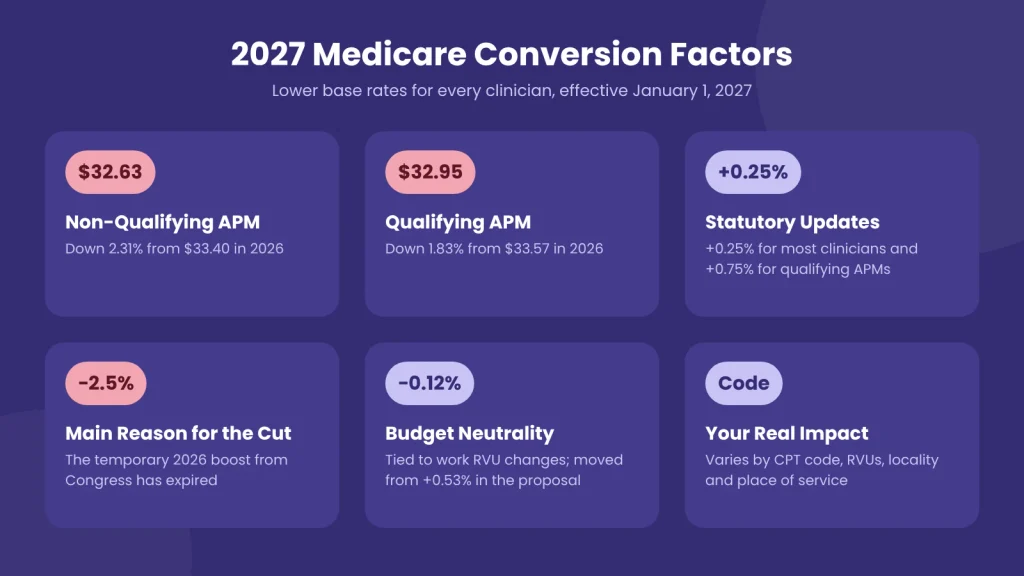
Medicare Physician Fee Schedule 2027 includes two new conversion factors. They are $32.63 for non-qualifying APM clinicians and $32.95 for qualifying APM participants. That is a reduction of 2.31% and 1.83% from 2026, respectively.
Other changes are:
- Additional payment opportunities for prevention and wellness services, including health and well-being coaching; shared medical appointments (G0686/G0687); increased values for smoking cessation and behavioral health screenings.
- Payment adjustment for services on the same day. In case one separately identifiable office or outpatient E/M visit is performed on the same day as a 0-day global procedure by the same physician or another same specialty physician in the same group practice, the most costly service would be paid at 100%, and the other eligible service would receive 80%.
- G2211 becomes modifiers. B1 (+16%) for eligible longitudinal-care E/M visits and B2 (+32%) for eligible MSSP and LEAD Model ACO practitioners.
- Tightened rules regarding RPM and RTM, but the employment of clinical staff rule was moved to January 1, 2029.
- Payment accuracy will also play an important role, including duplicate services.
What Is the CMS 2027 Physician Fee Schedule Final Rule?
Understanding the Medicare Physician Fee Schedule
PFS is the payment formula used by Medicare to compensate physicians and other health care professionals providing professional services under Part B of the program.
For each procedure performed, Medicare determines the relative value units (RVUs) which consist of three parts, namely work (time and effort spent by the provider), practice expense (cost of staff, space, equipment, and supplies) and malpractice expenses. The RVUs are then modified according to geographic location and multiplied by a conversion factor resulting in payment in dollars.
Payment for the procedure also varies depending on the procedure itself and the type of setting in which it was performed. Some procedures are reimbursed at a more expensive non-facility rate while being performed in the office and at a less expensive rate when performed in the hospital or other facility setting.
When Do the 2027 Medicare Payment Changes Take Effect?
The final rule was available for public viewing on November 4, 2026 and the publication date of the rule is November 9, 2026. Payment policies will go into effect on January 1, 2027 with exceptions including Shared Savings Program cost sharing flexibility on April 1, 2027 and the RPM/RTM clinical staffing requirement on January 1, 2029.
This rule applies to Medicare Part B physician professional services.
1. Medicare Reimbursement Rates 2027: What Physicians Need to Know
Updated Medicare Conversion Factors for 2027
Since 2026 there have been two conversion factors: one for clinicians who qualify through an advanced alternative payment model (APM) and one for everyone else.
| Conversion factor | 2026 | Final 2027 | Reduction |
| Non-qualifying APM participants | $33.40 | $32.63 | 2.31% |
| Qualifying APM participants | $33.57 | $32.95 | 1.83% |
Why are the rates lower?
The statutory changes for 2027 are favorable, coming in at +0.25% for most clinicians and +0.75% for qualifying participants of APMs. Even so, overall rates will be reduced as the temporary 2.5% increase provided by Congress for 2026 expires, and that offsets the favorable statutory increases.
Another budget neutrality adjustment related to work RVUs change went from +0.53% in the proposed rule to -0.12% in the final rule. It factors into the calculation, but it is not the primary reason for the rate reduction.
CMS finalized a deeper cut than it proposed in July. Medical Economics has a side-by-side comparison of the proposed and final figures.
How the 2027 Payment Changes May Affect Medical Practices
This 1.83% to 2.31% decrease will be applied to the 2027 Medicare Physician Fee Schedule conversion factor. The specific reimbursement decrease will depend on each CPT/HCPCS code, geographic adjustment, RVUs and payment setting.
- Additional billable opportunities for primary care physicians will be possible due to new prevention and chronic care billing codes, offsetting the impact of the decreased conversion factor on eligible providers.
- Procedure-heavy specialties face the lower conversion factor, the practice expense changes below and the same-day payment adjustment
- Increases for behavioral health specialists are expected due to the change in practice expense.
- Participants in the ACO have additional billable opportunities via the change in shared savings program and modifier B2.
- Do the math on your numbers. The 2% cut will matter more when Medicare is 30% of your revenue versus 70%.
How RVUs and Practice Expense Calculations Are Changing
CMS is phasing out the indirect practice cost index over a two-year period in favor of a stabilizer, which reduces short-term volatility. The index has previously linked the RVUs for the specialty practice expense with the practice expense per hour information from before 2007.
Projected impacts include large reductions for dermatologists, otolaryngologists, orthopedists and hand surgeons, and substantial gains for clinical psychologists and clinical social workers. These are projections of impact at the specialty level and do not imply uniform changes across all providers within a particular specialty, since individual changes may vary depending on the coding pattern.
The work RVUs of individual procedures have also been modified. For example, the work RVU for total hip arthroplasty (CPT 27130) and total knee arthroplasty (CPT 27447) has been finalized at 16.70 each, compared to 19.11. This is a change in the work RVU of one specific code rather than in the overall payment for the specialty.
For more detail, please refer to the Estimated Impact on Total Allowed Charges by Specialty and Impact on Payment for Selected Procedures files available on the CMS Physician Fee Schedule final-rule page. Run your top 20–30 CPT codes through the 2027 files and compare them with 2026.
2027 Medicare Changes: What Practices Should Review
| Policy change | What practices should review |
| Lower conversion factors | Revenue projections by code and payer |
| New B1 and B2 modifiers | E/M charge capture and billing software |
| Same-day payment adjustment | E/M and 0-day procedure combinations |
| RPM/RTM initiating visits | Patient enrollment workflows |
| Shared medical appointments (G0686/G0687) | Documentation and time tracking |
| New ACP codes (G0572, G0573) | Clinical staff time and supervision |
| Vaccine adverse effect add-on (G0576) | Time documentation beyond the E/M visit |
2. Shifting from Sick Care to Preventive Care and Wellness
CMS Expands Support for Medicare Preventive Care
In a previous statement, the CMS Administrator, Dr. Mehmet Oz, has admitted that payment by fee-for-service has traditionally paid for volume and not for value. The 2027 rule changes payment towards more recognition of prevention, chronic care management and primary care.
The following changes to the Medicare preventive care and wellness policy provide yet more opportunity for appropriate practices to assist their patients through coaching, chronic care management and coordination. They also make Medicare preventive care coverage even more relevant to the income of the practice.
Other items that the CMS has invited comments on relate to future payment models for primary care, including prospective payments and technology. These are part of a larger policy discussion and should not be confused with changes in payment for 2027.
Critical caveat: Coverage and payment depend on the exact service, coding, qualifications of the practitioner, supervision and other Medicare billing requirements. All wellness, nutrition, coaching or group services are not covered for all beneficiaries. Check before incorporating them into your billing process.

New Payment Pathways for Health and Well-Being Coaching
The final rule establishes national payment for health and well-being coaching using three CPT Category III codes:
| Code | Service | Time in CPT descriptor |
| 0591T | Individual, initial assessment | No minimum stated in the descriptor |
| 0592T | Individual, follow-up session | At least 30 minutes |
| 0593T | Group (2 or more individuals) | At least 30 minutes |
CMS finalized general supervision for these services, so the billing practitioner doesn’t need to be physically present. After public comments, CMS also revised the valuation of 0591T and 0592T from the proposed amounts. For group coaching, 0593T is reported for each Medicare beneficiary participating in the group.
Practices should confirm that staff delivering coaching meet the qualification and certification requirements, and that each session’s content and time are documented.
New Billing Opportunities for Shared Medical Appointments
Shared Medical Appointments (SMAs) are group visits, which comprise a combination of a medical visit with educational and behavioral services for patients with a particular condition.
CMS established:
- HCPCS code G0686 for the first 60 minutes of an SMA where there are 2–10 patients involved.
- The HCPCS G0687 has an additional code for each additional 30 minutes of the session, up to two units per session when medically necessary.
- CMS also restricted the billing of shared medical appointments to no more than one session per beneficiary per week.
Billing notes:
Documentation in each patient’s chart about the session and individual care of each particular patient.
- Documentation of session duration for the G0687 units.
- Patient eligibility check prior to the billing.
Changes to Smoking Cessation and Behavioral Health Services
Smoking and tobacco cessation counseling and structured assessment, brief intervention, and referral to treatment (SBIRT) reach the final year of a four-year valuation increase. Work RVUs for the psychiatric collaborative care model are also rising.
A higher valuation doesn’t automatically guarantee coverage for every encounter. Each service must still meet code requirements and be documented, and these services are often under-documented.
Medicare Diabetes Self-Management Training and Medical Nutrition Therapy
Rural health clinics (RHCs) can bill diabetes self-management training (DSMT) and medical nutrition therapy (MNT) as stand-alone billable visits. These services must be furnished by a certified provider under the direct supervision of an RHC practitioner. RHCs should review certification, supervision and billing requirements before adding these services.
3. Medicare Multiple Procedure Payment Reduction and Same-Day E/M Billing Changes for 2027
New Payment Adjustment for Same-Day E/M Visits and Procedures

As CMS says, in case when an E/M service is provided by the same physician on the same day as the procedure, there is some clinical service component that is already valued in the procedure. According to the final rule,
- it applies when the separately identifiable office/outpatient E/M service is furnished on the same day as the 0-day global procedure;
- it includes the same physician or a same specialty physician from the same group;
- the most expensive service will be paid at 100%;
- Other eligible surgical procedures or office/outpatient E/M visits will be paid at 80%.
The lower-valued service is not necessarily the E/M service. The service with a lower valuation gets the 80% payment.
This is not a universal replacement for the traditional Medicare multiple procedure payment reduction rules. It is only the specific provision that relates to E/M services performed with 0-day global procedures.
It is just one element of the larger issue of Medicare duplicate billing rules 2027.
How the Final Policy Differs from the Original CMS Proposal
| Proposed (July 2026) | Final (November 2026) | |
| Payment for other eligible service(s) | 50% | 80% |
| Global periods covered | 0-, 10- and 90-day | 0-day only |
| Who it applies to | Any physician in the same practice | Same physician or same-specialty physician in the same group |
| Overall approach | Broader policy | Narrower finalized policy |
CMS narrowed the policy after commenters pointed out that patients often see physicians of different specialties on the same day. Dermatology, otolaryngology and podiatry are still expected to be affected most, though less than under the proposal.
What Medical Practices Should Review Before Submitting Claims
- The E/M and 0-day combination codes that you use more than others, particularly within dermatology, ENT, podiatry and urgent care.
- Medical necessity and separately performed service documentation. The E/M must be meaningful and distinguishable from other services, backed up with modifier 25 as needed.
- Modifier use and claim scrubbing. Modify the rules for the scrubber to avoid finding out the change the hard way through the remit.
- Reimbursement implications of the change on a code pair and specialty basis.
A routine medical billing audit of modifier 25 usage helps test whether documentation will hold up. Our medical coding services page explains how accurate code selection protects revenue.

4. G2211 Updates: New E/M Complexity Payment Methodology
What Is HCPCS Code G2211?
CMS finalized separate payment for HCPCS code G2211 in the CY 2021 PFS final rule. After implementation was delayed by statute, Medicare began paying for the add-on in 2024. It recognizes the complexity of eligible office/outpatient E/M visits that are part of ongoing, longitudinal care, such as a primary care physician managing chronic conditions over time or a specialist who is the continuing focal point for a serious condition.

New Modifier B1 and the 16% Payment Increase
The G2211 add-on code will be replaced by the B1 modifier which will be appended to the E/M base code in question. In 2027, when all the relevant conditions are satisfied, B1 should replace the G2211 add-on code.
B1 increases the fee for the underlying E/M service by 16%. B1 will increase the fee by 16% proportionally for each level of E/M visit, not a flat dollar amount. B1 does not apply automatically to all E/M visits. There must be some longitudinal care involved in the visit.
New Modifier B2 for Eligible ACO Practitioners
Modifier B2 is available to eligible practitioners participating in a Medicare Shared Savings Program ACO or as participant providers in a Long-term Enhanced ACO Design (LEAD) Model ACO. It increases payment for an eligible associated E/M service by 32%. It applies to the same eligible office/outpatient and home/residence E/M services as B1. Use is voluntary and is not limited to beneficiaries assigned to the ACO.
The specialists involved in ACOs who care for an individual with a severe or complicated medical condition can use B2 as well. Determine whether or not you are MSSP or LEAD participants before billing.
Modifier 25 restriction: B1 or B2 generally cannot be reported with an E/M service carrying modifier 25. The exception applies when the same practitioner reports the E/M service on the same day as an Annual Wellness Visit, vaccine administration, or another Medicare Part B preventive service furnished in the office/outpatient setting. Check the CMS billing instructions and final rule before configuring claim edits.
A financial note: B2 payments also count toward ACO spending, so the financial benefit depends on their effect on shared savings. Medicare Advantage and commercial payers that adopted G2211 may not recognize B1 or B2 right away.
What Providers Should Do to Prepare for the G2211 Changes
- Review the E/M process flow to determine where G2211 is currently being coded, as well as whether the relationship requirements have been met.
- Upgrade your billing system to have B1 and B2 available, and no longer submit a line for G2211 for 2027 dates of service.
- Make sure that you are a participant in the ACO before submitting B2.
- Train your coders and billers on when to use each modifier.
5. Remote Patient Monitoring and Telehealth Billing Changes for 2027
Medicare Remote Patient Monitoring (RPM) Updates
CMS tightened RPM requirements:
- A separately reportable initiating visit is required in association with the start of RPM or RTM services.
- The initiating visit doesn’t have to be solely for discussing remote monitoring.
- Payment valuation was updated.
Document why monitoring is clinically appropriate, what data was collected and how it was used in care.
Remote Therapeutic Monitoring (RTM) Changes
RTM is only for established patients, and an individually reportable initial visit is needed when RTM is initiated. The above conditions apply under the 2027 policy. Check your enrollment process to ensure that patients do not undergo RTM without the initial visit.
What Practices Need to Know About the Clinical Staff Employment Requirement
CMS implemented a rule that the RPM/RTM services be done by the clinical staff who work for the billing practice and not by any third-party vendors. Nevertheless, CMS decided to defer the implementation of this rule until January 1, 2029. This rule is different from the above rule regarding 2027, yet the practices using outside vendors should be prepared.
Telehealth Flexibilities
In addition to the PFS reimbursement rules, statutory law also extends some telehealth flexibilities under Medicare until December 31, 2027. Providers must be aware of the appropriate telehealth services and associated provider, geographic and place-of-service criteria instead of assuming all telehealth services qualify. See CMS telehealth guidance and our telehealth billing guide for modifiers and POS codes.
6. Other Important Medicare Physician Payment Policy 2027 Changes

Psychiatric Collaborative Care Model (CoCM)
The final rule enhances RVUs for CoCM work and adjusts pricing for behavioral health care managers. Practices which have incorporated behavioral health into primary care should consider how care manager time is tracked and billed. Our guide to mental health billing services covers common denial patterns.
Vaccine Adverse Effect Diagnosis and Treatment
CMS finalized HCPCS add-on code G0576 for each 15 minutes of personally performed physician or qualified healthcare professional time spent diagnosing and treating vaccine adverse effects, reported with eligible E/M codes. The medical record must support the additional work beyond the services already captured in the E/M visit.
Advance Care Planning (ACP) Billing Changes
CMS established two new HCPCS codes, G0572 and G0573, for advance care planning performed by clinical staff under direct supervision. The use of CPT codes 99497 and 99498 remains limited to the time spent personally by the billing physician. Do not include staff time when counting time for 99497 and 99498.
Medicare Shared Savings Program Updates
- Starting April 1, 2027, approved ACOs may reduce or waive Part B cost-sharing for many items and services for assigned beneficiaries. DME, prosthetics, orthotics, supplies and prescription drugs are excluded.
- The BASIC Level E shared savings rate rises from 50% to 60%.
- The prepaid shared savings option is removed.
- Traditional MIPS reporting sunsets beginning with the CY 2031 performance period, and three new MVPs were finalized for diabetes, hypertension and hospitalists.
7. Medicare Payment Integrity: How CMS Plans to Curb Waste
Reducing Duplicate Laboratory Testing and Imaging
CMS is worried that fractured patient records might cause duplicative testing and imaging without any value-added. This was the reason why the CMS called for public input on how to decrease the number of duplicative diagnostic services. It is important to note that it is just a request for information about potential future actions and is not a ban on duplicative testing. The providers have to be prepared for further initiatives.
The final rule limits annual clinical laboratory fee schedule reductions to 15 percent through 2029.
Improving Medical Billing Accuracy and Payment Transparency
Adjustment on the same day is just one more example of the overall concept – CMS would like to pay only once for something that is already priced. When making Medicare payments, providers need to:
- Code correctly and avoid unbundling
- Not charge for something that is already counted in another procedure
- Prove the medical necessity of each separate service
An incentive payment loophole was corrected by CMS. The correction can save the government from about $2.38 billion of unintended Medicare payments in the coming 10 years.
What Providers Can Do to Reduce Medicare Billing Errors
- Review claim edits and billing patterns.
- Conduct internal billing audits regularly.
- Monitor denial trends by payer, code and reason.
- Strengthen coding and documentation processes.
A structured denial management process helps spot patterns before they become systemic revenue loss.
8. How the CMS 2027 Final Rule Will Affect Medical Billing and RCM
More Complex Medicare Coding and Documentation Requirements
New codes (G0686, G0687, G0576, G0572, G0573), new modifiers (B1, B2), separately billable initiating services for RPM and RTM, and the same-day visit adjustment add another layer of difficulty. All of these require proper coding and documentation.
Revenue Impact of Updated Medicare Reimbursement Rates
A decrease of 1.83% to 2.31% would affect the PFS conversion factor in 2027. The effect on reimbursement depends on various factors such as codes, geographic modification, RVUs, and place of payment. Smaller underpayments as a result of forgotten modifiers or unrecorded services may counterbalance the gain.
Why Practices Should Review Their Billing Workflows
However, if the processes of charge capture, claim scrubbing, and denials management have been developed in accordance with the 2026 guidelines, they should be reviewed and adjusted accordingly. Examples of possible flaws are obsolete G2211 edits, absence of B1/B2 modifiers, no edit for same-day E/M + 0-day procedure, and lack of initiating visit edit for RPM/RTM.
How Revenue Cycle Management Can Help Practices Adapt
A strong revenue cycle management partner can help with:
- Coding accuracy against 2027 code sets and rules
- Charge capture and claim submission that reflect new modifiers and codes
- Modifier and documentation review before claims go out
- Denial prevention and appeals
- Payment posting and A/R follow-up through accounts receivable management
- Reimbursement monitoring and reporting to compare actual payments with expected 2027 rates
9. How Medical Practices Can Prepare for the 2027 Medicare Payment Changes
Use this checklist before January 1, 2027:
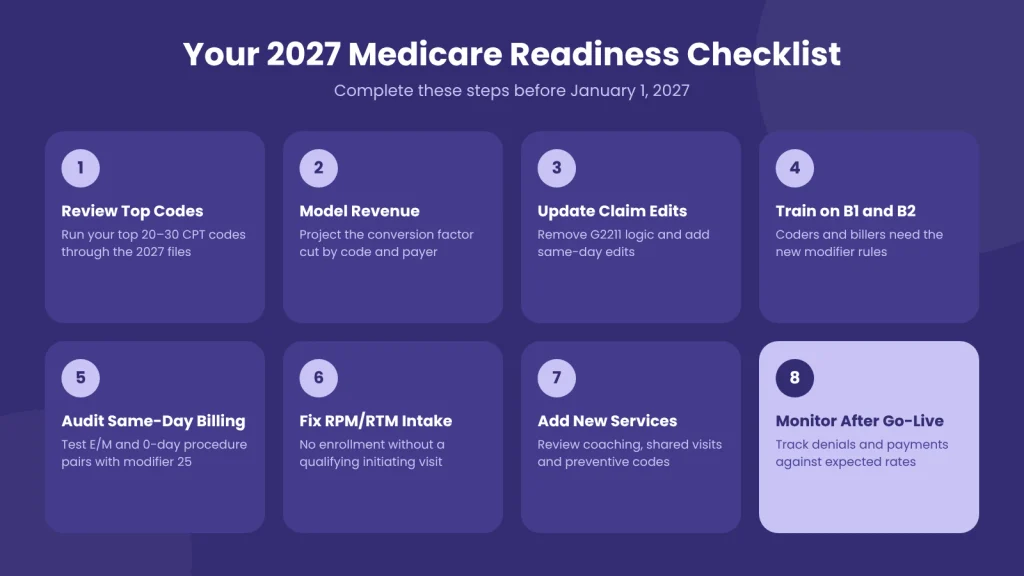
- Medicare physician fee schedule changes for 2027 and top CPT Codes
- Impact analysis of changes in the conversion factors to revenue
- Upgrade your billing software and claim edits
- Training of billing and coding team on the use of B1 and B2 modifiers
- Review of same-day E/M and procedure claims
- Review of RPM and RTM services including the initiating visit service
- Review of coaching, shared medical appointments, and preventive care opportunities
- Perform a Medicare billing audit
- Monitor denial and reimbursement impacts after go-live
10. How iSolve RCM Helps Practices Navigate Medicare Billing Changes
Accurate Medical Coding and Claim Submission
Clean claims start with accurate codes and modifiers. Through our medical coding services, iSolve RCM’s coding team reviews E/M levels, procedure pairs and new 2027 codes and modifiers, which helps improve first-pass claim accuracy and reduce avoidable denials.
Medicare Denial Management and A/R Follow-Up
Should claims be denied or paid in part, our denial management will investigate the cause and process appeals. Our accounts receivable management will continuously follow up on payments owed. Our trends will be communicated to your office for the purpose of correcting repetitive errors.
Medical Billing Audits and Compliance Support
A medical billing audit reviews coding, documentation, modifiers and claims to help identify compliance risks and missed revenue.
Full-Cycle Revenue Cycle Management
iSolve RCM supports the full billing cycle through outsourced medical billing services and end-to-end revenue cycle management, including:
- Patient eligibility verification
- Charge entry
- Medical coding
- Claims submission
- Denial management
- Payment posting
- A/R management
You can review our pricing or compare options in our guide to in-house vs. outsourced billing. Primary care practices may also find our family practice billing guide useful.
Frequently Asked Questions About the CMS 2027 Physician Fee Schedule
What is the CMS 2027 Physician Fee Schedule?
This is the final rule to establish the payment amounts and policies for physicians and other medical billers for 2027. It includes conversion factors, relative value units (RVUs), coding, billing guidelines, and policy changes. Most of the changes become effective on January 1, 2027.
When do the 2027 Medicare payment changes take effect?
The rule became available for public inspection on November 4, 2026, and it was published on November 9, 2026. The majority of payment changes will be effective on January 1, 2027. Cost-sharing flexibility in ACO starts on April 1, 2027, and RPM/RTM clinical staff requirement is delayed until January 1, 2029.
What are the Medicare reimbursement rates for 2027?
The conversion factor is $32.63 for non-qualifying APM clinicians and $32.95 for qualifying APM participants. Actual payment for a service depends on its RVUs, geographic adjustment and whether it is paid at a facility or non-facility rate.
How much will the Medicare conversion factor decrease in 2027?
The non-APM factor falls 2.31%, from $33.40 to $32.63. The qualifying APM factor falls 1.83%, from $33.57 to $32.95. The main reason is the expiration of a temporary 2.5% increase that applied only in 2026.
What are the major changes in the 2027 Medicare Physician Fee Schedule?
Some key changes include: reduced conversion factor, two-year phase-out of the indirect practice cost index, development of coaching and shared medical appointments, a same-day payment adjustment for E/M services performed on the day of a 0 day global procedure, G2211 being moved to modifiers B1 and B2.
How is CMS changing Medicare preventive care coverage?
CMS has made the final rule for payment for health coaching codes (0591T-0593T) under general supervision and updated codes for Shared Medical Appointment (G0686/G0687) and valuation for smoking cessation and SBIRT codes. Payment for services is still based on each individual service/code.
What are the new Medicare duplicate billing rules for 2027?
When a separately identifiable office/outpatient E/M visit is furnished on the same day as a 0-day global procedure by the same physician or a same-specialty physician in the same group, the most expensive service is paid at 100% and other eligible services at 80%. CMS also requested feedback on duplicate lab and imaging services.
Does Medicare’s 2027 rule change the multiple procedure payment reduction?
Not across the board. The final policy is a specific same-day adjustment for an E/M visit furnished with a 0-day global procedure. It doesn’t replace or universally modify traditional Medicare multiple procedure payment reduction rules.
What is changing for G2211 in 2027?
The separate code G2211 add-on will move to B1 modifier, increasing the payment for eligible longitudinal care E/M services by 16%. Eligible participants in MSSP and LEAD Model ACO may use B2 modifier to increase the payment by 32%. Both modifiers will apply to eligible office and home E/M services.
How will the 2027 final rule affect medical billing companies and providers?
It increases complexity in terms of new codes, modifiers, requirements for visits, and edits on the same day. Providers and billers will have to ensure that the charge capture, claim scrubbing, training, and payment monitoring procedures remain up-to-date with the reduced fee schedule.
What should medical practices do to prepare for the 2027 Medicare payment changes?
Model revenue effect per code and specialty, upgrade the billing software, B1 and B2 modifiers, perform an audit of same-day E/M and procedure billing, upgrade the RPM and RTM processes, evaluate the potential for preventative care.
Final Thoughts: Preparing for a More Prevention-Focused Medicare Payment System
The Physician Fee Schedule in 2027 from the CMS rewards preventative services, primary care, and coordinated care. The CMS 2027 Physician Fee Schedule pays more deliberately for prevention, primary care and coordinated care, and less for work already valued elsewhere. The low conversion factor leaves little margin for error, which makes it imperative for practices to scrutinize their coding, documentation, and revenue cycle process before the start of 2027.
Official CMS References
- CMS: CY 2027 Physician Fee Schedule Final Rule Announcement (via HHS Press Room)
- CMS: Fact Sheets, CY 2027 Medicare Physician Fee Schedule Final Rule
- CMS: PFS Federal Regulation Notices (CMS-1848-F), including specialty and procedure impact files
- CMS: Physician Fee Schedule Relative Value Files
- Federal Register: CY 2027 PFS Final Rule (Document 2026-22743)
- CMS: Medicare Telehealth